The purpose of this thesis was to create a functional framework for an international employee exchange program for the city of Rauma. One was the described employee exchange program and the second was an analysis of the employee's perspective and interest towards the exchange program. To achieve this goal, one of the proposed methods is to create an employee exchange program to gain experience and ideas to apply in the field (Kansainvälistymiso-hjelma 2012, 13).
Purpose and objectives
The twin city concept has existed since the aftermath of the Second World War, due to the initiative of a handful of mayors convinced that friendship between the citizens of Europe was the necessary first step in rebuilding a stable and peaceful center. Europe. The purpose of the questionnaires will be to obtain the detailed opinions of the interviewees on this topic.
Conceptual framework
Delimitation of the project
Qualitative research
Quantitative research
Questionnaires and surveys
Checklists provide a list of items and the participant is asked to check those that apply to the situation. Multiple-choice questions provide several possible answers and the participant is asked to choose the most relevant one. In addition to the types of data sought, the types of questions distinguish surveys from questionnaires.
Chosen method of data collection
For the research, it would have been better to conduct interviews, but when this was not possible, the questionnaires were almost as effective. There is a risk that some details are missing, but from the author's point of view the results support the expected outcome. The questionnaires were provided to recipients in Finnish to avoid misunderstandings due to language barriers.
Short description of Rauma and the twin towns and their organizational
- Rauma, Finland
- Gävle, Sweden
- Næstved, Denmark
- Gjøvik, Norway
- Comparison of structures
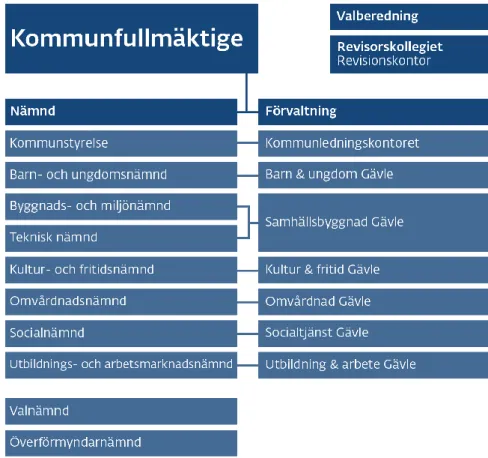
The highest decision-making power of the city of Rauma belongs to the Municipal Council, which is formed by elections. A municipal board is formed from these representatives, which then closely cooperates with the elected mayors. These bodies then work closely with the 5 main boards that deal with different areas of the organization, seen above.
The city of Gävle is located on the east coast of Sweden, north of Stockholm. Næstved is a city with 80,000 inhabitants and also the largest municipality by area, covering 683 square kilometers. The executive committee has the most decision-making power over other committees that have power in their area.
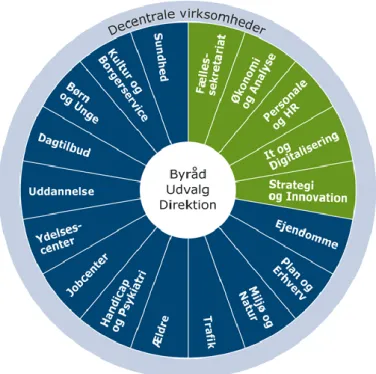
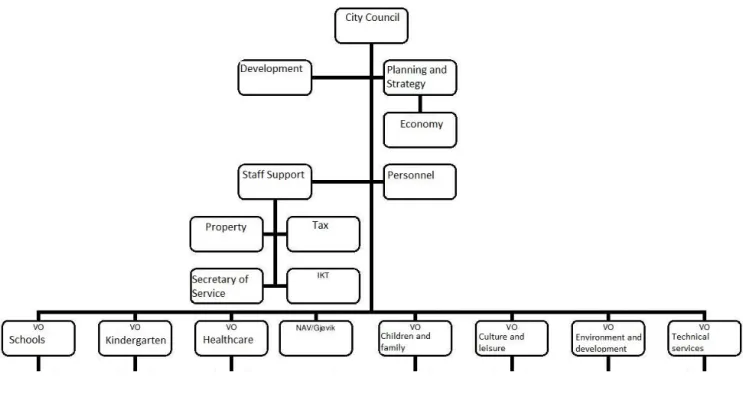
Center for Culture and Citizens (Centre for Kultur og Borgerservice) - Center for Environment and Nature (Centre for Miljø og Natur) - Center for Economics and Analysis (Centre for Økonomi og Analyze) - Center for Personnel and HR (Centre for Personale og HR ). Fakta om Gjovik 2010, 1) The Gjovik City Council as the highest decision-maker, followed by planning and strategy, and 8 sub-governments representing their own fields. As can be seen above, all the municipalities involved in this study have a similar structure, with the municipal council having the highest decision-making authority and political power and governance for each area, e.g. social and health services or cultural and leisure services.
It is also easy to select contact persons within each board who will take care of the exchange issues around their scope.
International operations in the city of Rauma
The meaning of culture to an individual in working life
It is also easy to select contact persons within each board who will take care of the exchange issues around their scope. scales than national and regional circles, to which they still have to adapt. As MNEs expand their operations into different countries, it is inevitable that many forms of economic organization and management practices will change and adapt as work culture changes, converging on the most effective as MNE operations shape business culture accordingly of global competition. Rees 2011, 13) National and regional economies in the private and public sectors need to respond to the challenge to maintain and form relationships and continue to function.
Culture is a pattern of behavior exhibited by a particular group that manifests itself through superficial behaviors and values and is driven by a particular perception of the world. These national-level factories tend to produce commonalities between some countries in the form of norms of behavior, attitudes, and values.
The meaning of organizational culture for an work assignment abroad
Culture derives from history, art, the legal system, literature, religion, the media education system, the political system and the economic system, but also from the experiences and reactions of the people around us. It is important to know these cultures and their importance because that is the single biggest thing that will happen to a person participating in an employee exchange program - living and working in a culture that is unfamiliar in the workplace and outside it. workplace. It consists of the set of shared attitudes, values, goals and practices that characterize an institution or organization.
For businesses, it is essential to be able to create a recognized organizational culture because it is the main driver that keeps the business flowing. It has an impact on everything from employee motivation to the reputation of the business itself. At its best, a strong organizational culture is a powerful competitive advantage in markets, but it also holds operations closer together, connecting managers and employees to work toward a common goal.
For someone participating in an employee exchange program, organizational cultures will be the biggest challenge and source of inspiration. Leena Kuorikoski, a teacher who participated in the employee exchange program in Jyväskylä, worked for 3 months in Caldas da Rainha, Portugal at a local school. Her observations of the culture were as follows: school days are generally longer than in Finland, due to the 3-hour lunch break, but she also found the atmosphere almost too relaxed and peaceful compared to Finnish schools.
She states that she learned a lot and developed in the profession as a result of the exchange period.
Expatriates working abroad
In public sector
International employee exchange program: Case city Jyväskylä
The employees participating in this program spend 1-3 months in their exchange position as interns, depending on the position and how the exchange period is planned. After the exchange period, they write a report about their exchange period in which they indicate what they have experienced and what they have learned.
Networking system for employee exchange in churches and parishes
(Mujis 2004, 65) Most of the concepts we want to measure cannot be measured, like thoughts and feelings - they are considered latent variables, variables that cannot be measured. Therefore, we developed instruments to measure these concepts indirectly by using data collection methods. In this form, the concept becomes measurable – manifest variable, something we can actually measure.
Content validity refers to whether the content of the manifest variables is correct in measuring the latent concept that we are trying to measure. It is important to use theoretically defined terms and conduct a comprehensive literature search to achieve content validity. This means that it is the theoretical background that supports the aims and results of this thesis.
The background information presented in this thesis has been collected from various sources and takes into account many different points of view. Reliability then refers to the extent to which test scores are free from measurement errors.” (Mujis 2004, 71) The research has been done with a qualitative approach and the results have been carefully examined in accordance with the objectives of the thesis. The questionnaires sent to recipients were written in Finnish to avoid language barriers.
Processing questionnaires
Reliability then refers to the extent to which test points are free from measurement errors.". (Mujis 2004, 71) The research was done with a qualitative approach and the results were carefully examined according to the objectives of the thesis. Appendix 1) All the respondents were in management positions in different boards of the organizational structure which gave an insight into the whole organizational perspective.
Knowledge of languages
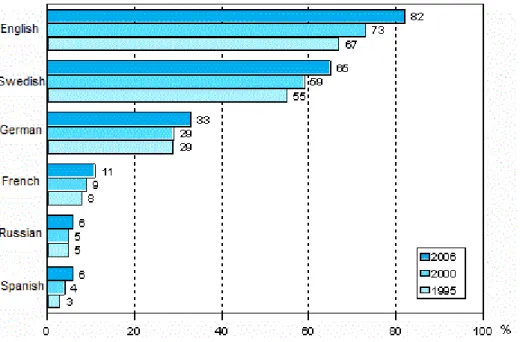
The results about the language skills of the respondents support the statistics and therefore it is safe to assume that the management level staff in the city of Rauma would be qualified to participate in the exchange program.
Internationality in work
Approaching the twin towns
The exchange process in Rauma's case will be very similar to the one currently in use in Jyväskylä, with a strong emphasis on the employees' own activity to make the exchange program successful. On the basis of this thesis, an informative brochure about the exchange program will be created, which will be distributed to all departments. Language skills will also be clarified so that the participant is able to work at the exchange site.
An initial exchange period plan will be drawn up to be submitted to the international exchange program contact in the human resources department in Rauma. The duration of the exchange period can be from a few weeks of visiting to several months of more in-depth study. By the time the exchange period is finally over, the participant will have arranged everything with the exchange location as well as his/her job.
The participant will keep a diary of his/her time on the exchange and keep in mind the learning objectives set for that period, as well as write down experiences, things and situations that have been inspiring. Financial assistance for the exchange period may be for the participant to receive his or her normal salary for the exchange period, as well as accommodation and flights to the location. This will be determined in the budget of the exchange program, which has been established by the city of Rauma.
After the exchange period, the participant will write a written report in English about his exchange experience. The report will be written according to the diary kept during the exchange. The exchange period can last from a few weeks to a few months, destinations in the Scandinavian twin cities.