The purpose of the Bachelor thesis was to research the Degree Program in Facilities Management taught in English in the School of Business and Services Management at the JAMK University of Applied Sciences. The results of the interviews showed that the facilities management professionals were quite critical when evaluating the Degree Program in Facilities Management.
Background information
Basis of the Bachelor’s Thesis
Object of the Bachelor’s Thesis
When the entire curriculum planning process begins, work life must be considered. In Universities of Applied Sciences, important study components are based on the demands and occupations of working life.
Working life in curriculum planning
Definition of competence
Differentiation of competence and qualification
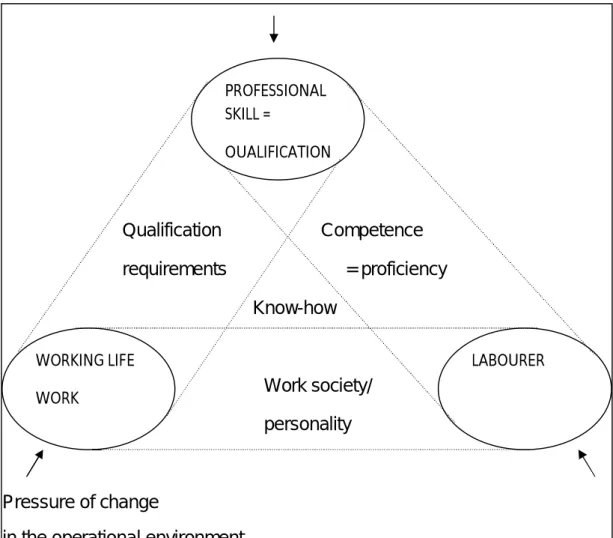
The figure shows how the requirements for qualifications arise from working life, while competences consist of the skills and willingness possessed by the worker. Each worker may have an ability to multitask, or may partially meet the qualification requirements.
Definition of qualification
Qualification model
The socio-cultural features are defined as interaction within the work organization as well as externally from the work organization and identification with one's profession. These functions become more frequent when working life and work processes change in a rapid phase and when more complicated structures are adopted.
Changes in working life
More use is made of temporary workers, which creates a feeling of insecurity and motivation problems when performing the job. Developing the working community, adapting to the needs of the work and resources of employees, professional development and education are the keywords.
Changes in workplace
The changes in working life can be seen in working methods, organisations, occupational structures and the skills needed. Reservations are not made very far in advance, and the workspaces can be used by any group in the company.
Changes in the field of facility management
All in all, the development of the entire society creates new challenges for the lifestyle. Technical development of the work processes, automation and development of the socio-technical work structure create new frameworks for the qualification and competence challenges and their application.
Future trends in facility management
IFMA Facility Management Forecast
Facilities management professionals must be able to foster leadership development, maintain the diversity of workers and work styles, and create flexibility between different work cultures. This requires facility management professionals to determine facility return on investment (ROI), analyze the condition of aging buildings and develop strategies to deal with them.
Facility Management Studies in Jyväskylä University of Applied Sciences
The Facility Management course is taught in the Business and Services Management unit under the Global Business Management sector. The curriculum work on the program in Facility Management is based on information from working life.
Facility Management Studies in Hanze University of Groningen
It should be noted that in the near future the International Facility Management study program will undergo changes again. Today's international facilities management curriculum structure is as follows: the first year is a concentration of study and the role of the facilities manager (in parenthesis) is in issues such as policy formulation (policy maker), product development (innovator), and process control (facilitator, process controller ). In the second year, the focus is on product development (director), entrepreneurship (entrepreneur), policy formulation (consultant) and process control (quality manager).
All the students have the same basic courses in year one, after that their courses may differ from each other based on whether they choose the corporate or commercial emphasis of the facilities management studies.
Competences in Jyväskylä University of Applied Sciences
Competences in Hanze University of Groningen
Competences used in Jyväskylä University of Applied Sciences and Hanze
This chapter discusses the research that has been done to gain a broader perspective on the issue. In the second chapter the research methods are introduced and in the third chapter the implementation is explained.
Research question
The research is also targeted at the students who will benefit from the new updated curriculum, which will provide them with better preparedness to meet the future needs of facility management at both national and international level. The thesis is by Maiju Ala-Jääski and Hanne Kurki from the program in Facility Management and Consumer. The subject is Working Life Correspondence of the curriculum of the Facility Management programme, and it will be completed in the spring of 2008.
Research method
Execution
To get a perspective of what a facilities manager really needs to know in working life, and to get an opinion of how these needs are implemented in the curriculum in facilities management education, three facilities management. Rauhala started his career in the world of banking in 1986, moved to the world of facilities management in 1997, and started his full-time career in facilities management in 2002. Van den Ende worked as a facilities manager in healthcare (hospital) for 20 years, and for For 17 years he worked as Principal Lecturer in the Degree Program in Facilities Management at the Hanze University Groningen.
Puromäki and Rauhala are both heavily involved in the activities of the Finnish International Facility Management Association, FIFMA.
Orientation alternatives, stress on curriculum
Real estate techniques including streamlining, outsourcing, real estate maintenance and leasing can be seen as part of green thinking that encompasses a large whole that will be taught at Jyväskylä University. From van den Ende's point of view in Jyväskylä, the curriculum is not in balance. According to van den Ende the degree program taught in Jyväskylä is quite extensive if one is willing to work in a hotel and stay in Finland.
The cooperation with the universities would be a great way to develop the curriculum used in Jyväskylä.
Professional skills (qualifications)
In the current curriculum there is a third year for orientation studies, but in practice there is no possibility to deepen knowledge as much as professional life requires. All skills mentioned by Rauhala, Puromäki and Van den Ende can all be included in the innovative qualifications. Therefore, these skills should be considered and it should be ensured that they are included in the study curriculum as competencies taught to alumni.
When comparing the skills and competencies covered in the new facility management curriculum, it can be seen that it covers more or less all the career essentials mentioned in the IFMA report (Exploring the Current Trends and Future Outlook for Facility Management Professionals 2007 ); Operations and Management; Object function; Real estate; Finance; Human and.
Changes in working life
Change management, strategic leadership, the use of computer-enhanced tools, security, productivity and globalization all appear to be included in the course objectives of the new curriculum. In the Dutch model, it is clearly seen how the first two years concentrate on policy formulation, product development, process control and entrepreneurship. Rauhala and Puromäki bring the outlook for the future way of using office space.
There is already a small group in Helsinki that goes to cafeteria-restaurant Karuselli in Eira, Helsinki in the morning.
Trends
The purpose of Screen Office is to innovate reporting of issues with energy consumption, waste. Organizational changes are accelerating all the time, staff may be reduced but the workload remains the same, and facility managers must be reactive in how the changes shape their duties and the business strategy of the organization. It also forces facility management professionals to focus on sustainability to improve the core business.
Focusing more on the core business does not reduce the workload of facility managers, on the contrary," says Rauhala.
Comparing competences
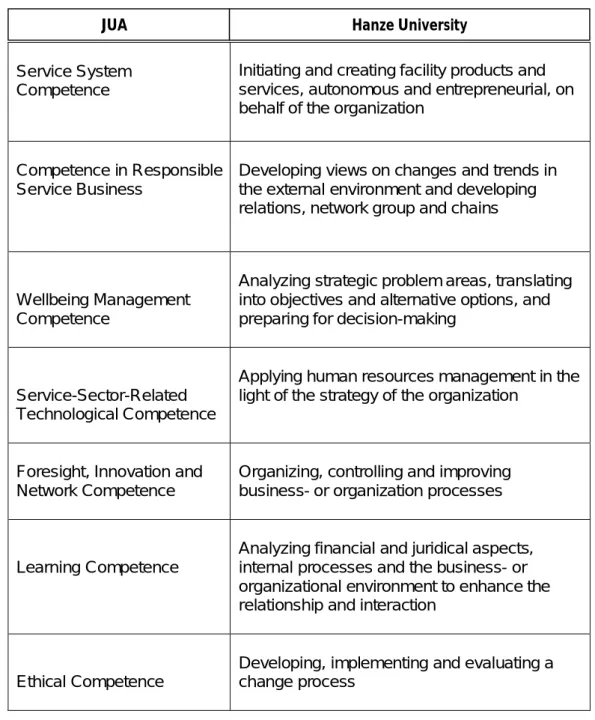
Jyväskylä University of Applied Sciences has a competence called 'Competence in Responsible service business' including equivalent studies as at Hanze University of Applied Sciences. Applying human resources management in light of the organizational competence strategy implemented at Hanze University of Applied Sciences is something that Jyväskylä University of Applied Sciences does not have. In Jyväskylä University of Applied Sciences a competency called 'Foresight, Innovation and Network Competence' in which student uses the opportunities offered by networks for business activities.
Internationality is more visible at Jyväskylä University of Applied Sciences than at Hanze University Groningen.
Differences between curriculums in Jyväskylä Applied Sciences and Hanze
In conclusion, Jyväskylä University of Applied Sciences is slightly behind the Netherlands in the curriculum development process, but in the last 10 years it has changed the curriculum towards a more qualified study program. One of the reasons for creating this thesis was the idea that the Facility Management study program should be developed to meet the needs of professional life and the FM field. The interviewees were quite critical of the evaluation of the facilities management curriculum, especially regarding the depth of study.
The most relevant issues regarding the curriculum planning process and the factors that define what is needed of the competencies taught in the facilities management curriculum are well brought out.
In the future, facility management professionals should be able to use these building management systems, such as Building Information Modeling (BIM), which is used to design buildings, and Integrated Workplace Management Systems (IWMS), which is a potential future tool to channel various sources of information through a common portal. Facility management professionals should be able to utilize these systems to their full potential and are expected to manage facilities based on and extend these models. The demands this trend places on facility management professionals are to keep abreast of changing technology (BIM, IWMS), work closely with tenants/users to be able to act ahead of changes, and use technology as a hook to attract young professionals for facility management.
Due to the large number of mature employees, ergonomics and accessibility will become more important for professionals in facility management.
MMEF1Z / BUSINESS ENVIRONMENTAL COMPETENCE IN SERVICE COMPANIES / BUSINESS ENVIRONMENTAL COMPETENCE IN SERVICE COMPANIES / 20 op/cr. MMTF1Z / ELECTIVE STUDIES OF OTHER DEGREE PROGRAMS IN THE SCHOOL OF TOURISM AND SERVICES MANAGEMENT / ELECTIVE STUDIES OF OTHER DEGREE PROGRAMS IN THE SCHOOL OF TOURISM AND SERVICES MANAGEMENT / 40 op/cr.
The student is able to promote the well-being of customers, consumers, employees and organizations in the service sector. The student can assess his own competences and define his development and learning needs. The student is able to use the value systems and ethical principles of the subject area in his conduct and tasks.
Student understands the principles of group and team work and can work with others in multidisciplinary teams.
The student has knowledge of HRM techniques such as job interviews, performance interviews and development interviews. Analyzing financial and legal aspects, internal processes and the business or organizational environment to improve the relationship and interaction. Student can analyze and interpret qualitative and quantitative data, can work systematically and think logically.
The student initiates change processes, maintains their assumptions and directs change processes and projects.