この研究では、相対的な色比率の色の知覚がローカル/グローバルプライミング効果によって調整されることがわかりました。 Mundy (2014) は、ローカル/グローバルプライミング効果によるミュラー・リヤー錯視で知覚される外観の影響を調査しました。
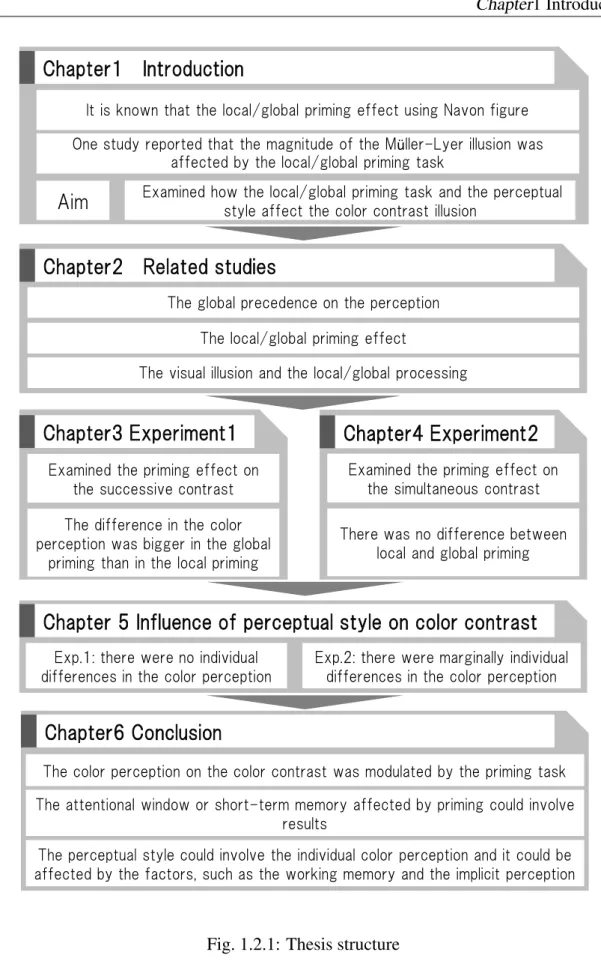
Structure of Thesis
Furthermore, the influence of the perceptual style on the color perception was taken into account. Investigate how the local/global priming task and the perceptual style affect the color contrast illusion.
Influence of perceptual style on color contrast
Global precedence on perception
Paquet and Merikle (1984) found that the interference pattern between global and local letters was affected by exposure time [14]. In Navon's experiment, a global advantage in perceptual processing from global to local was suggested.
![Fig. 2.1.1: The experimental stimuli used in Navon (1997) [1]](https://thumb-eu.123doks.com/thumbv2/9pdfco/1891391.267557/15.892.264.621.166.669/fig-experimental-stimuli-used-navon.webp)
Local/Global priming effect
They reported that each individual was more or less sensitive to the global or local interference and that there were inter-individual differences in how the perceptual information was processed. These findings support that the local/global priming task influences subsequent performance from a neuroscience perspective.
Visual illusion and local/global processing
In addition, there is a report that the magnitude of the illusion varied depending on the style of perception. 2007) conducted the experiment using the Ebbinghaus illusion in the culture of the Himba people, who have no words for geometric shapes. They argued that the Himba's more accurate judgments of size stem from their tendency for local priority in the visual processing of multiple objects[31].
![Fig. 2.3.1: The regression line in the error of the responded line length between local / global priming and control group [11]](https://thumb-eu.123doks.com/thumbv2/9pdfco/1891391.267557/20.892.252.630.165.488/regression-error-responded-length-local-global-priming-control.webp)
Purpose
Methods
- Participants
- Apparatus
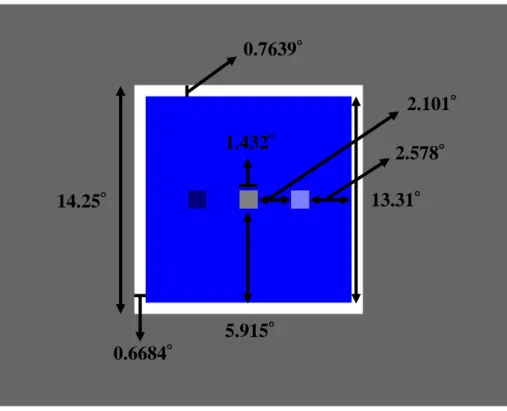
- Stimuli
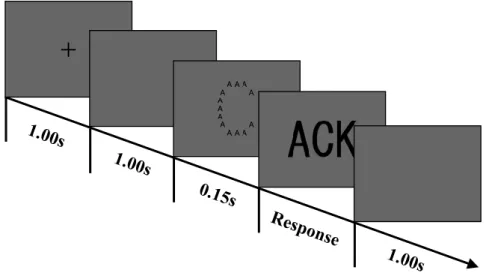
- Procedure
A total of 60 conditions were used in the experiment, 30 in the local condition and 30 in the global condition. To assess the magnitude of the illusion of color constructs, six color stimuli consisting of RGB values of 0 or 255 were used in the experiment. In the test color, there were three color conditions that were either the same color as the target or the colors changed with τ= 0.8 or τ=0.2 were displayed randomly.
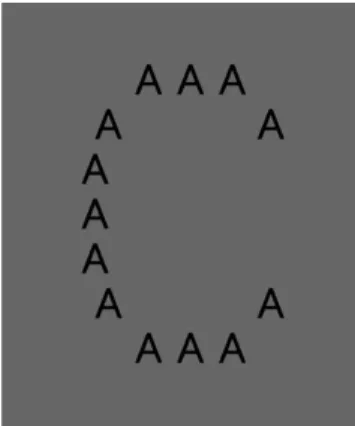
The participants responded to the local/global letter in the test figure after seeing a Navon figure. In the local and global conditions, participants were asked to focus on the local or global letter of the Navon figure, respectively.
Analysis methods
- Index of color appearance
The procedure in Stage 3 was the same as in Stage 1, except for two Stage 2 priming attempts, which were inserted before Stage 3. The test color randomly used the color of the base condition from stage 1, modified by τ, which had values in between. The participants adjusted the test color to the same color as the target color using a numeric keypad.
Results
- τ response between local and global priming
There was a significant difference between the two conditions (condition: t p = 0.04277, Cohen's d = 0.2544) and the difference in color appearance between the local and global baseline conditions was significant.
Discussion
As a result, in the movement with constant viewing condition, the retina strongly adapted to the average chromaticity of the background. However, movement led to less attention to the color of the background, causing a weaker effect of the exposure estimation. Conversely, in the static condition with a random viewing condition, more attention to the background colors produced a stronger illumination estimation effect and color constancy was generally improved.
The result suggested that when participants perceived color, luminance matching required higher-order color constancy, such as luminance estimation, and appearance matched lower-order constancy, such as the contribution of retinal adaptation. Therefore, my findings show that the local/global priming task affects color constancy not only at higher orders but also at lower orders in color contrast using successive color tuning.
Purpose
Methods
- Participants
- Apparatus
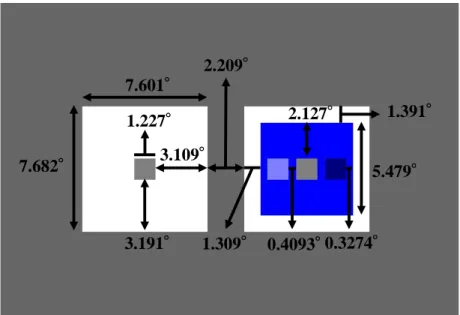
- Stimuli
- Procedure
This stimulus size in Exp.2 was slightly different from the stimulus size in Exp.1 because the overall stimulus size on the simultaneous contrast was adjusted to match the size of the large letter of Navon figure. A series of procedures was the same as Exp.1 except that the stimulus and procedure for phase1 and phase3 were different from Exp.1. The target color and the test color, including the filter and distractors, were randomized to the left and right depending on the participant.
Participants adjusted the test color to be the same as the target color while viewing the target. To reduce the effects of sudden color changes and color adaptation to changes in color appearance, the numeric keypad is designed to respond to just one touch.
Results
- τ response between local and global processing
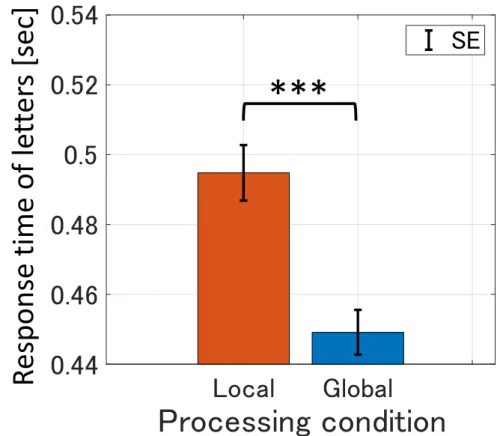
There was a significant difference between the two conditions (condition: t p=.0000, Cohen's d =1.317) and the response time between the local and the global priming conditions was significant. The horizontal axis represents the local/global priming conditions and the vertical axis represents the overall mean value of τ.
Discussion
Purpose
- Analysis methods
Influence of perceptual style on color contrast in Exp.1
- result: τ response depending on the individuals
- Discussion
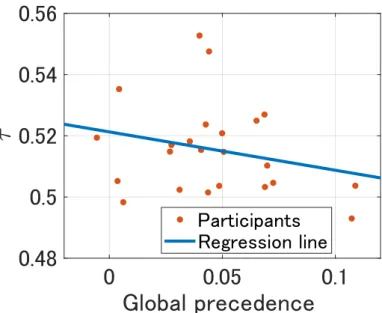
There was a weak negative correlation between the value ofτ and the index of global precedent, but it was not significant (regression: r= -.2410,p= .2259). There was no significant correlation between the value of τ and the index of global precedence. The horizontal axis shows the participant's number and the vertical axis represents the average response time in the global letter trials.
Error bars represent standard errors and (∗) at the top of the bars represents the p-value from the thet test (∗∗∗: p< .001). At the same time, the correlation was not significant in Exp.1, which shows the result after priming.
Influence of perceptual style on color contrast in Exp.2
- result: τ response depending on the individuals
- Discussion
These results suggest that the influence of local/global washout on color contrast using sequential adaptation could be greater than individual differences in perceptual style. However, an experiment directly comparing the influence of perceptual style with the priming effect is needed to clarify these relationships. There was a negative correlation between the τ value and the global preference index and it was borderline significant (regression: r =−.3717,p=.0807)..
There was a negative correlation between color appearance and an index of global advantage (perceptual style), as the value of τ varied with the participant's level of global advantage, even when all participants performed local/global processing. This result indicates that the difference in color appearance was greater for those with a local perceptual style and less for those with a global perceptual style.
General Discussion
- Effect of local/global priming on color appearance
- Influence of local/global perceptual style on color appearance
These studies support my prediction that the range of focus on color contrast using simultaneous tuning may be wider than the size of the attentional window modulated by local/global priming. Hine and Ito (2014) reported that performance on a face recognition task after reading letters in Navon pictures was different depending on the size of the Navon picture. Given the uncertain size of the attentional window modulated by the local/global priming task, color perception may be influenced by distractors or background color area.
The result showed that the face recognition accuracy was different according to the local or global primary in phase encoding and recognition. These studies confirm that short-term memory performance influenced by the local/global priming task may be related to the color perception outcome in this study.
Conclusion
In addition, the difference in color appearance may be greater for high WM capacity than for low WM capacity. 2011) reported that there was a difference in color constancy between higher and lower WM capacities. Goodhew (2021) examined whether individual differences in attentional shifting efficiency were related to WM capacity.
Therefore, these findings suggest that the mode of attention variably depending on the local/global perceptual style contributes to WM capacity and this resulted in individual differences in color appearance. Given that the higher WM group showed significantly better successive color constancy than the lower WM group [49], the difference in color appearance should be greater for the global perceptual style than for the local perceptual style.
Limitaions
このプロジェクトに関わってくださった皆様に感謝したいと思います。皆さん一人ひとりに感謝します 階層的に組織された視覚刺激のグローバルおよびローカルな側面の処理に関与する神経機構 全体的/局所的な注意のさまざまな構成要素に対する半球の非対称性は、別個の側頭頭頂座の部位で発生します。
Functional hemispheric asymmetries of global/local processing mirrored by the steady-state visual evoked potential. The results for each color condition between local and global priming conditions in Phase 3 of Exp.1 and Exp.2 are mentioned below.
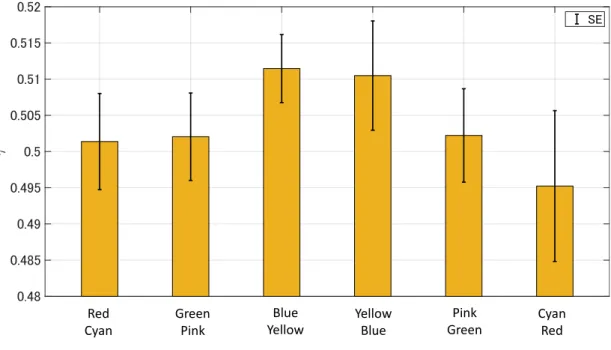
Exp1: The result of each color in phase3
Color constancy
The spectral distribution of the light incident on the human eye from an object is determined by the spectral distribution of the illumination and the spectral reflectance of the object. The spectral distribution of the reflected light from the object varies when looking at the same object under an incandescent or fluorescent lamp. However, we do not notice that the object color has varied significantly and we are not affected by such lighting variations.
It is believed that lighting conditions are estimated by analyzing not only the spectrum reflected from the object, but also the spectrum reflected from the surrounding area, and the light reflected from the target object is then corrected using the estimated lighting condition. The stability of our color perception is maintained even under different lighting conditions due to color constancy.
Color contrast
The color of the left center patch is bluish, but the two center patch colors are physically the same in Figure B.1. In general, the greater the intensity of the influencing stimulus and the closer the stimuli are to each other, the greater the contrast effect will be. A smaller target color area compared to the surrounding color area results in a greater color contrast effect.
The effect of color contrast is greatest where there is little or no lighting contrast. If the brightness is the same, the color contrast is affected by the color saturation of the surrounding color.
Working memory
The former retain color information as words, the latter retain color information perceptually, the short-term retention is believed to occur in different brain regions [55]. The global primacy of perception Do we always see the forest before the trees or the trees before the forest. The magnitude of the Müller-Lyer illusion increased due to the global priming effect and the size of the illusion decreased due to the local priming effect, compared to the control condition.
Investigate whether the local/global priming task affects color perception using the color contrast illusion, including the distractors. There is a possibility to perceive the varied color depending on the perception of the distractors.
![Fig. 2.1.2: The experimental results in Navon (1997) [1]](https://thumb-eu.123doks.com/thumbv2/9pdfco/1891391.267557/16.892.242.649.160.706/fig-experimental-results-navon.webp)