Introduction
In addition to VYR, other important organizations active in the field of nuclear safety also finance the program. This annual report summarizes the results of the individual projects (chapter 2) and provides financial statistics of the research program (chapter 3). Project publications are listed in Appendix 1, information on international cooperation in Appendix 2, list of academic degrees obtained in Appendix 3, list of international trips in the projects in Appendix 4.
This report has been prepared by the program manager and project coordinator in collaboration with managers and employees in the individual research projects.
Main results of the research projects in 2018
Plant safety and systems engineering
- CORE - Crafting operational resilience in nuclear domain
- EXWE - Extreme weather and nuclear power plants
- MAPS - Management principles and safety culture in complex projects
- PRAMEA - Probabilistic risk assessment method development and
- SAUNA - Integrated safety assessment and justification of nuclear power
- GENXFIN - Safety of new reactor technologies
- ESSI - Electric systems and safety in Finnish NPP
- ORSAPP - Practical applications and further development of Overall Safety
Similar tendencies were also observed in normal situations where a task was performed as expected: further investigation into how exactly the success was achieved (to create lessons) was often not found to be motivating - the successes were "business as usual". Extreme convective weather (hereafter called ECW) is associated with thunderstorms and manifests as heavy rain, large hail, intense lightning, eruptions and/or tornadoes. The specific objectives in 2018 were i) to evaluate the use of machine learning methods together with data on atmospheric conditions in order to predict the onset of ECW; ii) to assess the impact of climate change on ECW climatology from 1979 to the present; and iii) to determine probabilities of high lightning peak currents. The project covered most of the topics relevant to the PRA of nuclear power plants.
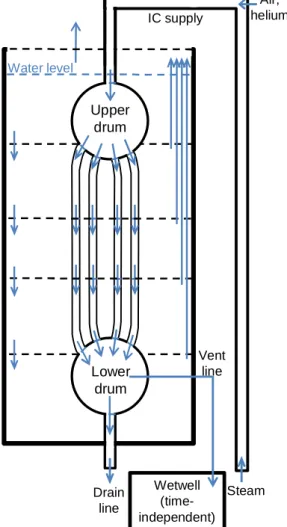
Examining the role of technical support center (more generally emergency response organization) in multi-unit scenarios. The emphasis of the project was on SMR (Small Modular Reactor) design, which could be implemented in Finland in the near future. The rated heat transfer rate of the helicoil steam generators is 10% lower than in design.
Reactor safety
- CASA - Comprehensive analysis of severe accidents
- CATFIS - Chemistry and transport of fission products
- COVA - Comprehensive and systematic validation of independent safety
- INSTAB - Couplings and instabilities in reactor systems
- INTEGRA - Integral and separate effects tests on thermal-hydraulic
- KATVE - Nuclear criticality and safety analyses preparedness at VTT
- MONSOON - Development of a Monte Carlo based calculation sequence for
- NURESA - Development and validation of CFD methods for nuclear reactor
- PANCHO - Physics and chemistry of nuclear fuel
- SADE - Safety analyses for dynamical events
- USVA - Uncertainty and sensitivity analyses for reactor safety
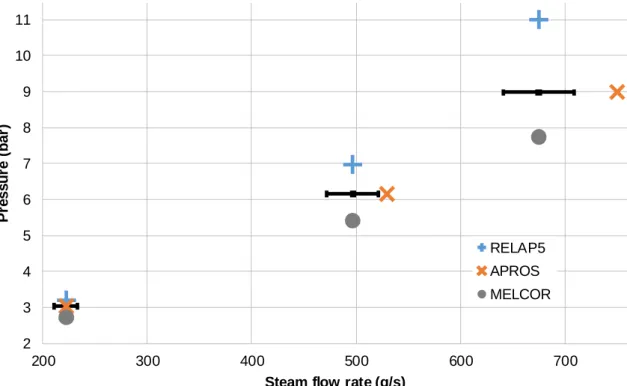
These topics are very important in the management of severe accidents in Finnish nuclear power plants. The results of the first stage overestimated the pressure and cooling capacity of the system. The analysis was divided into four different parts due to the ventilation of the test room.
The design of the plant is such that the effective momentum (liquid force carried by the condensate liquid) can be measured directly with a force sensor or it can be calculated on the basis of measured steam momentum (steam force at the injection hole). Most of the organizations participating in the OECD PKL Phase 4 Project will do analytical work with thermal-hydraulic codes. It would be an advantage for LUT to also participate in the analysis work of the experiments with the PKL plant.
A flow reversal occurs in the affected loop due to the reversal of pressure distribution in the loop caused by the other running pumps. One of the main objectives of the project was to develop radiation shielding functionalities in the Serpent Monte Carlo code.

Structural safety and materials
- ERNEST - Experimental and numerical methods for external event
- FIRED - Fire risk evaluation and Defence-in-Depth
- FOUND - Analysis of fatigue and other cumulative ageing to extend
- LOST - Long term operation aspects of structural integrity
- MOCCA - Mitigation of cracking through advanced water chemistry
- THELMA - Thermal ageing and EAC research for plant life management
- COMRADE - Condition monitoring, thermal and radiation degradation of
- EVOGY - Evolving the Fennoscandian GMPEs
For wool II and III, the binder content is quite high and the additional heat release due to the exothermic reaction affects the cold side temperature, i.e. the asymmetric bell shape observed at 20 min and 25 min for wool II and III, respectively. The predicted cold side temperature rise at the start of the test is much faster than the measured one. The heat flux specified on the test sample page depends only on the standard fire curve.
Comparisons of the results obtained with the fluid-structure interaction procedure with selected reference results are presented in the research report. During the lifetime of existing plants, several cases of SCC in dissimilar metal welds have been reported. For the first time, a test method was used to characterize the effect of cooling rate on fracture toughness in the upper shelf region.
The effect of the investigated additives on the corrosion of 22K carbon steel in borate buffer solution at 50 °C was also studied. Susceptibility to cracking is believed to have a strong dependence on the redox potential of the crack environment. NDE is one of the recommended tools for early detection of deterioration of NPP materials.
A zero state NDE research report and monitoring methods for concrete model wall. The project included (i) analysis of newly acquired data sets from recent earthquakes and synthetic ground motions generated in the SYNTAGMA project, (ii) application of state-of-the-art intensity measures to the analysis procedure, and (iii) calibration of constants GMPE. In Task 1 the goal was to create a homogeneous dataset of earthquake records for GMPE calibration.
The columns in the figure are the radial from epicenter, transverse and vertical components of the displacement.
Research infrastructure
- INFRAL - Development of thermal-hydraulic infrastructure at LUT
- JHR - JHR collaboration & Melodie follow-up
- RADLAB - Radiological laboratory commissioning
- BRUTE - Barsebäck RPV material used for true evaluation of
Overall, the usability of the PIV system has been significantly improved during the INFRAL project. PIV will remain an important part of the LUT thermal hydraulic measurement infrastructure in the future. Advanced applications of wire mesh sensing technique are actively studied in LUT.
Especially in the case of swirling flow, the upstream edge of the sensor breaks the flow and affects the void fraction results. Within work package 2, the annual calibrations of the (PWR) PACTEL measurements were carried out during the summer. In work package 3, when the design of the MOTEL test facility was completed, a report was written describing the initial configuration of the facility.
A report describing the actions and development of the advanced measurement techniques (PIV, WMS, high-speed cameras etc.) in the LUT laboratory in 2018. A report describing the preliminary design of the first configuration of the upcoming integral test facility, MOTEL . The RADLAB project carries out the renewal of the radiological research infrastructure offered by VTT, embodied in the new VTT Center for Nuclear Safety.
Supply and installation of the wet-waste handling liquid evaporator-recondenser designed and manufactured on a contract with Platom Oy. The work began with the writing of a report that described the necessary work and the status of the infrastructure. A report describing the procedures required for the work and the status of the necessary infrastructure has been published.
WP4 includes the paperwork that VTT needs to transport the samples to VTT.

Financial and statistical information
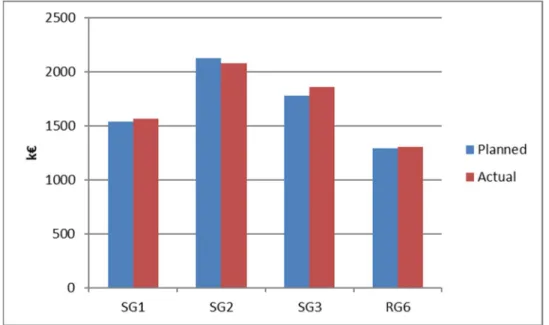
In the figures, the following abbreviations are used for the research areas of the Steering Group: SG1 Plant Safety and Systems Engineering, SG2 Reactor Safety, SG3 Structural Safety and Materials, and RG6 Research Infrastructure. On the other hand, the actual quantities in person-years were higher than planned (Figure 3.4). In research areas SG3 and RG6, the shares of person-years were lower than their shares in the overall funding due to higher costs other than personnel (Figures 3.5-3.6).
In SG2, the shares of person-years were greater than their shares of the total funding, or The number of different types of publications carried out in SAFIR2018 research projects in 2018 is shown in Table 3.1. Within the framework of the program, 296 publications were produced in 2018, of which 41 scientific articles, 60 conference articles, 141 research reports of participating organizations and 54 other publications (theses, reports of other organizations, etc.).
The average number of publications in the research projects was 6.1 per person-years, and the average number of scientific journal articles was 0.86 per personal year. There were differences in the number and type of publications between the projects, most of the projects also wrote scientific articles and conference papers in addition to research reports.
Programme management
Korhonen, 2018: Precipitation extremes and droughts in the current and future climate of Finland, modeled by a state-of-the-art high-resolution regional climate model. In: Proceedings of the International Workshop on Status of Site Level PSA Developments organized by the OECD/NEA RISK Working Group, July Munich, Germany, Paper II-8 (2018). Report on the trip to the IAEA Consultative Meeting on the Development of a Human Reliability Assessment Safety Report for Nuclear Facilities, Vienna, 19-22 February 2018, Report 14124_R009, Risk Pilot AB, Espoo (2018).
Methods for detection of the OPC condition and recommendations to improve the safety of nuclear power plants in case of OPC. Conference paper: Gouëllo, M., Hokkinen, J., Kärkelä, T., Experimental investigation of the effect of molybdenum on iodine transport in the primary circuit during a serious nuclear power plant accident, In proceedings of the International Congress on Advances in Nuclear Power Plants (ICAPP 2018), Charlotte, USA, April 8-11, 2018. Vesa Riikonen, Quick look report of the PWR PACTEL nitrogen reference experiment in the OECD/NEA PKL Phase 4 project, research report, INTEGRA 2/2018, Lappeenranta University of Technology / Nuclear Engineering, Lappeenranta s.
34; Assessment of hose cross-sections of the second generation fuel from TVEL for Loviisa NPP." In proc. Syrjälahti, E., Preliminary simulations of the Kalinin-3 benchmark problem for uncertainty and sensitivity analyses, VTT Research Report, VTT-R- 06972-18. The Minerals , Metals & Materials Society 2018. eds.), Proceedings of the 18th International Conference on Environmental Degradation of Materials in Nuclear Power Systems – Water Reactors, The Minerals, Metals & Materials Series.https://doi.org Mouginot, R.
IAEA expert group for the development of the Safety Report on Human Reliability Assessment for Nuclear Installations. Teperi, A.-M., 32nd Triennial Congress of the International Commission on Occupational Health (ICOH), Dublin, Ireland, 29 April – 4 May, 2018. IAEA Consultation Meeting on the Development of the Safety Report on Human Reliability Assessment for Nuclear Power Installations, Vienna , February 19-22, 2018.
Heikki Purhonen, Vesa Riikonen, Program Review Group and Management Board meetings of the OECD/NEA PKL Phase 4 Project, Barcelona, Spain, 6 November 2018. OECD/NEA RIA standards phase III kick-off meeting and status of RIA's - State of the art report update meeting, March Paris, France. Fülöp, annual meeting of the Working Group on Integrity and Aging of Components and Structures (WGIAGE), seismic engineering subgroup.




![Figure 2.18. Gaseous iodine transport [mg/m 3 ] as a function of the precursor and carrier gas compositions](https://thumb-eu.123doks.com/thumbv2/9pdfco/19386709.0/44.892.170.725.116.472/figure-gaseous-iodine-transport-function-precursor-carrier-compositions.webp)