Here we describe our work on extending the HeidelTime timestamp for the Greek language. HeidelTime is a multilingual rule-based timestamper that performs the entire timestamping task, including extraction and normalization subtasks. HeidelTime can extract and then classify time expressions into date, time, duration and setting classes and then normalize them with a standard format value.
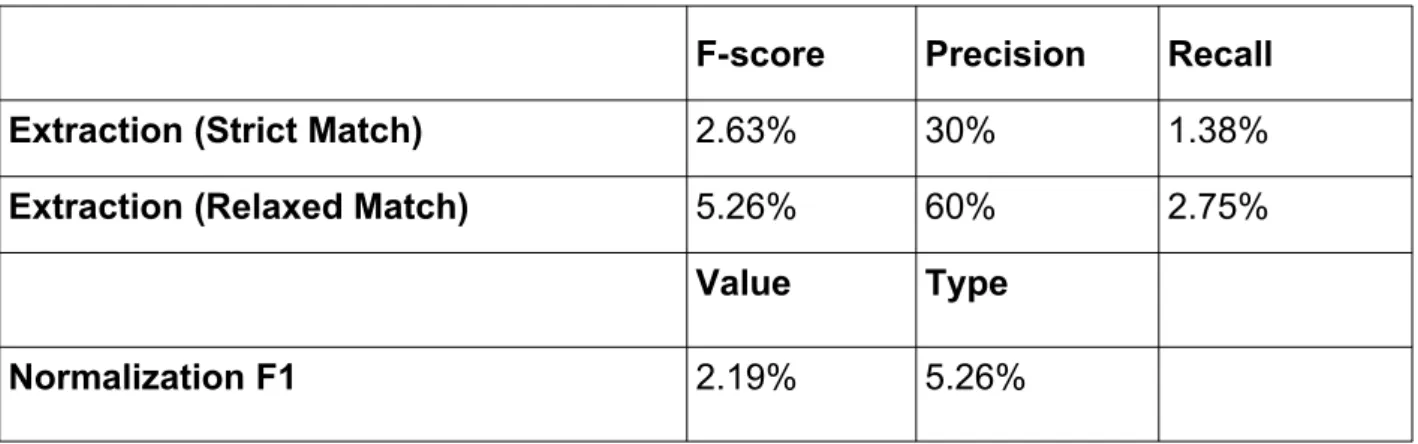
The aim of the project is to manually develop publicly available Greek resources that extend the automated ones. Finally, we evaluated the newly developed resources with more war documents from Wikipedia that were not used in the training process. The value F1 score result we achieved was 82.31%, a significant improvement over the 2.19% of the automated resources.
The current paper is part of the requirements for obtaining a Master's degree in the Department of Informatics and Telecommunications of the National and Kapodistrian University of Athens (UoA), in cooperation with the Technological Educational Institute (TEI) of Athens and in cooperation. with the Biomedical Research Foundation of the Academy of Athens (BRFAA) and the Institute of Informatics and Telecommunications of the National Center for Scientific Research. For example, expressions such as "one hundred years" should be extracted and then normalized to a standard format such as "P100Y" which means Period of 100 years in ISO 8601. The temporal information can then be easily passed to software programs and be used in different ways.
This assignment involved working with the structure of the Greek languages, which was an experience that made me realize the complexity of natural languages and also gave me an insight into how natural language processing and artificial intelligence in general is an important part of knowledge.
INTRODUCTION
Also, after the annotation was complete, the system's automatic tagging detected errors in the Annotator's manual work, which we fixed. After several iterations, the corpus reached a stable period where no modifications were needed to continue our work.
BACKGROUND
- The Annotation Task
- HeidelTime Temporal Tagger
- Types of Temporal Expressions
- Normalization of Relative Expressions
- Language Resources
- Installation
- Software Versions
- Reproducing German evaluation results
- Development Environment for Greek Resources
- Annotation Tools
An implicit expression does not provide all the information for normalization because it depends on the general knowledge of the reader. An example is 'Christmas', which implies December 25 without mentioning this date anywhere in the text. In the first scenario (a) where the domain of the document is news, the tense of the verb is 'quoted'.
Pattern files contain one regular expression in each line for use in the extraction phase. Normalization files contain one regular expression in each line for use in the normalization phase and rule files contain a line in each line of how the extraction and normalization phases should be performed. This method gives us the ability to use an abstract concept of a group instead of complicated regular expressions in the extraction part when developing the rules.
An example is shown in Table 2 where two word normalization files are used. Each line in the rule files joins the extraction and normalization phases for a particular type of expression. Following the correct syntax, we write a regular expression in the EXTRACTION field which matches an integer of one or more digits, a space and the patterns inside the pattern file resources_repattern_reUnit.txt from the previous example.
We installed heideltime-kit-2.2.1 from the official github repository1 following the instructions in the README file. Because some of the links provided in the README file were no longer valid, we used the most recent versions at the time of writing as an alternative for UIMA2, TreeTagger3, TreeTagger scripts4, TreeTagger english parameters5, TreeTagger German parameters6 and TreeTagger Greek parameters7 files. To get familiar with the system and test its operation, we followed the instructions in the wiki8 to reproduce the evaluation results on the German WikiWarsDE corpus.
The maximum difference we observe is 0.4% which is probably due to the difference in the software versions we used. We started by creating a similar directory structure as in the evaluation process to take advantage of the already existing scripts and tools to test the performance of Greek resources during the development process. We completed 3 out of 19 documents with this software, but due to some bugs and the fact that Callisto was no longer supported, we developed custom VIM scripts10 for annotating the rest of the documents.

CORPUS DEVELOPMENT
- Annotation Overview
- Conventions
- Contractions
- Compounds
- Ages
- Annotation Examples
- Statistics
- Notes and Further Work
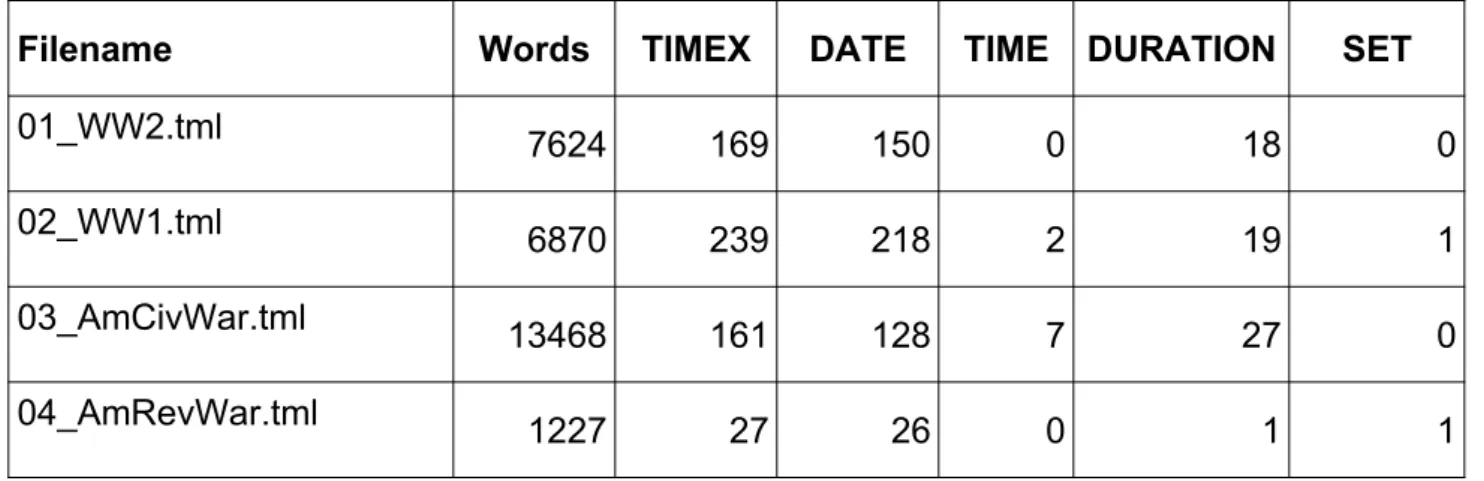
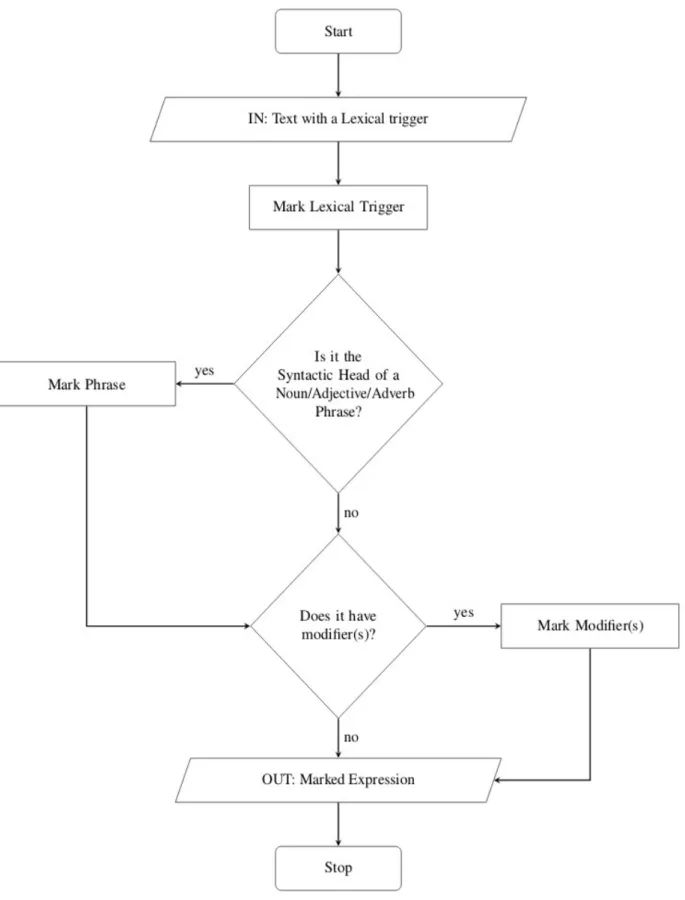
The development of WikiWarsEL was parallel to the development of Greek HeidelTime Resources and this gave us the ability to detect certain temporal expressions that the Annotator did not notice during the reading. Although all articles were read at least twice by the annotator, having an automatic tagger like HeidelTime was very useful. Note that on each of the two decision blocks in the flowchart, if the fully marked expression would become a prepositional phrase or a subordinate clause, then the answer was no and the additional text was not marked.
Since the guidelines we followed have not been adapted to the Greek language, we had to make some conventions about whether an expression is noticeable or not. The guidelines dictate that the full scope of the annotated expression cannot be a prepositional phrase. For example, the English expression "June 17, 2020" must be annotated with the exception of the preposition on, but in the same Greek expression "στις 17 Ιουνίου 2020", the word στις is a contraction containing the preposition στε and the article.
On the other hand, we decided to include compounds whose head is a temporal lexical trigger and therefore indicates a duration as in "διήμερο" (two days). We decided not to include ages as they do not indicate a specific time or duration. Here both μόνο (adverb) and λίγους (adjective) are modifiers of the temporal μήνες, hence their inclusion in the annotation.
This expression is annotated in its entirety, even though it contains the preposition από, because it is part of the adverbial modifier “ύστερα από”, which means. One thing that came back during the annotation process was finding expressions that the Annotator could not detect when reading the texts, even multiple times. Every time we encountered an expression whose annotation was not clear, we had to make arrangements.
Sometimes this meant that we had to re-comment the texts every time a new convention was made.
RESOURCES DEVELOPMENT
- Testing Automatic Resources
- Extending Automatic Resources
- Pattern and Normalization Resources
- Rules Resources
- Not covered expressions
- False Positives and False Negatives
- Relaxed matches
- Resources Syntax
- Evaluation
In terms of file and line changes, Table 6 shows the results of the git diff --stat ./normalization/* and git diff --stat ./repattern/* commands that we used to compare the respective Automatic Sources directories with the one of the manual sources. Instead of the article “το” we also used the pattern file “%reThe”, which contains all the inflections of this article. Idiom: For example, the phrase “χρόνο” (time/year) is similar even though it is part of the phrase “κέρδισε χρόνο” (bought time).
Additional rules covering combined datetime expressions were developed and worked successfully, but we practically doubled the number of rules involved. More work is needed to test this approach for the remaining possible pooled terms. The syntax is mostly straightforward and we were able to adapt and extend the automatic Greek immediately.
When we use UNDEF year or UNDEF month for the entire value, without the -REST part, the disambiguation stage returns unexpected results such as the DCT year, even though HeidelTime is set to the narrative article type. If we use UNDEF-this year instead, the problem is largely solved. To evaluate our manually developed resources, we used 3 test document files created in a similar way to the document files in WikiWarsEL.
The metrics we will use to quantify the performance/quality of the resources are Precision, Recall and F-score. We can describe Precision as the percentage of the correctly extracted expressions out of all the extracted expressions. Similarly, Recall is the percentage of the correctly extracted expressions out of all the expressions that should have been extracted.
A strict match is defined as the extraction of the full scope of an expression and a relaxed match as the extraction of at least one character in an expression. With F-score, we can have a metric that takes into account both precision and recall, and in our case this is 85.87% for Strict Match Extraction Phase and 94.33% for Relaxed Match Extraction Phase as presented in Table 8. Incorporating the results of the normalization phase into the F-score, where TP is this time the correctly extracted expressions with correct normalization values, we receive 82.31% normalization F1.

CONCLUSION
HeidelTime is shown to perform high quality Temporal Tagging for the Greek language similar to that shown in previous works for Arabic, Italian, Spanish, Vietnamese[3] and Chinese[8]. The effort to develop Greek language-specific resources was minimal due to the simplified syntax and file structure, which also makes them suitable for quick and easy updates or revisions. The evaluation of test documents that were not used in the training processes resulted in an F1 score of 82.31%, although some expression categories were omitted from the training.
For the annotation task of temporal expressions in formally written documents, this approach can be used effectively. More work is needed to adapt the annotation guidelines for the Greek language and to investigate possible solutions to improve the newly developed Greek resources.