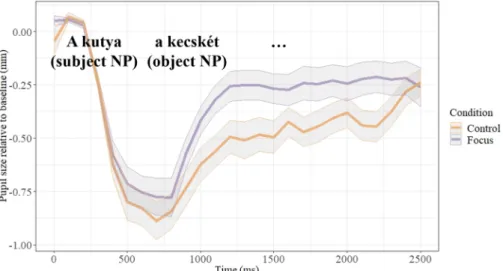
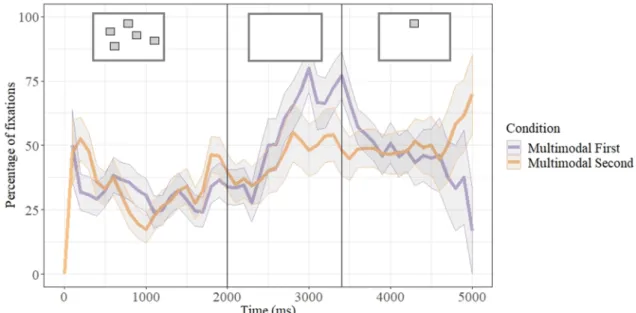
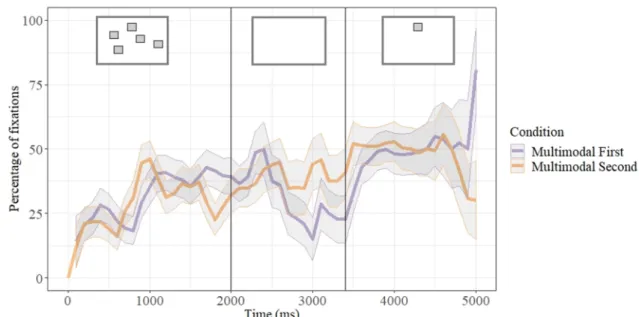
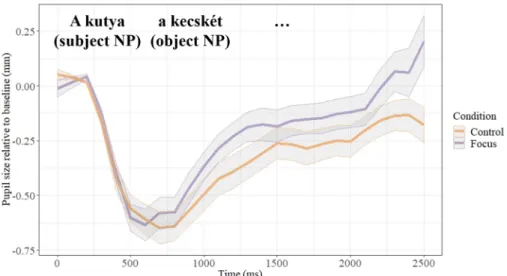
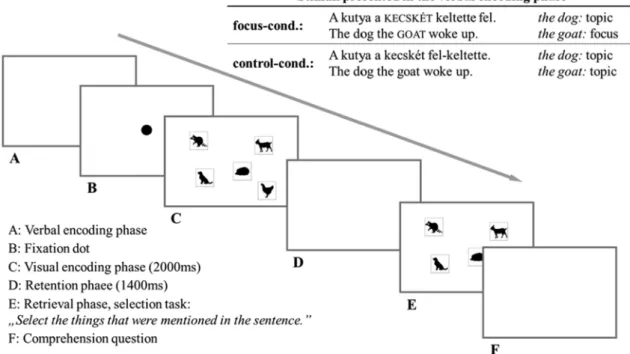
For example, is the wallet presented differently to the addressee if he hears (1a) than (1b)? We will address this question by examining three processes involved in the representation of focused information: i) encoding of linguistically focused information (i.e., the process of forming a representation of the focused item in the mind), ii) holding the representation associated with the focused item in memory, and iii) accessibility to this representation in memory, i.e. To investigate these questions, we set out to test the hypothesis that focus modulates addressee attention during encoding and retention processes. Retention: Focus modulates the refreshing of the representation associated with the selected item in working memory.
A comprehensive explanation of preverbal focus is best seen as a scalar-type implicature Thesis 10 (see Study 1):.
Focus in general
The authors argue that what is going on here is that since old, assumed, or given information is predictable, it requires no more than superficial processing on the part of the receiver, while the parts of the sentence that express new and unpredictable information will be processed in more detail. Despite the considerable diversity of its functions and interpretations discussed in the literature, authors in the theoretical linguistic, psycholinguistic, and psychological domains agree that linguistic focus has certain central properties that can be captured by a concise definition. To lay the groundwork for further discussion, we adopt one of these definitions as formulated by Stevens (2017): focus constitutes the part of the sentence that conveys the most informative or important information within the context of that sentence, and which is marked as such by some linguistic means.
Focus in Hungarian
On the other hand, in Hungarian, the configuration of constituents expresses information-structural roles as opposed to grammatical roles (É. Kiss 1995). Since information-structural roles are dependent on discourse, the category of languages to which Hungarian belongs is called discourse-configurational languages. Since evidence informing such theories comes mainly from configurational languages (such as English and German), we consider it important to extend the study to include discourse configurational languages such as Hungarian.
Therefore, one of the aims of this thesis is to study the psychological and interpretive characteristics of the Hungarian preverbal focus in particular and thus to contribute to expanding our knowledge of linguistic focus in general.
Focus as the most prominent part of the sentence
More specifically, they deal with the formation of the representation of the focused element in WM (i.e. its encoding), its retention and its retrieval. One of the central claims of the present Dissertation is that linguistic focus directs the attention of the addressee to the focused element. Therefore, we also ask how fine the representation of focused elements may be in the case of the Hungarian focus construction.
The situation in (4) illustrates a further point about focus representation that is prominently discussed in the literature: the representation of the set of alternatives for the focused element.
Memory representation processes
Encoding
Note, however, that the evidence provided by these studies is either limited in scope or is quite circumstantial with respect to our original question, that is, how focus modulates attention during the encoding of the focused item. Measurement of pupil size served to measure the distribution of attention during encoding of the focused element, i.e. Second, Ariel & Castel (2014) demonstrated that attention is selectively allocated during WM encoding depending on the degree of importance of the item to be encoded, and this is reflected in pupil dilation.
As will be detailed in Section 3.1.1 (see also Study 1), we used the modulation of the pupillary reflex to investigate the cognitive load associated with the encoding of linguistically oriented elements.
Refreshing
3.1.1 (see also Study 1), we used the modulation of the pupillary light reflex to investigate the cognitive load associated with the encoding of linguistically focused elements. Let us now turn to our original research question regarding attentional allocation during retention of focused elements: given that i) linguistically focused elements are more accessible in WM, similar to ii) memory items being refreshed at a higher rate during memory retention, it seems reasonable to suspect that linguistically focused elements are also more accessible in WM because they receive more attention during retention, i.e.
Retrieval
15. Let us turn to our original research question regarding the allocation of attention while maintaining focused items: given that i) linguistically focused items are more accessible in WM similarly to ii) memory items that are refreshed at a higher rate during memory retention, it seems reasonable to conjecture that linguistically focused items are also more accessible in WM because they receive more attention during retention, i.e.
The nature of memory representations
The semantic detail of representations
Representation of focus alternatives
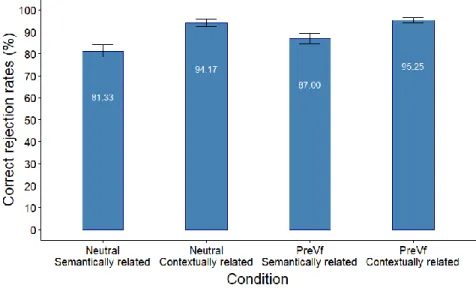
Pléh & Sinkovics (2011) asked whether this pattern of recognition can also be observed in preVf sentences and their counterparts in the neutral word order. In other words, the seemingly superficial syntactic feature of word order in the case of preVf is used to express structural information. Therefore, word order in the case of preVf may not be strictly a surface property.
Based on theoretical considerations (such as Krifka Rooth Kenesei 2006) and data on Germanic languages (see e.g. Gotzner & Spalek 2017), we assume that a set of alternatives is also activated in the case of Hungarian preverbal focus.
Theses related to the representation of the focused expression
- Thesis 1. Encoding: Focused elements are allocated more attention during Working Memory
- Thesis 2. Retention: Focus modulates the refreshing of the representation associated with the focused
- Thesis 3. Alternatives: Focus activates the representation of a set of alternatives in Working Memory
- Thesis 4. Retrieval: Focus enhances the accessibility of the focused element in Working Memory . 20
A second aim of Study 1 was to investigate the allocation of attention to the presentation of a focused item during WM retention. Thus, in the decision-making task, the relevance of the two elements to be kept in memory was unequal. In other words, in the decision task experiment, the presentation of the focused item was refreshed at a higher rate than its unfocused counterpart.
In the case of the decision task, the multimodally presented item became more refreshing during the retention phase.
Findings on the representation of pre-verbal focus: Summary and conclusion
Thus, we expected to see similar patterns of attentional allocation in the case of multimodally presented items as in the case of preVf. In addition, the authors found different activation patterns in the case of new items, based on which they concluded that the processing of focus and new information involves different cognitive processes. Results indicated that the spatial attention task and focus marking in the language task activated common cortical areas.
The second part of the thesis deals with the question related to the interpretation of preVf, which is extensively discussed in the literature, namely the comprehensive explanation.
Background
- Theoretical accounts of exhaustive interpretation
- Experimental findings on the exhaustive interpretation of the pre-verbal focus
- Scalar implicature
- Exhaustivity as a scalar type implicature: A theoretical proposal
- Processing models of (scalar) implicature generation
One of the major questions addressed in this thesis concerns the source of exhaustive interpretation associated with preVf. In the case of (20a), a speaker using the word therefore implies (but does not claim) that being brave follows from being English, just as in (20b) the appositive structure implies (but does not claim) that Bohumil Hrabal was a Czech writer. Therefore, in the following section we give a brief overview of the results of the treatment of scalar implicature.
Degen & Tanenhaus (2011) also examined whether the modular model is stable and tried to answer the following questions: what factors contribute to i) the computation of scalar implications and ii) the time course of these computations in the case of some.
Theses related to the interpretation of the pre-verbal focus
Thesis 6: Contextually available sets motivate the use of the pre-verbal focus
First, we predicted that the presence of a relevant set in the context plays a crucial role in the licensing of preVf constructions: if such a set is available, the preVf construction is used (cf. also Kenesei 2006). The experimental task was to create sentences that naturally fit the context by clicking on the words in the cloud. The dependent variable in the experiments was the proportion of preVf and postVf constructs produced in the different context conditions.
Results revealed that the presence of a set in the contexts motivates the use of a preVf construct.
Thesis 7: Context modulates the rate of exhaustive interpretation associated with the pre-verbal focus
In contrast, the scalar implicature predicts that while the rate of exhaustive interpretation should be uniformly high in f-only sentences in both contexts, in the case of preVf this rate should be comparable to f-only sentences exclusively in the restrictive contexts, while it should be lower in the non-restrictive contexts. The results of both experiments were consistent with the prediction of the scalar implicature view: while the rate of exhaustiveness in f-only sentences was not affected by context, in nonrestrictive contexts, the rate of exhaustiveness decreased in case of preVf sentences significantly. While rates of exhaustive interpretation were at ceiling in the restrictive contexts for both sentence types, these rates declined uniformly in the nonrestrictive contexts.
Given i) that there is a consensus that exhaustiveness of postVf should be analyzed as an implicature, and ii) that a consistent pattern was found in the rate of exhaustion in preVf and postVf in the two context types, we argue that the view that.
Thesis 8: Context modulates the mental processes associated with the computation of exhaustivity
Gazing patterns obtained in the forced choice task experiment showed that gazes towards the target image converged equally in the case of the two sentence types. Namely, the gazes to the target image must be replaced in both sentence types in the restrictive context. Gaze measurements during the processing of postVf sentences showed a similar pattern: gazes towards the target converged faster in the restrictive context than in the nonrestrictive context.
These results, just as in the case of pre-sentences, show that the interpretation process of entertaining non-exhaustive alternatives is affected by the presence of contextual constraints.
Thesis 9: The exhaustive interpretation of the pre-verbal focus is best seen as a scalar type implicature
In other words, how can we explain the intuition that the tendency to interpret focus-containing sentences is stronger in the case of preVf than postVf. However, a visual inspection of the viewing patterns associated with the processing of preVf sentences (Figure 14 in Study 5) and those associated with the processing of postVf sentences (Figure 15 in Study 5) suggests that full referent identification later in the case of postVf sentences. In the case of ad hoc implications, a series of alternatives are also created and excluded as part of the inference.
We also hope that the paradigms used in the experiments can inspire and inform future studies using online methods in the study of the processing of Hungarian sentences.
Thesis 10. Exhaustivity associated with focus is derivable from its attention capturing properties . 45
9 sentence, there was a significant effect change during stimulus processing. First, we conducted a statistical analysis of accuracy rates in the same-probe condition. In case (i) the set was explicit by enumeration, while in case (ii) the implicit set was implied.
The last word of the self-contained sentence was yyet (one-ACC) in the restrictive-condition and yyet (some-ACC) in the non-restrictive-condition.