He never rested when sharing his inspiring knowledge of the cognitive neuroscience of language—and, importantly, his wit. Some authors, such as Fónagy (1999), have suggested that metaphors contradict one of Saussure's basic ideas, the linearity of linguistic expression.
Linguistic and conceptual interpretations
Since mappings are always partial, it is a matter of analysis to determine which elements of the source domain are mapped to which elements of the target domain (Kövecses, 2005). At the same time, only a small proportion of the many theories of metaphor (for reviews see Fónagy, 1999; Nuessel, 2006) attempt to provide a precise description of language processing.
On-line metaphor processing
In the following section, I will provide a critical review of the currently available studies of metaphor research. Metaphors that make unique linguistic demands have also been proposed to be addressed by RH.
Lateralization and metaphor
Today, however, the RH appears to be involved in a wide variety of language functions (e.g. Van Lancker Sidtis, 2006). A pioneering PET experiment by Bottini et al. 1994) found that the RH participates in the processing of tropes in healthy individuals.
Novelty: salience, coarse coding, & difficulty
Although all unfamiliar metaphors elicited a stronger BOLD signal change in the right insula, this area was activated by each metaphor. Novel metaphors may not be processed identically to novel literals, which contradicts GSH and CSC theories.
Sentence complexity, context, & pragmatics
Priming effects were only found for congruent contexts in the LH, but for both congruent and incongruent contexts in the RH (Faust & Chiarello 1998). In general, the RH seems to be able to support a wider range of possible interpretations, either to revise/repair the interpretation (Chiarello, 1991) or in.
Conclusions
Some of the tasks used in previous studies (e.g. in Mashal et al. Decide silently whether words are metaphorically related) might have had subtle pragmatic demands. The above considerations raise the possibility that it is pragmatics rather than semantic features that evoked RH computations in at least some of the previous studies.
Semantics of category assertions
Therefore, the name 'shark' will stand for the category of predators instead of simply the concept SHARK. In this case, 'shark' would not represent an actual ad hoc category, but would refer to a very narrow, very shark novel category, containing the relevant non-physical properties.
Inverse containment
Instead, one can be born with some (but certainly a limited number of) very abstract concepts, such as LIVE and NOT-LIVING, ANIMATE and. Abstract conceptual properties can be conceived of as atoms born of inherent parameters or laws of nature.
Abstract substitution
It follows that there must be different background processes, but the theory argues just the opposite. In fact, from a Relevance Theory perspective (Sperber & Wilson, 1995) the cognitive effects should differ in the two cases - metaphor is a kind of free language use - and simply choosing one option over the other indicates the speaker's communicative intentions.
The neuroscience of abstractness
Understanding metaphor as a kind of abstract procedure is not without precedents (e.g. the works of Max Müller, Ernst Leisi or Hedvig Konrad), but previous theories have considered metaphorical abstraction to be fundamentally different from conceptual abstraction (Fónagy, 1999). Desai, Binder, Conant, Mano, and Seidenberg (2011) designed an fMRI experiment that presented literal action ('The daughter grabbed the flowers'), metaphorical action ('The public got the idea') and abstract sentences ('The public understood the idea').
The lateralization of relevance
An important gain in the context of abstract substitution is that combining narrowing-broadening with the abstract-concrete dimension allows for a more accurate description of processing, namely a substitution procedure using an abstract ad hoc concept. The conceptual progression on the narrow-wide continuum proposed by relevance theory could be understood as the interplay between the widening in the RH and the narrowing in the left.
The use of metaphor
It could also have contributed to the success of the conceptual metaphor theory (Lakoff & Johnson, 1980a), which drew attention to the literal reading of conventional metaphors. This level of interpretation is related to the relevance of the implicature of the metaphorical utterance.
Metaphors of the mind
Since then, various proposals have emerged about the nature of the mind's content, and about how information processing is implemented in the brain. What and how are represented by neural substrates can be interpreted as a kind of semiotic question – how are phenomena (objects) represented (via signs) in bran. At the same time, some researchers propose an iconic, some an indexical and some others a symbolic relationship between concepts and their instantiation in the brain and mind.
Champions of classical Chomskyan cognitivism and a representational theory of mind propose purely symbolic relationships in the brain (e.g., LOT by Fodor, 2008). In the absence of conclusive evidence, the debate between the previous three types of representations of the mind is inconclusive. Although the repeated observation of sensorimotor activations during language comprehension makes a weak version of embodiment consistent, the theory has been seriously challenged (discussed in section 4.4. The Importance of Abstractness).
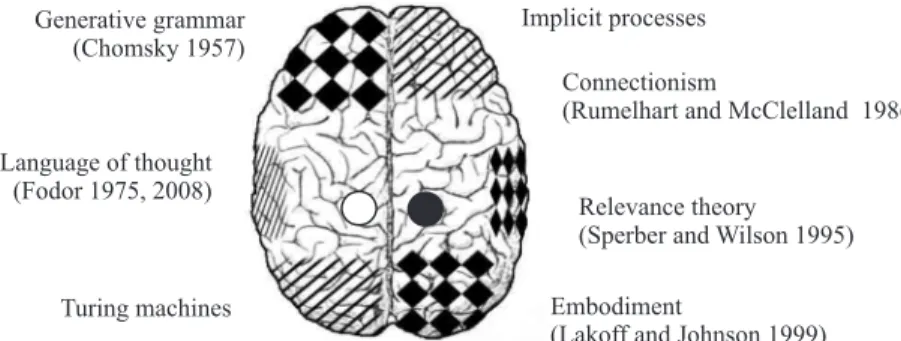
Brains mapped on the brain
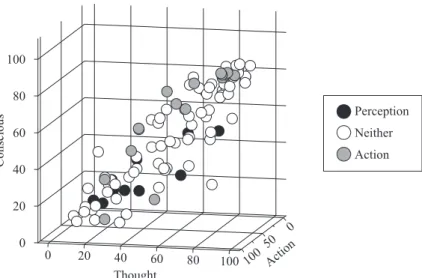
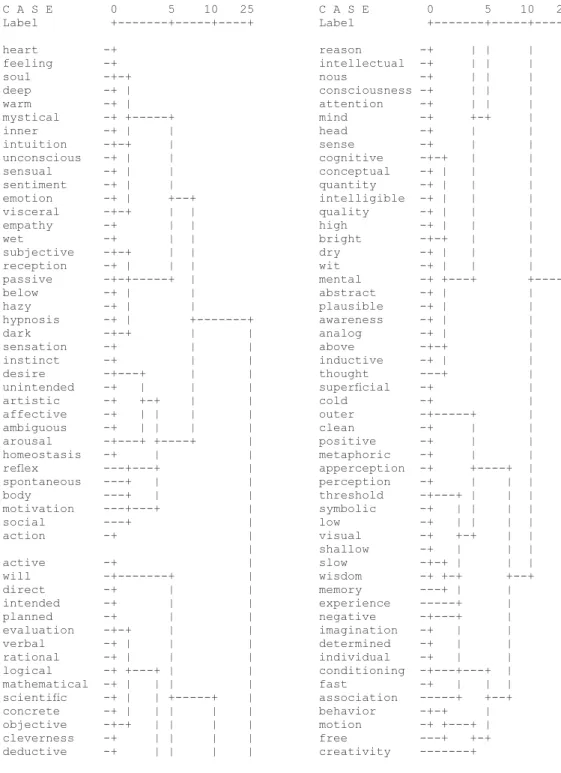
Similarly, implicit processes emphasized over explicit operations can be understood as a turn to the non-verbal and more automatic functions of the RH - again metaphorically, of course. Hypothetically, not only could metaphors shape the scientific conceptualization of the brain, but the structure of the brain also shapes the metaphors of science. Such an orientation aspect could refer to the anterior-posterior dimension of the brain, with an action- and a perception-weighted interpretation of conscious experience, respectively.
The compelling part of the theory is that it distinguishes between two historical approaches and integrates them into a neural framework. Taken together, the overall architecture of the brain can exert constraints not only on how people experience the world, but as a result, on how they interpret it. Any major brain system allows for the possible uptake of cognition, emotion, insight, instinct or induction—and ultimately science.
Unresolvable debates of cognition
The puzzle of the nature of consciousness may be at least partly linguistic (Block, 2005b), and competing views may reflect competing personal preferences that, at the same time, highlight salience. Proponents of a particular way of understanding can often take sides as a result of their mental architecture, which is reflected in their way of framing the phenomenon. On the other hand, it also reflects on the limits of thought and verbal exploration of the world – a linguistic limit that can be a burden for RH.
Nevertheless, different perspectives usually coexist, and some debates seem impossible to settle. One of the most famous debates goes back to the birth of scientific psychology: to the rivalry between the 'imageless thoughts' (Ogden, 1911) of the Würzburg School and the Leipzig structuralists (Pléh, 2008). This option is getting closer as we understand more about the structure and function of the brain's systems.
Systems of domains
The fourth independent domain is considered to be linguistic intelligence that is not related to any of the former abilities, but emerged on its own. The most compelling part of the theory is the eventual transformation of the cathedral's architecture. Mithen takes such metaphorical thinking (of cross-domain mapping) as the most important feature of the truly modern human mind.
While the core system approach proposes mapping problems into domains, the cathedral of the mind proposes cross-domain mapping. A central workspace is at the heart of the system, which is connected to several modular processors. Synchronized activation of widespread regions allows processor resources to be used productively in the workspace.
Thesis point I
In contrast to an embodiment where mappings are instantiated by the identical sensorimotor system, the GNW perspective allows metaphors to be thought of as mappings between all neural networks. These system-to-system mappings can also account for the high number of source domains mapped onto a single target domain by conventional conceptual mappings and the high number of target domains a single source domain can structure. Instead of looking for answers to centuries-old debates, the scientist's attention could move on to the very source and mere possibility of such debates, the brain itself, to gain more insight into the nature of the human way of thinking.
Thanks to cognitive science, this endeavor need not be reduced to a biological level, and hopefully comprehensive models will provide better templates for future collaboration between different disciplines. Perhaps one of man's highest achievements involves metaphorical mappings of known and familiar approaches, personal perspectives, and thus underlying brain systems to questions such as the nature of the human mind itself.
Thesis point II
Thesis point III
Thesis point IV
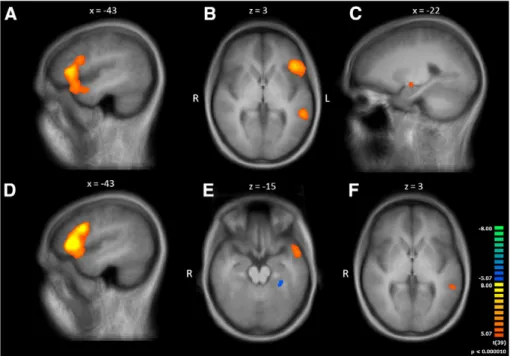
By radiological convention, the left side of the brain is on the right side of the figure. The role of the right hemisphere in the processing of nonsalient metaphorical meanings: application of principal component analysis to fMRI data. The first words of the expressions (the adjectives) that served as primes were presented centrally, while the second, target words (the nouns) appeared randomly either in the LVF or in the RVF.
The aim of the present study was to elucidate the role of RH0 in the comprehension of novel expressions, especially novel metaphors. The role of the right hemisphere in the interpretation of figurative aspects of language: a positron emission tomography activation study. The brain. Right hemisphere sensitivity to novel metaphorical relations: An application of signal detection theory. Brain and language.
An fMRI study of the neural correlates underlying the processing of novel metaphorical expressions. Brain and language. 2008) The role of the right hemisphere in the processing of novel metaphorical expressions: A transcranial magnetic stimulation study. The role of the right hemisphere in interpreting the figurative aspects of language: A positron emission tomography activation study.
Thirty years and counting: finding meaning in the N400 component of the event-related brain potential (ERP).

Study 1: Neural correlates of combinatorial semantic processing of literal
Study 2: Lateralized processing of novel metaphors: disentangling
Study 3: Verbal metacommunication – Why a metaphorical mapping can be
Study 4: The right hemisphere of cognitive science