Problems of efficient use of teachers' resources (see "The problem of efficient use of teachers' resources" by P. Khobzey) and the role and place of modern vocational education and training in Ukraine (see "Education and vocational training in the Ukrainian system of Education ” by P. Khobzey) are analyzed within the context of another field of research, i.e. Research and findings from experts have been published in the press, at conferences and other events, including the Roundtable on Educational Finance and Administration Issues. (July 2002), Forum for Children at the Limits of Educational Space - the Right to a High Standard of Education and Life in Society (September 2002), Seminar on State Standards of Secondary Education (January 2003) and Forum for Education. Reform – Dialogue on Standards (June 2003).
Executive Summary
Involve Ukraine in the discussion on key competencies at all levels and integrate the country into the international DeSeCo (Definition and Selection of Competencies) network. Integration of key competencies into the curriculum (standards, programs and textbooks), development of innovative pedagogical techniques through the introduction of competencies.
Providing information about a competencybased approach via various teacher training and inservice teacher training systems
This research performs a comparative analysis of the definition and selection of key competences in different countries (Netherlands, Belgium, Austria and other countries); suggests a classification of key competences and their general list; provides recommendations on initial steps to be taken in terms of incorporating key competences into the educational process of a national school.
Incorporation of key competencies into the process of student performance as sessment
Introduction
In recent years, the concept of key competence has been the subject of a wide debate among the member states of the Organization for Economic Co-operation and Development (OECD), which have studied this problem in most European countries (8). The paper will focus on the definition and selection of key competencies in the developed economies of the world; provide a summary and ranking of lists of key competencies; perform a comparative analysis and offer tentative recommendations for initial steps to improve the quality of national education.
Analysis of the problem
- Competency Approach Application Problem in the Ukrainian Secondary Educa tion
- Council of Europe Approaches
- Position of the International Board of Standards for Training, Performance and Instruction (IBSTPI)
- Lisbon Conference Input (2001)
- Organisation for Economic Cooperation and Development Competency Ori ented Approach (OECD)
This definition of the idea of competences corresponds to the position expressed by Ukrainian educators. Position for International Board of Standards for Training, Performance and Instruction (IBSTPI) Instruction (IBSTPI).
Key competencies for successful life and well-functioning society
List of Recommendations
Description of Recommendations
This recommendation provides for the conceptualization of the competency concept and the key competencies. It is proposed that students' achievements in acquiring key competencies are taken into account when developing new programs and plans.
Providing information about a competencybased approach via various teacher training and inservice teacher training systems
In the future, such a strategy could lead to Ukraine joining the “DeSeCo” program (definition and selection of competencies), which currently united 18 countries in a joint discussion on the lists of key competencies, their renewal and the mechanisms for the introduction to the educational process within the framework of an international network. Components of key competencies, knowledge and skills and other aspects should be defined and proposed for implementation in accordance with the scope of the proposals across disciplines to enable the creation of an integrated system of competencies.
Incorporation of key competencies into the process of student performance assessment
- Conclusion
- References
- Annexes
- Problem Analysis 1. Current Legislation
- Funding Approaches
- Existing Practice of Student Admission to Different Types of School 25
- Reasons for the Problem
The concept of the European language portfolio was formulated during the last decade. 23 The first phase of the project (2001) provided technical support for the development of an education reform strategy to the Ministry of Education and Science of Ukraine.

Results of the Survey Conducted by the Social Monitoring Centre
- Forecasting Further Development
- List of Policy Options
- Description of Policy Options 1. Policy Option A
- Policy Option B
- Problem Analysis
- The Problem of Profile Education Organization at Upper Secondary School Level in Ukraine
- Approaches to Differentiation of Upper Secondary School Abroad
- The profile education organization model in upper secondary school
- Types of training courses (basic, profiled courses based on choice, optional), their correlation
- Correlations between the system of education quality monitoring and State Education Standards
- Teacher training for profile upper secondary school organization and advanced teacher training
- Annexes
- Gymnasia
- Grade 1 and senior grade
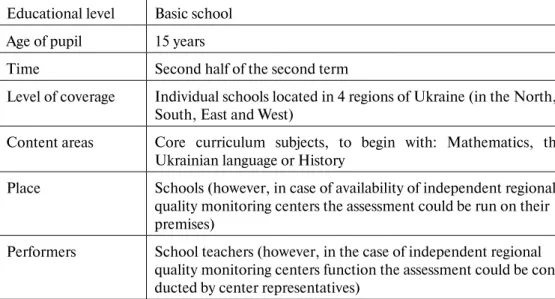
- Analysis of Foreign Experience of External Assessment of Student Achievements
- Description of Policy Options
- Training of experts in this sphere is not less important. It could be realized on the base of high education institutions or institutes of inservice teacher training
- Items for external testing should be of different types and measure all aspects of student performance
- The assessment items should measure the level of student mastering of educational stan dards established legislatively
- Assessment procedures and results should be understandable for everybody
- Assessment results should be open for everybody
- The assessment system should be subject to continuous improvement
- State and Trends of VET Development in Ukraine
26 Decree of the President of Ukraine "On the National Doctrine of Education Development"/. On the fulfillment of the legislation on the development of general secondary education in Ukraine of October 1, 2002. The participants of the regional seminars (Cherkasy, Ternopil, Mykolayiv, Lu hansk) elaborated recommendations for the introduction of profiling in higher secondary schools.
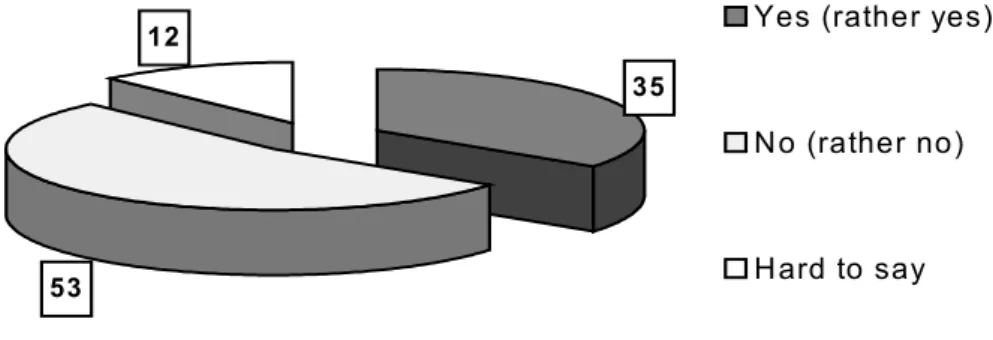
As stated in the instruction of the Ministry of Education and Science “On the application of the law of Ukraine. National Doctrine of Educational Development; the results of the sociological opinion polls (cited in the work) testify to the need to introduce external evaluation. Attitude of the representatives of Ukrainian education to the problem of external assessment of student performance.
The beginning of 1. year of study in primary school (high school) at the age of 11. The beginning of 1. year of study in high school (lyceum) at the age of 16. At the end of school at 19 – a final written exam (in 1 + 2 further subjects).
Dynamics of vocational education and training institutions under the jurisdiction of the Ministry of Education and Science of Ukraine.

- Main Problems of the VET System
- General Recommendations for VET Quality Improvement in Ukraine
- List of Policy Options
- Description of Policy Options 1. Description of Policy Option A
- Policy Option B
- Conclusion
- References
- Annexes
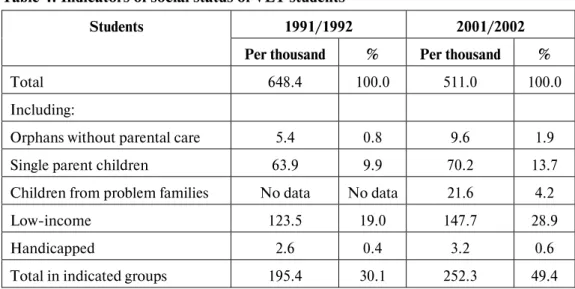
The emergence and intensive development of various forms of ownership has led to a significant weakening and, in most cases, destruction of the links between vocational education and the sectoral bodies of economic management, vocational education and programs and enterprises. Today, new mechanisms for the participation of employers and social partners in the training of the workforce are lacking,” the Ministry of Education of Ukraine has noted (5). Given the foregoing, it would be worthwhile to replace expensive, highly specialized education with broad-based vocational education and training, which would reduce the number of specializations.
In the given research, we offer policy options to change the administration of the vocational training system mentioned in 4), 5) and 6). One possible option would be to leave some EUD program areas with regional status under the direct control of the Ministry of Education and Science (such as printing, communication, art and railway schools). Therefore, with support from the OSAs and in collaboration with the employment services, it would be appropriate to organize vocational training for the unemployed on the basis of EUD institutions.
Therefore, it is necessary to apply a flexible approach to the proposed policy option to avoid the demise of existing vocational education and training in individual regions (oblasts) and in the state in general. This analysis has made it possible to formulate and propose policy options to address the problem of the gap between general secondary education and vocational education at the secondary school level.
- Analysis of the problem of evaluating school efficiency
- Evaluation Agency
- Evaluation Process
- Evaluation Results
- For the purpose of overcoming the disparity between the social role a teacher has to play and his/her social status it is suggested that the Ukrainian government abandon the
- The problem of inefficient use of teacher resources could be solved partially by means of the following policy options
- Main Indicators of Teacher Income Funding
- Comparative Analysis of State Expenditures on Education in the World
- Analysis of Efficient Use of Teacher Working Time
- The Ukrainian government should abandon the principle of “residual" funding for national education and undertake measures for increasing state expenditure on
- The problem of inefficient use of teacher resources could be solved by means of the following policy options
- Description of the Policy Options 1. Description of Policy Option A
- Description of Policy Option В
- Description of Policy Option С Consolidation of the rural school network
The above-mentioned decision stipulates that the same aspects of school work are examined as in most other countries. Qualified personnel is one of the most important conditions for the successful work of this body. The results can be used by the Ministry of Education and Science for the coherence of aspects of education policy.
Materials of the experimental statement of schools of Ukraine (for workers of education management, principals). It contains the positive aspects of the school work and recommendation for the further activities. The choice of the aspects is made by the inspectorate together with the ministry of education.
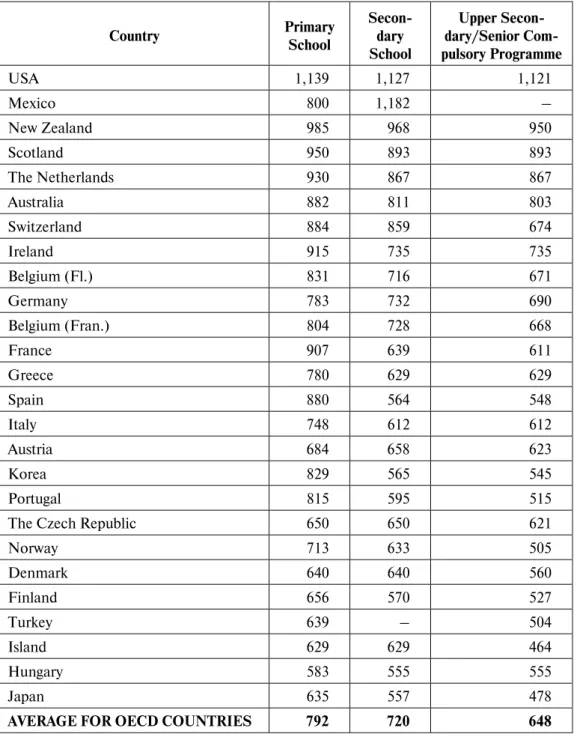
A key indicator of effective use of teachers' working time is the number of students per teacher. The forced intensification of the study process does not lead to an increase in the number of working days. Establishing a five-day work week for general secondary schools; and Extension of the academic year (e.g. until July 25).
Consolidation of the rural school network will enable an improvement in the quality of education even when funding is insufficient.

Table 7)
Table 8)
- Textbook Content
- Problems of Textbook and Author Selection
- Textbook Authorization Procedures
- Textbook Funding and Supply Problems
The list of textbooks approved as a result of the 2001/2002 review does not include these textbooks. There is a problem of the non-proportional selection of various school textbooks in the list of recommended literature. The first version of the order on the payment procedure approved by the Ministry of Education and Science in 1996 stated that the approved budget allocations for the acquisition of school textbooks would be reduced by the amount received for textbook use (33).
In accordance with the decree of the Cabinet of Ministers of Ukraine and the orders of the Ministry of Education and Science on the procedure for the supply of textbooks (35), the policy of centralized supply of textbooks and teaching aids through school libraries was reaffirmed. At the beginning of the academic year 2001/2002, 3.7 million textbooks (29% of the circulation in 2001) were printed and distributed to general education institutions (43), and at the beginning of the academic year 2002/2003, only 49% of the funds intended for printing textbooks were received from of the state budget (45). The choice of textbooks is not dictated by the bottom level of the consumer market (teachers and parents), but by the top, i.e.
Матеріали прес-конференції Міністра освіти і науки Василя Кременя в прес-центрі «Українського часу» І. Наказ Міністерства освіти і науки України, Міністерства фінансів України та Міністерства економіки України про затвердження порядок забезпечення учнів загальноосвітніми та професійно-технічними навчальними закладами.
Calculation of the number of core textbooks required to support the core curriculum of general education schools. Therefore, the total demand from the students in general education institutions for textbooks is millions of textbooks. Teachers feel that about 20% of students can master all the material in this textbook independently, 30% can partially master it, and 50% cannot master the material, with the majority of students unable to master most of the terms and the definitions in the textbook.
Respondents believe that the content of the textbook corresponds to the age and psychological requirements of ninth graders and is based on a good learning foundation. Respondents found that major deficiencies in the system of textbook supply are related to the lack of appropriate ratios in the supply of textbooks to different districts of the city and region (oblast), as well as the absence of a regional textbook on the geography of the Odesa region (Oblast). This most important function consists of vertical integration (the continuous connection between knowledge and skills that goes from simple to complex provisions within one academic discipline) and horizontal integration (the connection between skills acquired during the study of different disciplines).
This feature is concerned with obtaining accurate data, especially where information cannot be accessed with the textbook as the only printed source of information. A school book must seek not only to transfer knowledge, but also to contribute to the development of a student's attitude to life, enabling the student to find his place in the family, society, cultural and ethnic environment.