The main focus of this report was to evaluate the likely consequences in the freight sector of the implementation of double-track railways for the entire distance between Gothenburg and Oslo. The net effect is more demand for rail freight and lower costs in the freight sector.
Background
The transport time in the current situation from Trafikverket and Jernbaneverket (2016) is shorter than the transport time for CargoNet in spring 2021, which is 7 hours and 51 minutes. It is closer to the transport time in the Norwegian freight transport model, which is 7 hours and 30 minutes.

The context of climate policy
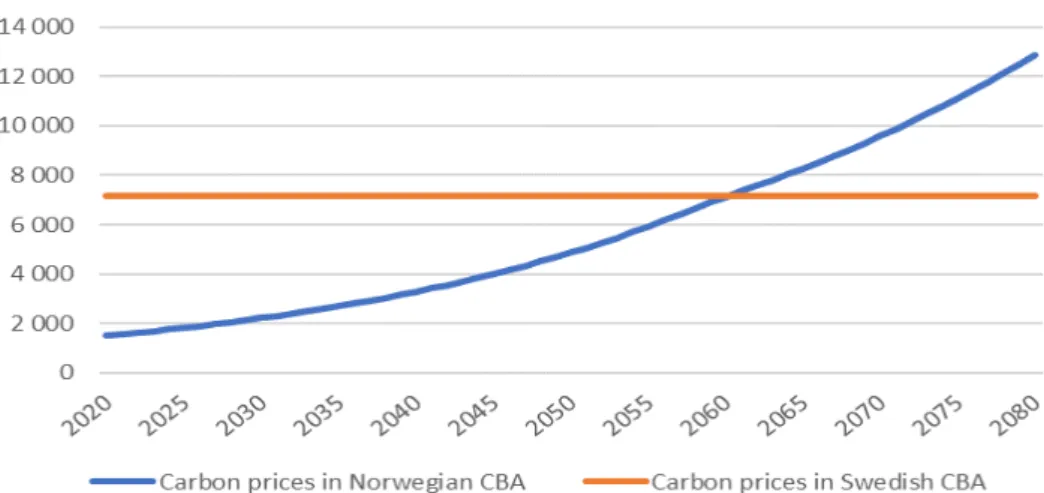
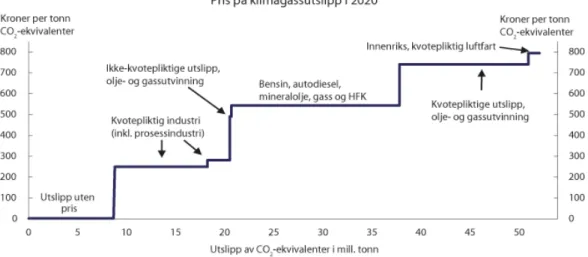
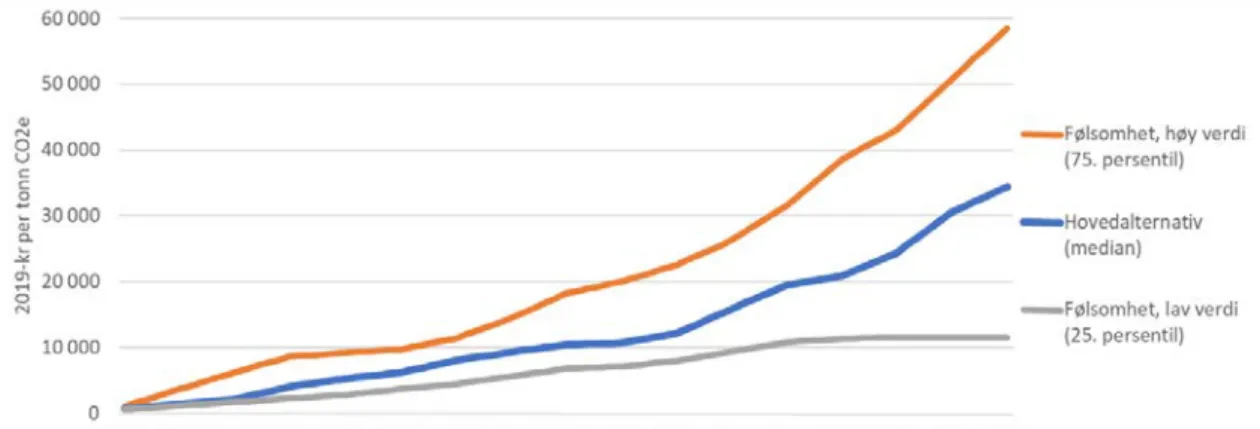
We can also mention that the transport time for trucks for this freight relationship in the model is 3 hours and 34 minutes, quite close to that in Trafikverket and Jernbaneverket (2016). Any change in the emissions calculated in model scenarios should be valued in the cost-benefit analysis according to the carbon price recommended by the Ministry of Transport for emissions in Norway (Samferdselsdepartementet, 2020), and of Transport. Using carbon pricing to make predictions about how it will affect the transportation market requires a specific assumption in transportation modeling of how much fuel will be taxed.
If there is a strong answer in terms of making the truck fleet less emission intensive (answer B), then this should be reflected in the transport modelling. We will have to rely on predicted efficiency improvements, which we will return to in the scenario descriptions.
Research questions
Freight transport can be shifted to other modes of transport, such as freight trains, as they become more competitive as fuel costs rise. Higher fuel costs can translate into higher transportation costs, to which consumers will respond with less demand, leading to lower freight rates. However, response B will depend to a large extent on technological developments in the coming decades, which will by definition be highly uncertain.
Response C is not included in the modelling, as the trajectory of freight volumes remains constant over time, but changes in policy (or other changes affecting the freight market) can affect the choices of modes and routes in the transport sector. We believe that the best way to answer these research questions is to use the Norwegian freight transport model for our analysis.
Limitations
What are the freight sector impacts on the relationship between the Oslo and Gothenburg areas if fuel tax policies in Norway and Sweden are adjusted more in line with climate ambitions, at the same time as the railway between Oslo and Gothenburg is improved so that the whole the line has two tracks.
Structure of the Report
The Norwegian Freight Transport Model
Excel-tool GodsNytte
The baseline scenario
The double-track scenario
High fuel tax scenario
We have therefore decided to split the fuel load scenario into what we consider to be a reasonably probable scenario and a stress test. In the likely scenario, we assume that the Swedish fuel tax will be lower than the Norwegian one in the future, which means that it will be the Swedish fuel price that will affect the cost per kilometer for trucks involved in cross-border freight transport. Assuming that between 2021 and 2030 the carbon component of the fuel tax will increase according to the target and the road user component remains constant, it will be a formidable tax increase.
The fuel tax trajectory that the Swedish government maintained before 2021 provides guidance on a possible fuel tax scenario. In addition to the possible fuel tax scenario, we add a stress test where the Swedish fuel tax trajectory is maintained, but fuel efficiency is the same in 2040 as in 2018.
Fuel tax and double-track combined
Adding a realistic growth in fuel taxes over time without adding realistic improvements in fuel efficiency over time will lead to unrealistic cost increases for trucks. This in turn will lead to unrealistically large shifts away from trucks used in freight. However, from a modeling point of view, this can be interpreted in the same way as a more aggressive tax policy that drives up prices faster.
The model calculates how the changes in infrastructure and policies in the scenarios lead to a change in the relative use of the different freight transport modes.
Impact on the cost of freight transport between Gothenburg and Oslo
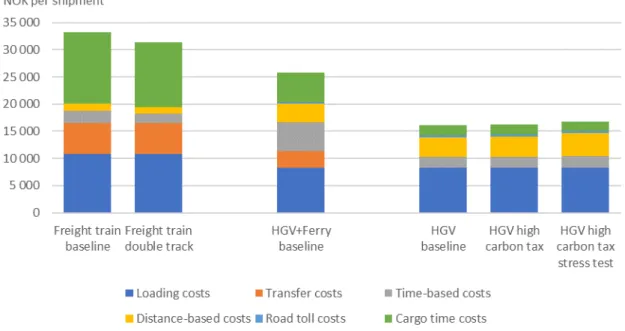
The basic cost for shipping by freight train is calculated at approximately NOK 33,000. For context, we look at the combination of road and sea transport, where truck transport is combined with ferry transport for the distance between the Gothenburg region and the Oslo region. The cost for the entire shipment is approximately NOK 26,000, with the majority of the cost being attributed to the loading cost (32%).
The freight time costs and the time related costs for the transport itself are of approximately the same importance and amount to 21% and 20% respectively of the total transport costs. The transport costs for using trucks are approximately NOK 16,000 in the base scenario, less than half of the costs for using the freight train.
Shifting modes: How will HGV traffic change?
The light blue line in Figure 8 shows the development of freight traffic through Svinesund in the base scenario, from the base year and in the simulation years 2040 and 2062 11. In the double-track scenario, represented by the orange dotted line, the shifting of the truck load results in a 2% decrease in truck traffic in Svinesund in 2040 compared to the baseline scenario. In the scenario with high Swedish fuel taxes (but also improvements in fuel efficiency), represented by the gray line, the model calculates a decrease in truck traffic of 4.4% in 2040 (104 trucks per day).
This means that truck traffic levels will be 5.1% and 6.4% lower in the respective model years. More dramatic changes are found in the stress test, the high fuel load scenario with no fuel efficiency improvements, represented by the dark blue line in Figure 8.

Shifting goods: How will freight volumes by rail change?
Shifting carbon: How will emissions from HGVs change, and how much to
In the scenario with high Swedish fuel taxes (but also improvements in fuel efficiency), we get a dramatically larger emission reduction from truck traffic between Gothenburg and Oslo. The accumulated emission reductions for this period amount to more than 226,600 tCO2 and have a total undiscounted value of 1,463 MNOK. The undiscounted value of this reduction over this period amounts to 1,594 MNOK, with approximately 70% of this value attributed to emission reductions on the Swedish side of the border.
All of these model scenarios end up with relatively large emission reductions for relatively short transport distances in scenarios where high fuel taxes are implemented. We emphasize, however, that in this subsection we have made a very simplified calculation, in which we only take into account the reduction of emissions due to the reduced traffic of heavy goods vehicles between Gothenburg and Oslo.

System-wide effects attributed to double-tracks – GodsNytte-analysis
And these simplifications are already on top of the uncertainty in model simulations of scenarios far into the future. Copyright © Institute of Transport Economics, 2021 23 Figure 12: Cost savings in the freight transport sector in 2040 due to upgrading to a double-track railway between Gothenburg and Oslo, broken down into different cost components. The biggest cost savings is the reduction in the use of heavy goods vehicles (HeavyLorry in Figure 12), which in 2040 amounts to 92 MNOK in total.
There are also some savings for the item owners in terms of lower holding costs (less need for inventory) and lower inventory capital costs (lower cost of having items unused in a warehouse). The present value of 278 MNOK is the net gain for transport operators and goods owners in the freight transport sector due to the availability of shorter transport times by train between Gothenburg and Oslo.

Conclusions
We expect Swedish fuel prices to be reflected in cross-border transport costs between Sweden and Norway. This change means for the road sector compared to the baseline, and forces the agents in the sector to e-optimize to reduce their overall costs. In this scenario, truck traffic over Svinesund is reduced by 4.4% in 2040, and further to 5.7% in 2062, compared to the corresponding years in the baseline simulations.
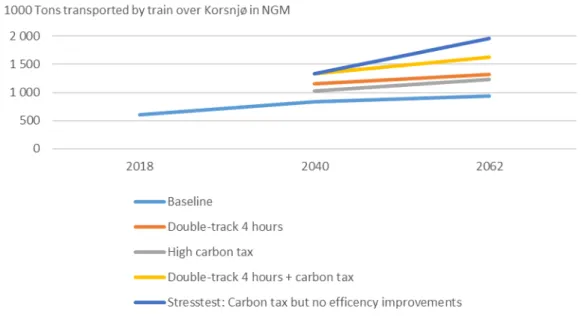
The reduced competitiveness of heavy goods vehicles leads to a change in the mode of transport, which means a 22% increase in the amount of goods transported by train across Kornsjø in 2040 and a 32% increase in 2062 compared to the baseline. With 36% higher fuel prices in 2040 and no longer-term fuel efficiency gains, we get 20% less HGV traffic over Svinesund in 2040 and 40% less HGV traffic in 2062 compared to the corresponding base years.
Caveats and alternative scenarios
This is related to the argumentation in the Expert Committee on Technology and Future Transport Infrastructure (Størdal et al., 2019). A future with larger transport chains on rail: There are possible future developments in the global freight system that could lead to large transport chains on rail, e.g. the Belt and Road Initiative of China. Although not on the same scale as the Belt and Road Initiative, the underwater tunnel currently under construction between the German island of Fehmarn and the Danish island of Lolland, the Fehmarn Belt Fixed Link, is also expected to increase rail freight demand. transport in the Nordic countries.
Regarding the latter, it is emphasized that feeder ships for short sea transport from European ports often do not have priority in the main ports of Europe. If this higher demand is met with shorter rail transport times than in the baseline, the benefits of double track railway will be higher.
Concluding remarks
From 2040 onwards, the model results will be the same as in the main scenario, but the benefits will have accumulated over the previous 19 years. The relative effect on truck traffic above Svinesund of the completion of the upgrade to double track routes is roughly the same as in the other model years 2040 and 2062. The present value of 474 MNOK is the net profit for hauliers and freight owners. sector due to the availability of shorter transport times by train between Gothenburg and Oslo.
As in the main scenario calculation, there are large reductions in external costs as more goods move from road and sea to rail. This is significantly higher than in the main scenario calculation and a higher relative increase in value compared to external costs in Norway.