4 Column F The Group recognized that many of the comments currently assigned to column F require further consideration. Furthermore, the Group recognized that, once the human health-related comments were transferred to column D3, it would leave column F for general comments that might relate to any other aspect of the Hazard Profile. 5 Column E3 The Group recognized the need to develop further criteria for assigning column E3 ratings based on both toxicology and physical properties.
Furthermore, the group agreed that such criteria should also include a reference to flammability, which would be an important factor in emergency response decision-making processes. As a result, the group considered the fourth draft of this document and finalized the text in principle for sections 4.3 and 4.4 relating to columns C and D, as shown in Annex 4, while recognizing that this may still require some minor editorial changes. The group believed that one of the current descriptions associated with the 2 classification would be sufficient to cover flammability if expanded slightly by adding this hazard as an example of the properties to be considered.
As a result, the Group agreed that this concept should be reflected in Reports and Studies 64. While it was agreed that the main purpose of this column was to identify floaters (F), stable floaters (Fp) and sinkers (S), the Group agreed that the results of applying the SEBC system to the products should also be shown either in column E2 or in the remarks column. Notwithstanding this point, the Group recognized that the feedback it would provide on the data submitted for a group of related chemicals would be useful to all sectors involved.
As a result, the group agreed that column E1 of the rGHP would be updated to reflect the results of this exercise, while acknowledging the previous decision not to carry out any further impairment assessments in the future.
Products discussed during the sub-groups meeting (Dec 2000)
Acute mammalian toxicity by swallowing, skin contact and inhalation (Column C) .1 Introduction
- Ratings
- Application
- Acute oral toxicity (swallowing) : Column C1
- Acute dermal toxicity (skin contact) : Column C2
- Acute inhalation toxicity: Column C3
The rating system is based on numerical values of dose or concentration expressed as LD50, approximate LD50 or LD50 intervals, respectively LC50 for inhalation risk. However, GESAMP is aware of the limited practical value of numerical lethal doses in assessing risks to human health from marine spills. In particular, because the IMO's regulatory risk classification systems require assessments based on LD50 and LC50 values, column C has been redesigned according to the integrated risk classification system developed by the OECD.
All available information is considered together by experts and the assessment is made on the basis of the total weight of evidence. Data quality and consistency are important. In general, for interspecies extrapolation, detailed extrapolation models (ie, based on metabolism or body volume) are not considered, dose values in "mg/kg" are used directly. In the past there has been growing public concern about the use of laboratory animals for lethal dose testing.
The OECD has already published guidelines as alternatives to the classical LD50 tests aimed at a reduction in the numbers and the stress of experimental animals used. Alternative test approaches based on structure-activity relationships (SAR) or the use of in vitro test systems have been presented in the scientific literature. Developments of this kind will be closely monitored by GESAMP and the content of this chapter may be amended accordingly in the future.
If tests are rejected or test data are missing based on such considerations, a comment should be added to the Comments column to explain the lack of information on acute dermal toxicity. Range finding studies and limit tests, as outlined for oral toxicity testing, are taken into account. Due to the complexity of acute inhalation studies and the need to minimize animal testing, there is considerable interest in estimating inhalation toxicity from other data, including acute oral lethal toxicity.
It may be possible for regulatory reasons to take such indicators into account to define the need for testing or estimate the inhalation hazard. In such cases, GESAMP will make an attempt to make a preliminary rating to advise relevant bodies of the dangers suspected of inhaling the chemical. In such cases, an NI will be applied in the C3 column and a comment added to the Remarks column indicating that inhalation studies will not be requested by GESAMP.
Column D. Long term health effects and irritation
- Skin Irritation/Corrosion, column D1
- Ratings
- Comparison with the OECD harmonized system
- Eye Irritation, column D2
- Ratings
- Comparison with the OECD harmonized system
- List of human health hazards
- Moderate long-term health effects Immunotoxic
- Serious long-term health effects Carcinogenic
- Sub-column E2: Behaviour of chemicals in the marine environment and physical effects on marine wildlife and on benthic habitats
Chemical eye injuries are unfortunately quite common both in the workplace and in private homes. Direct contact with the eye causing irritant, corrosive, allergic or deep tissue damage to the eye itself or surrounding tissue. N Neurotoxic chemicals that cause damage to the central or peripheral nervous system documented by epidemiological studies or well-documented animal experiments.
Both current guidelines are under review and, although these revisions have not yet been formally published, the reader is still advised to consider the progress in the draft updated guidelines when ordering testing. I Immunotoxic chemicals that cause adverse effects on the immune system and disrupt the body's defense mechanisms, documented by. The term immunotoxic refers to chemical substances or mixtures that can cause damage to the immune system and disrupt the body's defense mechanisms.
A mutation is a permanent change in the amount or structure of the genetic material in a cell. Reproductive toxicity includes adverse effects on sexual function and fertility in adult males and females or on the development of the offspring. The remark reprotoxic includes substances for which there is reliable evidence from human experience or from experimental animals of an adverse effect on reproductive capacity or capacity, or on development of the offspring in the absence of other toxic effects.
The term neurotoxic refers to chemical substances or mixtures that can cause damage to the central nervous system (brain and spinal cord) and/or the peripheral nervous system (nerves arising from the brain and spinal cord). However, for the benefit of other users of the GESAMP hazard profiles, other categories of physical behavior are also included in column E2 (see Table 14 and Annex 11). For mixes that will have a range of values for each of the relevant properties, the worst property will be used.
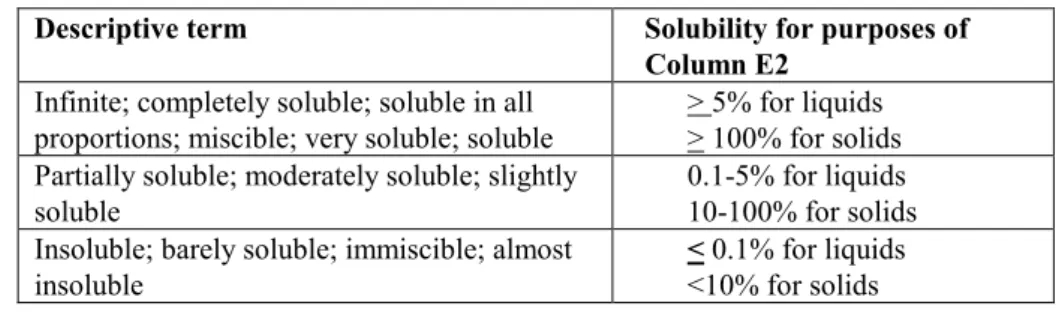
The behavior groups are defined according to the physical state of the substance (eg gas, liquid, solid) and their density, vapor pressure and solubility, which must be given at temperatures between 10°C and 20°C. For mixtures where a range is given for viscosity at transport temperature, a "best judgement" will be made to place the maximum of the viscosity range at 20°C. The following table is based on a review of the interpretation of solubility phrases from data sources where the descriptive term is qualified by a solubility range.
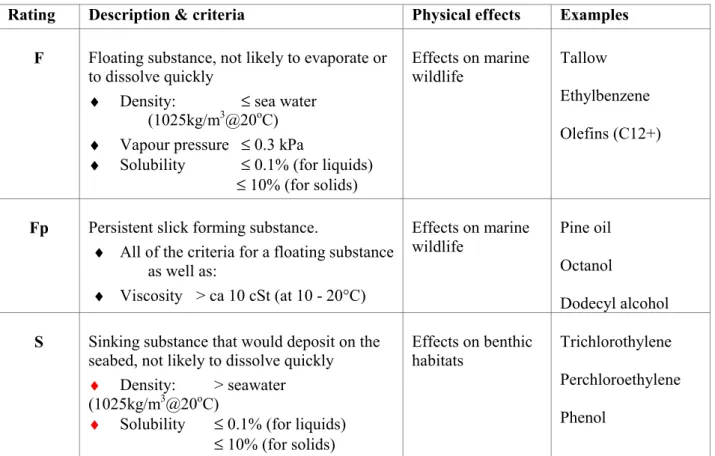
The European Behavioral Classification System has been developed within the framework of the Bonn Regional Agreement for the North Sea, aimed at cooperation in the management of marine pollution emergencies, in order to classify chemicals according to their physical behavior when spilled into the sea. The main principle of the system is a characterization of spilled loose chemicals as vaporizers, floaters, dissolvers and sinkers. The property groups in the European behavior classification system are defined according to the physical state of the substance (gas, liquid, solid) and by certain limits of vapor pressure (v.p.), density (d), solubility (s).
The method of classifying chemicals according to physical property limits is shown by the flow diagram of the European classification system in section 25.5. Gases in the context are chemicals that boil below ambient temperature at normal atmospheric pressure of 100 kPa. The meaning of liquids and solids refers to the state of aggregation at ambient temperature and atmospheric pressure (100 kPa).
Density. The relative density associated with seawater makes it possible to know whether a substance floats or not. The accepted solubility criteria are different according to the physical state of the substance. The following outline shows the principles of the European Behavior Classification System for chemicals that may be released into the sea.
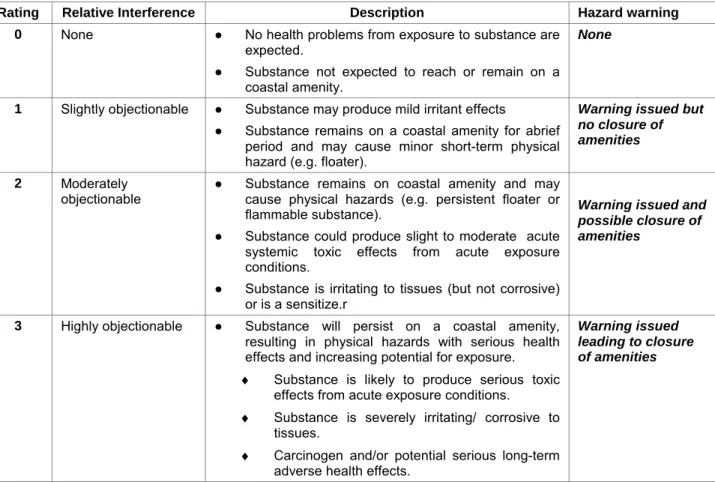
With this classification system, whole groups of chemicals can be associated with the same response strategies. European system of classification of the behavior of accidentally spilled chemical products according to the aggregate state and physical properties. Interference with coastal amenities refers to the potential for a chemical to interfere with activities in coastal waters, including harbors or estuaries, fishing activities, beach use, area appearance, coastal population health, and conservation of living resources.
A physical hazard is one where harm may be caused to people or wildlife due to the physical properties of the chemical, e.g. stickiness, flammability, etc. Due to the lack of information in this area and the difficulty in determining a To classify odor as 'offensive', this property of chemicals has not been evaluated by GESAMP. Additional factors related to the spill situation, such as weather and hydrodynamic conditions, the amount of spillage, local conditions, etc.
Products discussed during the meeting