Annual Report 2017-2018
Celebrating 30 Years of Research at
BSLTRU
Celebrating 30 Years of Research at BSLTRU
Thirty Years of Research at BSLTRU
This year sees BSLTRU celebrate 30 years of research in speech and language therapy. When Pam Enderby started the unit back in the late 1980s, her vision was to improve the provision and outcomes for individuals affected by speech, language, communication and swallowing impairments through clinically based research. Thirty years on, the landscape for research in speech and language therapy has changed immeasurably but through strong leadership and support from our academic partners and especially our clinical hosts, North Bristol NHS Trust, we have been able to successfully negotiate this terrain to continue the work Pam started.
Early activity in BSLTRU focused on emerging technologies and the opportunities they provided for individuals with communication impairments. The work pioneered by the Aphasia Computer Team led to a range of projects investigating the potential for new software and hardware devices to transform speech and language therapy management. This continues today with our ongoing project, the Aphasia Software Finder, led by Brian Petheram and funded by the Tavistock Trust, and our new collaboration with award winning app developers, Therapy Box, for the NIHR i4i funded ATLAS study.
In recent years, we have seen an expansion of our work funded through the National Institute of Health Research (NIHR), the health and care research funding arm of the NHS, and Health Education England. The flexibility of the schemes has meant we have been able to help establish the researchers of the future through internships for clinicians as well as masters, doctoral and post-doctoral fellowships. We have also had success in obtaining large funds through a NIHR Programme Grant, Child Talk, led by Sue Roulstone, to investigate interventions for preschool children with primary speech and language impairment. The impact of this work is still being realised with recent discussions with the All Wales Language Pathway group showing the potential for the work carried out in the Programme Grant to inform service delivery and lead to evidence-based practice.
As we look forward to another year, new challenges are ahead now that our clinical lead, Stef Ticehurst, has moved on from North Bristol NHS Trust, and our Director of Operations, Rebecca Coad, has returned full-time to the Research and Innovation team after an extended secondment. We are extremely grateful to both Stef and Rebecca for their input and support to the unit over many years.
Our core team and steering group remain in place and during the coming year, they will be complemented by students and research associates, to assist in expanding the research capabilities of all speech and language therapists in the UK.
We continue to receive core funding for BSLTRU from the Underwood Trust which enables us to bid for project specific funding. We are very grateful to the Underwood Trust for this ongoing support which is invaluable to us.
We look forward to an exciting and stimulating year ahead as we celebrate our 30th anniversary!
Celebrating 30 Years of Research at BSLTRU
Contents
1 BSLTRU Workforce
11.1 BSLTRU staff 1
1.2 Honorary staff 2
1.3 Postgraduate students, placements and internships 2
1.4 Overseas visitors 4
1.5 Steering Group 4
1.6 Measures of esteem 5
2 Funding and Grant Applications
82.1 Infrastructure Grants 8
2.2 Research Grants 8
3 Project Updates
10Projects completed in 2017/18 10
3.1 A preliminary investigation into the effectiveness and cost-effectiveness of speech and language therapist led interventions for children with speech sound disorder versus programmes delivered by assistants
10
Active Projects in 2017/18 (those marked with * are student projects) 12 3.2 ATLAS Automated Transcription & Language Analysis Software (NEW) 12
3.3 Aphasia Software Finder 13
3.4 COSTIS 1406: Enhancing children's oral language skills across Europe and beyond: a collaboration focusing on interventions for children with difficulties learning their first language
14
3.5 Are mindfulness and other CBT techniques effective in improving communication in people with acquired, non-progressive aphasia?
15 3.6 The impact of anxiety on aphasia - an investigation into the practice of mindful meditation
and its potential for anxiety reduction in people with aphasia (NEW)
15
3.7 The Cleft Collective Speech and Language Study 16
3.8 Understanding the Causal Pathway for Persistent Speech Disorder 17 3.9 The involvement of speech and language therapists in the treatment of people who need an
awake craniotomy (NEW)
18 3.10 A randomised controlled trial of the effectiveness of parent-based models of speech and
language therapy intervention for 2- to 3-year-old children with primary language impairment in areas of social disadvantage
18
*3.11 Speech processing in children born with cleft palate and its relationship to speech articulation at age 5
19
*3.12 The effect of infant feeding and non-nutritive sucking on speech sound development at age 5 years (NEW)
19
*3.13 The Fluency Trust Residential Course for young people (13-17yrs) who stammer: A feasibility study (NEW)
20
Celebrating 30 Years of Research at BSLTRU
3.14 Patterns of early speech and language therapy service delivery for children born with cleft palate in the first year of life (NEW)
21
Hosted Student Projects 22
*3.15 Unspoken Voices: What are the perspectives of people who use alternative and
augmentative communication (AAC) on the impact and effectiveness of AAC equipment?
(NEW)
22
4 Research Outputs and Engagement
254.1 Publications 25
4.2 Presentations and conferences 28
4.3 Public and patient involvement 30
4.4 Website 32
4.5 Social Media 33
5 Wider Impact of the work of the BSLTRU
34Glossary of Terms
361 | P a g e Celebrating 30 Years of Research at BSLTRU
1. BSLTRU People
BSLTRU consists of a core workforce of research and support staff who work in partnership with our honorary staff, students, clinical interns and volunteers.
1.1 BSLTRU staff
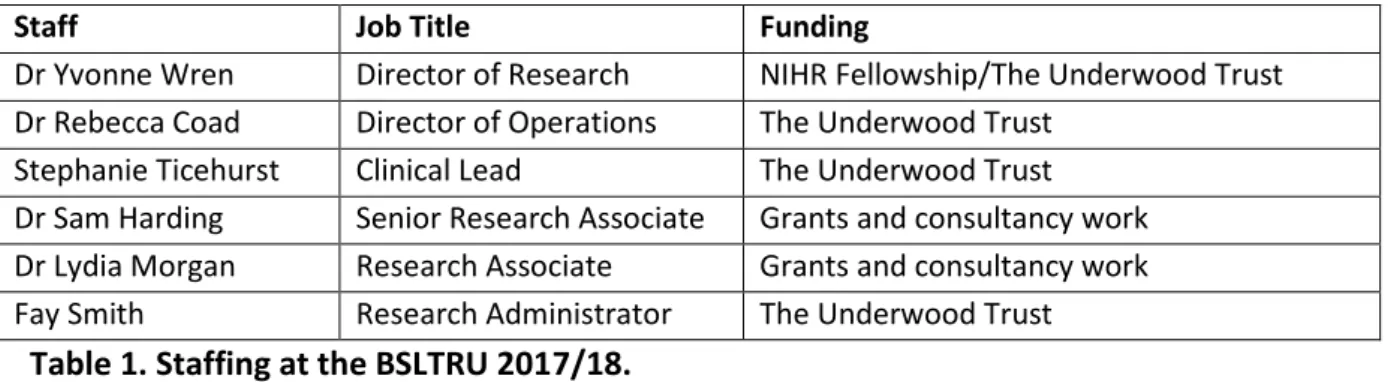
Over the past year, BSLTRU has retained its core staff team with Yvonne Wren and Rebecca Coad providing leadership as Directors of Research and Operations respectively. In April 2018, Rebecca Coad, who has been on part- time secondment to the unit, will return to her role in the Research and Innovation Office at North Bristol NHS Trust and Yvonne Wren will take on the role of Director of BSLTRU. This role is funded by the Underwood Trust.
Yvonne also has a post at the University of Bristol Dental School. Stephanie Ticehurst left her clinical role at North Bristol NHS Trust in March 2018;
ongoing collaboration with the clinical team will continue and be facilitated in part through Lydia Morgan, Research Associate at BSLTRU, who also has role within the clinical team. Sam Harding continues in her role as Senior Research Associate which she carries out alongside a role with the Research and Innovation Office at North Bristol NHS Trust. We continue to be well- supported by Fay Smith, Research Administrator for BSLTRU.
Staff Job Title Funding
Dr Yvonne Wren Director of Research NIHR Fellowship/The Underwood Trust Dr Rebecca Coad Director of Operations The Underwood Trust
Stephanie Ticehurst Clinical Lead The Underwood Trust Dr Sam Harding Senior Research Associate Grants and consultancy work Dr Lydia Morgan Research Associate Grants and consultancy work Fay Smith Research Administrator The Underwood Trust
Table 1. Staffing at the BSLTRU 2017/18.
In addition, two clinical speech and language therapists from North Bristol NHS
Trust successfully obtained funding to carry out discrete pieces of work with
BSLTRU. These projects address clinically motivated queries and open up new
areas of research for the unit.
2 | P a g e Celebrating 30 Years of Research at BSLTRU
Staff Job Title Funding
Sophie Cottrell
Specialist Speech and Language
Therapist Grants
Helen Spear
Specialist Speech and Language
Therapist Grants
Table 2. Clinical project staff at the BSLTRU 2017/18.
1.2 Honorary Staff
We continue to benefit from the input of experienced colleagues who have previously worked at the unit and are now involved on an honorary basis. In particular, our work in the fields of stammering (Rosemarie Hayhow), aphasia and technology (Brian Petheram) and primary speech and language impairment (Sue Roulstone) is growing as a result of this team work.
Staff Job Title Funding
Dr Rosemarie Hayhow Associate BSLTRU member Grants and consultancy work Dr Brian Petheram Associate BSLTRU member Grants and consultancy work Prof Sue Roulstone Emeritus Professor UWE Grants and consultancy work Prof Pam Enderby
Emeritus Professor University of Sheffield
The Underwood Trust (travel expenses)
Table 3. Honorary Associate staff at the BSLTRU 2017/18
1.3 Postgraduate students, placements and internships
BSLTRU has successfully supported a number of clinical speech and language therapists to embark on a research career through the HEE/NIHR Integrated Clinical Academic Pathway (ICA) scheme. The Doctoral Training Award in this scheme is highly competitive and three of the four awards made nationally to speech and language therapists in the last two years of the scheme have been to clinicians supported by BSLTRU. Two of these students are supervised directly by BSLTRU while the third is supervised remotely and hosted at the unit. BSLTRU in this capacity provides a research environment which is essential to the training and development of clinical academics.
In addition to the doctoral students, BSLTRU supports one Masters in Clinical
Research student and has hosted two HEE internships. The reputation of the
unit in terms of applied clinically based research and success with the
3 | P a g e Celebrating 30 Years of Research at BSLTRU
HEE/NIHR ICA scheme is demonstrated by the geographical spread of the students and interns who request our support, as shown in table 3.
Student/Intern Award Scheme Academic Institution Supervised by Lucy Southby,
Cambridge
HEE/NIHR Clinical Doctoral
Research Fellowship University of Bristol Yvonne Wren & Carol
Joinson (University of Bristol) Sam Burr,
Solent
HEE/NIHR Clinical Doctoral Research Fellowship
University of the West of England
Yvonne Wren & Toity Deave (University of the West of England)
Anna Prince, Bristol
HEE/NIHR Masters in Clinical
Research University of Plymouth
Yvonne Wren, Sam Harding, Rosemarie Hayhow (clinical mentors/project supervisors) Hannah Lane,
Doncaster and Bassetlaw
HEE/NIHR Research Internship
Yvonne Wren, Sam Harding and Lydia Morgan
Sarah Overton, Oxford
HEE/NIHR Research Internship
Yvonne Wren and Lydia Morgan
Table 4. Supervision at BSLTRU in 2017/18.
Student/Intern Award Scheme Academic Institution Supervised by Katherine
Broomfield, Gloucestershire
HEE/NIHR Clinical Doctoral Research Fellowship
Sheffield Hallam University (SHU)
Karen Sage (SHU), Karen Collins (SHU), Georgina Jones (Leeds Becketts University), Simon Judge (clinical supervisor)
Table 5. Hosted students at BSLTRU in 2017/18.
We are pleased to be able to offer placements to students on a variety of courses with relevance to speech and language therapy. Last year we supervised Tara Perkins, MSc Health Psychology student at the University of the West of England.
Placements Supervised by
Tara Perkins Research Placement University of the West of England
Sam Harding Table 6. Placements 2017/18
4 | P a g e Celebrating 30 Years of Research at BSLTRU
1.4 Overseas visitors
BSLTRU has an international reputation in the field of speech and language therapy. During 2017/2018, we hosted a visit from Professor Lawrence Shriberg of the University of Wisconsin-Madison for further discussion regarding our ongoing collaboration with the ALSPAC (Avon Longitudinal Study of Parents and Children) speech and language dataset. We also welcomed Kaitlyn Kilpatrick, graduate student from Molloy College, New York.
1.5 Steering Group
BSLTRU continue to be well supported by the BSLTRU Steering Group who maintain oversight and governance of the BSLTRU for the achievement of the unit objectives.
Name Title
Prof Sue Roulstone (Chair) Emeritus Professor University of the West of England Prof Pam Enderby Emeritus Professor University of Sheffield
Prof David Wynick Director of Research, UHBristol and North Bristol NHS Trusts
Prof Juliet Goldbart Professor of Developmental Disabilities, Manchester Metropolitan University Prof Tim Peters Research Director, Faculty of Health Sciences, University of Bristol
Prof Alan Emond Director, Centre for Child and Adolescent Health, University of Bristol
Prof Fiona Cramp Director, Centre for Health and Clinical Research, University of the West of England Mr Crispin Wigfield
Divisional Clinical Director for Neurological and Musculoskeletal Sciences, North Bristol NHS Trust
Ms Rhona Galt Divisional Manager for Neurological and Musculoskeletal Sciences, North Bristol NHS Trust Table 7. BSLTRU Steering Group Members 2017/18
Tara identified search terms for a systematic review for Dr Sam Harding.
Tara Perkins, MSc Health Psychology Student University of the West of England
5 | P a g e Celebrating 30 Years of Research at BSLTRU
1.6 Measures of esteem
Members of the BSLTRU team have been invited to participate in a variety of activities in recognition of the work we carry out to understand the nature of speech, language and communication impairments and what we can do to help:
Kaitlyn Kilpatrick, Master of Science- Speech Language Pathology Audiology
Kaitlyn visited BSLTRU while on a trip to the UK, and met with some of our research team Dr Yvonne Wren hosted a visit
from
Professor Lawrence Shriberg from the University of Wisconsin-Madison in October 2017 to discuss ALSPAC data and
projects.
6 | P a g e Celebrating 30 Years of Research at BSLTRU
Roulstone, S. received an invitation from Historic Royal Palaces to attend as a guest at the Curious Stories Conference (Raising literacy attainment in primary schools) in recognition and admiration of her work in this field.
Roulstone, S. was addressed by the RCSLT’s Honorary Vice President, Rt Hon John Bercow MP, Speaker of the House of Commons at the RCSLT Conference in Glasgow, September 2017, as he congratulated the ‘4 Musketeers of the Bercow Review’.
Wren, Y. continues as Associate Editor of Folia Phoniatrica et Logopedica and on the editorial board of Child Language Teaching and Therapy.
Harding, S. was invited to speak at Plymouth University’s Postgraduate Education and Job Opportunities Conference.
Wren, Y. has been asked to examine PhD theses from LaTrobe University, Melbourne, Queen Margaret University, Edinburgh and the University of Ulster.
Wren, Y. was asked to join a steering group for a PhD studentship at Ulster University.
Miriam Seifert, previous research assistant with BSLTRU, achieved a distinction in her Masters in Speech from Sheffield University.
Wren, Y. was a member of the RCSLT organising committee for the recent biannual conference, held in Glasgow in September 2017.
Coad, R. continues in her role as member of the People in Health West of England training and development working group and the Bristol Health Partners Contracts Task and Finish Group.
Wren, Y. continues to chair the UK and Ireland Child Speech Disorder Research Group and the Child Speech Committee of the International Association of Logopedics and Phoniatrics.
Cottrell, S., Harding, S. and Ticehurst, S. continue as members of the Stroke Health Integration Team.
Ticehurst, S. and Harding S. continue as members of the Health Coaching and Stroke Research Group.
Harding, S. and Roulstone, S. are members of an international Parent Child Interaction grant writing team.
Ticehurst, S. was invited to present at the MOVE Health Integration Team showcase event in May at the University of the West of England.
7 | P a g e Celebrating 30 Years of Research at BSLTRU
Harding, S. was invited to talk with Bath children’s speech and language therapy services about engagement in and development of research.
Roulstone, S. is a member of the COST Action IS1406 Enhancing children’s oral language skills across Europe and beyond.
Members of BSLTRU have been asked to review papers from a wide range of
journals including International Journal of Speech-Language Pathology,
Language, Speech and Hearing Services in Schools, Journal of Child Science,
Scientific Reports, Journal of Developmental Medicine and Child Neurology,
British Medical Journal, PeerJ, Current Paediatrics Reviews, The Open Nursing
Journal, Health and Quality of Life Outcomes, and American Journal of Burns
and Trauma.
8 | P a g e Celebrating 30 Years of Research at BSLTRU
2. Funding and grant applications
BSLTRU, together with our collaborators, has been successful in grant applications for new funding totalling £173,633 over the past year, with
£36,303 specifically allocated to BSLTRU activity. Additional funds from existing grants and infrastructure support enable us to continue to develop our research programme.
2.1 Infrastructure grants
The Underwood Trust has been a long-term supporter of the BSLTRU and this continued into 2017/2018 through their agreement to provide funds to support the core admin and management function of the unit, to a total of
£50,000. We are very grateful for the support of the Underwood Trust to enable us to further develop our research into speech, language and communication.
2.2 Research grants
This year has seen the submission of 13 grants led by the BSLTRU and a further 3 to which we contributed as co-applicants:
Wren, Y., Stock, N., Sandy, J. Rumsey, N. & Coad, R. Improving speech, language and
psychosocial outcomes for children born with cleft lip and palate at age 5. NBT RCF July 2017- November 2017. £11,329.
Bright, R., Wren, Y. Automated Transcription and Language Analysis Software (ATLAS) project. NIHR i4i Connect Scheme, Phase 1: January – December 2018. £149,330 (£12,000 to BSLTRU).
Cottrell, S. The impact of stress on aphasia - an investigation into the practice of mindful meditation and its potential for stress reduction in people with aphasia. NBT RCF September 2017-April 2018. £12,974.
9 | P a g e Celebrating 30 Years of Research at BSLTRU
We are awaiting the outcome of two grants, one submitted to ESRC and the other to The Nuffield Foundation. Three bids were successful: two of these were pump priming funds from the North Bristol NHS Trust Research Capability Fund which has facilitated the development of larger bids which will be submitted to NIHR. The third was a successful bid to the NIHR Invention for Innovation Connect Scheme and was in collaboration with Therapy Box, a SME developing apps for speech and language therapy. A follow-on bid to develop this work further is currently in preparation for submission next year.
A wide range of funding streams were applied to in 2017/2018 including the Research Councils (ESRC and MRC PHIND scheme), NIHR (Fellowships and Research for Patient Benefit), The Health Foundation, Sparks/GOSH and Action Medical Research. In addition, we have made use of small, local funding streams such as the Elizabeth Blackwell Institute and Avon Primary Care Research Collaborative for early development work and proof of concept.
Where bids have been unsuccessful, feedback from reviews has been taken on
board and applications have been redeveloped for alternative funding streams.
10 | P a g e Celebrating 30 Years of Research at BSLTRU
3. Project Updates
Over the past year, one project has been completed and another seven new studies have started. We are currently involved directly in 13 studies, some of which we are leading on while we are involved in others as collaborative partners. This includes a number of student/internship projects, all of which have been funded through the NIHR ICA scheme. More details on all of our projects are provided below.
Projects completed in 2017/18
3.1 A preliminary investigation into the effectiveness and cost-effectiveness of speech and language therapist led interventions for children with speech sound disorder versus programmes delivered by assistants
Investigators: Yvonne Wren, Lydia Morgan & Rebecca Kandiyali (Centre for Child and Adolescent Health, University of Bristol)
Timescale: October 2016 - October 2017
Funder: Avon Primary Care Research Collaborative
Speech and language therapy provision for children with speech sound disorder is sometimes in the form of generic programmes which have been written by Speech and language therapists (SLTs) but which are then delivered by SLT assistants or teaching assistants (SLTAs/TAs). In other services, intervention is provided directly by SLTs. Decisions regarding which way to provide services for these children is typically led by service constraints and caseload demands rather than robust research evidence.
The aim of this project was to compare the outcomes and costs for the two types of provision from two services as well as to identify the range of programmes being used with children with speech sound disorder (SSD) throughout the UK.
Sixty-three case notes were reviewed in total across two sites, with 140 blocks of speech and language therapy within these. Few blocks of therapy had assessment data for both baseline and outcome. This meant the data we collected was not sufficiently meaningful to compare therapy delivered by SLTs vs that delivered by SLTAs/TAs. There were frequently delays between initial assessment and the start of therapy, and outcomes often relied on
‘targets met’ rather than formal assessments.
An electronic survey about SLTs practice with children with SSD received 193 responses.
The vast majority (nearly 98%) reported that they work with SLTAs/TAs in some capacity.
SLTs often reported multiple ways that they worked with children and TAs e.g. seeing some children frequently, others less often. Most SLTs reported working with TAs between their
11 | P a g e Celebrating 30 Years of Research at BSLTRU
frequent visits, however a significant number reported only infrequently seeing children, or seeing children for assessment only.
We also spoke to a small number of SLTs (n=9) about the programmes they use to deliver intervention for children with SSD. Data from these conversations helped us to find out more about how programmes are used in practice. We used this information to summarise the content of programmes used in practice, particularly those handed over to assistants.
Recommendations from the research
1. There remains a need for further research studies to examine the role of SLTAs/TAs in therapy for children with speech sound disorder and impacts on outcomes. This may enable more targeted provision by assistants rather than (as the current research indicates) their use being variable and appearing to be largely determined by service models and constraints.
2. The field would benefit from further exploration of the content of programmes handed over to assistants and an understanding of how these are developed.
3. It is important to close the gap between research and practice. Clinically based investigation that uses existing clinical records as the source of data, as attempted here, could lead to larger sample sizes and findings that can be more easily generalised, but we need more robust data to achieve this. This includes more accurate accounts of how much therapy children are receiving from SLTAs/TAs.
4. There is a need for an agreed ‘minimal data set’ for speech sound disorder. The field would benefit from consensus about what data is essential and at what time it should be collected. This has cross over application for other fields in speech and language therapy.
Dissemination and impact
The findings of this research were presented as an oral presentation at the Royal College of Speech and Language Therapy: Maximising Impact conference, 27-28th September 2017. A
‘lightening talk’ was also presented to speech and language therapists summarising this work in Bristol, 12th April 2018. A paper is in preparation for submission for publication.
This work has attracted interest from other clinicians and researchers. Specifically, colleagues in Northern Ireland, Reading and Oxfordshire have considered whether the methodology could be replicated in their services. In all cases, the same conclusions were reached – that case note records were inconsistent and comparison of different interventions or service delivery models were not possible. This has reached the attention of the Child Speech Disorder Research Network and discussions are in place regarding the need for a Delphi consensus building exercise with the profession to agree a core minimal dataset. This work will drive one of our research funding bids in 2018/2019.
12 | P a g e Celebrating 30 Years of Research at BSLTRU
Active projects in 2017/18 (those marked with * are student projects)
3.2 ATLAS Automated Transcription & Language Analysis Software (NEW)
Investigators: Rebecca Bright (Therapy Box), Swapnil Gadgil (Therapy Box), Yvonne Wren.
Research Associates: Sam Harding & Lydia Morgan Timescale: January 2018- January 2019
Funder: The National Institute for Health Research i4i Connect Scheme
Speech and language therapy services spend a considerable amount of time screening and assessing children for language difficulties. This is labour intensive and may include assessment of some children who do not need intervention, while others with language difficulties may be missed.
Therapy Box (www.therapy-box.co.uk) are in the process of developing an app that will use automated audio and language analysis tools, developed using a machine learning approach, to help identify children likely to need speech and language therapy, as well as to highlight their specific language difficulties. The ATLAS app is using a very large dataset from the Avon Longitudinal Study of Parents and Children (ALSPAC), including recordings along with children’s scores on language assessments and other measures. The app will provide a screening tool for parents and schools to indicate the need for referral to speech and language therapy, as well as data on the nature of a child’s language difficulties for SLTs.
BSLTRU are carrying out information gathering and research activities to inform the design of the app. This includes two focus groups with expert SLTs, and parent and public involvement activities via social media crowd sourcing.
The ATLAS project team are carrying out research and development work which will lead to the development of an app using acoustic and linguistic analysis, with machine learning, to screen for developmental language disorders.
13 | P a g e Celebrating 30 Years of Research at BSLTRU
3.3 Aphasia Software Finder
Investigators: Brian Petheram and Sarah Woodward, (Independent Speech & Language Therapist)
Funder: The Tavistock Trust Timescale: 2009-2020
This project is necessary due to the proliferation of aphasia apps of varying quality and the overall lack of other support in matching the available resources to the individual needs of a particular person with aphasia. It has been designed to be as “aphasia friendly” as possible but there also includes resources aimed at SLT professionals.
https://www.aphasiasoftwarefinder.org/
The aim of this project is to provide a web-based resource that will enable both professionals and people with aphasia or their carers to find the most suitable apps or programs to support their particular needs in relation to aphasia rehabilitation. The project is funded by the
Tavistock Trust for Aphasia (TTA,
https://aphasiatavistocktrust.org) with support from the Eranda Rothschild Foundation. The project is coordinated by Nicole Campbell of the TTA; Brian Petheram is the BSLTRU lead and Sarah Woodward is the SLT lead.
To date the first focus group has been conducted and a report written. Expert SLTs were very positive about the concept and highlighted areas that were felt to have particular utility in the app, they also raised concerns and challenges regarding the full capabilities of the software. This work will feed into the next phases of the research and facilitate the ongoing software development.
The Aphasia Software Finder has now been running for 7 years and continues to be very well used with 18,000 sessions and nearly 73,000 page views in the last 12 months alone. All the upgrades from last year are now bedded in and the resource continues to run reliably
14 | P a g e Celebrating 30 Years of Research at BSLTRU
3.4 COSTIS 1406 Enhancing children's oral language skills across Europe and beyond: a collaboration focusing on interventions for children with difficulties learning their first language
Investigators: Led by Prof James Law, (Newcastle University), with 27 European partners.
Sue Roulstone is one of the 2 invited UK researchers on the ‘Membership Committee’.
Timescale: April 2015 – March 2019.
Funder: European Union (The COST action funds expenses to attend the meetings but does not fund salaries or research per se).
Evidence to support intervention for children with developmental language disorder (DLD) is not well disseminated and services are inconsistent across Europe. The Action aims to enhance the science in the field, improve the effectiveness of services for children with DLD and develop a sustainable network of researchers well placed to answer the key questions in this area.
Professor Sue Roulstone attended a meeting in Utrecht in November 2017 regarding the COST Action. She is also continuing in a collaboration with Maja Kelic in Croatia related to this work. Maja has completed eight interviews with SLTs in Croatia, transcribed seven of them and translated three into English. Interview data is currently being analysed. As part of the analysis, issues that need further exploration and clarification are being identified that will be put to a broader group of SLTs who will be invited to attend a workshop later this year. An update of progress is being presented to the next COST action meeting which will take place in Lisbon in May 2018.
15 | P a g e Celebrating 30 Years of Research at BSLTRU
3.5 Are mindfulness and other CBT techniques effective in improving communication in people with acquired, non-progressive aphasia?
Investigator: Sophie Cottrell
Timescale: November 2016 – November 2017
Funder: Southmead Hospital Charity - PAT fund (Stephanie Ticehurst)
AND
3.6
The impact of anxiety on aphasia - an investigation into the practice of mindful meditation and its potential for anxiety reduction in people with aphasia (NEW)Investigator: Sophie Cottrell
Timescale: November 2017 – April 2018
Funder: North Bristol NHS Trust Research Capability Fund
Initial funding for this work came from a charity source (project 3.5). A subsequent application to North Bristol NHS Trust was successful to provide funds to develop this work for submission as a Clinical Doctoral Fellowship Application to the NIHR (project 3.6).
Clinical practice tells us that anxiety has a significant impact on communication for people with aphasia. There is a substantial body of evidence in support of mindfulness-
based approaches for a number of health and psychological conditions, including anxiety. If anxiety can be more effectively managed, we might speculate that communicative
effectiveness will be enhanced. Furthermore, mindfulness has also been shown to have a positive impact on attentional skills, which in turn have been shown to be compromised in people with aphasia.
A systematic review has been carried out and submitted for publication. In addition, further PPI activities have been carried out in order to develop an application to the NIHR for a Clinical Doctoral Research Fellowship. There has been ongoing liaison with experts in the field of mindfulness and communication disability in order to strengthen the application and build a supervisory team.
16 | P a g e Celebrating 30 Years of Research at BSLTRU
3.7 The Cleft Collective Speech and Language Study
Investigators: Yvonne Wren, Sam Harding, Lydia Morgan, The Cleft Collective Team Timescale: 2012-2019
Funder: NIHR Postdoctoral Fellowship
As with speech disorder in the non-cleft population, it is currently not possible to predict which children are likely to have persistent rather than transient problems with their speech. Working with colleagues on a cross-sectional study of 248 non-syndromic children with unilateral cleft lip and palate (Cleft Care UK), considerable progress has been made towards the identification of risk factors for PSD in children born with cleft palate. However, this study is limited to children with unilateral cleft lip and palate. A larger, longitudinal and more inclusive study involving all cleft types is needed to fully explore the risk factors for PSD in this population.
The Cleft Collective Speech and Language Study (CC-SL) is a national cohort study of children born with cleft palate in which data on speech and language and relevant risk factors are being collected. Carried out in partnership with the £2.4million funded joint University of Bristol/University of the West of England/Scar free Foundation Cleft Collective Cohort studies, it is currently recruiting from 13 out of a maximum 17 clinical sites with the remaining four awaiting local site approval. At the time of writing, over 550 participants have been recruited to the CC-SL study with recruitment increasing month on month.
The CC-SL study is collecting data on a range of potential risk factors including parent-child interaction, infant vocalisations, the audio environment, SLT assessments at 18, 24 and 36months and hearing. Other important variables are available from the Cleft Collective Birth cohort (e.g. demographics, psychology, syndromic status, genetics, type/size of cleft, surgical interventions). This is an extensive dataset that is unprecedented in terms of its size and scale and will be a unique resource that will be made available for other researchers and clinicians to access. Further funding requests to include collection of speech and language therapy intervention data to the dataset and linkage to education, health and registry datasets is ongoing.
Children born with cleft palate are at high risk of persistent speech disorder (PSD) with 44% children showing ongoing difficulties with their speech at age 5.
17 | P a g e Celebrating 30 Years of Research at BSLTRU
3.8 Understanding the Causal Pathway for Persistent Speech Disorder
Investigators: Yvonne Wren, Paul White (University of the West of England) Timescale: 2012-2017
Funder: NIHR Postdoctoral Fellowship
While prevalence is high in the younger years at 16% of three-year-olds, as many as three quarters of these children will have typically developing speech by the time they start school. However, when problems persist beyond age 5, children are more likely to be bullied and have difficulties being understood and making friends than their peers. These children are also at risk of low outcomes in education and employment.
Currently, there is no way to identify which children who present to speech and language therapy clinics at age 3 with delayed speech will have persistent speech disorder beyond age 5. This study is using data from a population cohort study, the Avon Longitudinal Study of Parents and Children (ALSPAC), to identify risk factors which are associated with persistent speech disorder at age 5. These risk factors could then be used by clinical speech and language therapists to identify children who are at risk of persistent speech disorder and to prioritise them for early intervention.
Previous work for this study has involved the phonetic transcription of the speech recordings of over 700 5-year-old children. Analyses of these transcriptions have been carried out providing measures of speech accuracy, including the primary outcome measure; percentage consonants correct. Over the past year, variables from the ALSPAC data set which are potential risk factors for persistent speech sound disorder have been identified. A study specific dataset containing these variables for the 700+ children whose speech recordings have been phonetically transcribed and analysed has been obtained from ALSPAC. Regression analyses are ongoing to determine which of these variables are most important in identifying children at risk of persistent speech disorder.
18 | P a g e Celebrating 30 Years of Research at BSLTRU
3.9 The involvement of speech and language therapists in the treatment of people who need an awake craniotomy (NEW)
Investigator: Helen Spear Timescale: 2017 - 2018
Funder: PAT Fund NBT Charities Fund No 20190
The aim of this work is to understand the contribution that speech and language therapists can make to the care and management of individuals who require awake craniotomy. There are two separate parts to this study: a qualitative element to understand the experience of having an awake craniotomy through talking to patients who have undergone the procedure and a systematic review.
The qualitative work will provide us with a meaningful bank of information which would be useful for patients to receive before attending an awake craniotomy for language mapping.
The impact will be the development of a form that can be used across North Bristol Trust to ensure patients are given important details of what their surgery will be like in order to ensure they are relaxed as possible, which in turn hopes to optimise results. It is hoped that this will also manage expectations and empower the patients to ask questions and be better informed about their care and treatment outcomes.
The second aspect of the project is a systematic review of the literature around language mapping in awake craniotomy.
3.10 A randomised controlled trial of the effectiveness of parent-based models of speech and language therapy intervention for 2- to 3-year-old children with primary language impairment in areas of social disadvantage
Investigators: Deb Gibbard (Solent NHS Trust), Chris Markham (University of Portsmouth), Claire Smith (Solent NHS Trust), Sue Roulstone, Sam Harding, Lydia Morgan
Timescale: 2017-2020 Funder: Nuffield Foundation
The unit continues to work on a Nuffield Foundation grant, led by Solent NHS Trust, which aims to evaluate the clinical effectiveness of an enhanced parent-based intervention programme on outcomes in children with primary language delay in areas of social disadvantage.
Over this last year the unit has delivered a modified speech and language therapy (UK) specific version of the Patient Activation Measure (PAM). This is being used to collect data from the participants in the study and the anonymous data will be used to validate the modified SLT-UK PAM.
19 | P a g e Celebrating 30 Years of Research at BSLTRU
The unit has worked with Solent NHS Trust to advise on the use of Language Environment Analysis Software (LENA) in the study, so that the work includes large natural language samples before and after intervention. To date the unit has supported the development of information resources provided to participants and supported the use of the software and facilitation of the recordings from the digital language processors to computer. Data collection is ongoing and the unit will be assisting in the analysis of the language samples in due course.
*3.11 Speech processing in children born with cleft palate and its relationship to speech articulation at age 5
Investigator: Lucy Southby
Timescale: June 2016 – May 2020
Funder: HEE/NIHR Clinical Doctoral Fellowship
The aim of this study is to understand whether there are relationships between speech processing skills and articulation, specifically cleft speech characteristics, in children born with cleft palate with or without cleft lip at five-years-old. Children born with cleft palate are at high risk of disordered speech and this study will further inform clinical practice with this population.
Based on the model of speech processing proposed by Stackhouse and Wells, the focus in this cross-sectional study is input processing skills. Eligible children are being identified and recruited from five regional cleft centres. Their parents are invited to consent to an assessment of their child’s speech processing skills. In addition, parents are asked to complete questionnaires and provide consent for additional data to be collected from clinical records. Subsequent analyses of relationships between children’s speech processing skills and speech articulation will be undertaken at the end of the phase.
Recruitment commenced in October 2017 and to date, 13 participants have been recruited with recruitment continuing until Summer 2019.
*3.12 The effect of infant feeding and non-nutritive sucking on speech sound development at age 5 years (NEW)
Investigator: Samantha Burr Timescale: June 2017-June 2021
Funder: HEE/NIHR Clinical Doctoral Fellowship
When a baby is born parents make different choices about feeding their baby. Some
20 | P a g e Celebrating 30 Years of Research at BSLTRU
breastfeed, some bottle-feed and some use a mixture of both. Some babies also like to have a dummy, while others suck their hand and some don’t suck anything. Some studies have found that breastfeeding is linked to better language and learning in later childhood, while others have found that dummy sucking has the opposite effect. However, the effect that different types of feeding have on speech sound development has not been looked at in as much detail.
A systematic review is being carried out in order to identify studies, which investigate the association between infant feeding, dummy and finger sucking and early speech development. The work in this fellowship will then consider the impact of patterns of infant feeding and non-nutritive sucking using data collected from three samples: Avon Longitudinal Study of Parents and Children (ALSPAC), CoCo90s (Children of the Children of the 90s – ALSPAC second generation study) and a NHS clinical sample. Recruitment began in October 2017 for the CoCo90s strand of the study and to date over 50 of the target of 135 children aged between 2-5 years have been recruited to the study. Recruitment began in January 2018 for the NHS strand of the study. Engagement from clinical staff has been excellent and the study is currently broadly on target for month-on-month recruitment.
*3.13 The Fluency Trust Residential Course for young people (13-17yrs) who stammer: A feasibility study (NEW)
Investigator: Anna Prince
Timescale: Sept 2017 – Sept 2019
Funder: NIHR Funding for Masters in Clinical Research (at Plymouth University)
Stammering is a communication disorder involving interruption of the forward-flow and timing of speech. Stammering can have adverse effects upon emotional and mental health, anxiety levels and vocational choices; the potential negative consequences are far-reaching.
There is a significant lack of interventions developed specifically for adolescents who stammer, and the evidence-base for such interventions is currently weak. The Fluency Trust (www.thefluencytrust.org.uk) Residential Course is a five-day course specifically designed for adolescents who stammer. It combines speech and language therapy and outdoor activities within a residential context. However, the impact of the course hasn’t yet been formally researched.
The aim of the study is to determine the feasibility of conducting a future feasibility randomised controlled trial (RCT) of the Fluency Trust Residential Course for adolescents who stammer. The study will measure some of the key parameters required to design a feasibility RCT and to determine if/how a future study can be completed.
21 | P a g e Celebrating 30 Years of Research at BSLTRU
A PPI focus group was conducted with young people who attended last year’s residential course. Their responses informed the study design. A PPI consultation (via asynchronous email interviews) was conducted with four SLTs from the Fluency Trust. The outcomes have shaped the research materials and study design. Young people’s opinions have been sought on the research materials e.g. the participant information sheets. The interview questions for young people will be piloted. The main study will utilise a mixture of quantitative and qualitative methods.
3.14 Patterns of early speech and language therapy service delivery for children born with cleft palate in the first year of life (NEW)
Investigator: Hannah Lane
Timeline: September 2017 – June 2018 Funder: HEE/NIHR Internship Scheme
A literature review was completed to explore the current evidence surrounding early interventions for children born with Cleft Palate under the age of 2. Early intervention is often identified as beneficial for children at risk of speech and language disorder with the aim of reducing the risk of poor long-term outcomes and maximising children’s potential.
However, evidence is limited regarding the benefits of early intervention for children born with CP with studies in the literature focusing on children aged two and over.
Semi-structured interviews have been carried out with 10 lead SLTs representing Cleft Centres across the UK and Ireland in order to map provision of speech and language therapy interventions provided for children with Cleft Palate in the first year of life. Based on these interviews, a descriptive framework is currently being developed to identify the patterns of current service delivery offered to children under 13 months old and how this relates to evidence reported in the literature. Preliminary results suggest a range of patterns of early intervention are provided, typically focusing on empowering parents to deliver the early interventions and promote development. It appears that no specific outcome measures are currently being collected by the Cleft Centres in terms of the impact of early intervention on speech development. However, many Cleft Centres informally report that children are coming to their 12-month assessment with more oral pressure consonants, a key outcome in cleft related speech development.
The aim of this project is to map provision of SLT interventions provided in the first year of life by regional cleft centres across the UK and Ireland for children born with CP.
22 | P a g e Celebrating 30 Years of Research at BSLTRU
Hosted Student Projects
In addition to the students who are supervised directly by BSLTRU staff, we also host a student who is local to the area but registered at a distant institution. The hosting arrangement means that we do not provide
supervision but instead provide a research environment and networks with local clinical academics.
*3.15 Unspoken Voices: What are the perspectives of people who use alternative and augmentative communication (AAC) on the impact and effectiveness of AAC equipment? (NEW)
Investigator: Katherine Broomfield (Sheffield Hallam University) Timeline: April 2017-March 2022
Funder: HEE/NIHR Clinical Doctoral Fellowship
Alternative and augmentative communication, otherwise known as AAC or communication aids, can support people with communication difficulties. We know that some people engage really well with their communication aid equipment and with the services who provide it, but others do not. There is currently no consistent way of gathering feedback from people who use AAC services.
This research aims to build on existing knowledge to develop a greater understanding about what factors influence how well people engage with communication aid services. It also aims to find out what supports people to use their communication aid equipment and what outcomes are important following receipt of equipment. This will enable the development of tools that allow AAC services to gather feedback from people who use communication aids.
A systematic review protocol has been published on Prospero: A systematic review to identify and appraise the quality of tools used to record patient-reported outcomes in users of alternative and augmentative communication (AAC). Database searches and title/abstract screening have commenced.
Health research authority ethics approval has been received and the project has been registered on the NIHR/CRN portfolio. Two successful PPI groups have been held and co- design principles have been employed in order to promote the engagement of members with significant communication impairments. This has resulted in some excellent collaborative work and some innovative recruitment materials being developed.
In the coming year, the systematic review will be completed and presented at conferences in September. A second literature, focusing on understanding more about the perspectives
23 | P a g e Celebrating 30 Years of Research at BSLTRU
of AAC users, will inform the development of topic guides for use during qualitative data collection. Data collection will commence locally.
The PPI group will develop in scope to encompass some co-collaboration with experts in the development of ideas, materials and resources to support the dissemination of the research. Collaborations with artists and designers at Sheffield Hallam University will support the development of dissemination materials.
24 | P a g e Celebrating 30 Years of Research at BSLTRU
The Child Speech Disorder Research Network meeting in Glasgow
Dr Lydia Morgan presenting at RCSLT Conference in Scotland
Dr Sam Harding’s graduation ceremony
A poster presentation by Sam Burr at RCSLT Conference in Scotland Dr Yvonne Wren leading a
focus group of Cleft specialists SLTs in Newcastle
Lucy Southby presenting at the Craniofacial Society Conference in Birmingham
BSLTRU activities – April 2017 to March 2018
Dr Yvonne Wren giving a Keynote speech at the Craniofacial Society
Conference in Birmingham
Maja Kelic from Croatia visiting Prof Sue Roulstone at BSLTRU
25 | P a g e Celebrating 30 Years of Research at BSLTRU
4. Research Outputs
4.1 Publications
The unit has maintained a strong record of publishing both as lead and co- authors this year with nineteen publications in respected journals for the field.
In addition, one book chapter, written by members of BSLTRU with collaborators from the Sound Start study, is in press.
Invited Publications
PUBLISHED
1. McCormack, J. M., Baker, E., Masso, S., Crowe, K., McLeod, S., Wren, Y. & Roulstone, S.E. (2017) Implementation fidelity of a computer-assisted intervention for children with speech sound disorders. International Journal of Speech-Language Pathology, 19, 265-276.
2. McLeod, S., Crowe, K., McCormack, J., White, P., Wren, Y., Baker, E., Masso, S. &
Roulstone, S. (2017 early online) Preschool children’s communication, motor and social development: What concerns parents and educators? International Journal of Speech and Language Pathology.
3. McLeod, S., Crowe, K., Masso, S., Baker, E., McCormack, J., Wren, Y., Roulstone, S. &
Howland, C. (2017) Profile of Australian pre-schoolers with speech sound disorders at risk for literacy difficulties. Australian Journal of Learning Difficulties, 22, 15-33.
4. McLeod, S., Baker, E., McCormack, J., Wren, Y., Roulstone, S., Crowe, K., Masso, S., White, P. & Howland, C. (2017) Cluster Randomized Controlled Trial Evaluating the Effectiveness of Computer-Assisted Intervention Delivered by Educators for Children with Speech Sound Disorders. Journal of Speech, Language and Hearing Research, 60, 1891-1910.
5. Wills, A.K., Mahmoud, O., Hall, A., Sell, D., Smallridge, J., Southby, L., Toms, S., Waylen, A., Wren, Y., Ness, A.R. & Sandy, J. (2017) Centre level variation of treatment and outcome in 5-year-old children with non-syndromic unilateral cleft lip and palate: The Cleft Care UK study. Part 1: Methodology and results for dento-facial outcomes. Orthodontics and Craniofacial Research, 20 (Suppl. 2), 1-7.
26 | P a g e Celebrating 30 Years of Research at BSLTRU
6. Sell, D., Southby, L., Wren, Y., Wills, A.K., Hall, A., Mahmoud, O., Waylen, A., Sandy, J.R. & Ness, A.R., (2017) Centre level variation of treatment and outcome in 5-year- old children with non-syndromic unilateral cleft lip and palate: The Cleft Care UK study Part 4: Centre level variation in speech outcome and interventions, and factors associated with poor speech outcomes in 5-year-old children with non-syndromic unilateral cleft lip and palate. Orthodontics and Craniofacial Research 20 (Suppl. 2), 27-39.
7. Ness, A., Wills, A., Mahmoud, O., Hall, A., Sell, D., Smallridge, J., Southby, L., Stokes, D., Toms, S., Waylen, A., Wren, Y. & Sandy, J.R. (2017) Centre level variation in treatment and outcomes and predictors of outcomes in 5-year-old children with non-syndromic unilateral cleft lip treated within a centralised service: The Cleft Care UK study. Part 6: summary and implications. Orthodontics and Craniofacial Research 20 (Suppl.2), 48-51.
8. Crowe, K., Cumming, T., McCormack, J., Baker, E., McLeod, S., Wren, Y., Roulstone, S. & Masso, S. (2017) Educators’ perspectives on facilitating computer-assisted speech intervention in early childhood settings. Child Language Teaching and Therapy, 33, 267 -285.
9. McLeod, S., Verdon, S. & International Expert Panel on Multilingual Children's Speech (2017). Tutorial: Speech assessment for multilingual children who do not speak the same language(s) as the speech-language pathologist. American Journal of Speech-Language Pathology, 26, 691-1055.
10. Harding, S. & Moss, T. (2017, early online) The impact of treatment for head and neck cancer on positive psychological change within a year of completing treatment.
International Journal of Oral and Maxillofacial Surgery.
11. Harding, S. (2017, early online) The trajectory of positive psychological change in a head and neck cancer population. International Journal of Oral & Maxillofacial Surgery.
12. Wren, Y., Humphries, K., Stock, N., Rumsey, N., Lewis, S., Davies, A., Bennett, R. &
Sandy, J. (2018) Setting up a cohort study in speech and language therapy: Lessons from The UK Cleft Collective Speech and Language Study. International Journal of Language and Communication Disorders, 53, 421-430.
27 | P a g e Celebrating 30 Years of Research at BSLTRU
13. Wren, Y.E., Harding, S., Goldbart, J. & Roulstone, S.E. (2018) A systematic review and classification of interventions for speech-sound disorder in preschool children. International Journal of Language and Communication Disorder, 53, 446- 467.
14. Lyons, R. & Roulstone, S. (2018) Well-being and resilience in children with speech and language disorders. Journal of Speech, Language and Hearing Research. Vol 61 324 – 334.
15. Harding, S. (2018) Positive Psychological Change in Head and Neck Cancer Populations. Journal of Cancer Treatment and Diagnosis, 2, 1- 7.
16. Morgan, L. & Wren, Y. (2018, early online) A systematic review of the literature on early vocalisations and babbling patterns in young children. Communication Disorders Quarterly.
17. Lyons, R. & Roulstone, S. (2018) Listening to the voice of children with developmental speech and language disorders using narrative inquiry:
Methodological considerations. Journal of Communication Disorders, 72, 16-25.
18. Marshall, J., Harding, S. & Roulstone, S. (2017) Language development, delay and intervention – the views of parents from communities that Speech and Language Therapy managers in England consider to be under-served. International Journal of Language and Communication Disorders, 52, 489–500.
19. Lyons, R. & Roulstone, S. (2017) Labels, identity, and narratives in children with primary speech and language impairments. International Journal of Speech and Language Pathology, 19, 503 -518.
28 | P a g e Celebrating 30 Years of Research at BSLTRU
4.2 Presentations and conferences Invited presentations
1. Wren, Y.E. (November 2018) London Mainstream Schools Clinical Excellence Network.
2. Wren, Y.E. (April 2018) The Craniofacial Society of Great Britain and Ireland Annual conference. Birmingham. Keynote speech: Predicting Speech Outcomes in Children:
Findings from a community population study.
3. Wren, Y.E. (March 2018) North East Clinical Excellence Network for Speech Sound Disorders in Children in March 2018. ‘Evidence for practice in SSD – current activity’.
4. Wren, Y.E. (November 2017) Northern Ireland Speech Clinical Excellence Network.
The Causal Pathway for Persistent Speech Disorder. University of Ulster.
5. Wren, Y.E. (May 2017) Scottish Speech Sound Disorders Clinical Excellence Network, Risk factors for Persistent Speech Disorder. University of Strathclyde.
6. Wren, Y.E., Sharp, G. & The Cleft Collective team (2017) The Biology of Scar Free Healing Symposium. London, October 2017. A unique resource for advancing understanding of the causes, prevention and treatment of cleft and scarring.
Paper Presentations
1. Wren, Y.E., Southby, L., Davies, A. & The Cleft Collective Research Team (April 2017) Patterns of consonant production at 13 months old in children born with cleft palate:
Preliminary findings from the UK Cleft Collective Cohort Studies. Craniofacial Society of Great Britain and Ireland, Newcastle, UK.
2. Roulstone, S. Zwitserlood-Nijenhuis, M., Wiefferink, C., Harding, S., Goldbart, J., Klatte, I., & Davies, K. (July 2017) Symposium: An exploration of parent-child interaction therapy. International Association for the Study of Child Language, Lyon, France.
3. Harding, S., Goldbart, J. & Roulstone, S. (July 2017) A critical analysis of the evidence basis of parent-child interaction therapy International Association for the Study of Child Language, Lyon, France.
29 | P a g e Celebrating 30 Years of Research at BSLTRU
4. Klatte, I. & Roulstone, S. (July 2017) Speech & language therapists’ perceptions of parents’ engagement in parent-child interaction therapy, International Association for the Study of Child Language, Lyon, France.
5. Davies, K. (July 2017) Changes in parents’ conceptions of roles during their children’s speech and language intervention. International Association for the Study of Child Language, Lyon, France.
6. Wren, Y., Roulstone, S., McLeod, S., Baker, E., McCormack, J., Crowe, K., & Masso, S.
(September 2017) Sound Start Study: A communi