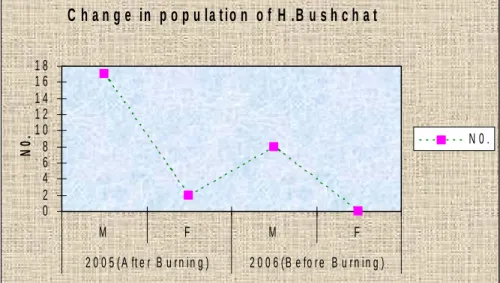
Status, distribution and habitat preference of Hodgson's Bushchat (Saxicola insignis) in Suklaphanta Wildlife Reserve was conducted in Jan 2005 (after the grass burned) and Jan 2006 (before the grass burned). A total of 19 Hodgson's Bushchat (19=17M+2F) were recorded in the first survey (after burning) in Suklaphanta Game Reserve on January 2005.
Background
The female White-tailed Stone chart Saxicola leucura is very similar to the female Hodgson's Bushchat, but it should be easy to tell them apart in the field using the characteristics mentioned above. Immature and immature specimens can look similar to common stonewort (Saxicola torquata), but with practice you should be able to tell the former from the latter.
Current global status
The females in Suklaphanta were noted to be slightly lighter in color than illustrated in Grimmatt et. The literature indicates that females were observed and collected less frequently than males (Blyth 1847, Hume1877a).
Range
For a woman, this was a very demanding task; we had to face many difficulties to identify the female birds of Hodgson's Bushchat. A total of 19 Hodgson's Bushchat (19=17M+2F) were recorded in the first survey at Suklaphanta Wildlife Reserve in January 2005. The population of Hodgson's Bushchat is very low in the pre-burn case than in the post-burn case.
The distribution of Hodgson's Bushchat in JZV is more in the southwest and somewhat less in the southeast in the Suklaphanta grasslands, as can be seen from the distribution map. The 'F' statistics show that mean grass height (ft), water distance (m), forest distance and cattle grazing pressure have a significant group difference in Hodgson's Bushchat observation and habitat use. In Suklaphanta, the Mahakali River has greatly affected the habitat of the Hodgson's Bush.
A total of 19 Hodgson's Bushchat (19=17M+2F) were recorded in Suklaphanta Wildlife Reserve January 2005 (after the grass burning). The population of Hodgson's Bushchat is much smaller in the case of before winter grass burning compared to the population after winter grass burning. The population of Hodgson's Bushchat is relatively smaller in 2005 (after grass burning) than in the study by Baral, 1997 (after grass burning).
The distribution of Hodgson's Bushchat in the SWR is more south west and a little south east in Suklaphanta. Plot condition such as partially burned/unburned has a more influential co-relationship in Hodgson's Bushchat observation than others.
Distribution of Hodgson’s in the world and in Nepal
Project aims & objectives
The main objective of this project was to assess the population status, distribution and habitat preferences of Saxicola insignis to provide a global management of prescription to ensure long-term survival in its natural habitat.
Limitation of the study
General Introduction
- Climate
- Geology and Soil
- Demography
- Land Use Changes
The soil of forests around grassland areas is sandy loam but slightly alkaline (pH is 8.0) (Bhatta and Shrestha 1977). The soil of the grassland area is clay-loam, slightly alkaline, with a pH of 7.81 (Bhatta, 1999). The reserve area is generally flat with ancient deposits of Gangetic alluvium.
Biological Feature
Flora
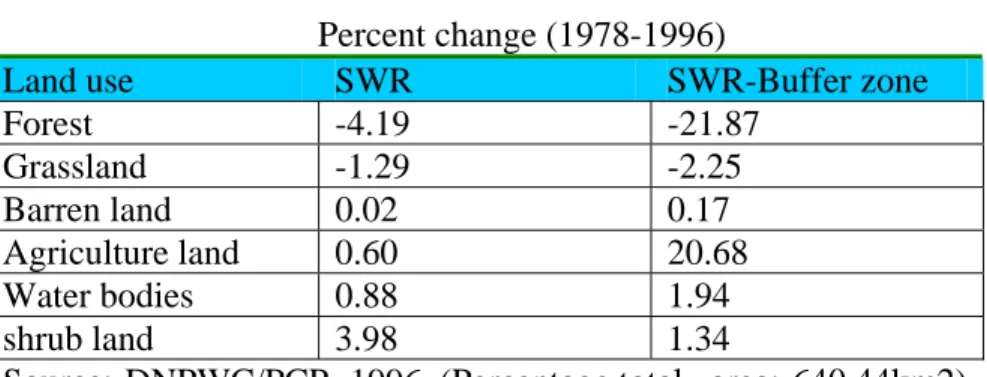
Common soil types found in the reserve are loamy sand, sand and clay (Bhatta and Shrestha1977). Regarding the caste/ethnicity composition of the households in the buffer zone, about 62 percent of the households belonged to the Brahmin/Chhetri/Takuri caste, followed by Kami/Damai/. Table 2: Percentage of land use change in SWR and its buffer zone.
Fauna
The high meadows mainly contained Narenga, Saccharum and Themeda species with Phragmites in the submerged areas. Anecdotal accounts suggest that more than 2 species of reptiles, 20 species of amphibians, 21 species of fish and 35 species of butterflies also occur.
Data Collection
- Bird census
- Habitat Preference
- Distribution
- Data collection time
- Observation Bias
- Secondary data collection
Several surveys and observations showed that more Hodgson's Bushchats were detected in the afternoon than in the morning. Therefore, in the afternoon compared to the morning, there was a much greater activity of birds, since the activity of insects is greatest after the soil has warmed up. Visibility is a bit better in the afternoon than in the morning and that may have played a part.
In practice we discussed how to distinguish the Hodgson's Bushchat from other Bushchats and how to fill out the data sheet. Such effects were eliminated by counting all sites simultaneously and by discussion in the field. In the pilot study we found that the same species program in the same place in two days, but in study period we found the same result showing that they do not fly greater distances.
Formal and informal interviews were arranged among local residents, park staff, naturalists, wildlife technicians and wildlife biologists working in the area.
Population Status of Hodgson in the Study Area
Change in Population
The effect of burning plays a key role in determining the population of Hodgson's Bush in the grasslands of Suklaphant. The main concern of the study was to determine what changes might occur after and before the burning of the grass during the winter seasons of 2005 and 2006. In a study of Bushchat, Baral (1997) found only 26 specimens of Bushchat in the condition of the grassland after burning. , while this study found only 19 individuals of Bushchat.
It can therefore be concluded that there has been no drastic change in population since 1997. This shows that the certain area of Suklaphanta is still good to stay in winter. The recent study emphasizes that burning grass on time is the most important management job.
There has been a tendency to burn grass regularly for Swamp Deer, but this has also helped to maintain the population of Hodgson's Bushchat in Suklaphanta.
Distribution of Hodgson’s Bushchat in the Study Area
Habitat Preferred by Hodgson’s Bushchat in the Study Area
Grass Composition of Study Area
Habitat use condition and analysis after burning 2005
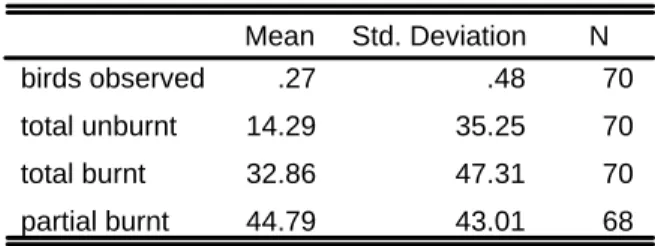
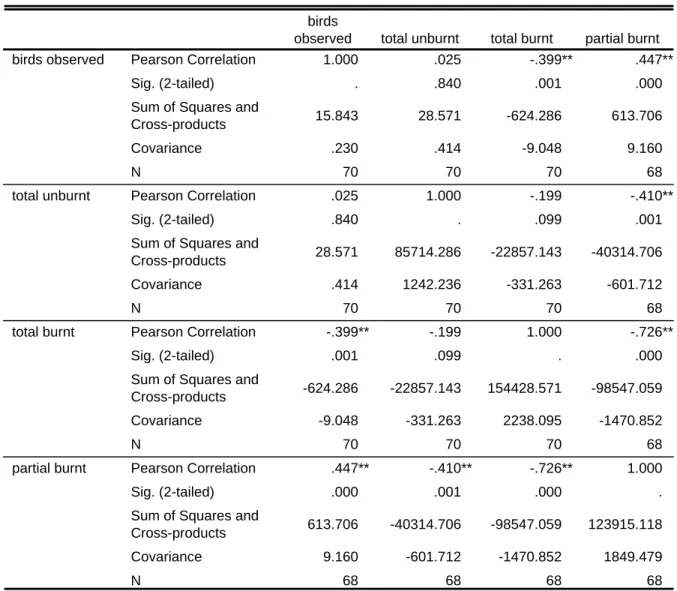
Since the birds were observed in different plot conditions, i.e. burnt, unburnt and partially burnt, it becomes necessary to determine if there is any relationship between bird observation and plot condition, Pearson correlation analysis is established. In the Pearson correlation analysis of observed birds, total unburned plot, total burned plot and partial burned plot, the relationship between observed bird population and partial plot burning has significant correlation. In the pre-burning survey of the grasslands of the Suklaphanta Wildlife Reserve, out of 53 sample plots, Hodgson's Bushchat was observed in only 7 plots and a total of 8 numbers.
The diagram above shows that in the habitat used by Hodgson's Bushchat, the minimum height of the grass in which it sits is about 2.5 feet and the maximum height is about 8 feet. The grasses of 4-7 feet height can than the general grass height in which it sits. The result showed that the relationship between the bird sighting and habitat use is strongly influenced by the grass height, cattle grazing and game grazing pressure, regardless of the forest and water distance.
The influence of grass height in the habitat preference of Forest Chats may be facilitated by foraging and serving as a vantage point.
Habitat analysis after and before burning of grassland
Habitat use and Avoid
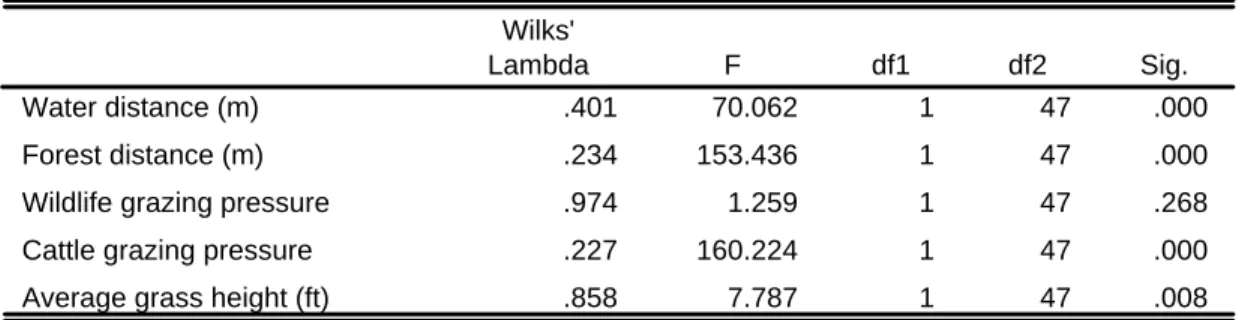
It indicates that these act as a strong group difference in the observation of Hodgson Bushshact. However, Wilks' lambda value of wildlife grazing pressure and mean grass height (ft) which are .974 and .858 respectively, indicating no group difference in observation and habitat use of Hodgson's Bushchat. Which can be very realistic in the case of Barkaula grassland as it has high grazing pressure and close forest spacing and availability of water.
The table below shows that grazing pressure of livestock and grazing pressure of wildlife has minimal covariance i.e. 389 and .500 in determining habitat use and avoidance by Hodgson's Bushchat. Water distance (m) Forest distance (m) Wildlife grazing pressure Livestock grazing pressure Average grass height (ft) Water distance (m) Forest distance (m) Wildlife grazing pressure Livestock grazing pressure Average grass height (ft) Water distance (m) Forest distance (m) Wild grazing pressure animals Grazing pressure of livestock Average grass height (ft) Birds observed. While the lambda value of the Wilks is .098, indicating that the birdwatching and/or habitat used is significantly different even if the habitat composition/factor is similar.
This structure matrix with different variables showed that cattle grazing pressure, forest distance and water distance as an absolute correlation to distinguish the variable of habitat at Hodgson's Bushchat.
Existing threats
Habitat loss
Thatch harvesting
Burning and cutting of grasses
Grazing
Flooding
Conclusion
Recommendation
Straw harvesting, habitat loss, grazing, flooding and burning and cutting of grasses are the major issues in the Suklaphanta. Knowledge of identification of this bird and other globally threatened birds and awareness of their global importance and conservation value is lacking among reserve staff and local residents. It New grassland should be created in the extended area of park especially Lalpani area of Rauteli Bichuwa-VDC.
The analysis of the relationship of change in vegetation succession and grassland composition in Suklaphanta is recommended for future study in detail. 1846) Catalog of the specimens and drawings of mammals and birds of Nepal and Thibet, presented by B. 1998) Birds of the Indian subcontinent. Status and Habitat Use of Barasingha Cervus duvauceli duvauceli population in Royal Suklaphanta Game Reserve, Far Western Lowland, Nepal.
The birds of Madhubani subdivision of Darbhanga district, Tirhut, with notes on species observed elsewhere in the district.
Frequency, Relative Frequency, Density and Relative Density of Barkaula
A Checklist of birds of Suklaphanta Wildlife Reserve
229 Rusty Flycatcher Muscicapa ruficauda 230 Rusty Flycatcher Ficedula strophiata 231 Red-throated Flycatcher Ficedula parva. 234 Gryskop Canary Flycatcher Culicicapa ceylonensis 235 Blue Flycatcher Cyornis rubeculoides 236 Tickell's Blue Flycatcher Cyornis tickelliae 237 Small Pied Flycatcher Ficedula westermanni. 282 Pale-footed Woodsanger Cettia pallidipes 283 Chestnut Crowned Warbler Cettia major 284 Deviated Woodsanger Cettia flavolivacea.
285 kitajska penica Bradypterus tacsanowskius 286 pegasta penica Bradypterus thoracicus 287 rjava penica Bradypterus luteoventris 288 suličasta penica Locustella lanceolata. 302 Tickellova penica Phylloscopus affinis 303 Zahodna penica Phylloscopus occipitalis 304 Blythova penica Phylloscopus reguloides.
Some photo plates
Protected area of Nepal
A set of questionnaires was designed to interview key informants to obtain information on population status, distribution and habitat condition of Hodgson's Bushchat. -SIX: CONCLUSION AND RECOMMENDATION. grazing pressure, bush distance and water distance acted as an absolute correlate to differentiate the variable of the habitat by Hodgson's Bushchat in Suklaphanta Game Reserve.