response to the Social Security Advisory
Committee (SSAC) consultation
Contents
About us 2
Acknowledgments 2
Introduction 3
Part 1 - Plans for the schedule, monitoring and evaluation of managed
migration 6
The schedule for rollout 6
Starting managed migration 7
Monitoring and evaluating performance 8
Part 2 - Communication and support 12
Communications to claimants ahead of migration 12
Communications to claimants during migration 12
Support needs 14
Provision of support for claimants 16
Part 3 - Making a new claim and ending legacy benefits 18
Challenges in making a new UC claim 18
Non-digital claims 22
Requesting an extension 23
Ending legacy benefit claims 25
Deductions 27
Part 4 - Calculation and impact of transitional protection 29
Calculation of transitional protection 30
Erosion and ending of transitional protection 31
People who face large losses 32
Part 5 - Fluctuation of Incomes 33
Timing of initial claims 33
Self-employed claimants and Minimum Income Floor 34
Part 6 - Severe Disability Premium 37
Identifying those who have naturally migrated already 37
Correct transitional and backdated payments 38
Designing a clear process for current SDP recipients 38
Ensuring all disabled people are protected 39
Support for new claimants who do not live with an adult carer 40
About us
Citizens Advice provides free, confidential and independent advice to help
people overcome their problems. We are the membership body for local Citizens Advice services in England and Wales. We provide support in 2,700 locations in England and Wales, including high street offices, libraries, courts, prisons and GP's surgeries.
Last year we helped over 2.7 million people face to face, by phone, email or webchat. We also had 43 million visits to our online advice pages. The real-time data we receive from our clients helps us identify emerging issues, understand what is causing them and make recommendations on how to fix the problems.
Issues with benefits are our largest advice area. Since the rollout began, we have helped more than 120,000 people with Universal Credit issues. Thousands more have accessed our Universal Credit advice content online. We have published several reports on Universal Credit based on our client data, insights from frontline advisers, and interviews with clients.
Acknowledgments
This response was prepared by Gwennan Hardy, Jessica Perera, Rebecca Jeffrey and Charles Smith. Thanks go to colleagues at Citizens Advice including Afzal Rahman, and Frank Hobson. Thanks also go to staff and volunteers across our network of local Citizens Advice who provided evidence.
Introduction
Universal Credit (UC) is the biggest ever change to the welfare system. Over 7 million households will be receiving UC by the time it is fully rolled out, more than half of whom will be in work. From 2019, the Government intends to start the final and biggest phase of UC rollout - moving people currently on legacy benefits over to UC. This process is known as ‘managed migration' and will affect an estimated 2.8 million people. 1
Delivering reform on this scale is always going to present challenges. However, aspects of the design and delivery of UC add to this challenge. The key
challenges are:
● UC brings together 6 legacy benefits into one single payment, meaning any errors during migration could put people's entire income from benefits at risk.
● Those being migrated are likely to have higher support needs than those who have claimed UC so far - this includes 1 in 3 (36%) claimants due to be migrated who are disabled or have a long-term health condition. 2
● Managed migration will require the DWP to communicate the process effectively to all claimants - including people who claim tax credits or disability benefits and have had little or no engagement with the Jobcentre in recent years.
It is therefore vital that managed migration is completed in a way that protects the financial stability of claimants and causes minimal disruption to their lives.
Failure to do so could lead to considerable stress or hardship for families and vulnerable claimants.
At Citizens Advice, we support the aims and principles of UC. This reform is an opportunity to improve on the previous benefit system, which presented significant challenges to many people. We welcome the Government's commitment to working with partner organisations to understand where
improvements are needed. In considering the draft regulations, we chose to set out key principles which we believe should inform any approach to managed migration.
We believe a successful model for managed migration should use the following 5 principles:
1 DWP, Explanatory Memorandum for the Social Security Advisory Committee , June 2018
2 DWP, Explanatory Memorandum for the Social Security Advisory Committee , June 2018
1. The burden of migration should not fall wholly on individuals. The current proposals for managed migration require everyone on legacy benefits to make a full new claim to UC. The DWP should ensure it is making best use of existing data held by government departments to reduce the administrative burden on all claimants and avoid unnecessary risks to people's incomes, including working families and those who are disabled or have a health condition.
2. Managed migration must not result in a sudden loss of income for claimants.
If people fail to make a new UC claim, their benefits may be stopped. Not completing all aspects of a claim can also mean delays in full payment. Our
evidence and DWPs own data shows many people are already struggling with the UC claims process. The Government must ensure everyone has security of income as they transition to UC.
3. People must be supported through the migration process. Our evidence shows that current UC claimants are struggling to access the support they need. 3 The Government should ensure adequate and comprehensive support is in place.
Vulnerable claimants and people with complex benefit claims or support needs must be proactively identified so that support can be appropriately targeted.
4. Transitional protection must be in place for people who face losses as a result of moving to UC. We strongly support the Government's commitment to providing transitional protection. The Government should review the measures proposed to ensure these protections are in place for all those migrating to UC and minimise the risk of disparities between claimants in identical circumstances as a result of the way they migrate onto UC. We would also urge the Government to strengthen protections for groups who need more financial support from the benefits system and who face large losses, similar to the measures proposed for Severe Disability Premium recipients, and by limiting how easily these protections erode.
5. A clear framework for success should be established to set targets and
review points for moving people onto UC. The proposed schedule for migrating people onto UC lacks detail on how the rollout will be phased and how quickly large volumes of people could be migrated. The use of migration notices rather than commencement orders means there are no concrete checkpoints at which progress can be reviewed. The DWP should build on its test and learn approach and establish ‘break points’ at which migration can be transparently assessed before it is further extended which should be incorporated into the regulations.
3 Citizens Advice, Making a Universal Credit Claim , July 2018
Part 1 - Plans for the schedule, monitoring and evaluation of managed migration
We welcome the DWP's commitment to continuing the 'test and learn' approach throughout the process of managed migration. The Government has already committed to working with partner organisations to understand where improvements are needed. On this basis, it is right that managed migration should be flexible enough to allow changes to the process.
At the same time, we do not think the level of detail currently provided through the draft regulations and Explanatory Memorandum is sufficient to allow an assessment of how effective proposed measures to facilitate managed migration will be, or the potential impacts on our clients. To support its 'test and learn' approach, we believe the DWP should provide more detail on the timeline for migration and put measures in place to assess the readiness of UC systems prior to the start of rollout.
In addition, there is a need for more concrete opportunities for monitoring and evaluation. We are concerned that the use of notifications rather than
Commencement Orders to progress the rollout of managed migration means there are no breakpoints built in at which performance can be evaluated before claimant volumes are increased.
The schedule for rollout
We understand that the DWP needs to retain some degree of flexibility within the process of managed migration, allowing it to respond to issues as they arise and control the flow of claimants to ensure there is operational capacity within UC systems. Nonetheless, we believe that more detail is needed on the phasing of the roll out and how DWP will approach decisions to accelerate / decelerate the expansion of managed migration.
In particular, the regulations should include:
● How migration notices will be issued (e.g. by region, benefit type etc.)
● How the issuing of migration notices and 'warm up' communications will be phased.
● What criteria the DWP will use when deciding whether to increase / decrease the volume of migration notices being issued.
Without this information, it is not possible to make a full assessment of the potential impact of managed migration or propose areas where the approach to migration could be improved. Setting these details out would also allow third
sector organisations, local authorities and other agencies which support legacy benefit claimants to feedback on the impact to their services and begin planning and preparing their work in this area.
Decisions on how migration notices are rolled out should include insight from front line staff and third party agencies. Our experience with full service rollout suggests that phasing by location has the advantage of allowing our local offices to learn from the experience of early adopters and avoids the pressure of
introducing change all at once. However, geographical rollout has presented challenges around communicating with claimants. Therefore, phasing rollout at a regional level, rather than Jobcentre, could provide more opportunities for larger scale communications or information campaigns.
Recommendation 1: A clear schedule for rollout must be set out in regulations. Details should be provided on:
● How migration notices will be issued (e.g. by region, benefit type e.t.c).
● How the issuing of migration notices and 'warm up' communications will be phased.
● What criteria the DWP will use when deciding whether to increase / decrease the volume of migration notices being issued.
Starting managed migration
Improvements have been made to the design and delivery of UC since it was initially rolled out - for example, the removal of the seven day waiting period and the development of a 'landlord portal' for social landlords and local authorities.
A 'test and learn' approach allows for activities to be re-prioritised based on emerging evidence of what works. However, this has also meant that some of the functions which were expected to be in place at this point have had to be delayed and delivery challenges continue.
Ahead of managed migration, these build features should be sped up and completed, including:
● Completing development of and fully rolling out the landlord portal.
● Extending the concept of the landlord portal by introducing a centralised system to help claimants evidence their costs, including for childcare and housing costs in the Private Rented Sector.
● Ensuring it is possible for people to easily provide evidence online at the beginning of their claim, including the extension of ‘digital fit notes’ to UC.
● Publishing an evaluation of ‘prove your identity’ and, if the evidence suggests it is successful, making sure this is new feature is available the development and full roll out of the landlord portal.
● Extending the scope of Universal Support so it helps people to make a claim.
With a number of delivery challenges continuing and without adequate support in place, we are concerned that the proposed high level timetable for managed migration risks expanding the number of claimants moving onto UC before its systems are able to effectively manage increased volumes. While UC works well for many people, we know that around 1 in 6 (17%) claimants are not being paid in full and on time. Were this trend to continue through managed migration, it would result in many thousands more people going for several weeks without the level of income it is deemed they need.
To protect against this, we believe the DWP should follow the recommendations of the National Audit Office and formally assess the readiness of UC systems to support increased volumes of claimants before it begins the process of managed migration. This should also include looking at the equality impact of the 4
proposals for the managed migration process.
To support assessing the readiness of UC, both ahead on managed migration and throughout, the DWP must establish a transparent framework for success which sets out criteria against which performance can be monitored. We address this recommendation in further detail below.
Recommendation 2 : The DWP must transparently assess the readiness of UC systems before significantly increasing the volume of claimants
through managed migration
Recommendation 3: Ahead of managed migration starting, build features currently in development should be sped up and completed
Monitoring and evaluating performance
In accordance with its 'test and learn' approach, the DWP has indicated that it will trial managed migration with a smaller number of claimants and use learning from this period to amend the process where necessary. Retaining
4 NAO, Rolling out Universal Credit , June 2018
some flexibility over the flow of claimants being migrated will also enable further improvements to be made if and when issues arise.
We support the inclusion of measures which will allow the DWP to continue to address issues within UC as it rolls out. Previously, the use of Commencement Orders to progress the roll out of full service meant there were set points at which the progress and performance of UC could be assessed. For managed migration, the use of migration notices to progress the roll out means these opportunities will no longer be in place.
Therefore, processes to monitor and evaluate the progress of managed
migration must be set out in regulations. Ideally, these measures should allow the DWP to retain some flexibility over how claimant volumes are increased, whilst also establishing 'break points' at which progress can be regularly and transparently reviewed.
To do this, we recommend that the DWP establish a framework for success against which the performance of UC systems can be monitored and reported upon. The framework should set out indicators to measure progress in key areas, designed in collaboration with front line staff and stakeholders. The framework and the data its is assessed against should be regularly published to ensure transparency.
There are a range of measures which could be used to assess the readiness of UC systems - both to assess claimant experience and build readiness. It is important that these measures are considered across claimant groups, for example those receive different UC elements, so that measures do not mask particular groups who are struggling. To capture the readiness of UC from a claimant perspective, we suggest the following key performance indicators are included:
● Payment timeliness - Recent figures show that around 1 in 6 (17%)
claimants do not receive their initial UC payment in in full and on time. For certain groups such as those entitled to support for a disability this is much lower, with only 1 in 3 being paid in full on time. While payment timeliness performance has improved significantly over the past year, if current rate were to continue throughout managed migration, increased claimant volumes would mean thousands more people going without an income for more than 5 weeks.
● Claim drop out and response rates to migration notices - Evidence from the DWP has shown that 1 in 5 (20%) new UC claims are closed due to non-compliance with the process - including 10% who failed to book an
initial appointment and 6% who failed to accept their claimant commitment. This should also include looking at response rates to 5 migration notices as under the current proposals there is is risk that some do not respond to notices and drop out without beginning their claim.
● Wait times for additional DWP support, including helpline, journal and home visits - One of the key concerns amongst our advisers is the length of time they are required to wait for a response on the UC helpline.
Many have reported wait times of between 20 and 30 minutes. For our advisers, it limits the amount of time they have to support clients. For claimants, we believe it adds to the delays people have in successfully completing their claim. Similarly, our advisers have also expressed concerns about the difficulty some clients see in getting a response to queries submitted via their online journal or in getting a timely home visit appointment.
● Claimant satisfaction - Published data on UC claimant satisfaction currently only covers live service claimants from May - July 2016. This showed claimant satisfaction at 83% compared to Jobseekers Allowance which was 85%. 6
● The availability and coverage of Universal Support - we discuss this further in section 2.
From a UC build perspective, we recommend the following are considered:
● The cost of claim.
● The percentage of payments which are automated.
● Work coach capacity and the quality of support given.
● The completion and roll out of additional features which support people with their claim (discussed above).
Finally, the DWP could also consider criteria which directly address the key aims of UC - for example, the impact on employment.
Recommendation 4: Regulations should set out break points within the process of managed migration at which the DWP must review
performance indicators to inform decisions on the next stage of roll out.
5 FoI:2025, May 2018
6https://assets.publishing.service.gov.uk/government/uploads/system/uploads/attachment_data/
file/693573/dwp-claimant-service-and-experience-survey-2016-2017.pdf
Recommendation 5 : The DWP should establish a transparent framework for success within UC, including criteria which it will use to monitor and evaluate performance.
● The framework and key performance indicators should be designed in collaboration with frontline workers and third party organisations.
● The data and key performance indicators should be regularly published to ensure transparency.
Part 2 - Communication and support
Moving existing benefit claimants to UC through managed migration requires clear communication with claimants about the process, what to expect and what is expected of them. Communicating reform on this scale is always going to present challenges. Aspects of the design and delivery of UC add additional challenges to this by bringing together six benefits from across three parts of Government, and requiring action and behaviour change from claimants. In order to meet this challenge and ensure people have a smooth migration process, it will be vital that people get the support they need adapting and moving to UC.
Communications to claimants ahead of migration
In the months leading up to the managed migration process it will be critical that all communications to affected claimants are clear, concise and timely, in order for them to both understand the process and effectively prepare for making a UC claim. To help minimise confusion or potential fears associated with the transition the steps people will need to take and when should be clearly and consistently set out across the range of communication channels used. In addition we would recommend sufficient support is in place to deal with any queries claimants may have on receiving both the ‘warm up’ and notification letters, with any contact details relating to that support being clearly laid out within all correspondence. This is in addition to the help currently available under Universal Support.
We welcome the work currently underway to test communication products directly with claimants and note that stakeholder organisations are also being consulted. It will be critical that this consultation continues throughout the whole process to ensure all communications remain appropriate and accessible to all future UC claimants, particularly those with additional needs. HMRC should also play a role in this vital ‘pre-awareness’ stage.
The involvement of stakeholders and third party organisations will be key to this process - particularly for those who don’t currently interact with the Jobcentre.
Communications to claimants during migration
Regulation 44 makes provision for legacy benefit claimants to be issued with a migration notice. This will inform them of the requirement to make a new UC claim for them to continue receiving benefits. It will also give claimants a deadline by which they must complete a new UC claim.
We broadly agree with the content of the migration notice set out in Annex 1 of the Explanatory Memorandum. We recommend that the migration notice also: 7
● Make it clear that legacy benefit payments will end on the day they make a claim for UC.
● Inform claimants that their UC award will be paid approximately 5 weeks after they complete their claim.
● Provide instructions and contact details for how to request an extension to the migration deadline.
● Inform claimants on how the timing of the assessment period will affect how their UC award is calculated (see Part 5) for more information about this). The notice could also suggest that claimants seek advice if they are unsure whether their UC award will be affected.
● Signpost to the Universal Support service.
We recognise the challenge in providing this amount of information in a format which is accessible and easily comprehensible, and as noted previously welcome the qualitative testing which is currently being carried out for this product.
We are however concerned that currently the main form of communication for this information is by letter. Given that claimants will need to act relatively promptly sole reliance on this format risks a significant minority of existing claimants not receiving this information in time. This will particularly affect people who are homeless or temporarily not at home because of caring responsibilities or periods in medical care. It will also impact those who are unable to open letters - either because of chaotic or stressful life events, or a mental health condition. We note from the Explanatory Memorandum that ahead of managed migration, the DWP intends to identify claimants who have complex needs or evidence of vulnerability however we are concerned how this will work in practice. This issue is discussed further in subsequent sections of our response.
We would strongly recommend a range of communication channels are used including SMS, email and trusted third party intermediaries for claimants with specific support needs.
Citizens Advice client case study - missing important benefit letters Jay was being assessed for Employment Support Allowance, and needed to attend a work capability assessment as part of their claim. Jay was also due to visit family for just over a week during the Christmas period. As the letter informing them of the
7 DWP, Explanatory Memorandum for the Social Security Advisory Committee , June 2018, p35
assessment date had not arrived before they left on 23 December, Jay assumed the assessment would be in the new year.
However, when Jay returned from being away they realised that they had missed the appointment which had been booked for 29 December. Although the letter Jay came home to was dated 15 December, it hadn’t arrived until over week later, and after the time Jay had left for their family visit. Postal delivery delays had meant Jay hadn’t been given enough notice to attend the WCA appointment.
As a result of missing the WCA, Jay’s ESA was stopped. They then had to make a new claim for Universal Credit instead.
The Explanatory Memorandum states that migrators who have not successfully made a UC claim will be issued with reminders two weeks after the initial
notification has been sent and one week before their migration deadline. We 8 suggest that this responsibility should be set out in regulations.
We believe the regulations should be expanded to also include a process of escalation for cases where claimants have failed to respond to two or more notifications. In these instances, the DWP must ensure it is using the most appropriate channels to reach claimants - including email or SMS if this is how they are accustomed to receiving communications.
Recommendation 6 : Regulations should be introduced to require reminders to be issued during the migration period. This should include a requirement to:
● Escalate cases where no UC claim has been received following 2 or more notifications.
● Use a range of communication channels to reflect the differing needs and preferences of claimants.
Support needs
The move to UC requires a range of changes for claimants - from interacting with new Government departments, to changes in budgeting and the introduction of a digital service. This also presents an opportunity to develop key skills for those who are able, not just for interacting with the benefits system but also for work.
8 DWP, Explanatory Memorandum for the Social Security Advisory Committee , June 2018, p11
It is important people get the support they need to make the most of this opportunity.
With large numbers of people moving to UC through managed migration adequate support is more crucial than ever and, regardless of the approach to managed migration, must be in place before this process starts.
Our previous research into managed migration found that 9 in 10 of our clients would need support to manage the transition to UC. These support needs 9 ranged from getting online, to budgeting and banking. The process of natural migration has also shown that there is a clear need for basic claims support alongside this.
Digital support
As UC is a digital service, support with accessing the internet or understanding how to make and manage an online claim is particularly important. Previous research has found that 1 in 10 adults in the UK has never used the internet, and 1 in 5 lack basic digital skills. Around 1 in 7 (14%) do not have internet access at 10 home. This group are disproportionately likely to be disabled or have a 11
long-term health condition, and to be unemployed or on low incomes. 12 Budgeting
For many claimants, UC will be an unprecedented change in the way their benefits are delivered. UC is paid on a monthly in arrears basis to a household by default and the amount awarded can vary significantly from month to month.
By contrast, many people - particularly those who claim tax credits - are
accustomed to being paid a consistent amount on a weekly or fortnightly basis.
Migration to UC is therefore going to present new challenges to many legacy benefit claimants relating to how they manage their money.
Debt advice
Our evidence consistently shows clients seeking help on a UC issue are more likely to have debt problems than those on legacy benefits . A round 1 in 4 13 clients helped with a UC issue also receive debt advice, primarily in relation to
9https://www.citizensadvice.org.uk/about-us/policy/policy-research-topics/welfare-policy-researc h-surveys-and-consultation-responses/welfare-policy-research/universal-credit-managing-migrati on-pilot-final-results/
10 ONS (2016) Internet users in the UK and Go On UK and Ipsos Mori (2015) Basic Digital Skills UK Report 2015.
11 Good Things Foundation, Digital Nation 2016
12 Go On UK and Ipsos Mori. (2015) Basic Digital Skills UK Report 2015 and Good Things Foundation, Digital Nation 2016
13 Citizens Advice, Universal Credit and Debt , September 2017
rent and council tax arrears. We believe the provision of debt advice should be a key element of support provided to UC claimants. Budgeting support will also often identify debt issues and, just as importantly, unmanaged debt can often undermine budgeting suppo rt.
Claim support
Moving to and claiming UC can be a complex process. There are multiple stages to the process which often have time limits ro risks of dropout. It is therefore vital that the right support is in place for those who need it to complete the claims process. This support can range from assisting people to submit a claim, to help understanding the evidence requirements for a claim or alternative payment arrangements.
The DWP has recognised the need for support and this is currently provided through Universal Support. Funding is given to local authorities to provide both Assisted Digital and Personal Budgeting support. This is decided and delivered locally, either by the local authority or a partner organisation. However, DWP evidence suggests that people are not currently getting the support they need, with more than 2 in 5 (43%) saying they needed more help to set up their claim. 14 A survey of Citizens Advice Chief Officers showed that 81% were not confident that support services in their area would meet local need and demand among UC full service claimants. 15
Whilst Universal Support has previously focused on developing the skills needed to make and manage a claim, in some areas the need for additional help making a UC claim has meant skills support has been diverted to this. For example Assisted Digital support can be focused on helping people to set up their initial online claim rather than developing longer term digital skills. The requirements for these different types of support - making a claim and skills building - are different. For example, help to make a claim may need to take place quickly to ensure time limits are met, whereas developing skills can be built up over a longer period of time. Therefore, it is important that there is a clear offer available on both skills support and support for completing a claim.
Further evidence from our local Citizens Advice network suggests that support provided through Universal Support can be patchy and can lack a coherent local strategy. Whilst, with adaptations and often additional funding, Universal 16
14 DWP, Full service claimant survey , June 2018 p. 37
15 Citizens Advice survey of local Citizens Advice Chief Officers, December 2017 - January 2018
16 Citizens Advice, Making a Universal Credit Claim , July 2018
Support in a few localities is working well, often this approach is not meeting local need. For example, one local Citizens Advice reported that Assisted Digital Support for Universal Credit in their rural area consisted of sessions in local libraries. However, this would only take place one day each week - and in some areas for only two hours per week. As this support is needed to help people make their claim to UC, coverage and availability are crucials as this could leave some people waiting a week without entitlement to UC. For managed migration, this could be the difference between someone being able to meet the date set out in their migration notice, or not and therefore their income stopping.
"People are supported at our town hall to claim but there is only a computer, no wider information given to prepare claimants for the cultural upheaval of a UC claim. Delays are caused when there are computer literacy problems."
Response to a survey of Citizens Advice advisers
In addition, there is a risk that variation in Universal Support offers can make it more difficult for claimants to find out what support is on offer. Awareness of support among our clients is low. Only 1 in 5 (21%) of the clients we spoke to know about budgeting support - with almost half (47%) saying they would have used this service if they had known it was available. Coupled with poor referral 17 processes, this can mean some people are not getting the support they needed.
30% of local Citizens Advice told us they feel systems are not currently effective at ensuring claimants are referred to the right services. 18
Finally, our research suggests that the current scope of Universal Support is too narrow as it doesn’t provide adequate support for all stages of the claims
process or beyond and therefore not meeting the needs of those going on to UC.
For example, help with evidence requirements is currently not available under Universal Support, despite the difficulty that many claimants have with providing suitable evidence in order to successfully complete their claim and receive their first full payment on time (see part 1).
Outside of Universal Support, UC claimants who are unable to complete a claim unaided or leave their house to visit a Jobcentre can request a home visit or make their claim via the UC helpline. Provision of this support appears to be inconsistent however, with our advisers reporting difficulties, delays or errors in arranging appointments, and low awareness of adjustments like this available to claimants. We look at this issue in more detail in Part 5.
17 Citizens Advice, Making a Universal Credit Claim , July 2018
18 Citizens Advice, Making a Universal Credit Claim , July 2018
Recommendation 7: DWP should amend the regulations to include the requirement to have a published minimum standard of Universal Support that is adequate for managed migration. This minimum standard should include:
● Sufficient availability and coverage.
● Clear and distinct offers to help people make and complete their claim and to empower people with the skills they need to manage the new benefit.
● Extending the scope of support to include free impartial debt advice to meet existing increases in demand as a result of UC.
● Strengthened referral routes including introducing a ‘no wrong door’ policy to ensure UC claimants can access the help they need without a direct referral.
Part 3 - Making a new claim and ending legacy benefits
Under current proposals, everyone subject to managed migration will be issued with a notification and a deadline by which they must submit a new UC claim. All legacy benefit payments can be stopped the day before a claimant's migration deadline - whether or not they have successfully completed a new UC claim.
The requirement to make a new claim therefore puts the whole onus of migrating to UC on individual claimants, many of whom will have to fit
completing a UC claim around work and caring responsibilities. As UC brings together six benefits, challenges with this could see peoples whole benefit income affected. Requiring everyone to make a full claim as part of managed migration risks significant disruption to the lives and finances of many
low-income households.
Challenges in making a new UC claim
The process of claiming UC can be complex. To successfully complete a new claim, individuals will need to create and register an account, complete an online application, verify their ID (either online or by submitting documents in person at the Jobcentre), attend an appointment at the Jobcentre, provide evidence of additional costs (like housing or childcare costs) and sign a claimant
commitment. Our recent report highlighted the common issues that people face in successfully completing a new UC claim. 19
Firstly, DWP evidence suggests that people are struggling to start their claim , with 44% of those who made their claim online making multiple attempts. 20 Guidance from DWP suggests that completing a claim should take between 20 minutes and an hour, depending on whether you are single or in a couple. 21 However, their evidence also shows that on average people take two days to go from registering a claim to making the declaration. For those who struggle this can be longer - our survey of UC clients shows 1 in 4 (28%) took more than a week to make their claim.
Citizens Advice client case study - difficulty completing a claim
Mo had worked continuously for 30 years but when the company he worked for went into liquidation, he was made redundant. He had no savings and had to wait 6 weeks for his redundancy pay - as a result of this, he struggled financially was left unable to
19 Citizens Advice, Making a Universal Credit Claim , July 2018
20 DWP, Full service claimant survey , June 2018 p. 33
21 DWP guidance, Understanding Universal Credit: making a claim. June 2018
pay the direct debit on his car tax.
Mo did try to make a claim for UC including an advance payment but he was unable to complete the claim because he struggled to get SMS messages and emails on his mobile phone. The Jobcentre was unable to resolve this issue and Barnaby was left without support, not knowing how he would finish the claim or when he would receive the money that he needed.
Claimants may also face challenges in completing their claim. Once the online claim is submitted, claimants must verify their identity and book a new claim interview normally at the Jobcentre in order to sign a claimant
commitment. More than half (59%) of clients we surveyed found the Government Verify service difficult to use. The most recent DWP evidence indicates that 1 in 5 claims were closed because claimants had not completed part of the application process. Some of this group will be people who have 22 found work and are therefore no longer entitled to UC. For others, it may be because they have struggled with the process or do not understand that they might be entitled to UC whilst working.
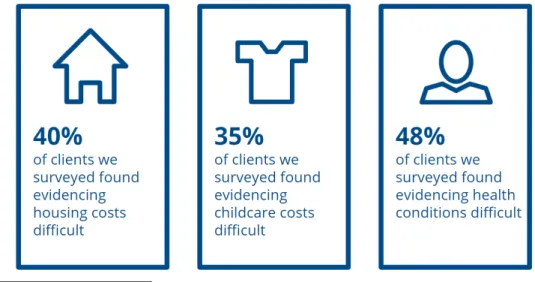
A significant number of people are not receiving their full UC award on time as claimants have difficulty providing evidence as part of their claim . DWP data shows that currently 17% of UC claimants are still waiting longer than five weeks to receive their full payment, and that many of these delays are due to challenges with outstanding evidence. A survey of our clients showed that 23 many are having difficulty evidencing additional costs.
Figure 1 - Client experiences providing supporting evidence 24
22 FoI:2025, May 2018
23 DWP, Length of payment delays for new claims to Universal Credit , July 2018
24 Citizens Advice survey of 646 UC clients in full service areas, June 2017 - May 2018
We are concerned that the difficulties existing claimants face with claiming online, completing the claim, and providing additional evidence, mean that the requirement to make a new claim under managed migration is too onerous for many to complete within the required deadline and without risking gaps in income.
It is vital that the stability of people's incomes is maintained through managed migration particularly as claimants already face a built in 5 week wait for their first payment.
Our evidence shows that existing UC claimants are struggling to cope with the initial wait for payment - particularly those who are not paid in full and on time. 25 This has knock-on effects for their household finances. Half (49%) of clients we surveyed who were paid their UC award on time had to borrow from friends or family during the initial wait - rising to 62% among those who were not paid on time. Similarly 1 in 4 (25%) clients who were paid on time fell behind on their rent, rising to a third (32%) of those were not paid on time. Around 1 in 12 (8%) clients who had not been paid on time had resorted to borrowing from other lenders.
Unless delays to payment are improved before managed migration begins, the requirement to make a new claim means thousands more people will have to manage an extended period without sufficient income.
Citizens Advice case study - problems from payment delays
Kate is a single parent with an 18-month-old child who she works part time. After moving house, Kate was required to apply for Universal Credit.
Kate came to Citizens Advice because she was in arrears with her childcare costs - she owed some money for the previous month, and because the nursery asked for
payment in advance, she owed money for the next month too. The nursery had threatened that her son would lose his place if the debt was not paid.
Kate found herself unable to pay off the debt because, unlike previous benefits when she received help to cover childcare costs upfront, under UC help towards these costs is paid in arrears. This meant that Kate needed to be able to cover the full cost of the debt herself, and then be reimbursed the following month. However, she didn’t have the money to do this.
As a result, Kate had to find a new childcare provider for her son.
25 Citizens Advice, Making a Universal Credit Claim , July 2018
In addition Regulation 48 (which sets out entitlement to transitional protection) appears to disqualify claimants who are deemed to have not properly completed their claim in the first instance from transitional protection - even if they go on to successfully complete their claim. Given that 20% of UC claims are currently closed because of non-compliance with the process, we are concerned this regulation would result in high numbers losing their transitional protection. 26 Given these risks the administrative burden on claimants must be reduced as far as possible. For instance DWP must ensure it is making best use of existing claimant data and minimise the need for claimants to supply extra evidence. It should also establish which aspects of a UC claim need to be completed
immediately, and which can be left to a later date. For instance, given that Tax Credit claimants will never have experienced conditionality before it may be unnecessary and indeed disproportionate to require them to sign a full claimant commitment immediately.
Recommendation 8: Claimants should not have to complete a full UC claim at the point at which they migrate to UC. The DWP could reduce the burden on individual claimants by:
● Establishing where there is an immediate need to complete an aspect of the UC claim, and where aspects could be done at a later stage.
● Ensuring it makes best use of existing claimant data to reduce the need to re-submit information and evidence.
Non-digital claims
Some claimants going through managed migration will be unable to complete an online claim or manage their claim online unaided. These claimants have the possibility of making a claim over the phone with the help of a DWP agent, or requesting a home visit where their circumstances mean they are unable to do this. It is important that this provision is in place to assist claimants with
additional needs - for example, those with learning difficulties or severe health conditions.
However, our evidence suggests that provision of these services is patchy, with some claimants struggling to get the help they need. Our advisers have reported instances of delays because of callbacks for telephone applications not taking
26 FoI:2025, May 2018
place, or because of long waits for home visits. Others suggest difficulting in showing need for these services - with clients initially having requests for
additional support refused, before finally being accepted after intervention by a Citizen Advice adviser or when the case is passed to a UC adviser with a higher level of authority.
"One client had requested a home visit, which was granted. It took three weeks for the visit to take place. After the visit all the paperwork was lost resulting in a long wait until the claim was resolved." Response to a survey of Citizens Advice advisers
Several advisers also suggested that these types of adjustment were poorly advertised, meaning that vulnerable clients were left feeling that their only option was to risk their health by travelling to the Jobcentre. This is not a sustainable solution for many and means that problems which they may face managing their claim on an ongoing basis are not necessarily being addressed.
We are concerned that the difficulties many are facing in trying to access this support may mean some people will just give up and disengage from the process. We know that our clients often only come to us for advice when they reach a crisis point. There is a risk that people will wait until they are in severe financial difficulty before they seek other help to make their claim if it is not readily available in the first instance.
Citizens Advice case study - difficulty requesting to claim by telephone Polina has learning difficulties which can make some tasks difficult for her. Although she tried to make an online claim for Universal Credit, she struggled to do so and came up against several problems.
As a result of these issues, Polina tried to claim via a telephone application instead.
However, the person that she spoke to on the Universal Credit helpline didn’t seem to understand and kept insisting that Polina make the claim online, even though she’d explained that her learning difficulties made that impossible. Polina didn’t feel that she was being listened to, and the phone call therefore made her very distressed - and she still hadn’t managed to make her Universal Credit application.
When Polina visited Citizens Advice, an adviser called the helpline on Polina’s behalf and asked to speak to a manager, who then allowed Polina to make a telephone claim. This experience was very frustrating for Polina because she’d done everything right but hadn’t been able to access the support she was entitled to without help from Citizens Advice.
Recommendation 9: Throughout the managed migration process the government should further advertise the availability of telephone application and home visits, making eligibility criteria clear.
Extending the managed migration deadline
The regulations make it possible to extend the deadline set out in a migration notice for making a new UC claim if it is needed. We are concerned that the DWP may miss people who are vulnerable or have complex needs; and those who are struggling to meet the deadline and need support will therefore have to request an extension proactively.
The Explanatory Memorandum sets out the process DWP will follow during managed migration. Firstly, agents will check for evidence of complex needs or vulnerability before existing benefits are stopped. They then have the option of suggesting an extension, arranging a home visit, or (in exceptional cases)
cancelling the migration notice where it is felt that claimants are currently unable to make a new UC claim.
We welcome the intention to identify claimants who are vulnerable or have complex support needs. Although neither the Explanatory Memorandum or the regulations establish how this will happen. In addition, for those requesting an extension of the deadline, the regulations do not provide clear detail on what criteria or evidence DWP agents will consider when making the decision on whether or not to extend the deadline for managed migration. Without this level of detail, we are unable to assess whether this method of protecting vulnerable people will be effective.
We welcome measures to protect more vulnerable claimants or those with extra support needs from the pressure of meeting a deadline or facing having their benefits stopped. However, as it stands, claimants may have to go through the considerable stress of missing their migration deadline before they will be offered additional support.
Relying heavily on individual claimants requesting an extension does not provide sufficient protection for those who are vulnerable or have complex needs. It is likely that those with the highest support needs or experiencing a difficult life event are also those least likely to proactively request additional support.
A useful parallel can be found in research Citizens Advice recently conducted looking at the problems clients with mental health problems have accessing additional support with essential services. The report found that despite 27 providers' efforts to promote their services, most clients are unaware that they could get additional support with essential services. Even where they are aware, clients can struggle to access additional support without help. Actions which may be reasonably expected from a 'typical' customer - filling out a form or calling a helpline - may be impossible for someone whose mental health problem means they are struggling to manage day to day tasks.
Ending legacy benefit claims
Universal Credit brings together six legacy benefits into one single payment. This means that, unlike previous benefit migrations, errors in the transition to UC could put people's entire income from benefits at risk. Regulation 46 makes provision for the DWP to stop all legacy benefit claims the day before a
claimant's migration deadline - which could be as little as one month after their migration notice was issued.
Given the difficulties current UC claimants face in making a new claim, and the challenges of identifying those with vulnerabilities or support needs through the managed migration process, we believe there is a significant risk that some people will miss this deadline and therefore lose their income from benefits altogether when their legacy payments are stopped. This risk is particularly acute for more vulnerable claimants, or those who have been on an existing legacy benefit claim for many years with little interaction with DWP services.
Whilst regulation 45 has been put in place to guard against this risk, as noted in the section above, we do not think these measures can provide sufficient
protection given the risk that vulnerable people could lose all of their benefit income.
We believe that legacy benefit claims should not be terminated even if claimants have not successfully made a new UC claim by the specified date. Instead, at the point a migration deadline is missed the Government should proactively provide support for claimants so that they can continue with the managed migration process. Legacy benefit payments should continue until it is confirmed that a UC claim has been successfully completed.
Citizens Advice client case study - challenges from time limits
27 Citizens Advice, Beyond good practice , May 2018
Following a change of circumstances Francesca was required to leave legacy benefits and make a UC claim. However, due to a lack of digital skills she has found using both a computer and the online portal difficult to navigate.
Francesca came to us because she was experiencing difficulties getting through the verification process and required IT support. She said her mental health condition was getting worse because of the initial time-limit placed on new UC claims combined with the lack of support making it harder to complete her claim. Her heightened anxiety was causing her to forget any login and password details she had created, causing further problems and delays.
Consideration should also be given to additional measures that could be taken to help avoid gaps in income or negative financial impact during the migration process. One such measure could be to introduce an automatic 2 week run on for all legacy benefits, similar to the Housing Benefit run on introduced in April of this year. This could significantly help existing legacy benefit claimants to better manage their finances during the initial wait for their first UC payment, as well as helping them to adjust to a monthly payment cycle. While Advance
Payments are available to help people with this initial wait, as detailed in the section below, they are not always the best option for claimants who are already struggling financially.
Recommendation 10: People must not have their benefits stopped or reduced as a result of problems with the migration process. To prevent this, the DWP should:
● Clarify / amend Regulation 48 and ensure those who make a defective claim but go on to successfully make their claim still receive transitional protection.
● Remove Regulation 46 to prevent any claimants from having their benefits stopped and losing their income.
● Ensure that failure to complete a UC claim after a migration notice should trigger an offer of support.
● Specify in more detail how it will identify those who are vulnerable and have support needs and what criteria/evidence will be used to
determine extensions of deadlines.
● Prioritise developing functionality to identify vulnerability within UC.
● Consider introducing an automatic 2 week run on for all legacy benefits similar to the current run on for existing Housing Benefit claimants.
Deductions
As with legacy benefits, the DWP has the power to deduct sums of money directly from UC claimants to pay certain debts and costs each month such as advance payment repayments, tax credit overpayments, housing and utility arrears. This can be an important measure to help people pay back debts, and for some, last resort deductions help people stay in their home. However, these payments are not always balanced with the need for people to cover essential ongoing costs risking further debts being built up.
Difficulties resulting from deductions from UC awards are an issue we commonly see when clients begin a UC claim. In May 2018 a third of all UC claimants had deductions from their UC payment . Despite this, deductions are 28 not mentioned in the managed migration regulations, making it unclear how they will be transferred to the new benefit and how they will be treated within the calculation of transitional protection.
Deductions tend to build up early on in a claim. Taking out advance payments, the discovery of historical Tax Credit overpayments and deductible arrears are all common early in claims and can result in deductions from UC. These issues are likely to affect those migrating onto UC as the current proposals for
managed migration mean they will face similar waits for their first payments as current UC claimants.
Early insight suggests some claimants are experiencing knock on effects and hardship as a result of deductions including:
● Cutting back on essentials such as food and heating
● Selling or pawning personal possessions
● Building up further debts, falling into additional arrears, using credit and borrowing from family or friends
"[Deduction] rates are arbitrary and take no account of ability to pay. DWP always impose deductions at the highest possible rate and attempts to get reductions based on hardship can take months for them to respond. UC
advance repayments mean that clients start in debt." Response to a survey of Citizens Advice advisers
28Freedom of information request cited in the Guardian in August 2018
Beyond this, we have also seen reported impacts on mental health such as stress and depression.
Those migrating onto UC are also likely to face similar problems to current claimants with an inflexible system that is very difficult to understand and plan around, and a lack of support available to cope with existing debts.
Citizens Advice client case study - the impact of high levels of deductions Georgina is a single-parent with a 4 month old child. She came to Citizens Advice because she was experiencing serious financial hardship. This was primarily caused by an old Tax Credit overpayment - deductions were being taken from her Universal Credit to repay this debt but they were unaffordable.
Georgina also has some rent arrears. The high level of deductions for the
overpayment meant that she stopped being able to make repayments she had setup with her landlord directly to pay off her rent arrears. This only made her debt
situation worse and put her at risk of homelessness.
Some deductions can be taken at higher rates in UC than under legacy benefits.
For example rent arrears are normally deducted at 5% of Jobseekers Allowance, whereas in UC this debt is deducted between 10-20% of the standard allowance.
It is unclear if deductions set up in the legacy system will automatically be transferred to UC, and if so if these will be at the legacy benefit rate a claimant has been used to paying, or if these will automatically increase to the UC amount.
Applying deductions at a higher level means claimants with these debts risk losing income with the move to UC, even with transitional protection on their overall award. It is also unclear, how this would work if court orders have set the amount of debt to be deducted at the lower legacy amount. The current
regulations for transitional protection ensure that the transitional element is calculated prior to any sanctions being applied. It is important that this is extended to include deductions for Government debt and third party deductions.
The principle of transitional protection is that those migrating should not
experience a financial loss because of the move to UC. Deductions are currently affecting a significant proportion of claimants. Without either further protections for migrators or significant changes to the deductions regime, this will remain the case for people moved across, leaving many with lower monthly payments.
Recommendation 11: Regulations need to ensure that claimants are not worse off following managed migration because of deductions.
● DWP should consider extending the regulations and using this opportunity to make changes to the current deductions scheme, including overpayments and advance payments, so they are made at a more manageable rate and take a person’s ability to cover their
expenses into account.
● For those migrating, the calculation of transitional protection should take place prior to deductions being applied.
● More detail is needed on how deductions are transferred from legacy benefits to UC. This should be done in a way that ensures claimants do not face a drop in income to cover their ongoing essential costs.
Part 4 - Calculation and impact of transitional protection
We welcome the Government's proposals to provide transitional protection for claimants who stand to lose out from the migration to UC. Transitional
protection payments - alongside the proposed capital disregard for Tax Credit claimants - will ensure families have the security of their level of income during the transition to UC.
Qualifying claims
We are concerned however that the qualifying criteria as proposed will create disparity between claimants. If someone experiences a change of circumstances which triggers a natural migration before they have received their managed migration notification, they will not get transitional protection.
For example this is particularly unfair for those who naturally migrate because they have moved to a different local authority but have no other change of
circumstance. In this situation, a claimant could be entitled to less than someone in identical circumstances who moves within their local area. To minimize this unequal treatment DWP could change the gateway conditions so that claimants who move to a new local authority can continue to apply for Housing Benefit, and migrate with full transitional protection when they receive a managed migration notification.
Consideration should be given to other circumstances that will create this kind of disparity and to cases which will lead to significant losses of income for those naturally migrating on to UC without transitional protection.
This is the approach being taken for those who get the Severe Disability
Premium (SDP). The Government has rightly identified that this group face large losses moving from the legacy system to UC. They will be prevented from
naturally migrating to UC and will only move over through managed migration with the benefits of transitional protection. We welcome this as it will provide increased financial security for disabled people who do not live with an adult carer.
The government needs to identify which other groups face significant losses when comparing entitlement under UC to the legacy system. Our analysis suggests this includes some lone parents, working disabled people, disabled carers and parents with a disabled child. The enhanced gateway conditions for SDP recipients could be applied to all groups which face losses moving onto UC.
Recommendation 12: To prevent the loss of transitional protection, a gateway condition should be added to allow claimants who move local authority to claim for Housing benefit.
Recommendation 13 : The DWP should identify all other groups which face losses moving onto UC and consider putting in place gateway conditions which prevent them from naturally migrating without transitional protection. This would replicate the approach currently being considered for those receiving the Severe Disability Premium.
Calculation of transitional protection
Transitional protection is calculated by taking the representative legacy benefit amount on the day of migration and comparing this with the indicative UC amount. As Tax Credit awards are finalised at the end of the year, the daily rate which will be used to calculate a representative monthly rate may not be
accurately reflect the claimants circumstances or earnings. This creates a particular risk of under/overpayment of transitional protection for tax credit claimants.
The Government originally committed to award transitional protection wherever a claimant's UC award would be less than the amount of their existing benefit.
We welcome the decision to calculate the representative monthly rate before any reduction for sanction. It should be confirmed that any deductions for third party or Government debts will also be excluded from the calculation.
In addition, large families who are not yet subject to the benefit cap are likely to lose out when they are migrated to UC . The draft regulations make provision for the benefit cap to be applied to the representative monthly legacy award before transitional protection is calculated. As a result, a small group will see their benefits reduced by managed migration - likely to be predominantly families with 3 or more children.
Recommendation 14 : The benefit cap should not be applied to the calculation of transitional protection, to ensure no one loses out when they are migrated to UC.
Erosion and ending of transitional protection
The current regulations mean that whenever a claimant’s UC maximum amount rises, either because of annual uprating or elements being added/increased, their transitional element will be reduced accordingly. Therefore the amount of transitional protection a claimant receives will erode over time.
For some people this will be gradual process, but problems may arise for
claimants who have a significant changes in circumstance, such as the birth of a child or serious illness. If a claimants’ transitional element is greater than or equal to the value of any elements being added, the value of the claimants UC payment will not increase. Therefore, despite experiencing a life change which may bring significant extra costs they will have no extra income to meet these costs.
The draft regulations specify that an increase in the childcare element does not count as a ‘relevant increase’ for the purposes of reducing transitional
protection. This is a welcome change and recognises extra and fluctuating costs - particularly for those who have differing childcare costs during school holidays.
The Government should consider whether other elements of UC should have a similar exemption, for example those designed to meet the extra costs of disability or long term illness.
Regulation 56(2) means transitional protection can also be ended completely if a claimants income drops below their earnings threshold for three or more
months. In some instances this could mean claimants see a sudden drop in their income through no fault of their own for example due to reducing their work hours because of a fluctuating in health condition. The intent of this regulation need clarifying and the regulation needs to be amended or removed to prevent this situation occurring.
A similar rule exists for claimants who increase their earnings to a level which means their UC is eroded to £0 for 3 months. We are concerned that three months may be too short a period over which to remove transitional protection, and may act as a disincentive claimants to improve their earnings. Claimants may turn down opportunities to temporarily increase their earnings (perhaps through seasonal work) because the subsequent withdrawal of transitional protection will make them worse off overall. Claimants may also not want to take the risk trying a new higher paying roles if they will lose transitional protection if they leave the jobs after more than three months. The Government should therefore consider extending this period during which claimants can resume
their previous UC claim with Transitional Protection, beyond three months, in order to ensure temporary increases in earnings do not reduce claimants income overall.
Recommendation 15 : The Government should review which elements will contribute to the erosion of transitional protections, for example those designed to meet the extra costs of disability or long term illness.
Recommendation 16 : Regulation 56(2) should be removed or amended so that claimants who have a drop in earnings for 3 months do not lose their transitional protection.
Recommendation 17 : The Government should consider extending the period during which claimants can resume their previous UC claim with Transitional Protection beyond three months