TECHNICAL STANDARDS (EUROPEAN MARKET INFRASTRUCTURE REGULATION) (EU EXIT) (No 2) INSTRUMENT 2019
Powers exercised
A. The Financial Conduct Authority (“the FCA”), being an appropriate regulator within the meaning of the Financial Regulators’ Powers (Technical Standards etc.)
(Amendment etc.) (EU Exit) Regulations 2018 (“the Regulations”), with the approval of the Treasury, makes this instrument in exercise of the powers conferred by
regulation 3 of the Regulations.
Pre-conditions to making
B. The FCA and the Bank of England are the appropriate regulators for the
EU Regulations under European Market Infrastructure Regulations that are specified in Part 5 of the Schedule to the Regulations.
C. The FCA has consulted the Prudential Regulation Authority and the Bank of England as appropriate in accordance with regulation 5 of the Regulations.
D. In accordance with regulation 3(2)(b), the Bank of England has given consent to the modifications in Annexes A - C of this instrument.
E. A draft of this instrument has been approved by the Treasury, the Minister
considering that it makes appropriate provision to prevent, remedy or mitigate any failure of retained EU law to operate effectively, or any other deficiency in retained EU law, arising from the withdrawal of the United Kingdom from the European Union.
Interpretation
F. Any reference in this instrument to any EU Regulation or EU tertiary legislation (within the meaning of section 20 of the European Union (Withdrawal) Act 2018) is, unless the contrary intention appears, to be treated as a reference to that EU regulation or EU tertiary legislation which is part of UK law by virtue of the European Union (Withdrawal) Act 2018.
Modifications
G. The FCA thereafter amends the following EU Regulation in accordance with Annexes A - C of this instrument.
(1) (2)
Commission Implementing Regulation (EU) No 1247/2012
of 19 December 2012 laying down implementing technical standards with regard to the format and frequency of trade reports to trade
Annex A
Page 2 of 23
repositories according to Regulation (EU) No 648/2012 of the European Parliament and of the Council on OTC derivatives, central counterparties and trade repositories
Commission Delegated Regulation (EU) No 148/2013
of 19 December 2012 supplementing Regulation (EU) No 648/2012 of the European Parliament and of the Council on OTC derivatives, central counterparties and trade repositories with regard to regulatory technical standards on the minimum details of the data to be reported to trade repositories
Annex B
Commission Delegated Regulation (EU) No 149/2013 of 19 December 2012 supplementing Regulation (EU) No 648/2012 of the European Parliament and of the Council with regard to regulatory technical standards on indirect clearing arrangements, the clearing obligation, the public register, access to a trading venue, non-financial counterparties, and risk mitigation techniques for OTC derivatives contracts not cleared by a CCP
Annex C
Commencement
H. This instrument comes into force on exit day as defined in the European Union (Withdrawal) Act 2018.
Citation
I. This instrument may be cited as the Technical Standards (European Market Infrastructure Regulations) (EU Exit) (No 2) Instrument 2019.
By order of the Board 28 March 2019
Page 3 of 23
In this instrument, underlining indicates new text and striking through indicates deleted text.
Annex A
COMMISSION IMPLEMENTING REGULATION (EU) No 1247/2012 of 19 December 2012 laying down implementing technical standards with regard to the format and frequency of trade reports to trade repositories according to Regulation (EU) No 648/2012 of the European Parliament and of the Council on OTC derivatives, central counterparties and trade repositories
(Text with EEA relevance)
Article -1 Definitions
In this Regulation, ‘exit day’ has the meaning given in the European Union (Withdrawal) Act 2018.
Article 1
Format of derivative contract reports
The information contained in a report under Article 9 of Regulation (EU) No 648/2012 shall be provided in the format specified in the Annex to this Regulation.
Article 2
Frequency of derivative contract reports
Where provided for in Article 11(2) of Regulation (EU) No 648/2012, mark to market or mark to model valuations of contracts reported to a trade repository shall be done on a daily basis. Any other reporting elements as provided for in the Annex to this Regulation and the Annex to the delegated act with regard to regulatory technical standards specifying the minimum details of the data to be reported to trade repositories pursuant to Article 9(5) of Regulation (EU) No 648/2012 Regulation (EU) No 148/2013 shall be reported as they occur and taking into account the time limit foreseen under Article 9 of Regulation (EU) No 648/2012, notably as regards the conclusion, modification or termination of a contract.
…
Page 4 of 23 Article 4
Specification, identification, and classification of derivatives
…
5. The derivative shall be identified in Field 6 of Table 2 of the Annex using the following, where available:
(a) an ISO 6166 International Securities Identification Number (ISIN) code or an Alternative Instrument Identifier code (AII), as applicable, until 3 January 2018 the date of application of the delegated act adopted by the Commission pursuant to Article 27(3) of Regulation (EU) No 600/2014 of the European Parliament and of the Council;
(b) an ISIN from the date of application of the delegated act adopted by the Commission pursuant to Article 27(3) of Regulation (EU) No 600/2014 3 January 2018.
Where an AII code is used, the complete AII code shall be used.
…
9. Until the code referred to in paragraph 8 is endorsed by the FCA ESMA, derivatives for which an ISO 6166 ISIN code or an AII code are not available shall be classified using an ISO 10692 CFI code.
Article 4a
Unique Trade Identifier
1. A report shall be identified through either a global unique trade identifier endorsed by the FCA ESMA or, in the absence thereof, a unique trade identifier agreed by the counterparties.
…
Article 4b Venue of execution
The venue of execution of the derivative contract shall be identified in Field 15 of Table 2 of the Annex as follows: using the ISO 10383 Market Identifier Code (MIC).
Page 5 of 23
(a) until the date of application of the delegated act adopted by the Commission pursuant to Article 27(3) of Regulation (EU) No 600/2014:
(i) for a venue of execution inside the Union, the ISO 10383 Market Identifier Code (MIC) published on ESMA's website in the register set up on the basis of information provided by competent authorities pursuant to Article 13(2) of Commission Regulation (EC) No 1287/2006;
(ii) for a venue of execution outside the Union, the ISO 10383 MIC included in the list of MIC codes maintained and updated by ISO and published at ISO web site;
(b) from the date of application of the delegated act adopted by the Commission pursuant to Article 27(3) of Regulation (EU) No 600/2014, the ISO 10383 MIC.
Article 5 Reporting start date
1. Credit derivative and interest rate derivative contracts shall be reported:
(a) by 1 July 2013, where a trade repository for that particular derivative class has been registered under Article 55 of Regulation (EU) No 648/2012 before 1 April 2013;
(b) 90 days after the registration of a trade repository for a particular derivative class under Article 55 of Regulation (EU) No 648/2012, where there is no trade repository registered for that particular derivative class before or on 1 April 2013;
(c) by 1 July 2015, where there is no trade repository registered for that particular derivative class under Article 55 of Regulation (EU) No 648/2012 by 1 July 2015. The reporting obligation shall commence on this date and contracts shall be reported to ESMA in accordance with Article 9(3) of that Regulation until a trade repository is registered for that particular derivative class.
2. Derivative contracts not referred to in paragraph 1 shall be reported:
(a) by 1 January 2014, where a trade repository for that particular derivative class has been registered under Article 55 of Regulation (EU) No 648/2012 before 1 October 2013;
(b) 90 days after the registration of a trade repository for a particular derivative class under Article 55 of Regulation (EU) No 648/2012, where there is no trade repository registered for that particular derivative class before or on 1 October 2013;
(c) by 1 July 2015, where there is no trade repository registered for that particular derivative class under Article 55 of Regulation (EU) No 648/2012 by 1 July 2015. The reporting obligation shall commence on this date and contracts shall be reported to ESMA in accordance with Article 9(3) of that Regulation until a trade repository is registered for that particular derivative class.
Page 6 of 23
3. Those derivative contracts which were outstanding on 16 August 2012 and are still outstanding on the reporting start date shall be reported to a trade repository within 90 days of the reporting start date for a particular derivative class.
4. The following derivative contracts which are not outstanding on the commencement date for reporting for a particular derivative class shall be reported to a trade
repository within five years of that date:
(a) derivative contracts that were entered into before 16 August 2012 and were still outstanding on 16 August 2012;
(b) derivative contracts that were entered into on or after 16 August 2012.
5. The reporting start date shall be extended by 180 days for the reporting of information referred to in Article 3 of Regulation (EU) No 148/2013 the delegated act with regard to regulatory technical standards specifying the minimum details of the data to be reported to trade repositories pursuant to Article 9(5) of Regulation (EU) No 648/2012.
Article 6 Entry into force
…
This Regulation shall be binding in its entirety and directly applicable in all Member States.
…
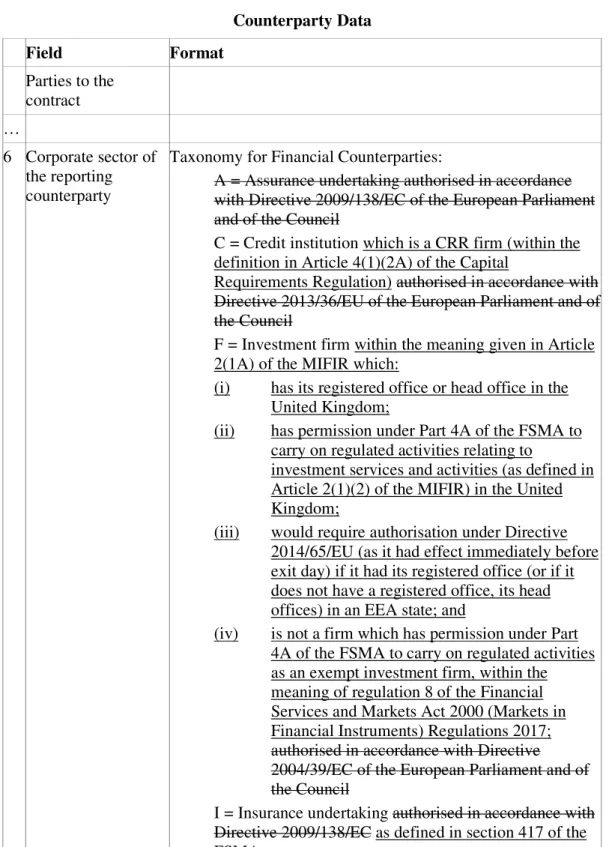
Page 7 of 23 ANNEX
Table 1 Counterparty Data
Field Format
Parties to the contract
…
6 Corporate sector of the reporting counterparty
Taxonomy for Financial Counterparties:
A = Assurance undertaking authorised in accordance with Directive 2009/138/EC of the European Parliament and of the Council
C = Credit institution which is a CRR firm (within the definition in Article 4(1)(2A) of the Capital
Requirements Regulation) authorised in accordance with Directive 2013/36/EU of the European Parliament and of the Council
F = Investment firm within the meaning given in Article 2(1A) of the MIFIR which:
(i) has its registered office or head office in the United Kingdom;
(ii) has permission under Part 4A of the FSMA to carry on regulated activities relating to
investment services and activities (as defined in Article 2(1)(2) of the MIFIR) in the United Kingdom;
(iii) would require authorisation under Directive 2014/65/EU (as it had effect immediately before exit day) if it had its registered office (or if it does not have a registered office, its head offices) in an EEA state; and
(iv) is not a firm which has permission under Part 4A of the FSMA to carry on regulated activities as an exempt investment firm, within the meaning of regulation 8 of the Financial Services and Markets Act 2000 (Markets in Financial Instruments) Regulations 2017;
authorised in accordance with Directive 2004/39/EC of the European Parliament and of the Council
I = Insurance undertaking authorised in accordance with Directive 2009/138/EC as defined in section 417 of the FSMA
Page 8 of 23
L = AIF (within the definition in regulation 3 of the Alternative Investment Fund Managers Regulations 2013) Alternative investment fund managed by
Alternative Investment Fund Managers (AIFMs) (within the definition in regulation 4 of those Regulations) authorised or registered in accordance with those Regulations authorised or registered in accordance with Directive 2011/61/EU of the European Parliament and of the Council
O = Institution for occupational retirement provision within the meaning of section 1(1) of the Pension Schemes Act 1993 within the meaning of Article 6(a) of Directive 2003/41/EC of the European Parliament and of the Council
R = Reinsurance undertaking as defined in section 417 of the FSMA authorised in accordance with Directive 2009/138/EC
U = Undertakings for the Collective Investment in Transferable Securities (UCITS) UK UCITS (within the definition in section 237(3) of the FSMA) and its management company (within the definition in section 237(2) of the FSMA), authorised in accordance with Directive 2009/65/EC of the European Parliament and of the Council
Taxonomy for Non-Financial Counterparties. The following categories correspond to the main sections of Statistical classification of economic activities in the European Community (NACE) as defined in Regulation (EC) No
1893/2006 of the European Parliament and of the Council (as it had effect immediately before exit day)
1 = Agriculture, forestry and fishing 2 = Mining and quarrying
3 = Manufacturing
4 = Electricity, gas, steam and air conditioning supply 5 = Water supply, sewerage, waste management and remediation activities
6 = Construction
7 = Wholesale and retail trade, repair of motor vehicles and motorcycles
8 = Transportation and storage
9 = Accommodation and food service activities 10 = Information and communication
11 = Financial and insurance activities 12 = Real estate activities
13 = Professional, scientific and technical activities 14 = Administrative and support service activities
Page 9 of 23
15 = Public administration and defence; compulsory social security
16 = Education
17 = Human health and social work activities 18 = Arts, entertainment and recreation 19 = Other service activities
20 = Activities of households as employers;
undifferentiated goods — and services — producing activities of households for own use
21 = Activities of extraterritorial organisations and bodies
Where more than one activity is reported, list the codes in order of the relative importance of the corresponding activities, separating them with a “-”.
Leave blank in the case of CCPs and other type of
counterparties in accordance with Article 1(5) of Regulation (EU) No 648/2012.
…
Page 10 of 23 Table 2 Common Data
Field Format Applicable types of
derivative contracts Section 2a —
Contract type
All contracts
…
6 Product identification
For product identifier type I: ISO 6166 ISIN 12 character alphanumerical code For product identifier type A: Complete AII code in accordance with Article 4(86)
7 Underlying identification type
I = ISIN A = AII U = UPI B = Basket X = Index
8 Underlying identification
For underlying identification type I: ISO 6166 ISIN 12 character alphanumerical code
For underlying identification type A:
complete AII code in accordance with Article 4(86)
For underlying identification type U:
UPI
For underlying identification type B: all individual components identification through ISO 6166 ISIN or complete AII code in accordance with Article 4(86).
Identifiers of individual components shall be separated with a dash “-”.
For underlying identification type X:
ISO 6166 ISIN if available, otherwise full name of the index as assigned by the index provider
…
15Venue of execution
ISO 10383 Market Identifier Code (MIC), 4 alphanumerical characters, in accordance with Article 4(b).
Page 11 of 23 Annex B
COMMISSION DELEGATED REGULATION (EU) No 148/2013 of 19 December 2012 supplementing Regulation (EU) No 648/2012 of the European Parliament and of the Council on OTC derivatives, central counterparties and trade repositories with regard to regulatory technical standards on the minimum details of the data to be reported to trade repositories
(Text with EEA relevance)
… Article -1 Definitions
In this Regulation:
‘exit day’ has the meaning given in the European Union (Withdrawal) Act 2018;
‘UK-adopted IFRS’ means UK-adopted international accounting standards; and
‘UK-adopted international accounting standards’ means (in accordance with section 474(1) of the Companies Act 2006) international accounting standards which are adopted for use within the United Kingdom by virtue of Chapter 2 or 3 of Part 2 of the International Accounting Standards and European Public Limited-Liability Company (Amendment etc.) (EU Exit) Regulations 2019.
… Article 3
Reporting of exposures
…
6. For contracts not cleared by a CCP, the counterparty shall report, in accordance with fields 17 to 20 in Table 1 of the Annex to this Regulation, the valuation of the contract performed in accordance with the methodology defined in International Financial Reporting Standard 13 Fair Value Measurement as contained in UK-adopted IFRS adopted by the Union and referred to in the Annex to Commission Regulation (EC) No 1126/2008.
Page 12 of 23 Article 5 Entry into force
…
This Regulation shall be binding in its entirety and directly applicable in all Member States.
…
Page 13 of 23 ANNEX Details to be reported to trade repositories
…
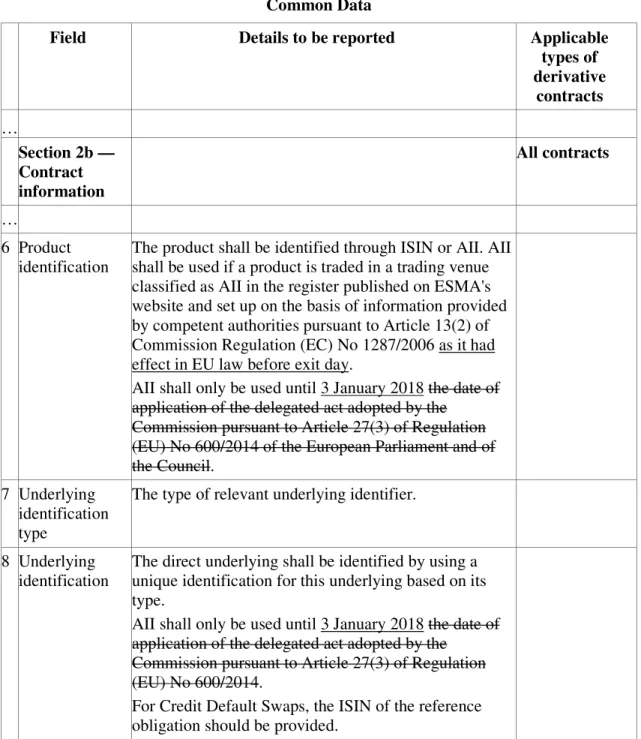
Table 2 Common Data
Field Details to be reported Applicable
types of derivative
contracts
…
Section 2b — Contract information
All contracts
…
6 Product identification
The product shall be identified through ISIN or AII. AII shall be used if a product is traded in a trading venue classified as AII in the register published on ESMA's website and set up on the basis of information provided by competent authorities pursuant to Article 13(2) of Commission Regulation (EC) No 1287/2006 as it had effect in EU law before exit day.
AII shall only be used until 3 January 2018 the date of application of the delegated act adopted by the
Commission pursuant to Article 27(3) of Regulation (EU) No 600/2014 of the European Parliament and of the Council.
7 Underlying identification type
The type of relevant underlying identifier.
8 Underlying identification
The direct underlying shall be identified by using a unique identification for this underlying based on its type.
AII shall only be used until 3 January 2018 the date of application of the delegated act adopted by the
Commission pursuant to Article 27(3) of Regulation (EU) No 600/2014.
For Credit Default Swaps, the ISIN of the reference obligation should be provided.
Page 14 of 23
In case of baskets composed, among others, of financial instruments traded in a trading venue, only financial instruments traded in a trading venue shall be specified.
…
Page 15 of 23 Annex C
COMMISSION DELEGATED REGULATION (EU) No 149/2013 of 19 December 2012 supplementing Regulation (EU) No 648/2012 of the European Parliament and of the Council with regard to regulatory technical standards on indirect clearing arrangements, the clearing obligation, the public register, access to a trading venue, non-financial counterparties, and risk mitigation techniques for OTC derivatives contracts not cleared by a CCP
(Text with EEA relevance)
…
Article 1 Definitions
For the purposes of this Regulation the following definitions apply:
…
(e) ‘third indirect client’ means a client of a second indirect client.;
(f) ‘authorised credit institution’ means a credit institution which is a CRR firm (within the definition in Article 4(1)(2A) of the Capital Requirements Regulation);
(g) ‘authorised investment firm’ means an investment firm within the meaning given in Article 2(1A) of the MIFIR which:
(i) has its registered office or head office in the United Kingdom;
(ii) has permission under Part 4A of the FSMA to carry on regulated activities relating to investment services and activities (as defined in Article 2(1)(2) of the MIFIR) in the United Kingdom;
(iii) would require authorisation under Directive 2014/65/EU (as it had effect immediately before exit day) if it had its registered office (or if it does not have a registered office, its head offices) in an EEA state; and
(iv) is not a firm which has permission under Part 4A of the FSMA to carry on regulated activities as an exempt investment firm, within the meaning of regulation 8 of the Financial Services and Markets Act 2000 (Markets in Financial Instruments) Regulations 2017.
(h) ‘exit day’ has the meaning given in the European Union (Withdrawal) Act 2018.
Page 16 of 23 Article 2
Requirements for the provision of indirect clearing services by clients
1. A client may only provide indirect clearing services to indirect clients provided that all of the following conditions are fulfilled:
(a) the client is an authorised credit institution or investment firm or an entity established in a third country that would be considered to be a credit institution or investment firm if that entity were established in the Union United Kingdom;
…
…
Article 5a
Requirements for the provision of indirect clearing services by indirect clients
1. An indirect client may only provide indirect clearing services to second indirect clients provided that the parties to the indirect clearing arrangements fulfil one of the requirements set out in paragraph 2 and that all of the following conditions are met:
(a) the indirect client is an authorised credit institution or investment firm or an entity established in a third country that would be considered to be a credit institution or investment firm if that entity were established in the Union United Kingdom;
…
Article 5b
Requirements for the provision of indirect clearing services by second indirect clients
1. A second indirect client may only provide indirect clearing services to third indirect clients provided that all of the following conditions are met:
(a) the indirect client and the second indirect client are authorised credit
institutions or an investment firms or entities established in a third country that would be considered to be a credit institution or an investment firm if that entity were established in the Union United Kingdom;
Page 17 of 23
…
Article 6
Details to be included in the notification
1. The notification for the purpose of the clearing obligation shall include the following information:
(a) the identification of the class of OTC derivative contracts;
(b) the identification of the OTC derivative contracts within the class of OTC derivative contracts;
(c) other information to be included in the public register in accordance with Article 8;
(d) any further characteristics necessary to distinguish OTC derivative contracts within the class of OTC derivative contracts from OTC derivative contracts outside that class;
(e) evidence of the degree of standardisation of the contractual terms and operational processes for the relevant class of OTC derivative contracts;
(f) data on the volume of the class of OTC derivative contracts;
(g) data on the liquidity of the class of OTC derivative contracts;
(h) evidence of availability to market participants of fair, reliable and generally accepted pricing information for contracts in the class of OTC derivative contracts;
(i) evidence of the impact of the clearing obligation on avail- ability to market participants of pricing information.
2. For the purpose of assessing the date or dates from which the clearing obligation takes effect, including any phasing-in and the categories of counterparties to which the clearing obligation applies, the notification for the purpose of the clearing obligation shall include:
(a) data relevant for assessing the expected volume of the class of OTC derivative contracts if it becomes subject to the clearing obligation;
(b) evidence of the ability of the CCP to handle the expected volume of the class of OTC derivative contracts if it becomes subject to the clearing obligation and to manage the risk arising from the clearing of the relevant class of OTC derivative contracts, including through client or indirect client clearing arrangements;
(c) the type and number of counterparties active and expected to be active within the market for the class of OTC derivative contracts if it becomes subject to the clearing obligation;
(d) an outline of the different tasks to be completed in order to start clearing with the CCP, together with the determination of the time required to fulfil each task;
Page 18 of 23
(e) information on the risk management, legal and operational capacity of the range of counterparties active in the market for the class of OTC derivative contracts if it becomes subject to the clearing obligation.
3. The data pertaining to the volume and the liquidity shall contain for the class of OTC derivative contracts and for each derivative contract within the class, the relevant market information, including historical data, current data as well as any change that is expected to arise if the class of OTC derivative contracts becomes subject to the clearing obligation, including:
(a) the number of transactions;
(b) the total volume;
(c) the total open interest;
(d) the depth of orders including the average number of orders and of requests for quotes;
(e) the tightness of spreads;
(f) the measures of liquidity under stressed market conditions;
(g) the measures of liquidity for the execution of default procedures.
4. The information related to the degree of standardisation of the contractual terms and operational processes for the relevant class of OTC derivative contracts provided in point (e) of paragraph 1 shall include, for the class of OTC derivative contracts and for each derivative contract within the class, data on the daily reference price as well as the number of days per year with a reference price it considers reliable over at least the previous 12 months.
CHAPTER IV
CRITERIA FOR THE DETERMINATION OF THE CLASSES OF OTC DERIVATIVE CONTRACTS SUBJECT TO THE CLEARING OBLIGATION
(Article 5(4) of Regulation (EU) No 648/2012) Article 7
Criteria to be assessed by ESMA Bank of England
1. In relation to the degree of standardisation of the contractual terms and operational processes of the relevant class of OTC derivative contracts, the European Securities and Markets Authority (ESMA) Bank of England shall take into consideration:
…
2. In relation to the volume and liquidity of the relevant class of OTC derivative contracts, ESMA the Bank of England shall take into consideration:
…
Page 19 of 23
3. In relation to the availability of fair, reliable and generally accepted pricing information in the relevant class of OTC derivative contracts, ESMA the Bank of England shall take into consideration whether the information needed to accurately price the contracts within the relevant class of OTC derivative contracts is easily accessible to market participants on a reasonable commercial basis and whether it would continue to be easily accessible if the relevant class of OTC derivative contracts became subject to the clearing obligation.
CHAPTER V PUBLIC REGISTER
(Article 6(4) of Regulation (EU) No 648/2012) Article 8
Details to be included in ESMA the Bank of England’s Register
1. The ESMA Bank of England’s public register shall include for each class of OTC derivative contracts subject to the clearing obligation:
…
2. In relation to CCPs that are authorised or recognised for the purpose of the clearing obligation, the ESMA Bank of England’s public register shall include for each CCP:
…
(c) the country of establishment;
(d) the competent authority designated in accordance with Article 22 of Regulation (EU) No 648/2012.
3. In relation to the dates from which the clearing obligation takes effect, including any phased-in implementation, the ESMA Bank of England’s public register shall include:
…
(b) any other condition required pursuant to the regulatory technical standards made, or adopted (and forming part of domestic law), under Article 5(2) of Regulation (EU) No 648/2012, in order for the phase-in period to apply.
…
Page 20 of 23
4. The ESMA Bank of England’s public register shall include the reference of the regulatory technical standards made, or adopted (and forming part of domestic law), under Article 5(2) of Regulation (EU) No 648/2012, according to which each clearing obligation was established.
5. In relation to the CCP that has been notified to ESMA by the competent authority, the ESMA public register shall include at least:
(a) the identification of the CCP;
(b) the asset class of OTC derivative contracts that are notified;
(c) the type of OTC derivative contracts;
(d) the date of the notification;
(e) the identification of the notifying competent authority.
CHAPTER VI
LIQUIDITY FRAGMENTATION
(Article 8(5) of Regulation (EU) No 648/2012) Article 9
Specification of the notion of liquidity fragmentation
…
5. Clearing arrangements referred to in point (b) of paragraph 2 may foresee the transfer of transactions executed by such market participants to clearing members of other CCPs. Although access by a CCP to a trading venue should not require
interoperability, an interoperability arrangement which has been agreed by the relevant CCPs and approved by the relevant competent authorities Bank of England may be used to fulfil the requirement for access to common clearing arrangements.
Article 10
Criteria for establishing which OTC derivative contracts are objectively reducing risks
1. An OTC derivative contract shall be objectively measurable as reducing risks directly relating to the commercial activity or treasury financing activity of the non-financial counterparty or of that group, when, by itself or in combination with other derivative contracts, directly or through closely correlated instruments, it meets one of the following criteria:
…
Page 21 of 23
(c) it qualifies as a hedging contract pursuant to International Financial Reporting Standards (IFRS) adopted in accordance with Article 3 of Regulation (EC) No 1606/2002 of the European Parliament and of the Council international
accounting standards which are adopted for use within the United Kingdom by virtue of Chapter 2 or 3 of Part 2 of the International Accounting Standards and European Public Limited-Liability Company (Amendment etc.) (EU Exit) Regulations 2019.
…
Article 12
(Article 11(14)(a) of Regulation (EU) No 648/2012) Timely confirmation
…
4. Financial counterparties shall have the necessary procedure to report on a monthly basis to the FCA competent authority designated in accordance with Article 48 of Directive 2004/39/EC of the European Parliament and of the Council the number of unconfirmed OTC derivative transactions referred to in paragraphs 1 and 2 that have been outstanding for more than five business days.
…
Article 15
(Article 11(14)(a) of Regulation (EU) No 648/2012) Dispute resolution
…
2. Financial counterparties shall report to the FCA competent authority designated in accordance with Article 48 of Directive 2004/39/EC of the European Parliament and of the Council any disputes between counterparties relating to an OTC derivative contract, its valuation or the exchange of collateral for an amount or a value higher than EUR 15 million and outstanding for at least 15 business days.
…
Page 22 of 23 Article 18
(Article 11(14)(c) of Regulation (EU) No 648/2012)
Details of the intragroup transaction notification to the competent authority
…
2. As part of its application or notification to the relevant competent authority, a counterparty shall also submit supporting information evidencing that the conditions of Article 11(6 8) to and (10 9) of Regulation (EU) No 648/2012 are fulfilled. The supporting documents shall include copies of documented risk management procedures, historical transaction information, copies of the relevant contracts
between the parties and may include a legal opinion upon request from the competent authority.
Article 19
(Article 11(14)(d) of Regulation (EU) No 648/2012) Details of the intragroup transaction notification to ESMA
1. The notification by a competent authority of the details of the intragroup transaction shall be submitted to ESMA in writing:
(a) within one month of the receipt of the notification with respect to a notification under Article 11(7) or (9) of Regulation (EU) No 648/2012;
(b) within one month from the decision being submitted to the counterparty with respect to a decision of the competent authority under Article 11(6), (8) or (10) of Regulation (EU) No 648/2012.
2. The notification to ESMA shall include:
(a) the information listed in Article 18;
(b) whether there is a positive or a negative decision;
(c) in the case of a positive decision:
(i) a summary of the reason for considering that the conditions set in Article 11(6), (7), (8), (9) or (10) of Regulation (EU) No 648/2012 as applicable are fulfilled;
(ii) whether the exemption is a full exemption or a partial exemption with respect to of a notification related to Article 11(6), (8) or (10) of Regulation (EU) No 648/2012;
(d) in the case of a negative decision:
(i) the identification of the conditions of Article 11(6), (7), (8), (9) or (10) of Regulation (EU) No 648/2012 as applicable that are not fulfilled;
(ii) a summary of the reason for considering that such conditions are not fulfilled.
Page 23 of 23
…
Article 21
Entry into force and application
…
This Regulation shall be binding in its entirety and directly applicable in all Member States.
…