Universal credit managing migration pilot
Final results
How we can support universal credit claimants to successfully manage under the new system
Citizens Advice Impact Team, December 2013
Universal credit managing migration pilot final results | Citizens Advice Impact Team December 2013| 2
Universal credit managing migration pilot final results | Citizens Advice Impact Team December 2013| 3
Executive summary
Universal credit
Universal credit is the single welfare payment that has started to replace six existing benefits, including those paid to people in employment on low incomes: working tax credit; income-based jobseeker’s allowance; income-related employment support allowance; income support; child tax credit and housing benefit.
Citizens Advice welcomes the aims of universal credit to simplify the benefits system and make work pay. This principle has value for both society and claimants alike, and chimes with our ideals of enabling and empowering people, making them more independent and able to manage their money. But, universal credit needs to be implemented correctly in order to realise its potential. We recognise that claimants may need support to
successfully migrate to the new system, and to therefore realise the advantages this change could bring.
The Government’s proposals for universal credit could have the following key advantages:
• The claims process will be simpler requiring claimants to deal with only one Government department, reducing risks of delays in benefits being paid or over payment.
• The system will be more responsive and efficient at adapting to changes in individuals circumstances and earnings.
• It will be easier for people to calculate whether or not they would be better off by working more hours and increase financial work incentives.
Universal credit must be implemented correctly to realise these advantages. To empower and enable claimants it is vital that the right support is in place to help people migrate successfully to the new system. It is essential that the Government provides additional funding to support those transferring to universal credit to prepare and improve their capacity to manage under the new system.
Managing migration pilot
The Managing migration pilot was designed to understand how many of our current clients would be affected by universal credit, and understand their demographic and capability profile. From this, we wanted to identify which services were needed to provide them with necessary support, and how effective these were at equipping clients to
successfully manage the migration to universal credit.
Universal credit managing migration pilot final results | Citizens Advice Impact Team December 2013| 4
Major findings
9 out of 10 clients will need support to manage the transition, in one or more of the following capability areas: monthly payments, budgeting, banking, staying informed and getting online.
After receiving advice and support from the CAB service over half of clients have improved skills in all five key areas.
It is not just those that are vulnerable that will need support. Our pilot identified initial support needs across all capability areas were the same for all profile characteristics, with 38 per cent of clients needing support across all five capability areas.
50 per cent of everyday CAB clients are currently affected by the change, and already see our bureaux as a place for advice and support. This is equivalent to one million people across our service. We anticipate that we will be a first port of call for many of the 10 million people1 who are expected to deal with universal credit. This demand will have significant implications for our service.
Our pilot shows that our advice and support, combined with new tailored
services, can help empower the majority of people who need support to become more independent by improving their skills and ability to manage the change.
With additional funding for the right support services to meet people’s needs, we can move over half of those clients who lacked the appropriate capabilities for universal credit to improve their skills and abilities and be more likely able to manage a claim.
1 House of Commons Committee of Public Accounts, Universal Credit: early Progress, Thirtieth Report of Session 2013–14 (7 November 2013), Page 13
http://www.publications.parliament.uk/pa/cm201314/cmselect/cmpubacc/619/619.pdf
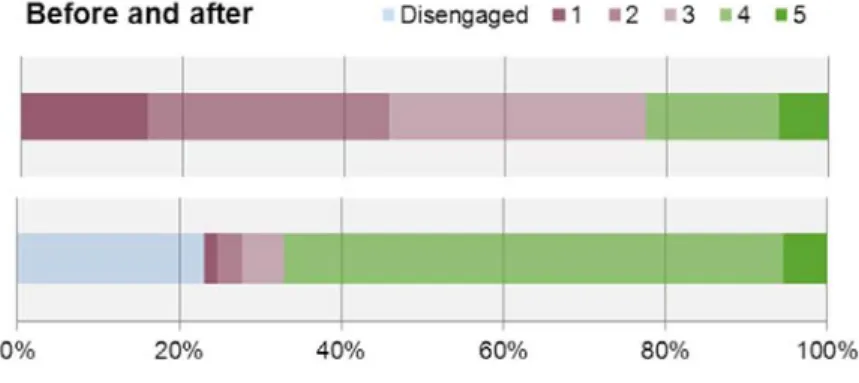
Before:
92% do not have the necessary capacity to manage transitionAfter:
CAB support improved capacity and skills for over half of clients; 23% disengaged; 20% have not progressed.Universal credit managing migration pilot final results | Citizens Advice Impact Team December 2013| 5
The need for support
We have identified the barriers that exist around successful transition to universal credit.
These barriers are a combination of external factors (e.g. internet access), client capacity (e.g. literacy), client knowledge (e.g. financial capability), and client behaviour (e.g.
knowing about and responding to the changes).
Key findings on the barriers around the transition to universal credit include:
95 per cent agree they would benefit from having a choice to be paid fortnightly;
80 per cent agree they would benefit from having rent paid directly to their landlord;
21 per cent would struggle having their benefit paid to one bank account in the household.
A further challenge with our pilot is that some clients have disengaged with the process, as they do not yet feel that universal credit is relevant to them.
Behaviour change is a long-term process, and provision needs to be put in place to ensure individuals are supported across the entire transition period, know when and how to prepare for changes and are provided with help that suits individuals’ personal needs.
We know the services that our clients will need to make the transition and these go above and beyond our normal delivery in terms of volume and types of services provided.
We will need support to help those who will turn to us for help.
Universal credit managing migration pilot final results | Citizens Advice Impact Team December 2013| 6
Contents
Executive summary 3
Managing migration pilot: what have we piloted, and why? 7 How many will need support to successfully migrate? 11 How many now have improved capacity after CAB support? 12
Monthly payments 14
Budgeting 16 Banking 18
Staying informed 20
Getting online 22
Implementing universal credit and the support required 24
Appendix: methodology 26
Universal credit managing migration pilot final results | Citizens Advice Impact Team December 2013| 7
Managing migration pilot: what have we piloted, and why?
What is universal credit, and how will it affect our clients?
Universal credit is the single welfare payment being rolled out to replace six existing benefits: income-based jobseeker’s allowance, income-related employment support allowance, incapacity benefit, working tax credit, child tax credit and housing benefit. The idea of a single benefit administered by one Government department (instead of three) is to make claiming and maintaining a claim simpler and easier to ensure clear gains from earning more. However, how the benefit is claimed and paid is also changing which will require huge adaptations for many people. Major changes include:
• adapting to a single monthly payment, made in arrears – instead of two or three payments of these benefits at different times in the month.
• one payment made per household, to one bank account – instead of ensuring payments for children being paid to the main carer.
• claimant responsibility for managing direct rent payments to the landlord
• making and managing a claim online
Individuals need to be supported through this transition to ensure that they are able to successfully manage the change to
universal credit.
We have identified five key capability areas in which people need to have the appropriate capacity to
manage a claim.
These are the five areas that we assesed clients skills and abilities in and that CAB advice and support targetted to improve.
Universal credit managing migration pilot final results | Citizens Advice Impact Team December 2013| 8
What is the Managing migration pilot?
The Managing migration pilot was a project designed and run by Citizens Advice to understand the level and nature of support our clients will need in making the successful transition to universal credit. The project worked with more than 1,700 clients, across three Citizens Advice Bureaux (Birmingham, Ynys Mon and North Dorset).
Citizens Advice funded each bureau to investigate the support requirements of their clients, increasing the volume of interventions delivered during this period, and adapting existing advice and support services as appropriate. These three bureaux were chosen as they reflected the diverse nature of our service – operating in both rural and urban environments with differing client profiles and resources.
Running from March-September 2013 the pilot had three key phases each designed to further Citizens Advice’s understanding of the impact of universal credit implementation.
Initial
assessment:
During a three month period every client that came into each pilot bureau was assessed to identify if universal credit was relevant to them (i.e. if they were in receipt of an affected benefit). For clients who would be affected by universal credit we assessed how capable they were across the five identified capability areas. From this, we gathered an
understanding of the scope and scale of support needed for universal credit within our existing client base.
CAB advice and support:
After identifying clients support needs each bureau ran tailored interventions that aimed to tackle the potential gaps in the skills and abilities necessary to manage universal credit. These were offered to all clients who were identified as needing further support. This enabled us to understand what was effective in terms of client progress and
engagement. We measured clients’ progress each time we saw them.
Follow-up survey:
At the end of the pilot we surveyed clients about what impact our interventions had on them and what further support they may require come the rollout of universal credit.
Further details about the methodology, capability areas and scoring system can be found in the appendix.
Why did the Citizens Advice service run this pilot?
To best support our clients
DWP figures state that the transition to universal credit will have a direct impact on 10 million people. They will have to develop new skills and behaviours and figures.
We recognise that the Citizens Advice service will play a vital role in providing support to individuals needing help. Through the pilot, we identified that 50 per cent of our current client base will be affected by the change. This is equivalent to one million people. We anticipate that we will be a first port of call for many of the 10 million individuals affected by the introduction of universal credit.
Universal credit managing migration pilot final results | Citizens Advice Impact Team December 2013| 9
As a key support provider we wanted to understand how we can best help our clients and address their capability needs. This pilot was therefore designed to help prepare our service delivery ahead of the roll-out of universal credit, gaining an insight into how it will affect our clients and what barriers might impede their transition.
Our results show that Citizens Advice Bureaux (CAB) can enable and empower clients but that many people will need a wide range of support. We found that 9 out of 10 clients will need support to make the change, with 38 per cent having support needs across all of the five capability areas we identified.
It is not just those usually regarded as vulnerable (e.g. disabled people and those with mental health problems) that will need support. Our pilot identified initial support needs across all capability areas were the same for all profile characteristics. The support structures that are put in place to enable people to manage this transition will need to encompass a range of services to provide for the full-spectrum of individuals needing support and with differing levels of need.
To inform our understanding of how universal credit can be best implemented We are using information from this pilot to inform our understanding of how specific aspects of universal credit implementation will affect claimants and therefore how the opportunities provided by instigating a simpler benefits system might be realised without compromising individuals financially, or their capacity to manage the changes. This is part of our wider engagement with the impact of welfare reform, which includes examining the effect that multiple benefits changes have on individuals.
To prepare our bureaux and service
Building upon our extensive knowledge of advice and support we have shown we can improve clients’ capacity to successfully migrate to universal credit. The insights gleaned from this pilot will enable our bureaux to prepare for universal credit rollout, through our learning about the level of anticipated traffic, the services that will be required and the resources that will need to be in place to ensure effective delivery. This includes knowledge of:
• the support and resources required to assist clients’ varying capacity levels; and
• how far we can improve clients’ skills and abilities.
Ynys Mon Citizens Advice Bureau:
“Taking part in the Managing migration pilot has enabled us as a bureau to understand the impact universal credit will have on our clients, and allowed us to consider different ways of working to see how we can best help them to cope with the transition.”
Birmingham Citizens Advice Bureau:
“The Managing migration pilot has allowed us further opportunity to engage with the welfare reform programme as a whole, whilst also giving us the impetus and the opportunity to develop strong partnerships with other service providers affected by the reforms.”
Universal credit managing migration pilot final results | Citizens Advice Impact Team December 2013| 10
Such demand for support and advice will have a big impact on the Citizens Advice service and our ability to respond to our clients’ needs.
For example, the transition from incapacity benefit to employment support allowance (ESA) has had, and is having, a noticeable impact on the CAB service. Incapacity benefit problems used to represent eight per cent of all benefits issues we saw and ESA is now 22 per cent.
Universal credit managing migration pilot final results | Citizens Advice Impact Team December 2013| 11
How many will need support to successfully migrate?
50 per cent of our clients will be affected by the change to universal credit This is not just those clients coming to see us about benefits issues but anyone seen during this period who therefore already see their CAB as a place for advice and support.
9 out of 10 clients do not have the appropriate capacity to manage
92 per cent (1,615 of 1,746 clients) were not equipped for universal credit in one or more of the five identified capability areas identified as necessary for managing a claim:
monthly payments, budgeting, banking, staying informed and getting online.
38 per cent of clients needed support across all five identified capability areas
73% need help with monthly payments.
77% need help with budgeting.
52% need help with banking.
81% need help staying informed.
66% need help getting online.
Not just those considered ‘vulnerable’ are affected:
While some clients might need greater levels of assistance than others individuals across all different client profiles (such as age, gender, employment status, and housing
situation) will require support to ensure they have the necessary skills and abilities to manage the new system.
Universal credit managing migration pilot final results | Citizens Advice Impact Team December 2013| 12
How many now have improved capacity after CAB support?
Our pilot shows that our advice and support combined with new tailored
services can help empower the majority of people who need support to become more independent, by improving their skills and ability to manage the change.
With additional funding for the right support services to meet people’s needs we can move over half of those clients who lacked the appropriate capabilities for universal credit towards improved skills and abilities making them more likely to be able to manage a claim.
Improvement across all identified capability areas
Before CAB support 38 per cent lacked the appropriate capabilities for universal credit across all five of the identified capability areas. After providing information, advice and education to our clients this has reduced to eight per cent and instead 62 per cent now have improved skills across all five necessary areas.
It is important to be aware, however, that most of our clients are now rated at a score of four (out of five) on our capability area scoring system – noting the difference that they may now know how to do something, or have the necessary skills, but that this learning is as yet unproven.
After CAB support:
52% improved their skills and abilities across all areas (907 of 1,746 clients) 5% have the necessary capacities for most of the capability areas (86 clients) Have not progressed:
23% disengaged, and did not have an intervention (404 clients)
20% still need further support to gain the necessary capabilities (349 clients)
Universal credit managing migration pilot final results | Citizens Advice Impact Team December 2013| 13
The need for further support
2 in 5 clients have not progressed2 in 10 clients opted out of receiving the advice and support on offer and disengaged with the pilot. For some, this was due to personal commitments.
Others did not feel that it was relevant to them yet as they had not been told when universal credit was going to start. Our pilot took place in areas where rollout has not yet occurred highlighting the importance of timely
communications as a significant factor in getting people to engage. People need to understand the implications for them in the migration to universal credit, in order to effect any sustained behaviour change that may be required. This reinforces the need for long-term support to ensure sustainable and timely behaviour change that focuses on capacity-building to pre-empt problems with managing under the new system. This assistance also needs to be suited to their needs and patterns to ensure that they can access the support they require.
2 in 10 clients have not been able to progress despite engagement and we must recognise that some people will find managing a universal credit claim much more challenging due to external factors and personal capacity, and will require more sustained support to cope. Some overarching barriers have been identified during this pilot for a number of clients who provided demographic details, including:
• 21 per cent would find income being paid to one bank account per household problematic
• 26 per cent would not be able to make a claim in English or Welsh Further support for those who have improved their skills and abilities
1 in 2 respondents to our follow-up survey state that they do not feel ready and able to make the change to universal credit.
6 out of 10 feel they would require further support from agencies such as CAB when universal credit rolls out – such as support with their specific circumstance.
Through one or more interventions we have been able to empower clients and move them forward. But behaviour change is a long-term process and while many people have taken the right initial steps they may require further assistance to be fully independent and capable of applying for, and managing their universal credit claim on an successful on-going basis. Clients may still access the service to learn more about how the changes will affect them personally, to get help in the administrative side of making a claim and for further capacity-building. Sufficient support therefore needs to be in place for the entire transition period to ensure clients manage and are given the necessary time to adapt.
Looking at each capability area in context
For each of the five capability areas, we have identified what impact our interventions have had on clients, as well as some of the challenges that still exist to progressing towards being equipped for universal credit.
Universal credit managing migration pilot final results | Citizens Advice Impact Team December 2013| 14
Monthly payments
Under universal credit, benefit payments will shift to a single monthly sum paid to one bank account per household. Under the current system claimants may be used to receiving different payments across the month. As a result of the change claimants will need to adapt existing patterns of managing their money in order to spread their costs and budget over the course of a month. Without this capacity claimants will not be able to manage their necessary expenditure over a monthly period leaving themselves at risk of falling into financial difficulties. As this payment is made to one account per household potential mismanagement of funds can affect others as well. This can have
consequences that also link to other aspects of universal credit delivery, as explored in the ‘Budgeting’ section.
What impact has our advice and support had on clients?
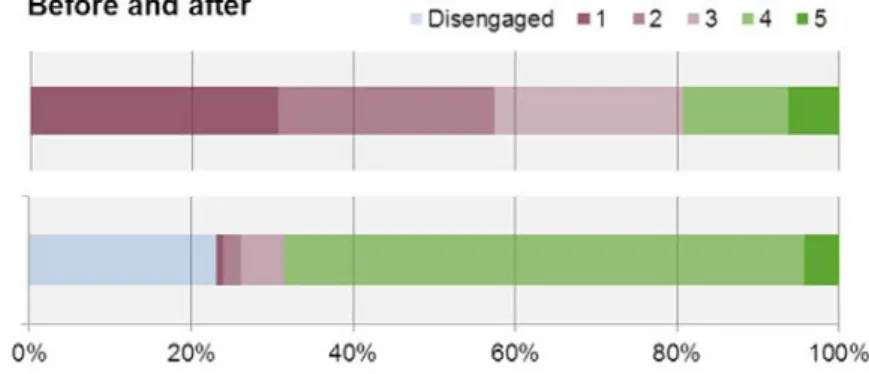
73 per cent were not able to manage monthly payments at initial assessment.
Following CAB support 67 per cent have improved skills and abilities.
How have CAB tackled this capability area?
Clients have been offered budgeting support either in group workshops or one-to-one sessions. These aim to enable individuals to successfully budget on a monthly basis and adapt their current money management techniques to suit the changes that will come. This might involve taking them
through the basics of how to construct a monthly budget by adjusting their current spending practice or starting from scratch. Such financial capability work is pre-emptive and proactive in its approach – aiming to address potential problems before they develop.
Another part of the pro-active preparation for monthly
payments is ensuring client financial health. Universal credit could, without the appropriate support and advice provision, worsen existing debt issues.
Therefore clients were also offered debt advice sessions, where necessary, on a one-to- one basis, to give them specific help to resolve any problematic circumstances and to inform them for the future.
Written support materials Budgeting
support
Debt advice Monthly
payments
Universal credit managing migration pilot final results | Citizens Advice Impact Team December 2013| 15
Overcoming barriers to managing monthly payments
CAB advice and support enabled clients to overcome potential barriers to managing monthly payments by providing:
• increased understanding of their income and expenditure
• ways to keep a better track of this on a monthly basis; and
• how budgeting on a monthly basis can be managed as a household.
After working with our clients 60 per cent (1,046 clients) are at four (out of five) on our capability scale, indicating that they ‘have a good idea of how much they spend as a household each month but do not always plan ahead’.
Challenges to improving client capacity
95 per cent agree that they would benefit from having the option of fortnightly payment arrangements to allow them to transition onto the new system.
Many clients already carefully manage income on a weekly and fortnightly basis. Moving to monthly payments, without careful adjustment, could be challenging.
This concern does not come from an inherent inability to budget or inflexibility. Instead, clients have already adjusted to managing on limited income and are afraid of changes to their coping mechanisms. Many clients state that the
changeover time is of particular concern. This could be aggravated by related factors, such as needing to support dependents or underlying disabilities.
Concerns highlighted to us and also mentioned during our surveying process indicate a lack of confidence in knowing when and how they will have to adapt, underscoring the need for support prior to and throughout the transition period.
Figure 1: How clients express the challenges around monthly payments
Universal credit managing migration pilot final results | Citizens Advice Impact Team December 2013| 16
Budgeting
Claimants will have greater responsibility under universal credit for managing their own finances – adapting to a monthly payment and also making direct rent payments from this to their landlord (if relevant). Therefore, it is imperative that claimants can budget
accordingly and are able to manage changes in their income, while maintaining payment schedules. Failing to pay priority bills could have severe consequences for the individual and household and there are also knock-on costs to society as a result.
What impact has our advice and support had on clients?
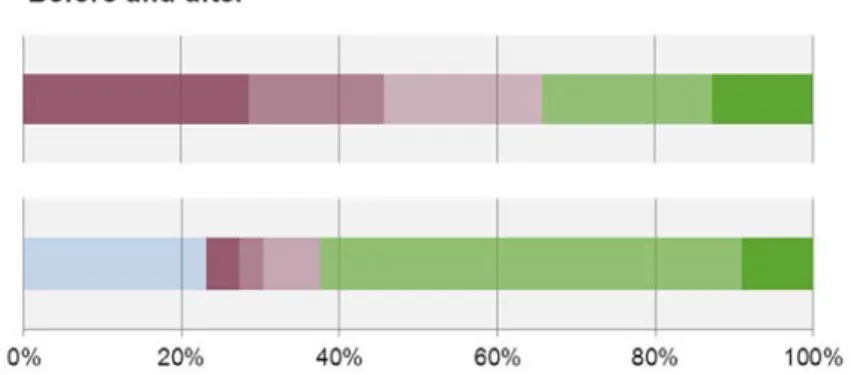
77 per cent were not able to manage changes in their money at initial assessment.
Following CAB support 67 per cent have improved skills and abilities.
How have CAB tackled this capability area?
Clients were offered budgeting support either in group workshops or one-to-one sessions. In general, during this pilot more one-to-one interventions were provided than is business as usual for CAB. Although they required additional resource, this type of session had the advantage of boosting client engagement rates and enabled CAB to provide help tailored to a client’s
specific situation.
Debt advice was also offered to clients, where
necessary, and one-to-one support in both these areas allowed the opportunity to provide support that
addressed short term and long term financial capability issues, in an integrated manner.
Furthermore, clients were also sometimes provided with specifically written support materials that illustrated ways to reduce spending drawing on local knowledge of relevant organisations and saving opportunities, such as Ynys Mon highlighting discounted food times at local supermarkets.
Written support materials Budgeting
support
Debt advice Budgeting
Universal credit managing migration pilot final results | Citizens Advice Impact Team December 2013| 17
Overcoming barriers to sustainable budgeting
CAB advice and support enabled clients to overcome potential barriers to budgeting by :
• providing an understanding of why they might run out of money and the implications of this
• enabling clients to make changes to the way they budget; and
• showing clients ways to save money or increase their income.
After working with our clients 62 per cent (1,076 clients) are now at four (out of five) on our capability scale, indicating that they ‘check out the best deals and have found ways to save money/increase money’. However it is yet to be proven whether clients stick to these goals and always maximise their potential income.
Challenges to improving client capacity
80 per cent agree that they would benefit from having the option of alternative payment arrangements for directly paying their rent at least during a transition period.
Many state they are only able to
‘sometimes’ manage currently tight budgets and the impact of further changes is worrying.
Individuals link their ability to cope with the degree of change or flux that they would have to deal with and whether or not they would have prior warning. For those that already have debts, money troubles or have
dependents this is likely to be compounded.
This highlights the need for support and timely information about changes as well as budgeting support to boost individuals’ confidence and capacity to adjust.
Figure 2: How clients express challenges around ‘budgeting’
Universal credit managing migration pilot final results | Citizens Advice Impact Team December 2013| 18
Banking
Under universal credit claimants’ payments will be paid into a bank account. They will need to be able to use banking services to make direct payments to their landlord. This is not possible for those that do not currently have or are unable to get a transactional bank account. It is also challenging for those that lack the necessary experience and
knowledge of how to manage such services.
We recognise that this later element, and how it overlaps with good financial capability and budgeting skills could undermine a client’s capacity to manage the responsibility of paying rent directly. At initial assessment of our clients found that 46 per cent were not equipped with the appropriate capabilities to manage monthly payments, budgeting or banking.
What impact has our advice and support had on clients?
52 per cent were not able to use an account to pay priority bills at initial assessment.
Following CAB support 70 per cent have improved skills and abilities.
How have CAB tackled this capability area?
Ensuring clients were aware of appropriate banking services available to them was part of our financial capability work – underscoring the interrelationship of effective banking with successful budgeting. To get the full benefits of having a bank account it must be used
responsibly and not endanger a client to potential financial difficulties or debt. CAB support may be in the form of ensuring clients know about services available to them, informing them about how to use their account’s
functionality or diagnosing reasons why a client might not be able to access a bank account.
Written support materials Budgeting
support (financial services)
Debt advice Banking
Universal credit managing migration pilot final results | Citizens Advice Impact Team December 2013| 19
Overcoming barriers to banking
CAB advice and support enabled clients to overcome potential barriers to banking by providing a:
• diagnosis of whether or not a client had the appropriate banking services
• explanation of priority bills and how to pay them; and
• support in setting up payment arrangements
After working with our clients 56 per cent (985 clients) are at four (out of five) on our capability scale, indicating that they ‘have setup payment arrangements for priority bills and know how to monitor them’. However clients may not have done this yet as they have no need until universal credit changes impact on them. This highlights the need for timely support.
Challenges to using banking services to manage payments
21 per cent would find income being paid into one bank account per household problematic
Some clients do not have access to a
transactional bank account, which would allow them to make direct debits or standing order payments. Others have not yet got such an account – and may need help in setting one up. The majority do have the right account but are not fully utilising it. Therefore, support is needed around ensuring all clients are financially included. Some need help in understanding how they can use direct debits and standing orders to manage their money. Others do not feel comfortable using
services that seemingly undermine their ability to directly control the money that comes out of their pocket. Money may be tight or they may fear becoming overdrawn and incurring charges showing how financial worries and a lack of budgeting support can impact on uptake of banking services. Moving away from existing coping mechanisms could lead to mismanagement of funds and stress for the individual if the necessary support is not in place.
Figure 3: How clients express the challenges around banking
Universal credit managing migration pilot final results | Citizens Advice Impact Team December 2013| 20
Staying informed
Universal credit comprises many changes to the way that benefits are paid. Claimants need to stay informed about these adaptations and how they affect them so that they can take the necessary steps to prepare and manage under the new system successfully. If claimants are not kept up to date their ability to make the behavioural changes necessary to successfully claim universal credit without problems or detriment is reduced.
Timely preparation and appropriate support are vital to ensuring that claimants are able to transition onto the adapted system as easily as possible and are able to successfully claim their benefit.
What impact has our advice and support had on clients?
81 per cent were not able to stay informed about the changes at initial assessment.
Following CAB support 68 per cent have improved skills and abilities
How have CAB tackled this capability area?
Benefits advice is a core aspect of CAB work and in this pilot we have delivered tailored advice on how universal credit will affect our clients and, where appropriate, produced written guidance materials on the changes.
To ensure that clients were given accurate and up-to- date information the CAB service invested the time and resources into fully training staff and volunteers to deliver the appropriate information. For example, Birmingham CAB delivered training workshops on the universal credit changes to 100 staff and volunteers before working directly with clients.
Delivering this advice has also provided clients with the opportunity to address other benefits-related support needs holistically. This has provided our CAB with an insight into the way that individuals can feel the cumulative effect of different changes to the welfare system and how this can have an impact on the way that they are able to manage multiple changes.
Staying informed
Written support materials Benefits
advice
Universal credit managing migration pilot final results | Citizens Advice Impact Team December 2013| 21
Overcoming barriers to staying informed about benefits changes
CAB advice and support enabled clients to overcome potential barriers by:• informing clients that the change will take place and providing specific information on the changes and how individuals will be personally affected; and
• highlighting sources of information and what a client can do to prepare.
After working with our clients 64 per cent (1,119 clients) are at four on our capability scale indicating that they ‘understand the changes that affect them, and know where to go for help (including useful websites)’ but might not yet know how to stay up-to-date.
Challenges to knowing how to prepare for universal credit
88 per cent believe that they have not yet been provided with enough information by Government or local authorities about the change.
The lack of information currently provided was frequently mentioned along with a degree of uncertainty about when and how claimants would be informed of changes. Many clients hoped that they would be provided with timely and specific information from DWP or their local authority, which would allow them time to prepare. This could act as a potential barrier to successful behaviour change.
Generally clients link their capacity to manage the changes with their ability to ask for assistance. The local CAB is noted by clients as a primary source of help, support and information that they would be able to access when they most need it. While many people highlight that they would like to receive written information from authorities on the changes, client comments and survey results indicate that people also want the safety net of being able to talk to a support agency directly about their particular situation or for help with forms and process. However a number of clients also noted underlying issues that will affect their ability to stay informed – including disability barriers, access to information and support services linked to rural isolation, as well as language and literacy issues.
Figure 4: How clients express the challenges around staying informed
Universal credit managing migration pilot final results | Citizens Advice Impact Team December 2013| 22
Getting online
Claimants will now have to make and manage their benefits claim online. This requires two main requirements from them – that they can access the internet to do this, and that they have the relevant capacity to fill out a complex online form and manage their claim.
Fundamentally, the skills needed to manage the administration of a claim are different from browsing the web or using social media.
Universal credit is aimed at simplifying the way that claims are made and reducing the costs of benefit administration to society, but claimants will need support to do this successfully.
What impact has our advice and support had on clients?
66 per cent were not able to get online to manage a claim at initial assessment.
Following CAB support 62 per cent have improved skills and abilities.
How have CAB tackled this capability area?
The resources to deliver digital assistance varied across bureaux, but we are able to utilise our diagnostic ability and key local partnerships to improve clients’ capacity to get online. For example, North Dorset were able to use their knowledge and links with existing local services, as well as those in development, to direct clients to the support relevant for their situation.
In this pilot bureau they identified client capacity, including noting issues around access or barriers to getting online and potential ways to improve this. They have provided written support materials and guidance where appropriate and referred or booked clients onto externally delivered online courses. Where resources have allowed bureaux have also provided specific one-to-one support to individuals on specific issues such as assistance in filling out an online form - a transferable skill highly relevant to universal credit.
Getting online
Written support materials Signposting
digital assistance
Universal credit managing migration pilot final results | Citizens Advice Impact Team December 2013| 23
Overcoming barriers to getting online to manage a claim
CAB advice and support enabled clients to overcome potential barriers by:• diagnosing whether or not someone has the capacity to get online – and if not, what is preventing them
• giving relevant information of how they can do this and signposting the necessary support to do this successfully and confidently.
53 per cent (932 clients) are at four (out of five) on our capability scale indicating that they
‘have been online to search, get information and carry out activities’ but might not be able to do this regularly without support.
Challenges to managing a claim online
Access can be a key obstacle with many clients not owning a computer and therefore being reliant on publically provided facilities such as libraries. This may be due to the expense or because their living
arrangements prevent gaining internet access. Many cite trust and privacy issues as barriers – either due to not wanting to input personal information in public surroundings or a fear of fraud and identity theft through using online services. For those in rural communities there might be underlying challenges to internet access such as broadband availability or a lack of transport options to get to public facilities.
For those that do have computers many cannot use them without support and are reliant on family or others for help. Being able to get online and actually manage a universal credit claim online is crucial. Many cite wanting to learn but need support to manage online.
Figure 5: How clients express the challenges getting online
Universal credit managing migration pilot final results | Citizens Advice Impact Team December 2013| 24
Implementing universal credit and the support required
Citizens Advice supports the principles of universal credit, believing that a well-
implemented system would have the advantage of simplifying this process for people, making it easier to understand and comply with. Claimants would only have to deal with one Government department, making the system more responsive and efficient in
adapting to changes in individuals’ circumstances, reducing the risk of delays in benefits being paid, or overpayment. Universal credit also has the potential of increasing the incentive to work, by making this more financially viable and attractive for people to increase their working hours, as well as more broadly reducing the complexities of working out whether claimants are better or worse off.
However, we also recognise that claimants may need support to successfully migrate to and manage under the new system. The pilot that we ran and the results presented clearly demonstrates this need. The services provided by our bureaux have come at a cost over and above the advice services we provide day by day.
The pilot found that around half of our existing client base will be affected by the roll out of universal credit. However, these clients are already accessing our advice services for a whole range of issues including, but not exclusively, benefits advice. Our existing advice services primarily concentrate on resolving the current problems and issues that clients present with. We envisage that this advice provision will continue through the roll out of universal credit and beyond. The pilot has identified that clients require additional personalised and tailored support to prepare them for transition. This will create new demand on our services which, if not met, may risk the displacement of others who rely on our advice services for a range of other issues and problems (approximately 50 per cent of our client base).
North Dorset Citizens Advice Bureau:
“Taking part in the Managing migration pilot has provided some invaluable learning for us.
We now know what infrastructure is needed to deliver a sustainable service which can cope with the demands created by welfare reform – both in terms of greater capacity and new mechanisms - to support claimants through the entire transition period.”
The learning from this pilot, alongside our geographical presence, trusted reputation and highly trained advisers puts us in a unique position to enable claimants to improve their capabilities for universal credit. However, additional investment is required to provide for the resources, infrastructure and training that is necessary to ensure a consistent and effective roll out of our support.
Our core costs for running the pilot are best expressed as per 100 clients. This recognises that no-one is average and within 100 clients a whole range of issues, capabilities and barriers are present. Our average cost per 100 clients was £9,400. This ranged between £5,200 and £12,000 per 100 clients.
The range of costs reveals a number of factors. Clients received a range of different interventions over the course of this pilot, and while the majority needed only one or two interventions, some required four or more. The pilot was also conducted over three distinct areas, Birmingham, North Dorset and Ynys Mon. Each has its own geographical, economic and societal profile, as do the clients that made up the pilot and made use of
Universal credit managing migration pilot final results | Citizens Advice Impact Team December 2013| 25
our services. We also recognise that each bureaux is its own independent charity and is funded, staffed and run in different ways, which can also have a bearing on costs.
We feel it is absolutely vital for the Government to provide additional funding to support those who will be transferred across to universal credit to prepare and improve their capacity to manage under the new system. The implications of not funding, or providing too little support would risk the successful delivery of universal credit. Our analysis shows that many clients are unlikely to manage, leading to financial difficulty and debt. It may also lead to a dramatic increase in enquires and casework for Jobcentre Plus to manage, leading to delays and a likely increase in Citizens Advice Bureaux reactionary work to help clients in crisis. We believe preventing a crisis is preferable to ‘curing’ an emergency.
Throughout the pilot it was our intention to establish the resources required to deliver effective support. A separate paper will be produced that will model our resource
requirements based on anticipated universal credit support needs and volumes, and local bureaux costs.
Universal credit managing migration pilot final results | Citizens Advice Impact Team December 2013| 26
Appendix: methodology
The Managing migration pilot was a project working with three bureaux (Birmingham, Ynys Mon and North Dorset) to understand the level of support clients will need in managing universal credit. These bureaux were chosen as they reflected the diverse nature of our service – operating in both rural and urban environments with differing client profiles and resources. During this time we worked with 1,746 clients from initial
assessment – with 1,342 going on to receive interventions at their bureau. This represents a statistically valid sample of the Citizens Advice service’s client base and their demographic profiling is representative of the client profile we see each year.
We operated a census-style surveying process over a three month period with every CAB client that came into our three pilot bureau over a set three month period asking whether they were in receipt of one of the benefits that would be affected by universal credit. If they were we identified them as ‘universal credit relevant’ and therefore applicable for this pilot.
Client
identification (March-June 2013)
If universal credit relevant each client completed an initial assessment that identified their capacity across the five capability areas measured in this pilot. They were scored on a standardised 1-5 scale for each area (details below), and bureaux offered CAB advice and support interventions to any clients with scores of equal or less than three in any area.
CAB advice and support interventions (July-
September)
After each intervention received clients were rescored on each capability area – using the same scoring process and scales as during their initial assessment. Bureaux also identified and recorded whether there were any barriers to the client progressing towards improved capability. The scores we have taken in this report are each client’s final capability reading as the last time they were in contact with the bureau, whether that is at their last intervention, during the follow-up survey or – if they disengaged – their initial and only scoring.
Client follow- up
(September- October)
We did not operate a sampling process for our follow-up survey but instead attempted to contact with each client that had an initial assessment. Following a
‘three strikes and out’ contact policy 329 clients responded and answered our survey.
This covered a final capability reading, identifying any further barriers and client perception of whether they will require additional support in managing the transition.
Our understanding of needing support: five capability areas
Our understanding in diagnosing the nature andlevel of support our clients will need is underpinned by our organisation’s wealth of theoretical and practical experience in financial capability and other areas.
We have created a capability scoring system that enabled our pilot bureaux to diagnose client capacity across five key aspects associated with universal credit and what the level and nature of support should be (assessed on a scale of 1-5).
This provided us with a standardised approach to supporting and addressing client needs, including
specific steps that have to be taken in order to move clients forward in their journey to self-sufficiency.
Universal credit managing migration pilot final results | Citizens Advice Impact Team December 2013| 27
By breaking down our client experience and capacity into this format we could identify those that needed support and worked with clients with scores equal to or less than level three in any capability area.
The five capability areas identified for universal credit and our scoring system
Monthly payments:
I am able to keep track of my money on a monthly basis.
(1) they do not know how much money is going out and coming in each month;
(2) they know what information is needed to keep track of money in and out but find it hard to do so; or
(3) they have a rough idea of what they spend each month as a household but need support.
(4) they have a good idea of how much they spend as a household each month but don’t plan further ahead;
(5) they always keep track of their household money in and out and plan ahead for changes
Budgeting:
I/we can manage changes in the money I receive
(1) they often run out of money and do not know what to do;
(2) they often end up borrowing money to cover living expenses; or (3) they try different things but do not feel they can make real changes.
(4) they check out the best deals and have found ways to save money / increase money;
(5) they always seek out the best deals and keep up to date with ways to manage our money effectively
Banking:
I use an account to pay priority bills on time
(1) they are not sure what priority bills are and/or the type of account needed for universal credit;
(2) they have the right account but do not know how to prioritise or pay their bills;
or
(3) they understand how to pay their bills but are not sure what to do if they do not have enough money to pay the costs.
4) they have set up payment arrangements for priority bills and know how to monitor their account
(5) they use their account to pay priority bills on the time and do not have any problems or concerns about this
Staying informed:
I get the help I need and can keep up to date
(1) they do not know about the changes that may be coming;
(2) they have had some information about changes but are not sure what they mean to them; or
(3) they understand the changes that affect them but are not sure what to do next.
(4) they understand the changes that affect them and know where to go for help including useful websites
(5) they understand the changes that affect them and know how to stay up to date with changes that may affect them
Getting online:
I can get online to manage a universal credit account
(1) they do not know how to get online and manage their benefits claim online;
(2) they have received information of how to get online and what they will have to do but need support; or
(3) they know how to get online and know the main risks/benefits of being online but need support
(4) they have been online to search, get information and carry out activities (5) they have online access and regularly go online to look at content and manage services
Universal credit managing migration pilot final results | Citizens Advice Impact Team December 2013| 28
Aims and principles
The Citizens Advice service provides free, independent, confidential and impartial advice to everyone on their rights and responsibilities. It values diversity, promotes equality and challenges discrimination.
The service aims:
• To provide the advice people need for the problems they face.
• To improve the policies and practices that affect people’s lives.
Citizens Advice
115-123 Pentonville Road London N1 9LZ
Telephone: 020 7833 2181 www.citizensadvice.org.uk www.adviceguide.org.uk
Citizens Advice is an operating name of The National Association of Citizens Advice Bureaux.
Registered charity number 279057.