❊♥s❛✐♦s ❊❝♦♥ô♠✐❝♦s
❊s❝♦❧❛ ❞❡
Pós✲●r❛❞✉❛çã♦
❡♠ ❊❝♦♥♦♠✐❛
❞❛ ❋✉♥❞❛çã♦
●❡t✉❧✐♦ ❱❛r❣❛s
◆◦ ✹✷✷ ■❙❙◆ ✵✶✵✹✲✽✾✶✵
❍②❜r✐❞ ❆✉❝t✐♦♥s ■■✿ ❊①♣❡r✐♠❡♥t❛❧ ❊✈✐❞❡♥❝❡
❋❧❛✈✐♦ ▼❛rq✉❡s ▼❡♥❡③❡s✱ ❏♦ís❛ ❈❛♠♣❛♥❤❡r ❉✉tr❛
❖s ❛rt✐❣♦s ♣✉❜❧✐❝❛❞♦s sã♦ ❞❡ ✐♥t❡✐r❛ r❡s♣♦♥s❛❜✐❧✐❞❛❞❡ ❞❡ s❡✉s ❛✉t♦r❡s✳ ❆s
♦♣✐♥✐õ❡s ♥❡❧❡s ❡♠✐t✐❞❛s ♥ã♦ ❡①♣r✐♠❡♠✱ ♥❡❝❡ss❛r✐❛♠❡♥t❡✱ ♦ ♣♦♥t♦ ❞❡ ✈✐st❛ ❞❛
❋✉♥❞❛çã♦ ●❡t✉❧✐♦ ❱❛r❣❛s✳
❊❙❈❖▲❆ ❉❊ PÓ❙✲●❘❆❉❯❆➬➹❖ ❊▼ ❊❈❖◆❖▼■❆ ❉✐r❡t♦r ●❡r❛❧✿ ❘❡♥❛t♦ ❋r❛❣❡❧❧✐ ❈❛r❞♦s♦
❉✐r❡t♦r ❞❡ ❊♥s✐♥♦✿ ▲✉✐s ❍❡♥r✐q✉❡ ❇❡rt♦❧✐♥♦ ❇r❛✐❞♦ ❉✐r❡t♦r ❞❡ P❡sq✉✐s❛✿ ❏♦ã♦ ❱✐❝t♦r ■ss❧❡r
❉✐r❡t♦r ❞❡ P✉❜❧✐❝❛çõ❡s ❈✐❡♥tí✜❝❛s✿ ❘✐❝❛r❞♦ ❞❡ ❖❧✐✈❡✐r❛ ❈❛✈❛❧❝❛♥t✐
▼❛rq✉❡s ▼❡♥❡③❡s✱ ❋❧❛✈✐♦
❍②❜r✐❞ ❆✉❝t✐♦♥s ■■✿ ❊①♣❡r✐♠❡♥t❛❧ ❊✈✐❞❡♥❝❡✴
❋❧❛✈✐♦ ▼❛rq✉❡s ▼❡♥❡③❡s✱ ❏♦ís❛ ❈❛♠♣❛♥❤❡r ❉✉tr❛ ✕ ❘✐♦ ❞❡ ❏❛♥❡✐r♦ ✿ ❋●❱✱❊P●❊✱ ✷✵✶✵
✭❊♥s❛✐♦s ❊❝♦♥ô♠✐❝♦s❀ ✹✷✷✮
■♥❝❧✉✐ ❜✐❜❧✐♦❣r❛❢✐❛✳
Hybrid Auctions II: Experimental Evidence
¤
Joisa C. Dutra and Flavio M. Menezes
yEPGE/FGV
Praia de Botafogo 190, 11o. andar
Rio de Janeiro, RJ, 22253-900
Brazil
April 12, 2001
Abstract
In this paper we report the results of an experiment designed to ex-amine the properties of a hybrid auction - a Dutch-Vickrey auction, that combines a sealed bid …rst-price auction with a sealed bid second-price auc-tion. This auction mechanism shares some important features with that used in the sale of the companies constituted through the partial division of the Telebras System - the government-owned Telecom holding in Brazil. We designed an experiment where individuals participate in a sequence of independent …rst-price auctions followed by a sequence of hybrid auc-tions. Several conclusions emerged from this experimental study. First, ex-post e¢ciency was achieved overwhelmingly by the hybrid auctions. Secondly, although overbidding (with respect to the risk-neutral Bayesian Nash equilibrium) was a regular feature of participants’ bidding behavior in the …rst-price auctions — as it is commonly reported in most experimental studies of …rst-price auctions, it was less frequent in the hybrid auctions. By calibrating the results to allow for risk-averse behavior we were able to account for a signi…cant part of the overbidding. Finally, we compared the revenue generated by the hybrid auction with that generated by a standard …rst-price sealed bid auction and the results were ambiguous.
JEL Classi…cation: C72, C91, D44.
Keywords: experiments; hybrid auctions; expected revenue; e¢ciency.
¤We are thankful to the direct …nancial support provided by EPGE/FGV. Dutra also
ac-knowledges the …nancial support from CNPq and Menezes acac-knowledges the …nancial support from CNPq and ARC (Grant no. A000000055). We thank Aloisio Araujo, John Asker, Tim Cason, Simon Grant and Sergio Werlang for useful comments.
yCorresponding author: Flavio M Menezes. School of Economics (#26), Australian National
1
Introduction
There was a change in the perceived role of government in the last decades of the
twentieth century. This change brought about a worldwide privatization process
and major restructuring of infrastructure sectors such as electricity, gas
distribu-tion, and telecommunications. Auctions were one of the favored sale instruments
in the privatization process and auction-like markets were instrumental for the
introduction of competition in most restructuring processes.
Although auctions have been used since time immemorial, they have never
been used on such a scale before. By using insights from auction theory and
known properties of standard auction formats, such as the …rst-price, English
and Dutch auctions, several new auction formats were designed to deal with
speci…c concerns such as how to prevent collusive, predatory and entry deterring
behavior, to maximize e¢ciency (for example by allowing synergies to be realized)
or to maximize the number of potential competitors.
As an example, with asymmetric players, a sealed bid auction may attract
more bidders than an English auction as weaker bidders have a higher chance
of winning in the former than in the latter auction format. English auctions,
however, allow information to be revealed about other players’ signals. Klemperer
[15], for instance, follows along these lines to suggest an Anglo-Dutch auction,
a hybrid of the ascending and sealed bid auctions, that may perform better in
terms of the traditional concerns of competition policy.
In this paper we examine the properties of another hybrid auction - a
Dutch-Vickrey auction, that combines a sealed bid …rst-price auction with a sealed bid
second-price auction. This auction mechanism shares some important features
with the Dutch-Anglo mechanism used in the sale of the companies constituted
through the partial division of the Telebras System - the government-owned
Tele-com holding in Brazil. The sale represented a major step towards the
US$20 billion.
The Dutch-Anglo auction works as follows. Each buyer submits a sealed bid.
Once the highest bid is known, the bidder who submitted it wins if her bid is
higher than the second highest bid by more than a predetermined amount or
percentage. If at least one bidder submits a bid su¢ciently close to the highest
bid (that is, if the di¤erence between this bid and the highest one is smaller
than the predetermined amount or percentage) the quali…ed bidders compete in
an open ascending bid auction that has the highest bid of the …rst stage as the
reserve price. The quali…ed bidders include the one with the highest bid in the
…rst stage of the auction and those who bid close enough to her.
In a related paper Dutra and Menezes [7] develop a model that captures
some of the features of this hybrid auction. We model a situation where risk
neutral bidders compete in a two stage auction: a …rst price auction followed by
a Vickrey auction as a second stage when there are bids su¢ciently close to the
highest bid in the …rst stage. We consider a model in which potential buyers’
values have both a private and a common component. Special cases include
the independent private values model and the pure common values model. Of
course, with private independent values the Vickrey and the Ascending (English)
auctions are strategically equivalent and, consequently, so are the Dutch-Vickrey
and the Dutch-Anglo auctions.
For the case of a discrete distribution, we show that the hybrid auction
gen-erates more revenue than any standard auction. The reason is that one may view
this hybrid auction as a Vickrey auction with an endogenously set reserve price at
the …rst stage. Although this hybrid auction generates (weakly) less revenue than
the optimal auction, it has the advantage of being ex-post e¢cient. In contrast,
the optimal auction may not be ex-post e¢cient.
In this paper we report the results of an experiment designed to verify this
exper-imental session composed of three parts, with 45 subjects recruited from
under-graduate economic courses. During the experiment the subjects were allocated
in groups of three participants according to a predetermined rule. Each subject
participated in 18 auctions. In the …rst six auctions the subjects bid for a
…cti-tious commodity sold through a standard …rst price sealed bid auction. In the
next twelve auctions, a hybrid Dutch-Vickrey auction was used.
Several conclusions emerged from this experimental study. Firstly, ex-post
e¢ciency was achieved overwhelmingly by the hybrid auctions. Secondly,
over-bidding (with respect to the risk-neutral Bayesian Nash equilibrium) was a regular
feature of individual behavior in …rst-price auctions. Overbidding, however, was
less prominent in hybrid auctions. Finally, we compared the revenue generated
by the hybrid auction with that generated by a standard …rst-price sealed-bid
auction and the results were ambiguous.
The paper is organized as follows. In the next section we describe our
theoret-ical model and predictions of equilibrium behavior in the Dutch-Vickrey auction.
Section 3 contains the key points developed in the instructions to subjects,
to-gether with other signi…cant design features. Section 4 discusses the results and
in section 5 we comment on issues that need further investigation.
2
The Dutch-Vickrey Auction
Suppose that three risk neutral bidders compete for a single object, so that each
bidder i receives a signal vi and her …nal valuation is equal to u(vi) = vi: The
private values may take one of three values:
vi =fx0; x1; x2g; i= 1;2;3:
We suppose further that each player i knows her own private value, but knows
only that her opponents’ values are x0with probabilityp0; x1 with probabilityp1
The seller’s value for the single object is equal to zero.
Given symmetry, we can restrict attention to the problem faced by one of
the bidders, say bidder 1. Her goal is to choose a bid b(vi) that maximizes her
expected payo¤. Letv(t) represent thetth highest signal. Conditional on winning
the hybrid auction the expected pro…t of Bidder1who receives signalv1 and bids
b is given by
¼(v1; b(v1)) = Ej £
(v1¡b(v1)) 1fb(v1)>b(vj)+z;j6=1g ¤
+ (1)
+Ej h¡
v1¡v(2)¢1fv(2)<b(v1)<b(v(2))+zg i
:
wherez stands for the cuto¤ value. If the di¤erence between the two highest bids
is less than or equal to the predetermined amount z, the winner of the hybrid
auction is chosen in a Vickrey auction that takes place in a second stage. This is
expressed in the second expectation term in the right hand side of equation(1):
We focus on the symmetric equilibrium. Given the discrete nature of the
model, we characterize a mixed strategy equilibrium for this game; that is, for
each individual’s possible value, we compute the support and the associated
dis-tribution of the equilibrium bidding functions.
Proposition 1 The symmetric equilibrium bid strategies for the Dutch-Vickrey auction are as follows:
b(v1) =
8 > > > > > > > > < > > > > > > > > :
¢ x0 if v1 =x0;
¢ bid randomly in the interval £x0; b1
¤
according to the bid distribution function
G1(b) if v1 =x1;
¢ bid randomly in the interval £b1; b2
¤
according to the bid distribution function
G2(b) if v1 =x2;
where the expressions forG1(b); G2(b); b1andb2can be found in the
appen-dix. 1
1A complete proof can be found in Dutra and Menezes [7]. The exact values that hold for
These equilibrium bidding strategies imply the following
Proposition 2 The Dutch-Vickrey auction generates more expected revenue than any standard auction with a reserve price equal to the seller’s valuation.
Sketch of the Proof. The seller’s expected revenue is the di¤erence between the expected social value and the bidder’s expected return. The e¤ect of z is to
reduce the expected return to the bidders who have a value other than the lowest
and, therefore, to increase the seller’s expected revenue. The reason is that the
hybrid auction may be seen as a Vickrey auction with an endogenously set reserve
price. This generates more revenue than any standard auction with a reserve price
set at zero (that is, equal to the seller’s value).
3
The Design of the Experiment
Bidder i0s valuation for the object consists of a private valuev
i only. At the
be-ginning of the period (auction) the buyer receives an envelope with an enclosed
bidding form that contains her private value to the …ctitious commodity in the
current period. The subject is also informed that in each and every period her
opponents’ values to the item are independent draws from a …xed discrete
distri-bution. In particular, in each period each agent’s private value, vi, is the result
of a lottery that with probability 0:4 is 0, with probability 0:3 is R$3:00 and with probability 0:3 is R$6:00: When bidder i wins the auction, she receives a
net amount ofvi¡p;where pstand for the commodity price at the period. The
subjects’ pro…ts in the experiment are expressed in monetary values (“reais”, the
local currency).2
The recruiter accepted subscriptions of 50 students in order to make a
provi-sion for bankruptcies or no shows. After all subjects arrived, the 45 participants 2Kagel[13] points to a procedure called the binary lottery, introduced by Becker, Degroot
were distributed in 15 groups, according to a preestablished order. In order
to minimize interactions we implemented a …xed rotation rule such that no
in-dividual would be matched with any opponent more than twice in the whole
experiment. In each group a graduate student previously selected and trained
was responsible for the conduct of the auctions, acting as a monitor.
The instructions were divided into three parts, one for each part of the
ex-periment.3 After reading the instructions relative to each part, the subjects were
required to answer some questions in order to verify their understanding of the
experiment rules. Monitors evaluated subjects’ understanding of the game rules
by checking their answers to these hypothetical questions. Once all subjects
…nished reading the instructions and all questions were properly answered the
experimental session started.
The complete experiment consisted of three parts.
Part 1. In each of the 6 auctions that composed the …rst part of the experiment
a …ctitious commodity was sold through a …rst-price sealed bid auction. This is
of course equivalent to a hybrid auction with z= 0. At the beginning of a period
each subject knew only her value of the commodity - which was printed on the
bidding form - and the process by which others’ values were generated – that is,
through the lottery. The private values signals were independently and identically
distributed across subjects and periods and the procedure for generating them
was common knowledge.
There were no restrictions on bids values. In order to bid the subjects had
a R$10 credit that could be used during the experimental session.4 Once each participant’s cumulative losses surpassed this amount, they would refrain from
bidding. During the …rst part of the experiment the subject who submitted the
highest sealed bid won. In the event of a tie, the winner was chosen randomly 3Full instructions are available from the authors by request.
4For comparison purposes, R$10 is about two times what a typical student would pay for
with equal probability. At the end of a period, the monitor in charge revealed only
the …nal price and the identity of the winner so that the winner could update his
or her earnings in an enclosed worksheet. At the end of the experimental session
the subjects received their monetary rewards in cash.
Part 2. The second part of the experiment lasted from period 7 through 12.
In every period of this session the commodity was sold through a hybrid of
…rst-price sealed bid auction and Vickrey auction: the subject who submitted the
highest bid won if her bid was higher than the second highest bid by more than
R$1:00: If one or more subjects submitted a bid smaller than the highest bid by
up to R$1:00, they were quali…ed, together with the subject who submitted the
highest bid in the …rst price auction, to compete in a Vickrey auction that had
the highest bid of the …rst price auction as the reserve price. The winner of the
Vickrey auction was declared the winner, earning a pro…t equal to the di¤erence
between her value and the second highest bid in the Vickrey auction.5
Part 3. The third part of the experiment lasted from period 13 to 18. In this
part a second stage occurred if one or more subjects submitted a bid smaller than
the highest bid by up to R$1.50. Then the quali…ed bidders played a Vickrey
auction.
Subjects and Bankruptcies. We conducted the experiment with inexperienced
subjects recruited at undergraduate economic courses. The experimental session
…nished within two hours and subjects earned R$ 6.50 on average plus a R$10.00
show up fee. Their starting capital of R$10.00 provided some bu¤er against
bankruptcies; a subject would become bankrupt if her initial cash balance of
R$10.00 was depleted. Only one subject went bankrupt. Even though subjects
were told that once their losses surpassed R$10.00 they would not be allowed to
bid, we did not enforce this rule.6 Instead we let the other subjects that were 5The reason for ordering the treatiment in the order z= 0;1 and 1:5 was a practical one.
Since we wanted to shift people around to avoid repated interaction, this was the most e¢cient way to design the experiment.
matched with the bankrupt subject continue playing (only) to give them the
opportunity to make some money. However, the data from these auctions were
discarded.
4
Results
In this session we report on subjects’ bidding behavior on both the …rst-price and
the hybrid auctions. We also provide a comparison of the actual revenue
gener-ated by the di¤erent auction formats and report on the overwhelming evidence
of the ex-post e¢ciency property of the hybrid auctions.
4.1
Equilibrium
According to our equilibrium predictions subjects with a null private value should
bid 0; that isb(x0) =b =x0= 0 in all auctions mechanisms. Subjects receiving
a value x1 bid in the range
£
b; b1
¤
while subjects with a x2value bid in the range
£
b1; b2
¤
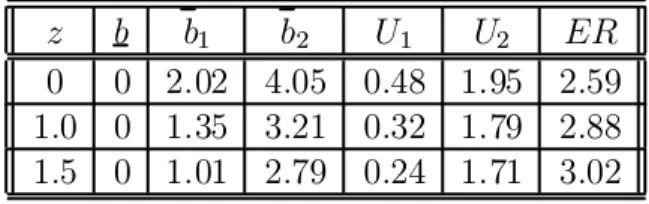
:>From now on we designate the hybrid auction with a R$1.00 cuto¤ by
hybrid-1 and the analogous auction with a R$1.50 cuto¤ by hybrid-2. Table 1
presents the exact values for the experimental session.
z b b1 b2 U1 U2 ER 0 0 2:02 4:05 0:48 1:95 2:59 1:0 0 1:35 3:21 0:32 1:79 2:88 1:5 0 1:01 2:79 0:24 1:71 3:02
Table 1: Exact Values
Table 1 also presents the expected payo¤ per auction under equilibrium play.
U1designates the expected pro…t to a winner with a value x1=R$3:00 whileU2
is the expected payo¤ when the winner’s value is R$6:00:
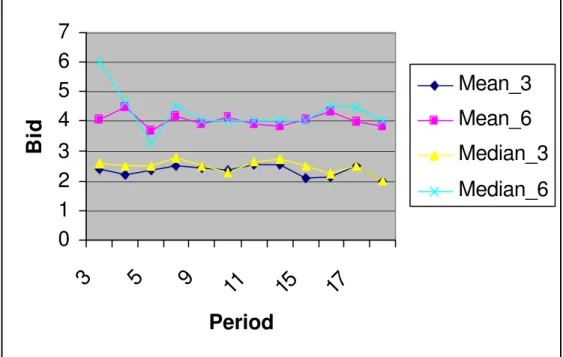
Figure 1 presents period-by-period bids for the whole experimental session
averaged over groups. When the value is R$0:00; there is occasional bidding above value, a phenomenon reported in the experimental literature. However,
looking at the data at an individual level one can verify that this behavior is
0
1
2
3
4
5
6
7
3
5
9
11
15
17
Period
Bid
Mean_3
Mean_6
Median_3
Median_6
Figure 1: Mean and Median Bids
0; their dominant strategy, when their private value was0. Nearly half of these
subjects bid higher than their dominant strategy only in the …rst-price sealed
bid auctions of the …rst part.
One concern is the properness of the equilibrium assumptions in the presence
of discernible time trends in the actual data. The existence of a time trend could
prevent beliefs from “settling down”. As suggested by Goeree, Holt and Palfrey
[9]we …tted a regression of average bids on time, pooled over all private values to
verify the possible existence of time trends in bid data. The time coe¢cient was
insigni…cant at a 10% level. Using the reciprocal of time, as suggested by Kagel
[13], we also estimated the coe¢cient of 1=t. We were unable to reject the null
hypothesis that mean bids were equal at a10%signi…cance level. In addition, we
estimated separate equations for each private value. The time coe¢cients were
all statistically insigni…cant.
Auction N N
3 15 14
4 18 14
5 12 10
6 13 14
9 16 9
10 13 16
11 14 16
12 13 10
15 16 13
16 14 12
17 13 18
18 14 16
ª The null hypothesis is that the empirical distribution agrees with the theoretical distribution of bids. *** indicates that the null hypothesis can be rejected with only a 0.01 chance of committing a type one error. ** indicates that the null hypothesis can be rejected with only a 0.05 chance of committing a type one error. * indicates that the null hypothesis can be rejected with only a 0.10 chance of committing a type one error.
Kolmogorov-Smirnov One Sample Test
0.50*** KS statistic ª (v=3) KS statistic ª (v=6)
0.53*** 0.15 0.60*** 0.26 0.32 0.33** 0.31 0.37** 0.32* 0.40** 0.42** 0.44*** 0.50*** 0.35* 0.25 0.71*** 0.75*** 0.83*** 0.76*** 0.54*** 0.38* 0.50*** 0.61***
Figure 2: Analysis of empirical distribution of bids under risk neutrality
the …rst two auctions from each part as the subjects were inexperienced. For
consistency, we also investigated the existence of a time trend in the …nal four
periods of each part. Again we found no evidence of a signi…cant time trend.
An individual bidder observes a private value and then computes a bid to
com-pete against the aggregate bid distribution that contains all the relevant strategic
information about her opponents’ bids. Using a Kolmogorov-Smirnov statistic we
tested the null hypothesis that the data were generated by our proposed
theoret-ical distribution. We decided to aggregate data over groups. For every period we
tested the null that for a given private value the empirical distribution of a set of
sample values (the observed bids in the period controlled by the subject’s value)
agrees with the corresponding theoretical distribution, as speci…ed in section 2.
Table 2 presents the results of the Kolmogorov-Smirnov tests applied to the
restricted data set.7 Observe that the …t is relatively worse in the …rst price
auctions and in the hybrid-1 auction when subject’s value is equal to R$3:00. It is a well documented fact in the experimental literature that market prices
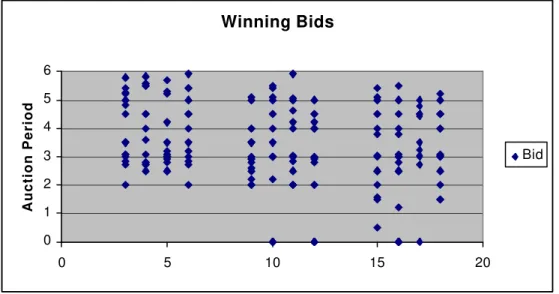
Winning Bids
0 1 2 3 4 5 6
0 5 10 15 20
Auction Period
Bid
Figure 3: Plot of the Winning Bids
librium (RNNE) prediction irrespective of the number of bidders in the auction or
the research group conducting the investigation.8 A naive plot of the bids points to a general overbidding pattern relative to the equilibrium prediction, detailed in
Table 1, as can be seen from Figures 4 and 5. This is consistent with risk averse
behavior. Some facts reinforce the explanation of this behavior in terms of risk
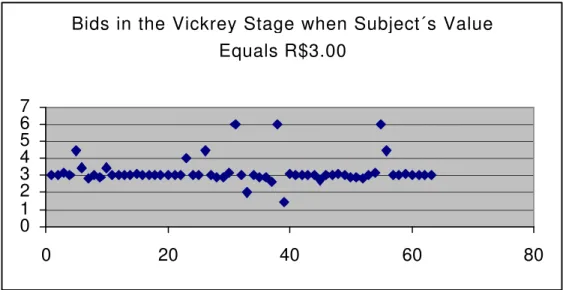
aversion. Bidding the dominant strategy in second price auctions is independent
of attitudes towards risk. Even though in the experimental session subjects were
not restricted to bid up to their private value, in general they did. Plots of the
bids in the contingent Vickrey stage present some adherence of subjects’ bids to
the dominant strategy, as can be seen by Figures 6 and 7. Additionally, we were
unable to reject the null hypothesis that mean bids were equal (using a simple
test of equality of means ) at a 5%signi…cance level. This suggests that subjects
follow their dominant strategy in the contingent Vickrey stage.
The examination of these …gures and of Table 2 allows one to infer that
deviations from this dominant strategy behavior are relatively more frequent for 8Cox,J.C., B.Roberson and V.L.Smith [4]; Kagel, J.H. and A.E. Roth. [14]; and Goeree,
Bids When Subject's Value is Equal to 3
0 1 2 3 4 5 6
0 5 10 15 20
Auction Period
Bid
Figure 4: First-price auction bids when subject’s value equals R$3.00
Bids When Subject's Value is Equal to 6
0 1 2 3 4 5 6
0 5 10 15 20
Auction Period
Bid
Bids in the Vickrey Stage when Subject´s Value Equals R$3.00
0 1 2 3 4 5 6 7
0 20 40 60 80
Figure 6: Bids in the Vickrey stage when subject’s value equals R$3.00
Bids in the Vickrey Stage when Subject´s Value Equals R$6.00
0 2 4 6 8
0 20 40 60 80 100
low value as compared to high value bidders. This supports Kagel and Roth’s
[14] examination of Harrison’s critique. Harrison [10] presents a methodological
critique of the evidence Cox, Smith and Walker[6]employ to reject RNNE bidding theory. He argues that under the typical payo¤ values employed the expected
cost of deviations from the RNNE is quite small, so that in terms of expected
monetary payo¤s many subjects had little to loose by deviating from the RNNE
strategy (that is, the payo¤ function around the maximum is ‡at).
Kagel and Roth [14] have examined some implications of Harrison’s critique. They present evidence that the greatest proportionate deviations from the RNNE
predictions are made by bidders who draw the lowest valuations by computing the
simple correlation coe¢cient between private values and the absolute value size
of the deviation from RNNE bidding relative to the underlying private valuation.
As these subjects have relatively smaller chances of winning the auction, their
expected cost of deviating from the Nash equilibrium is lower either if they are
risk neutral or risk averse. Our results are compatible with deviations from the
Nash equilibrium guided by risk aversion and low expected costs of deviating in
terms of expected payo¤.9
4.2
Revenue
Table 8 presents the expected payo¤ under equilibrium play as well as the mean
payo¤ observed in the experimental session controlled by the group private
val-ues’ con…guration. Given that values are drawn independently in each period
and, therefore, the composition of people having the same con…guration of
val-ues is changing at each round, there is no a priori reason to suspect that the
independence hypothesis has been violated.
Simple tests of equality of means were conducted in the data to verify the 9By stating that our results are consistent with Harrison’s critique we open the question of
Format
Observed Predicted Observed Predicted Observed Predicted Private Values ( P-values) ( P-values) ( P-values)
5.40 4.05 5.90 4.21 5.45 4.29
(n.a.) (n.a.) (n.a.)
5.67 4.05 4.85 4.21 5.46 4.29
(0.00) (0.43) (0.00)
5.24 4.05 4.54 4.21 5.57 4.29
(0.00) (0.31) (0.00)
5.10 4.05 3.83 4.21 3.90 4.29
(0.02) (0.40) (0.52)
3.95 4.05 4.01 4.21 4.13 4.29
(0.65) (0.38) (0.49)
4.13 4.05 4.13 4.21 4.26 4.29
(0.86) (0.87) (0.93)
2.65 2.52 3.00 2.68 3.01 2.76
(0.55) (n.a.) (n.a.)
2.40 2.52 3.00 2.68 3.00 2.76
(0.63) (n.a.) (0.00)
2.73 2.52 2.36 2.68 2.00 2.76
(0.06) (0.02) (0.03)
0.10 0.00 0.19 0.00 0.30 0.00
Hybrid-2 (6,6,6) (0,0,0) Expected Revenue (3,3,3) (3,3,0) (3,0,0) (6,6,3) (6,6,0) (6,3,3) (6,0,0)
First Price Hybrid-1
(6,3,0)
Figure 8: Observed and predicted revenue under risk neutrality
adherence of observed to predicted revenue. These results are also presented in
Table 8. As can be inferred from the data, in going from the second to the
third part, that is from the hybrid-1 to the hybrid-2 auction format, the observed
mean revenue increases, as expected. However, in the …rst price auctions the
mean observed revenue is higher than predicted for some values’ con…gurations.
One could argue that in the initial periods subjects could be bidding too high
due to their inexperience. According to Kagel [13], one must …nd an explanation
that works consistently across di¤erent treatment conditions before one could
relate the overbidding pattern in the …rst price auctions to risk aversion. We
have already veri…ed that in the second price auctions of the contingent second
stage the bidding pattern was consistent with risk aversion. In the next
subsec-tion we investigate the explanatory power of the risk aversion assumpsubsec-tion in the
alternative conditions of our experiment.
As the tendency for subjects to “overbid” in …rst price auctions is commonly
rationalized in terms of risk aversion (as in Cox, Smith and Walker, [5]), we
extended the hybrid auction model to the case in which a buyer i who values
the commodity at vi and purchases a single item at a price p receives a Von
Neumann utilityu(vi¡p), normalized so thatu(0) = 0:Conditional on winning
the auction, the expected payo¤ of Bidder 1who observes a private valuev1 and
bids b in the …rst price auction of the …rst stage is given by:
¼(v1; b(v1)) = Ej £
u(v1¡b(v1)) 1fb(v1)>b(vj)+z;j6=1g ¤
+ (2)
Ej h
u¡v1¡v(2)¢1fv(2)<b(v1)<b(v(2))+zg i
considering that in the contingent Vickrey Stage bidding one’s value remains a
bidder’s best response even under risk aversion. The property of an increase
in the expected revenue relative to standard auction institutions extends to the
present setting.10
It is a well known fact in the auction literature that under risk aversion the
expected revenue in the …rst price auction is higher than in the oral auction in
the private values case. It turns out that under risk aversion the equilibrium bids
distributions in the hybrid auction stochastically dominate the corresponding
distributions in the risk neutral case.11 Intuitively, in the present setting risk aversion induces a bidder to bid higher in the …rst price auction stage. Given
our interpretation that the hybrid auction amounts to a Vickrey auction with a
reserve price endogenously set, the e¤ect of risk aversion is to increase this reserve
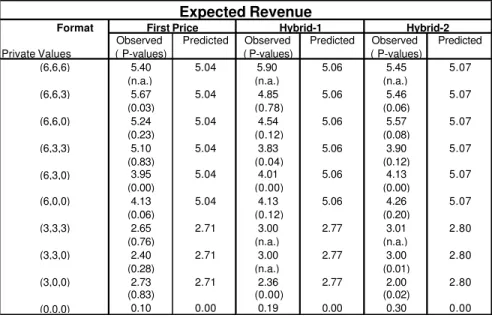
price. Comparing Tables 8 and 9 one can see that risk aversion implies a larger
increase in the expected revenue from the …rst price auction relative to the hybrid
auction.
We …tted alternative models corresponding to CARA (constant absolute risk
aversion) and CRRA (constant relative risk aversion) utility functions with dif-10See Dutra and Menezes[7]for details.
ferent risk aversion parameter values. The best …t corresponds to the utility
function u(x) = x1¡s; when s = 0:45:12 The fact that the overbidding is
rel-atively more pronounced between low value bidders corroborates our choice of
a utility function showing decreasing absolute risk aversion. This is compatible
with the experimental literature.
According to McAfee and Vincent[16] there is a general acceptance that
in-creasing absolute risk aversion is an unsatisfactory characterization of attitudes
towards risk. Goeree, Holt and Palfrey[9] report a risk aversion parameter esti-mate of 0.52 to their data set. Harrison [11] presents a risk aversion parameter
estimate of ri = 0:45 for the utility function ui(yi) = yri that implies “virtual
equality” between observed and predicted behavior in the data from a four
sub-jects experiment from Cox, Roberson and Smith [4].
Goeree, Holt and Palfrey [9] argue that there is some consistency in bidding
behavior across many auctions with varying number of bidders, and value
struc-tures, and that behavior is consistent with a simple model of risk aversion.13
Table 9 presents the expected payo¤ under equilibrium play for the preferred
speci…cation. The adherence of observed to predicted revenue is examined using
tests of equality of mean. Table 10 reports the Kolmogorov Smirnov statistic for
the model with risk averse bidders. The agreement between the empirical
distri-bution of bids and the equilibrium bids distridistri-bution denotes some improvement
when confronted to the risk neutral case. That is, the evidence we have is that
the model with risk aversion has a better …t to the experimental data. However,
like Goeree, Holt and Palfrey [9], we share Friedman’s [8] belief that one has to be careful when specifying a utility function parameter that has the e¤ect of
pushing predictions in the direction of the observed data. Our results imply only 12We …tted the model with the utility functions u(x) = 1 ¡ exp[¡ax]; u(x) =
(1=(1¡a)) (1 +x)1¡a
and u(x) = x1¡s
for di¤erent values of the a ands parameters. The results can be obtained upon request.
13Further references can be found in Chen and Plott [2], Cox and Oaxaca [3] and Holt and
Format
Observed Predicted Observed Predicted Observed Predicted Private Values ( P-values) ( P-values) ( P-values)
5.40 5.04 5.90 5.06 5.45 5.07
(n.a.) (n.a.) (n.a.)
5.67 5.04 4.85 5.06 5.46 5.07
(0.03) (0.78) (0.06)
5.24 5.04 4.54 5.06 5.57 5.07
(0.23) (0.12) (0.08)
5.10 5.04 3.83 5.06 3.90 5.07
(0.83) (0.04) (0.12)
3.95 5.04 4.01 5.06 4.13 5.07
(0.00) (0.00) (0.00)
4.13 5.04 4.13 5.06 4.26 5.07
(0.06) (0.12) (0.20)
2.65 2.71 3.00 2.77 3.01 2.80
(0.76) (n.a.) (n.a.)
2.40 2.71 3.00 2.77 3.00 2.80
(0.28) (n.a.) (0.01)
2.73 2.71 2.36 2.77 2.00 2.80
(0.83) (0.00) (0.02)
0.10 0.00 0.19 0.00 0.30 0.00
(6,6,6) (6,6,3) (6,6,0) (6,3,3) (3,3,3) (3,3,0) (3,0,0) (0,0,0) (6,0,0) (6,3,0) Expected Revenue
First Price Hybrid-1 Hybrid-2
Figure 9: Observed and Predicted Revenue under Risk Aversion -(u(w) =w0:55)
that in the experimental session subjects behaved “as if” they were risk averse.
5
Hybrid Auctions
>From auctions 7 to 18 a hybrid auction was played in each group in every
period, totalling 180 auctions. Of these, 84 required a Vickrey stage. In 27 of
these auctions the winner in the Vickrey stage was not the subject who submitted
the highest bid in the …rst price auction of the …rst stage. We suspect that one
type of behavior that could emerge in hybrid auctions is that, motivated by a
conservative bid from the high value subject, a bidder with a value di¤erent from
the highest value may have incentives to outbid a high value subject, hereby
winning the auction in the …rst stage. This happened in only 7 auctions. Within
these 7 auctions, 5 showed the highest value bidder winning the auction - as
predicted - in the second stage. In all 27 Vickrey stage auctions, the second stage
implied an increase in the seller’s revenue. Table 11 presents the total number of
auctions and the frequency with which a Vickrey stage took place, for periods 9
Auction N N
3 15 14
4 18 14
5 12 10
6 13 14
9 16 9
10 13 16
11 14 16
12 13 10
15 16 13
16 14 12
17 13 18
18 14 16
ª The null hypothesis is that the empirical distribution agrees with the theoretical distribution of bids. *** indicates that the null hypothesis can be rejected with only a 0.01 chance of committing a type one error. ** indicates that the null hypothesis can be rejected with only a 0.05 chance of committing a type one error. * indicates that the null hypothesis can be rejected with only a 0.10 chance of committing a type one error.
0.40** 0.25
0.39*** 0.36**
0.43** 0.47**
0.46*** 0.22
0.31* 0.44**
0.34
0.35** 0.26
0.23 0.25
0.35** 0.31*
0.49*** 0.33**
Kolmogorov-Smirnov One Sample Test KS statistic (v=3) KS statistic (v=6)
0.34* 0.19
0.15 0.28*
0.46***
Figure 10: Analysis of empirical distribution of bids under risk aversion
Traditional concerns of competition policy, such as entry deterring behavior,
are among the most prominent questions of auction design. There is a strong
presumption in ascending auctions that the bidder who values the commodity
the most will win the auction. Even if she is outbid in early stages, she can
eventually reverse this scenario. So other bidders, who believe themselves not
having a chance to win the object, might have reduced incentives to enter the
bidding.
On the other hand, sealed bid auctions may attract a larger number of bidders
as the chances of winning might be higher. However, there is a trade-o¤ in terms
of e¢ciency: a sealed bid auction has a relatively smaller ability to give the
commodity to the high value bidder as compared to open ascending bid auctions.
The experimental data indicated that this phenomenon did not occur in the
hybrid auction mechanism.
5.1
E¢ciency
One strategic complication introduced by a hybrid auction is the possibility that
Auction Format Total Total
Private Values Auction 9 10 11 12 15 16 17 18
(6,6,6) Vickrey Stage 1 1 1 1 2
Number of Auctions 1 1 1 1 2
(6,6,3) Vickrey Stage 2 1 3 1 2 2 1 6
Number of Auctions 2 1 3 1 2 3 1 7
(6,6,0) Vickrey Stage 1 1 2 1 5 0 1 1 2 4
Number of Auctions 3 2 3 2 10 2 1 2 2 7
(6,3,3) Vickrey Stage 0 2 0 1 3 1 1 1 3
Number of Auctions 1 2 1 1 5 2 2 1 5
(6,3,0) Vickrey Stage 0 1 1 0 2 3 2 1 2 8
Number of Auctions 2 5 3 3 13 4 4 2 6 16
(3,3,3) Vickrey Stage 1 1 2 2
Number of Auctions 1 1 2 2
(3,3,0) Vickrey Stage 3 1 1 2 7 2 3 0 1 6
Number of Auctions 3 1 1 3 8 2 3 1 1 7
(6,0,0) Vickrey Stage 0 0 0 0 0 0 0
Number of Auctions 1 1 2 4 1 1 2
(3,0,0) Vickrey Stage 1 0 0 1 1 0 0 1
Number of Auctions 6 3 2 11 3 2 3 8
(0,0,0) Vickrey Stage 2 2 4 3 1 4
Number of Auctions 2 2 4 3 1 4
Vickrey Stage 5 9 7 6 27 8 13 7 8 36
Number of Auctions 15 15 15 15 60 15 15 15 15 60 Hybrid 2
Hybrid -1
Figure 11: Frequency of Ocurrence of Vickrey Stage
Private Values FPA Hybrid-1 Hybrid-2 (6,6,6) Bid 5.50 5.90 3.03
Price 5.50 5.90 5.27
(6,6,3) Bid 5.60 4.50 4.51
Price 5.60 5.00 5.62
(6,6,0) Bid 5.35 4.35 4.51
Price 5.35 4.80 5.90
(6,3,3) Bid 5.25 3.50 3.01
Price 5.25 3.50 3.76
(6,3,0) Bid 3.55 4.01 3.90
Price 3.55 4.01 4.50
(6,0,0) Bid 3.5 4.25 4.26
Price 3.5 4.25 4.26
(3,3,3) Bid 2.65 2.85 2.50
Price 2.65 3.00 3.01
(3,3,0) Bid 2.51 2.90 2.51
Price 2.51 2.95 2.99
(3,0,0) Bid 2.80 2.20 2.25
Price 2.80 2.02 2.25
Median Bid and Prices by Auction Format
equilibrium predictions presented in Table 1. This might result in an ine¢cient
outcome: a subject with a private value distinct from the highest one could have
incentives to outbid a higher value bidder winning the auction in the …rst stage.
Out of the 270 auctions conducted in our experimental session, 9 resulted in
an ine¢cient outcome: 4 …rst-price auctions, 1 hybrid-1 auction and 4 hybrid-2
auctions. In three of the four hybrid-2 ine¢cient auctions the winner submitted
a bid higher than his value in the Vickrey stage. In the other hybrid-2 ine¢cient
auction and the hybrid-1 ine¢cient auction, a bid higher than the subject’s value
was submitted in the …rst price auction. In 8 out of these 9 ine¢cient auctions the
winner incurred in loss. So only one auction was characterized by an ine¢cient
outcome that can not be interpreted as a mistake. The achieved e¢ciency level
of the experimental session is higher than 96%.
6
Conclusion and Directions of Further Research
In this paper we developed and implemented an experimental design to
investi-gate a hybrid auction, similar to that used in the sale of the Brazilian Telecom
Company. This hybrid format has achieved e¢cient outcomes and induced less
overbidding (with respect to the risk-neutral Bayesian Nash equilibrium) than
…rst-price auctions. Calibrating the experimental results for risk aversion seems
to explain a signi…cant part of the overbidding. Finally, the revenue
compari-son between the hybrid auction and the standard-…rst price auctions has proven
ambiguous, although an increase in the parameter z has shifted the expected
revenue in the predicted direction. These conclusions indicate several questions
that need further investigation. Natural extensions include the introduction of a
continuous distribution of types, the use of an open auction in the second stage
when valuations are not independent, the introduction of asymmetric players,
.1
Equilibrium expressions for the experimental session.
b1=
¡
(x1¡z) (p0+p1)2¡(x1¡x0¡z)p20
¢
(p0+p1)¡2
G1(b) = +
h¡
(2 (x1¡b)p0p1)2+ 4 (x1¡b) (b¡x0¡z) (p0p1)2
¢0:5
¡2 (x1¡b)p0p1]
£
2 (x1¡b)p21
¤¡1
b2= (x2¡z)¡
¡
x2¡b1¡z
¢
(p0+p1)2
G2(b) =
¡
2 (x2¡b)p22
¢¡1
[¡(2 (x2¡b) (p0+p1)p2)
£
(2 (x2¡b) (p0+p1)p2)2¡4 (x2¡b)p22
£
(x2¡b)¡
¡
x2¡b1¡z
¢¤
(p0+p1)2
¤0:5i
For further references see [7].
References
[1] Becker, G. M., M. H. DeGroot and J. Marschak (1964), “Measuring Utility
by a Single-Response Sequential Method, ” Behavioral Science 9,
pp.226-232.
[2] Chen, Kay-Yut and Charles R. Plott (1998), “Nonlinear Behavior in Sealed
Bid First-Price Auctions,” Games and Economic Behavior, 25, pp. 34-78.
[3] Cox, J. C., and Ronald L. Oaxaca (1996) “Is Bidding Behavior Consistent
with Bidding Theory for Private Value Auctions,” in R. M.Isaac, ed.
Re-search in Experimental Economics, Vol. 6, Greenwich, Conn.: JAI Press,
131-148.
[4] Cox, J.C., B.Roberson and V.L.Smith. (1982). “Theory and behavior of
single object auctions.” In Research in Experimental Economics, Vernon L.
[5] Cox, J.C., V.L.Smith and James M. Walker (1988), “Theory and Individual
Behavior in First Price Auctions,” Journal of Risk and Uncertainty 1, pp.
61-99.
[6] Cox, J.C., V.L.Smith and James M. Walker (1992), “Theory and
Misbe-havior of First-price Auctions: Comment,” American Economic Review 82,
pp.1392-1412.
[7] Dutra, J. C.and F. M. Menezes, (2000). “A Hybrid Auction: Combining
Sealed Bid and Ascending Auctions.” Mimeo.
[8] Friedman, Daniel (1992), “Theory and Misbehavior of First-price Auctions:
comment.” American Economic Review 82, pp.1374-1391.
[9] Goeree, Jacob K., Charles A. Holt and Thomas R. Palfrey, (2000), “Quantal
Response Equilibrium and Overbidding in Private-Value Auctions.” Caltech,
Mimeo. Available at http://www.hss.caltech.edu/~trp/rev.pdf.
[10] Harrison, G.W. (1989), “Theory and Misbehavior of First-price Auctions,”
American Economic Review 79, pp.749-62.
[11] Harrison, G.W. (1990), “Risk Attitudes in First-Price Auction Experiments:
A Bayesian Analysis,” The Review of Economics and Statistics, pp. 541-546.
[12] Holt, Charles A. and Roger Sherman (1997) “Naive Bidding and the
Win-ner’s Curse in Auctions with Independent Common Value Componentes,”
Discussion Paper presented at the 1995 CREED Conference on Experimental
Economics, Amsterdan.
[13] Kagel, John (1995) “Auctions: a survey of experimental research, ” in J.
Kagel and A. Roth (eds.), Handbook of Experimental Economics, Princeton:
[14] Kagel, J.H. and A.E.Roth (1992), “Comment on Harrison versus Cox, Smith
and Walker: theory and misbehavior in …rst-price auctions,”American
Eco-nomic Review 82, pp. 1379-1391.
[15] Klemperer, P. 2000. “What Really Matters in Auction
De-sign”. Mimeo, Nu¢eld College, Oxford University. Available at
www.nu¤.ac.uk/economics/people/klemperer.htm.
[16] McAfee, Preston and Dan Vincent (1993), ”The Declining Price Anomaly,”
Journal of Economic Theory 60, pp. 191-212.
[17] Siegel, S. (1956), Nonparametric Statistics for the Behavioral Sciences.