.~ ~FUNDAÇÃO
. " GETUUO
VAR.GAS EPGEEscola de Pós-Graduaçao em Economia
,
SEivlINARIOS
DE PESQUISA
, .ECONOMICA
"Social
N
orms and Money"
Prof. Luis Araujo
(PUCIMG)
LOCAL
Fundação Getulio Vargas
Praia de Botafogo, 190 - 10" andar - Auditório- Eugênio Gudin
DATA 06/07/2000 (5" feira)
HORÁRIO 16:00h
Social Norms and Money*
Luis Araujo
Catholic University-MG
and
University of Pennsylvania
June5, 2000
Abstract
In an economy where there is no double coincidence of wants and without record-keeping of past transactions, money is usually seen as the only mechanism that can support exchange. In this paper, we show that, as long as the population is finite and agents are sufficiently patient, a social norm establishing gift-exchange can substitute for money. Notwithstanding, for a given discount factor, the growth of the population size eventually leads to the breakdown of the social norm, while money still works.
1
Introduction
The reasons for the existence of money and how it emerged in the economy are fundamental
questions in monetary theory but only recently have they been addressed in a systematic
way. In the work of Kiyotaki and Wright (KW) (1989, 1991, 1993) and the large literature
that followed their initial idea, the answer they give for the existence question is: money
exists to play the role of a medium of exchange. However, there are other mechanisms (or
institutions) in society that can also play the role of a medium of exchange. Kocherlakota
(1998a ,1998b) shows that every allocation that can be attained with money can be attained
"I am specially grateful to Randall Wright. Iam also in debt with Jan Eckoout, George Mailath, Andrew Postlewaite, Braz Camargo, Hamning Fang and Brandon Weber.As usual the remaining mistakes are mine.
with memory as long as there is perfect record-keeping of past transactions. Moreover, as
it will be demonstrated latter, a norm establishing gift-exchange can also be a substitute of
money.l
Memory is excluded, by construction, from the environment considered by KW. Despite
departing from the Walrasian Economy in the sense that they make the exchange process
non-trivial, they still preserve the anonymous market as the lo cus of trade. Hence since
agents are indistinguishable from one another at all times, there is no scope for exploiting
the history of past transactions.
Our objective is not to reject the idea that money actually plays the role of a medium of
exchange. This is an obvious feature of modem societies and we believe that the KW
envi-ronment captures in a natural and sim pIe way the fact that money overcomes the difliculties
of the exchange process in these societies. Our concem is the study of the conditions under
which altemative ways of addressing the exchange problem survive (or not). By considering
this problem, we can have better insight into the reasons money emerged as the dominant
mechanism.
In the next section, it will be discussed first the conditions under which memory can be
used in the KW environment as long as there is a perfect record-keeping of past transactions.
But our main concem is the analysis of an equilibrium with gift-exchange in the standard KW
environment (i.e., without record-keeping of past transactions). The main result establishes
that money is not essential as a medium of exchange device in small populations but it is
essential in a large population environment.2
2 The Model
lThe reference paper on norms, though not related to Monetary Theory, is Kandori (1992). See also
Ellison (1994) and Okuno-Fujiwara & Postlewaite (1995).
2.1
Memory
There is an economy with a continuum of infinitely-lived agents of k different types, and
with k distinct indivisible goods.3 Following KW (1989) assume that a type j agent only
consumes good j, which yields utility u, and produces good j
+
1 (modulo k) at a cost ofc (with u
>
c). Hence, as long as k>
2, there is no double coincidence of wants. At everydate, each agent enters the exchange sector and interacts with others under a uniformly
random matching technology; that is, there is a probability
í
that agent type j will meet,. for example, an agent type m. Finally, the agents discount the future with a discount factor
13·
Suppose that this economy has a record-keeping device that keeps track of all its
transac-tions, with this device being common knowledge across the agents. Under these assumptions
consider an exchange rule stating the following (denote it rule 1): every time an agent meets
another who likes his good he produces the good for him, as long as everyone has done so
in the pasto If any agent deviates, the economy reverts to autarky.4
Note that autarky is always an equilibrium in this economy. But we will show that the
above rule is an equilibrium that will make every agent better off than in autarky. Clearly,
this rule is efficient.
Lemma 1 I]
13
~ Ck~~-C' the strategy profile associated with the exchange rule stated above(rule
1)
constitutes a sub-game per]ect nash equilibrium.Proof. Let Vc be the expected payoff of the strategy profile on the equilibrium path and
Va = O the value function in autarky. The basic incentive to consider here is the incentive
for agent j to give the good after meeting agent j
+
1 (module k) for the first time: Sincethe environment is stationary, if the agent decides to cooperate for the first time, given that
the others are following the described ruIe, he will always cooperate. If he gives the good
he receives
-c+
f3Vc.
If the agent does not cooperate he will receive Va = O. We have thatcooperation is optimal after a first meeting whenever -c
+
f3Vc
~ c. One can calculate:3The assumption of indivisible goods is made only for simplicity, the results hold as well in the divisible good case.
4 A more formal way of stating this rule is: If agent type j meets an agent type j
+
l(modulo k), he willproduce one unit of the good and give it to j. If he meets an agent type j - l(modulo k), the latter will
produce one unit of the good and give it to j. In any other situation, there is no exchange at alI. Finally, if any agent deviates from this rule the economy reverts to autarky foreverj that is, there is no more exchange.
1 1 k - 2 1 (u -
c)
Vc
=
k(u+
,8Vc)+
k( -c+
,8Vc)+
-k-(Ü+
,8Vc)==>
Vc=
(1 _ ,8) kHence, the agent will cooperate if and only if:
,8
>
ck- ck
+
u - c-A natural question that arises from the previous lemma is whether it is reasonable to
imagine such a stringent rule. After all, if society has full information regarding past trans- .
actions, why not retaliate against only the deviating agent, instead of the whole community?
With this is mind the following result can be generated that implements the same exchange
pattern with a more reasonable rule (rule 2), which is the following: every time an agent
meets another who likes his good he produces the good to him, as long as everyone has done
so in the pasto If any agent deviates, he doesn't receive goods anymore.
Lemma 2 lf,8 ~ Ck~~-c' the strategy profile associated with the exchange rule stated above
(rule 2) constitutes a sub-game perfect nash equilibrium.
Proof. The proof is a straightforward modification of lemma 1 and hence is omitted. _
We can also modify the rule that implements this effi.cient outcome by allowing the
possibility of forgiveness, i.e., that punishment occurs for only a finite time. The rule (rule
3) in this case is: every timé an agent meets another who likes his good he produces the
good to him, as long as everyone has done so in the pasto If any agent deviates, he doesn't
receive any good during T periods and then he is forgiven. A similar result arises:
Lemma 3 For every T ~ 1, if ,8(1 - ,8T) ~ ck~~-C' the strategy profile associated with rule
Proof. Now, ifthe agent deviates, he receives
O+,8V
f , whereV
f indicates the punishmentand forgiving norm. We have that Vf = 0+
,8TVc.
Hence, he will cooperate whenever,8(1 -
,8T)
>
U+C,Ll)'
Clearly, there will be no deviations off the equilibrium path.-Note that the discount factor needed to guarantee cooperation in lemma 3 is bigger than
in lemmas 1 and 2, since now the cost of a deviation is smaller. Of course, when T goes to
infinity, the value of ,8 in lemma 3 approaches that in the previous ones.
The objective of the analysis so far is to introduce the idea that equilibrium strategies can
be seen as the result of rules in a society, and the three different lemmas try to capture the
diversity of rules that can arise. The problem with this approach is that the result completely
depends upon perfect record-keeping of past transactions and this is not a very reasonable
assumption. In this sense, the results above are basically the same as those obtained by
Kocherlakota (1998a) using gift-exchange strategies (actually, the gift-exchange procedure
can always be thought of as coming from a rule). In the next model, the assumption of perfect
record-keeping will be relaxed and it will be shown that exchange still can be implemented.
With this result the contrast between an environment where cooperation is supported by
the exploitation of the history of the transactions and one where cooperation is supported
by the existence of a norm will be made clear.
2.2
Social N orms
In what follows we are going to use the notion of a contagious equilibrium developed
by Kandori (1992).5 Under a uniform random matching technology, Kandori shows that
cooperation can be obtained in a one-shot prisoner's dilemma with a social norm establishing
that: " .... a single defection by a member means the end of the whole community trust, and a
player who sees dishonest behavior starts cheating all of his opponents. As a result, defection
spreads like an epidemic and cooperation in the whole community breaks down." (1992, page
69). The contagious defection differs from the rules of punishment considered in the previous
section because it is not personalized and it cannot be personalized (since there is no
record-keeping of transactions). Upon seeing a defection, an agent punishes the whole community,
and this is why such a pattern is well represented by the idea of a social norm.
This structure of punishment will be used to prove the main resulto For this to be
possible, two additional assumptions in the standard KW environment are needed:
(i) There is a finite number of agents (but as many as we wish) rather than a continuum
of agents.
(ii)
After the matching, every agent is able to identify if the agent he matches has thegood he likes or not .6
These assumptions are much weaker than the existence of a commonly known
record-keeping device that keeps track of all past transactions, but still implements the same pattern
·of exchange.
To simplify the proof and to make the main result I am pursuing here more clear, I will
assume that there are N agents in the economy, each one of them being of a different type.
Now, consider the social norm:
"every time an agent meets another who likes his good he produces the good, as long as
everyone has done so in the past for him. If at some point an agent does not receive a good
he likes, from that period on he doesn't give goods to anybody else,,7.
Proposition 1 For every N, there exists a discount factor ,8' (depending on N) such that,
for every ,8 ~ ,8', the strategy profile associated with the above social norm constitutes a
sequential equilibrium.
Proof. Let Vn be the expected payoff associated with universal cooperation and let
Vb
be the expected payoff associated with a single agent triggering the contagious punishment.The only decision we need to consider is whether an agent will give a commodity when he
is supposed to do so. If he follows the social norm and gives the good he receives -c+
,8V
n .6 Actually, this assumption can be replaced by the following mechanism: after the matching and before the gift-exchange takes place or not, there is a cheap-talk game where each agent asks the other to show which good he produces. If he refuses to do that, you assume that he is a defector and start the contagious punishment. Clearly, it is a Nash Equilibrium of this cheap-talk game for every agent to show the good he
produces.
7More formally, we have: If agent j meets agent j
+
l(module N), he will produce one unit of the good and give it to j. If he meets agent j - l(module N), the latter will produce one unit of the good and give it toI
In any other situation, there is no exchange at alI. Finally, if any agent deviates from this rule, he triggers a contagious punishment where every agent who meets another which is supposed to cooperate butIf he does not give the good he receives 0+ ,8lfb. The agent will not deviate whenever ,8(Vn
- lfb) ~ c. Let's calculate Vn and lfb (we will do the calculations for the case of N even but
in the appendix A we have the results for N odd as welI, and they are basicalIy the same):
00
lfb =
~,8t[l-
P(T = t)](N~
1)P(T = t) indicates the probability that the number of periods until the agent who deviates
is reached by the contagious process is equal to
t,
and we have that whent
goes to infinity .P(T ~ t) goes to one.8 Hence, an agent will not deviate whenever:
00
u-c ""
,8(Vn - lfb) ~ c==} ,8{ (1 _ ,8) - ~ ,8t[l - P(T = t)]u} ~ c (1)
When ,8 converges to 1 the expression on the left goes to infinity (since as stated above
and proved in the appendix, P(T ~
t)
goes to one whent
goes to infinity). So, there exists a00
discount factor ,8', which is the value of,8 that solves the equation ,8{(~~~) -
L: ,8t[l-P(T
=
t=o
t)]u} = c, such that, for alI ,8 ~ ,8', the above inequality is satisfied, implying that our strategy
profile is a Nash equilibrium. It remains to prove that this equilibrium is sequential. Under
the assumption that each agent specializes in the production of one good (and each agent
only likes the good of another specific agent) this is a straightforward resulto First, even if the
agent who deviated first wanted to slow down the contagious process he can't since he already
deviated with the only agent he can affect (which is the one that likes his good). Second,
any other agent, after being contaminated by the contagious process has no incentive to
slow down this process since there is no more good available to him in this economy. Hence,
for any possible off the equilibrium path history, the agents have incentive to folIow the
prescription of the social norm and transmit the punishment. _
As a remark, notice that this situation differs from Kandori (1992) and ElIison (1994)
where there exists incentives to slow down the contagious process once it started. Kandori
solves this problem by imposing a positive correlation between the size of the population
and the cost of slowing down the contagion, and Ellison uses a public randomizing device. Here, these assumptions are not needed.
As stated before, the history of economy-wide transactions is not used, only the personal
history of the agent, to implement the social norm. However, since it takes more time to
punish a deviant agent in this environment as compared to one with memory, the discount
factor needed to support the equilibrium here is higher than before.
One interesting feature of the above equilibrium is that it does not involve a complex
strategy profile. Actually, we can represent behavior under this strategy profile by means of a sim pie automaton. We have the following:
cooperation cooperation or defection
n n
kooperatIve statej defecti0"f lPumsliment stat€l
Despite the proposition being a positive statement, since it establishes the conditions
under which a social norm can support one-sided coincidence of wants exchange, its result
can be used to determine under what conditions such a social norm cannot be implemented.
In this respect there are two correlated factors: the discount factor (3 and the size of the
population N. The idea is: when the size of the population increases, an initial defection
requires a longer time in order to contaminate all the population. In other words, at a given
point in time, the probability that one agent will meet a non-cooperative one is decreasing in
population size. Formally this can be see if we look to the probability of all the population
be contaminated at a given point in time, that is (obtained from the appendix):
(
t -
1 ) ( 1 )
N-2(N _
2)
t-(N-2)P(T -
t)
-- - N - 3, t - (N - 2) N - 1 N - 1
Notice that for a fixed t, P(T
=
t) is decreasing in N, and P(T=
t) goes to zero whenN goes to infinity. If the discount factor is stable over time and the size of the population
increases, we will eventually reach a point where the social norm will fai! to support exchange.
Corollary 1 For any (3 E (O, 1), there exists N' (depending on (3) such that the efficient
'.
00
u-c """' u
,8{ (1 _
,8)(N _
1) -t:õ'
,8t[l - P(T
=
t)](N _
I)}=
c.In the previous analysis it was assumed that the economy is totally specialized, with each
agent being a different type. This assumption equates the population size and the number of
types. The crucial variable that supports this equilibrium is population size, not the degree
of specialization in the economy (number of types), as long as population is finite.
Fixing the discount factor, population growth will eventually lead to the breakdown of
this norm. Notwithstanding this conclusion, the degree of specialization in the economy
affects the incentives the agents have to follow the equilibrium strategy. The intuition is the
following: suppose the economy is such that there are k types of agents, with
!f:
agents per·type (N being even or odd depending on the value of k). In this case, an increment in the
value of k leads to a reduction in the future payoff, both on and off-the equilibrium path. This
increment has a similar effect as a reduction in the value of ,8, which creates more incentives
for anagent to deviate in order to avoid the cost of cooperating today. An increment in the
value of k also affects the speed of the contagion processo Since interactions which involve
gift-exchange become less frequent when k increases, the contagion process tends to be more
slow as compared to an economy where k is small, and hence interactions involving
gift-exchange are more frequento So, our intuition is that specialization has an effect similar to
population growth in our environment, i.e., it enhances the incentives for a deviation of the
social norm. Our next objective is to verify this intuition. We will obtain a closed form
expression for the contagion that can address the issue of the degree of specialization in the economy.
2.3
Specialization
In the economy analyzed so far specialization is measured by the relation between the
number of types and the size of the population (~), with a large value of ~ indicating a
high degree of specialization. If there are many types, the chance of meeting an agent that
has the good you like is small. Hence, to address the effects of specialization we just need
to study how changes in the probability of a single-coincidence of wants meeting affects the
"
this study turns out to be much simpler without loosing explanatory power. Up to this point
we have been using as baseline for our economy the KW model (1989), where the description
of an agent type embodies both a specification of a preference over goods and a production
technology. Now, we will consider an environment very similar to the KW model (1993),
where a type is characterized only by a preference relation, with alI the agents sharing the
same production technology.
More specificalIy, consider the folIowing economy: there are N agents and K distinct
indivisible goods.9 Each agent consumes k of these goods, with k varying from agent to
agent. Before being pairwise matched in the market, every agent enters the production sector
that yields one unit of the commodity, drawn randomly from the set of alI commodities. An
agent does not consume his own good. Agents are pairwise matched under a uniform random
matching structure, and before trade takes place or not each agent knows the good the other
agent is bringing to the market. Moreover, trade can take place in only one direction10 and
at a transaction cost of c, which is paid by the agent that gives the good.
Let x =
-f<;
x captures the extent to which commodities and tastes are differentiated. Ifthe economy is very specialized, x is low, Le., there are too many goods but agents only like
a small fraction of them.
Consider the following social norm, very similar to the previous one: "every time an agent
meets another in a double-coincidence ofwants meeting (which happens with probability x2),
there is
4
chance that he will give the good and he will follow this rule as long as everyonehas done so in the past for him. If he meets an agent in a single-coincidence meeting where
the other agent likes his good (which happens with probability x(l - x)), he always gives
the good as long as everyone has done so in the past for him. If at some point an agent does
not receive a good he likes and he was supposed to receive, from that period on he doesn't
give goods to anybody else" .
We can use a reasoning very similar to the one considered in proposition 1 to prove
that the strategy profile associated with this social norm constitutes an equilibrium. After
9The assumption of indivisible goods is made only for simplicity, the results hold as well in the divisible good case,
lOWe introduced the assumption that trade can only takes place in one direction because now there is a chance of a double-coincidence of wants meeting (which could not happen in the previous environment). This assumption makes it easier to caJculate the payoffs after a deviation from the equiJibrium but it can be
a deviation from the equilibrium path, the finiteness of the population guarantees that
eventually every agent will be a defector. Hence, for a sufficiently patient agent, there is no
incentive to deviate fram the equilibrium path.l l
If an agent follows the equilibrium he obtains:
v: _
O(u -c)
c - (1 - (3)where O = X(2;x) indicates the probability of receiving or giving a good at each period. If an
agent deviates from the equilibrium, he obtains (the calculation of Vd is done in the appendix
B)12:
00
Vd
=
L
(3te1At7rOU t=lwhere:
el = (1,0,0, .... , O), N-dimensional.
A {(aij)}NxN, where (aij)
=
Prob(#defector 8tH=
jI
#defector 8t=
i))7r
= (
7ri) , N-dimensional, where 7ri=
Prob(defector meets a cooperatorI
there exists i defectors)An agent will not deviate whenever:
In order to see what are the effect of a change in the degree of specialization over the social
norm equilibrium (if it reinforces the equilibrium or if it weakens it), we need to calculate
llTo prove that the equilibriurn is sequential is not as straightforward as before, but we can use the same argurnent as Kandori (1992) to prove that for a sufficiently high cost c, there will be no incentive to slow down the contagion process once it started.
12To calculate V d, we calculate first a closed forrn expression for the contagion process in this environrnent.
- ---,---~-~~~
a(p~; Vd) If
(.BVc - V
d ) increases, increasing the degree of specialization in the economyweakens the equilibrium we have been considering so far. We did not obtain the analytical
solution to a(p~;Vd) but we analyzed the behavior of
(,8Vc - V
d ) in terms ofO
under distinctpopulation sizes. The tables below summarize the results for N = 6, N = 60 for c = 1.** In
the appendix C we present additional results which analyzes in more detail the behavior of
(,8Vc - V
d ).TABLE 1
Value of
u
such that(,8Vc - V
d ) = 1O
0.9 0.5 0.1
N=6 N=60 N=6 N=60 N=6 N=60
0.99 1.02 1.04 1.2
,8 0.9 1.32 1.6 4.6
0.5 4.8 8.5 47.3
0.1 47.4 87.2 447
TABLE 2
a(pVc-Vd) ao (,8 " .
Ou' (,8v' -
V,) = 1 1)c d ,
()
0.9 0.5 0.1
N=6 N=60 N=6 N=60 N=6 N=60
0.99 1.68 3.67 21.15
,8 0.9 2.34 4.22 17.95
0.5 1.90 3.10 11.53
0.1 1.27 2.17 10.17
** The calculations for N = 60 are not finished yet, but the results obtained so far
indicate that we will obtain the same conclusions as the ones for the case of N = 6.
In table 1, we calculate the minimum value of u that supports the social norm equilibrium
(for various values of ,8 and O). Given this value of u, we obtained in table 2 the a(p~;Vd)
at the corresponding equilibrium points. We can see that a(p~;Vd)
>
O, does not matter thedegree of specialization and the discount factor, which supports the idea that specialization
way as the population growth does. In a more specialized economy the single-coincidence of
wants meetings are more rare, which reduces the future benefits of giving a good today.
3
Conclusion
The objective of this paper is to show that social norms can support the exchange
process in the Kiyotaki-Wright environment if the population is not too large and agents
are sufEciently patient. The importance of this result is that it gives a possible explanation
for the dominant role of money in modem economies as compared to social norms. As
long as agents believe that money is valuable as a medium of exchange, we can support a .
monetary equilibrium. 13 Hence, even though social norms played a role in the past sustaining
the exchange process, for example in village economies,14 they cannot support exchange in
modem economies, while money cano
In general, the basic result obtained in this paper is robust to some modifications of
the environment. That is, as long as the population is finite and agents are sufEciently
patient, gift-exchange can be supported in the KW environment as a Nash equilibrium.
Notwithstanding, thefact that we could obtain a sim pie expression for the contagion process
(and the fact that the incentives to follow the norm off the equilibrium path are trivially
satisfied) depends on the assumption that each agent specializes in the production and
consumption of only one good. Moreover, by considering an economy where heterogeneity
among the agents is reftected only in the preferences and not in the production technology,
we conclude that specialization can be a key factor l~ading to the breakdown of the social
norm. Specialization, by reducing the value of future benefits and by reducing the speed of
the contagion process, increases the incentives for the agents to deviate. Hence, even if the
population size is fixed, the social norm equilibrium can collapse if the degree of specialization in the economy increases.
The results here are distinct from Kocherlakota (1998a,1998b). The conclusion from
Kocherlakota's work is that if the cost of keeping track of the past is too high, memory
cannot substitute money and money becomes essential. Our conclusion is that money is
essential not due to the complexity of the past but to the complexity of the present, to the
13This result is proved in KW(1989) and KW(1993).
fact that is hard to punish a defector in a world that is either too large (wrt population size) or too specialized.
References
[1] ELLISON, G. (1994), Cooperation in the Prisoner's Dilemma with Anonymous
Ran-dom Matching, Review of Economic Studies, 61, 567-588.
[2] KANDORI, M. (1989), Social Norms and Community Enforcement, CARESS
Work-ing Paper No.89-14, University of Pennsylvania.
[3] KANDORI, M. (1992), Social Norms and Community Enforcement, Review of
Eco-nomic Studies, 59, 63-80.
[4] KIYOTAKI, N and WRIGHT, R. (1989), On Money as a Medium of Exchange,
Journal of Political Economy, 97, 927-954.
[5] KIYOTAKI, N and WRIGHT, R.(1991), A Contribution to the Pure Theory of
Money, Journal of Economic Theory, 53, 215-235.
[6] KIYOTAKI, N and WRIGHT, R. (1993), A Search-Theoretic Approach to
Mon-etary Economics, American Economic Review, 83(1), 63-77.
[7] KOCHERLAKOTA, N. (1998a), The Technological Role of Fiat Money, Federal
Reserve Bank of Minneapolis Quarterly Review, Vol. 22 (3), 2-10.
[8] KOCHERLAKOTA, N. (1998b), Money is Memory, Journal of Economic Theory, Vol.81 (2), 232-51.
[9] LANDA, J. T. (1994), The Enigma of the Kula-Ring: Gift-Exchanges and
Prim-itive Law and Order, in Trust, Ethnicity and Identity: Beyond the New Institutional
Economics of Ethnic Trading Networks, Contract Law and Gift-Exchange, Landa, Janet
Tai, Economics, Cognition and Society Series. Ann Arbor: U niversity of Michigan Press, Page 141-70.
[10] OKUNO-FUJIWARA, M. and POSTLEWAITE, A. (1995) Social Norms and
Random Matching Games, Cames and Economic Behavior, Vol,09(1), pago 79-109,
April.
A
Appendix
First we calculate the probability distribution of the random variable
Ti=
"number of periodsuntil agent i is reached by the contagious process" since after this period, he will receive
zero as a payoff. In the model we are analyzing here the distribution of
Ti
coincides with .the distribution of
T=
"number of periods until all the population be contamined by thecontagious process". This happens for the following reason: the only way an agent can be
affected by the contagious process is when he meets another that was supposed to give him a
good but didn't. Moreover by assumption each agent is specialized in the production of one
good. Hence, at each period, there is only one agent that can transmit the information of
defection, namelly, the last agent to be contaminated.15 Finally, the agent that is supposed
to give the good to agent i is the last one to be contaminated in the population, which leads
the coincidence of these two distributions. So, from now on, we will restrict attention to the
calculation of the distribution of T.
Consider a population of size N. After a deviation by agent i (WLOG, suppose that
i=1) we can summarize the relevant states of the world that can appear in the model by the
following way (where the ith position in the vector indicates the ith agent, 1 indicates that
he is a deviator and
°
indicates that he still cooperates):S2=(1,1,0,0,0,0, ... ,0,0) S3=(1,1,1,0,0,0, ... ,0,0)
S4= (1,1,1,1,0,0, ... ,0,0)
SN=(1,1,1,1,1,l, ... ,1,1), where the subscript indicates the number of deviators and each
vector has dimension 1xN.
.
Now, let's calculate the probability of moving from state i to state j, where i, j=1,2,3, ....
,N-1. First, note that we cannot move backwards, that is, we cannot move from i to j, where
j
<
i. Moreover, since only one agent can transmit the contamination at each period, wecannot move as well from i to j, where j
>
i+
1. To obtain the probabilites Pij (Probabilityof moving from i to
j),
we need to know what are all the possible partitions of the populationacross matches . By induction, we can find that:
N even
#(N) = (N - l)#(N - 2)
N odd
#(N) = N#(N - 1),
where #(N) indicates the number of possible partitions of the population across matches
of size one (only for the odd number case) and two (for both cases). At each state i, the
probability of moving to state (i
+
1) next period is equal to the number of partitions wherei meets (i
+
1) divided by the total of partitions. But, for a population of size N, the numberof partitions where i meets (i
+
1) is exactly equal to the number of partitions at (N - 2)(for N even) and (N - 1) (for N odd). Looking to the above formulas, we have that (for
i =1= N):
N even
p.. 11 N-2
N -1
Pii+l
1
-N -1
N odd
p.. 11
- -
N -1N
Pii+l
1
-N
.,'
FinalIy, since the state 5N is absorbing, PNN=l.
We want to obtain the Pr(T =
t),
for everyt.
In order to see how this can be done,consider the folIowing diagram:
t
= 1 51t = 2 52 53
t
=t
52 5N - 1 5NNotice that to find Pr(T =
t)
we need to consider alI the possible paths that go from 52at
t
=
O to5
N att
=
t
and then calculate the probability of each path. Let's consider ageneric path P. The number of movements to the right that P needs to make in order to
reach 5N at
t
=t
is equal to N - 2. The number of down movements that P needs to makeis equal to t -
(M -
2). This result holds for any size of the population and any number ofperiods. Moreover, since Pii is the same for every i (i
i=
N), Pii+l is the same for every i(i
i=
N), the probability of each path is always the same. Hence, we only need to calculatethe number of paths.
For every path, the last movement is always to the right. So, we can find the total number
of path by calculating the number of different ways of combining
t -
1 objects, the objectsbeing of two different types: type 1 (movements to the right) and type 2 (down movements). This number is equal to:
(
N - 3,t -
t -
1 )
(N - 2) (N -3)![t -
(t -
I)! (N - 2)]!FinalIy, we have the following result:
N even
P(T
=
t)
=
( t - l ) (- - - -
1 )N-2(N_2)t-(N-2).'
N odd
P(T =
t)
=(N _
3,
~
=
~N
_
2))
(~)
N-2 (N;
1)
t-(N-2) (3)From the previous result, we can calculate the expected payoff of an agents after he
deviates. It is equal to:
N even
00
~,Bt[l
-
P(T = t)]. (N~
1)N odd
00
L
,Bt[l-P(T=t)]
~
t=l
Agent i will not deviate whenever (consider the case of an even number of agents):
From the above expressions we can adress questions like: What is the minimum cost of
production that allows gift-exchange for a given discount factor, if we fix the utility u and
the size of the population? By answering this question, we can have an exact notion of the
degree of patience required to support gift-exchange, for some given population size.
B
Appendix
Let Dt be equal to the number of defectors at time
t.
We want to calculate the matrixdefectors is non-decreasing over time, aij = O whenever j
<
i. Moreover, if j ;::: i and(j -
i)>
min (Dt, N - Dt ), aij = O since in order to increase the number of defectors by(j -
i) it is necessary to have at least(j -
i) defectors and cooperators. Another situationwhere it is easy to identify the value of aij is when i=l. In this case, after a first deviation
of a player, in the next period there will be exactly 2 defectors in the economy. That is,
aIj = O if j =1= 2 and aIj = 1 if j = 2. The non-trivial case is when i =1= 1, j ;::: i and
(j -
i) ::; min (Dt , N - Dt ). In this case, we have the following lemma:Lemma 4 If i =1= 1, j ;::: i and
(j -
i) ::; min (Dt, N - Dt), the probability of moving from jto i defectors (aij) is equal to:
max(Tlm-2T>j-i)
I: - (m~2T) (m:'2T)(m-2T)!(j-=.~T)/I(j-i)(I-/l)[(,:,-2T)-(j-i)lS(2T)S(M -(m-2T))
'T'=o
aij = S(N)
where:
m = Min(Dt, N - Dt)
M = max(Dt, N - Dt)
S(x)=number of different ways to make ~ pairs out of x pairs.
Proof. In order to generate
(j -
i) defectors, we need to have at least(j -
i) meetingsbetween defectors and cooperators. We have to consider situations where the number of
meetings between cooperators and defectors is above
(j -
i) since not always a cooperatorturns in to a defector upon meeting a defector. More specifically we need to consider up to
m meetings between a cooperator and a defector, since this is the maximum possible number
of meetings of this kind.
Fix a number of meetings m - 27, for some 7 ~ 0,7 ::; max( 7
I
m - 27 ;::: j - i).The number of possible distinct partitions in groups of two (where one agent is a cooperator
and another is a defector) with size m - 27 is equal to (m~2J (m:2T) (m - 27)!. N ow, for
each of these partitions, the chance of the number of defectors increase to
(j -
i) follows abinomial distribution with parameter O, and is equal to (~-=-~T)O(j-i)(l - o)[(m-2T)-(j-i)].Now,
since we are fixing attention on only m - 27 meetings between a defector and a cooperator,
the number of possible ways of choosing pairs with the rest of the population where cooperator
meets cooperator and defector meets defector is equal to S(27)S(M - (m - 27)). Ey varying
7 for all its possible values, we obtain the number of possible partitions of the population in
pairs such that the number of defectors increase to
(j
-i), and dividing this number by S(N)Notice that the contagion process described by Kandori (1989, 1992) can be seen as a
particular case of the one analyzed here, which happens when a cooperator always starts to
defect after meeting a defector, i.e., when 0= 1. Now, we can calculate the payoff obtained
by an agent who deviates from the proposed social norm equilibrium. First, an agent only
has incentive to deviate when he meets another agent that he is supposed to give a good,
according to the trade technology assumed here. In this case, by deviating he receives O
today, ,BeIA7TOu tomorrow, ,BeIA2
7TOu two days from now and so on. Hence, the overall
payoff after a deviation is equal to:
00
Vd =
L
,BteI At7TOUt=l
or
00
Vd =
(L
,BteI At7TOU) - Out=o
where:
el (1, O, O, .... , OhXN
A (aij) N X N
=
(Pr ob( # defectorst+l=
jI
#defectorst=
i)) N X N7r (7T
i)
= (Pr ob( defector meets a cooperatorI
there exists i defectors)) N XlNotice that A is not invertible but (1 - ,BA) is invertible as long as ,B
=/:
1. 80 we willrestrict attention from now on for values of ,B such that ,B
=/:
1. The invertibility of (I - ,BA)00
implies that we can substitute
(2:
,BteI At7TOU) by el(I - ,BA)-I7TOU. Hence, we can rewritet=O
An agent will not deviate as long as:
-c +,BVc
>
Vd,BO(u - c)
When (3 -+.1, the expression on the left-hand side goes to infinity while the expression
on the right-hand side is finite. Hence, as long as agents are sufficiently patient, there will
be no deviation frorn the social norrn equilibriurn16.
C
Appendix
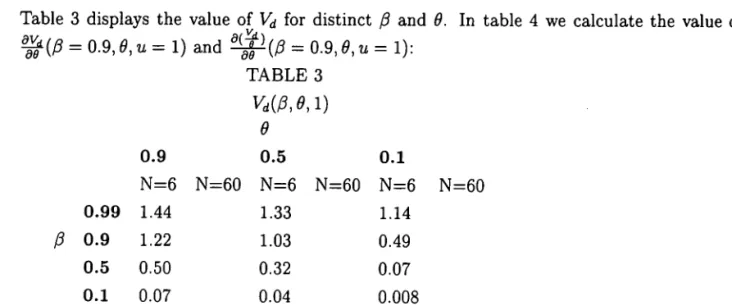
Table 3 displays the value of Vd for distinct (3 and O. In table 4 we calculate the value of
8(~)
~((3 = 0.9,0, u = 1) and
T((3
= 0.9,0, u = 1):0.9
N=6 N=60
0.99 1.44
(3 0.9 1.22
0.5 0.50
0.1 0.07
TABLE 3
Vd((3, 0,1)
°
0.5N=6 N=60
1.33
1.03
0.32
0.04
0.1
N=6 N=60
1.14
0.49
0.07
0.008
~((3 = 0.9,
e,
u = 1) N=6e
0.9 0.400.5 0.63
0.1 3.21
TABLE 4 8(ji)
88
((3
=
0.9,e,u=
1)N=60 N=6 N=60
**The calculations for N = 60 are not finished yet, but the results obtained so far indicate
that we will obtain the same conclusions as the ones for the case of N = 6.
We can se that Vd((3,
e,
1) reduces whene
goes down (fixing(3),
as shown in table 3.However, if we only consider the effect of
e
in reducing the contagion process (i.e., if wecompute
8(8:)'
as in table 4, Vd is decreasing ine.
The intuition is the following: despitethe fact that the speed of the contagion process declines when
e
gets smaller, the reductionon the frequency of single-coincidence meetings dominates the former effect, leading to an
overall reduction on Vd .
Hence, the key feature that leads to a reduction on the incentives to follow the norm
equilibrium after an increment in the degree of specialization is not the gain fram deviating
in an economy where the contagion pracess is slower. What drives our result is that the cost
of cooperating today becomes too high in an environment where single-coincidence meetings are not as frequent as before.