F.M. Pontes
Laborato´rio Interdisciplinar de Eletroquı´mica e Ceraˆmica (LIEC), Centro Multidisciplinar Para Desenvolvimento de Materiais Ceraˆmicos (CMDMC), Departamento de Química, Universidade Federal de Sa˜o Carlos (UFSCar), Via Washington, Km 235, CP-676, CEP-13565-905, São Carlos, S. P., Brazil
S.H. Leal
Laborato´rio Interdisciplinar de Eletroquı´mica e Ceraˆmica (LIEC), Centro Multidisciplinar Para Desenvolvimento de Materiais Ceraˆmicos (CMDMC), Departamento de Química, Universidade Federal de Sa˜o Carlos (UFSCar), Via Washington, Km 235, CP-676, CEP-13565-905, São Carlos, S. P., Brazil, and Centro de Cieˆncias da Natureza (CCN), Departamento de Química, Universidade Federal do Piauı´ (UFPI), Teresina, PI, Brazil
P.S. Pizani
Departamento de Física, Universidade Federal de Sa˜o Carlos (UFSCar), Via Washington, Km 235, CEP-13565-905, São Carlos, S. P., Brazil
M.R.M.C. Santos
Centro de Cieˆncias da Natureza (CCN), Departamento de Química, Universidade Federal do Piauı´ (UFPI), Teresina, PI, Brazil
E.R. Leitea)and E. Longob)
Laborato´rio Interdisciplinar de Eletroquı´mica e Ceraˆmica (LIEC), Centro Multidisciplinar Para Desenvolvimento de Materiais Ceraˆmicos (CMDMC), Departamento de Química, Universidade Federal de Sa˜o Carlos (UFSCar), Via Washington, Km 235, CP-676, CEP-13565-905, São Carlos, S. P., Brazil
F. Lanciotti, Jr. and T.M. Boschi
Departamento de Física, Universidade Federal de Sa˜o Carlos (UFSCar), Via Washington, Km 235, CEP-13565-905, São Carlos, S. P., Brazil
J.A. Varela
Instituto de Química, Universidade Estadual Paulista (UNESP), Araraquara, S. P., Brazil
(Received 27 July 2002; accepted 13 December 2002)
Strontium-modified lead titanate thin films with composition Pb1−xSrxTiO3were grown
on Pt/Ti/SiO2/Si substrates using the polymeric precursor method. The structural phase
evolution as a function of the Sr contents was studied using micro-Raman scattering, specular reflectance infrared Fourier transform spectroscopy, and x-ray diffraction. The results showed a gradual change from tetragonal to cubic structure, the transition occurring at about x⳱0.58. The infrared reflectance spectra showed that the
frequency of several peaks decreases as the strontium concentration increases. These features are correlated with a decrease in the tetragonal distortion of the TiO6
octahedra as the strontium concentration increases.
I. INTRODUCTION
Intensive research has been focused on ferroelectrics thin films in the last decade with particular emphasis on new processing and characterization techniques.1,2 A considerable amount of research has been developed for
thin films because of their potential applications in the field of microelectronic and optoelectronic devices.3,4
Among the ferroelectric thin films, PbTiO3has received special attention in recent years due to its applications such as pyroelectric infrared detectors, piezoelectric sen-sors, optical switches, and dynamic random-access memory (DRAM) and nonvolatile ferroelectric random-access memory (NVFRAM) devices.5–7 On the other
hand, pure PbTiO3 has a large tetragonal distortion at room temperature, approximately 1.064, which introduces
a)
e-mail: [email protected] b)
a stress upon the cooling through the phase transition, producing cracking in the material.8Recently, Ca-, La-,
or Sm-doped PbTiO3 thin films have been focused to-ward establishing the structure–property relationships to modify their optical, structural, and electrical proper-ties.9–11 Ca substitution reduces the tetragonality (ap-proximately), reducing the strain of pure PbTiO3 thin
films, and inhibits cracking. Wanget al.12showed that sol-gel-deposited (Pb,Ca)TiO3 (PCT) films exhibited a
low tetragonal distortion and hindered the grain growth in the microstructure, both by means of the increase of the Ca content. La-doped PbTiO3 thin films show very
good pyroelectric properties, and the approximate ratio decreases with increasing La concentration.13However, there is only little work on (Pb,Sr)TiO3thin films. It is
well know that PbTiO3 and SrTiO3 are very typical
perovskite materials and they can form solid solutions in a wide range of compositions. Chung et al.14 reported PST (Pb,Sr)TiO3 thin films prepared by liquid source misted chemical deposition, where the leakage current density was greatly influenced by the postannealing in O2 and N2 ambient gas. Recently, Kang et al.15 reported
(Pb,Sr)TiO3 thin films prepared by the sol-gel process and their characteristics were investigated as a function of the strontium content. However, in both works de-tailed studies using spectroscopy techniques were not accomplished. Furthermore, micro-Raman and infrared (IR) spectroscopy have, over the years, emerged as rapid and very sensitive techniques for comprehensive material characterization in thin films. The micro-Raman and IR techniques can also be used to study the effects of the size and stress on the actions of the phonon modes, con-tributing to the understanding of physical properties in the ferroelectric phase.
Reports on Raman spectroscopy study of perovskite (Pb,Sr)TiO3 thin films prepared by soft chemical
proc-essing are difficult to find in the literature. Hence, in this paper, we report experimental data to reveal the effects of the Sr contents of the soft chemically prepared (Pb,Sr)TiO3thin films on the vibrational properties using
Raman and Fourier transform infrared (FTIR) spectros-copies to provide the detailed information on molecular and group vibrations in the surface layers.
II. EXPERIMENTAL
Pb1−xSrxTiO3 (PST) thin films studied in this work
were derived from a soft chemical processing with Sr contents corresponding tox⳱0.10, 0.20, 0.30, 0.40, and
0.50. Details of the preparation method can be found in the literature.16,17The polymeric precursor solution was
spin-coated on substrates [Pt (140 nm)/Ti (10 nm)/SiO2 (1000 nm)/Si] by a commercial spinner operating at 6000 rev/min for 20 s (spin-coater KW-4B, Chemat Technology, Northridge, CA), via a syringe filter to
avoid particulate contamination. After spinning, the films were kept in ambient air at 150 °C on a hot plate for 20 min to remove residual solvents. A two-stage heat treatment was carried out with initial heating at 400 °C for 4 h at a heating rate of 1 °C/min in an oxygen atmos-phere for the oxidation of residual organics, finally fol-lowed by heating at 600 °C for 2 h for crystallization. The film thickness was controlled by adjusting the num-ber of coatings and the coating/drying operation repeated until the desired thickness was obtained.
The micro-Raman measurements were performed at room temperature as a function of the Sr content, using the 514.5-nm line of an argon ion laser as the excitation source. The power was kept at 15mW, and a 100× lens was used. The spectra were recorded using a T-64 Jobin-Yvon (Longjumeau, France) triple-monochromator cou-pled to a charge-coucou-pled device detector. IR analyses were performed by using an Equinox/55 (Bruker, Bil-lerica, MA) FTIR spectrometer to observe the variations in the chemical bond densities. The FTIR reflectance spectra of the thin films were recorded at room tempera-ture in the frequency range 350–1200 cm−1 equipped
with a 30° specular reflectance accessory.
To corroborate the interpretations, (Pb,Sr)TiO3 thin films were also structurally characterized by x-ray diffraction (XRD) (Cu K␣ radiation) in the mode of
–2 scan, recorded on a Rigaku diffractometer (D/ max-2400).
III. RESULTS
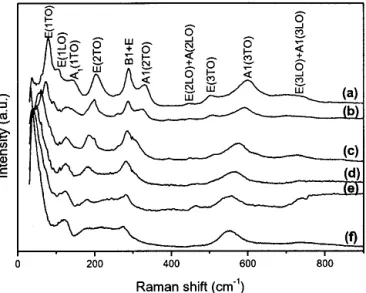
The room-temperature micro-Raman spectra of PST thin films for the different compositions are displayed in Fig. 1, within the frequency range from 30 to 850 cm−1.
All the Raman modes are assigned according to the re-sults of Foster et al.18,19 Raman peak frequencies are
found to be extremely sensitive to Sr content in these samples, as shown in Fig. 2. In particular, as it is know, the lowest wave number A1(1TO) and E(1TO) phonons (considered as the “soft” mode) originate from Pb ions vibrating against TiO6octahedra. The Sr substitution in
PbTiO3 lattice affects the ionic bond between Pb and
oxygen. As a result, the E(1TO) mode in PST thin films
is shifted toward a lower wave number with respect to pure PbTiO3 thin film and its linewidth increases with increasing Sr content, showing a damped behavior, as can be seen in Fig. 3. This broadening can be attribut-ed to the local disorder inducattribut-ed by the Sr doping, asso-ciated with the fluctuation concentration of Sr and/or distortion in lattice parameters, related to the differences of ionic radii between Pb and Sr ions. When the Sr con-tent approaches 50%, the E(1TO) mode frequency tends to zero, indicating the tetragonal to cubic phase transi-tion. Furthermore, for x ⳱ 0.50, while the data from
XRD analysis indicate that the crystal structure appears as pseudocubic, Raman scattering revealed the presence of a tetragonal distortion. This apparent contradiction can be explained by the fact that Raman scattering probes short-range structural order, while XRD probes long-range order.
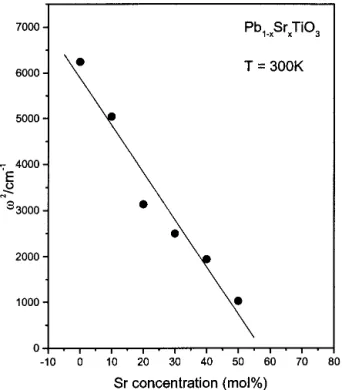
Figure 4 shows the squared wave number of the E(1TO) soft mode as a function of Sr content in the PbTiO3lattice. According to the quadratic equation20
E共1TO兲2 共x兲 =E共1TO兲2 共0兲关1 −xⲐx0兴 ,
the squared wave number of the soft mode tends to zero at x0 ≈ 0.58. According to Fig. 4, the phase transition from tetragonal to cubic should occur atx0≈0.58. This value is very close to the tetragonal to cubic transition reported in PST (0.57) ceramics at room temperature,21 showing that the behaviors of thin films and bulk samples are similar.
FIG. 2. Dependence of the Raman shift with the Sr concentration in Pb1−xSrxTiO3thin films.
FIG. 3. Low-frequency region of the Raman spectra for the different Sr concentrations: (a) undoped PbTiO3thin-film reference; (b)x⳱ 0.10; (c)x⳱0.20; (d)x⳱0.30; (e)x⳱0.40; (f)x⳱0.50. The arrows indicate the E(1TO) soft mode.
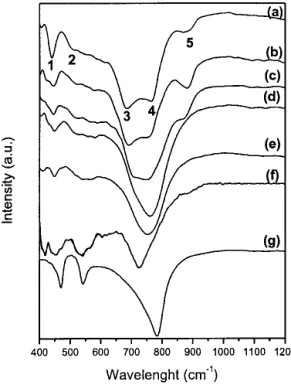
The infrared spectra in the oxygen–metal stretching regime between 400 and 1200 cm−1of the PST thin films
are compared in Fig. 5. The infrared spectra of pure PbTiO3 and SrTiO3 thin films are shown, for compari-son. In their elementary cell of five atoms, thus there are (3n− 3)⳱12 optic modes at long wavelength. Only the
optical modes can be infrared active. The three triply degenerate T1u modes are IR active, and so, the modes
transform into 3A1+ 3E irreducible representations. 22,23
Depending on the direction of propagation of the mode with respect to its polarization, the modes split into longitudinal optical (LO) and transversal optical (TO) components. The principal bands observed for pure PbTiO3 (PST0), located in the regions of 686 and
765 cm−1, correspond to the irreducible representations A1(3TO) and E(3LO), respectively, and may be assigned
to the Ti−O bond stretching vibration.24,25 The band at 886 cm−1, corresponding to the irreducible representa-tions A1(3LO), may be attributable to the Pb−O stretch-ing absorbance.25 In addition, for pure PbTiO
3 the
IR-active modes at around 438 and 511 cm−1 are
as-signed to the Ti–O3 torsion and to the Ti–O stretch, respectively.
We can easily recognize a series of changes of the spectra with increasing Sr content. In the spectra taken from PST thin films of different Sr values, the band at around 886 cm−1is observed to decrease monotonically
in its intensity and red shifts with increasing Sr value.
This disappearance is obviously due to the contribution of the new Sr−O vibrations absorbance arising from the Sr enrichment. Another effect is on the Ti−O bonding vibration, resulting from the augment of Sr content in the PST thin films, with the shift of the bands 686 and 765 cm−1, merging into a single peak which characterizes the lattice deformation. In addition, the appearance of the bands around 534 and 565 cm−1that are assigned to the Ti−O stretch associated with the highest frequency TO mode shows the beginning of a structural transition, where these changes can be correlated with the distor-tion of the TiO6octahedra which occurs as the Sr
con-tent raises. Therefore, the IR active mode at 686 and 765 cm−1for pure PbTiO3, assigned to the Ti−O
stretch-ing, shifts for the mode corresponding to pure SrTiO3to
777 cm−1. However, fromx⳱ 0.40 tox ⳱0.50, short
peaks appear at 534 and 565 cm−1assigned to the Ti−O stretch and the 441-cm−1 mode for PbTiO3 assigned to
the Ti−O3torsion [peak 1, Fig. 5(a)] shifts to the corre-sponding mode for SrTiO3 at 470 cm−1associated with
the LO mode. They should be related to higher Sr con-tents. With Sr concentration increasing, the structure of pure PbTiO3 thin film at room temperature loses the symmetry of tetragonal characteristics and follows a phase transition from tetragonal to cubic structure. On the other hand, the characteristics of pure SrTiO3 thin film appear gradually, and the properties of pure PbTiO3 and those of SrTiO3thin films compete with each other. Therefore, the peaks close to 886, 686, and 765 cm−1 representing the tetragonal structure of pure PbTiO3 disappear and the peaks representing the SrTiO3
gradu-ally appeared.26 Notice that these results are in agree-ment with the results presented by the micro-Raman and XRD, in which the structural change occurs at a compo-sition of about Sr⳱0.50.
IV. CONCLUSION
Polycrystalline single-phase perovskite PbxSr1−xTiO3
thin films with various Sr concentrations were obtained by a soft chemical process, the so-called polymeric pre-cursor method, at an annealing temperature 600 °C. They were characterized by micro-Raman spectroscopy and infrared specular spectroscopy. A gradual change from tetragonal to cubic structure, as the Sr concentration in-creases, was revealed by the evolution of the Raman spectra, mainly by the softening of the E(1TO). This implies a decrease of the Curie temperature in PST thin films as Sr concentration increases. The phase transition from the tetragonal to cubic phase was found to occur at
x0 ≈ 0.58, obtained from the extrapolation to the zero
frequency of the E(1TO) soft mode dependence with the Sr content. The IR specular measurements at oblique incidence evidenced the optical vibrational modes of the PST thin films with perovskite structure. We found that
the increasing tetragonal distortion of the TiO6octahedra with increasing Sr concentration induces the appearance of the new perovskite bands in the spectrum character-istics of the cubic structure as the smaller Sr ion interacts more strongly with anions and thereby distorts the TiO6 octahedra, so as to give the resultant upward shift of the infrared mode in question. Finally, the use of both tech-niques, IR and Raman spectroscopy, was shown to be very efficient to provide comprehensive information on the vibrational structure of the thin ferroelectric films, which have attracted great attention due to their potential application in a variety of devices such as DRAM or NVFRAM memories.
ACKNOWLEDGMENTS
The authors gratefully acknowledge the financial sup-port of the Brazilian financing agencies Fundac¸a˜o de Amparo a` Pesquisa do Estudo de Sa˜o Paulo (FAPESP), Conselho Nacional de Desenvolvimento Cientı´fico e Tecnolo´gico (CNPq)/Programa de Apoio a Nu´cleos de Exceleˇncia (PRONEX), and Coordenaca˜o de Aperfeic¸oa-mento de Pessoal de Nı´vel Superior (CAPES).
REFERENCES
1. L. Preda, L. Courselle, B. Despax, J. Bandet, and A. Ianculescu, Thin Solid Films389,43 (2001).
2. Q. Zou, S. Nourbaskhsh, and J. Kim, Mater. Lett.40,240 (1999). 3. F.M. Pontes, E. Longo, E.R. Leite, and J.A. Varela, Thin Solid
Films386,91 (2001).
4. C.H. Lin, S.W. Lee, H. Chen, and T.B. Wu, Appl. Phys. Lett.75, 2485 (1999).
5. C.H. Wang and D.J. Choi, J. Am. Ceram. Soc.84,207 (2001). 6. T. Iijima, G. He, and H. Funakubo, Integr. Ferroelectr.36,255
(2001).
7. A.A. Bosak, S.V. Samoilenkov, O.Y. Gorbenko, I.E. Graboy, A.N. Botev, A.R. Kaul, and H.W. Zandbergen, Chem. Mater.13, 981 (2001).
8. S.Y. Chu and C.Z. Chen, Sens. Actuators, A89,210 (2001). 9. P. Venkateswarlu, S.S.N. Bharadwaja, and S.B. Krupanidhi, Thin
Solid Films389,84 (2001).
10. H. Li, X. Tang, Q. Li, Y. Liu, Z. Tang, Z.Y. Zhang, and D. Mo, Solid State Commun.114,347 (2000).
11. M.L. Calzada, R. Sirera, J. Ricote, and L. Pardo, J. Mater. Chem. 8,111 (1998).
12. C.C.M. Wang, Y.T. Huang, Y.C. Chen, M.S. Lee, and M.C. Kao, Jpn. J. Appl. Phys.39,3579 (2000).
13. G. Shen and P.Y. Du, J. Inorg. Mater.17,117 (2002).
14. H.J. Chung, S.J. Chung, J.H. Kim, and S.I. Woo, Thin Solid Films 394,213 (2001).
15. D.H. Kang, J.H. Kim, J.H. Park, and K.H. Yoon, Mater. Res. Bull. 36,265 (2001).
16. F.M. Pontes, E.B. Araújo, E.R. Leite, J.A. Eiras, E. Longo, J.A. Varela, and M.A. Pereira-da-Silva, J. Mater. Res.15,1176 (2000).
17. F.M. Pontes, D.S.L. Pontes, E.R. Leite, E. Longo, E.M.S. Santos, S. Mergulhão, A. Chiquito, P.S. Pizani, F. Lanciotti, Jr., T.M. Boschi, and J.A. Varela, J. Appl. Phys.91,6650 (2002). 18. C.M. Foster, Z. Li, M. Grimsditch, S.K. Chan, and D.J. Lam,
Phys. Rev. B48,10160 (1993).
19. S.M. Cho and H.M. Jang, Appl. Phys. Lett.76,3014 (2000). 20. P.S. Dobal, S.B. Majumder, S. Bhaskar, and R.S. Katiyar,
J. Raman Spectrosc.30,567 (1999).
21. J. Meng, G. Zou, Y. Ma, X. Wang, and M. Zhao, J. Phys.: Con-dens. Matter.6,6549 (1994).
22. G. Burns and B.A. Scott, Phys. Rev. Lett.25,1191 (1970). 23. V. Sivasubramanian, V.R.K. Murthy, B. Viswanathan, and
M. Sieskind, J. Phys.: Condens. Matter.8,2447 (1996). 24. D.M. Adams, Metal-Ligand and Related Vibration (Edward
Arnold, London, U.K., 1967).
25. H.Y. Chen, J. Lin, K.L. Tan, and Z.C. Feng, Thin Solid Films289, 59 (1996).