Research Article
Available online through
www.ijrap.net
STUDIES ON DIURETIC AND LAXATIVE ACTIVITY OF
ACACIA SUMA
(ROXB) BARKS
Mondal Sumanta
1*, Parhi Rabinarayan
1, Suresh P
1and Dash Gauri Kumar
2 1Gitam Institute of Pharmacy, Gitam University, Gandhinagar Campus, Rushikonda, Visakhapatnam, A.P., India
2
Institute of pharmacy and Technology, Salipur, Cuttack, Orissa, India
Received: 05-10-2010; Revised: 10-11-2010; Accepted: 21-11-2010
ABSTRACT
The diuretic and laxative activity of aqueous extract of Acacia suma (Roxb.) barks (Family: Fabaceae) were studied in Wistar albino rats. Furosemide (10 mg/kg, p.o.) and agar-agar (300 mg/kg, p.o.) were used as reference standards respectively for activity comparison. The aqueous extract (400 mg/kg) has shown significant increase in the volume of urine, urinary concentration of Na+, K+ and Cl- ions. However 200mg/kg dose failed to do so. On the other hand the extract was found to produce significant laxative activity in dose dependant manner. Presence of different phytoconstituents in aqueous extract of Acacia suma may be responsible for the specific activities.
KEYWORDS:Acacia suma, Acute toxicity study, Agar-agar, Diuretic activity, Furosemide, Laxative activity.
*
For correspondence Author
Sumanta Mondal Lecturer
Gitam Institute of Pharmacy
Gitam University, Gandhinagar Campus, Rushikonda, Visakhapatnam-530 045, A.P., India
Email: [email protected] Contact No.: +91-9703615761
INTRODUCTION
Acacia suma (Roxb.) var. Acacia polyacantha (Family- Fabaceae) is a medium sized erect tree; trunk with fissured bark and knobby persistent prickles found in the greater part of India and costal districts of Orissa1,2. The bark is reported to be used as blood purifier2 and possesses anti-cancer and astringent properties3,4. The seeds are reported to have hypoglycaemic effect3. Presence of proanthocyanidin, quercetin and 5, 4’-dihydroxy-7, 3’-dimemethoxyflavone-3-0-D galactopyranoside in the barks have been reported earlier3-5.
Present study aims at exploring the details of diuretic and laxative action of aqueous extract of A. suma barks.
MATERIALS AND METHODS Plant material
The plant material was collected from the herbal garden of Regional Plant Research Centre, Bhubaneswar in July 2008 and identified by the taxonomists of the Botanical Survey of India, Shibpur, Howrah. A voucher specimen [Sp. No: CNH/ I-I / (17)/2009/Tech.II/28] has been kept in our research laboratory for further reference. After authentication, fresh bark material was collected in bulk, washed, shade dried and pulverized in a mechanical grinder to obtain coarse powder.
Preparation of the extract
The dried powdered material was macerated in distilled water: chloroform (9:1) to form an aqueous extract. The extract was concentrated to a small residue (5 gm) and the phytoconstituents in the extract were identified to besaponins, flavonoides, tannins, terpenoids and phenolic compounds by using standard methods6,7. Furosemide (10 mg/kg, p.o.) and agar-agar (300 mg/kg, p.o.) were used as reference standards where applicable.
Animals
Swiss albino mice (20–25 g) of either sex were used for acute toxicity study and adult wistar albino rats (150-200 g) of either sex were used for evaluation of pharmacological studies. The animals were kept in standard polypropylene cages at room temperature of 34 ± 2 0C and at 60-65 % relative humidity during the experimental work. The institutional Animal ethics committee approved all the experimental protocols (Regd. No. 1212/ac/08/CPCSEA).
Acute toxicity study
The acute toxicity of aqueous extract of A. suma barks was determined as per the CPCSEA guideline no. 420 (fixed dose method). It was observed that the test extract was not mortal even at 2000 mg/kg dose hence, 1/10th (200 mg/kg) and 1/5th (400 mg/kg) of this dose was selected for further study.
Evaluation of Diuretic activity
Evaluation ofLaxative activity
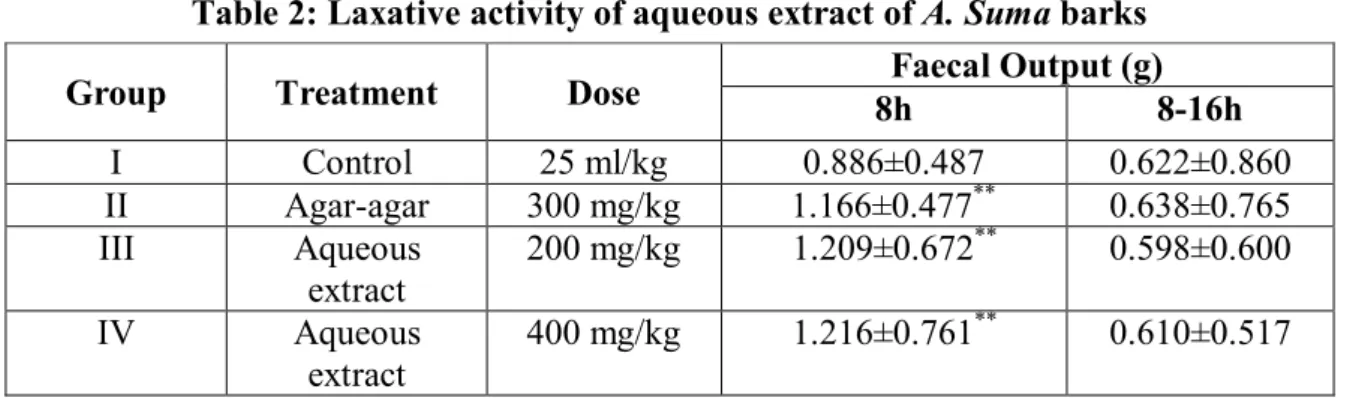
The laxative activity was performed according to Bose et al. 200614 on rats of either sex, fasted for 12 hours before the experiment, but with water provided ad libitum. The animals were divided into four groups, each group consisting of six rats. The first group of animals, serving as control, received normal saline (25 ml/kg, oral); second group, serving as reference, received agar-agar (300 mg/kg, p.o.) in saline; the third and fourth groups received orally the test extract at doses 200 and 400 mg/kg respectively in a similar manner. Immediately after dosing, the animals were separately placed in specially designed plastic containers suitable for collection of faces. After 8 hours of drug administration, the faces were collected and weighed. Thereafter, food and water were given to all rats and faecal outputs were again weighed after a period of 16 h (Table 2).
Statistical analysis
The data obtained in the studies were subjected to one way of analysis of variance (ANOVA) for determining the significant difference. The inter group significance was analyzed using Dunnet’s-t test. A P-value < 0.05 were considered to be significant. All the values were expressed as mean ± SEM.
RESULTS
Preliminary phytochemical tests revealed presence ofsaponins, flavonoides, tannins, and phenolic compounds in the aqueous extract of A. suma barks. The treatment with aqueous extract (400mg/kg) has significantly enhanced the volume of urine. However, the test extract at lower dose (200mg/kg) failed to do so. The urinary levels of Na+, K+ and Cl- ions were significantly increased by 400mg/kg of test extract. The diuretic activity demonstrated by the test extract at 400 mg/kg was significantly lesser than the standard drug (Furosemide-10 mg/kg). The results are compiled in the table 1.
The aqueous extract of A. suma (200 and 400 mg/kg, oral) showed significant and dose dependant increase in faecal output of rats (Table 2) at selected dose levels. The effect was comparable with that of standard (Agar-agar).
DISCUSSION
Diuretics relieve pulmonary congestion and peripheral edema and are useful in reducing the syndrome of volume overload, including orthopnea and paroxysmal nocturnal dyspnoea. They decrease plasma volume and subsequently venous return to the heart (preload). This decreases cardiac workload, oxygen demand and plasma volume, thus decreasing blood pressure15. Thus, diuretics play an important role in hypertensive patients. In present study, we can demonstrate that the aqueous extract of A. suma barks significantly increased the urinary out put as well as urinary electrolyte concentration at a dose of 400 mg/kg, p.o. but the effect was found to be the less potent in increasing the urinary out put when compared with the reference standard. Further, the aqueous extracts were found to be more effective in enhancing urinary electrolyte concentration for all the three ions tested (Na+, K+, Cl-). The increase in the ratio of concentration of excreted sodium and potassium ions indicates that the extracts increase sodium ion excretion to a greater extent than potassium, which is a very essential requirement of an ideal diuretic with lesser hyperkalaemic side effect.
REFERENCES
1. Kiritikar KR, Basu BD. Indian Medicinal Plants. 2nd ed. Allahabad: Lalit Mohan Basu; 1993. 2. Anonymous. The Wealth of India. Vol. I. New Delhi: CSIR; 1985.
3. Gandhi P. New proanthocyanidin from stem bark of Acacia suma. Experientia 1977; 33(10): 1272. 4. Rastogi RP, Mehrotra BN. Compendium of Indian medicinal plants. Vol. II. New Delhi: Drug
Research Institute, Lucknow and Publications and information Directorate; 1993. 5. Anonymous. Reviews on Indian medicinal plants. Vol.I. New Delhi: ICMRV; 1990. 6. Trease GE, Evans WC. Pharmacognosy. Delhi: ELBS Publication; 1989.
7. Harborne JB. Phytochemical Method: A guide to modern techniques of plant analysis. 2nd ed. New York: Chapman and Hall; 1984.
8. Lipschitz WL, Haddin Z, Kerpscar A. A bioassay of diuretics. J Pharmcol Exp 1943; 79: 97-110. 9. Murugesan T, Manikandan L, Suresh KP, Pal M, Saha BP. Evalution of diuretics potential of Jussiaea
suffruticosa Linn. In rats. Indian J Pharm Sci 2000; 62(2): 150-151.
10.Adebayo MA, Adebayo JO, Ajaiyeoba EO. Preliminary phytochemical investigation and diuretics studies of Alstonia boonei stem bark in male wistar rats. J. Nat. Rem. 2004: 4(2): 179-182.
11.Jeffery GH, Bassell J, Mendham J, Denny RC. Vogel’s text book of quantitative chemical analysis. 5th ed, England: Addison Wesley Longman Ltd.; 1989.
12.Beckette AH, Stenlake JB. Practical Pharmaceutical Chemistry. 1st ed. Part-1. New Delhi: CBS Publishers and Distributors; 1997.
13.Vetrichelvan T, Jegadeesan M, Palaniappan MS, Murali NP, Sasikumar K. Diuretic and anti-inflammatory activities of Aerva lanata in rats. Indian J Pharm Sci 2000; 62(4): 300-302.
14.Bose A, Mondal S, Gupta JK, Dash GK, Ghosh T. Studies on diuretic and laxative activity of ethanolic extract and its fractions of Cleome rutidosperma aerial parts., Phcog. Mag 2006;2(7): 178–
182.
15.Hoeland RD, Mycek MJ. Lippincott’s Illustrated Reviews: Pharmacology. Philadelphia: Lippincott Williams and Wilkins; 2000.
16.Chodera A, Dabrowska K, Sloderbach A, Skrzypczak L, Budzianowski J. Effect of flavonoid fractions of Solidago virgaurea L on diuresis and levels of electrolytes. Acta Pol Pharm. 1991; 48: 35-37.
Table 1: Diuretic activity of aqueous extract of A. Suma barks
Values are expressed as mean ± S.E. (n = 6). All columns are significant using ANOVA. * P<0.05, **P<0.01 when compared to control; Dunnet’s t-test.
Table 2: Laxative activity of aqueous extract of A. Suma barks
Values are expressed as mean ± S.E.M (n = 6). All columns are significant using ANOVA.
*
P<0.05, ** P<0.01 when compared to control; Dunnet’s t-test.
Source of support: Nil, Conflict of interest: None Declared
Group Treatment Dose
Urine Volume (ml)
Concentration of ions (mEq / l )
Na+/ K+ ratio
Na+ K+ Cl
-I Control 25 ml/kg 2.14 ± 0.15 52.33 ± 2.15 139.5±0.42 106.22±3.46 0.38
II Furosemide 10mg/kg 7.16 ± 0.37** 96.33± 3.71** 163.67 ± 8.84** 136.96± 4.29** 0.59
III Aqueous extract 200 mg/kg 2.29±0.12 51.43±3.16 140.72±2.68 100.88±4.77 0.37
IV Aqueous extract 400 mg/kg 5.06±0.15** 68.11±1.47** 155.10±1.53* 120.36±3.68** 0.44
Group Treatment Dose 8hFaecal Output (g)8-16h
I Control 25 ml/kg 0.886±0.487 0.622±0.860 II Agar-agar 300 mg/kg 1.166±0.477** 0.638±0.765 III Aqueous
extract
200 mg/kg 1.209±0.672** 0.598±0.600
IV Aqueous
extract