Submitted17 August 2016 Accepted 20 October 2016 Published29 November 2016
Corresponding author
Li Yang, [email protected]
Academic editor Monique Roobol
Additional Information and Declarations can be found on page 6
DOI10.7717/peerj.2708
Copyright 2016 Zhang et al.
Distributed under
Creative Commons CC-BY 4.0
OPEN ACCESS
Open surgery versus retroperitoneal
laparoscopic nephrectomy for renal
tuberculosis: a retrospective study of 120
patients
Su Zhang*, You Luo*, Cheng Wang, Hu Xiong, Sheng-Jun Fu and Li Yang
Department of Urology, Lanzhou University Second Hospital, Lan Zhou, China *These authors contributed equally to this work.
ABSTRACT
Background. Laparoscopic renal surgery has been widely used in the treatment of renal diseases. However, there is still little research about its application in addressing renal tuberculosis. The purpose of this study is to retrospectively investigate the surgical results of laparoscopic and open surgery for nonfunctional tuberculous kidneys.
Methods. Between May 2011 and June 2016, 120 nephrectomies were performed in patients with a nonfunctional tuberculous kidney. Of these, 69 patients underwent retroperitoneal laparoscopic nephrectomy, and 51 patients underwent open nephrec-tomy. Data about the patients’ characteristics and surgical outcomes were collected from their electronic medical records. Outcomes were compared between these two groups.
Results. Our results showed that a number of renal tuberculosis patients presented no significant symptoms during their disease. Lower urinary tract symptoms (LUTS) were the most common at a rate of 73/120, followed by flank pain or accidently discovery (66/120), urine abnormality (30/120) and fever (27/120). Patients who underwent open surgery were similar to laparoscopic patients with regard to sex, BMI, location, previous tuberculous history, grade, anemia, adhesion, hypertension, diabetes and preoperative serum creatinine level, but were generally older than laparoscopic patients. There were no significant differences between open and laparoscopic surgery in estimated blood loss, transfusion, postoperative hospital days and perioperative complication rate. However, the median operation time of laparoscopic operation was much longer than open surgery (180 [150–225] vs 135 [120–165] minutes,P<0.01). Seven of the 69
laparoscopic operations were converted to open surgery because of severe adhesions.
Conclusion. Laparoscopic nephrectomy is as an effective treatment as open surgery for a nonfunctional tuberculous kidney, although it requires more time during the surgical procedure. No significant differences in other surgical outcomes were observed.
SubjectsSurgery and Surgical Specialties, Urology
INTRODUCTION
In recent years, the resurgence of tuberculosis has become a subject of global interest,
particularly for developing countries, due to drug resistance of the Mycobacterium
tuberculosisand population mobility (World Health Organization, 2015). Renal tuberculosis is a kidney-destructive disease and comprises one of the most common types of extrapulmonary tuberculosis (Fader et al., 2010). In many patients, the disease has already progressed to the end stages before they consult their doctors. The standard treatment for a nonfunctional tuberculous kidney is a nephrectomy combined with anti-tuberculosis chemotherapy. The laparoscopic technique was considered contraindicative for resecting a kidney with tuberculosis because the disease caused severe adhesion and perinephritis. However, with the development of new techniques and increased experience, the laparoscopic operation is no longer contraindicated for experienced laparoscopic surgeons (Kim et al., 2000;Lee et al., 2002). In this paper, we aim to summarize recent developments in nephrectomies and compare the outcomes of laparoscopic operations with open surgery.
MATERIAL AND METHODS
Patient population
From May 2011 to June 2016, surgical records from patients treated by nephrectomy with unilateral nonfunctioning kidney secondary to renal tuberculosis were collected from the Department of Urology in Lanzhou University Second Hospital in this case-control study, after the approval of the Ethics Committee of Lanzhou University Second Hospital (Number: 2016A-076). Preoperative laboratory (e.g., urine smear for acid-fast bacilli, urine polymerase chain reaction for acid-fast bacilli) and imaging examinations (e.g., renal ultrasonography, computerized tomography, intravenous pyelogram), were conducted in patients suspected of renal tuberculosis, who were also conformed finally by postoperative pathological diagnosis. The patients who had abdomen operation history or underwent other surgeries simultaneously were excluded from the study.
anemia, hypertension, diabetes and their American Society of Anesthesiologists (ASA) grade. Electronic medical records and the designated entries for ‘‘Chief complaint’’ and ‘‘Present illness’’ were used to collect data on biographical information and medical history. The patient’s ASA grade was obtained from the anesthesiology records, and their adhesion status was gathered from descriptions by the operating surgeon. Additional information was gathered regarding the following surgical-relevant outcomes: operation time, estimated blood loss, administration of transfusion, postoperation hospital days, perioperative complications, and conversion to open surgery.
Outcomes and statistics
Perioperative complications were defined as any of the following symptoms or conditions: fever, abdominal distention or ileus, abscess or infection of the incision area, and seroma volume of drainage with more than 200 ml and classified according to the Clavien–Dindo
grading system (Dindo, Demartines & Clavien, 2004) Normality was measured using the
Shapiro–Wilk test. Non-normal parameters were presented as median ranges (interquartile range: IQR), and the Mann–Whitney test was used to test the difference. Normal outcomes
were presented as the mean±standard deviation (SD) and independentt-test samples were
used for comparison. Chi-square test was used for counting data, and MedCalc Statistical Software version 15.5 (MedCalc Software bvba, Ostend, Belgium) was used to perform statistical evaluations. A two-sidedP<0.05 was considered statistically significant.
RESULTS
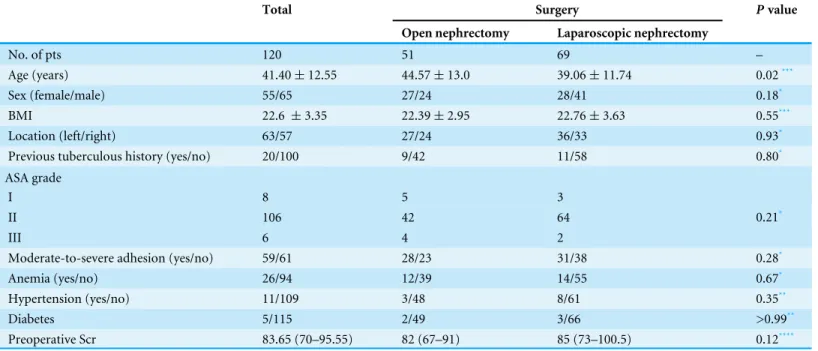
The basic characteristics of included patients are shown in Table 1. Open nephrectomy
patients with a mean age of 44.57 years old were greater than laparoscopic patients with
a mean age of 39.06 years old (P=0.02). Only four were over 65 years old, and the
youngest was 17 years old. The age of entire cohort ranged from 17 to 67 years old. Previous tuberculosis history was present in 20 patients. There were 59 patients with moderate to severe adhesion and 26 patients with anemia. No statistical significance was observed between open nephrectomy and laparoscopic nephrectomy by sex, BMI, surgical location, ASA grade, moderate to severe adhesion rate, anemia, hypertension, diabetes, or preoperative serum creatinine level. Additionally, data about the symptoms patients indicated as their chief complaint was collected and classified into four categories: lower urinary tract symptoms (LUTS), flank pain or accidently discovery, urine abnormality (hematuria or cloudy urine) and fever. The rate of each symptom was demonstrated as LUTS (73/120), flank pain or accidently discovery (66/120), urine abnormality (30/120) and fever (27/120). It is noteworthy that 23 of the 120 patients only complaint of flank pain or fatigue and seven cases were accidently discovered. Renal tuberculosis is often asymptomatic and is difficult to diagnose.
Table 2lists the surgical outcomes of the two treatment options. Seven laparoscopic
cases were converted to open nephrectomy. The median operation time was 135 min (IQR: 12,0165 min) for open surgery and 180 min (IQR: 150–225 min) for laparoscopic
nephrectomy (P<0.01). All postoperative complications were grade 1 according
Table 1 Characteristics and comparative results of open versus laparoscopic surgery for renal tuberculosis.
Total Surgery Pvalue
Open nephrectomy Laparoscopic nephrectomy
No. of pts 120 51 69 –
Age (years) 41.40±12.55 44.57±13.0 39.06±11.74 0.02***
Sex (female/male) 55/65 27/24 28/41 0.18*
BMI 22.6 ±3.35 22.39±2.95 22.76±3.63 0.55***
Location (left/right) 63/57 27/24 36/33 0.93*
Previous tuberculous history (yes/no) 20/100 9/42 11/58 0.80*
ASA grade
I 8 5 3
II 106 42 64
III 6 4 2
0.21*
Moderate-to-severe adhesion (yes/no) 59/61 28/23 31/38 0.28*
Anemia (yes/no) 26/94 12/39 14/55 0.67*
Hypertension (yes/no) 11/109 3/48 8/61 0.35**
Diabetes 5/115 2/49 3/66 >0.99**
Preoperative Scr 83.65 (70–95.55) 82 (67–91) 85 (73–100.5) 0.12****
Notes.
Annotation: the interval in the parenthesis is interquartile range and the number before parenthesis is the median value; Scr- serum creatinine; *Chi-square test.
**Fisher’s exact test. ***Independent samplest-test. ****Mann–Whitney test.
Table 2 Surgical outcomes of the different operation methods.
Total Open nephrectomy Laparoscopic nephrectomy Pvalue
No. of pts 120 51 69 –
Operation time (minutes) 160 (132–198.75) 135 (120–165) 180 (150–225) <0.01***
Estimated blood loss (ml) 100 (50–200) 100 (50–150) 100 (50–200) 0.69***
Transfusion (yes/no) 9/111 1/50 8/61 0.08**
Postop hospital days 8 (7–10.75) 9 (7–11) 8 (7–10) 0.11***
Perioperative complication rate 37/120 14/51 23/69 0.49*
Conversion to open surgery – – 7/69 –
Notes.
*Chi-square test **Fisher’s exact test ***Mann–Whitney test
nephrectomy and laparoscopic nephrectomy in estimated blood loss, transfusion rate, postoperative hospital days and perioperative complication rates (Table 2).
DISCUSSION
The 2015 global tuberculosis report showed that there were an estimated 9.6 million new TB cases and China accounted for 10% of the world’s TB cases ranking second in the
world (World Health Organization, 2015). According to the National Health and Family
1918 new cases in Gansu province citing the Health and Family Planning Commission
of Gansu (Gansu, 2016) As the data show, the people in Gansu have a high incidence of
tuberculosis, and furthermore seek medical advice with relative delay. The manifestation of tuberculosis is increasingly atypical. Unfortunately, the prevalence of drug-resistant strains of the tuberculosis bacterium is increasing (Lee et al., 2015). Latent tuberculosis presents great challenges in terms of diagnosis and treatment (Getahun et al., 2015). Renal tuberculosis is a severe organ-destroying disease. The majority of symptomatic outpatients has progressed to the end stages and has a nonfunctional kidney. According to the 2005 EU guideline, the drug treatment is the first line therapy for renal tuberculosis (Cek et al.,
2005). However, patients in Gansu usually present end stage and the surgical excision of
non-functioning kidneys or highly destructive lesion is unavoidable.
As our results describe, 23 of 120 patients only presented with flank pain or fatigue, symptoms they had previously ignored, and seven patients were discovered accidently. Huang et al. surveyed 239 cases of renal tuberculosis. In their study, 94 of the 239 renal tuberculosis cases were atypical. The main symptoms experienced by the typical group were lower urinary tract symptoms, flank pain, hematuria and fever, etc. In addition, flank pain was regarded as the major complaint in the atypical group (Huang, Li & Jin, 2013). Wang et al. also confirmed these findings (Wang et al., 2016). A previous history of tuberculosis was observed in twenty patients in our cohort. Huang et al. reported that nearly 50% (125/239) of renal tuberculosis patients had a tuberculosis history or extrarenal findings in radiological images (Huang, Li & Jin, 2013). Therefore, we can conclude that tuberculosis history is a good clue for the diagnosis of renal tuberculosis (Cek et al., 2005).
The use of the laparoscopic technique has become very popular among surgeons for dealing with renal diseases. However, renal tuberculosis challenges this application because of its severe adhesion and perinephritis. Both of these obstacles could contribute to the need to convert to open surgery during the laparoscopic procedure. All surgery was performed by retroperitoneal laparoscopic approach Compared with transperitoneal laparoscopic nephrectomy, retroperitoneal laparoscopic nephrectomy has several advantages, particularly for patients with normal anatomy (Fan et al., 2013;Garg et al., 2014;Zhang et al., 2013). Although one study reported 10 laparoscopic nephrectomies using the transperitoneal approach and 21 using the retroperitoneal approach, the
comparison between the two approaches was not conducted in the results (Lee et al.,
2002) Hence, the advantages and disadvantages between the two laparoscopic approaches
consistent with the result of Hemal’s study to a certain extent (Hemal, Gupta & Kumar,
2000). However, compared with existing reports in which surgical time of laparoscopic
approach ranged from mean 92 min to mean 244 min (Lee et al., 2002;Tian et al., 2015;
Zhang et al., 2005b), the median time of our operations was 180 min and this difference may be due to the selection of patients or the surgical experience.
In 1998, among five patients with renal tuberculosis treated by laparoscopic nephrectomy, four patients (80%) suffered the conversion to open surgery because of difficult dissection of the severe adhesions (Rassweiler et al., 1998). ThenZhang et al. (2005a)reported 12 successful retroperitoneoscopic nephrectomies without conversion to open operation for an infective nonfunctioning kidney with dense perinephric adhesions. Additionally, they also confirmed the operability and advantages of retroperitoneal laparoscopic nephrectomy for renal tuberculosis by comparing 22 successful laparoscopic
with 22 open nephrectomies (Zhang et al., 2005b) RecentlyTian et al. (2015)reported
51 consecutive patients with tuberculous nonfunctioning kidney treated by laparoscopic nephrectomy and there was only one case required conversion to open surgery due to non-progression of dissection. The present research presented nearly 10 percent of conversion to open surgery and the good news is all these surgical conversion resulted from uncompleted dissection of the severe adhesions without any vascular injury or visceral injury. Thus, perinephric adhesions should not be considered an absolute contraindication to laparoscopic nephrectomy and the comprehensive preoperative evaluation, the delicate surgical technique and the accumulation of surgical experiences are very important to complete laparoscopic nephrectomy for tuberculous nonfunctioning kidneys successfully. There were some discrepancies within our study, and the results could thus be attributed to sample size and a more recent time period. We have noted that this study was a retrospective. Selection bias was unavoidable. Randomized controlled trials with a larger sample size are needed to confirm these results.
CONCLUSION
Laparoscopic nephrectomy is as an effective treatment as open nephrectomy for a nonfunctional tuberculous kidney. Although the laparoscopic procedure takes longer than the open surgery, no significant differences in other surgical outcomes were observed.
ADDITIONAL INFORMATION AND DECLARATIONS
Funding
The authors received no funding for this work.
Competing Interests
The authors declare there are no competing interests.
Author Contributions
• Su Zhang conceived and designed the experiments, performed the experiments, analyzed
• You Luo conceived and designed the experiments, performed the experiments, analyzed the data, wrote the paper.
• Cheng Wang prepared figures and/or tables.
• Hu Xiong performed the experiments, prepared figures and/or tables.
• Sheng-Jun Fu and Li Yang reviewed drafts of the paper.
Human Ethics
The following information was supplied relating to ethical approvals (i.e., approving body and any reference numbers):
Ethics Committee of Lanzhou University Second Hospital Number:2016A-076.
Data Availability
The following information was supplied regarding data availability:
The raw data has been supplied as aData S1.
Supplemental Information
Supplemental information for this article can be found online athttp://dx.doi.org/10.7717/
peerj.2708#supplemental-information.
REFERENCES
Cek M, Lenk S, Naber KG, Bishop MC, Johansen TE, Botto H, Grabe M, Lobel B, Redorta JP, Tenke P. 2005.EAU guidelines for the management of genitourinary
tuberculosis.European Urology48:353–362DOI 10.1016/j.eururo.2005.03.008.
Dindo D, Demartines N, Clavien PA. 2004.Classification of surgical complications: a new proposal with evaluation in a cohort of 6336 patients and results of a survey.
Annals of Surgery240:205–213DOI 10.1097/01.sla.0000133083.54934.ae.
Fader T, Parks J, Khan NU, Manning R, Stokes S, Nasir NA. 2010.Extrapulmonary
tu-berculosis in Kabul, Afghanistan: a hospital-based retrospective review.International
Journal of Infectious Diseases14:e102–e110DOI 10.1016/j.ijid.2009.03.023.
Fan X, Xu K, Lin T, Liu H, Yin Z, Dong W, Huang H, Huang J. 2013.Comparison of transperitoneal and retroperitoneal laparoscopic nephrectomy for renal cell
carcinoma: a systematic review and meta-analysis.BJU International111:611–621
DOI 10.1111/j.1464-410X.2012.11598.x.
Gansu HaFPCo. 2016.August 2016 Gansu tuberculosis report.Available athttp:// www. gsws.gov.cn/ html/ /2016/ 09-09/ 69/ 6dc48ed0-0082-48fc-a09f-28e11c18a3bf.html (accessed on September 2016).
Garg M, Singh V, Sinha RJ, Sharma P. 2014.Prospective randomized comparison
of transperitoneal vs retroperitoneal laparoscopic simple nephrectomy.Urology
84:335–339DOI 10.1016/j.urology.2014.04.038.
Getahun H, Matteelli A, Chaisson RE, Raviglione M. 2015.Latent Mycobac-terium tuberculosisinfection.New England Journal of Medicine372:2127–2135
Hemal AK, Gupta NP, Kumar R. 2000.Comparison of retroperitoneoscopic
nephrec-tomy with open surgery for tuberculous nonfunctioning kidneys.Journal d Urologie
164:32–35DOI 10.1016/S0022-5347(05)67442-3.
Hemal AK, Kumar A, Kumar R, Wadhwa P, Seth A, Gupta NP. 2007.Laparoscopic versus open radical nephrectomy for large renal tumors: a long-term prospective
comparison.Journal d Urologie177:862–866DOI 10.1016/j.juro.2006.10.053.
Huang HC, Li X, Jin J. 2013.Epidemiology and clinical features of renal tuberculosis: 239
cases report.Beijing Da Xue Xue Bao45:600–604.
Kim HH, Lee KS, Park K, Ahn H. 2000.Laparoscopic nephrectomy for nonfunctioning
tuberculous kidney.Journal of Endourology14:433–437
DOI 10.1089/end.2000.14.433.
Lee HY, Lee J, Lee YS, Kim MY, Lee HK, Lee YM, Shin JH, Ko Y. 2015.Drug-resistance
pattern ofMycobacterium tuberculosisstrains from patients with pulmonary and
ex-trapulmonary tuberculosis during 2006 to 2013 in a Korean tertiary medical center.
Korean Journal of Internal Medicine30:325–334DOI 10.3904/kjim.2015.30.3.325.
Lee KS, Kim HH, Byun SS, Kwak C, Park K, Ahn H. 2002.Laparoscopic nephrectomy for tuberculous nonfunctioning kidney: comparison with laparoscopic simple
nephrectomy for other diseases.Urology60:411–414
DOI 10.1016/S0090-4295(02)01759-4.
PRC NHaFPCo. 2016.August 2016 national tuberculosis report.Available athttp:// www.
nhfpc.gov.cn/ jkj/ s3578/ 201609/ 6dc46a3f8d874da7941beb56e5378fd7.shtml(accessed
on September 2016).
Rassweiler J, Fornara P, Weber M, Janetschek G, Fahlenkamp D, Henkel T, Beer M, Stackl W, Boeckmann W, Recker F, Lampel A, Fischer C, Humke U, Miller K. 1998.Laparoscopic nephrectomy: the experience of the laparoscopy
work-ing group of the German Urologic Association.Journal d Urologie160:18–21
DOI 10.1016/S0022-5347(01)63015-5.
Tian X, Wang M, Niu Y, Zhang J, Song L, Xing N. 2015.Retroperitoneal laparo-scopic nephroureterectomy for tuberculous nonfunctioning kidneys: a
single-center experience.International Brazilian Journal of Urology41:296–303
DOI 10.1590/S1677-5538.IBJU.2015.02.16.
Wang J, Fan S, Xiao J, Liang CZ. 2016.Renal tuberculosis tends to be low symptoms:
how to improve the diagnosis and treatment of renal tuberculosis.Asian J Androl
18:145–146DOI 10.4103/1008-682X.150839.
World Health Organization. 2015.Global tuberculosis Report. WHO, Geneva. Available
athttp:// apps.who.int/ iris/ bitstream/ 10665/ 191102/ 1/ 9789241565059_eng.pdf?ua=1
(accessed on October 2015).
Zhang X, Ma X, Li HZ, Chen Z, Li LC, Ye ZQ. 2005a.Retroperitoneoscopic subcapsular nephrectomy for infective nonfunctioning kidney with dense perinephric adhesions.
BJU International94:1329–1331.
Zhang X, Zheng T, Ma X, Li HZ, Li LC, Wang SG, Wu ZQ, Pan TJ, Ye ZQ. 2005b.
nonfunctioning tuberculous kidneys: a report of 44 cases.Journal d Urologie
173:1586–1589DOI 10.1097/01.ju.0000154624.44403.b9.
Zhang ZL, Li YH, Luo JH, Liu ZW, Yao K, Dong P, Han H, Qin ZK, Chen W, Zhou FJ. 2013.Complications of radical nephrectomy for renal cell carcinoma: a retro-spective study comparing transperitoneal and retroperitoneal approaches using
a standardized reporting methodology in two Chinese centers.Chinese Journal of