Abstract— The main focus of this study was mesophilic anaerobic co-digestion of cow dung, chicken droppings and grass clippings using pilot bio-digesters. The biochemical methane potential (BMP) works under batch anaerobic
digester operating in ambient mesophilic temperature of 35 oC
and 37 0C and pH of 7 to generate biogas. The carbon/nitrogen
(C/N) ratio for cow dung and chicken droppings was found to be 17.70 and 63.67 respectively and grass clippings to be 20.54. Through co-digestion in a ratio of 1:1, the C/N ratio for cow dung and grass clippings settled at 19.19 while that for chicken droppings and grass clippings settled at 20.49. The conversion rate of the reaction and biogas production increased with the increase in temperature and hydraulic retention time until an equilibrium state was achieved. At the temperature 37 OC, it was observed to be the suitable mesophilic temperature for anaerobic digestion due to high dissociation and collision leading to high rate of biogas production.
Keywords— Anaerobic digestion, Co-digestion, Mesophilic Temperature
I. INTRODUCTION
HE energy consumption worldwide is spontaneously increasing due to industrialization, population growth, and state of development. The need for an alternative source of energy for centralized and decentralized power
Manuscript received June 7, 2016; revised June 9, 2016. This work was supported in part by the University of Johannesburg, Process Energy Environmental station (PEETS) and City of Johannesburg, South Africa.
Anthony Njuguna Matheri; is with Department of Chemical Engineering; University of Johannesburg; Doornfortein, Johannesburg 2028 South Africa; Cell: +27616986335 ([email protected])
Mohamed Belaid; Senior lecturer and HOD at Department of Chemical Engineering; University of Johannesburg; Doornfortein, Johannesburg 2028 South Africa; Tel: +27115596402 ([email protected])
Tumisang Seodigeng; Senior lecturer at Department of Chemical Engineering; Vaal University of Technology; Private Bag X021-Vanderbijilpark-1911, Andries Potgieter Blvd South Africa; Tel: +27169509734 ([email protected])
Catherine Jane Ngila; Professor and HOD at Department of Analytical Chemistry; University of Johannesburg; P.O. Box 17011, Doornfortein, Johannesburg 2028 South Africa; Tel: 27115596169 ([email protected])
Charles Mbohwa; Professor and Vice Dean at Faculty of Engineering and Build Environment (FEBE); University of Johannesburg; Johannesburg 2028 South Africa; Tel: +2711 559 6165 ([email protected])
generation has led to researchers looking for alternative source of energy [1].
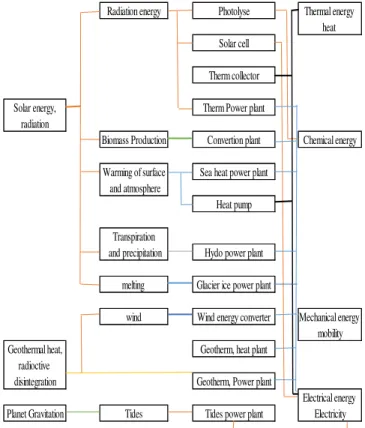
With the fast depletion of non-renewable energy sources such as fossil fuel and coal which has led to human health problems and global climate change and environmental degradation, the commercial production of biogas and other alternative energy source such as solar energy, hydropower, wind energy, bioenergy, geothermal will definitely give a drive for the development of the economy [2, 3]. Fig. 1 shows renewable energy conversion technologies. Energy derived from biogas is used in the form of fuel, heat, and electricity. It is desirable to create sustainable and with zero carbon emissions worldwide energy system [4, 5]. This results in resource conservation and environmental protection [5, 6].
Radiation energy Photolyse Thermal energy heat Solar cell
Therm collector
Solar energy, Therm Power plant
radiation
Biomass Production Convertion plant Chemical energy
Warming of surface Sea heat power plant and atmosphere
Heat pump
Transpiration
and precipitation Hydo power plant
melting Glacier ice power plant
wind Wind energy converter Mechanical energy mobility
Geothermal heat, Geotherm, heat plant
radioctive
disintegration Geotherm, Power plant
Electrical energy Planet Gravitation Tides Tides power plant Electricity
Fig I: Renewable energy conversion technologies
Biogas is produced by anaerobic decomposition process called Anaerobic Digestion (AD). It is the biological breakdown of organic matters in the absence of oxygen. The main product of biogas is methane and carbon dioxide [7, 8].
Biogas production follows four fundamentals processes. These processes include hydrolysis, acidogenesis,
Mesophilic Anaerobic Co-digestion of Cow
dung, Chicken Droppings and Grass Clippings
Anthony Njuguna Matheri1, Member, IAENG, Mohamed Belaid2, Member, IAENG, Tumisang Seodigeng3, Catherine Jane Ngila4, Charles Mbohwa5
T
Proceedings of the World Congress on Engineering and Computer Science 2016 Vol II WCECS 2016, October 19-21, 2016, San Francisco, USA
ISBN: 978-988-14048-2-4
ISSN: 2078-0958 (Print); ISSN: 2078-0966 (Online)
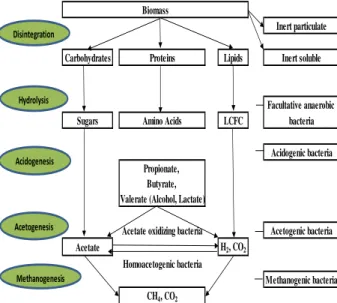
acetogenesis and methanogenesis [9]. Fig. 2 shows a simplified generic anaerobic digestion process [10].
Inert particulate
Carbohydrates Proteins Lipids Inert soluble
Facultative anaerobic
Sugars Amino Acids LCFC bacteria
Acidogenic bacteria Propionate,
Butyrate, Valerate (Alcohol, Lactate)
Acetate oxidizing bacteria Acetogenic bacteria
Acetate H2, CO2
Homoacetogenic bacteria
Methanogenic bacteria CH4, CO2
Biomass
Hydrolysis
Acidogenesis
Acetogenesis
Methanogenesis Disintegration
Fig 2: Degradation steps of the anaerobic digestion process.
Hydrolysis is theoretically the first step of anaerobic digestion, during which the complex organic matter (Polymers) are decomposed into smaller units (mono- and oligomers). During hydrolysis long-chain molecules, such as carbohydrate, protein, and fat polymers, are broken down to monomers (small molecules). Different specialized microbial produce a number of specific enzymes which catalyze the decomposition, and the process is extracellular. During hydrolysis, polymers like carbohydrates, proteins, lipids and nucleic acids are converted into glucose, glycerol, purines, and pyridines [11]. In the acidogenesis process, the acidogenic bacteria transform the products of the hydrolysis into short chain volatile acids, alcohol, ketones, carbon dioxide and hydrogen. Some of the major acidogenesis stage products are acetic acid, propionic acid, formic acid, butyric acid, lactic acid, ethanol, and methanol. From these products, the carbon dioxide, hydrogen, and acetic acid will skip the third stage, acetogenesis, and be utilized directly by the methanogenic bacteria in the final stage [12, 13]. The third stage is known as the acetogenesis stage, the rest of the acidogenesis products, i.e. the butyric acid, propionic acid and alcohols are transformed by acetogenic bacteria into hydrogen, carbon dioxide, and acetic acid. Hydrogen plays an important role in this process, as the reaction will only occur if the hydrogen partial pressure is low enough to thermodynamically allow the conversion of all compounds of acids. Such lowering of the partial pressure is carried out by hydrogen scavenging bacteria thus, the hydrogen concentration of a digester is an indicator of its health [14]. Methanogenesis is the final stage of the biogas production. The production of methane and carbon dioxide from intermediate products is carried out by Methanogenic bacteria. 70% of the formed methane during AD originates from acetate, while the remaining 30% is produced from the conversion of carbon dioxide (CO2) and hydrogen (H2) [11]. The methanogens bacteria have the slowest growth rate involved in the process; they also the limiting factor for how
quickly the process can proceed and how much material can be digested in AD. The growth rate of the methanogens is only around one fifth of the acid-forming bacteria [15].
The activity of biogas production depends on various parameters like temperature, partial pressure, pH, hydraulic retention time, C/N ratio, pre-treatment of feedstock, trace of metals and concentration of substrate [5, 16-18]. Table I shows different thermal stages and typical hydraulic retention times for the AD process.
TABLE I:
THERMAL STAGES AND TYPICAL HYDRAULIC RETENTION TIMES [19].
Thermal stages Process temperature (0C) HRT(days)
Psychrophilic <20 From 70-80
Mesophilic From 30-42 From 14-40
Thermophilic From 43-55 From 14-20
Biogas can be produced from co-digestion of various substrates. In the present study, anaerobic digestion of co-digestion of cow dung/chicken droppings and grass clippings were studied in laboratory experiments in a 10 liters digester under a constant temperature of 35 oC and 37 0
C.
II.METHODOLOGY
A. Substrate Collection
Cow dung and Chicken droppings were collected at the farm in Gauteng province while grass clippings were collected from the University of Johannesburg. Waste characterization was done to ascertain the composition. These included physical and chemical composition with regards to C/N ratio, total solids, volatile solids and elemental analysis for Carbon, Nitrogen, Sulphur and Hydrogen in accordance with the standard method (APHA 1995) [20].
To determine biogas production rate, a batch digester was fed with the co-digested substrates and inoculum under pre-set conditions of 37 0C and pH of 7 as shown in Fig. 3. pH was neutralized by a solution of 8g NaOH in 100 ml and H2SO4. The digester was flushed with Nitrogen gas to expel the oxygen and create an anaerobic process. It was then immersed in the water bath and kept under constant temperature. The liquid sample collected was analyzed using a spectrophotometer. The gas produced was measured using downwards displacement method on a daily basis until the end of retention time. The gas collected was sampled by extracting it from the digester using a gas syringe and was analyzed using gas chromatography instrument with flame- ionization detectors. The operating conditions were; helium was used as carrier gas at 20 ml/min, oven temperature 70 0C, detector temperature 150 0
C and injector port at 80 0C. Proceedings of the World Congress on Engineering and Computer Science 2016 Vol II
WCECS 2016, October 19-21, 2016, San Francisco, USA
ISBN: 978-988-14048-2-4
ISSN: 2078-0958 (Print); ISSN: 2078-0966 (Online)
Fig 3: Biogas production setup.
Where: 1 – Thermostatic water bath, 2 - T-Glass bottle reactor, 3 – CO2 fixing unit and 4 – Gas volume measuring device.
III. RESULTSANDDISCUSSION
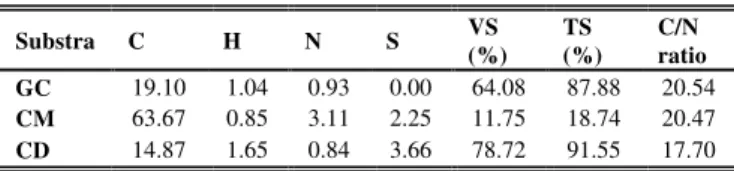
The purpose of this experiment was to determine the efficiency of biogas production under mesophilic conditions. In this study, co-digestion of Cow dung/Chicken droppings and grass clippings were evaluated for the purpose of getting the bio-methane potentials and biochemical kinetics at optimum temperature 35 oC, 37 0C and initial pH of 7. Table II shows the substrate characterization. Cow dung and chicken droppings were found to contain more volatile solids compared to grass clippings which had more nutrients. The elemental analysis of cow dung indicated low C/N ratio compared to grass clippings. Through co-digestion, the C/N ratio increased to 19.19 while that one for co-digestion of chicken droppings and grass clippings the C/N ratio was 20.49.
TABLE II:
SUBSTRATE CHARACTERIZATION
Substra C H N S VS
(%) TS (%)
C/N ratio
GC 19.10 1.04 0.93 0.00 64.08 87.88 20.54
CM 63.67 0.85 3.11 2.25 11.75 18.74 20.47
CD 14.87 1.65 0.84 3.66 78.72 91.55 17.70
Where: Substrate, GC-Grass clippings, CM-Chicken manure, CD-Cow dung, C – Carbon, H – Hydrogen, N – Nitrogen, S – Sulphur, TS – Total Solids, VS – Volatile Solids.
TS is the sum of dissolved solids and suspended solids. TS and pH are important to assess anaerobic digestion process efficiency [14, 19]. VS is the organic portion of TS that biodegrade in the anaerobic process. C/N ratio is an important factor in bacteria stability in the anaerobic process. The C/N ratio required for the production of biogas is from 15-30 [21, 22]. TS and VS are calculated using equation (1) and (2) respectively while C/N ratio is calculated using equation (3).
M
M
M
wet burned dried
VS(%) (1)
M
M
wet dried
TS(%) (2)
Where:
Mdried = Amount dried sample (mg) Mwet = Amount of wet sample (mg) Mburned = Amount of burned sample (mg)
) * ( ) * (
) * ( ) * (
N
N
S
C
f f
f F
F F
S F
N C
(3)
Where: F = First substrate, S = Second substrate, Cf = Carbon composition for the first substrate, Cs = Carbon composition for the second substrate, Nf = Nitrogen composition for the first substrate, Ns = Nitrogen composition for the second substrate.
In order for a chemical reaction to take place, the ions or particles, which are reactants, must physically come into contact with one another. Anything that increased the frequency of these encounters increased the rate at which products were formed. The rate of a chemical reaction can be increased by increasing the temperature at which the reaction occurs. Temperature affects the chemical properties of the components in the substrates and the growth rate and metabolism of the micro-organisms as reported by Fogler (2010) [23]. High temperature kills the microorganisms and thus decreasing methane produced. It affects the population dynamics in the digester. The temperature sensitivity and classification can be divided into psychrophilic, mesophilic and thermophilic. Acetotrophic methanogens and degradation of butyrate and propionate are sensitive to high temperatures. Temperature also affects the partial pressure of H2 in the digesters and thus the movements of the syntrophic metabolism. High temperature mesophilic 30-40 0
C favored the production of acetate, carbon dioxide and hydrogen from propionate. It was desirable to keep the operating temperature stable so as to avoid disturbing the livelihood of the bacteria, especially the methanogens.
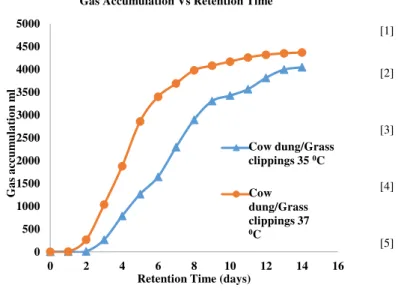
Fig. 4 and 5 shows the effect of mesophilic temperature on AD 35 0C and 37 0C. Between 1-10 days the rate of conversion increased with retention time. This was because, with time, the conversion rate/percent of reactants to products increased. Temperature played an important role in dissociating reactant particles to form new species. The conversion rate of the reaction and biogas production increased with the increase in temperature and hydraulic retention time until an equilibrium state was achieved.
The average CH4 and CO2 contents for Cow dung and Chicken droppings co-digested with Grass clippings were reported as 60 %, 58 % and 35 %, 38 % respectively. From the analysis using gas chromatography instrument (GC), CH4 was observed to contain 60 % and 58 % in biogas. According to the literature, the energy content of biogas is directly proportional to CH4 concentration. 1 m3 of CH4 has Proceedings of the World Congress on Engineering and Computer Science 2016 Vol II
WCECS 2016, October 19-21, 2016, San Francisco, USA
ISBN: 978-988-14048-2-4
ISSN: 2078-0958 (Print); ISSN: 2078-0966 (Online)
a calorific value of around 9.81 kWh, while CO2 had zero [24]. The biogas generated can be used to generate renewable (green) energy in the form of electricity and heat using combined heat and power (CHP) engine.
0 500 1000 1500 2000 2500 3000 3500 4000 4500 5000
0 2 4 6 8 10 12 14 16
Ga
s
a
c
c
u
m
u
la
ti
o
n
m
l
Retention Time (days) Gas Accumulation Vs Retention Time
Cow dung/Grass clippings 35 0C
Cow dung/Grass clippings 37
0C
Fig 4: Effect of different temperature constant on rate of conversion with co-digestion of cow dung and grass clippings
0 5000 10000 15000 20000 25000 30000 35000
0 2 4 6 8 10 12 14 16 18 20
Ga
s
A
c
c
u
m
u
la
ti
o
n
(
m
l)
Retention Time (days) Gas Accumulation chic Vs Retention Time
Chicken droppings/Grass clippings 35 0C
Chicken droppings/Grass clippings 37 0C
Fig 5: Effect of different temperature constant on the rate of conversion with co-digestion of chicken dropping and grass clippings.
IV. CONCLUSION
Biogas production from co-digestion of cow dung and grass clippings was established to be feasible at a temperature of 37 0C. All co-digestion in a ratio of 1:1 showed a good productivity of methane indicated as 58-60 %.
ACKNOWLEDGEMENT
The author wish to express their appreciation to Process Energy Environmental and Technology Station (PEETS) funded by South Africa National Energy Development Institute (SANEDI) and Technology Innovation Agency
(TIA), City of Johannesburg (COJ) through Prof. Charles Mbohwa, Chemical Engineering and Applied Chemistry Departments at the University of Johannesburg for allowing us to work in their laboratories.
REFERENCE
[1] Matheri, A.N., et al., Modelling the Kinetics of Biogas Production
from Co-digestion of Pig Waste and Grass Clippings. 24th World
Congress on Engineering (WCE 2016) London-UK, 2016.
[2] Abbasi, T., S.M. Tauseef, and S.A. Abbasi, Anaerobic digestion for
global warming control and energy generation—an overview.
Renewable and Sustainable Energy Reviews, 2012. 16(5): p.
3228-3242.
[3] Matheri, A.N., et al., The Kinetic of Biogas Rate from Cow Dung
and Grass Clippings. 7th IIENG International Conference of latest
trends in Engineering and Technology (ICLTET’2015) Pretoria,
South Africa, November 2015, 2015.
[4] Yusuf, M.O.L., A. Debora, and D.E. Ogheneruona, Ambient
temperature kinetic assessment of biogas production from
co-digestion of horse and cow dung. Research in Agricultural
Engineering, 2011. 57(3): p. 97-104.
[5] Latinwo, G.K. and S.E. Agarry, Modelling the Kinetics of Biogas Production from Mesophilic Anaerobic Co-Digestion of Cow Dung with Plantain Peels. International Journal of Renewable Energy Development (IJRED), 2015. 4(1): p. 55-63.
[6] Allan, H., ―Grass productivity‖. Island Press Conservation
Classics Series, Washington DC, 1998: p. 56-89.
[7] Omer, T.O., and M.O. Fedalla, Engineering design and Economic
Evaluation of a family—sized biogas project in Nigeria.
Technovation, 2002.
[8] Sambo, A.S., B. Garba, and B.G. Danshehu, Effect of some
operating parameters on biogas production rate. Renewable
Energy, 1995. 6(3): p. 343-344.
[9] Tiehm, A., et al., Ultrasonic waste activated sludge disintegration
for improving anaerobic stabilization. Water Research, 2001.
35(8): p. 2003-2009.
[10] Sreekrishnan, T.R., S. Kohli, and V. Rana, Enhancement of biogas
production from solid substrates using different techniques––a review. Bioresource technology, 2004. 95(1): p. 1-10.
[11] Ostrem, K., Greening waste: Anaerobic digestion for treating the
organic fraction of municipal solid wastes. Earth Engineering
Center Columbia University, 2004: p. 6-9.
[12] B., B., G. H., and K. M., Waste Management. 1997.
[13] Mata, A.J., Biomethanization of the organic fraction of municipal
solid wastes. 2003: IWA publishing.
[14] Jrgensen, P.J., PlanEnergi, Biogas green energy, Faculty of
Agricultural Sciences, Aarhus University. 2009, ISBN
978-87-992243-2-1.
[15] Sutter, K., A. Wellinger, and S. Güllengrubeal, Biogas a lager.
FAT-Berichte. 1986.
[16] Rao, S., A. Retter, and P.J. Hobbs, Effect of biomass hydrolysis on
biogas production.
[17] Sundararajan, R., S. Jayanthi, and R. Elango, Anaerobic digestion of organic fractions of municipal solid waste and domestic sewage
of Coimbatore. Indian Journal of Environmental Health, 1997.
39(3): p. 193-196.
[18] Matheri, A.N., et al., Optimising biogas production from anaerobic
co-digestion of chicken manure and organic fraction of municipal
solid waste Renewable and sustainable energy review journal,
(Submitted). 2015.
[19] Noshy, R., Optimization of bioenergy solutions at different farm scales. 2013: p. 17-84.
[20] Rice, E.W., L. Bridgewater, and A.P.H. Association., Standard
methods for the examination of water and wastewater. 2012:
American Public Health Association Washington, DC.
[21] Mojapelo, N., et al., Bio-methane potential of the organic fraction
of the municipal solid waste. 2014.
[22] Patil, J.H., et al., Kinetics of anaerobic digestion of water hyacinth
using poultry litter as inoculum. International Journal of
Environmental Science and Development, 2012. 3(2): p. 94-98.
[23] Fogler, H.S., Essentials of chemical reaction engineering. 2010: Pearson Education.
[24] Jarvis, A., 'Biogas Renewable Energy from Organic Waste' The
Swedish Biogas Association, Sweden.
Proceedings of the World Congress on Engineering and Computer Science 2016 Vol II WCECS 2016, October 19-21, 2016, San Francisco, USA
ISBN: 978-988-14048-2-4
ISSN: 2078-0958 (Print); ISSN: 2078-0966 (Online)