www.biogeosciences.net/4/125/2007/ © Author(s) 2007. This work is licensed under a Creative Commons License.
Biogeosciences
Soils apart from equilibrium – consequences for soil carbon balance
modelling
T. Wutzler and M. Reichstein
Max Planck Institute for Biogeochemistry, Jena, Germany
Received: 28 August 2006 – Published in Biogeosciences Discuss.: 10 October 2006 Revised: 6 February 2007 – Accepted: 7 February 2007 – Published: 15 February 2007
Abstract.Many projections of the soil carbon sink or source
are based on kinetically defined carbon pool models. Para-meters of these models are often determined in a way that the steady state of the model matches observed carbon stocks. The underlying simplifying assumption is that observed car-bon stocks are near equilibrium. This assumption is chal-lenged by observations of very old soils that do still accumu-late carbon. In this modelling study we explored the conse-quences of the case where soils are apart from equilibrium. Calculation of equilibrium states of soils that are currently accumulating small amounts of carbon were performed us-ing the Yasso model. It was found that already very small current accumulation rates cause big changes in theoretical equilibrium stocks, which can virtually approach infinity. We conclude that soils that have been disturbed several centuries ago are not in equilibrium but in a transient state because of the slowly ongoing accumulation of the slowest pool. A first consequence is that model calibrations to current carbon stocks that assume equilibrium state, overestimate the decay rate of the slowest pool. A second consequence is that spin-up runs (simulations until equilibrium) overestimate stocks of recently disturbed sites. In order to account for these con-sequences, we propose a transient correction. This correc-tion prescribes a lower decay rate of the slowest pool and accounts for disturbances in the past by decreasing the spin-up-run predicted stocks to match an independent estimate of current soil carbon stocks. Application of this transient cor-rection at a Central European beech forest site with a typical disturbance history resulted in an additional carbon fixation of 5.7±1.5 tC/ha within 100 years. Carbon storage capacity of disturbed forest soils is potentially much higher than cur-rently assumed. Simulations that do not adequately account for the transient state of soil carbon stocks neglect a consid-erable amount of current carbon accumulation.
Correspondence to:T. Wutzler ([email protected])
1 Introduction
nwl Branches
Coarse Roots Stem
fwl cwl
ext cel lig hum1
hum2 Foliage
Fine Roots CO2
CO2
CO2 CO2
CO2
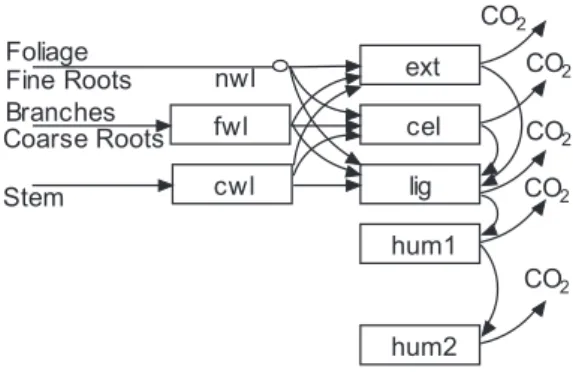
Fig. 1. Model Structure of the Yasso Model (Liski et al., 2005). The pools on the left side describe woody litter that becomes avail-able for decomposition after a delay (nwl: non-woody litter, fwl: fine woody litter, cwl: coarse woody litter). The pools on the right side (ext: extractives, cel: celluloses, lig: lignin, hum1: humus1, hum2: humus2) represent soil carbon pools of different stability that are modeled by different decay rates of an exponential decay. The ext pool has the largest decay rate (i.e. least stability and short-est turnover time) and the hum2 pool has the smallshort-est decay rate (i.e. highest stability and longest turnover time).
This implies increasing stocks at old soils. Many modellers argue that the equilibrium assumption might be wrong, but it works and must be used until other approaches are evolving. Nevertheless, the consequences of relaxing the equilibrium assumptions are not well understood.
The aim of this study was to explore the consequences of a relaxed equilibrium assumption. The paper has the following outline. In a first part we perform an equilibrium experiment using the Yasso model’s standard parameterization and show that the decay rate of the slowest pool and theoretical equilib-rium stocks are highly uncertain. This implies that soil might be far apart from theoretical equilibrium yet. Based on these findings we propose a method how to initialize models to a transient state instead of equilibrium. In a second part we apply this initialization to a Central European case study. We discuss consequences for current soil modelling. Further, we show and discuss ways to overcome the equilibrium assump-tion.
2 Methods
2.1 The Yasso model
The soil carbon model Yasso was designed by Liski et al. (2005) in order to model soil carbon stocks of mineral soils in managed forests. Despite its simplicity and low de-mands on input data and parameters it shares many prop-erties of the family of models that are based on kinetically defined pools. Figure 1 displays the model structure and the flow of carbon. The right part describes the separation of the different litter types into compartments that correspond to the kinetically defined pools and it describes a delay of
nwl Branches
Coarse Roots
Stem
fwl
cwl
ext
cel
lig
hum1
hum2 Foliage
Fine Roots
CO2
CO2
Equilibrium of fast pools Stock (ext+cel+lig+hum1): 40.7 tC/ha
Carbon flow to hum2:
0.063 tC/ha/yr (plig=phum1=0.2)
0.127 tC/ha/yr (plig=phum1=0.4)
Fig. 2. Relaxed equilibrium assumption: All pools are assumed to be in equilibrium except the slowest pool (hum2). Constant average litter input determines equilibrium stocks of the faster pools and the constant flow to the slowest pool.
the woody litter compartments before decomposers can at-tack the chemical compounds. The left part describes the decomposition of the chemical compounds. The decay rates are dependent on mean annual temperature (or alternatively effective temperature sum) and a drought index (difference between precipitation and potential evapotranspiration dur-ing vegetation period). In the standard parameterization the decay rates of the slower pools are less sensitive to tempera-ture increase than the fast pools (hums one: 60%, humus two: 36% of sensitivity of fast pools). The model has been tested and successfully applied to boreal forest (Peltoniemi et al., 2004), litter bag studies in Canada (Palosuo et al., 2005), and as part of the CO2FIX model all over Europe (e.g. Kaipainen et al., 2004; e.g. Nabuurs and Schelhaas, 2002).
2.2 The relaxed equilibrium assumption
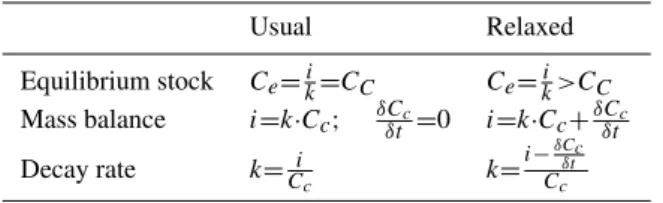
The relaxed equilibrium assumption corresponded to the usual equilibrium assumption, except that the slowest pool was excluded from this assumption. Assuming that time since last disturbance is longer than a century and that the inputs to the soil system did not change much within this time, the faster pools (turnover times of at most decadal time scale) have had enough time to recover from former distur-bance. They were regarded to be near a dynamic equilibrium (averaging across changes during rotation periods and with climate fluctuations). The relaxed equilibrium assumption assumed that this is not true for the slowest pool which needs long time scales to reach the theoretical equilibrium. Hence the relaxed equilibrium assumption assumed the slowest pool to be still accumulating (Table 1). If all the faster pools are in equilibrium, the input rate to the slowest pool is constant (Fig. 2).
2.3 The equilibrium experiment
from former disturbance. The development of the carbon stock of the slowest poolC(tC/ha) over timet (yr) was de-scribed by a first order kinetics with decay ratek(1/yr) and with inputi(tC/ha/yr) (Eq. 1).
δC
δt =i−k·C (1)
When applying a constant input rate, integration of Eq. (1) resulted in the closed form of Eq. (2), wherea (dimension-less) is an integration constant.
C= i
k
1−ae−k·t (2)
Constraining the stock at time t=0 to C0 in Eq. (2) gives Eq. (3).
C= i
k−
i
k −C0
·e−k·t (3)
The decay ratekcan be expressed as a function of the current stockCc, (tC/ha), input i, and by an approximation of its current rate of assimilation1Cc
1t (tC/ha/yr). Resolving Eq. (1) for the decay rate gives Eq. (4).
k= i−
1Cc 1t Cc
(4) For a given decay ratek, the equilibrium stock, which corre-sponds to an assimilation rate of 0, is given by Eq. (5).
Ce= i
k (5)
And the accumulation timet95 (yr), i.e. the time for an in-crease of stocks from zero to 95% of equilibrium stock, is given by Eq. (6).
t95=
ln(0.05·Ce)
k (6)
In the equilibrium experiment we prescribed different cur-rent assimilation rates and calculated corresponding decay rates of the slowest pool (Eq. 4). Given these decay rates, we determined equilibrium stocks (Eq. 5), and the times that are needed to accumulate 95% of these stocks (Eq. 6). Initial pools size (40.7 t/ha) and input to the slowest pool (i=0.063 tC/ha/yr) were calculated by equilibrium of the faster pools of the Yasso model with standard parameteri-zation for Norway spruce in standard climate (Appendix B). Reasonable constant average litter inputs of Norway spruce were applied (non woody litter=1.7 tC/ha/yr, fine woody lit-ter=1.4 tC/ha/yr, thin coarse woody litter=0.1 tC/ha/yr, large coarse woody litter=0.1 tC/ha/yr). The development of car-bon stocks with average litter inputs represents the trend (moving average over time) of the carbon stocks that result from the application of non-constant litter input. Addition-ally, calculations were repeated using an increased input to the slow pool (i=0.127 tC/ha/yr) that resulted from a change in the Yasso parameterization in which a larger part of de-cay material was spent to form more recalcitrant compounds (plig=phum1=0.4).
Table 1. Comparison of equations between the usual equilibrium assumption and the relaxed equilibrium assumption for the slowest pool.k: decay rate,i: input rate,Cc: current stock,Ce: equilibrium stock.
Usual Relaxed
Equilibrium stock Ce=ki=CC Ce=ki>CC Mass balance i=k·Cc; δCδtc=0 i=k·Cc+δCδtc
Decay rate k= i
Cc k=
i−δCc δt Cc
2.4 The transient correction
In continuation to the results of the equilibrium experiment, we developed a method of correcting spin-up-run predicted pool sizes for the effects of former disturbance. This “tran-sient correction” is only valid for sites that have not been disturbed for about a century, because it uses the relaxed equilibrium assumption, which assumes that all pools are in equilibrium except the slowest pool. According to the re-sults of the equilibrium experiment, which are described in the results section of this study, the effects of former dis-turbance are an overestimation of the slowest pool’s decay rate in model calibration and that current carbon stocks are smaller than equilibrium carbon stocks. Hence, the correc-tion, first, prescribes a lower decay rate of the slowest pool. Below it will be shown that about 20% of the decay rate that is determined by the usual equilibrium assumption is ap-propriate for century term simulations. Second, the correc-tion decreases the spin-up-run predicted equilibrium stock of the slowest pool by subtracting an amount of carbon. The amount that has to be subtracted is chosen so that the sum of the stocks of the soil carbon pools matches an independent estimate of current carbon stocks.
2.5 Application of the transient correction
Table 2. Scenario groups of the simulations of the Leine-felde/M¨uhlhausen chronosequence. Within each group simula-tions were performed with different decay rates of the slowest pool (hum2) and repeated with increased temperature sensitivity.
Scenario group Description
base current inputs and current temperature litter increase of litter inputs by assuming that all
the wood remains in the forest (conserva-tion scenario)
t3–t9 increase of temperature by 3,6, and 9 Kelvin gradually over the next 100 years
t3+litter increase of litter input and increase of tem-perature by 3 Kelvin
Table 3. Average litter inputs to the Yasso model [tC/ha/yr]. nwl: non woody litter, fwl: fine woody litter, cwl small: coarse woody litter with a diameter diameter 6–20 cm, cwl large: coarse woody litter with a diameter 20–60 cm.
Scenario group nwl fwl cwl small cwl large
base, t3–t9 3.148693 0.528087 0.208115 0.08467 litter, t3+litter 3.148693 0.865541 1.242068 0.213914
carbon stocks of the mineral soil (41.7±5.0 tC/ha) and the organic layer (3.7±0.8 tC/ha) was used. The used standard parameterization of the Yasso model is listed in Appendix B. We studied the effect of assuming different intrinsic de-cay rate of the hum2 pool (slowest most stable pool of the Yasso model) on both, the average carbon stock, and the un-certainty of the carbon stocks after 100 years. The decay rate was varied by dividing the standard value of 1.2e-3 yr−1by 1, 5, 25, 125, and 625. This corresponds to turnover times of 830 to 5.2e5 years. We used four scenario groups in order to gain insight, in how this effect varies with combinations of changes in temperature and litter input (Table 2). Table 3 lists average litter inputs to the Yasso model. We did not vary litter inputs with stand age but applied a constant litter input that was averaged across one rotation cycle. For details of derivation of litter input see Appendix A. First we studied the effect with four scenario groups and standard parameteriza-tion. Next, we studied the effect in four scenario groups that differed from the corresponding previous scenario groups by increased temperature sensitivity of the slow pools apparent decay rate. The apparent decay rate depends on the intrin-sic decay rate, water availability, temperature, and several parameters. We modified the standard parameterization in a way so that the slowest pools were as sensitive to warming as the decay rates of fast pools (s1=s2=100%).
20 40 60 80 100 120 140 160
-500 0 500 1000 1500 2000 2500 3000
Time [yr]
S
to
c
k
o
f F
ir
s
t O
rd
e
r K
in
e
ti
cs
[tC
/h
a
] k = 1/(830 yr)
k = 1/(1300 yr) k = 1/(1900 yr) k = 1/(2800 yr) k = 1/(4200 yr)
Fig. 3. Trajectories of the slowest pool of the Yasso model with different decay rates. Dynamics is described by a first order ki-netics with constant input (Eq. 3): C=ki−
i k−C0
·e−k·t; input
i=0.06345 tC/ha/yr; stock at time zeroC0=52.874 tC/ha. At time
t=0 the current carbon stockC0is observed. The lower the decay
rate, the larger is the current rate of carbon accumulation, which is given by the slope1C/1t at time zero.
3 Results
3.1 Decay rates and equilibrium stocks in the equilibrium experiment
(a) Prescribed Accumulation Rate [tC/ha/yr]
Decay Rate [1/yr]
0.00 0.05 0.10 0.15 0.20 0.25
1e6 5e6 1e5 5e5 1e4 5e4 1e3 5e3
oo ooo
o o o o oo o o o x x x x xxx x x x x
x x x x
x
xx
xx x x o
x
i=0.063 tC/ha/yr i=0.127 tC/ha/yr
(b) Prescribed Accumulation Rate [tC/ha/yr]
Equilibrium Stocks [tC/ha]
0.00 0.05 0.10 0.15 0.20 0.25 50
100 200 500 1000 2000 5000 10000 20000 50000
ooo
oo
o
oo
o o o o o o
x x x x x xx x x
x x x x
x x
x
xx
x x x x
(c) Prescribed Accumulation Rate [tC/ha/yr]
Accumulation Time (t95) [yr]
0.00 0.05 0.10 0.15 0.20 0.25 1e3
1e4 1e5 1e6 1e7
oo oo
o o
oo o o o o o o
x x x x xx x x x x x
x x x x
x xx
x x x x
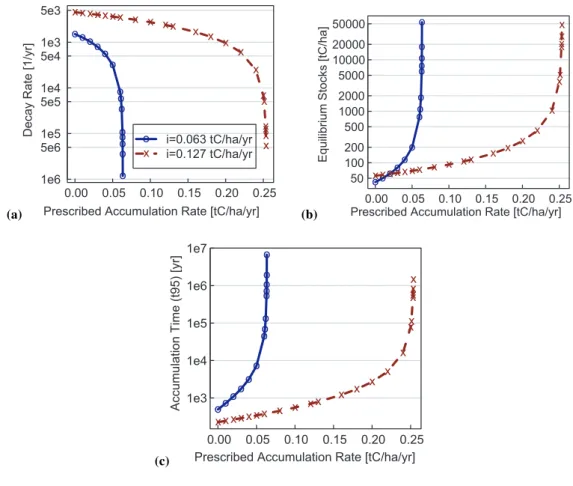
Fig. 4.Decay rates(a)(Eq. 4), equilibrium stocks(b)(Eq. 5), and accumulation times(c)(Eq. 6) that result when different rates of current carbon accumulation (x-axis) are prescribed. Symbols correspond to two different equilibrium inputs that result from a variation in the proportion of decomposed mass in the Yasso Model.
3.2 Effects of accounting for former disturbance by the application of the transient correction
The sum of the equilibrium carbon pools after the spin-up-run exceeded observed stocks by about 30% for the M¨uhlhausen/Leinefelde study site that has been disturbed until 150 years ago (Fig. 5). With the relaxed equilibrium assumption (all pools are in equilibrium except the slowest pool), we interpreted that the slowest pool (hum2) was far from equilibrium yet. The application of the transient cor-rection decreased the slowest pool, i.e. the carbon above the line of observed carbon stocks in Fig. 5. In the scenario of in-creased temperature sensitivity the relative proportion of the slowest pool after the correction was larger because the spin-up-runs resulted in smaller sum of stocks of all the pools.
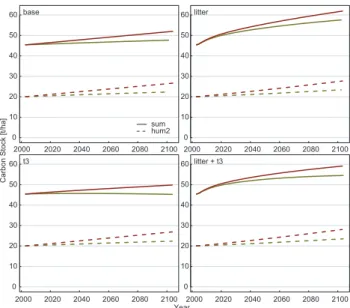
The carbon accumulation due to the adjustment of the spin-up-run predicted pools for former disturbances was 5.7±1.5 tC/ha with standard temperature sensitivity (Fig. 6 top left) and 5.5±1.8 tC/ha with increased temperature sen-sitivity (Fig. 7 top left) within 100 years for the baseline sce-nario. This corresponds to a flux of 5.7 gC/m2/yr and an in-crease of about 13% of initial carbon stocks over 100 years.
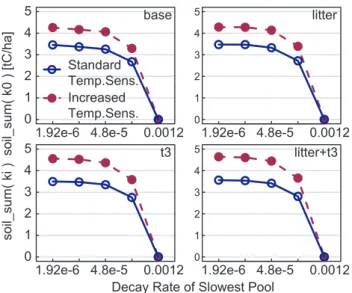
This carbon accumulation would have been neglected with-out the transient correction. The transient correction pre-scribes a lower intrinsic decay rate of the slowest pool but does not specify this rate. Hence, we studied the uncertainty that resulted from a range of prescribed decay rates that cor-respond to turnover times from 830 to 5.2e5 years. The ab-solute amount of uncertainty of 1.5 tC/ha (or 1.8 tC/ha for increased slow pool temperature sensitivity) did not change much with different scenarios of litter input and temperature increase (Figs. 6 and 7). Hence the relative size of the un-certainty depended on the projected change of carbon stocks and varied between 9% in the conservation scenario (Fig. 7 litter) and 59% in the temperature increase scenario (Fig. 7 t3).
Standard Increased
Climate Sensitivity SpinupRun Predicted Pools [tC/ha] 0
20 40 60 80 100
120 hum2
hum1 lig cel ext
Observed Carbon Stocks
Fig. 5. Transient correction at the M¨uhlhausen/Leinefelde site. Spin-up-runs of the Yasso model simulate the theoretical equilib-rium stocks of the kinetically defined soil carbon pools (ext, cel, lig, hum1, and hum2). The transient correction decreased the slow-est pool (hum2) so that the sum of the pools matches the observed carbon stocks. Climatic sensitivity: The decay rates of the slower pools were less sensitive to warming than the faster pools with stan-dard parameterization and equally sensitive (s1=s2=100%) in the scenarios of increased temperature sensitivity.
4 Discussion
4.1 Highly uncertain decay rates and equilibrium stocks
Our study for the first times explores the consequences of relaxing the usual assumption that soil carbons stocks are in equilibrium. The consequences for the parameterization of slow pool decay rates and resulting theoretical long-term equilibrium were studied by performing an equilibrium ex-periment, in which the slowest pool was still accumulating carbon. The equilibrium experiment showed that already very small rates of current accumulation caused tremendous changes in equilibrium stocks (Fig. 4). The necessary ac-cumulation rates are so small, that it is practically impossi-ble to measure them within a few years. The times to reach equilibrium could span millennia. Hence, soils may be far apart from a theoretical equilibrium. The theoretical equilib-rium does not account for non-respiratory losses out of the system. Hence, soils may never reach this theoretical equi-librium because of changing conditions and partial resets by disturbances (e.g. forest fires (Parker et al., 2001; Wardle et al., 2003), or erosion (Hedges et al., 1997; Polyakov and Lal, 2004)). In addition soil weathering continues and soil hori-zons may change in a way to increase humus stabilization and potential carbon stocks.
4.2 The transient correction – an approach to account for former disturbance
In order toaccount for former disturbances, we suggested a heuristic technique that we call the transient correction. Soils that have been disturbed centuries ago are still in a tran-sient state due to the long timescales of the slowest pool. The transient correction can account for this transient state, where the relaxed equilibrium assumption is valid (time since last disturbance is longer than a century).
The transient correction does not specify the decay rate of the slowest pool, because the rate can not be determined by calibrating equilibrium states to current stocks or observing current stock changes. If no method of constraining this rate is available, 1/5 of the standard decay is a reasonable first estimate, because lower rates did not change results much in decadal time scale, as we showed in our sensitivity analysis (Fig. 8).
The transient correction modifies a valid state by changing the stock of a single pool. This procedure potentially may initialize models tonon-valid states. However, most models have no feedbacks or very weak feedbacks from the slowest pool to the other pools. Hence, we do not expect big numer-ical errors or anomalies due to the transient correction when simulating the system.
One precondition for applying the transient correction is
an independent estimate of current soil carbon stocks.
This estimate must account for the disturbance history. Best choice is measuring carbon stocks at the site. However, this is laborious and expensive. If the disturbance history can be assumed to be similar within a region, a spatial extrapola-tion of measured carbon stocks can be used (e.g. Liski and Westman, 1997; Perruchoud et al., 2000; Wirth et al., 2004; Wutzler et al., 2006).
We note, that neither the equilibrium nor the relaxed equi-librium assumption is applicable for sites with more recent (less than a century ago) disturbances. In order to initialize the model for such sites, the stocks of all the pools have to be estimated. There are recent advances in reflectance meth-ods to achieve this (Couteaux et al., 2003). Zimmermann et al. (2007) related fractions of grassland soil carbon that were chemically distinguished to the carbon pools used in the Roth-C model. These pools then could be classified quite well by analysing reflectance spectra.
4.3 Incorrect initial model state and underestimation of car-bon accumulation and it’s uncertainty
2000 2020 2040 2060 2080 2100 0
10 20 30 40 50 60 base
2000 2020 2040 2060 2080 2100 0
10 20 30 40 50 60 litter
2000 2020 2040 2060 2080 2100 0
10 20 30 40 50 60 t3
2000 2020 2040 2060 2080 2100 0
10 20 30 40 50 60 litter + t3
Year
Carbon Stock [t/ha]
Uncertainty due to Lower Decay Rate of the Hum2 Pool
Accumulation Because Hum2 Pool is Apart from Equilibrium
sum hum2
Fig. 6. Development of the soil carbon stocks at the Leinefelde chronosequence simulated by the Yasso model with standard tem-perature sensitivity.sumrepresent the sum of the stocks of the Yasso soil pools (ext+cel+lig+hum1+hum2). The lower ones of the di-verging lines are trajectories of the simulation with standard param-eterization of the slowest pool decay (khum2=1.20e–3) and upper ones of a much lower value (khum2=1.92e–06). The four panels correspond to different scenario groups (base: no change in litter inputs and temperature, litter: increase litter input, t3: temperature increase of 3K gradually over 100 years).
If soils are apart from equilibrium, this leads to a big over-estimation of the decay rate of the slowest pool with the cur-rent method of constraining the slow pool decay rates. The spin-up-runs will still give reasonable results for soils that have a similar disturbance history as the sites used for pa-rameterization of the model (Peltoniemi et al., 2004). How-ever, with an overestimated decay rate of the slowest pool, the spin-up-runs underestimate the stock at sites that have not been disturbed for a very long time. Further, the spin-up-runs overestimate the stock at sites that have been disturbed in the last two or three centuries ago. For this time we can assume that the sites used for parameterization of the Yasso model have not been severely disturbed. The spinup-runs possibly will overestimate stock at sites where last disturbance is even longer ago, but this depends on disturbance history of the sites used for parameterization of the Yasso model.
When applying the transient correction to the Central European beech forest we found an additional increase of 5.7 g/m2/yr due to recovering from disturbance (Fig. 6). This additional increase was of the same magnitude as the increase due to climate change projected for Finland (9 g/m2/yr) (Liski et al., 2006) or Sweden (7.5 g/m2/yr) ( ˚Agren et al., 2007). In a first very rough extrapolation to ropean scale we assume that half of the forested area in Eu-rope is still recovering from former disturbance and that the
2000 2020 2040 2060 2080 2100 0
10 20 30 40 50 60 base
2000 2020 2040 2060 2080 2100 0
10 20 30 40 50 60 litter
2000 2020 2040 2060 2080 2100 0
10 20 30 40 50 60 t3
2000 2020 2040 2060 2080 2100 0
10 20 30 40 50 60 litter + t3
Year
Carbon Stock [t/ha]
sum hum2
Fig. 7. Development of the soil carbon stocks at the Leinefelde chronosequence simulated like the ones in Fig. 6 except an in-creased temperature sensitivity of the slow pools (s1=s2=100%).
additional increase that we calculated for the Leinefelde site would occur on this area. With these assumptions, the pro-jected forest soil carbon sink of 7.5 TgC for Europe (EU15 + Norway + Switzerland: 120 million ha) by a recent LPJ mod-elling study by ATEAM (Lindner et al., 2004; Schr¨oter et al., 2004) would be increased by 3.42 TgC or by 46%. Hence, the potential carbons sink due to recovering from former dis-turbance is in the same magnitude as the currently projected sink in Europe.
Relaxing the equilibrium assumption added another de-gree ofuncertainty to projections of carbon stocks. With applying the transient correction, this additional uncertainty entered the model by the unknown slowest pools decay rate. The uncertainty of projected carbon stocks was smaller than projected stock change but of the same magnitude (Figs. 6 and 7). Further, the uncertainty varied with assumptions about the temperature sensitivity of the slow pools decay rates (Fig. 8). This variation of the uncertainty of carbon stock changes was caused in part by the higher initial per-centage of the slow pool in the increased temperature sensi-tivity scenarios (Fig. 5). We suppose that uncertainty of stock changes due to slow pool parameterization will be largest in soils, where the initial percentage of the slow pool after the transient correction is large or where decay rates are high. 4.4 Consequences apply also to other models
0 1 2 3 4 5
1.92e-6 4.8e-5 0.0012 base
0 1 2 3 4 5
1.92e-6 4.8e-5 0.0012 litter
0 1 2 3 4 5
1.92e-6 4.8e-5 0.0012 t3
0 1 2 3 4 5
1.92e-6 4.8e-5 0.0012 litter+t3
Decay Rate of Slowest Pool
soil_sum( ki ) soil_sum( k0 ) [tC/ha]
Standard Temp.Sens. Increased Temp.Sens.
Fig. 8. Difference of carbon stocks from base line (standard pa-rameterization,khum2=0.0012) after 100 years (y-axis) caused by different parameterization of the decay rate of the slowest pool (log-arithmic x-axis). The four panels correspond to different scenario groups (base: no change, litter: increase litter input, t3: increased temperature).
these models use the equilibrium assumption to infer initial states. Therefore, the consequences of Yasso model simu-lations also apply to these models. The transient correction should also be readily applicable to these models except the RothC model. The RothC shares the same problem; how-ever the application of the transient correction is impaired. This is because the model specifies no input to the inert pool and already calibrates the size of the inert pool in a way to match average age of soil carbon that was determined by C14 measurements (Falloon et al., 1998; Martel and Paul, 1974; Rumpel et al., 2002).
4.5 Evidence and tests for the hypothesis of soil carbon stock being apart from equilibrium
From repeated measurement after 5–10 years, we can practi-cally not infer if a soil carbon stock is near equilibrium be-cause small changes in carbon stocks could be attributed to inter-annual variance (Fig. 3). However, the influence of for-mer disturbances, namely forfor-mer land use, on current soil carbon stocks, C:N ratios, nitrification and other soil proper-ties is confirmed by many studies at several sites (e.g. Berger et al., 2002; Goodale and Aber, 2001; Koerner et al., 1997; Mund, 2004; Mund and Schulze, 2005; Rothe et al., 2002; Thornton et al., 2002; Wardle et al., 1997). These influences can be much stronger than climatic influences (Caspersen et al., 2000; Janssens et al., 2001) and can be observed af-ter 1700 years (Dupouey et al., 2002). A recent review re-garding soil carbon changes in forests concludes that the vast intensive cultivation throughout Europe (deforestation,
drainage, deflation and erosion) has caused immense histor-ical losses of soil carbon. Nowadays forested areas with degraded soils are abundant and offer a tremendous poten-tial to restore carbon stocks (Baritz et al., 2004). Foster et al. (2003) describe processes that alter soil properties in historic timescales. The most important ones are probably tillage (Grandy and Robertson, 2006; Wall and Hytonen, 2005) and erosion (Polyakov and Lal, 2004). Hence, we sup-port the hypothesis that soil carbon stocks of many sites are apart from equilibrium. In order to further increase the evi-dence we suggest testing some consequences of the hypoth-esis.
One consequence is the underestimation of current soil carbon stocks for sites that have not been disturbed for a much longer time than the sites used for parameterization. Are these overestimations observed? We did not apply the Yasso model to the old-growth forest with high carbon stocks (Harmon et al., 2004; Wardle et al., 1997), but we realize that the litter input and adjustment of decay rates with climate would not be sufficient to simulate the large observed stocks. Soils with an even longer track (i.e. more than millennia) of stable conditions can be found at sites of tropical evergreen rainforests. However, caution has to be applied in translating models and parameters between boreal and temperate zone. Due to the very different apparent decay rates, the soil car-bon stocks are not readily comparable between the temperate and the boreal zone.
A second consequence is the overestimation of current soil carbon stocks for sites that have been disturbed in the last two or three centuries ago. In this study we presented simulations of forest soils that have been disturbed by wood pasture 150 years ago with lower observed carbon stocks than stocks pre-dicted by spin-up runs (Fig. 5). These observations confirm the notion of soils being apart from equilibrium.
Koerner et al. (1999) found thatδ15N values increase with intensity of former land use. They related this to former input of15N enriched manure, and to the activation of soil nitrification. The increaseδ15N can be used as a (yet non-quantitative) tracer of previous land use in forests.
4.6 How can we interpret and constrain the slow pool’s de-cay rate without assuming equilibrium?
late phase to the pools lignin and humus one pool, and the final stage to the decay of the most recalcitrant pool. Howard et al. (1974) found, when extrapolating mass loss of litter bag studies with an asymptotic model, that in many cases the proportion of mass that is decayed, is smaller than 100% and that there is a part of the litter that is transformed to stable components. Berg et al. (2003, 1996) termed the asymptote of the decay “limit value” and showed that it can be corre-lated with litter quality and climatic conditions. If pools are attributed to the decay phases as described above, the por-tion above the limit value, i.e. the not or extremely slowly decomposing fraction, corresponds to the flux into the slow-est pool. It needs to be invslow-estigated, if this approach together with the age of soil carbon (Falloon et al., 1998; Martel and Paul, 1974; Rumpel et al., 2002) can be used to constrain the slower pools without the equilibrium assumption. The parameterization of the slow pools then will depend on litter quality, namely initial nitrogen content, and climatic drivers. Decomposition, especially the late states, also depends on soil mineralogy and spatial inaccessibility of carbon (Mikutta et al., 2006; von L¨utzow et al., 2006). Finally, Fontaine and Barot (2005) could increase dramatically the decay rates of the soil organic matter by increasing the energy input into the soil, indicating that microbial starvation could also be a reason for stabilization, particularly in deeper horizons. The YASSO model, however, assumes that decomposition is gov-erned by chemical litter quality and climatic drivers. Hence, the transient correction should only be considered as a diag-nostic approach and we believe that models need to be devel-oped which explicitly represent these additional processes. These models will give better mechanistic constraints on and interpretation of soil organic matter decomposition rates.
5 Conclusions
– Observations of current soil carbon stocks are not suf-ficient to constrain the decay rates of the recalcitrant components and the corresponding equilibrium carbon stocks. The reason is that because of the long time scales of recovering from disturbances it is not known whether carbon stocks are in equilibrium.
– If soils are apart from equilibrium, spin-up runs are only valid for sites that have a similar disturbance history as the sites used for model calibration. The spin-up runs underestimate the stock of sites that have not been dis-turbed for a very long time, i.e. thousands of year, and overestimate the stock of sites that have been disturbed in the last two or three centuries
– Carbon stocks that have been generated by spin-up runs of models that work similar as YASSO should be cor-rected by the “transient correction”. This means to ad-just the slowest pool in a way that the sum of soil pools matches an independent estimate of soil carbon stocks.
Such an estimate can be obtained by soil carbon stock observations or by regional statistical models that can account for the unknown but similar disturbance history.
– In century-term simulations the uncertainty due to the unknown decay rate of the slowest pool results in uncer-tainty of stock changes in the magnitude of 1′g/m2/yr. This considerable amount of uncertainty is of the same magnitude of the simulated changes in soil carbon stocks due to litter input and climate change. The amount of uncertainty does not change very much with changing litter input and changing temperature. How-ever, this amount increases with temperature sensitivity of the slow pools and the initial proportion of the stock of the slowest carbon pool.
– Carbon storage capacity of disturbed forest soils is po-tentially much higher than currently assumed.
– Century-term simulation of changes in soil carbon stocks that use spin-up-runs without the transient cor-rection miss a considerable amount of carbon accumu-lation at many disturbed forest sites.
Appendix A
Calculation of average litter inputs
Table A1. Partitioning of the harvest residues and the root af-ter harvest (excluding fine roots) to different inputs of the Yasso model. fwl: fine woody litter, cwl small, coarse woody litter with a diameter diameter 6–20 cm, coarse woody litter with a diameter 20–60 cm. Proportion of fwl/cwl of roots is based on Kummetz (1996), proportion of cwl small/cwl large of roots is a reasonable guess according proportion coarse roots/stump. Other studies of root biomass do not distinguish different coarse roots with a diam-eter greater 2 mm (e.g. Drexhage and Gruber, 1998; Le Goff and Ottorini, 2001).
Harvest residues Root
fwl 25% 21%
cwl small 67% 55%
cwl large 8% 24%
Appendix B
Parameterization of the Yasso model
Following tables list the standard parameters that have been applied to the Yasso Model for simulation experiments. Climatic parameters (standard climate).
mat0 3.3◦C standard mean annual temper-ature
drought0 −32 mm standard precipitation – potential evapotranspiration from may to september beta 0.105 effect of mean annual
temper-ature
gamma 0.00274 effect of drought
Decomposition rates (k) and mass proportions of decay use to form more recalcitrant components (p).
Compartment k [1/yr] p [1]
ext 0.48 0.2 conifers
ext b 0.82 0.2 deciduous
cel 0.30 0.2
lig 0.22 0.2
hum1 0.012 0.2
hum2 0.0012 0
Standard relative sensitivity of slow pool decay rates to differences in temperature and drought.
s1 (hum1) 0.60 s2 (hum2) 0.36
Microbial invasion rates with standard climate. compartment a [1/yr]
fwl 0.540
cwl small 0.077 cwl large 0.030
Chemical composition of litter, used in the equilibrium ex-periment (Pinus sylvestris).
compartment ext cel lig
nwl 0.27 0.51 0.22
fwl 0.03 0.66 0.31
cwl 0.01 0.69 0.30
Chemical composition of litter, used in the Leinefelde appli-cation (broadleaved).
compartment ext cel lig
nwl 0.38 0.36 0.26
fwl 0.03 0.65 0.32
cwl 0.01 0.77 0.22
Acknowledgements. The authors thank their participants of the international workshop on “Development of Models and Forest Soil Surveys for Monitoring of Soil Carbon“ for fruitful discussions. Further we want to thank J. Leifeld, Z. Cai, and one anonymous reviewer for valuable comments that helped to improve the manuscript.
Edited by: Z. Cai
References
˚
Agren, G. I.: Temperature dependence of old soil organic matter, Ambio, 29, 55–55, 2000.
˚
Agren, G. I., Hyv¨onen, R., and Nilsson, T.: Are Swedish for-est soils sinks or sources for CO2 – model analyses based on forest inventory data, Biogeochemistry, in press (online first), doi:10.1007/s10533-006-9064-0, 2007.
Baritz, R., De Neve, S., Brancikova, G., Gronlund, A., Leifeld, J., Katzensteiner, K., Koch, H. J., Palliere, C., Romanya, J., and Schaminee, J.: Task Group 5 – Land Use Practices and Soil Or-ganic Matter, in: Reports of the Technical Working Groups es-tablished under the Thematic Strategy for Soil Protection. Vol-ume 2 Soil Organic Matter Decline, edited by: Van-Camp, L., Bujarrabal, B., Gentile, A. R., Jones, R. J. A., Montanarella, L., Olazabal, C., and Selvaradjou, S.-K., Office for Official Publica-tions of the European Communities, Luxembourg, 2004. Berg, B., De Santo, A. V., Rutigliano, F. A., Fierro, A., and
Ek-bohm, G.: Limit values for plant litter decomposing in two con-trasting soils – influence of litter elemental composition, Acta Oecologica-International J. Ecology, 24, 295–302, 2003. Berg, B., Ekbohm, G., Johansson, M. B., McClaugherty, C.,
limits of forest litter types: A synthesis, Canadian Journal of Botany-Revue Canadienne De Botanique, 74, 659–672, 1996. Berg, B. and McClaugherty, C.: Plant Litter Decomposition, Humus
Formation, Carbon Sequestration, Springer, Heidelberg, 2003. Berger, T. W., Neubauer, C., and Glatzel, G.: Factors controlling
soil carbon and nitrogen stores in pure stands of Norway spruce (Picea abies) and mixed species stands in Austria, For. Ecol. Manage., 159, 3–14, 2002.
Caspersen, J. P., Pacala, S. W., Jenkins, J. C., Hurtt, G. C., Moor-croft, P. R., and Birdsey, R. A.: Contributions of land-use history to carbon accumulation in US forests, Science, 290, 1148–1151, 2000.
Chertov, O. G., Komarov, A. S., Nadporozhskaya, M., Bykhovets, S. S., and Zudin, S. L.: ROMUL – a model of forest soil or-ganic matter dynamics as a substantial tool for forest ecosystem modeling, Ecological Modelling, 138, 289–308, 2001.
Couteaux, M. M., Berg, B., and Rovira, P.: Near infrared reflectance spectroscopy for determination of organic matter fractions in-cluding microbial biomass in coniferous forest soils, Soil Biol. Biochemistry, 35, 1587–1600, 2003.
Couteaux, M. M., Bottner, P., and Berg, B.: Litter decomposition, climate and litter quality, Trends in Ecology & Evolution, 10, 63–66, 1995.
Davidson, E. A. and Janssens, I. A.: Temperature sensitivity of soil carbon decomposition and feedbacks to climate change, Nature, 440, 165–173, 2006.
Dittmar, O., Knapp, E., and Lembcke, G.: DDR Buchenertragstafel 1983, IFE-Berichte aus Forschung und Entwicklung, 4, 1–59, 1986.
Drexhage, M. and Gruber, F.: Architecture of the skeletal root system of 40-year-old Picea abies on strongly acidified soils in the Harz Mountains (Germany), Canadian Journal of Forest Research-Revue Canadienne De Recherche Forestiere, 28, 13– 22, 1998.
Dupouey, J. L., Dambrine, E., Laffite, J. D., and Moares, C.: Irre-versible impact of past land use on forest soils and biodiversity, Ecology, 83, 2978–2984, 2002.
Falloon, P., Smith, P., Coleman, K., and Marshall, S.: Estimating the size of the inert organic matter pool from total soil organic car-bon content for use in the Rothamsted carcar-bon model, Soil Biol. Biochemistry, 30, 1207–1211, 1998.
Fontaine, S. and Barot, S.: Size and functional diversity of microbe populations control plant persistence and long-term soil carbon accumulation, Ecology Lett., 8, 1075–1087, 2005.
Foster, D., Swanson, F., Aber, J., Burke, I., Brokaw, N., Tilman, D., and Knapp, A.: The importance of land-use legacies to ecology and conservation, Bioscience, 53, 77–88, 2003.
Goodale, C. L. and Aber, J. D.: The long-term effects of land-use history on nitrogen cycling in northern hardwood forests, Ecol. Applications, 11, 253–267, 2001.
Grandy, A. S. and Robertson, G. P.: Aggregation and organic matter protection following tillage of a previously uncultivated soil, Soil Sci. Soc. Am. J., 70, 1398–1406, 2006.
Harmon, M. E., Bible, K., Ryan, M. G., Shaw, D. C., Chen, H., Klopatek, J., and Li, X.: Production, respiration, and overall car-bon balance in an old-growth Pseudotsuga-tsuga forest ecosys-tem, Ecosystems, 7, 498–512, 2004.
Hedges, J. I., Keil, R. G., and Benner, R.: What happens to ter-restrial organic matter in the ocean?, Organic Geochemistry, 27,
195–212, 1997.
Howard, P. J. A. and Howard, D. M.: Microbial decomposition of tree and shrub leaf litter. 1. Weight loss and chemical composi-tion of decomposing litter., Oikos, 25, 311–352, 1974.
Janssens, I. A., Lankreijer, H., Matteucci, G., Kowalski, A. S., Buchmann, N., Epron, D., Pilegaard, K., Kutsch, W., Long-doz, B., Grunwald, T., Montagnani, L., Dore, S., Rebmann, C., Moors, E. J., Grelle, A., Rannik, U., Morgenstern, K., Oltchev, S., Clement, R., Gudmundsson, J., Minerbi, S., Berbigier, P., Ibrom, A., Moncrieff, J., Aubinet, M., Bernhofer, C., Jensen, N. O., Vesala, T., Granier, A., Schulze, E.-D., Lindroth, A., Dolman, A. J., Jarvis, P. G., Ceulemans, R., and Valentini, R.: Productivity overshadows temperature in determining soil and ecosystem res-piration across European forests, Global Change Biol., 7, 269– 278, 2001.
Jansson, P.-E. and Karlberg, L.: Coupled heat and mass trans-fer model for soil-plant-atmosphere systems, Royal Institute of Technolgy, Dept of Civl and Environmental Engineering, Stock-holm, 2004.
Jenkinson, D. S.: The Turnover of Organic-Carbon and Nitrogen in Soil, Philosophical Transactions of the Royal Society of London Series B-Biological Sciences, 329, 361–368, 1990.
Kaipainen, T., Liski, J., Pussinen, A., and Karjalainen, T.: Manag-ing carbon sinks by changManag-ing rotation length in European forests, Environ. Sci. Policy, 7, 205–219, 2004.
Koerner, W., Dambrine, E., Dupouey, J. L., and Benoit, M.: delta N-15 of forest soil and understorey vegetation reflect the former agricultural land use, Oecologia, 121, 421–425, 1999.
Koerner, W., Dupouey, J. L., Dambrine, E., and Benoit, M.: Influ-ence of past land use on the vegetation and soils of present day forest in the Vosges mountains, France, J. Ecology, 85, 351–358, 1997.
Kummetz, E.: Die Wurzelentwicklung der Fichte (Picea abies[L.] Karst.). Universit¨at Bayreuth, Bayreuth, 1996.
Le Goff, N. and Ottorini, J. M.: Root biomass and biomass incre-ment in a beech (Fagus sylvatica L.) stand in North-East France, Ann. For. Sci., 58, 1–13, 2001.
Lindner, M., Lucht, W., Bouriaud, O., Green, T., and Janssens, I. A.: Specific Study on Forest Greenhouse Gas Budget, Concerted Action CarboEurope-GHG, 2004.
Liski, J., Lehtonen, A., Palosuo, T., Peltoniemi, M., Eggers, T., Muukkonen, P., and Makipaa, R.: Carbon accumulation in Fin-land’s forests 1922–2004 – an estimate obtained by combination of forest inventory data with modelling of biomass, litter and soil, Ann. For. Sci., 63, 687–697, 2006.
Liski, J., Palosuo, T., Peltoniemi, M., and Sievanen, R.: Carbon and decomposition model Yasso for forest soils, Ecological Mod-elling, 189, 168–182, 2005.
Liski, J., Perruchoud, D., and Karjalainen, T.: Increasing carbon stocks in the forest soils of western Europe, Forest Ecology and Management, 169, 159–175, 2002.
Liski, J. and Westman, C. J.: Carbon storage in forest soil of Finland .2. Size and regional patterns, Biogeochemistry, 36, 261–274, 1997.
Martel, Y. A. and Paul, E. A.: Use of Radiocarbon Dating of Organic-Matter in Study of Soil Genesis, Soil Sci. Soc. Am. J., 38, 501–506, 1974.
recalcitrance?, Biogeochemistry, 77, 25–56, 2006.
Mund, M.: Carbon pools European beech forests (Fagus sylvatica) under different silvicultural management, University G¨ottingen, G¨ottingen, 2004.
Mund, M. and Schulze, E.-D.: Silviculture and its interactions with biodiversity and the carbon balance of forest soils, in: Forest diversity and function: temperate and boreal Systems, edited by: Scherer-Lorenzen, M., K¨orner, C., and Schulze, E.-D., Springer, Berlin Heildelberg New York, 2005.
Nabuurs, G. J. and Schelhaas, M. J.: Carbon profiles of forests across Europe, an application of co2fix., Ecological Indicators, 1, 213–223, 2002.
Palosuo, T., Liski, J., Trofymow, J. A., and Titus, B. D.: Litter de-composition affected by climate and litter quality – Testing the Yasso model with litterbag data from the Canadian intersite de-composition experiment, Ecological Modelling, 189, 183–198, 2005.
Parker, J. L., Fernandez, I. J., Rustad, L. E., and Norton, S. A.: Ef-fects of nitrogen enrichment, wildfire, and harvesting on forest-soil carbon and nitrogen, Soil Sci. Soc. Am. J., 65, 1248–1255, 2001.
Parton, W. J., Stewart, J. W. B., and Cole, C. V.: Dynamics of C, N, P and S in Grassland Soils – a Model, Biogeochemistry, 5, 109–131, 1988.
Peltoniemi, M., Makipaa, R., Liski, J., and Tamminen, P.: Changes in soil carbon with stand age – an evaluation of a modelling method with empirical data, Global Change Biology, 10, 2078– 2091, 2004.
Perruchoud, D., Walthert, L., Zimmermann, S., and Luscher, P.: Contemporary carbon stocks of mineral forest soils in the Swiss Alps, Biogeochemistry, 50, 111–136, 2000.
Polyakov, V. and Lal, R.: Modeling soil organic matter dynamics as affected by soil water erosion, Environ. Int., 30, 547–556, 2004. Rothe, A., Kreutzer, K., and Kuchenhoff, H.: Influence of tree species composition on soil and soil solution properties in two mixed spruce-beech stands with contrasting history in Southern Germany, Plant and Soil, 240, 47–56, 2002.
Rumpel, C., Kogel-Knabner, I., and Bruhn, F.: Vertical distribution, age, and chemical composition of organic, carbon in two forest soils of different pedogenesis, Organic Geochemistry, 33, 1131– 1142, 2002.
Schr¨oter, D., Acosta-Michlik, L., Arnell, A. W., Ara´ujo, M. B., Badeck, F., Bakker, M., Bondeau, A., Bugmann, H., Carter, T., de la Vega-Leinert, A. C., Erhard, M., Espi˜neira, G. Z., Ewert, F., Fritsch, U., Friedlingstein, P., Glendining, M., Gracia, C. A., Hickler, T., House, J., Hulme, M., Kankaanp¨a¨a, S., Klein, R. J. T., Krukenberg, B., Lavorel, S., Leemans, R., Lindner, M., Liski, J., Metzger, M. J., Meyer, J., Mitchell, T., Mohren, F., Morales, P., Moreno, J. M., Reginster, I., Reidsma, P., Rounsevell, M., Pla, E., Pluimers, J., Prentice, I. C., Pussinen, A., S´anchez, A., Sabat´e, S., Sitch, S., Smith, B., Smith, J., Smith, P., Sykes, M. T., Thonicke, K., Thuiller, W., Tuck, G., van der Werf, G., Vayreda, J., Wattenbach, M., Wilson, D. W., Woodward, F. I., Zaehle, S., Zierl, B., Zudin, S., and Cramer, W.: ATEAM Final report 2004, Potsdam Institute for Climate Impact Research, Potsdam, Ger-many, 2004.
Smith, J., Smith, P., Wattenbach, M., Zaehle, S., Hiederer, R., Jones, R. J. A., Montanarella, L., Rounsevell, M. D. A., Reginster, I., and Ewert, F.: Projected changes in mineral soil carbon of Euro-pean croplands and grasslands, 1990–2080, Global Change Bi-ology, 11, 2141–2152, 2005.
Smith, P., Smith, J. U., Powlson, D. S., McGill, W. B., Arah, J. R. M., Chertov, O. G., Coleman, K., Franko, U., Frolking, S., Jenkinson, D. S., Jensen, L. S., Kelly, R. H., Klein-Gunnewiek, H., Komarov, A. S., Li, C., Molina, J. A. E., Mueller, T., Par-ton, W. J., Thornley, J. H. M., and Whitmore, A. P.: A compari-son of the performance of nine soil organic matter models using datasets from seven long-term experiments, Geoderma, 81, 153– 225, 1997.
Thornton, P.: Description of a numerical simulation model for pre-dicting the dynamics of energy, water, carbon, and nitrogen in a terrestrial ecosystem, 1998.
Thornton, P. E., Law, B. E., Gholz, H. L., Clark, K. L., Falge, E., Ellsworth, D. S., Golstein, A. H., Monson, R. K., Hollinger, D., Falk, M., Chen, J., and Sparks, J. P.: Modeling and measuring the effects of disturbance history and climate on carbon and water budgets in evergreen needleleaf forests, Agricul. For. Meteorol., 113, 185–222, 2002.
von L¨utzow, M., Kogel-Knabner, I., Ekschmitt, K., Matzner, E., Guggenberger, G., Marschner, B., and Flessa, H.: Stabilization of organic matter in temperate soils: mechanisms and their rele-vance under different soil conditions – a review, European J. Soil Sci., 57, 426–445, 2006.
Wall, A. and Hytonen, J.: Soil fertility of afforested arable land compared to continuously forested sites, Plant and Soil, 275, 247–260, 2005.
Wardle, D. A., Hornberg, G., Zackrisson, O., Kalela-Brundin, M., and Coomes, D. A.: Long-term effects of wildfire on ecosystem properties across an island area gradient, Science, 300, 972–975, 2003.
Wardle, D. A., Zackrisson, O., Hornberg, G., and Gallet, C.: The influence of island area on ecosystem properties, Science, 277, 1296–1299, 1997.
Weiss, P., Schieler, K., Schadauer, K., Radunsky, K., and En-glisch, M.: Die Kohlenstoffbilanz des ¨osterreichischen Waldes und Betrachtungen zum Kyoto-Protokoll (The carbon balance of the Austrian forest and considerations in view of the Kyoto-protocol), Umweltbundesamt, Vienna, Austria, 2000.
Wirth, C., Schulze, E.-D., Schwalbe, G., Tomczyk, S., Weber, G., and Weller, E.: Dynamik der Kohlenstoffvorr¨ate in den W¨aldern Th¨uringens- Abschlussbericht zur 1, Phase des BMBF-Projektes ”Modelluntersuchung zu Umsetzung des Kyoto-Protokolls”, Th¨uringer Landesanstalt f¨ur Jagd, Wald und Fischerei, Jena Gotha, 2004.
Wutzler, T., K¨ostner, B., and Bernhofer, C.: Spatially Ex-plicit Assessment of Carbon Stocks of a Managed Forest Area in Eastern Germany, J. European For. Res., online first, doi:10.1007/s10342-006-0155-1, 2006.