The
,
and class
Pathways Display Synergistic Interactions in
Regulating Floral Meristem Activities
Udi Landau, Lior Asis, Leor Eshed Williams*
The Robert H. Smith Institute of Plant Sciences & Genetics in Agriculture, The Robert H. Smith Faculty of Agriculture, Food and Environment, The Hebrew University of Jerusalem, Rehovot, Israel
Abstract
In angiosperms, the production of flowers marks the beginning of the reproductive phase. At the emergence of flower primordia on the flanks of the inflorescence meristem, the WUSCHEL (WUS)gene, which encodes a homeodomain transcription factor starts to be ex-pressed and establishesde novostem cell population, founder of the floral meristem (FM). Similarly to the shoot apical meristem a precise spatial and temporal expression pattern of WUSis required and maintained through strict regulation by multiple regulatory inputs to maintain stem cell homeostasis. However, following the formation of a genetically deter-mined fixed number of floral organs, this homeostasis is shifted towards organogenesis and the FM is terminated. In here we performed a genetic study to test how a reduction in ERECTA,CLAVATAandclass III HD-ZIPpathways affects floral meristem activity and flow-er development. We revealed strong synflow-ergistic phenotypes of extra flowflow-er numbflow-er, supflow-er- super-numerary whorls, total loss of determinacy and extreme enlargement of the meristem as compared to any double mutant combination indicating that the three pathways,CLV3,ER andHD-ZIPIIIdistinctively regulate meristem activity and that they act in parallel. Our find-ings yield several new insights into stem cell-driven development. We demonstrate the cru-cial requirement for coupling floral meristem termination with carpel formation to ensure successful reproduction in plants. We also show how regulation of meristem size and alter-nation in spatial structure of the meristem serve as a mechanism to determine flower organ-ogenesis. We propose that the loss of FM determinacy due to the reduction in CLV3, ER and HD-ZIPIII activity is genetically separable from theAGAMOUScore mechanism of meristem termination.
Introduction
In angiosperms, the production of flowers marks the beginning of the reproductive phase. At the emergence of flower primordia on the flanks of the inflorescence meristem, theWUSCHEL (WUS) gene, which encodes a homeodomain transcription factor, starts to be expressed in a few
OPEN ACCESS
Citation:Landau U, Asis L, Eshed Williams L (2015) TheERECTA,CLAVATAand classIII HD-ZIP
Pathways Display Synergistic Interactions in Regulating Floral Meristem Activities. PLoS ONE 10 (5): e0125408. doi:10.1371/journal.pone.0125408
Academic Editor:Mohammed Bendahmane, Ecole Normale Superieure, FRANCE
Received:January 21, 2015
Accepted:March 23, 2015
Published:May 6, 2015
Copyright:© 2015 Landau et al. This is an open access article distributed under the terms of the Creative Commons Attribution License, which permits unrestricted use, distribution, and reproduction in any medium, provided the original author and source are credited.
Data Availability Statement:All relevant data are within the paper and its Supporting Information files.
Funding:This work was supported by the Israel Science Foundation 1351/10 (http://www.isf.org.il/ English/), Vaadia-BARD IS-4336 ( http://www.bard-isus.com/) and the MARIE CURIE IRG 249270 (http:// cordis.europa.eu/mariecurie-actions/irg/home.html). The funders had no role in study design, data collection and analysis, decision to publish, or preparation of the manuscript.
cells known as the organizing center (OC). WUS then specifies stem cell identity in the overlying cells to establishde novostem cell population, founder of the floral meristem (FM) [1–3]. The stem cells divide and their daughter cells can either remain stem cells or proliferate before being incorporated into floral organ primordia. To maintain the organization of the FM, an homeosta-sis which is the balance between stem cell renewal, cell proliferation and cell differentiation, must be kept [4]. Similar to the shoot apical meristem (SAM), stem cell homeostasis within the FM is mediated by the CLAVATA–WUS feedback loop [5–7]. However, following the forma-tion of a genetically determined fixed number of floral organs, this homeostasis is shifted to-wards organogenesis and the FM activity terminates. Genetic studies have identified numerous mutants in which the homeostasis between stem cell population size and cells that are recruited for floral organ primordia formation is disrupted, leading to a decrease or increase in floral
organ number. For example mutations inWUS,TOUSLEDandAUXIN RESISTANT 6genes
lead to reduced meristem size and organ number [1,8,9], whereas loss-of-function alleles of CLAVATA3(CLV3),ULTRAPETALA1(ULT1) andPLURIPETATAlead to an increase in FM size and floral organ number [5,6,10,11].
InArabidopsis thalianathe flowers consist of four sepals, four petals, six stamens and a bi-carpellate gynoecium arising in four concentric whorls in a centripetal chronological manner (i.e. with the outer whorls developing before the inner ones).
During early flower development, the flower primordium becomes separated from the inflo-rescence meristem and starts to grow larger very quickly in all directions to increase meristem size and to provide sufficient cells for the formation of floral organ primordia [12]. The sepal primordia appear first concurrently with further increase in the diameter of the developing flower primordium [13]. Next the petal and stamen primordia become visible. At floral stage 6 (stages according to Smythet al. [13]), simultaneously with FM termination a rim at the central dome of the flower primordium grows upward to produce a hollow tube that will become the gynoecium consisting of two fused ovule-bearing carpels [14,15]. Early in flower development, at floral stage 3, WUS activates the expression of theAGAMOUS(AG) MADS-box gene, a cen-tral factor in specifying stamen and carpel identities [16]. AG in turn terminates floral stem cell maintenance by repressingWUSexpression thus promoting meristem determinacy [2,17–19]. Mutations inAGcause the formation of indeterminate meristem which produces flowers-with-in-flower phenotype with no stamens and carpels [20–22]. Accordingly, late stageagmutant flower still shows strongWUSexpression in the center of a regular size floral meristem [17].
Therefore, to allow proper flower development, a precise spatial and temporal expression pattern ofWUSis required and maintained through strict regulation by multiple regulatory inputs.
It was shown by several independent groups that the ERECTA receptor like kinase (ER), the CLAVATA (CLV) signaling pathway and class III HD ZIP (HD-ZIPIII) factors regulate SAM size via regulation ofWUSexpression [23–32].
Our recent study demonstrated that all three act in separate pathways at the SAM and have similar functions in the FM [33]. Here, we further address how loss-of-function in those path-ways affects FM activity and flower development, and demonstrates the importance of cell pro-liferation regulation for correct flower organogenesis to ensure successful reproduction.
Results and Discussion
The
ERECTA
,
CLAVATA
and class III
HD-ZIP
pathways synergistically
regulate floral meristem activity
erandjabba-1D(jba-1D). In thejba-1Dmutant overexpression ofmiR166gleads to decrease in severalHD-ZIPIIItranscripts level leading to up-regulation ofWUSexpression and enlarge-ment of the SAM [25]. No detailed analysis of FM size or floral organ numbers has been re-ported forjba-1D. Loss of function of the threeERfamily genes leads to flattened and broadened SAM and aberrant flower development [34].Yet the single mutant does not exhibit increase in FM size or in floral organ number. However, theclv3-2mutant exhibits enlarged floral meristem and increased number of floral organs [5,6].
Analyzing the flowers of the single double and triple mutant combinations we observed two major categories of phenotypes. The first is increase in floral organ numbers, [Fig 1], extra whorlsS1 Figand fasciated FM, all which can be attributed to an enlargement of the FM. To date, in all identified mutants that display enlarged FM but no reduction in floral organ num-bers, the increase in meristem size was the results ofWUSup-regulation [10,30–32,35]. There-fore the first category of phenotype is likely to be a result ofWUSup-regulation or an
expansion of theWUSexpression domain.
The second category is supernumerary whorls [Figs2and3] and a total loss of determinacy [Figs2Eand3D] that can be attributed to extended meristem activity. As was shown previously for mutants such asclv3,agandult1, this phenotype of extended meristem activity is most like-ly the outcome of prolongedWUSexpression [10,17].
In the single or combined mutants studied, all floral organs were present in higher numbers [Fig 1C], indicating that the increase in organ and whorls numbers result from either an in-crease in the stem cell population or from the temporal alteration in stem cell termination rath-er than an homeotic convrath-ersion of one organ type into anothrath-er. An enlarged stem cell
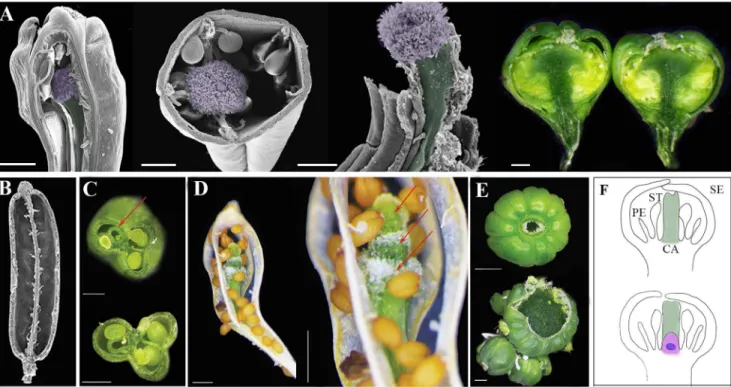
population provides more cells for organogenesis allowing more organ primordia to develop. Among the single mutants,clv3-2displayed the most dramatic increase in floral organ num-ber, particularly for stamens and carpels with more than 80% of flowers producing at least one extra stamen and up to a total of 10 stamens, and all flowers producing at least one extra prima-ry carpel [Fig 1]. Furthermore, we observed two types of supernumeraprima-ry carpels within the gy-noecium of theclv3-2flowers: one that developed from extended meristem activity, seen as ectopic carpel inside the primary carpel [Fig 2A and 2F], and the other arising from the septum [Fig 2C]. We also observed abnormally wide replaS1 Fig, which might be due to enhanced car-pel margin meristem activity [36]. Clark et al [5] showed that theclv3-2FMs are significantly taller and only slightly wider than wild-type FMs. This may explain the much greater increase in numbers of stamens and carpels arising from the inner pair of whorls as compared to num-bers of sepals and petals arising from the perianth whorl, the outermost two whorls. In the jba-1D/+single mutant low percentage of flowers exhibits increased floral organ number although these flowers occasionally displayed petals arising on consecutive whorls, seen as a petal on top of another petalS1 Fig, suggesting that injba-1D/+the FM expands laterally thus providing more cells for the development of extra perianth whorl. Both the Lerbackground andjba-1D/+ enhanced theclv3-2flower phenotypes of floral organ numbers [Fig 1] and extra whorl num-bers [Fig 2D], displaying up to 3 extra whorls of carpels formed within carpels. However, the enhancement ofclv3-2byjba-1D/+was stronger than the enhancement by Ler. Indeed,clv3-2 jba-1D/+double mutants showed increased numbers of floral organ in all whorls [Fig 1C], with an average of 4.5 sepals, 4.7 petals, 8.5 stamen and 5 carpels [S1 Table]. This increase sug-gests that the FMs of theclv3-2 jba-1D/+double mutant expanded both laterally and horizon-tally. Amongclv3-2 jba-1D/+flowers, 46% and 61% developed 5 sepals and 5 petals,
result in strong up-regulation ofWUS, starting at the onset of its expression and leading to a born enlarged FM.
Of the three double-mutant combinations studied,jba-1D/+ er-20showed the lowest percent-age of flowers with supernumerary organs [Fig 1]. Moreover, this double mutant did not produce extra carpel whorls [Fig 2B]. Our analysis showed that in the combinations carrying mutation in ER, the carpels and siliques were shorter and widerS2 Fig, as has been previously reported forer mutants [37,38]. In wild type flower the gynoecium develops from two congenitally fused carpels that arise from the center of the meristem as a tube [14,15]. Therefore the wide carpels iner back-groundsS2 Figmight be due to an increase in the width of the FM central zone resulting in a wider gynoecial tube. Uchidaet al. [28] showed that loss of function of all threeERfamily genes leads to lateral expansion of theWUSexpression domain, resulting in flattened and broadened SAMs. A lateral expansion of theWUSdomain was also shown injba-1D/+seedling SAM [25].
Fig 1. TheERECTA,CLAVATAand classIII HD-ZIPpathways display synergistic interaction in regulating floral organ numbers.[A,B] Phenotypes ofERmutants,clv3-2andjba 1D/+, single, double and triple mutants. Top views of [A] flowers under optical binocular microscope and [B] fruits by scanning electron microscopy, from single double and triple mutant plants. Combinations of double and triple mutants withclv3-2display increase in numbers of all floral organs (A) and extra carpels (B) [4 carpels inclv3-2(Col), 5 inclv3-2(Ler) andclv3-2 jba 1D/+and 8 inclv3-2 jba 1D/+ er-20]. Scale bars: Panel A-500μM and B- 100μM [C] Floral organ and primary carpel number are altered in single, double and triple mutants. Numbers of organs appear in the colored
code BAR. Genotypes are marked from 1–8 as follow:1. Col.2. Ler.3.clv3-2(Col),4.clv3-2(Ler).5.jba 1D/+6.jba 1D/+ er-20.7.clv3-2 jba 1D/+and8.
clv3-2 jba 1D/+ er-20. Data are shown in percentages. N = 45. In all double and triple combinations the numbers of flowers with supernumerary organ compared with their background [Col or Ler] are highly significant. For each line the significance of the categorical partition of organs number was calculated
using Fisher`s exact test (p<0.05) in comparison to its background (i.e Col or Ler). The P values are listed inS2 Table.
We propose that reduction in both ER and HD-ZIPIII activity in the FM leads to lateral expan-sion of theWUSdomain, resulting in spatially alteration of the meristem so that the stem cell population expands horizontally at the expense of a reduced peripheral zone. As a consequence more cells remain as stem cells with strong pluripotent signals that are not competent to differen-tiate and to be recruited for primordia initiation, leaving fewer cells for the periphery. This can provide an explanation for the low percentage of flowers with supernumerary floral organs that were observed injba-1D/+ er-20plants. The evidence that introducinger-20toclv3-2 jba-1D/+ suppresses the increased number of sepals, petals and stamens phenotype observed inclv3-2 jba-1D/+but not the supernumerary carpel phenotype [S1 Table], further support this idea that er-20changes the meristem structure, leading to a reduced peripheral zone from where sepals petals and stamens are formed. In theclv3-2 jba-1D/+ er-20the most dramatic increase was detected in the number of primary carpels in all the flowers [Fig 1]. We found flowers with up to 14 carpels, all of which developed from the primary gynoecial tube [data not shown]. Our findings suggest that in the triple mutant compared with WT all the FM domains are expanded, providing more cells for all whorls. In addition, the triple mutant flowers exhibited reiteration of multi-fused car-pel within carcar-pels that encircle a gradually growing everlasting meristem [Fig 3C] until it bursts and becomes a gigantic meristem [Figs2Eand3D]. Introducingwus-1into the triple mutant
Fig 2. Siliques from plants ofclv3-2single, double and triple mutants exhibiting extra whorl.[A] Extra whorl of carpels develops inside primary carpels of double and triple mutants. SEM views of dissected fruit revealing the fifth whorl of carpels growing from inside the initial carpels [from left to right:clv3-2 (Col),clv3-2(Ler), andclv3-2 jba 1D/+]. Stigma and carpel are false-colored with purple and green, respectively. Dissectedclv3-2 jba 1D/+ er-20fruit reveals an indeterminate floral meristem (dark green) producing numerous whorls of carpels within carpels. [B] SEM views of dissectedjba 1D/+ er-20fruit showing no extra whorl. [C] Dissectedclv3-2(Col) silique shows extra carpel developed within a primary carpel [red arrow]. [D] Dryclv3-2(Ler) silique revealing 3 extra whorls of carpels—fifth, sixth and seventh growing inside each other [red arrows]. [E] Top:clv3-2 jba 1D/+ er-20sphere-shaped siliques with 8 fused
carpels. Lower: later in development the silique displays numerous carpels and a gigantic meristem erupting through the center of the gynoecium indicating a permanent loss of determinacy. Scale bars: Panel A, C and D 500μM, E 1 mm. [F] Arabidopsis flower at stage 6. Top: in wild type flower as the gynoecium no
meristem is visible. Lower: Inclv3-2mutants gynoecium develop while flower meristem is still active (in purple) andWUSis still expressed (blue) [14].
background resulted in awus-1phenotype, indicating thatwusis fully epistatic to the three path-ways [data not shown], thus in agreement with previously reported data [25,33].
These strong synergistic phenotypes observed in the triple mutant of extra flower number, supernumerary whorls, total loss of determinacy and extreme enlargement of the meristem as compared to any double mutant combination, indicate that theCLV3,ERandHD-ZIPIII path-ways regulate FM activity in parallel.
Coordinated FM termination and carpel formation ensure successful
reproduction
The flowers of the triple mutant continued to produce carpels while stem cells were still prolifer-ating. This provides additional evidence that carpel identity specification and floral stem cell ter-mination are two separable processes [39]. Yet scanning electron microscope analysis of the triple mutant flower at stage 7, which reveals a dome shaped meristem at the center of the gynoe-cial tube [Fig 3A], strongly emphasizes the fundamental requirement for coordination between those two independent processes to ensure successful reproduction of plants [2,40–42].
In wild-type flowers, following the initiation and growth of the gynoecial tube, the medial ridges meet and fuse to form the septum, which divides the fruit, stretching from the inner side of one replum to the other replum while the ovule primordia arise from the placenta [Fig 3I]. Later, cells in the middle of the septum will form the transmitting tract, a specialized tissue es-sential for pollen tube growth [15].
Fig 3. Coordinated FM termination and carpel formation ensure successful reproduction.[A-D] SEM analysis ofjba-1D/+er-20 clv3-2flower and silique [A] flower at stage 7 showing the gynoecial tube with meristem at the center [false-colored with purple].[B]The active meristem blocks the medial ridge growth and septum formation. [C] gynoecia exhibits multiple whorls of multi-fused carpels within carpels. [D] extremely fascinated meristem encircled by multiple whorls of ectopic fused carpels. [E–G]SEM of transverse dissected siliques. [E and F] Col andjba-1D/+er-20respectively display two fused carpels, septum and developing seed. [G] Injba-1D/+er-20 clv3-2 the space inside the gynoecium is filled with meristem and ectopic carpels and exhibits no septum. [H] Injba-1D/+er-20 clv3-2 developing ovule primordia projecting on the placenta are visible (highlighted with a square). [I] Transverse section through WT ovary showing the septum [S] stretching from one replum to another, placenta, ovules, and transmitting tract [TT] Krizek, BA [50]. Scale bars: A and B 25μM C, D G and H 500μM E and F 250μM.
In Col, Ler,jba-1D/+andjba-1D/+ er-20double mutant, the gynoecium internal tissues de-veloped properly, leading to successful fertilization and seed production [Fig 3E and 3F]. In clv3-2single and double mutants, the septum and the transmitting tract developed normally, and fertilization occurred prior to the development of the supernumerary carpel whorls that later disrupted the septum [Fig 2A and 2D]. In contrast, the triple mutant FM showed strong meristematic activity and loss of determinacy. Upon the rising of the gynoecial tube, the active meristem physically blocked the development of the septum and consequently the formation of the transmitting tract [Fig 3A and 3B]. Dissecting mature fruits, we found dense meristemat-ic tissue filling the inner spaces of the gynoecium [Fig 2A]. Though at later stages, when the meristem erupts, some ovules can be seen developing on the exposed placenta [Fig 3H]; with no transmitting tract the pollen tube is incapable of reaching the ovules thus resulting in infer-tile silique.
We conclude that, although carpel specification and floral stem cell termination are separa-ble processes, both processes must be strictly coordinated for successful reproduction.
The robust activity of the FM causes FM indeterminacy
Many regulators governing the temporal repression ofWUSto terminate floral stem cell prolif-eration are part of theAGnetwork, acting asAGactivators or downstream to AG [2,19,43–47]. AG has recently been shown to directly repressWUSexpression by binding to theWUSlocus and recruiting the Polycomb Group (PcG) factor CURLY LEAF for chromatin silencing via de-position of Histone3 Lysine27 repressive methylation marks atWUS[19].
Although a decrease in the activity ofCLV3,ERECTAandHD-ZIPIIIresults in loss of deter-minacy, we propose that these pathways are genetically separable from theAGcore mechanism of meristem termination: TheAGgene is required for carpel development as demonstrated by theagmutant having no carpels. Also, we have previously shown thatAGis required to confer thejba-1D/+er-20ectopic carpel phenotype [33]. Since thejba-1D/+ er-20 clv3-2triple mutant flowers continually producing carpels it is likely that theAGgene is highly expressed and that AG did not lose its function, however fails to repressWUS.
We hypothesize that, due to a reduction in these three pathways that restrictsWUS expres-sion, theWUSlocus is fully occupied by the transcriptional machinery complexes, keeping it in an active chromatin state and preventing the AG-dependent chromatin modifier mechanism to act. The result would be a failure in shutting downWUSand a total loss of FM determinacy. A future challenge will be to test the molecular basis of this hypothetical scenario.
In summary, the analysis of flowers from combined mutants demonstrates that CLV3, ER and HD-ZIPIII participate to regulate FM activity, presumably through distinct pathways, all controllingWUSexpression. We show that meristem activity termination is not a prerequisite for carpel formation but that coupling FM termination with carpel formation is crucial for seed formation. We also demonstrate that regulation of meristem size is one mechanism that leads to determine flower organogenesis.
Materials and Methods
Growth conditions and plant materials
Microscopy
Plant images were captured using an Olympus SZX7 Stereomicroscope.
Scanning electron microscopy was performed by fixing tissue in methanol as described [48] and using a JEOL 5410 LV scanning electron microscope.
Floral organ counting and Statistical analysis
Floral organ counting was performed as described by Fiume et al. [49]. Statistical analysis was carried out using JMP 10 software (SAS Institute Inc., Cary, NC). For each line the significance of the categorical partition of organs number was calculated using Fisher`s exact test
(p<0.05) in comparison to it background (i.e Col or Ler).
Supporting Information
S1 Fig. Flower and fruit phenotype of the different mutants.[A]jba 1D/+flower exhibits extra petals and extra whorl of petals. The petal emerged in sequential whorls [red arrow]. [B] Theclv3-2(Col) fruit shows abnormal replum development (dark green tissue). [C, D] SEM micrograph of Col (C) andclv3-2(Col) fruits (D). Theclv3-2(Col) fruit shows wider replum in one out of the five repla. [E]clv3-2 jba 1D/+fruit. Counting the carpels, we assigned a 0.5 value to partial valves, a phenotype observed in allclv3double mutants but in high frequently in clv3-2 jba 1D/+[replum is highlighted by yellow line]. [F]clv3-2 jba 1D/+ er-20exhibits sphere-shaped fruit with variable valve size [replum is highlighted]. Scale bars: A -1 mm, B E and F -500μM, C and D -100μM.
(TIF)
S2 Fig. Siliques from single double and triple mutants ofer-20 clv3-2, andjba 1D/+.[A,B] typical silique from a wild-type Columbia (Col) (A) and Landsberg erecta (Ler) (B) is com-posed of two fused carpels [C]clv3-2(Col) and [D]),clv3-2(Ler), shows siliques comprised of four to five fused carpels. [E]jba 1D/+[F]jba 1D/+ er-20[G]clv3-2 jba 1D/+exhibits club-shaped siliques comprised of four to six fused carpels. [H]clv3-2 jba 1D/+ er-20exhibits short sphere-shaped siliques with numerous extra carpels. Note that siliques from mutants carrying mutation inERECTAare much shorter and border compared to the background plants. Scale bar: 2mm
(TIF)
S1 Table. Average of floral organ numbers.Numbers of sepal petal stamen and carpel were counted according to Fiume [49] (number of flowers counted in parentheses) and the mean was calaculated [in bold]. The Std Err Mean appears on the right column.
(DOCX)
S2 Table. P Value for Fisher's Exact test presented in Fig.1.Number of flower organs of each genotype was compared to the corresponding genotype. The corresponding background on the left compared with mutant on the right [i.e. Col Xjba1D+compared to Col].
(XLSX)
Author Contributions
References
1. Laux T, Mayer KF, Berger J, Jurgens G (1996) The WUSCHEL gene is required for shoot and floral meristem integrity in Arabidopsis. Development 122: 87–96. PMID:8565856
2. Sun B, Xu Y, Ng KH, Ito T (2009) A timing mechanism for stem cell maintenance and differentiation in the Arabidopsis floral meristem. Genes Dev 23: 1791–1804. doi:10.1101/gad.1800409PMID: 19651987
3. Mayer KF, Schoof H, Haecker A, Lenhard M, Jurgens G, Laux T (1998) Role of WUSCHEL in regulating stem cell fate in the Arabidopsis shoot meristem. Cell 95: 805–815. PMID:9865698
4. Gross-Hardt R, Laux T (2003) Stem cell regulation in the shoot meristem. J Cell Sci 116: 1659–1666.
PMID:12665547
5. Clark SE, Running MP, Meyerowitz EM (1995) CLAVATA3 is a specific regulator of shoot and floral meristem development affecting the same processes as CLAVATA1 Development 121: 2057–2067.
6. Durbak AR, Tax FE (2011) CLAVATA signaling pathway receptors of Arabidopsis regulate cell prolifer-ation in fruit organ formprolifer-ation as well as in meristems. Genetics 189: 177–194. doi:10.1534/genetics. 111.130930PMID:21705761
7. Brand U, Fletcher JC, Hobe M, Meyerowitz EM, Simon R (2000) Dependence of stem cell fate in Arabi-dopsis on a feedback loop regulated by CLV3 activity. Science 289: 617–619. PMID:10915624
8. Roe JL, Rivin CJ, Sessions RA, Feldmann KA, Zambryski PC (1993) The Tousled gene in A. thaliana encodes a protein kinase homolog that is required for leaf and flower development. Cell 75: 939–950.
PMID:8252629
9. Ni W, Xie D, Hobbie L, Feng B, Zhao D, Akkara J, et al. (2004) Regulation of flower development in Ara-bidopsis by SCF complexes. Plant Physiol 134: 1574–1585. PMID:15047903
10. Carles CC, Lertpiriyapong K, Reville K, Fletcher JC (2004) The ULTRAPETALA1 gene functions early in Arabidopsis development to restrict shoot apical meristem activity and acts through WUSCHEL to regulate floral meristem determinacy. Genetics 167: 1893–1903. PMID:15342527
11. Running MP, Lavy M, Sternberg H, Galichet A, Gruissem W, Hake S, et al. (2004) Enlarged meristems and delayed growth in plp mutants result from lack of CaaX prenyltransferases. Proc Natl Acad Sci U S A 101: 7815–7820. PMID:15128936
12. Kwiatkowska D (2006) Flower primordium formation at the Arabidopsis shoot apex: quantitative analy-sis of surface geometry and growth. J Exp Bot 57: 571–580. PMID:16377735
13. Smyth DR, Bowman JL, Meyerowitz EM (1990) Early flower development in Arabidopsis. Plant Cell 2: 755–767. PMID:2152125
14. Alvarez-Buylla ER, Benitez M, Corvera-Poire A, Chaos Cador A, de Folter S, Gamboa de Buen A, et al (2010) Flower development. Arabidopsis Book 8: e0127. doi:10.1199/tab.0127PMID:22303253
15. Roeder AH, Yanofsky MF (2006) Fruit development in Arabidopsis. Arabidopsis Book 4: e0075. doi:
10.1199/tab.0075PMID:22303227
16. Lohmann JU, Hong RL, Hobe M, Busch MA, Parcy F, Simon R, et al. (2001) A molecular link between stem cell regulation and floral patterning in Arabidopsis. Cell 105: 793–803. PMID:11440721
17. Lenhard M, Bohnert A, Jurgens G, Laux T (2001) Termination of stem cell maintenance in Arabidopsis floral meristems by interactions between WUSCHEL and AGAMOUS. Cell 105: 805–814. PMID: 11440722
18. Ming F, Ma H (2009) A terminator of floral stem cells. Genes Dev 23: 1705–1708. doi:10.1101/gad. 1834409PMID:19651982
19. Liu X, Kim YJ, Muller R, Yumul RE, Liu C, Pan Y, et al. (2011) AGAMOUS terminates floral stem cell maintenance in Arabidopsis by directly repressing WUSCHEL through recruitment of Polycomb Group proteins. Plant Cell 23: 3654–3670. doi:10.1105/tpc.111.091538PMID:22028461
20. Mizukami Y, Ma H (1997) Determination of Arabidopsis floral meristem identity by AGAMOUS. Plant Cell 9: 393–408. PMID:9090883
21. Bowman JL, Smyth DR, Meyerowitz EM (1991) Genetic interactions among floral homeotic genes of Arabidopsis. Development 112: 1–20. PMID:1685111
22. Yanofsky MF, Ma H, Bowman JL, Drews GN, Feldmann KA, Meyerowitz EM (1990) The protein en-coded by the Arabidopsis homeotic gene agamous resembles transcription factors. Nature 346: 35–
39. PMID:1973265
23. Uchida N, Shimada M, Tasaka M (2012) Modulation of the balance between stem cell proliferation and consumption by ERECTA-family genes. Plant Signal Behav 7: 1506–1508. doi:10.4161/psb.22080
24. Shpak ED (2013) Diverse roles of ERECTA family genes in plant development. J Integr Plant Biol 55: 1238–1250. doi:10.1111/jipb.12108PMID:24016315
25. Williams L, Grigg SP, Xie M, Christensen S, Fletcher JC (2005) Regulation of Arabidopsis shoot apical meristem and lateral organ formation by microRNA miR166g and its AtHD-ZIP target genes. Develop-ment 132: 3657–3668. PMID:16033795
26. Prigge MJ, Otsuga D, Alonso JM, Ecker JR, Drews GN, Clark SE (2005) Class III homeodomain-leu-cine zipper gene family members have overlapping, antagonistic, and distinct roles in Arabidopsis de-velopment. Plant Cell 17: 61–76. PMID:15598805
27. Green KA, Prigge MJ, Katzman RB, Clark SE (2005) CORONA, a member of the class III homeodo-main leucine zipper gene family in Arabidopsis, regulates stem cell specification and organogenesis. Plant Cell 17: 691–704. PMID:15705957
28. Uchida N, Shimada M, Tasaka M (2013) ERECTA-family receptor kinases regulate stem cell homeo-stasis via buffering its cytokinin responsiveness in the shoot apical meristem. Plant Cell Physiol 54: 343–351. doi:10.1093/pcp/pcs109PMID:22885615
29. Schoof H, Lenhard M, Haecker A, Mayer KF, Jurgens G, Laux T (2000) The stem cell population of Ara-bidopsis shoot meristems in maintained by a regulatory loop between the CLAVATA and WUSCHEL genes. Cell 100: 635–644. PMID:10761929
30. Fletcher JC, Brand U, Running MP, Simon R, Meyerowitz EM (1999) Signaling of cell fate decisions by CLAVATA3 in Arabidopsis shoot meristems. Science 283: 1911–1914. PMID:10082464
31. Clark SE, Williams RW, Meyerowitz EM (1997) The CLAVATA1 gene encodes a putative receptor ki-nase that controls shoot and floral meristem size in Arabidopsis. Cell 89: 575–585. PMID:9160749
32. Jeong S, Trotochaud AE, Clark SE (1999) The Arabidopsis CLAVATA2 gene encodes a receptor-like protein required for the stability of the CLAVATA1 receptor-like kinase. Plant Cell 11: 1925–1934.
PMID:10521522
33. Mandel T, Moreau F, Kutsher Y, Fletcher JC, Carles CC, Eshed Williams L (2014) The ERECTA recep-tor kinase regulates Arabidopsis shoot apical meristem size, phyllotaxy and floral meristem identity. De-velopment 141: 830–841. doi:10.1242/dev.104687PMID:24496620
34. Shpak ED, Berthiaume CT, Hill EJ, Torii KU (2004) Synergistic interaction of three ERECTA-family re-ceptor-like kinases controls Arabidopsis organ growth and flower development by promoting cell prolif-eration. Development 131: 1491–1501. PMID:14985254
35. Ziegelhoffer EC, Medrano LJ, Meyerowitz EM (2000) Cloning of the Arabidopsis WIGGUM gene identi-fies a role for farnesylation in meristem development. Proc Natl Acad Sci U S A 97: 7633–7638. PMID: 10840062
36. Reyes-Olalde JI, Zuniga-Mayo VM, Chavez Montes RA, Marsch-Martinez N, de Folter S (2013) Inside the gynoecium: at the carpel margin. Trends Plant Sci 18: 644–655. doi:10.1016/j.tplants.2013.08.002
PMID:24008116
37. Shpak ED, Lakeman MB, Torii KU (2003) Dominant-negative receptor uncovers redundancy in the Ara-bidopsis ERECTA Leucine-rich repeat receptor-like kinase signaling pathway that regulates organ shape. Plant Cell 15: 1095–1110. PMID:12724536
38. Torii KU, Mitsukawa N, Oosumi T, Matsuura Y, Yokoyama R, Whittier RF, et al. (1996) The Arabidopsis ERECTA gene encodes a putative receptor protein kinase with extracellular leucine-rich repeats. Plant Cell 8: 735–746. PMID:8624444
39. Engelhorn J, Moreau F, Fletcher JC, Carles CC (2014) ULTRAPETALA1 and LEAFY pathways func-tion independently in specifying identity and determinacy at the Arabidopsis floral meristem. Ann Bot 114: 1497–1505. doi:10.1093/aob/mcu185PMID:25288633
40. Zuniga-Mayo VM, Marsch-Martinez N, de Folter S (2012) The class II HD-ZIP JAIBA gene is involved in meristematic activity and important for gynoecium and fruit development in Arabidopsis. Plant Signal Behav 7: 1501–1503. doi:10.4161/psb.21901PMID:22951401
41. Prunet N, Morel P, Negrutiu I, Trehin C (2009) Time to stop: flower meristem termination. Plant Physiol 150: 1764–1772. doi:10.1104/pp.109.141812PMID:19493967
42. Sun B, Ito T (2015) Regulation of floral stem cell termination in Arabidopsis. Front Plant Sci 6: 17. doi:
10.3389/fpls.2015.00017PMID:25699061
43. Muller R, Goodrich J (2011) Sweet memories: epigenetic control in flowering. F1000 Biol Rep 3: 13. doi:10.3410/B3-13PMID:21876724
44. Carles CC, Fletcher JC (2009) The SAND domain protein ULTRAPETALA1 acts as a trithorax group factor to regulate cell fate in plants. Genes Dev 23: 2723–2728. doi:10.1101/gad.1812609PMID: 19952107
46. Das P, Ito T, Wellmer F, Vernoux T, Dedieu A, Traas J, et al. (2009) Floral stem cell termination involves the direct regulation of AGAMOUS by PERIANTHIA. Development 136: 1605–1611. doi:10.1242/dev. 035436PMID:19395638
47. Sun B, Ito T (2010) Floral stem cells: from dynamic balance towards termination. Biochem Soc Trans 38: 613–616. doi:10.1042/BST0380613PMID:20298230
48. Talbot MJ, White RG (2013) Methanol fixation of plant tissue for Scanning Electron Microscopy im-proves preservation of tissue morphology and dimensions. Plant Methods 9: 36. doi: 10.1186/1746-4811-9-36PMID:24083940
49. Fiume E, Pires HR, Kim JS, Fletcher JC (2010) Analyzing floral meristem development. Methods Mol Biol 655: 131–142. doi:10.1007/978-1-60761-765-5_9PMID:20734258
50. Krizek BA (2011) Auxin regulation of Arabidopsis flower development involves members of the AINTE-GUMENTA-LIKE/PLETHORA (AIL/PLT) family. J Exp Bot 62: 3311–3319. doi:10.1093/jxb/err127