Balance Rehabilitation Unit (BRU
TM)
posturography in
relapsing-remitting multiple sclerosis
Natália Kessler1, Maurício Malavasi Ganança2,
Cristina Freitas Ganança3,Fernando Freitas Ganança4,
Sabrina Chiogna Lopes5,Ana Paula Serra5, Heloisa Helena Caovilla6
ABSTRACT
Objective: To evaluate balance control with Balance Rehabilitation Unit (BRUTM) posturography in patients with multiple sclerosis (MS). Method: A cross controlled study was performed including 39 relapsing-remitting multiple sclerosis patients with scores less than or equal to 4 in the Expanded Disability Status Scale (EDSS), and a homogeneous control group consisting of 65 healthy individuals, matched by the age and gender. The experimental group was distributed according to the EDSS scale scores in 0-2.5 and 3-4. To assess the vestibular system function, the patients underwent a neurotological evaluation, including posturography of the Balance Rehabilitation Unit (BRUTM). Results: Statistically significant differences were observed when comparing the values of the sway velocity and the ellipse area of the MS 0-2.5 group with the control and the MS 3-4 group with the control. A statistically significant difference was verified between the MS 0-2.5 and the MS 3-4 groups in the condition 3 ellipse area values. Conclusion: The evaluation of the balance control with posturography of Balance Rehabilitation Unit (BRUTM) enables the identification of abnormalities of the sway velocity and confidential ellipse in patients with relapsing-remitting multiple sclerosis.
Key words: multiple sclerosis, dizziness, vestibular system evaluation.
Posturografia do Balance Rehabilitation Unit (BRUTM) na esclerose múltipla
recorrente-remitente
RESUMO
Objetivo: Avaliar o equilíbrio corporal à posturografia do Balance Rehabilitation Unit (BRUTM) em pacientes com esclerose múltipla (EM). Método: Estudo transversal controlado em 39 pacientes com esclerose múltipla do tipo recorrente-remitente, com pontuação menor ou igual a 4 na escala de incapacidade funcional expandida, e por um grupo controle homogêneo, constituído por 65 indivíduos hígidos, homogêneo em relação à idade e gênero. O grupo experimental foi distribuído, de acordo com a pontuação da EDSS, em 0-2,5 e 3-4. Para avaliar a função do sistema vestibular, os pacientes foram submetidos a uma avaliação otoneurológica, incluindo a posturografia do Balance Rehabilitation Unit (BRUTM). Resultados: Foram observadas diferenças significantes na comparação dos valores da velocidade de oscilação e da área de elipse do grupo EM 0-2,5 com o controle e do grupo EM 3-4 com o controle; diferença significante foi verificada entre os grupos EM 0-2,5 e EM 3-4 nos valores da área de elipse na condição três. Conclusão: A avaliação do equilíbrio corporal por meio da posturografia do Balance Rehabilitation Unit (BRUTM) possibilita a identificação de anormalidades da velocidade de oscilação e da área de elipse em pacientes com esclerose múltipla.
Palavras-chave: esclerose múltipla, tontura, testes de função vestibular. Correspondence
Natália Kessler
Rua Martiniano de Carvalho 629 / 22 01321-001 São Paulo SP - Brasil E-mail: [email protected]
Received 22 June 2010
Received in final form 15 December 2010 Accepted 29 December 2010
Multiple sclerosis (MS) is an autoimmune demyelin-ating disease of the central nervous system. It is con-sidered the commonest cause of neurological disability in young adults and can be classiied in two major clin-ical forms: relapsing-remitting and primary progressive1.
he relapsing-remitting MS occurs in approximate 85% of the cases; the most common initial clinical man-ifestations are pyramidal, sensitive and cerebellar
disor-ders2. he MS preferentially afects caucasians, young
adults and females3. he clinical feature of the disease
in the Brazilians is similar to the one described in other countries4.
Progressive demyelinization of vestibulo-spinal path-ways fibers may cause balance disturbances5. In 5% of
the cases, dizziness is the irst manifestation of the dis-ease6. Posturography may be useful not only to assess the
damages of the vestibular system but also to monitor the course of the MS5.
he Balance Rehabilitation Unit (BRUTM)
posturog-raphy developed by Medicaa® provides information about the position of the patients’ center of pressure in ten sensorial conditions through quantitative indicators, limit of stability, ellipse area and sway velocity. Moreover, this equipment enables to select adequate balance reha-bilitation exercises according to the found disorder and follows the performance of the patients7.
References about Balance Rehabilitation Unit (BRUTM) posturography to evaluate balance control in patients with multiple sclerosis were not found. hat is the reason this research was performed.
he purpose of this research is to evaluate the bal-ance control with the posturography of the Balbal-ance Re-habilitation Unit (BRUTM) in patients with relapsing-re-mitting multiple sclerosis.
METHOD
his was a cross controlled study performed in the Otology and Neurotology Discipline of the Department of Otolaryngology, Head and Neck Surgery of the Federal University of São Paulo - Paulista School of Medicine. he project was submitted to the Ethic Committee of the Institution and approved under the number 01723/07. Written consent was obtained from all the patients be-fore enrollment.
One hundred and four patients were evaluated. hirty-nine of them were clinically and/or laboratorially diagnosed with relapsing-remitting MS according to Mc-Donald8, with scores less than or equal to 4.0 in the
Ex-panded Disability Status Scale (EDSS)9, in the
Neuromus-cular and Autoimmune Diseases Clinic of the Neurology Discipline of the Federal University of São Paulo. Sixty-ive healthy homogeneous individuals, insofar as age and gender are concerned, constituted the control group.
he experimental group was distributed according to the EDSS scale score in 0-2.5 (mild disability) and 3-4 (moderate). Patients that presented outbreaks of the dis-ease during the evaluation, with musculoskeletal or vi-sual disorders, dementia, and neuropathy, or were inca-pable of understanding simple verbal instructions were excluded from this study.
Patients underwent a neurotological assessment: clinical history, ENT examination, audiological and ves-tibular evaluation, including posturography of the Bal-ance Rehabilitation Unit (BRUTM). If the patient had diz-ziness complaint, they answered the Dizdiz-ziness Handicap Inventory10, adapted to the Portuguese of Brazil11 and the
dizziness analogical scale12.
he Balance Rehabilitation Unit (BRUTM)
posturog-raphy assessed the postural control by measuring the limit of stability, the confidence ellipse of the body’s center of pressure distribution area and the sway velocity. he conidence ellipse and the sway velocity were mea-sured in ten diferent sensorial conditions on the plat-form: [1] standing position, eyes open; [2] standing po-sition, eyes closed; [3] standing position on foam, eyes closed; [4] standing position, eyes open with surrounding saccadic stimulation; [5] standing position, eyes open with surrounding optokinetic stimulation to the right; [6] standing position, eyes open with surrounding op-tokinetic stimulation to the left; [7] standing position, eyes open with surrounding optokinetic stimulation downwards; [8] standing position, eyes open with sur-rounding optokinetic stimulation upwards; [9] standing position, visuovestibular interaction - horizontal stimu-lation; [10] standing position, visuovestibular interaction - vertical stimulation. he virtual reality helmet was used on sensorial condition from four to ten. To determine the limit of stability, the patient received the instruction to sway forwards, backwards and laterally along the ankles, without neither losing balance nor using trunk strategies.
Statistical analyses were performed using a Chi-Squared (χ2) test, T-Student test, Mann-Whitney test,
Kolmogorov-Smirnov test, Anova test e Bonferroni test. Statistical analyses were performed using SPSS 10.0 for Windows (Statistical Package for Social Sciences, version 10.0, 1999). he signiicance level was set at 5% (α=0.05).
RESULTS
showed an average age of 39.72±11.78 years old. here was no signiicant diference between the groups in re-lation to the age group average (p=0.075). In rere-lation to the EDSS score, the experimental group showed the min-imum value of zero and the maxmin-imum of four scores (av-erage=1.77; standard-deviation=1.12). According to the EDSS scale score, 29 patients (74.4%) were included in the 0-2.5 MS group and 10 (25.6%), in the 3-4 MS group.
As for vestibular system evaluation, 30 MS patients (76.9%) reported dizziness. he average total score ob-tained at the Dizziness Handicap Inventory was 31.60 points (standard-deviation=21.33 points). he average score obtained at the dizziness analogical scale was 4.18 (standard-deviation=2.69). Unterberger-Fukuda test was abnormal in 34 patients (87.2%). Nystagmog-raphy showed 22 (56.4%) patients with normal results, 15 (38.5%) with peripheral vestibular disorders and 2 (5.1%) with central signs.
As for the posturography evaluation, there was no significant difference (p=0.144) between the values of the limit of stability (cm2) of the control group
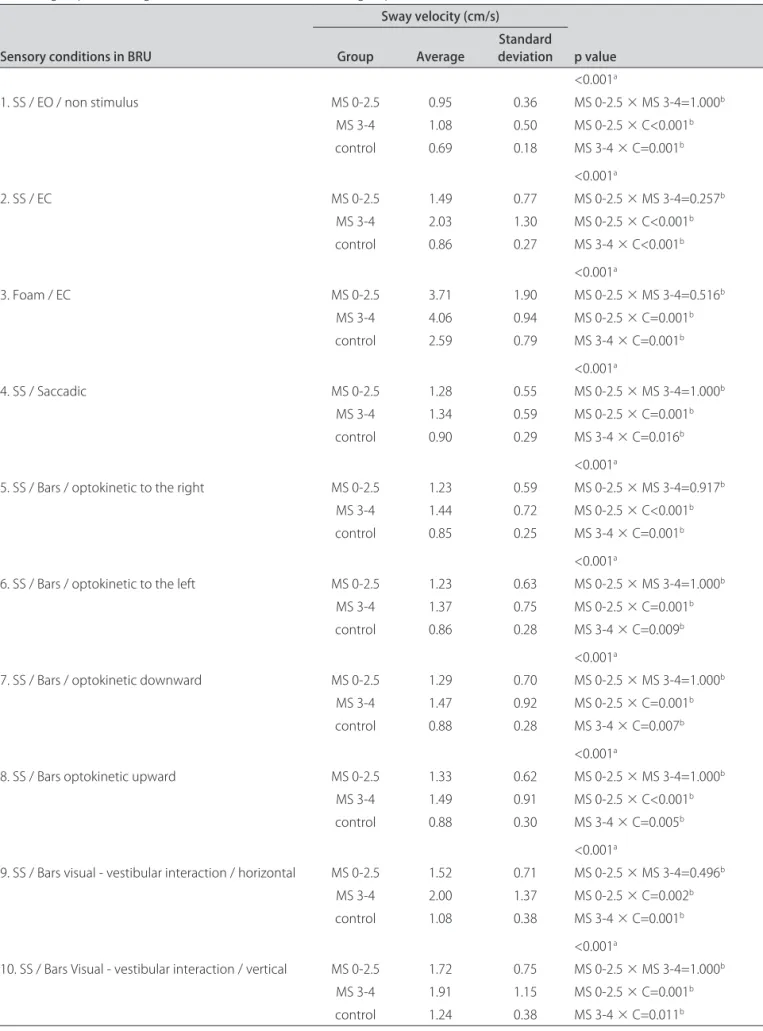
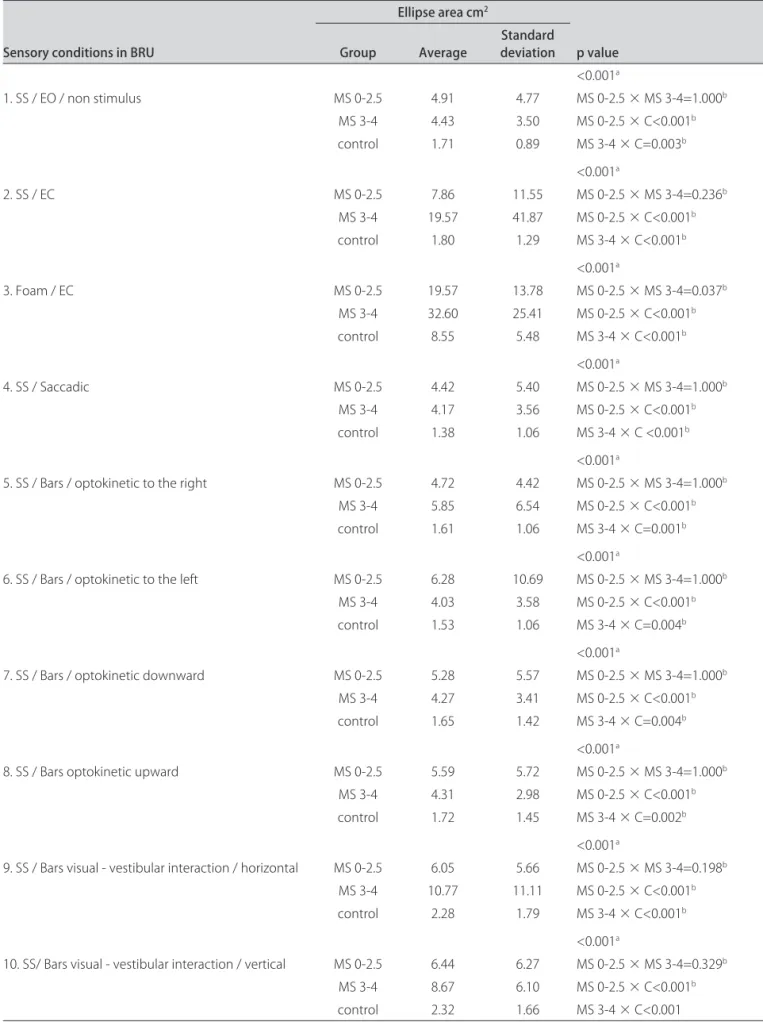
(av-erage=185.43; standard-deviation=51.94; median=180.00; variation=77-298) and the values of the MS 0-2.5 group (average=165.17, standard-deviation=57.38, varia-tion=67-286) and the MS 3-4 group (average=157.80, standard-deviation=75.04, variation=92-287). Table 1 displays the descriptive values and comparative analysis of the sway velocity in the ten stimulation conditions for the 0-2.5 and 3-4 multiple sclerosis groups according to the EDSS scale score, and for the control group.Table 2 displays the descriptive values and comparative analysis of the ellipse area in the ten stimulation conditions for the 0-2.5 and 3-4 multiple sclerosis groups according to the EDSS scale score, and for the control group. Statis-tically signiicant diferences were observed when com-paring the values of the sway velocity and the ellipse area of the MS 0-2.5 group with the control and of the MS 3-4 group with the control. A statistically signiicant difer-ence was veriied between the MS 0-2.5 and the MS 3-4 groups in the condition 3 ellipse area values.
DISCUSSION
he majority of the patients with relapsing-remitting MS in our study complained about vertigo and other kinds of dizziness, probably related to vestibular system disorders, which moderately afected their quality of life. hey also showed dynamic balance disorder, and vestib-ular disorder signals were found in approximately ifty percent (50%) of the patients. he majority of them pre-sented peripheral vestibular disturbances and only two showed central signs.
In our study, the values of the limit of stability of the control group were similar to the values of the MS
groups, indicating that there are no abnormalities in motor coordination while patients do the maximum os-cillation of their body pressure center on the platform.
he values of the sway velocity and the conidence el-lipse of the body’s center of pressure distribution area in the ten evaluated conditions on the posturography of the Balance Rehabilitation Unit (BRUTM), in the relapsing-re-mitting MS groups, showed statistically signiicant difer-ences (p<0.001) when compared to the ones of the con-trol group. It was observed that patients with MS showed a worse performance on steady surface with their eyes closed, foam surface with their eyes closed, and visual-vestibular interaction conditions. Patients with MS 3-4 showed worse performance on foam surface with their eyes closed when compared to the MS 0-2.5 group. hese data show the involvement of static balance when there is visual deprivation and somatosensory conlict. We can compare our results with others13-15 which also
demon-strated balance control disturbances in patients with MS, especially in conditions of high sensorial conlict.
It was also verified in our study that the Balance Rehabilitation Unit (BRUTM) was able to detect distur-bances when it was performed on patients in the ortho-static position with their eyes closed and open. How-ever, one study showed that the average displacement of anterior-posterior sway was not able to detect disor-ders in patients when the test was performed with eyes open, suggesting that the test was more sensitive to de-tect balance control disturbances in patients with MS when it was performed in the orthostatic position with their eyes closed16.
Our indings in patients with MS evaluated by Bal-ance Rehabilitation Unit (BRUTM) posturography are dii-cult to be compared with others from diferent posturog-raphy tests, because of diferences between evaluation parameters and procedures. Besides the different pa-rameters of the posturographies and diferent classiica-tion criteria, it is also important to consider diferences among the studies as for the duration of the disease, neu-rological capability, and physical and sensorial conditions at the moment of the evaluation.
Table 1. Average values, standard deviations and p-values of sway velocity in the ten stimulation conditions for the 0-2.5 and 3-4 multiple sclerosis groups according to the EDSS scale score and control group.
Sensory conditions in BRU
Sway velocity (cm/s)
p value Group Average Standard deviation
<0.001a
1. SS / EO / non stimulus MS 0-2.5 0.95 0.36 MS 0-2.5 × MS 3-4=1.000b
MS 3-4 1.08 0.50 MS 0-2.5 × C<0.001b
control 0.69 0.18 MS 3-4 × C=0.001b
<0.001a
2. SS / EC MS 0-2.5 1.49 0.77 MS 0-2.5 × MS 3-4=0.257b
MS 3-4 2.03 1.30 MS 0-2.5 × C<0.001b
control 0.86 0.27 MS 3-4 × C<0.001b
<0.001a
3. Foam / EC MS 0-2.5 3.71 1.90 MS 0-2.5 × MS 3-4=0.516b
MS 3-4 4.06 0.94 MS 0-2.5 × C=0.001b
control 2.59 0.79 MS 3-4 × C=0.001b
<0.001a
4. SS / Saccadic MS 0-2.5 1.28 0.55 MS 0-2.5 × MS 3-4=1.000b
MS 3-4 1.34 0.59 MS 0-2.5 × C=0.001b
control 0.90 0.29 MS 3-4 × C=0.016b
<0.001a
5. SS / Bars / optokinetic to the right MS 0-2.5 1.23 0.59 MS 0-2.5 × MS 3-4=0.917b
MS 3-4 1.44 0.72 MS 0-2.5 × C<0.001b
control 0.85 0.25 MS 3-4 × C=0.001b
<0.001a
6. SS / Bars / optokinetic to the left MS 0-2.5 1.23 0.63 MS 0-2.5 × MS 3-4=1.000b
MS 3-4 1.37 0.75 MS 0-2.5 × C=0.001b
control 0.86 0.28 MS 3-4 × C=0.009b
<0.001a
7. SS / Bars / optokinetic downward MS 0-2.5 1.29 0.70 MS 0-2.5 × MS 3-4=1.000b
MS 3-4 1.47 0.92 MS 0-2.5 × C=0.001b
control 0.88 0.28 MS 3-4 × C=0.007b
<0.001a
8. SS / Bars optokinetic upward MS 0-2.5 1.33 0.62 MS 0-2.5 × MS 3-4=1.000b
MS 3-4 1.49 0.91 MS 0-2.5 × C<0.001b
control 0.88 0.30 MS 3-4 × C=0.005b
<0.001a
9. SS / Bars visual - vestibular interaction / horizontal MS 0-2.5 1.52 0.71 MS 0-2.5 × MS 3-4=0.496b
MS 3-4 2.00 1.37 MS 0-2.5 × C=0.002b
control 1.08 0.38 MS 3-4 × C=0.001b
<0.001a
10. SS / Bars Visual - vestibular interaction / vertical MS 0-2.5 1.72 0.75 MS 0-2.5 × MS 3-4=1.000b
MS 3-4 1.91 1.15 MS 0-2.5 × C=0.001b
control 1.24 0.38 MS 3-4 × C=0.011b
BRU: balance rehabilitation unit; SS: steady surface; EO: eyes open; EC: eyes closed; MS: multiple sclerosis; C: control. ap-value / Anova test; bp-Value / Bonferroni
Table 2. Average values, standard deviations and p-values of ellipse area in the ten stimulation conditions for the 0-2.5 and 3-4 multiple sclerosis groups according to the EDSS scale score and control group.
Sensory conditions in BRU
Ellipse area cm2
p value Group Average deviationStandard
<0.001a
1. SS / EO / non stimulus MS 0-2.5 4.91 4.77 MS 0-2.5 × MS 3-4=1.000b
MS 3-4 4.43 3.50 MS 0-2.5 × C<0.001b
control 1.71 0.89 MS 3-4 × C=0.003b
<0.001a
2. SS / EC MS 0-2.5 7.86 11.55 MS 0-2.5 × MS 3-4=0.236b
MS 3-4 19.57 41.87 MS 0-2.5 × C<0.001b
control 1.80 1.29 MS 3-4 × C<0.001b
<0.001a
3. Foam / EC MS 0-2.5 19.57 13.78 MS 0-2.5 × MS 3-4=0.037b
MS 3-4 32.60 25.41 MS 0-2.5 × C<0.001b
control 8.55 5.48 MS 3-4 × C<0.001b
<0.001a
4. SS / Saccadic MS 0-2.5 4.42 5.40 MS 0-2.5 × MS 3-4=1.000b
MS 3-4 4.17 3.56 MS 0-2.5 × C<0.001b
control 1.38 1.06 MS 3-4 × C <0.001b
<0.001a
5. SS / Bars / optokinetic to the right MS 0-2.5 4.72 4.42 MS 0-2.5 × MS 3-4=1.000b
MS 3-4 5.85 6.54 MS 0-2.5 × C<0.001b
control 1.61 1.06 MS 3-4 × C=0.001b
<0.001a
6. SS / Bars / optokinetic to the left MS 0-2.5 6.28 10.69 MS 0-2.5 × MS 3-4=1.000b
MS 3-4 4.03 3.58 MS 0-2.5 × C<0.001b
control 1.53 1.06 MS 3-4 × C=0.004b
<0.001a
7. SS / Bars / optokinetic downward MS 0-2.5 5.28 5.57 MS 0-2.5 × MS 3-4=1.000b
MS 3-4 4.27 3.41 MS 0-2.5 × C<0.001b
control 1.65 1.42 MS 3-4 × C=0.004b
<0.001a
8. SS / Bars optokinetic upward MS 0-2.5 5.59 5.72 MS 0-2.5 × MS 3-4=1.000b
MS 3-4 4.31 2.98 MS 0-2.5 × C<0.001b
control 1.72 1.45 MS 3-4 × C=0.002b
<0.001a
9. SS / Bars visual - vestibular interaction / horizontal MS 0-2.5 6.05 5.66 MS 0-2.5 × MS 3-4=0.198b
MS 3-4 10.77 11.11 MS 0-2.5 × C<0.001b
control 2.28 1.79 MS 3-4 × C<0.001b
<0.001a
10. SS/ Bars visual - vestibular interaction / vertical MS 0-2.5 6.44 6.27 MS 0-2.5 × MS 3-4=0.329b
MS 3-4 8.67 6.10 MS 0-2.5 × C<0.001b
control 2.32 1.66 MS 3-4 × C<0.001
BRU: balance rehabilitation unit; SS: steady surface; EO: eyes open; EC: eyes closed; MS: multiple sclerosis; C: control. ap-value / Anova test; bp-value / Bonferroni
was sensitive to identify abnormalities in the balance of patients with no obvious equilibrium disturbances.
In conclusion, the evaluation of balance control with the posturography of the Balance Rehabilitation Unit (BRUTM) enables the identiication of abnormalities of the sway velocity and conidence ellipse of the body’s center of pressure distribution area in patients with relapsing-remitting multiple sclerosis.
REFERENCES
1. Bar-Or A, Oliveira EML, Anderson DE, Haler DA. Molecular pathogenesis of multiple sclerosis. J Neuroimmunol 1999;100:252-259.
2. Lublin FD, Reingold SC. Deining the clinical course of multiple sclerosis. Neurology 1996;46:907-911.
3. Kurtzke JF. Epidemiologic contributions to multiple sclerosis: an overview. Neurology 1980;30:61-79.
4. Oliveira EML, Annes M, Oliveira ASB, Gabbai AA. Esclerose múltipla: estudo clínico de 50 pacientes acompanhados no Ambulatório de Neurologia UNIFESP-EPM. Arq Neuropsiquiatr 1999;57:51-55.
5. Shimizu K, Murofushi T, Sakurai M, Halmagyi M. Vestibular evoked myogenic potentials in multiple sclerosis. J Neurol Neurosurg Psychiatry 2000;69:276-277. 6. Mangabeira Albernaz PL, Ganança MM, Albernaz Filho PM, et al. Aspectos
oto-neurológicos da esclerose múltipla: caso clínico. Acta AWHO 1983;2:35-48.
7. BRUTM. Unidade de Reabilitação do Equilíbrio. Manual do usuário. Versão
1.0.7. Versão do Software: 1.3.5.0. Uruguai: Medicaa, 2006.
8. McDonald WI, Compston A, Edan G, et al. Recommended diagnostic cri-teria for multiple sclerosis: guidelines from the international panel on the diagnosis of multiple sclerosis. Ann Neurol 2001;50:121-127.
9. Kurtzke JF. Rating neurological impairment in multiple sclerosis: an expended disability status scale (EDSS). Neurology 1983;33:1444-1452. 10. Jacobson GP, Newman CW. The development of the dizziness handicap
inventory. Otolaryngol Head Neck Surg 1990;116:424-427.
11. Castro ASO, Natour J, Gazzola JM, Ganança FF. Dizziness Handicap Inven-tory: adaptação cultural para o português brasileiro. Pró-Fono Rev Atualiz CientIf 2007;19:97-104.
12. Whitney SL, Herdman SJ. Physical therapy assessment of vestibular hy-pofunction. In: Herdman SJ (Ed). Vestibular rehabilitation. Philadelphia: FA. Davis; 2000:336.
13. Williams NP, Roland PS, Yelli W. Vestibular evaluation in patients with early multiple sclerosis. Am J Otol 1997;18:93-100.
14. Nelson SR, Di Fabio RP, Anderson JH. Vestibular and sensory interaction deicits assessed by dynamic platform posturography in patients with mul-tiple sclerosis. Ann Otol Rhinol Laryngol 1995;104:62-68.
15. Jackson RT, Epstein CM, De l’Aune WR. Abnormalities in posturography and estimations of visual vertical and horizontal in multiple sclerosis. Am J Otol 1995;16:88-93.