ESCOLA DE ADMINISTRAÇÃO DE EMPRESAS DE SÃO PAULO
LEE CATHERINE BOOKER
THE PROMISED LAN:
The Transformative Power of Information and Communications Technology in Developing Countries
A Revision of Current Best Practices and Measurements
FUNDAÇÃO GETÚLIO VARGAS
ESCOLA DE ADMINISTRAÇÃO DE EMPRESAS DE SÃO PAULO
LEE CATHERINE BOOKER
THE PROMISED LAN:
The Transformative Power of Information and Communications Technology in Developing Countries
A Revision of Current Best Practices and Measurements
SÃO PAULO 2013
Dissertação apresentada à Escola de Administração de Empresas de São Paulo da Fundação Getúlio Vargas, como requisito para obtenção do título de Mestre Profissional em Gestão Internacional.
Campo do Conhecimento:
Gestão e Competitividade em Empresas Globais
Booker, Lee Catherine.
THE PROMISED LAN: The Transformative Power of Information and Communications Technology in Developing Countries / Lee Catherine Booker. - 2013.
174.
Orientador: Antonio Gelis Filho
Dissertação (MPGI) - Escola de Administração de Empresas de São Paulo.
1. Tecnologia da informação - Áreas subdesenvolvidas. 2. Investimentos em tecnologia da informação. 3. Internet (Redes de computação) na
educação. 4. Sistemas de comunicação móvel. 5. Educação - Áreas
subdesenvolvidas. I. Gelis Filho, Antonio. II. Dissertação (MPGI) - Escola de Administração de Empresas de São Paulo. III. Título.
LEE CATHERINE BOOKER
THE PROMISED LAN:
The Transformative Power of Information and Communications Technology in Developing Countries
A Revision of Current Best Practices and Measurements
Dissertação apresentada à Escola de Administração de Empresas de São Paulo da Fundação Getúlio Vargas, como requisito para obtenção do título de Mestre Profissional em Gestão Internacional.
Campo do Conhecimento:
Gestão e Competitividade em Empresas Globais
Data de Aprovação: ___/___/____.
Banca Examinadora:
_________________________________ Prof. Dr. Antonio Gelis Filho (ORIENTADOR)
_________________________________ Prof. Dr. Richard Rochman
RESUMO
Este tese analise as implicações dos investimentos em tecnologia de informação e comunicação (ICT) em países ainda em desenvolvimento, especialmente em termos de educação, para estimular a implementação de uma infra-estrutura mais moderna em vez da continuação do uso de métodos tradicionais. Hoje, como o interesse e os investimentos em ICT estão crescendo rapidamente, os módulos e as idéias que existem para medir o estado de ICT são velhos e inexatos, e não podem ser aplicados às culturas de países em desenvolvimento. Políticos e investidores têm que considerar estes problemas quando estão pensando em investimentos ou socorros para programas em ICT no futuro, e investigadores e professores precisam entender os fatores importantes no desenvolvimento para os ICTs e a educação antes de começar estudos nestes países. Este tese conclue que investimentos em tecnologias móbeis e sem fios ajudarem organizações e governos ultrapassar a infra-estrutura tradicional, estreitando a divisão digital e dando o resulto de educação melhor, alfabetização maior, e soluções sustentáveis pelo desenvolvimento nas comunidades pobres no mundo de países em desenvolvimento.
ABSTRACT
This thesis analyzes the prospects and implications of investment in Information and Communications Technology (ICT) in developing countries, particularly in terms of education, to spur the implementation of a more modern infrastructure versus conversion of traditional methods. Given the rapid pace of interest and investments in ICT, current readiness models and capability measurements have become outdated, inaccurate, and inapplicable to developing cultures. Policymakers and financiers must be cognizant of these considerations when evaluating investments in or aid for future ICT initiatives around the world, and researchers and educators should understand the factors involved in development for both ICTs and education before beginning studies in poor areas. This paper concludes that investments in mobile and wireless technologies will allow organizations and governments to leapfrog traditional infrastructure, narrowing the digital divide and resulting in enhanced education, higher literacy rates, and sustainable solutions for development in impoverished communities in the developing world.
Acknowledgements
Dedication
One evening in the early 1990s, my father took the whole family out to dinner for a celebration. As we waited for our meal, he presented my sister and me with small slips of paper with an odd string of letters. “These are your new email addresses,” he said; “this is a big deal.”
We had no idea what email was at the time, but by my 12th birthday I could type fluently as a result of hopping online after school every day to chat with my friends. The advent of internet also gave me access to online shopping, and I begged my mother to buy me every item from every link my friends would send. She finally got tired of always saying “no” after I showed her an online advertisement for Birkenstocks that lauded them as The Stradivarius of Sandals. “Write me an essay on why it’s good to be the Stradivarius of Sandals and maybe you can have them,” she hedged.
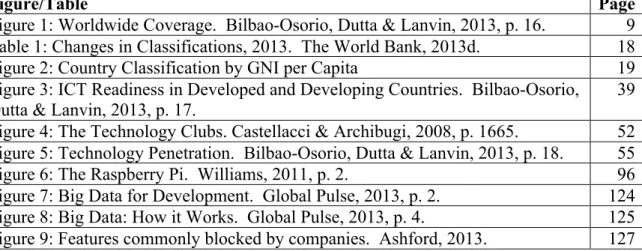
List of Figures and Tables
Figure/Table Page
Figure 1: Worldwide Coverage. Bilbao-Osorio, Dutta & Lanvin, 2013, p. 16. 9 Table 1: Changes in Classifications, 2013. The World Bank, 2013d. 18
Figure 2: Country Classification by GNI per Capita 19
Figure 3: ICT Readiness in Developed and Developing Countries. Bilbao-Osorio, Dutta & Lanvin, 2013, p. 17.
39 Figure 4: The Technology Clubs. Castellacci & Archibugi, 2008, p. 1665. 52 Figure 5: Technology Penetration. Bilbao-Osorio, Dutta & Lanvin, 2013, p. 18. 55
Figure 6: The Raspberry Pi. Williams, 2011, p. 2. 96
Figure 7: Big Data for Development. Global Pulse, 2013, p. 2. 124 Figure 8: Big Data: How it Works. Global Pulse, 2013, p. 4. 125 Figure 9: Features commonly blocked by companies. Ashford, 2013. 127
List of Abbreviations and Acronyms
Acronym/Abbreviation Full Name
3G Third generation of mobile communications technology 4G Fourth generation of mobile communications technology
APM Assets Pentagon Model
ArCo ArCo Technological Capabilities Index
ATM Automated Teller Machine
BRIC Brazil, Russia, India, China
BYOD Bring Your Own Device
CEO Chief Executive Officer
CT Communications Technology
ENIAC Electronic Numerical Integrator And Computer
GDP Gross Domestic Product
GNI Gross National Income
GSM Global System for Mobile Communications
GSMA Global System for Mobile Communications Association
HDI Human Development Index
HiWEL Hole-in-the-Wall Education Limited
IBM International Business Machines
ICT Information and Communications Technology
ICT4D Information and Communications Technology for Development
IT Information Technology
ITU International Telecommunications Union
LTE Long Term Evolution
MIE Minimally Invasive Education
MNC Multi National Company
Mpbs Megabits per second
NGO Non-governmental Organization
NRI Networked Readiness Index
NWNP Nepal Wireless Networking Project
OECD Organization for Economic Co-operation and Development
OLPC One Laptop per Child
PC Personal Computer
R&D Research and Development
RAND Research and Development Corporation
SARI Sustainable Access in Rural India
SMS Short Message Service
SOLE Self-Organised Learning Environment
TAI Technology Achievement Index
TED Technology, Entertainment, Design
UN United Nations
WEF World Economic Forum
WiFi Wireless Fidelity
WiMAX Worldwide Interoperability for Microwave Access
WLAN Wireless Local Area Network
Table of Contents
1 INTRODUCTION 13
2 ARGUMENT 17
2.1 ANOTE ON TERMINOLOGY 17
2.1.1 COUNTRY CLASSIFICATIONS 17
2.1.2 IT,CT, AND ICT 20
2.2 ICTMEASUREMENT AND INDICES 22
2.2.1 BASIC CONCEPTS OF INDEX THEORY 22
2.2.2 ASELECTION OF ICTINDICES 26
2.2.3 INDICATORS COMMON TO ICTMEASUREMENT SYSTEMS 28
2.2.4 ICTINDICES AND COUNTRY RANKINGS 36
2.3 LEAPFROGGING THE DIGITAL DIVIDE:THE RELEVANCE OF ICTINDICES 47
2.3.1 WHAT IS LEAPFROGGING? 47
2.3.2 THE DIGITAL DIVIDE 49
2.3.3 ICT4D 70
2.3.4 WHAT’S E-GOVERNMENT GOT TO DO WITH IT? 71
2.4 ICT IN EDUCATION 73
2.4.1 HISTORY OF EDUCATION 73
2.4.2 ICT:ANEW TOOL FOR EDUCATION 75
2.5 INVESTMENT IN ICT IN DEVELOPING COUNTRIES 98
2.5.1 WHERE’S THE MONEY? 98
2.5.2 INVESTMENT ARGUMENTS:FOR AND AGAINST 100
2.5.3 WHAT IMPACTS ICTINVESTMENT IN DEVELOPING COUNTRIES? 102
2.5.4 CURRENT INVESTMENTS 104
2.5.5 PUBLIC INVESTMENT 106
2.5.6 DOES INVESTMENT IN ICT IN DEVELOPING COUNTRIES PAY? 107
2.5.7 POSITIVE EXAMPLES OF ICTINVESTMENT 108
2.5.8 POLICY RECOMMENDATIONS 114
3 IMPLICATIONS FOR POLICY MAKING 121
3.1 GAME-CHANGERS:BIG DATA,THE CLOUD, AND BYOD 122
3.1.1 BIG DATA 123
3.1.2 THE CLOUD 125
3.1.3 BYOD 126
4 CONCLUSION: IMPLICATIONS AND FUTURE WORK 129
5 REFERENCES 132
6 APPENDIX 148
6.1 INDEX STRUCTURES AND RANKINGS 148 6.2 MOBILE AND INTERNET PENETRATION AND MAXIMIZATION 156
6.3 SELECT COUNTRY PROFILES 160
6.4 BYOD 165
1
Introduction
Advances in Information and Communications Technologies (ICTs) play an integral part in driving economic and social development. Consequently, numerous studies seek to quantify ICT capability or readiness among countries; while the indicators employed vary significantly, most use general metrics to assess technology development, infrastructure, and human skills or education. Universally it has been demonstrated that developing countries severely lack resources in human development, education services and especially in technology. Because of this, certain areas of infrastructure (power and telephone lines) have automatically relegated them to “unready” or “not capable” status.
Many policymakers use these rankings to make the case that, even if provided access to technological resources, low-income countries would be unable to employ them in a sustainable manner in the long-term. They claim countries with poor literacy rates – and nearly negligible ICT literacy rates – will not benefit from opportunities provided by technological upgrades or initiatives. When considering increases in foreign aid or government subsidies for technology diffusion programs that help the poverty-stricken learn to use computers and the internet, policymakers point to these rankings as justification for denying funding.
construction of wired broadband. Those without mobile devices frequent internet cafes, thereby rendering useless indicators such as number of computer owners or internet subscribers to tell the story of how many people are online (CID, 2006).
Perhaps more importantly, developing countries may be on the verge of leapfrogging developed ones in educational innovations with modern ICT infrastructure models, thereby diminishing the gap in quantity and quality of schooling. For decades now, academics who study teaching methods have tried to convince developed countries that effective implementation of ICT in education has the potential to change the way we learn and hence the pace of learning. Recently these educators have directed efforts toward developing countries, where local teachers welcome any research that might help efforts in the world’s poorest communities. Experiments like Sugata Mitra’s (2005) “Hole-in-the-Wall,” which monitored children in Indian slums exposed to computers and the internet for the first time, have been extremely revealing. Mitra, who won the 2013 TED Prize to spark global change, found that the children in his experiments taught themselves to use the computer and the internet within a few days – and despite speaking only the local language at the beginning of the experiment, within months the children were reading and writing in English online.
aid for future ICT initiatives around the world, and researchers and educators should understand the factors involved in development for both ICTs and education before beginning studies in poor areas. Investments in mobile and wireless technologies will allow organizations and governments to leapfrog traditional infrastructure, narrowing the digital divide and resulting in attainable education, skyrocketing literacy rates, and sustainable solutions for development in impoverished communities.
2
Argument
2.1
A Note on Terminology
2.1.1 Country Classifications
The World Bank classifies world economies based on gross national income (GNI) per capita, with revisions every July. The current classifications are: Low income, for countries with a 2012 GNI of $1,035 or less; Lower middle income, with 2012 GNIs of $1,036 to $4,085; Upper middle income, from $4,086 to $12,615; and High income, for $12,616 or more. These classifications help determine a country’s lending potential and eligibility. Changes from 2012 to 2013 are displayed in Table 1, with major moves highlighted (The World Bank, 2013d). For the complete 2013 classification tables from The World Bank, please see Appendix 6.5.
ECONOMY OLD GROUP NEW GROUP
Albania Lower middle Upper middle
Antigua and Barbuda Upper middle High
Belize Lower middle Upper middle
Chile Upper middle High
Fiji Lower middle Upper middle
Hungary High Upper middle
Iraq Lower middle Upper middle
Latvia Upper middle High
Lithuania Upper middle High
Marshall Islands Lower middle Upper middle
Mauritania Low Lower middle
Russian Federation Upper middle High
South Sudan Lower middle Low
Tonga Lower middle Upper middle
Uruguay Upper middle High
Table 1: Changes in Classifications, 2013 (The World Bank, 2013d).
between the four countries (United Nations Statistics Division, 2013; A. Gelis, personal communication, October 7, 2013).
Figure 2. Country Classification by GNI per Capita. Pasquali & Aridas, 2013.
poorest individuals live in rapidly-growing India and China, while only roughly one quarter remain in sub-Saharan Africa (Sumner & Kanbur, 2011). Poverty can no longer be tied to low-income countries, and solutions to global poverty should consider investments for states more broadly defined as “developing.”
2.1.2 IT, CT, and ICT
Understanding the metrics of ICT capability and the factors that contribute to it enables governments to adjust their efforts appropriately and give their citizens the greatest advantages in ongoing development. The first step in this process is dispelling the confusion regarding the differences between Information Technology (IT), Communications Technology (CT), and Information and Communications Technology (ICT). Common usage of IT to ubiquitously refer to any technology obscures its true meaning, which is the application of technology to store or manipulate information or data. CT pertains specifically to communications and given the transition of communications to platforms that also manage data, CT is typically contextualized by ICT. This paper concentrates specifically on the ICT sector, the unified and integrated communications between data networks and devices.
2.2
ICT Measurement and Indices
Policy analysts, academic researchers, and governments share an interest in defining and utilizing measures of ICT capability or readiness, as ICT improvements often lead to significant social, political, and economic progress (Archibugi & Coco, 2005). Readiness or capability measurements show to what point a country is ready or willing to embrace ICT and its benefits, typically through a mix of indicators that impart information on the status of that country’s infrastructure, education, government policies, levels of innovation, international openness, and usage. In addition to providing potential investors with metrics, the indicators help countries that struggle with ICT capability or readiness determine what steps to take to improve (Dada, 2006).
This section discusses the system of ICT preparedness indices and the way in which they measure readiness or capability. After an overview of the history and assumptions of some relevant indices, a short description of the most common indicators in ICT measurement follows. Ranking methods are next broken down to demonstrate how countries can move up or down by improvements in various indicators. Finally, a note on the concerns with rankings and indices for understanding ICT readiness details the issues inherent in attempting to quantify capabilities and compare heterogeneous states.
2.2.1 Basic Concepts of Index Theory
Archibugi, 2008). Technological advances require effort and investment to take hold, and a higher GDP per capita eases the weight of that burden on the government (Archibugi & Coco, 2004). Indicators typically consider the extent of technology available as well as the use of that technology, and connect that to increase in welfare or growth (Álvarez & Magaña, 2007). This limits the true understanding of actual ICT capability in a country, since it ties capability to GDP per capita – and, therefore, development level – almost inextricably. In ICT measurements, GDP is not usually considered as its own indicator, but must be considered as biasing results in general.
In a report by Harvard University’s Center for International Development, economist Jeff Sachs notes that the “Readiness for the Networked World” analysis is meant to serve as a general guide to aid in “creating a strategic approach to planning for developing world communities,” not to outline a specific path or set of requirements to achieve readiness (CID, 2006, p. 3). Such guides, he continues, are meant for the purpose of identifying weak areas that may be addressed so that developing countries can begin to bridge the digital divide (CID, 2006). In fact, some evidence suggests that just the process of researching indicators for networked readiness starts the domino effect of increased ICT in developing countries, as experts and institutions begin networking with academics and each other, discussing the ramifications of the research results and talking with government officials about possibilities for the future (Dada, 2006).
2.2.1.1
A Short History of ICT Measurement
investors could quickly and easily understand what new and improved measures might be emerging where. Notably, the OECD did not attempt to use the indicators to rank countries by innovation or ICT readiness, nor does the OECD today produce any index that collates relevant indicators (Grupp & Mogee, 2004). Many other modern scoreboards, however, have moved away from the OECD example and do focus on rank through indices that consider a variety of indicators.
In the past ten years, several measurement systems for ICT capabilities have emerged from academics and public policy experts. Archibugi & Coco (2005), two of the foremost scholars on ICT capability measurement, caution that social indicators are inherently flawed; assigning one number to measure a country’s Gross National Income (GNI) or Human Development Index (HDI) makes any academic uneasy about whether the ranking holds true. Archibugi & Coco (2005) continue that technology is particularly difficult to measure, as “one of the key features of technology is precisely its variety; research activities, infrastructures, human skills, the stock of capital, and many other components constitute the technological capabilities of a country” (Archibugi & Coco, 2005, p.176). Nonetheless, such indicators are necessary when attempting quantitative comparisons of country development, and even if slightly incorrect individually, they tend to be helpful when examined together.
2.2.1.2
Understanding Synthetic Indices
innovation dissemination, thereby explaining differences in some technological capabilities across particularly heterogeneous countries; however, it fails to hold up for similar groups of countries. As a result, most ICT capability measurements are determined by an analysis of multiple variables in a composite, or synthetic, index. Synthetic indices distill necessary information about complex topics such as ICT readiness into a quickly-interpreted number that policymakers and investors might easily understand, and are particularly useful for comparing differences between similar sets of countries (Archibugi et al, 2009). Unfortunately, these indices also have shortcomings: many production functions and typical efficiency measurement methods cannot be represented in an index, and complications of multicollinearity lurk beneath any conclusions drawn from the eventual coalescence of data points (Grupp & Mogee, 2004).
2.2.1.3
Basic ICT Index Assumptions
Composite indices for technological capabilities rely upon three assumptions in
order to make logical comparisons. The first is that it makes sense to weigh countries
against each other; this assumes that each national innovation system disseminates ICT
capability to the entire country. The second assumption is that international comparisons
must hold relevance. Comparisons are stronger between similar countries, as they can
more clearly show convergences and divergences unmarred by other factors. Broad
international comparisons, therefore, often require fewer, broader indicators in order to
tell a consistent story. Finally, there needs to be a reason to combine different types of
statistical data into one index. Mathematically, this may not make perfect sense. Many
individual indicators may be correlated – for example, literacy rates with years of
indicators. Here, Archibugi et al (2009) make the analogy of the vitamin intake of a man
who eats an apple and an orange, two different types of fruit, versus the man who eats no
fruit at all; in such a situation, like that of certain ICT indicators, cross-pollination of
statistical data points does make sense. If these three assumptions do not hold, the index
becomes defunct and no longer valuable for measuring ICT capabilities.
2.2.2 A Selection of ICT Indices
In the late 1990s, investment and development in ICT skyrocketed. In response, by the early 2000s, indices to determine ICT capabilities blossomed. Some of the early indices that most influenced today’s measurement systems include:
- The World Economic Forum Technology Index (WEF) compares growth competitiveness and current competitiveness in ICT. The WEF manages to reduce some of the errors inherent in measuring human capital by including macroeconomic environmental conditions and business environment factors, but unfortunately the index fails to consider additional forms of human capital that could be helpful (Archibugi & Coco, 2004).
- The UN Industrial Development Organization Industrial Development Scoreboard combines skills and infrastructures, which obscures many of the differences between developing countries with poor infrastructure and increasing skills versus increasing infrastructure and poor skills. Since improvements to infrastructure and skills require divergent policies, this combination frustrates attempts to proscribe recommendations (Archibugi & Coco, 2004).
Factors, which attempts to form an idea of the social and economic environment by looking at GDP, education, and other statistics (Archibugi & Coco, 2004). Unfortunately, this index is not widely available for a significant number of countries in recent years.
- The United Nations Development Program Technology Achievement Index (UNDP TAI) looked at four areas of technology: Creation of technology; Diffusion of newest
technologies; Diffusion of oldest technologies; and Human skills. While the breakdown of old and new technologies is particularly interesting, the UNDP TAI ceased generating new data in 2003 (Archibugi & Coco, 2004).
Archibugi & Coco (2004) developed their ArCo Technological Capabilities Index (ArCo) after evaluating the indices described above and many others. ArCo pays special
attention to innovative activity, such as patent applications, and human capital. ArCo also considers both old and new technology infrastructure rather than separating mobile from fixed telephony. In an updated tool, Archibugi & Coco (2005) include import technology, FDI, tech licensing payments, and capital goods imports.
productivity in developing countries (Dedrick, Kraemer & Shih, 2011).
Finally, the World Economic Forum’s (WEF’s) annual Networked Readiness Index (NRI) specializes in comparing ICT competitiveness across global economies in
order to aid policymakers and investors in their ICT decisions. The NRI uses indicators to measure a country’s economic and political environment toward ICT (“friendliness”); societal preparation to use affordable ICT; in-country work to increase ICT usage and capacity for ICT usage; and the social and economic impacts that will create (or are already creating) a greater propensity for ICT usage (Bilbao-Osorio & Dutta, 2012; Bilbao-Osorio, Dutta, & Lanvin, 2013). The WEF continues to produce the NRI, so it exemplifies the current thinking and development on ICT indices. For 2013 rankings and index breakdowns of the NRI, see the Appendix (Section 6.1).
2.2.3 Indicators Common to ICT Measurement Systems
E-readiness indices typically employ indicators that consider economic growth, often measured in GDP per capita, and ones that focus specifically on readiness for the society to utilize and benefit from ICTs (Bridge Organization, 2001, as quoted in Ifinedo, 2005). ICT readiness indicators usually fall into one of five categories: human skills/education, tacit knowledge, infrastructure, usage, and availability/affordability. Not all indices consider all these factors, but they do make up the base of most measurement systems.
2.2.3.1
Human Skills/Education
skills are necessary for imitation and even adoption (Filippetti & Peyrache, 2011, p. 4). In the NRI, the skills pillar accounts for four variables out of a total of fifty-four, and focuses on literacy and education (Bilbao-Osorio, Dutta, & Lanvin, 2013). ArCo counts development of human skills as one third of the index and includes one indicator each for: tertiary science and engineering enrollment, mean years of schooling over 14 years old, and basic literacy rate (Archibugi & Coco, 2004). Noticeably, this does not put a premium on human skills specific to technology, which other indices tend to do. However, when pressed on this subject, Archibugi ruefully notes that the absence of these skills in the indicators does not reflect a lack of importance, but a lack of data (D. Archibugi, personal communication, August 6, 2013). Similarly, the ArCo creators struggled to find sufficient job qualifications data to shed light on learning-by-doing and learning-by-using and so were unable to make justified comparisons between countries (Archibugi & Coco, 2004). Even in a small index to test nine African economies, Ifinedo (2005) dedicates roughly a fifth of his indicators to literacy rates, school enrollments, English language speakers (instructors?), the United Nations Development Program Technology Achievement Index, skilled workforce, and spending on education. Unfortunately, the work concluded that all of Africa appeared unfavorable for ICT capability; with the measurements on a scale of 1-5, each of the nine countries ended up below the average of 3 (Ifinedo, 2005).
rates and developed countries (Álvarez & Magaña, 2007). When it comes to education, studies of poor nations found that measuring tertiary education rather than average years of schooling produced better results. In developing countries, tertiary education is more likely to incorporate ICT and skills helpful for ICT development and production than basic education. Since ICT diffusion in schools tends to be driven by unit cost per pupil, computers usually enter the university level first and trickle into basic levels last (CID, 2006). This difference did not show up in developed countries, where basic education may already make use of ICT in the classroom – or where students have access to computers and the internet at home (Kiiski & Pohjola, 2001; Dedrick, Kraemer & Shih, 2011).
Archibugi considered students enrolled in science and technology degrees in his ArCo index, but notes that measuring both technical skills and education can be extremely tricky. When using tertiary education in science and technology as a proxy for technical skills, the quality may vary so widely as to make a comparison useless. Even among developed countries, he says that in some universities the classroom could have hundreds of students in lecture halls or center around virtual teaching, whereas “in Sweden you have a few students per teacher so quality is much better, for example” (D. Archibugi, personal communication, August 6, 2013).
that can train and prepare an ICT workforce?” (CID, 2006, p. 7). They break the indicators down into schools’ access to ICTs, as measurable by number of computers, physical access to the technology, types of computers, diffusion of the network, access to and organization of electronic content, and quality and speed of connectivity in the school; enhancing education with ICTs, calculated by teacher training and curricula incorporating ICTs; and developing the ICT workforce, which considers opportunities for ICT training and potential work for those with ICT skills (CID, 2006).
2.2.3.2
Tacit Knowledge
While education, or learned “know-how,” can be described and quantified to some extent, tacit knowledge cannot. Tacit knowledge is the inherent understanding of education’s practiced techniques. For a complex technology process to succeed, workers must possess both tacit and learned skills (Nelson, 2003).
Tacit knowledge in no way replaces education or human skills; in fact, due to its intangible nature and its virtual uselessness in a vacuum, tacit knowledge does not play heavily in ICT indicators. Some indices consider education a proxy for tacit knowledge, but this both distorts education indicators and ignores the basic concept of tacit knowledge (Archibugi et al, 2009). Since tacit knowledge is by definition not quantifiable, attempts to measure it with education indicators completely miss the mark.
Nevertheless, tacit knowledge as observed and encouraged in education may
reveal important truths that help governments and investors better understand the nature
of a country’s ICT readiness. Most studies show that the behavior and attitudes of
children and teachers in a classroom – the “nurture” side of the nurture vs. nature
development. This holds particularly true when the differences between how children
learn begins to become more obvious in the classroom; as some children gravitate toward
math and others struggle with it, the interplay between tacit and learned knowledge
grows. Differences in both learning and tacit knowledge are magnified in the classroom
as student personalities clash or mesh with teachers’ and some believe that the inherent
de-socialization that increased technology brings to education may help balance out
children’s various comprehension styles. However, computerizing education alone has
not yet been shown to eliminate these problems (Nelson, 2003).
Incorporation of the internet and various computerized learning and instructional
aids in the classroom have helped raise tacit knowledge in technology. Through learning
the new technology by working with it, playing with it, and using it with other children to
explore how they might view the mechanics of the system, children exposed to ICTs in
the classroom develop a tacit understanding of how to think with the technology. This
cannot be taught to a student who encounters a computer for the first time in university.
When considering the example of typing instruction those who gain exposure to
computers when older can certainly learn to type and even become quite quick and
capable on a keyboard. But children who grow up with computers as everyday tools in
the classroom think of a keyboard as almost an extension of their fingers (D. Archibugi, personal communication, August 6, 2013).
Of course, since this tacit knowledge cannot be quantified, indices struggle to
incorporate it in meaningful ways. Learning by doing does not replace or diminish the
importance of technical instruction, but, it is worth noting that children may receive a
high-cost individual computers or even integrated, computerized educational environments
(Nelson, 2003; Mitra, 2010). The basic exposure that stimulates the tacit learning may be
enough to begin helping children bridge the digital divide (Mitra, 2010).
2.2.3.3
Infrastructure
Nearly all indices include infrastructure. This may be a measurement of fixed
telephone mainlines, traditional power lines, electricity consumption, mobile phones per
population, or wireless dissemination; currently, each index differs in its definition of
infrastructure. Many studies show that telecommunications infrastructure in particular
carries great importance in ICT productivity and therefore capability. Since lower costs
mean mobile versus fixed telephony reins in developing countries, infrastructure
measurements that focus on wired capabilities may unfairly paint developed countries in
a more ICT-ready light (Dedrick, Kraemer & Shih, 2011). For example, through a
non-profit project in Nepal, many unwired mountain villages now have WiFi; indices that
only take wired technologies into account do not properly evaluate the readiness levels of
these villages (Thapa & Sæbø, 2012).
An entire third of the ArCo index comprises infrastructure indicators that consider
percent of internet users, telephone users, and electricity consumption. There is less of a
focus on computer or internet access in homes – number of houses with a computer is a
common indicator in many readiness measurements – and more room for different
interpretations of infrastructure to allow developed and developing country comparisons
(Archibugi & Coco, 2004). In a study of ICT productivity, measurements of
telecommunications infrastructure considered investment rather than mainlines density in
technologies, with their low-cost, quick-growing, complementary diffusion, catch on
more quickly than traditional technology in developing countries, and indices that design
indicators that can consider both traditional and new telecommunications infrastructure
provide a more thorough and accurate view of current readiness comparisons (Dedrick,
Kraemer & Shih, 2011).
2.2.3.4
Availability/Affordability of ICT
The two main questions regarding programs aimed at increasing ICT availability in developing countries are whether targeted individuals will be able to afford the devices to use the new technology and, if so, whether they will know how to use the new technology. Telecommunications providers and others interested in boosting ICT in developing countries now work with plans that specifically create technology solutions at affordable rates for that market; in fact, some organizations are finding that the “paying less for less” strategies boost their global reach in developed countries as well (Bilbao-Osorio & Dutta, 2012). The recent focus on pre-paid phone models and similar data plans, as well as increased government support, have made affordable ICT connections possible, though these are not always considered in developed countries as “real” advances (Bilbao-Osorio & Dutta, 2012). Not surprisingly, studies from the World Bank (2012) show that “direct correlations can be made between the affordability of broadband connectivity and an individual’s or country’s ability to successfully transform itself through the utilization of ICT capabilities;” if you make the technology reasonably affordable, developing countries will find a way to use it (Bilbao-Osorio & Dutta, 2012, p. xv).
particularly in developing countries, their measurement in indices helps give an idea of
future diffusion and usage. To balance the differences between developed and
developing countries in these indicators, many indices consider business rather than
consumer telecoms costs, since so few individual consumers exist in developing countries
that their marginal operational costs still soar over those in developed countries (Dedrick, Kraemer & Shih, 2011). Harvard University’s Center for International Development (CID) expanded the criteria even further to consider availability, cost, and quality of networks, services and equipment, and accounting for developing countries’ tendencies to engage in public access through telecenters, internet cafes, and community centers (CID, 2006). The CID specifically cites wireless telecommunications and mobile devices as development catalysts for poor countries, with their tide of low costs, short deployment time (as compared to fixed lines), accelerated rollout potential, increasing power, convenience, and the trend for extremely inexpensive disposable devices with pay-as-you-go plans (CID, 2006).
2.2.3.5
Usage
Usage indicators attempt to determine what percentage of the population employs
ICTs. Sometimes these indicators break measurements down into societal versus
business usage, or even further into firm and government usage; other indices, however,
simply compare gross usage (CID, 2006). Gross usage may distort true data reading of
ICT readiness in the same ways that misclassification of infrastructure capabilities might
– indices that measure usage based off of households with computers or households with
kiosks or even the sharing of email accounts significantly increases percentage of the
population accessing ICTs, usage can be tough to quantify. Poor communities
increasingly share network infrastructure in public areas and sometimes even share
mobile phones, so even the most cautious indicators mapping usage should be taken with
a grain of salt (CID, 2006).
2.2.3.6
Additional Factors
Depending on the index, indicators may also measure the regulatory environment, openness to the global economy, and technology creation. Though these indicators appear less frequently than those considering skills and infrastructure, they tell an important story about a country’s ICT potentiality in the long run. In the CID’s Readiness Guide (2006), they consider the regulatory environment as part of the state’s “Networked Policy,” and question whether policies and legislation help or hurt ICT dissemination and usage. Notably, many developing countries – including Mauritius and India (see “Positive Examples of ICT Investment,” Section 2.5.7) – with pro-ICT policies have reaped significant gains as a result (Bilbao-Osorio & Dutta, 2012; Krishna & Walsham, 2005). Openness to the global economy is often a precursor to improved policy or other ICT advances (Dedrick, Kraemer & Shih, 2011). Technology creation, often left off of indices that consider developing countries, which tend to use rather than create ICT, makes up an entire third of the ArCo index. Often, indices specific to technology creation are simply compared alongside other ICT readiness measurements (Archibugi & Coco, 2004).
2.2.4 ICT Indices and Country Rankings
countries tend to appear in roughly similar places in various ICT readiness rankings (Archibugi & Coco, 2005). Archibugi & Coco (2004) group countries into leaders (1-25); potential leaders (26-50), characterized by investment in human skills and basic infrastructure, but lack innovation; latecomers (51-111), which work to stimulate technology growth while simultaneously pushing for additional development; and marginalized (112-162), lacking telephony and electricity and without the capability to even begin technology creation. Filippetti & Peyrache (2011), in a more recent study, take a slightly different view of the similar four groups of countries. They refer to them as composition improving, which includes some traditional European leaders and emerging growth countries like the Asian Tigers; losing momentum, as characterized by low growth and slow performance loss from previous leaders; balanced catch-up, with good performance in growth from China, Mexico, Turkey, Estonia, and Lithuania; and unbalanced catch-up, composed mainly of transition economies and including most of the same countries as Archibugi & Coco’s (2004) marginalized group. The results from Filippetti & Peyrache (2011) when compared against those from Archibugi & Coco (2004), or those from many studies around 2004 with more recent studies from today, show that North America, Western Europe, and Japan no longer run the gamut in ICT capability. Though the marginalized or unbalanced “catch-up” countries may still struggle far behind, the safe lead previously held by developed countries has already begun to dissolve.
dominated ICT readiness indices; in the 2013 Networked Readiness Index, Finland, Sweden, Norway, and Denmark placed in the top ten, and Iceland, the fifth Nordic country, ranked seventeenth (World Economic Forum, 2013; Bilbao-Osorio, Dutta, & Lanvin, 2013). Exemplary education and human skills are featured prominently in each of the top ten countries on the list, and the Asian Tigers crept forward with business-friendly approaches and infrastructure investments complementing their highly-skilled populations (Bilbao-Osorio, Dutta, & Lanvin, 2013; World Economic Forum, 2013). Finland, which stole the top spot on most indices away from Sweden in recent years, boasts one of the world’s best educational systems with the highest number of ICT patent applications per capita, an extremely connected population (90% of Fins are online, as compared to only 70% of Americans), and a major digital innovator (World Economic Forum, 2013). Interestingly, when asked why Nordic countries do so well at ICT readiness, Archibugi responds, “it’s because it’s so cold! What else are you going to do? Try to go shopping in Finland in the winter. Certain conditions force countries to develop cooperation and social development” (D. Archibugi, personal communication, August 6, 2013). While a bit tongue-in-cheek, Archibugi’s evaluation certainly makes sense.
Traditionally, higher education and technology rates seem to boost rankings for
advanced economies, whereas increased basic education and institutions have helped
developing economies. However, with the tide of wireless networking and mobile
telephony, low-cost technology can more easily be made available to marginalized or
lagging-behind countries. While rich countries still dominate the top quarter of any
transitions might have the chance to change the balance of power and help narrow the
digital divide (Filippetti & Peyrache, 2011).
Around half of the measurable countries usually fit in the middle two categories –
potential leaders and latecomers for Archibugi & Coco (2004). Many emerging
economies, such as some of the Asian Tigers and the BRICs, typically end up in these
categories. They have recently invested in business and innovation and worked hard to
improve infrastructure and education, and ICT’s impact on their societies stands out as an
importance of BRIC economies and investment in ICTs have exploded over the last decade, their technological capabilities are catching up more slowly than those of many Asian and Eastern European countries (Archibugi et al, 2009).
The marginalized countries, which make up at least a fourth of measurable
countries and likely would hold countries not included in indices due to problems of
accessing data (for example, Sudan and South Sudan), lack basic infrastructure,
electricity, and often any formal educational system at all. These are the low-income
countries in The World Bank’s classification system (The World Bank, 2013a). Many of
these countries have extremely low literacy rates, and all measurable Sub-Saharan
African countries aside from Mauritius and South Africa fall into the bottom (Bilbao-Osorio, Dutta, & Lanvin, 2013). These countries still have a very long way to go before most financiers, international foreign investors and governments consider them ICT ready enough for significant investments. In a 2009 study, Archibugi et al (2009) noted that five years after the creation of the ArCo index, countries remained relatively stable in their ranks across various indices. However, the recent advances in wireless and mobile technology may yet help these marginalized countries to leap forward far enough in capability to catch investors’ attention.
2.2.4.1
The Problems with ICT Indices
definitions of indicators and readiness, variations in methodologies, imbalances between micro and macro indicators, and problems of multicollinearity complicate even the best-researched and most thoroughly worked indices. Despite these issues, indices remain the preeminent mechanisms for measuring ICT capability; however, it is important to remember their common limitations when analyzing rankings, especially before an investment or policy change (D. Archibugi, personal communication, August 6, 2013).
2.2.4.1.1 Rankings and Cross-Country Comparisons
Though advantageous in their ability to give a quick snapshot of the overall relative status of a country, by simplifying such a complex process, ICT capability rankings fail to provide the complete picture. These indices are so aggregate that an attempt to glean conceptual intelligence to shape policy may be misplaced (Archibugi et
al, 2009). Furthermore, rankings give only a limited account of the actual gaps between countries; though Poland and Bulgaria may only be separated by one ranking in the list, the true differences between their capabilities may be much greater than the differences between Finland and Sweden (Grupp & Mogee, 2004; Archibugi & Coco, 2005).
Perhaps most discouragingly, Archibugi laments that for many, “The purpose of the data is not to develop academic work, but to appear in the press. The press likes the rankings. If you produce a new ranking, you can be almost certain it will go to the press, but that doesn’t mean it is helpful” (D. Archibugi, personal communication, August 6, 2013).
help a community decide which indicators it should focus on to improve networked readiness (CID, 2006). Nonetheless, composite indices currently provide the only reasonable measurement of ICT readiness. When methodologies remain stable over
several years, country groupings become relevant, as their spots are relative. Analysis of
an index with a consistent methods, indicators, and data sources results in an
understanding of how countries have increased their ICT capabilities compared to each
other (Archibugi et al, 2009).
If rankings must tell the story, policymakers must understand their shortcomings. For a general overview of how a country fares in comparison to the rest of the world – whether it is in the top quarter, middle half, or at the bottom – rankings from composite indices provide a quick and easy starting point. To mold strategy, though, policymakers need to go beyond these synthesized indicators for a comprehensive comprehension of ICT readiness. Any policy based off rankings alone could easily magnify these indices’ shortcomings at the cost of global negative implications (Grupp & Mogee, 2004).
The first assumption of the theory of indices of technological capability – that it makes sense to compare countries – also inherently generates problems. Countries differ
in their abilities to create, accept, diffuse, and alter technology; otherwise there would be
no need to make any comparison of their ICT capabilities (Filippetti & Peyrache, 2011).
However, these variations also muddle analysis. Along with differences in ICT
indicators like education, skills, and infrastructure, diversity of size (geographical and
population), GDP, development stage, and currency strength – among others – influence
results. For example, former second-world countries had no business sector at all until
years; yet such dynamics fall out of consideration in most synthesized indices (Archibugi
et al, 2009). Perhaps most importantly, finding uniform data across countries is nearly
impossible, and for certain indicators developing countries keep no data at all; for this
reason many indices only attempt to cover small groups of countries, such as OECD
members (Pohjola, 2002).
Indices that endeavor to provide full cross-country comparisons do best to use
only a few macro indicators, thus eliminating many differences specific only to certain
groups of countries (Archibugi & Coco, 2004). Such indices need also to present clear questions not open to interpretation. Lall (2001) suggests setting up surveys with answers in numeric or yes-no form, and warns against repetitive or redundant questions unless researchers can weight them appropriately (Lall, 2001). When comparing countries, the simpler the index, the better. When ranking countries, the focus should be on a general grouping, not a country’s exact position or literal score (D. Archibugi, personal communication, August 6, 2013).
2.2.4.1.2 Index Issues
unless comparing one index against itself across years (Archibugi & Coco, 2005).
Even when considering the same index over multiple years, legitimate analysis requires a constant methodology. When an index’s authors switch up the indicators significantly, it no longer becomes relevant to follow scores from year to year (D. Archibugi, personal communication, August 6, 2013). Methodological haziness obfuscates results; without a clear process, meaningful analysis becomes almost impossible. Certainly, if an index addresses a different question, its methodology should differ as well. For example, an ICT capability study of Africa may aim to determine whether the population would benefit from subsidized mobile phones, while one focused on Nordic countries may probe preparedness of children to innovate in technology fields. In this case, what both researchers and interpreters of these indices must ask themselves is, as Maugis et al (2005) put it, “e- Readiness for what?” (Maugis et al, 2005, p. 3).
Since the purpose of the index shapes its methodology, Dada (2006) diverges from Archibugi and argues for evaluating the micro level in addition to the macro environment. Performing e-readiness assessments costs significant time and money but infrequently results in identification of specific ways in which developing countries can better themselves, so Dada (2006) believes that a careful breakdown of firms and industries provides a more helpful output. Countries that are not ready, he notes, know they are not ready; what they need is an index to tell them what specifically, where specifically, and how specifically they should attack the issue (Dada, 2006). Archibugi does not discount this theory, but cannot imagine the amount of time and money such an effort would cost. He also admits that one factor in his studies has been that the macro data was available – a major consideration for building indices (D. Archibugi, personal communication, August 6, 2013).
A related problem with adding on more indicators becomes multicollinearity. The more indicators a study employs, the more likely those indicators will represent inseparable characteristics contributing to a country’s ICT readiness. Though many assume that the basic categories of creation, diffusion, infrastructure, and human skills are somewhat interchangeable, those factors are in fact highly correlated – the improvement of one tends to spike the progress of others. Infrastructures and human skills have a particularly robust complementarity, as they both add to the capability of a country to accept and disseminate technology (Filippetti & Peyrache, 2011; Castellacci & Archibugi, 2008).
internet users (Álvarez & Magaña, 2007). Unsurprisingly, PCs and internet usage are also extremely complementary (Dewan, Ganley & Kraemer, 2009). Interestingly, though, internet use is not as strongly correlated with traditional infrastructures such as phone and electric lines (Archibugi & Coco, 2004). This may result from the recent surge in wireless technologies and alternative energy sources in developing.
2.3
Leapfrogging the Digital Divide: The Relevance of ICT Indices
“The developing world is now more mobile than the developed world.”- The World Bank: InfoDev, 2012a.
As discussed in Section 2.2, many of today’s ICT measurements still contain indicators that are more common in developed countries than developing ones, such as fixed-line electricity and telephony. However, in the past few years developing countries have embraced mobile services at a shocking pace. Not only are the majority of mobile phones owned by users in developing countries; those users also drive applications for mobile health, mobile agriculture, and mobile money (The World Bank: InfoDev, 2012a). This section considers the argument that developing countries are employing mobile and wireless technologies to leapfrog traditional ICT infrastructure and capability requirements, thus beginning to bridge the digital divide. After mapping the upsurge in mobile and wireless use in poor areas, a project that has successfully provided internet access to the mountainous regions of Nepal is given as an example. This section next assesses the different methods of mobile and internet usage in developing countries, including public access centers and high incidences of sharing devices. Finally, the implications of leapfrogging are discussed in terms of ICT for development.
2.3.1 What Is Leapfrogging?
Speaking of this phenomenon in the context of mammoth transportation companies, Schumpeter once remarked, “add as many mail-coaches as you please, you will never get a railroad by doing so” (as cited in Archibugi & Coco, 2004, p. 670). Long after history validated Schumpeter’s theories, Steve Jobs popularized them. In a Harvard Business Review article published shortly after Jobs’ death, his biographer noted that one of the
Apple mogul’s top lessons to innovators is simply, “When behind, leapfrog” (Isaacson, 2012). Time and again, Jobs leapfrogged over well-known competitors like Microsoft and IBM by looking forward rather than stagnating in success; he even pushed his company to build products that would overtake his old best-sellers, essentially making the groundbreaking iPod obsolete with the release of the iPhone, because he knew that otherwise another young tech firm would be able to leapfrog over Apple (Isaacson, 2012).
process of narrowing the digital divide through an original pathway better-suited to a developing country (Maugis et al, 2003).
2.3.2 The Digital Divide
The “digital divide” refers to the expansive difference in current ICT capability between developed and developing countries. Seventy-seven percent of the developed world is online, compared to only 31% of developing populations; Europe’s penetration rate is 75%, whereas Africa’s is only 16%. Internet usage in developed countries is nearly equal between men and women, but in developing areas 16% fewer women than men are online (ITU, 2013).
Advanced countries continue to make significant progress in technology, but many developing countries struggle to innovate at all. Asian Tigers have combated this divide to some extent, capitalizing on the electronics market successfully. However, there remains a clear segregation between developed and developing countries in ICT diffusion, innovation, and overall capabilities, augmented by the complementary factors of education, GDP per capita, and infrastructure (Fagerberg, Srholec & Knell, 2007).
the 80% of the world’s population that lives in the developing world…there now exists a unique opportunity for many of these communities to join global information networks to propel them to greater wealth and prosperity” (CID, 2006, p. 3).
Some argue that ICT diffusion is exponential in nature; the further along a country’s technological capability, the more quickly it can diffuse new technology. If true, this could point to a widening of the digital divide (Fagerberg, Srholec & Knell, 2007). However, it seems more likely that advances in ICT specifically for developing countries will lead to leapfrogging possibilities that will allow nations currently behind to narrow and eventually bridge the divide. Technology diffusion in developed countries may actually provide great opportunities for developing nations, as they can easily imitate the existing advanced technology rather than needing to home-grow the capability to innovate it, which takes much more time, effort, and capital (Fagerberg, Srholec & Knell, 2007).
Dutta, & Lanvin, 2013, p. 17-18). Though these may seem like obvious observations, they in fact highlight serious problems. Many in rural areas of developing countries focus foremost on access to clean water, sufficient food, and sewage. It is only after those basic needs are attained that priority shifts to healthcare, education, roads, and general infrastructure – all before ICT development (Pun, 2012). Lack of investment and concentration on technology dooms those areas to fall even further behind without substantial aid from others.
In an analysis that sheds light on the current nature of the digital divide, Archibugi and his colleague Castellacci (2008) group countries into three “technology clubs.” The advanced club is characterized by high infrastructure, skills, and innovation, and comprises roughly 15-21 technologically advanced countries, including the US, Japan, and many European countries; in 2000 a few of the Asian Tigers joined the group, but otherwise it is extremely stable. The Advanced club accounts for only 15% of the world’s population but 40% of GDP. The Followers club holds 70 countries – 27% of the world’s population and 36% of its GDP – and boasts medium-high infrastructures and skills but low innovation. In the 1990s, the sudden investments and improvements in ICTs in a few countries in Asia, the Middle East, Central America, and even Africa pushed those states into the Followers club. The Marginalized club holds developing countries with low infrastructures, skills, and innovation; with 60% of the world’s population and 23% of GDP, this group suffers the most from the digital divide (Castellacci & Archibugi, 2008).
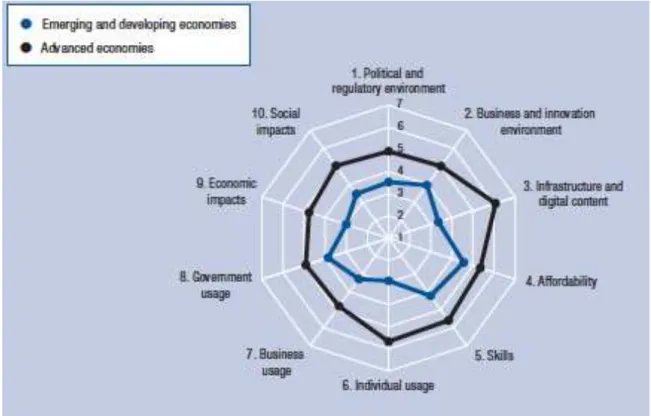
developing countries (see Figure 3 below). In every type of indicator except Tertiary Science and Engineering Enrollment, Followers narrowed the gap to the Advanced club – often quite aggressively. Marginalized countries made significant progress in terms of Internet users and phone dissemination, with close to a 100% change in the Internet User ratio, and they closed the literacy rate and Science and Engineering Enrollment gaps notably better than the Followers club. In many of the categories, though, the Marginalized group fell behind or only made small improvements. The failure of Marginalized countries to make more progress in such areas indicates the widening disparity in innovation capabilities between many of the most and least developed nations (Castellacci & Archibugi, 2008).
Figure 4: The Technology Clubs. Castellacci & Archibugi, 2008, p. 1665.
when the international diffusion of advanced technologies will eventually benefit less developed countries as well” (Castellacci & Archibugi, 2008, p. 1670). Notably, despite data showing the potential for a widening of the digital divide, no country moved backward into a lower-innovation club and a total of twenty countries actually improved their standing by one level (six from followers to advanced and fourteen from marginalized to followers) (Castellacci & Archibugi, 2008).
2.3.2.1
Developing Countries Leapfrogging Across the Digital Divide
It is widely understood that technological development cuts costs and aids in economic development. In addition to driving growth by increasing efficiency of communication, ICTs paved the way for mobile money systems (The World Bank, 2011). The mobile money industry, which allows for individuals without access to banking institutions (mostly those living in poverty or developed countries) to use currency more easily, grows as quickly as the rest of the ICT sector – if not more so. This “unbanked” population currently has access to more than 150 services in 72 countries, an increase of almost 38% from 2012, with 109 new deployments in the works for 2013 (Penicaud, 2013). To put the mobile money industry into perspective, as many of these outlets exist for the “unbanked” as do Western Unions (Penicaud, 2013).
orders to banks rather than relying on cash (Dewan, Ganley & Kraemer, 2009). Though adoption has previously been slower in poorer countries, such recent changes are now helping them ramp up connectivity much more rapidly (Bilbao-Osorio & Dutta, 2012).
By some estimates, digitization could result in half a billion people rising out of poverty by 2023 (World Economic Forum, 2013). Many independent studies find that diffusion in developing countries is beginning to pick up as complementary effects slowly come into play; installed PCs in public areas, for example, have accustomed many to the idea of technology development and created a desire in poor countries for internet access (Filippetti & Peyrache, 2011; Dewan, Ganley & Kraemer, 2009). Though higher GDP per capita appears to correlate to the rate of ICT dissemination more than many other factors, ICT adoption in developing countries is currently growing at a vastly faster rate, resulting in the beginnings of a reduction in the digital divide. Interestingly, GDP per capita matters less in countries with low ICT saturation, meaning that those countries now working to catch up may not be penalized as heavily for their lack of resources. Countries with higher years of schooling, lower telephone costs, and significant international trade may lead toward more impressive adoption rates when compared with countries boasting high GDP per capita alone (Dewan, Ganley & Kraemer, 2005).