TESTING OF CARBONACEOUS ADSORBENTS FOR REMOVAL
OF POLLUTANTS FROM WATER
RAISA NASTAS1, MARINA TCACI1, TATIANA GOREACIOC2, V.RUSU1, T.LUPASCU1
ABSTRACT. – Testing of carbonaceous adsorbents for removal of pollutants from water. Relevant direction for improving of quality of potable water is
application of active carbons at various stages of water treatments. This work includes complex research dealing with testing of a broad spectrum of carbonaceous adsorbents for removal of hydrogen sulfide and nitrite ions from water. The role of the surface functional groups of carbonaceous adsorbents, their acid-basic properties, and the influence of the type of impregnated heteroatom (N, O,) or metals (Fe, Cu, Ni,) on removal of hydrogen sulfide species and nitrite ions have been researched. The efficiency of the catalyst obtained from peach stones by impregnation with Cu2+ ions of oxidized active carbon was established, being
recommended for practical purposes to remove the hydrogen sulfide species from the sulfurous ground waters. Comparative analysis of carbonaceous adsorbents reveals the importance of surface chemistry for oxidation of nitrite ions.
Keywords: active carbons, adsorption, oxidation, hydrogen sulfide, nitrite ions.
1. INTRODUCTION
In Republic of Moldova water supply is covered by 85% from surface water (the rivers Dniester and Prut) and 15% from groundwater. Groundwater is an important source of water supply for about 85-90% of rural population (***, 2007). Many of underground sources of water do not follow the requirements of standards for drinking water, being detected high concentrations of F-, Fe total, NH
4+,
hydrogen sulfide, NO2- etc. (Garaba, 2005; Mirza, 2005; ***, 2007). Relevant
direction for improving of quality of potable water is application of active carbons at various stages of water treatments. Activated carbons are well known as versatile adsorbents for many different applications (Lupascu, 2004; Marsh and Rodriguez-Reinoso, 2006; Rodriguez-Rodriguez-Reinoso, 1998).
The purpose of this work was to test vegetal carbonaceous adsorbents, with a broad spectrum of physical-chemical characteristics, for removal of hydrogen sulfide and nitrite ions from water.
1 Institute of Chemistry, Academy of Sciences of Moldova, 3, Academiei str., MD-2028, Chisinau,
Republic of Moldova, e-mail: [email protected]
2 Institute of Ecology and Geography, Academy of Sciences of Moldova, 3, Academiei str.,
2. EXPERIMENTAL
A broad spectrum of carbonaceous adsorbents, obtained from vegetable raw materials (fruit stones and nutshells), have been tested for removal of hydrogen sulfide, and nitrite ions from water, to chose the more efficient adsorbents. Methods with different agents for activation and oxidation of carbons have been applied (Lupascu et al., 2006; Lupascu and Nastas, 2004; Nastas et al., 2007) and procedures for modification of surface chemistry have been used (Maroto-Valer et al., 2004; Nastas et al., 2008; Nastas, 2006; Tcaci et al., 2011).
2.1. Characterization of carbonaceous adsorbents
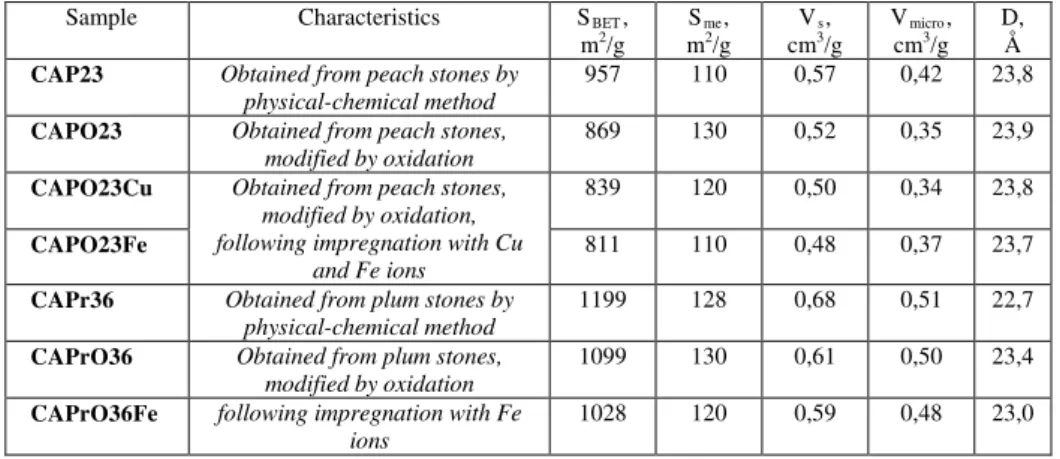
Structural parameters (obtained from sorption isotherms of nitrogen at 77 K) of carbonaceous adsorbents and surface chemistry are presented in tables 1 and 2.
Total surface groups of the initial activated carbon (CAi, obtained from nut
shells by physical-chemical method of activation) and of the samples obtained by modification with urea at different temperatures (Tcaci et al., 2011) (CAN-200, CAN-300, CAN-400, CAN-500, CAN-600, CAN-700 and CAN-800) are
presented in Fig. 1.
Testing of carbonaceous adsorbents for the elimination of hydrogen sulfide and nitrite ions from model solutions was performed in static conditions (Rusu et
al., 2010). Elemental sulfur, thiosulfate, sulfite, sulphate and nitrite ions were determined by standard methods (***, 1995).
Table 1. Structural parameters of activated carbons (Maroto-Valer et al., 2004; Maroto-Valer et al., 2006)
Sample Characteristics SBET,
m2/g mSme2/g , cmVs3/g , Vcmmicro3/g , D, Å
CAP23 Obtained from peach stones by physical-chemical method
957 110 0,57 0,42 23,8
CAPO23 Obtained from peach stones, modified by oxidation
869 130 0,52 0,35 23,9
CAPO23Cu Obtained from peach stones, modified by oxidation, following impregnation with Cu
and Fe ions
839 120 0,50 0,34 23,8
CAPO23Fe 811 110 0,48 0,37 23,7
CAPr36 Obtained from plum stones by physical-chemical method
1199 128 0,68 0,51 22,7
CAPrO36 Obtained from plum stones, modified by oxidation
1099 130 0,61 0,50 23,4
CAPrO36Fe following impregnation with Fe ions
1028 120 0,59 0,48 23,0
SBET – BET surface area;
Sme – mesopore surface area;
Vs – total pore volume; Vmicro – micropore volume;
Table 2. Surface chemistry of activated carbons (Nastas et al., 2008; Rusu et al., 2007)
Sample Characteristics
Character of the functional groups. Amount, meq/g Total
acidic Carboxylic Phenolic Total basic Strong Weak
CAP23 Obtained from peach stones 0,58 0,10 0,19 0,29 0,59 CAPO23 modified by oxidation 2,71 1,34 0,31 1,06 0,35
CAPr36 Obtained from plum stones 0,73 0,22 0,10 0,41 0,69 CAPrO36 modified by oxidation 2,48 0,99 0,48 1,01 0,43
CAN-7 Obtained from nut shells by chemical method with H3PO4
1,79 0,74 0,31 0,74 0,10
CAPr-1 Obtained from plum stones by chemical method with H3PO4
1,98 0,48 1,10 0,40 0,10
CAP-7 Obtained from peach stones by physical chemical method with NH3/H2O
0,37 - 1,07
CAP-8 Obtained from peach stones by physical chemical method with SO2/H2O
0,28 - 0,67
Efficiency of carbonaceous adsorbents for removal of hydrogen sulfide and nitrite ions from solutions in the presence of carbonaceous adsorbents(particle size
0,63 - 1,00 mm) were performed by using lab installation provided with an air bubbler and recovery flask for aerated hydrogen sulphide (Rusu et al., 2010). All sulfur species were recalculated as H2S, and removal of hydrogen sulfide from
solutions was expressed as R, %.
3. RESULTS AND DISCUSSION
3.1. Removal of hydrogen sulfide
3.1.1. Removal of hydrogen sulfide from model solutions
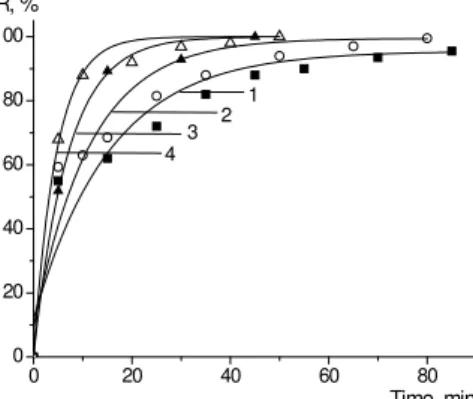
Testing of adsorbents for the elimination of hydrogen sulfide from model solutions in static conditions (Fig. 1) emphasize high capacity for carbonaceous adsorbent obtained from peach stones modified with copper ions (CAPO23Cu).
Quantity of H2S aerated and oxidized to sulphur species in the presence of
catalysts are presented in Table 3. Results highlight the important role of oxygenated functional groups on the surface. It is stated that the ability on oxidation of hydrogen sulphide to sulphur species of higher degree of oxidation (SO32- and SO42-) is more pronounced for higher content of strong carboxylic
groups on the surface (CAPO23, Tables 2 and 3).Carbonaceous adsorbent CAP23-N, obtained from peach stones and modified with urea, also presents good capabilities for hydrogen sulfide removal from solutions (Figs. 2, 3 and Table 3).
Modification of surface chemistry of activated carbons with transition metals changes its catalytic properties (Maroto-Valer et al., 2004; Maroto-Valer et al., 2006). State or form of the impregnated metal greatly influences the selectivity of sulfur species formation in solution (Nastas, 2006). In the presence of NiO (sample CAP23-NiO, Tab. 3) the main sulfide oxidation product is elemental sulphur while in the case of adsorbents modified with copper and iron ions the sulfide oxidation products are thiosulfate, sulfite and sulfate ions, and there is no present elemental sulphur.
Fig. 1 Capacity of carbonaceous adsorbents to remove hydrogen sulfide
from solution.
Fig. 2 Capacity of carbonaceous adsorbents (following modification with urea at different temperatures) to remove
hydrogen sulfide from solution.
Fig. 3 Kinetics of the removal (R, %) of hydrogen sulfide from model solution in
the presence of adsorbents: (1)-CAPO23Fe; (2)-CAPO23Cu;
(3)-CAP23-NiO; (4)- CAP23-N. (C0= 10 mg/L,
pH=8,5, ratio mgO2/mgH2S = ¾)
0 100 200 300 400 500 600 700
Capacity, mg/g
CA
P23 CAPO
23 CA
PO 23F
e CA
PO 23Cu
0 20 40 60 80 100 120 140 160 180 200
Capacity, mg/g
CA in itial
CA N5
00 CA
N6 00
CA N8
00
0 20 40 60 80
0 20 40 60 80 100
4
3 2
1
Table 3. Quantity of H2S aerated and oxidized to sulfur species in the presence of
catalysts (C0= 10 mg/L, pH=8,5, ratio mgO2/mgH2S = ¾, solid/liquid ratio of 1:800)
Catalysts (characteristics)
Quantity aerated,
%
Quantity oxidized
%
Quantity (%) of H2S
oxidized to sulfur species: S0
coloidal ∑(S2O3
2-+SO32-)
SO4
2-CAP23
(acidic groups 0,6 meq/g, pH 5,2) 12,0 88,0 20,4 12,5 67,1
CAPO23
(acidic groups 2,7 meq/g, pH 4,6) 4,3 95,6 6,1 27,1 65,9
CAP23-N
(modified with urea, 3,7% N) 5,2 94,8 0 30,6 69,4
CAP23-NiO
(0,5 meq Ni2+ /g) 5,3 94,7 95,5 4,5 0 CAPO23Fe
(0,8 meq Fe3+ /g) 23,3 76,5 0 33,8 66,2 CAPO23Cu
(0,4 meq Cu2+/g) 41,6 58,3 0 41,9 58,1
3.1.2. Removal of hydrogen sulfide from ground water
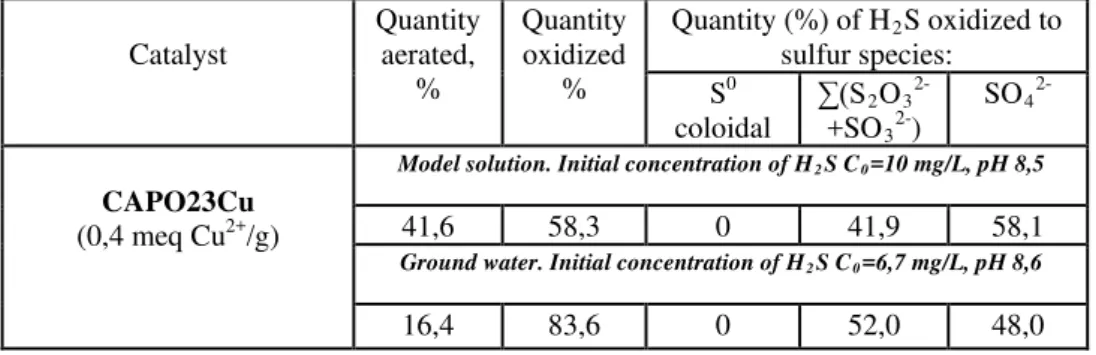
Figure 4 shows the kinetics of hydrogen sulfide removal from model solution (with concentration and pH appropriate to natural conditions) and from sulfurous ground waters (Hincesti, RM). Generally, the kinetics of these processes is the same in the presence of catalyst CAPO23Cu. To be mentioned that in both cases the colloidal sulfur has not been registered (Table 4). Therefore, this catalyst can be used for a long time, keeping the pores unblocked, and may be recommended for practical usage for hydrogen sulfide removal from groundwater.
Fig. 4 Kinetics of the hydrogen sulfide removal (R, %) in the presence of CAPO23Cu from: (1)-model solution
(C0=10 mg/L, pH 8,5); (2)-sulfurous
ground water (C0=6,7 mg/L, pH 8,6).
0 20 40 60 80
0 20 40 60 80 100
R, %
Table 4. Quantity of H2S aerated and oxidized to sulfur species in the presence of
CAPO23Cu (ratio mgO2/mgH2S = ¾, solid/liquid ratio of 1:800)
Catalyst Quantity aerated, %
Quantity oxidized
%
Quantity (%) of H2S oxidized to
sulfur species: S0
coloidal ∑(S2O3
2-+SO32-)
SO4
2-CAPO23Cu
(0,4 meq Cu2+/g)
Model solution. Initial concentration of H2S C0=10 mg/L, pH 8,5
41,6 58,3 0 41,9 58,1
Ground water. Initial concentration of H2S C0=6,7 mg/L, pH 8,6
16,4 83,6 0 52,0 48,0
3.2. Removal of nitrite ions
3.2.1. Removal of nitrite ions from model solutions
Comparative analysis emphasizes high capacity for removal of nitrite ions by carbonaceous adsorbents obtained from plum and peach stones, modified with iron ions (CAPO23Fe, CAPrO36Fe), also obtained from nut shells by chemical method with phosphoric acid (CAN-7) (Fig. 5). Generally, catalytic activity of these adsorbents is comparable and reaction rate is as CAPO23Fe
≈CAPrO36Fe≈CAN-7.
There are certain differences for active carbons obtained by chemical method of activation (CAN-7, CAPr-1) used for oxidation of nitrite ions. Although, both adsorbents have a good developed surface chemistry, sample CAN-7 posses a higher capacity for nitrite ions oxidation, for about 2 times, in comparison with CAPr-1 (Table 2, Fig. 5). There are certain differences concerning surface chemistry of these samples. Active carbons CAN-7 possess much stronger carboxyl functional groups than CAPr-1. Carboxyl functional groups for CAN-7 are characterized by values of pKa 4,5-4,7 while for CAPr-1 such values constitute
5,5-6,0 (Nastas et al., 2008; Rusu et al., 2007). The results (Fig. 5) show much smaller capacities for carbonaceous adsorbents obtained from plum stones by physical-chemical method (CAP-7, CAP-8) and for nitrogen enriched samples, obtained from nut shells (CAN-400, CAN-500, CAN-600, CAN-700, CAN-800). These active carbons contain predominantly basic functional groups (Table 2).
3.2.2. Removal of nitrite ions from ground water
obtained by chemical activation for water treatment with purpose for nitrite ions removal from natural waters.
Fig. 5 Relativecapacity (R.C., %) of carbonaceous
adsorbents to remove nitrite ions from solutions
Fig. 6 Kinetics of the nitrite ions removal (R, %) in the presence of CAN-7 (carbonaceous adsorbent obtained from nut shells by chemical method of activation) from: (1)-model solution
(C0=10 mg/L, pH 7,0); (2)- ground water
(Chisinau, R.M., C0=12,6 mg/L, pH 5,9).
4. CONCLUSIONS
The role of the surface functional groups of carbonaceous adsorbents, their acid-basic properties, and the influence of the type of impregnated heteroatoms (N, O,) or metals (Fe, Cu, Ni,) on removal of hydrogen sulfide species and nitrite ions have been researched.
The effects of surface modification of carbonaceous adsorbents towards the catalytic processes of hydrogen sulfide species oxidation were pointed out. The efficiency of the catalyst obtained from peach stones by impregnation with Cu2+
ions of oxidized active carbon was established, being recommended for practical purposes to remove the hydrogen sulfide species from the sulfurous underground waters. 0 10 20 30 40 50 60 70 80 90 100 R.C., % CA
Pr36CAPrO36CAPrO36 Fe CA
P23CAPO 23 CA PO 23F e CA N-7 CA
Pr-1CA P-7
CA P-8
CA in itia l CA N4 00 CA N5 00 CA N6 00 CA N7 00 CA N8 00
0 2 4 6 8 10
Comparative analysis of carbonaceous adsorbents reveals the importance of surface chemistry for oxidation of nitrite ions. Data demonstrate efficiency of the catalyst obtained from nut shells by chemical activation, being recommended for practical purposes to remove nitrite ions from natural waters.
REFERENCES
1. Garaba V. (2005) Problems of water supply in rural localities. Environment 19,
19-22. (in Romanian)
2. Lupascu T. (2004), Carbonaceous adsorbents from vegetal raw material. Stiinta,
Chisinau. (in Romanian)
3. Lupascu T., Petukhova G., Nastas R., Polyakov N. (2006) Pore structure and adsorption properties of stone active carbons prepared by physicochemical and chemical activation methods. Russian Chemical Bulletin, International Edition, Vol. 55, No. 5, 770-774.
4. Lupascu T., Nastas R. (2004) Procedure for obtaining of active carbons from vegetal raw materials and phosphates as supplement. Patent MD 2496.
5. Maroto-Valer M.M., Dranca I., Lupascu T., Nastas R. (2004) Effect of adsorbate polarity on thermodesorption profiles from oxidized and metal-impregnated activated carbons. Carbon, 42, 2655-2659.
6. Maroto-Valer M.M., Dranca I., Clifford D., Lupascu T., Nastas R., Leon y Leon C.A. (2004), Thermal regeneration of activated carbons saturated with ortho- and meta-chlorophenols, Thermochimica Acta 444, 32–40.
7. Marsh H., Rodríguez-Reinoso F. (2006), Activated Carbon. Elsevier, London.
8. Mirza C. (2005), Fresh water of Republic of Moldova. Environment 19, 26-27. (in
Romanian)
9. Nastas R., Tcaci M., Rusu V., Lupascu T. (2007), Synthesis of nitrogen enriched carbonaceous adsorbents. SIMI-2007, Bucharest, 127-132. (in Romanian)
10. Nastas R., Rusu V., Giurginca M., Meghea A., Lupascu T. (2008), Chemical structure modification of vegetal active carbons surface. Rev. Chim. (Bucharest)
59, 2, 159-164. (in Romanian)
11. Nastas R. (2006) Specific surface properties of carbonaceous adsorbents.
Dissertation, Institute of Chemistry of Academy of Sciences of Moldova.
12. Rodríguez-Reinoso F. (1998), The role of carbon materials in heterogeneous catalysis. Carbon36, 159–175.
13. Rusu V., Nastas R., Giurginca G., Meghea A., Lupascu T. (2007), Surface chemistry of carbonaceous adsorbents. SIMI-2007, Bucharest, 140-145.
14. Rusu V., Nastas R., Tcaci M., Postolachi L., Lupascu T. (2010) Chemical modification of mineral and carbonaceous adsorbents and testing for the elimination of hydrogen sulfide from solutions. International Symposium “Modern
problems of surface chemistry and physics”, 18-21 May, Kiev, Ukraine, 422-423. 15. Tcaci M., Himcinschi C., Nastas R., Petuhov O., Lupascu T., Zahn DRT. (2011)
Non-destructive characterization of modified activated carbon. Rev Chim (Bucharest) 62,727-731.
16. *** (2007) State of the Environment Report – 2006. Nova Imprim SRL,Chisinau.
17. *** (1995) Standard Methods for the Examination of Water and Wastewater.