THE ELUSIVENESS OF
LEARNER-CENTRED TEACHING
Ervin Kovačević1 and Azamat Akbarov2
1
International University of Sarajevo 1
Sarajevo, Bosnia and Herzegovina 2
International Burch University 2
Sarajevo, Bosnia and Herzegovina
2
DOI: 10.7906/indecs.14.2.10 2
Regular article
Received: 10 February 2016.
Accepted: 7 March 2016.
ABSTRACT
This research will explore teaching styles of university professors. Teaching style is an umbrella term for teaching decisions made during the entire teaching process – planning, delivery, and evaluation. Contemporary university teachers are advised to adopt the learner-centred teaching style which is assumed to produce remarkable possibilities. In the Fall Semester 2015 fifty-two respondents in different faculties of International University of Sarajevo were surveyed using The Principles of Adult Learning Scale inventory designed by Gary J. Conti. Inventory scores were calculated according to guidelines suggested by the author of the inventory. The scores revealed that majority of respondents strongly supported teacher-centred rather than learner-centred styles of instruction. Scores were analysed on gender lines and across three different faculties, namely: Arts and Social Sciences; Business and Administration; Engineering and Natural Sciences. In all five groups none of the seven teaching style indicators was found to conform with the learner-centred teaching criteria. There was no statistically
significant difference between the two genders’ preference for a teaching style. And there was no
statistically significant difference between teaching style preference across the three different faculties.The results of this research imply that the learner-centred style of instruction is not frequently implemented. Secondly, the results indicate that the requirements necessary for proper application of the learner-centred teaching style are not easy to meet in current written and unwritten norms. Finally, the results show that traditional teaching styles, which have been preserved in different scientific fields, still predominate in universities.
KEY WORDS
teaching styles, learner-centred, higher education, PALS
CLASSIFICATION
INTRODUCTION
High Level Group for the Modernisation of Higher Education, which was invited by the 2010-2014 European Commissioner for Education, Culture, Multilingualism and Youth “to
set out recommendations on enhancing higher education” [1], recommends the adoption of
the learner-centred instruction model. They also recommend in-service teacher training. Nevertheless there is a risk that if such training is not carefully designed, it may inadvertently employ teacher-centred instruction, which would have the effect of paradoxically undermining the philosophical basis of the learner-centred teaching model.
The principal aim of this research is to test the assumption that university professors still display traditional teaching styles and whether any of the seven factors (see PALS further in the text) that define their teaching styles are in fact learner-centred. Finally the paper will compare university professors’ teaching styles across gender and faculty types.
THEORETICAL FRAMEWORK
Teachers’ beliefs about education help teachers choose instructional content, set teaching objectives, develop instructional materials, engage in interaction with learners, and evaluate overall outcomes of both teaching and learning processes. These educational beliefs, which constitute frameworks by which teachers as individuals of varied backgrounds reflect on their behaviours, are described with the phenomenon of personal educational philosophy [2].
However, while the teachers’ beliefs about what they do and their beliefs about what should
be done are explained with the term of personal educational philosophy, what they actually do in their teaching settings is defined by the concept of teaching style –“the distinct qualities displayed by a teacher that are persistent from situation to situation regardless of the content” [3; p.76]. Conti [3] distinguishes between teacher-centred and learner-centred teaching styles. Teacher-centred styles are driven by the assumption that learner is naturally passive and is turned active after being stimulated to do so. The aim in the end of the stimulation is a ‘desired
behaviour’. Thus the teacher is engaged in designing an atmosphere where desired
behaviours are stimulated and the undesired behaviours are discouraged. Conti states that this approach to learning assumes that “motivation arises either from basic organic drives and emotions or from a tendency to respond in accordance with prior conditioning” [3; p.77]. Consequently, behavioural objectives are set and measured by criterion- or norm-referenced approaches, and outcomes are described “as competencies which the student must display after completing the educational activity” [3; pp.77-78].
On the other hand, learner-centred styles are driven by the assumption that every learner has an unlimited potential for personal growth. Therefore, personal perceptions define the desired behaviour. Motivation is a result of “people’s attempts to achieve and maintain order in their lives” [3; p.78]. The learner’s experience is of great importance and the learner is responsible for her/his own actions. The outcomes are measured by self-evaluation, which should be followed by
“constructive feedback from the teacher and other learners” [3; p.78]. There is always present
an attempt to match content and manner of presenting it with the learner and her/his needs.
The question of what style university teachers should adopt in the classroom is highly difficult to answer because personal educational philosophies vary. Mocinic [4] surveyed three hundred and sixty students of the University of Pula and concluded that “the method of
lecturing is the dominant one […] but with a frequent use of guided conversations and
discussions” [4; p.97]. The results imply university teachers’ tendencies to mainly adopt the teacher-centred rather than the learner-centred style.
knowledge is a product of the self–awareness resulting from critical reflection and critical self–reflection. According to Mezirow, the desired ‘transformation’ or learning is a personal process, and it is the learner who is the agent of change. The context or a situation is just a stimulator of a certain capacity. This way of reasoning strongly facilitates the learner-centred model of education since it prescribes a very active role to the learner in the process of transformation of values, assumptions, and convictions.
Like Mezirow, Jarvis [6] also attaches great importance to the phenomenon of experience and its potential follow up. Qualifying reflective learning as superior to other types of learning, Jarvis places importance on an experience and a route an individual follows afterwards. According to his model, a successful learning requires reflection which then upgrades learner’s biography, “all that a person is at a particular point in time” [6; p.284], and directs reactions in subsequent situations.
Cross [7] defines learners by their personal and situational characteristics. While personal characteristics comprise physical, psychological, and sociocultural dimensions, which are continua and reflect growth and development from childhood into adult life, situational characteristics focus on variables unique to adult participants; for instance, whether it is part-time or full-time learning, or whether it is voluntary or compulsory participation. It might be considered as incorporating aging, stage, and phase developmental studies, participation learning projects, and motivation. As Mezirow and Jarvis do, Cross also
attempts to explain that attitudes towards learning are being affected by contextual sets of factors which reveal rather dynamic forms. While a person acts on an environment through decisions and choices, the environment acts back by offering or not offering the chance for transformation of certain personal aspects.
According to the Knowles’ model [8] the learner enters the instructional process with a set of physical and psychosocial characteristics which may or may not be matched. In other words, such learner may be both empowered and depowered through either andragogical or pedagogical approaches. The learner’s experience or inexperience is of utmost importance and as such is a powerful stakeholder in the learning process. Furthermore, the learner’s self -awareness of the amount and kind of experience which is applicable or inapplicable in a learning situation is as powerful stakeholder as experience itself.
Mezirow, Jarvis, Cross, and Knowles identified relationships between learners’ personal and situational characteristics; consequences of learners’ decisions to reflect or not on learning experiences; and ongoing interrelations between personal skills, knowledge and attitudes which might be contextually restrained and fostered. Their reasoning is at the heart of learner-centred educational philosophy and allows researchers to identify learner-focused characteristics as a reference point in curricula writing tasks.
PRINCIPLES OF ADULT LEARNING SCALE
Conti developed the Principles of Adult Learning Scale (PALS) inventory in which he identified seven factors of which a teaching style is comprised [3; pp.79-91]:
Learner-centred Activities,
Personalizing Instruction,
Relating to Experience,
Assessing Student Needs,
Climate Building,
Participation in the Learning Process,
The presence or absence of Learner-centred Activities in a classroom might be used as one of
the indicators defining a teacher’s teaching style. For example, the teacher who always uses
disciplinary action when needed, encourages students to adopt middle class values, determines the educational objectives for students her/himself, plans units which differ as widely as
possible from the students’ socio-economic backgrounds, gets students to motivate themselves
by confronting them in front of their classmates, uses one basic teaching method because she/he has found that most adults have a similar style of learning, uses written tests to measure the degree of academic growth, uses formal tests as her/his chief method of evaluating the students, uses methods that foster quiet, productive desk work, and uses materials that were originally designed for students in elementary and secondary schools, is teaching in the highly teacher-centred mode. The opposite preferences indicate a learner-centred orientation.
Personalizing Instruction is a factor that measures the extent to which the learning process is
personalised in order to meet the needs of each student. A learner-oriented teaching style lets the lesson and process of learning pace itself – older students are allowed more time to complete the tasks when they need it. Different techniques depending on the students being taught are used. In opposite, a teacher-oriented teaching style favours lecturing and does not base objectives on individual motives and abilities. The same assignments on a given topic are given to all the students and competition is encouraged.
Relating to Experience is the third factor defining the educator’s style. If an educator takes into account a learner’s prior experience and tries to make the learner relate new learning experiences to the prior ones, she/he is practicing a learner-centred approach. Learner-centred
teaching also stimulates learner’s independence in the learning process and organizes
learning tasks in the way they could be encountered in everyday life. If all of these above are absent in the teaching style, the style is teacher-centred.
The way of Assessing Student Needs is the fourth indicator of one’s teaching style. If an educator counsels their students informally, takes into account the learners’ goals and helps them see the gaps between their goals and the current performance, and if she/he helps them develop both short-range and long-range objectives, her/his teaching style bears the learner-centred characteristics. If not, then the teacher adopts the teacher-oriented style.
The teaching style might also be defined by Climate Building in an educational setting. If the teacher fosters development of a friendly and informal atmosphere in a classroom and dialogue among the students, if she/he accepts errors as a natural part of the learning process and stimulates risk-taking which will help students explore and develop their interpersonal skills, if the failure is used as a feedback in the learning to come, the teacher possesses a learner-centred teaching style. If the opposite is practiced, the teacher is teacher-oriented.
Participation in the Learning Process is the sixth factor in defining the type of teaching style.
This concept identifies if teacher provides a chance to learners to participate in developing the criteria for evaluating their performance in class. It also asks if the teacher arranges the classroom in the way that students could easily communicate, if students can participate in making decisions about the topics to be covered and whether they are allowed to identify their own problems to be solved. If answers to all the questions asked are positive, the respondent has a highly learner-centred teaching style. If answers to all the questions are negative, then the respondent favours teacher-oriented approach to teaching.
aimed and if to do so flexibility is maintained through the process, the style under the scope is the one of learner-centred nature.
Oslund [9] conducted a meta-analysis of dissertations that utilized the PALS instrument. He
analysed “fifty-five dissertations [...] with nearly 5 300 subjects” [9; p.x]. Oslund classified
the dissertations as “(a) four-year colleges; (b) two-year colleges; [and] (c) other educators”
and found that the “PALS composite mean was statistically significant for each group, and within one standard deviation of the norm mean (M = 146) [which categorises them as] intermediate teacher-centred” [9; p.x].
Ahmed [10] surveyed twenty-two university instructors at the Midwestern University utilizing the PALS. The respondents were “teaching graduate classes at the Department of Educational Leadership, the Department of Educational Studies, the Department of Special Education, and the Department of Elementary Education” [10; p.25]. The study results show that the respondents adopted both the teacher- and learner-centred instructional practices with the overall mean score of 144,55 (SD = 16,62). Ahmed found no significant relationship “between the instructor’s age and his/her teaching style [… and] between the instructor’s teaching style and the overall years of teaching experience or the teaching experience at the Midwestern University” [10; p.22].
METHOD
Fifty-two (N = 52) university teachers employed at International University of Sarajevo were surveyed with the Principles of Adult Learning Scale (PALS) designed by Conti [3]. The responses were scored according to guidelines provided by the survey author. The scores were compared across the respondents’ genders and faculties.
RESEARCH QUESTIONS
RQ1: What are the teaching style preferences of International University of Sarajevo instructors as measured by the Principles of Adult Learning Scale (PALS) inventory?
RQ2: Is there any difference in teaching style preferences between female and male respondents?
RQ3: Is there any difference in teaching style preferences across the faculties of Arts and Social Sciences (FASS); Business and Administration (FEBA); and Engineering and Natural Sciences (FENS)?
PARTICIPANTS
Forty-four of the participants (N = 44) were Bosnians and eight of them (N = 8) were foreigners. Twenty-six (N = 26) females and twenty-six (N = 26) males participated in the study. Thirteen of them (N = 13) taught at the Faculty of Arts and Social Sciences (FASS), eleven of them (N = 11) taught at the Faculty of Business and Administration (FEBA), and twenty-eight of them (N = 28) taught at the Faculty of Engineering and Natural Sciences (FENS).
INSTRUMENT
The Principles of Adult Learning Scale (PALS) is composed of forty-four Likert-type items which elicit six answers: Always, Almost Always, Often, Seldom, Almost Never, and Never.
The instrument places a respondent’s teaching style on a continuum between extreme
teacher- and extreme learner-centred teaching style poles. The survey items are in the form of statements describing teaching actions such as I arrange the classroom so that it is easy for
students to interact or I use different techniques depending on the students being taught.
DATA ANALYSIS
Conti [3] provided scoring guidelines for his instrument. Scoring involves converting the values for the positive items and then summing the values of the responses to all items. Scores may range from 0 to 220. The average for PALS is 146 with a standard deviation of
20. Respondent’s overall teaching style and the strength of respondent’s commitment to that
style can be judged by comparing the score to 146. Scores above 146 indicate a tendency toward the learner–centred mode while lower scores imply support of the teacher–centred approach. Most scores are expected to be within one standard deviation of the mean; that is, they are expected to be between 126 and 166. Movement toward these scores indicates an increased commitment to a specific teaching style. Scores which are in the second standard deviation of 20 to 40 points indicate a very strong and consistent support of a teaching style. Scores that are in the third standard deviation and are at least 40 points from the mean indicate an extreme commitment to a style.
The overall PALS score can be analysed across seven factors (see Table 1). Each factor contains a similar group of items that make up a major component of a teaching style. High scores in each factor represent support of the learner–centred concept implied in the factor name. Low factor scores indicate support of the opposite concept. Factor scores are calculated by adding up the points for each item in the factor.
Table 1. Originally suggested reference points for classifying the factors as teacher- (if lower than the mean) or learner-centred (if higher than the mean) [3].
Factor No. Factor Name Mean Standard Deviation
1 Learner-centred Activities 38 8,3
2 Personalizing Instruction 31 6,8
3 Relating to Experience 21 4,9
4 Assessing Student Needs 14 3,6
5 Climate Building 16 3,0
6 Participation in the Learning Process 13 3,5 7 Flexibility for Personal Development 13 3,9
The scores, means, and standard deviations of the responses were calculated using SPSS 21.0 package. The same package was used for performing independent t-test and one-way ANOVA tests with which differences in means between respondents’ genders and faculties were tested. The Shapiro-Wilk’s test (p > 0,05), visual inspection of their histograms, normal
Q-Q plots and box plots showed that the teaching style scores approximated a normal distribution for both females and males across the three faculties. In addition, the assumption
of homogeneity of variances was tested and satisfied via Levene’s F test.
RESULTS
RQ1
The descriptive statistics associated with teaching style types (teacher-centred < 146 <
learner-centred) across the three teacher groups are reported in Table 2. It can be seen that
respondents regardless of the faculty background and gender strongly support the teacher-centred teaching style with arithmetic mean considerably lower than 146 (MFASS = 120,53,
MFEBA = 115,63, MFENS = 112,96, MMALE = 115,76, MFEMALE = 115,07).
RQ2
Table 2. Overall means and standard deviations of teaching style scores across respondents’ faculties and genders.
FASS
M 120,53
Teacher-centred
(<146) Male
M 115,76
Teacher-centred (<146)
N 13 N 26
SD 15,76 SD 13,77
FEBA
M 115,63
Teacher-centred
(<146) Female
M 115,07
Teacher-centred (<146)
N 11 N 26
SD 11,57 SD 15,30
FENS
M 112,96
Teacher-centred (<146)
N 28
SD 14,61
Total
M 115,42
Teacher-centred (<146)
N 52
SD 14,41
Table 3. Means and standard deviations of factors comprising teaching styles per gender.
Factor No: 1 2 3 4 5 6 7
Male
M 31,35 22,50 18,35 11,96 13,04 9,19 9,38
N 26,00 26,00 26,00 26,00 26,00 26,00 26,00
SD 5,82 5,49 4,11 2,58 2,51 2,61 3,26
Female
M 30,08 20,12 17,35 12,62 14,96 10,08 9,88
N 26,00 26,00 26,00 26,00 26,00 26,00 26,00
SD 5,77 3,94 5,46 3,88 2,68 4,22 4,23
Referring to the suggested score interpretations (see Table 1), it can be concluded that each factor’s arithmetic mean of both genders’ responses is closer to the teacher-centred pole than to the learner-centred pole.
RQ3
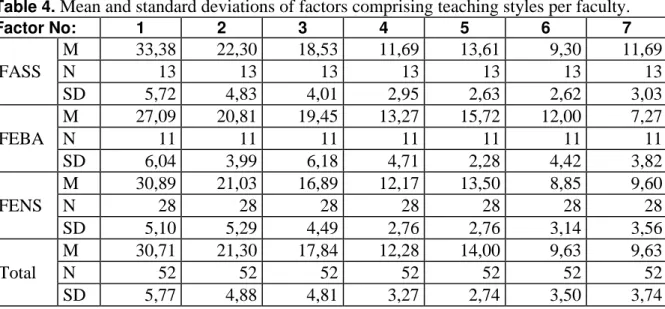
No statistically significant difference was found between the teaching styles across the three faculties as determined by the one-way ANOVA [F(2,49) = 1,24, p = 0,30]. The descriptive statistics associated with factors comprising teaching styles across the three faculties are reported in Table 4. Referring to the suggested score interpretations (see Table 1), it can be concluded that each factor’s arithmetic mean of each faculty group is closer to the teacher-centred than to the learner-teacher-centred pole.
Table 4. Mean and standard deviations of factors comprising teaching styles per faculty.
Factor No: 1 2 3 4 5 6 7
FASS
M 33,38 22,30 18,53 11,69 13,61 9,30 11,69
N 13 13 13 13 13 13 13
SD 5,72 4,83 4,01 2,95 2,63 2,62 3,03
FEBA
M 27,09 20,81 19,45 13,27 15,72 12,00 7,27
N 11 11 11 11 11 11 11
SD 6,04 3,99 6,18 4,71 2,28 4,42 3,82
FENS
M 30,89 21,03 16,89 12,17 13,50 8,85 9,60
N 28 28 28 28 28 28 28
SD 5,10 5,29 4,49 2,76 2,76 3,14 3,56
Total
M 30,71 21,30 17,84 12,28 14,00 9,63 9,63
N 52 52 52 52 52 52 52
DISCUSSION
The findings of this study are partly aligned with the findings reported by Mocinic [4] and Oslund [9] who found that university teaching is predominately based on the transmission model where the teacher is the active source of information and the student a passive recipient. Mocinic [4] and Ahmed [10] reported cases of non-traditional teaching techniques as well. This research also indicates that some university professors do not fully conform to the traditional teaching approaches. The arithmetic means of the scores presented in Table 2, 3 and 4 indicate that the respondents support teacher-centred ways. However, the analysis of their individual scores reveals the range between 82 (very strong teacher-centred style) and 150 (a weak learner-centred style) (Figure 1). Two out of fifty-two respondents scored higher than 146 points in the survey. Twelve of them scored between 126 and 146 points. And this
shows that some respondents’ have tendencies to balance their teaching styles. Therefore, it
may be concluded that while the learner-centred teaching style is possible it is not often adopted by university teaching staff.
The interpretation of the results does not present a positive view in relation to the adoption of learner-centred instruction in university teaching. The results clearly reveal a strong teacher-centred method of instruction, which is independent of gender and scientific field background. The reasons for the elusiveness of the learner-centred teaching style may lie in understanding of the required conditions for learner-centred instruction.
One way to promote a learner-centred style may be the inclusion of instructional activities that meet the individual needs of every learner profile into a curriculum. This would require careful diagnosis of learner needs. The corollary is flexible approaches to curricula writing, assessment, and instructional material design. It is recognised, however, that where instructors are teaching several courses to different groups of students, the task of a thorough needs analysis would not be feasible. In such cases flexible curricula could not be designed and formal assessment methods were inevitable.
Nevertheless some of the requirements for the learner-centred instruction style can be met if we assume the instructor is not the only source of information. Modern technology has made knowledge quite accessible. Yet the classroom time planning becomes a challenge if lecturing is completely abandoned because students expect teachers to be a source of knowledge [11, 12]. In addition, allocating time for individual student instruction during a lesson could lead to neglecting learning needs of other students. Advising instructors to focus their attention on particular students has been used as a remedy to treat random and unpredictable learners’ needs.
An effective learner-oriented teaching style should allow the learning process to pace itself. However, this is not always possible because undergraduate university programs are subject to institutional, national, and international regulations. Consequently, the number of lessons per semester, exam dates, and learning outcomes are often set before an instructor starts the instructional process. And where a student is not ready for a test and elects not to take it, she/he will fail. Hence most university instruction is pushed towards the teacher-centred pole by higher-education stakeholders because it is easier to administer.
Stimulating learners’ independence will make a teaching-style more learner-centred. Yet
undergraduate university programs emphasise the need to acquire the knowledge and expertise needed in the job market. Since it is assumed that university teachers are experts in their specific fields, the prioritising of material delivery seems to be a logical choice. While research-based instruction in postgraduate programs by definition will stimulate student independence, the degree that the same type of instruction can be integrated into undergraduate programs will depend on individual learner-profiles and the number of students per course. Knowles [8] explains that every andragogue (learner-centred instructor) will behave as a pedagogue (teacher-centred instructor) if students depend on her/him.
Another factor that militates against learner-centred teaching is the lack of financial and academic resources. Facilities such as huge amphitheatres and classrooms, which often mark university settings, are not designed for learner-centred instruction. Learner-centred instruction is only fully possible in small classes. For example, Rogers [13] suggests that the number of learners per group should be somewhere between ten and twenty-five. This requirement may in the end be too costly for limited university budgets because it requires rebalancing of the students-per-teacher ratio.
But even if detailed needs analyses, flexible curricula, less formal assessment, and learning independence are difficult to integrate into contemporary university programs, this does not necessarily mean that learner-centred instruction is impossible. A friendly classroom atmosphere that stimulates life-long learning goals and fosters interpersonal skills can move instruction towards the learner-centred pole. Rearranging the traditional way of sitting, incorporating the students’ suggestions about topics to be covered and integrating their own knowledge and experiences into classroom time are also features of learner-centred style. A learners’ personal fulfilment should not be overlooked since it is a strong element that affects their overall dedication to learning. Burden advises teachers to “build and maintain [learning] group cohesiveness” defining group cohesiveness as “the extent to which the group has a sense of
identity and oneness” [14; p.232]. Two of the nine ways he suggests are engaging students in
cooperative activities and increasing the frequency of interaction. By fostering collaboration,
the teacher improves the quality of teaching climate. According to Underwood [15] a happy, purposeful, and supporting atmosphere could be achieved by including every student in some way
during each lesson and providing opportunities for the students to talk and listen to each other.
is resourced, delivered and taken up […] But many universities are not yet ready for this
change” [1; p.4]. Vassiliou concludes that there is a lack of national and institutional
strategies which could increase dependence on technologically advanced tools and invites “The High Level Group for the Modernisation of Higher Education to set out recommendations on enhancing higher education through new technologies.” Their subsequent report states the following [1; pp.18-19]: Students are unique, and so is the way they learn. Therefore, the
teaching tools used in universities and colleges should cater for individual ways of learning, with the student at the centre […]This connects very strongly with the Group’s last report, which focused on enhancing the quality of teaching and learning in higher education. Its recommendations called for a change in attitudes towards the teaching mission, by introducing greater professionalism in teaching, more student engagement in the learning process and better recognition of good teaching.
It is argued in the Group’s previous report that “higher education institutions need to create environments and feedback mechanisms and systems to allow students’ views, learning experience, and their performance to be taken into account” [16; p.28]. The following is stated in the same report [16; p.40]: The notion of student-centred learning has been around
for many years now but its implications are still not realised by many academics or, indeed, students. It is not yet widely understood – or at least, acted upon – that student-centred learning means that the teacher’s role should shift from imparting knowledge to guiding the student in his or her own learning.
Another of their recommendations is that “continuous professional education as teachers should become a requirement for teachers in the higher education sector” [16; p.31]. Calling on Zinn [2] Powell also argues that the instructors who were trained in adult learning theory are more likely to display teaching behaviours that answer the needs of adult learners [17, 18].
CONCLUSION
The results of this research show that learner-centred instruction is not widely spread among university professors because there is still a strong adherence to teacher-centred instruction. In the above discussion assumptions were made about the reasons behind these findings. It is recognised, however, that further empirically grounded research is required to fully explore the reasons for this finding.
Empirical data for this research was collected at a small private university. This is a significant factor in terms of the research results because private universities are not usually subject to the same stringent bureaucratic procedures found in the ‘bigger’ universities. Therefore it is reasonable to assume that teacher-centred educational models are still deeply embedded in teaching practice. Additionally, this research shows that the predominant teaching norms are shared across very different scientific fields. Indeed it is significant that very similar teaching styles are evident in both the social and natural sciences. It is apparent that the national and international higher-education agencies should re-evaluate the ways in which they are coordinating university instruction if learner-centred model of education is to be widely adopted.
REFERENCES
[1] High Level Group on the Modernisation of Higher Education: Report to the European
Commission on New modes of learning and teaching in higher education.
Publications Office of the European Union, 2014,
http://ec.europa.eu/education/library/reports/modernisation-universities_en.pdf, [2] Zinn, L.M.: Exploring your philosophical orientation.
[3] Conti, G.J.: Identifying your teaching style.
In: Galbraith, M.W., ed.: Adult learning methods: A guide for effective instruction. Krieger Publishing Company, pp.75-91, 2004,
[4] Mocinic, S.: Active teaching strategies in higher education. Metodicki obzori 7(2012)(2), 97-105, 2012,
[5] Mezirow, J.: Transformative dimensions of adult learning. Jossey-Bass, 1991,
[6] Merriam, S.B. and Caffarella, R.S.: Learning in adulthood. Jossey-Bass, 1999,
[7] Hiemstra, R.: Three underdeveloped models of adult learning.
In: Merriam, S.B., ed.: An update on adult learning theory. New Directions for Adult and
Continuing Education, No. 57. Jossey-Bass, 1993, http://dx.doi.org/10.1002/ace.36719935706,
[8] Knowles, M.: The adult learner – a neglected species. Gulf Publishing, 1990,
[9] Oslund, L.E.: Teaching style preferences of educators: A meta-analysis. PhD. Thesis. Graduate School of Education and Psychology, Pepperdine University, 2015,
[10]Ahmed, K.A.: Teacher-centered versus learner-centered teaching style. Global Business Management 9(1), 22-34, 2013,
[11]Grasha, A.F.: Teaching with style. Alliance Publishers, 2002,
[12]Kovacevic, E.: Effective and Popular College Instructors: A Preferred Mold.
In: Mulalic, M.; Ozturk, A.S. and Boz, T., eds.: 1st International Conference on Education, Culture and Identity. International University of Sarajevo, Sarajevo, 2013,
[13]Rogers, A.: Teaching adults. Open University Press, 1996,
[14] Burden, P.R.: Classroom management and discipline. Longman, 1995,
[15] Underwood, M.: Effective class management. Longman, 1987,
[16]High Level Group on the Modernisation of Higher Education: Report to the European
Commission on Improving the quality of teaching and learning in Europe’s higher education institutions,
Publications Office of the European Union, 2013,
http://ec.europa.eu/education/library/reports/modernisation_en.pdf,
[17]Powell, L.: An exploratory study of the philosophy and teaching styles of Alabama
workforce education and entrepreneurship instructors. PhD. Thesis.
The Graduate Faculty of Auburn University, Auburn, Alabama, 2006,
[18]Kovacevic, E.: Integrity between personal educational philosophy and teaching style:
Reflective practice.
![Table 1. Originally suggested reference points for classifying the factors as teacher- (if lower than the mean) or learner-centred (if higher than the mean) [3]](https://thumb-eu.123doks.com/thumbv2/123dok_br/16435946.196351/6.893.113.775.491.716/originally-suggested-reference-classifying-factors-teacher-learner-centred.webp)