c e p sJournal | Vol.1 | No3| Year 2011 11
Regional Educational Performance Patterns in Europe
Péter Radó1
• he paper aims to contribute to the assessment of the contextual rel-evance of various educational policies through an analysis of three as-pects of the performance proiles of European countries: participation, the quality of learning outcomes and the equity of learning outcomes. Comparative analysis of international student achievement assessment surveys and statistical data reveals three European performance pat-terns: the compensative education systems of North and Northwest Europe, the selective education systems of Central Europe and the at-tritional education systems of Southeast Europe. On the basis of the identiied performance patterns, the paper provides a brief outline of major trends within the Central and Southeast European regions, shares relections on the alignment of policies that it the distinct context of the two regions and ofers a conceptual framework for further comparative research.
Keywords: Central Europe, PISA, South Eastern Europe, Trends
he historical regions of Europe
Since no education system can be good or bad in comparison to itself, the only reliable way to assess the actual performance of the education of a country is international comparison. However, it happens too oten that we compare the outcomes of our system with those of other countries with rather limited relevance. he further we go for international references, the greater the contextual diferences that may reduce the validity of comparisons. herefore, digging deeper into the contextual similarities and diferences requires deter-mining the group of countries that may serve as the basis of valid comparisons.
Ater the collapse of the Soviet Union, Eastern European communist systems and the former Yugoslavia, our approach to regional division within Europe remained very much determined by political categories. We oten talked
– and still talk – about the former communist countries and the countries of the former Yugoslavia where the “common heritage” determines all aspects of life, as well as the latitude for any development. However, all sorts of economic and social changes make this approach more and more dubious; in most aspects, Estonia appears to be more similar to Sweden than to Russia, and Slovenia is more similar to Austria than to Serbia. Gradually, the “historical regions of Eu-rope” that – as the Hungarian historian Jenő Szűcs demonstrated – developed their distinct characteristics through centuries of “structural changes” are re-claiming their explanatory power (Szűcs, 1983).
Obviously, explaining social processes on the basis of common com-munist heritage is not a promising exercise anymore. Bulgaria and Romania are adjusting to the rest of the Southeast European region. Also, as the northern ex-communist countries are applying Northern European type of institutions and the diferences between Austria, the Czech Republic and Hungary are fading, Central Europe is recovering its shape. he reaggregation of the Southeast and Central European regions is very much visible in countries where the “borders” of the two larger European regions represent internal regional diferences, such as in Croatia and Romania. (his shit in approach raises an extremely exciting question for international comparative research of education: how strong are these social and cultural determinations and to what extent do they constrain the latitude of public policies?) he question to be answered by the present pa-per is: are there regional patterns in education, too? If so, what are their major characteristics?
c e p sJournal | Vol.1 | No3| Year 2011 13
Figure 1: Average reading performance of students in selected European countries. (PISA 2006-2009)2
Still, to a certain extent these overall regional performance patterns can be explained by the diferent wealth of the various countries. As the report on the PISA 2009 results suggests, there is a relationship between the performance of education systems and the money spent on education (OECD, 2010). How-ever, since we know that there is no direct causal relationship between inputs and learning outcomes, we need to dig deeper into the performance proiles of the education systems of Southeast and Central European countries.
he composition of educational performance proiles
he prevailing underlying concept of contemporary educational poli-cies is based on a great emphasis on learning outcomes. he learning outcomes based approach is the result of two parallel processes: the growing emphasis on learning and learning pathways instead of emphasising teaching and school structure (lifelong learning), and the gradual reconsideration of relevant school knowledge, that is, the growing focus on applicable knowledge: the knowledge, skills and attitudes (competencies) that enable the learner to do things in di-verse contexts (Radó, 2010/b). Due to this paradigm shit in education – and due to the increasing amount and quality of comparative student performance assessment information – we have a tendency to forget about the rather tradi-tional statistical data and indicators. However, as the overview on the following
2 his and the following igures do not include all European countries. he selection of the
countries for the igures is intended to illustrate regional patterns in a visible way; including all
pages will demonstrate, when judging the output of primary and secondary ed-ucation systems we need to incorporate both types of information and should reveal how they are interlocked.
he performance proile of education systems is composed of three equally important aspects: (1) participation and progression, (2) the quality of learning outcomes and (3) the equity of learning outcomes. What determines the key features of an education system is the interplay between these aspects (Radó, 2010/a). In relation to any of these aspects there are many indicators available that enable comparative analysis. However, since the space in the pre-sent paper is limited, only certain signals will be ofered that support the major conclusions and help to identify questions for further analysis and research. For the sake of simplicity and comparability, when outlining a brief overview of the quality and equity of learning outcomes the reading literacy results of the PISA survey will be used. (Incorporating PISA data on Mathematics and Science or the results of other international assessment surveys would not really change the overall picture.)
Participation
c e p sJournal | Vol.1 | No3| Year 2011 15
Figure 2: Upper-secondary education enrolment rates, 2006/07 and 2008/2009 school years. (percentage of population aged 15-18, ISCED 3, all programmes)
Source: TransMonee database
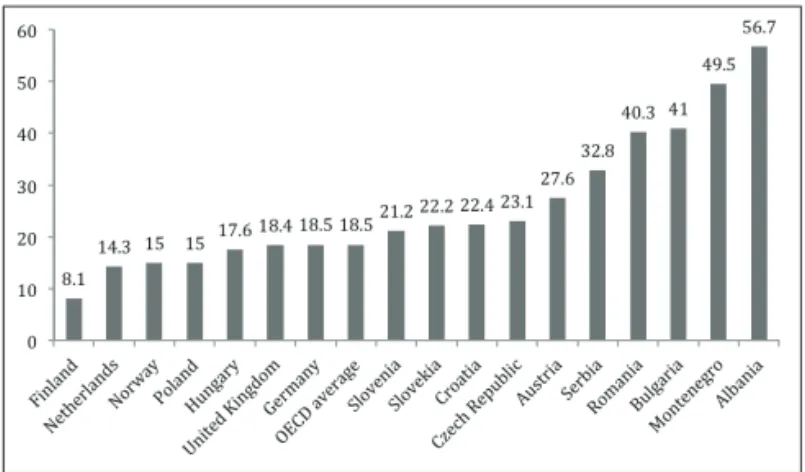
If we look at the proportion of early school leavers, which is the under-lying indicator for one of the EU’s 2020 benchmarks, it is rather salient that in this respect Central European countries are among the top performers on the continent. he relatively higher proportion of early school leavers in Austria and Hungary is the result of the high number of disadvantaged students drop-ping out from vocational training. Nevertheless, at the age of 15 the large ma-jority of children are still attending schools in all Central European countries.
Figure 3: he proportion of the population aged between 18 and 24 years without completed upper secondary education and not undertaking education in selected European countries. (2009)
he quality of learning outcomes
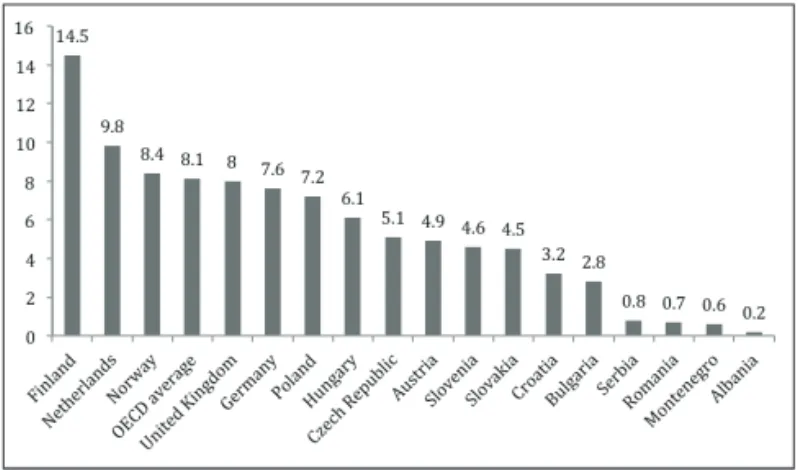
Data regarding the national average literacy results have already been presented in the introductory part of this paper. What is important to add here is the fact that national averages do not hide any serious deviations from the re-gional performance patterns highlighted earlier. For example, if we look at the proportion of extremely poorly performing (in fact, functionally illiterate) stu-dents we still see two clearly distinct groups: that of Central European countries below the OECD average and the group of Balkan countries with extremely high failure rates. (he only exception from the regional pattern is Hungary, which has fewer failing students.)
Figure 4: he proportion of students performing at level 1 or below in reading in selected European countries. (PISA 2009)
c e p sJournal | Vol.1 | No3| Year 2011 17
Figure 5: he proportion of students performing at level 5 or above in reading in selected European countries. (PISA 2009)
Figure 6: Calculated reading performance ater removing the impact of diferent student backgrounds in selected European countries. (PISA 2009)
Equity of learning outcomes
When describing the equity of learning outcomes we need to turn to two basic characteristics of primary and secondary education systems: the strength of the aforementioned impact of student background on learning outcomes and the strength of selectivity within an education system.
c e p sJournal | Vol.1 | No3| Year 2011 19
Figure 7: he impact of student background on learning outcomes (ESCS impact in score points) in selected European countries. (PISA 2009)
he other aspect of equity to be looked at is the extent to which these education systems are selective. In selective education systems there is strong pressure to separate all children who may cause diiculties in the teaching-learning process. As a result, in these systems there is a tendency to create ho-mogeneous classrooms for both advantaged and disadvantaged students. As various analyses have shown, average achievement levels are signiicantly high-er in hethigh-erogeneous classrooms than in homogeneous classrooms. hhigh-erefore, selection reduces the average performance of those children who are separated or segregated.
Figure 8: Selectivity of education systems (the proportion of variance explained by diferences between schools) in selected European countries. (PISA 2009)
Regional performance patterns
Ater reviewing some indicators regarding the three aspects that com-pose the performance proile of the primary and secondary education systems, we can assume with a high probability that there are distinct regional perfor-mance patterns. Moreover, we may attempt to summarise the key character-istics of the three regional patterns that will allow us to assess changes within individual countries against their respective regional references.
Characteristics of the three regional performance patterns
On the basis of the reviewed participation, quality and equity indica-tors, as well as on the basis of the interplay between them, we can identify three performance patterns along the Northwest – Southeast axis of Europe. hese patterns are: (1) the compensative education systems of North and Northwest European countries, (2) the selective education systems of Central European countries, and (3) the attritional education systems of the Southeast Europe-an region (Radó, 2010/a). he key characteristics of the three patterns are the following:
• Compensative education systems:
– Almost universal secondary completion
– Above OECD average quality of learning outcomes
c e p sJournal | Vol.1 | No3| Year 2011 21
• Selective education systems:
– Almost universal secondary completion
– Below OECD average quality of learning outcomes
– Low level of equity of learning outcomes (high impact of back-ground and very strong selection)
• Attritional education systems:
– High dropout in primary education
– Relatively poor quality of learning outcomes
– Average equity at secondary level
In short, the relative inability of schools in Central European countries to compensate for the impact of various disadvantages – combined with rela-tively high quality and high participation – results in very strong selectivity, that is, the streaming of students with diferent backgrounds into diferent tracks of education. he country where the education system represents the most ex-treme version of the Central European pattern is Hungary. On the one hand, ater removing the impact of student background, the quality of learning out-comes in Hungary is signiicantly higher, while, on the other hand, schools are unable to compensate for disadvantages and the level of selection is extremely high. Since inequities impose greater downward pressure on the performance of the system in Hungary than in any of the other Central European countries, the average PISA results are not signiicantly higher than in the other countries of the region.
In comparison to Central European countries, the lower quality and weaker compensatory capacity in Southeast European countries leads to very high primary education dropout, especially among the most vulnerable student groups, such as the Roma. he example of Bulgaria, which in many respects sticks out from the regional pattern, is very instructive. Bulgaria is more suc-cessful in terms of enrolling and retaining children in formal schooling, but the quality of education at the age when PISA measures the competencies of students is no diferent from other countries in its own region. herefore, the impact of student background on learning outcomes is the highest in all of Europe. As the 2006 PIRLS results suggest, the relative success of Bulgaria re-garding participation is not independent of the fact that the quality of the irst years of education is higher than in the rest of the Balkan region (PIRLS, 2006.)
A closer look at Central Europe
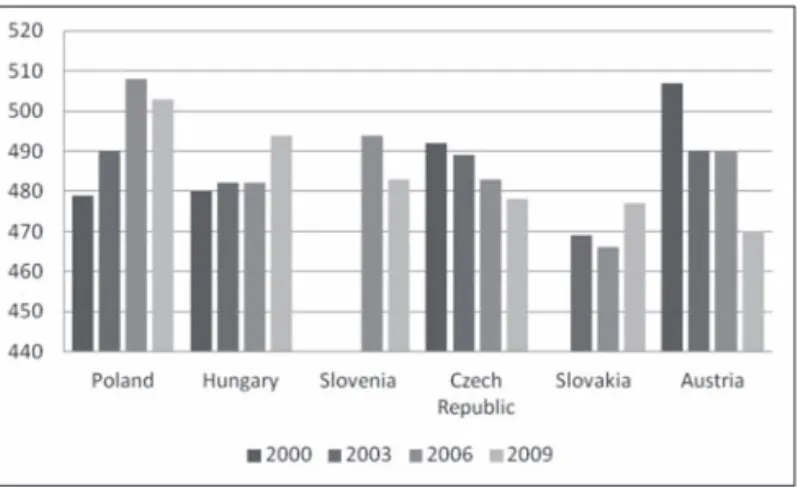
Although the Central European performance pattern was maintained in all of the four consecutive PISA surveys, there was a remarkable redistribution of positions within the region. In the former top performer countries (Aus-tria and the Czech Republic), the reading competencies of students declined throughout the entire decade (the decline in the Czech Republic was more persistent, but the decline in Austria was more dramatic). In contrast, reading competencies improved in Hungary and Slovakia to a signiicant extent (the improvement in Hungary is comparable to that in Poland, which is Europe’s development champion.)
Figure 9: Average reading performance of students in Central European countries. (PISA 2000-2009)
c e p sJournal | Vol.1 | No3| Year 2011 23
Figure 10: he proportion of students performing at level 1 or below level 1 in reading in Central European countries. (PISA 2000-2009)
At the same time, the signiicant change in the quality of learning out-comes did not result in signiicant changes in terms of equity. herefore, the basic feature of the performance proile of Central European education systems remained the same: a gap between quality and equity.
A closer look at Southeast Europe
41
29
27
16
-2
-5 0 5 10 15 20 25 30 35 40 45
Serbia Romania Bulgaria Montenegro Croatia
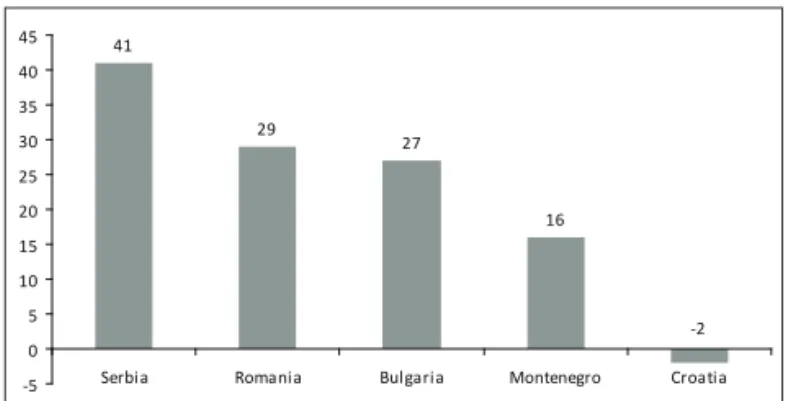
Figure 11: Change in the average reading performance of students in Southeast European countries. (PISA 2006-2009)
As in Central Europe, the major factor behind the change in overall per-formance in PISA was the decline of the proportion of failing students (in 2006, every second 15-year-old child was functionally illiterate in Serbia, Romania and Bulgaria). Again, the proportion of students with outstanding reading competencies basically remained the same.
-18.9
-13.2
-10.1
-6.8
Serbia Romania Bulgaria Montenegro
Figure 12: Change in the proportion of students performing at level 1 or below level 1 in reading in Southeast European countries. (PISA 2006-2009)
c e p sJournal | Vol.1 | No3| Year 2011 25
Bulgarian pattern – if nothing else changes, better participation indicators au-tomatically change equity indicators for the worse. here are two exceptions. he irst is Romania, where there are doubts about the reliability of the incred-ible improvement in the participation-related EU indicator (these doubts are supported by the unchanged selectivity of the Romanian system). he other example of Bulgaria, where in the last years of the previous decade – before the introduction of decentralised per capita inancing – a large scale school system rationalisation programme was implemented, with the closure of many hun-dreds of schools. he removal of surplus capacities from the system inevitably led to much weaker selectivity.
Figure 13: Selectivity: change in the proportion of variance of results explained by diferences between schools in Southeast European countries. (PISA 2006-2009)
Policy implications
he policy implications of the above outlined analysis are tremendous. All policies should target the very speciic problems of an education system. In other words: the contextual relevance of policies is essential. When govern-ments consider the improvement of the overall performance of their education systems, looking at good policy practices that have proved to be efective in im-proving average competence results somewhere else is far from being suicient. As may be obvious already, ameliorating literacy or any other competence level requires addressing the very speciic problems of the performance proile of an education system. No doubt, this calls for rather diferent policy approaches in Southeast and Central Europe.
dilemmas of countries with declining performance and with improving perfor-mance need to be raised in a diferent way. However, the common foundation for educational policies in the region lies in the fact that the underlying prob-lems are much more related to equity than to the quality of learning outcomes. Strengthening the capacity of schools to compensate for disadvantages and re-ducing selection within the school system are the key objectives that educational policies should focus on. For justiication, the Hungarian example is quite en-lightening; the heavy investment in the development of primary and secondary education between 2002 and 2008 resulted in an upgrading of quality indicators, but the gravity of serious equity-related problems remained the same.
For these purposes, it is worth looking at the skeleton of education re-form in Poland at the end of the nineties, which moved the perre-formance proile of Polish education closer to the top performing European countries in less than a decade. he Polish reform combined two basic components: (1) a school structure reform by introducing a new comprehensive school type for grades 7-9, and (2) strengthening professional accountability by introducing a per-formance standard-based school leaving examination at all of the three exit points (Jakubowski et al., 2008). he reason for regarding this policy model as applicable is the fact that it addresses the entire (mainstream) system, instead of focusing on supplementary targeted measures for speciic student groups. (Operating with supplementary measures only is an approach that has proved to be inefective in all Central European countries.)
A variation of this type of reform may well contribute to the improve-ment of the educational performance of Central European countries through improved equity of learning outcomes. Of course, there are no policy solutions that can be easily transferred from one country to another. A comparative analysis of the equity policies of Central European countries has revealed that – in spite of the very similar performance pattern of these countries – there are extreme diferences in the systemic environment of education (Radó, 2009). herefore, the “Polish reform model” needs serious adjustments to the speciic context of each country.
c e p sJournal | Vol.1 | No3| Year 2011 27
feasible is a sequential policy approach with two phases. In the medium term, a “back to basics” policy seems to be appropriate: strong emphasis on ensuring universal primary completion and secondary enrolment, as well as on strength-ening the learning foundations during the elementary phase of schooling. At a certain point, a gradual shit might occur towards policies that address growing equity problems, which will be very similar to the recent problems of Central European countries (Radó, 2010/a).
In relation to policy planning, the diiculties in Southeast Europe are much more serious, also due to the fact that all of the countries of this region operate highly centralised governance and management systems, while Central European countries have already undergone an almost complete decentralisa-tion process. One of the most striking features of centralised governance sys-tems is that they do not ofer a favourable environment for the implementation of policies of any kind. (he systemic environment of schools is much less di-verse in Southeast Europe than in the neighbouring region – highly centralised systems are much more alike than the decentralised systems.)
Towards a deeper understanding of regional patterns
Obviously, the brief comparative analysis presented on these pages only scrapes the surface of the extremely complex characteristics of the education systems of the two regions. he reasons for the similarities between the coun-tries belonging to the same regional patterns are still invisible, and revealing them requires a great deal of further research. However, there are no doubts about the added value of comparative studies, both in terms of understanding problems and of informing policy making.
Allocation of financial resurces
Governance / management
Curriculum and standards
Initial teacher training
Information system Research & Development Textbooks and teaching materials
Schools Curriculum and
standards
Quality evaluation Professional services
Demographic trends and their impact
New technologies (digital natives in the schools)
Fragmentation of learning pathways
External social pressure → highly selective school
systems
Changing expectations → weakening relevance
The systemic environment of schools
(functional governance instruments)
The economic and social environment of education
(Examples)
Figure 14: A framework for regional comparative analysis.
c e p sJournal | Vol.1 | No3| Year 2011 29
References
CEDEFOP (2008). he Shit to Learning Outcomes. Conceptual, Political and Practical Developments
in Europe.
EU Commission (2009). Progress Towards the Lisbon Objectives in Education and Training. Indicators
and Benchmarks 2009. Commission staf working document
Jakubowski, M., Patrinos, H. A., Porta, E. E., & Wisniewski, J. (2008). he Impact of the 1999
Education Reform in Poland. Retreived from http://www.eale.nl/Conference2009/Programme/
PapersC/add102407_pjtWNKQqMQ.pdf.
OECD (2010). PISA 2009 Results: What Makes a School Successful? Resources, Policies and Practices.
(Volume IV).
PIRLS 2006. International Report. IEAs Progress in International Reading Literacy Study in Primary
Schools in 40 Countries (2007). IEA.
Radó, P. (2009). Equity in Education – Synthesis Report: he Potential and Limitations of the
Learning Outcomes Based Approach. Policy-Making for Equity in Education in Austria, the Czech
Republic, Hungary, Slovakia and Slovenia. In Equity in Education. Country Notes of a Central
European Project. Tempus Public Foundation 2009.
Radó, P. (2010/a). School Failure in Serbia. Psiholoska Istrazivanja, XIII(1).
Radó, P. (2010/b). Governing Decentralized Education Systems. Systemic Change in South Eastern
Europe. Local Government and Public Service Reform Initiative. Budapest: Open Society Institute.
Szűcs, J. (1983). Vázlat Európa három történeti régiójáról. Gyorsuló idő. Budapest: Magvető Kiadó.
TransMONEE database. Monitoring the Situation of Women and Children in Central and Eastern
Europe and the Commonwealth of Independent States. Retreived form http://www.transmonee.org/.