Arq Bras Oftalmol 2001;64:333-5
Anterior capsule staining using 0.025% trypan blue in
cataracts without red reflex
Purpose: To describe the use of anterior capsule staining in cataracts without red reflex using a 0.025% trypan blue solution. Methods: Six eyes of 6 patients with cataracts without red reflex were submitted to phacoemulsification using a direct injection of 0.2 to 0.5 ml of 0.025% trypan blue in the anterior chamber previous to viscoelastic injection. All patients had an ophthalmologic examination prior to surgery, as well as pre and postoperative corneal endothelial cell count. Results: In all cases the capsule became stained with a faint blue color that enabled an adequate visibility of the flap during the continuous curvilinear anterior capsulotomy (CCC). There were no intra-or postoperative complications. The endothelial cell loss varied between 1.8% and 26.6% (mean 12.8%). Conclusion: Staining the anterior capsule with 0.025% trypan blue solution allows a good visibility of the capsular flap and facilitates the confection of CCC in cataracts without red reflex.
Uso de azul tripano a 0,025% para corar a cápsula anterior em catarata sem reflexo
Esse trabalho foi realizado no Departamento de Oftal-mologia, Escola Paulista de Medicina, Universidade Federal de São Paulo.
1Pós-graduando, nível doutorado, Departamento de Of-talmologia, Escola Paulista de Medicina, Universida-de FeUniversida-deral Universida-de São Paulo.
2Médico Colaborador do Setor de Catarata, Departamen-to de Oftalmologia, Escola Paulista de Medicina, Uni-versidade Federal de São Paulo.
3Aluna do Curso de Tecnologia Oftalmológica, Depar-tamento de Oftalmologia, Escola Paulista de Medicina, Universidade Federal de São Paulo.
4Residente do terceiro ano Departamento de Oftalmolo-gia, Escola Paulista de Medicina, Universidade Fede-ral de São Paulo.
5Professor Titular, Departamento de Oftalmologia, Esco-la Paulista de Medicina, Universidade Federal de São Paulo.
Os autores declaram que não tem interesse financeiro no desenvolvimento ou marketing dos produtos mencio-nados no texto.
Endereço para correspondência: Eduardo Ferrari Marback - Departamento de Oftalmologia-Universidade Federal de São Paulo - R. Botucatu, 822 - São Paulo (SP) CEP 04023-062. E-mail: [email protected] Eduardo Ferrari Marback1
Lincoln Lemes de Freitas2 Fernanda Pelegrino Fernandes3 Bruno Castelo Branco4
Rubens Belfort Jr.5
ABSTRACT
Keywords: Cataract; Cataract extraction; Lens capsule; Crystalline/surgery; Trypan blue/ therapeutic use; Dyes
INTRODUCTION
The continuous circular capsulotomy (CCC) that was introduced by Gimbel and Neuhann(1) in 1990 is resistant to radial tears during the various
surgical steps and also offers the advantages of in the bag intraocular lens (IOL) implantation. Another advantage of CCC is the opportunity of a safe sulcus IOL implantation over the anterior capsule rim in cases of a posterior capsule rupture. For a good control when performing a CCC, the visuali-zation of the anterior capsular flap is necessary and the lack of an adequate red reflex renders the technique very difficult.
Many techniques have been proposed to help the surgeon to perform a CCC in cataracts without red reflex(2-9).
The purpose of this report is to describe the use of 0.025% trypan blue solution to allow better anterior capsular flap visibility and a safe CCC in cataracts without red reflex. Trypan blue has classically been used to identify damaged endothelial cells and safety has been proved in donor corneal buttons(10), as well as in extracapsular cataract extraction(11).
METHODS
im-Arq Bras Oftalmol 2001;64:333-5
334 Anterior capsule staining using 0.025% trypan blue in cataracts without red reflex
plantation. The ages varied between 52 and 79 years (mean 68). All surgeries were done by the same surgeon (LLF), using the same equipment (Leggacy 20 000 - Alcon), under peribul-bar anesthesia, with a three-plane clear corneal incision, the “stop and chop”(12) technique and an implant with a 5.25 mm
optical zone.
After the ancillary paracenthesis, made in the limbus 90º away from the area where the clear cornea incision should be done, 0.2 to 0.5 ml of 0.025% trypan blue was injected in the anterior chamber, followed by filling of the anterior chamber with a viscoelastic solution, leaving the anterior capsule with a faint blue coloration. After the clear corneal incision, CCC was performed using the Ultrata forceps. The 0.025% trypan blue solution was obtained by diluting 0.1 ml of the 0.1% commercially available solution (Ophthalmos - São Paulo, Bra-zil) in 0.3 ml of balanced salt solution (BSS, Alcon). The total effective used ultrasound power was recorded for each case. At the end of surgery dexametasone and gentamicin were injected in the subconjunctival space. Patients were seen on the 1st, 6th, 30th and 40th postoperative day and received a
combination of 1 mg dexametasone, 5 mg neomicine sulfate and 6000 IU polymyxin B sulfate eyedrops (Maxitrol - Alcon) 6 times a day in the first postoperative week with gradual tapering of the dose in the following 3 weeks.
All patients had visual acuity, intraocular pressure (IOP) and anterior chamber reaction evaluated before surgery and on days 1, 6, 30 and 40. Endothelial cell count was performed prior to surgery and on day forty.
RESULTS
CCC was successfully performed in all eyes. In 2 of them it was necessary to inject more viscoelastic after the initial cap-sular puncture because of liquefied cortical material leakage. The contrast between the stained capsular flap and the white cortical material allowed a safe control of the CCC progression and the remaining anterior capsule edge was still stained du-ring phacosculpture. By the time of cortical aspiration, the faint blue coloration had disappeared from the anterior capsu-le rim. The remaining surgical steps were uneventful.
On the first postoperative day, mild corneal edema was seen in 1 eye and moderate edema in 5 eyes. By the 6th
posto-perative day the edema had vanished in all cases. There was no increase in IOP or any evidence of residual stain in the anterior segment during the postoperative period. A mild (+) cellular anterior chamber reaction was present on day 1 in the 6 eyes and had disappeared by day 6.
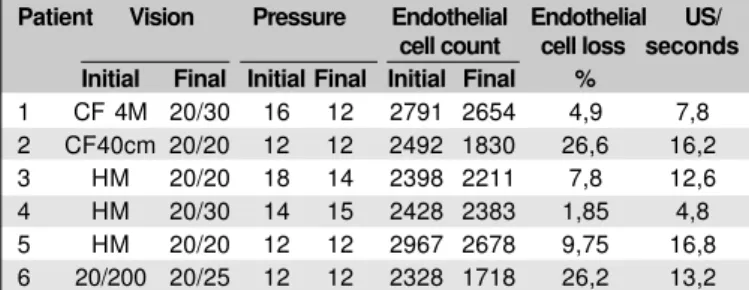
The visual acuity, IOP and endothelial cell count before surgery and on day 40 are showed in Table 1. The endothelial cell loss varied between 1.85 to 26.6% (mean of 12.8%).
DISCUSSION
Many techniques have been suggested to improve safety in CCC confection of cataracts without red reflex, such as the
use of a optic fiber endoilluminator in a lateral position(7),
endodiathermy(5), air filling of the anterior chamber(2),
two-step CCC under high magnification(3), autologous blood
im-pregnation(8) and the injection of various vital stains in the
anterior chamber like a solution of gentian violet and methy-lene blue, brilliant cresyl blue, fluorescein, trypan blue 0.1% and indocianine green(4,6,9). The endoilluminator and the
endo-diathermy imply in additional costs with sophisticated de-vices, and the endodiathermy capsulotomy is considered weaker than the traditional CCC(5). The two-step CCC involves
a change in the emulsification technique to work within a small CCC and the additional risk of a radial tear or peripheral escape during the enlargement of the primary CCC.
Among the vital stains, brilliant cresyl blue has never been used in vivo; the gentian violet and methyilene blue solutions result in corneal edema and endothelial decompen-sation(9), fluorescein must be injected underneath the anterior
capsule, staining the lens epithelium, not the capsule itself(4)
and it can stain the cornea and lens cortex also(6). Indocianine
green seems to be a good option(6), but it is expensive, not
available in a fractionated fashion, has a life span of only 8 hours after dilution and must be kept protected from light.
Trypan blue is a vital stain classically used to evaluate damaged endothelial cells, presenting no toxicity in concen-trations as high as 0.3%(11). Since it does not stain the healthy
endothelial cells, it poses no risk of lowering intraoperative visibility. The safety of intraoperative use of trypan blue in extracapsular cataract surgery has already been proved with follow-up periods up to 8 years(11).
Recently Melles et al.(9)reported the use of 0.1% trypan
blue to perform CCC in cataracts without red reflex. They advocated the use of an air bubble in the anterior chamber with injection of the stain between the air and the anterior capsule to prevent its dilution(9). We used the injection of a
0.025% solution without an air bubble in the chamber and achieved sufficient capsular staining. Injecting the dye bet-ween an air bubble and the capsule is not a easy maneuver and the size of the bubble is critical, since it can prevent the complete staining of the anterior capsule. CCC was safely
Table 1. Visual acuity, IOP and endothelial cell count in the pre-operative period and 40th postoperative day
Patient Vision Pressure Endothelial Endothelial US/ cell count cell loss seconds Initial Final Initial Final Initial Final %
1 CF 4M 20/30 16 12 2791 2654 4,9 7,8 2 CF40cm 20/20 12 12 2492 1830 26,6 16,2 3 HM 20/20 18 14 2398 2211 7,8 12,6 4 HM 20/30 14 15 2428 2383 1,85 4,8 5 HM 20/20 12 12 2967 2678 9,75 16,8 6 20/200 20/25 12 12 2328 1718 26,2 13,2
Arq Bras Oftalmol 2001;64:333-5
Anterior capsule staining using 0.025% trypan blue in cataracts without red reflex 335
performed with postoperative corneal findings similar to those usually seen in surgeries without it. Additionally, using a so-lution that is diluted starting from its original commercial presentation, without performance decay, represents a cost reduction that is an important goal of present medicine. Another possible application of capsular staining is in the training of new surgeons, since the improvement in flap visibi-lity may help to control its progression for beginners even when the cataract has a good red reflex.
ACKNOWLEDEMENT
The authors wish to thank Farmácia Ophthalmos for kindly supplying trypan blue solution to this study.
RESUMO
Objetivo: Relatar o uso de uma solução de azul tripano a 0,025% para corar a cápsula anterior em cataratas sem reflexo. Métodos: Seis olhos de 6 pacientes portadores de catarata sem reflexo foram submetidos à facoemulsificação com injeção di-reta de azul tripano a 0,025% na câmara anterior previamente à injeção de solução viscoelástica. Todos os pacientes tiveram exame oftalmológico prévio à cirurgia incluindo contagem de células endoteliais no pré-operatório e no 40ºdia pós-operató-rio. Resultados: Em todos os casos a cápsula anterior adquiriu uma tonalidade azul clara que permitiu uma boa visibilidade e controle da progressão durante a capsulotomia curvilínea contínua (CCC). Não houve complicação intra ou pós-opera-tória. A perda endotelial variou entre 1,8% e 26,6% (média 12,8%). Conclusão: O uso de azul tripano a 0,025% para corar
a cápsula anterior permite uma boa visibilidade do "flap", facilitando a confecção da CCC em cataratas sem reflexo.
Descritores: Catarata; Extração de catarata; Cápsula do cristalino; cristalino/cirurgia; Corantes; Azul tripano/uso terapêutico; Capsulotomia
REFERENCES
1. Gimbel HV, Neuhann T. Development, advantages, and methods of conti-nuous circular capsulorhexis technique. J Cataract Refract Surg 1990;16: 31-7. 2. Brusini P. Capsulorhexis in mature cataracts: Why not? Doc Ophthalmol
1992;81:281-4.
3. Gimbel HV. Two-stage capsulorhexis for endocapsular phacoemulsification. J Cataract Refract Surg 1990;16:246-9.
4. Hoffer KJ, McFarland JE. Intracameral subcapsular fluorescein staining for improved visualization during capsulorhexis in mature cataracts [letter]. J Cataract Refract Surg 1993;19:566.
5. Findl O, Amon M. Anterior capsulotomy created by radiofrequency endodia-thermy and continuous curvilinear posterior capsulorhexis in a patient with intumescent cataract and primary capsular fibrosis. J Cataract Refract Surg 1998;24:870-1.
6. Horiguchi M, Miyake K, Ohta I, Ito Y. Staining of the Lens Capsule for Circular Continuous Capsulorhexis in Eyes With White Cataract. Arch Oph-thalmol 1998;116:535-7.
7. Mansur AM. Anterior capsulorhexis in hypermature cataract [letter]. J Cataract Refract Surg 1993;19:116-7.
8. Cimetta DJ, Gatti M, Labianco G. Hemocoloration of the anterior capsule in white cataract CCC. Eur J Implant Refract Surg 1995;7:184-5.
9. Melles GR, de Waard PW, Pameyer JH, Houdijn Beekhuis W. Trypan blue capsule staining to visualize the capsulorhexis in cataract surgery. J Cataract Refract Surg 1999;25:7-9.
10. Almada AT. Coloração Vital. In: Belfort Jr R, Kara José N. Córnea. Clínica Cirúrgica. Rio de Janeiro:Roca; 1997. cap. 12.
11. Norn MS. Per operative trypan blue vital staining of corneal endothelium. Eight years’ follow up. Acta Ophthalmol (Copenh) 1980;58:550-5. 12. Koch S, Katzen LE. Stop and chop phacoemulsification. J Cataract Refract
Surg 1994;20:566-70.