BGD
11, 5869–5901, 2014Nitrate source identification in the
Baltic Sea
F. Korth et al.
Title Page
Abstract Introduction
Conclusions References
Tables Figures
◭ ◮
◭ ◮
Back Close
Full Screen / Esc
Printer-friendly Version Interactive Discussion
Discussion
P
a
per
|
D
iscussion
P
a
per
|
Discussion
P
a
per
|
Discuss
ion
P
a
per
|
Biogeosciences Discuss., 11, 5869–5901, 2014 www.biogeosciences-discuss.net/11/5869/2014/ doi:10.5194/bgd-11-5869-2014
© Author(s) 2014. CC Attribution 3.0 License.
Open Access
Biogeosciences
Discussions
This discussion paper is/has been under review for the journal Biogeosciences (BG). Please refer to the corresponding final paper in BG if available.
Nitrate source identification using its
isotopic ratios in combination with
a Bayesian isotope mixing model in the
Baltic Sea
F. Korth1,*, B. Deutsch2, C. Frey1, C. Moros1, and M. Voss1
1
Leibniz Institute for Baltic Sea Research Warnemünde, Seestr. 15, 18119 Rostock, Germany
2
Baltic Sea Centre, Stockholm University, 10691 Stockholm, Sweden
*
now at: GEOMAR Helmholtz Center for Ocean Research Kiel, Wischhofstrasse 1–3, 24148 Kiel, Germany
Received: 25 March 2014 – Accepted: 7 April 2014 – Published: 24 April 2014 Correspondence to: F. Korth ([email protected])
BGD
11, 5869–5901, 2014Nitrate source identification in the
Baltic Sea
F. Korth et al.
Title Page
Abstract Introduction
Conclusions References
Tables Figures
◭ ◮
◭ ◮
Back Close
Full Screen / Esc
Printer-friendly Version Interactive Discussion
Discussion
P
a
per
|
D
iscussion
P
a
per
|
Discussion
P
a
per
|
Discuss
ion
P
a
per
|
Abstract
Nitrate (NO−
3) is the major nutrient responsible for coastal eutrophication worldwide
and its production is related to intensive food production and fossil-fuel combustion. In the Baltic Sea NO−
3 inputs have increased four-fold over the last decades and now
remain constantly high. NO−
3 source identification is therefore an important
considera-5
tion in environmental management strategies. In this study focusing on the Baltic Sea, we used a method to estimate the proportional contributions of NO−
3 from atmospheric
deposition, N2fixation, and runofffrom pristine soils as well as from agricultural land. Our approach combines data on the dual isotopes of NO−3 (δ15N-NO−3 andδ18O-NO−3) in winter surface waters with a Bayesian isotope mixing model (Stable Isotope
Anal-10
ysis in R, SIAR). Based on data gathered from 46 sampling locations over the entire Baltic Sea, the majority of the NO−3 in the southern Baltic was shown to derive from runofffrom agricultural land (30–70 %), whereas in the northern Baltic, i.e., the Gulf of Bothnia, NO−
3 originates from nitrification in pristine soils (47–100 %). Atmospheric
deposition accounts for only a small percentage of NO−3 levels in the Baltic Sea,
ex-15
cept for contributions from northern rivers, where the levels of atmospheric NO−3 are higher. An additional important source in the central Baltic Sea is N2 fixation by dia-zotrophs, which contributes 31–62 % of the overall NO−3 pool at this site. The results obtained with this method are in good agreement with source estimates based upon
δ15N values in sediments and a three-dimensional ecosystem model, ERGOM. We
20
suggest that this approach can be easily modified to determine NO−
3 sources in other
marginal seas or larger near-coastal areas where NO−3 is abundant in winter surface waters when fractionation processes are minor.
1 Introduction
Throughout the world, anthropogenic reactive N currently exceeds natural production
25
BGD
11, 5869–5901, 2014Nitrate source identification in the
Baltic Sea
F. Korth et al.
Title Page
Abstract Introduction
Conclusions References
Tables Figures
◭ ◮
◭ ◮
Back Close
Full Screen / Esc
Printer-friendly Version Interactive Discussion
Discussion
P
a
per
|
D
iscussion
P
a
per
|
Discussion
P
a
per
|
Discuss
ion
P
a
per
|
have doubled in recent years, which has strongly impacted the marine N cycle and ecosystem health, both at regional and global scales. In coastal ecosystems, the ad-verse effects of these excess N loads include eutrophication, hypoxia, loss of biodiver-sity, and habitat destruction (Galloway et al., 2003; Villnäs et al., 2013). For the shal-low, brackish, semi-enclosed Baltic Sea, where intense anthropogenic nutrient loadings
5
have been documented since the 1950s (Elmgren, 2001), riverine and atmospheric nu-trient inputs are now at least four-fold higher than a century ago, when anthropogenic influences was low (Schernewski and Neumann, 2005; Stålnacke et al., 1999). Further-more, cyanobacterial blooms, which can fix N2, and thus add nutrients to the surface waters are regular large scale phenomenon each summer (Finni et al., 2001; Vahtera
10
et al., 2007) and the overall increase in nutrient input has supported the expansion of hypoxic zones (Conley et al., 2009, 2011).
A main component of the N pool and the one most readily available is nitrate (NO−
3)
(Nestler et al., 2011; Vitousek et al., 1997), which derives from a wide variety of sources. These can be identified by analysis of the N and oxygen (O) isotopes (δ15
N-15
NO−
3 andδ
18O-NO−
3) since the isotopic ratios of NO
−
3 from different sources fall within
distinct ranges (Kendall, 1998; Kendall et al., 2007). For example, NO−3 inputs from forested catchments can be discriminated from those coming from agricultural runoff, and the NO−
3 signature of microbial nitrification differs from that of atmospheric
de-position (Kendall, 1998; Kendall et al., 2007; Mayer et al., 2002). Source attribution
20
is, however, complicated by N-transformation processes such as denitrification, nitri-fication, and assimilation, each of which gives rise to significant isotope fractionation. Since heavier isotopes are sequestered more slowly than lighter ones, the reaction product will be isotopically depleted compared to the original NO−
3 source (Kendall,
1998). Alterations of isotope values because of microbial fractionation processes can
25
be minimized by collecting the samples in winter, when low water temperatures reduce microbial activity (Pfenning and McMahon, 1997).
BGD
11, 5869–5901, 2014Nitrate source identification in the
Baltic Sea
F. Korth et al.
Title Page
Abstract Introduction
Conclusions References
Tables Figures
◭ ◮
◭ ◮
Back Close
Full Screen / Esc
Printer-friendly Version Interactive Discussion
Discussion
P
a
per
|
D
iscussion
P
a
per
|
Discussion
P
a
per
|
Discuss
ion
P
a
per
|
Analysis in R), a Bayesian isotope mixing model originally developed to infer diet com-position from the stable isotope analysis of samples taken from consumers and their food sources (Moore and Semmens, 2008), was already successfully applied for NO−3 source identification. Xue et al. (2012, 2013) were able to estimate the proportional contributions of five potential NO−
3 sources in a small watershed in Flanders (Belgium).
5
Based on their determinations of the isotopes of nitrogen and oxygen they could show that manure and sewage were the major sources of NO−3.
The N cycle of the Baltic Sea follows the typical seasonal development of temperate oceans. Thus, the NO−3 pool present in the surface waters in spring originates from the previous growth season and is consumed during the onset of the phytoplankton
10
spring bloom, in February/March. In the central Baltic Sea, atmospheric deposition and N2 fixation are the major N sources, whereas in coastal areas riverine discharge dominates (Radtke et al., 2012; Voss et al., 2011). Yet, to what extent the various NO−3 sources add to the overall pool of NO−
3 in the Baltic as a whole is still a matter of
debate. In this study, a source attribution for four major sources is presented. Taking
15
the Baltic Sea as an example we will show, that the use of the isotopic composition of NO−
3 (δ 15
N-NO−
3 andδ 18
O-NO−
3) in combination with SIAR can be used elsewhere for
source identification on an ecosystem scale level.
2 Material and methods
2.1 Field sampling 20
Surface water samples from the Baltic Sea were collected in February 2008 (n=23) and 2009 (n=17) aboard the R/VAlkor and in November 2011 (n=1) aboard the R/V
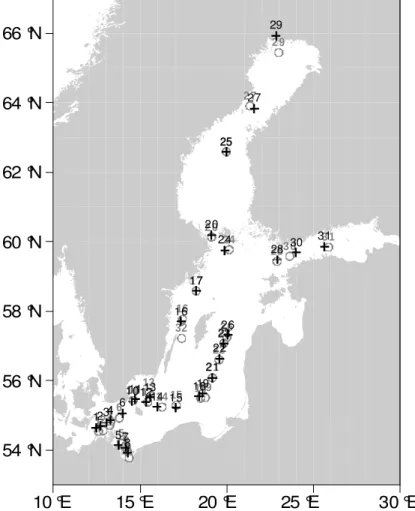
Meteorusing a Seabird CTD system with attached water bottles. Samples from the Ne-munas River (55◦18′5.5 N, 21◦22′53.9 E; 55◦41′25.6 N, 21◦7′58.4 E; n=4) and Kalix River (65◦56′4.2 N, 22◦53′9.2 E; n=1) (Fig. 1) were taken between November 2009
25
BGD
11, 5869–5901, 2014Nitrate source identification in the
Baltic Sea
F. Korth et al.
Title Page
Abstract Introduction
Conclusions References
Tables Figures
◭ ◮
◭ ◮
Back Close
Full Screen / Esc
Printer-friendly Version Interactive Discussion
Discussion
P
a
per
|
D
iscussion
P
a
per
|
Discussion
P
a
per
|
Discuss
ion
P
a
per
|
were obtained from wet deposition samples collected at three stations around the Baltic Sea: Warnemünde, Germany (54◦10′N, 12◦5′E,); Majstre, Sweden (57◦30′N,
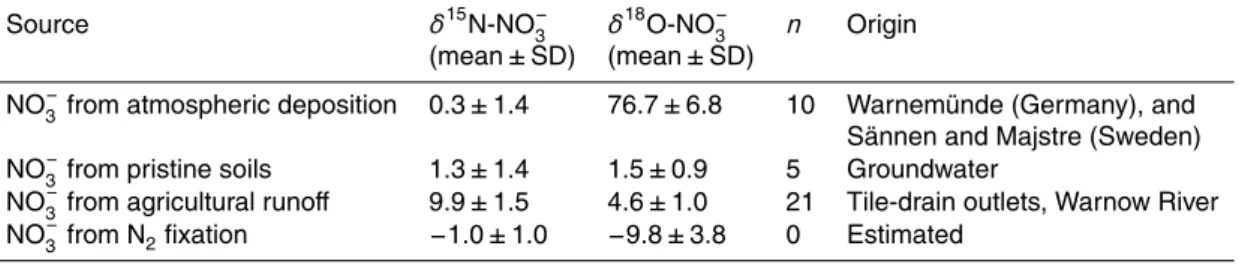
18◦31′E); and Sännen, Sweden (56◦13′N, 15◦17′E) from December 2009 until Febru-ary 2010 (Table 2). In Warnemünde, precipitation was collected on an event basis using a sampler consisting of a plastic funnel (diameter: 24 cm) connected to a 1 L
5
polyethylene bottle. At the two Swedish stations, rainwater was sampled monthly by the Swedish Environmental Research Institute (IVL) as part of the Swedish national long-term monitoring program. Here, the sampler consisted of a plastic funnel (diam-eter 20.3 cm) connected to an 8-L polyethylene bag. All samples were filtered through pre-combusted Whatman GF/F filters (4 h at 400◦C) and stored frozen until further
10
analysis.
2.2 Nutrient concentrations and dual isotope analysis of NO−
3
Samples were analyzed following a standard protocol for the determination of NO−
3 and
nitrite (NO−
2) (Grasshoff et al., 1983); the precision of the method is ±0.02 µmol L
−1.
Dual isotope analysis of NO−
3 (δ
15N-NO−
3 and δ
18O-NO−
3) was carried out using the
15
denitrifier method (Casciotti et al., 2002; Sigman et al., 2001), in which NO−3 and NO−
2 are quantitatively converted to nitrous oxide (N2O) by Pseudomonas aureofa-ciens(ATTC 13985), a bacterial strain that lacks N2O reductase activity. In brief, N2O is removed from the sample vials by purging with helium and then concentrated and purified in a GasBench II prior to analysis with a Delta Plus mass spectrometer
(Ther-20
moFinnigan). NO−
2 was not removed since its concentrations were always less than 2 %
(Casciotti et al., 2007). N and O isotope measurements of roughly 30 % of the sam-ples were replicated in separate batch analyses. Two international standards, IAEA-N3 (δ15N=4.7 ‰ vs. N2;δ18O 25.6 ‰ vs. VSMOW) and USGS 34 (δ15N−1.8 ‰ vs. N2;
δ18O−27.9 ‰ vs. VSMOW) (Böhlke et al., 2003), were measured with each batch
25
BGD
11, 5869–5901, 2014Nitrate source identification in the
Baltic Sea
F. Korth et al.
Title Page
Abstract Introduction
Conclusions References
Tables Figures
◭ ◮
◭ ◮
Back Close
Full Screen / Esc
Printer-friendly Version Interactive Discussion
Discussion
P
a
per
|
D
iscussion
P
a
per
|
Discussion
P
a
per
|
Discuss
ion
P
a
per
|
samples with concentrations>3.5 µmol L−1and 10 nmol for those with concentrations <3.5 µmol L−1. Isotope values were corrected after Sigman et al. (2009) for δ18 O-NO−
3; single point correction was referred to IAEA-N3 for δ 15
N-NO−
3. The precision
was<0.2 ‰ forδ15N and<0.6 ‰ forδ18O. Together with the samples, a culture blank was analyzed to which no sample was added. The isotope ratios are reported using
5
the delta notation in units of per mil (‰).
2.3 NO−
3 sources
To estimate the contribution of different NO−
3 sources, two isotopes δ 15
N-NO−
3 and δ18O-NO−
3 (j=2) from the four major NO−3 sources: (1) atmospheric deposition, (2)
runofffrom pristine soils, (3) runofffrom agricultural land and (4) N2 fixation were
ap-10
plied (Table 1). In this context, N2 fixation was defined as NO−3 originating from the degradation and remineralization of nitrogen fixers and therefore carried their low iso-topic signal. Thus, for NO−
3 from N2fixation,δ15N values of∼ −2 to 0 ‰ were assumed,
since N2fixation produces organic material that is only slightly N depleted against air nitrogen (Carpenter et al., 1999, 1997; Montoya et al., 2002). Theδ18O values were
15
estimated to be between−14.3 and−6.7 ‰, based on the assumption that newly pro-duced NO−3 should be 0.7–8.3 ‰ lower than theδ18O of seawater (Buchwald and Cas-ciotti, 2010), which according to Froehlich et al. (1988) is −6 ‰ for the central Baltic
Sea.
To expand the dataset, we included NO−3 isotope data from river water samples,
20
ground water samples, and samples from tile drain outlets collected in 2003 and pub-lished in Deutsch et al. (2006). In that study, the Warnow River (n=2) was sampled twice, in January and February 2003. These sources were likewise sampled in winter, since marked seasonal shifts in the isotopic composition of NO−3 can occur due to shifts in the origins of the sources (Knapp et al., 2005). Samples from tile drain outlets were
25
BGD
11, 5869–5901, 2014Nitrate source identification in the
Baltic Sea
F. Korth et al.
Title Page
Abstract Introduction
Conclusions References
Tables Figures
◭ ◮
◭ ◮
Back Close
Full Screen / Esc
Printer-friendly Version Interactive Discussion
Discussion
P
a
per
|
D
iscussion
P
a
per
|
Discussion
P
a
per
|
Discuss
ion
P
a
per
|
(Pagenkopf, 2001). Groundwater samples were used as the source of NO−3 from pris-tine land (Deutsch et al., 2006). Their δ15N-NO−3 and δ18O-NO−3 values significantly differed from those of agricultural runoff (p <0.05) but were similar to the values of other areas, such as Biscuit Brook (Burns et al., 2009) and the San River (Koszelnik and Gruca-Rokosz, 2013), where pristine soils were sampled. For these samples, dual
5
isotopes of NO−
3 were analyzed according to Silva et al. (2000). In this method, NO−3
is chemically converted via anion exchange resins to AgNO−
3 and the δ
15N-NO−
3 and δ18O-NO−3 values are measured via pyrolysis and isotopic ratio mass spectrometry (for a detailed description, see Deutsch et al., 2006). A normal distribution of the isotopic data from the four sources was confirmed by applying the Shapiro–Wilk normality test.
10
Six regions within the catchment of the Baltic Sea were investigated for their poten-tial NO−3 sources (Fig. 1). According to the topography of the Baltic Sea, the samples were assigned to four major areas: Western Baltic Sea, Baltic Proper, Gulf of Finland, and Gulf of Bothnia. Additionally, three rivers differing in their degree of anthropogenic impact were included in this study and divided into two groups: northern and southern
15
rivers. Rivers with high nutrient loads drain mainly into the southern Baltic Proper and were represented here by the Nemunas and Warnow Rivers, whose NO−3 concentra-tions in winter can be as high as 260 µmol L−1 (Deutsch et al., 2006; Pilkaityte and Razinkovas, 2006). The Gulf of Bothnia receives large amounts of fresh water from rivers represented by the Kalix River. These rivers drain mainly pristine, forested land
20
BGD
11, 5869–5901, 2014Nitrate source identification in the
Baltic Sea
F. Korth et al.
Title Page
Abstract Introduction
Conclusions References
Tables Figures
◭ ◮
◭ ◮
Back Close
Full Screen / Esc
Printer-friendly Version Interactive Discussion
Discussion
P
a
per
|
D
iscussion
P
a
per
|
Discussion
P
a
per
|
Discuss
ion
P
a
per
|
2.4 SIAR mixing model
The applied mixing model is described by the following equations:
Xi j = K X
k=1
pk(sjk+cjk)+εi j (1)
sjk∼N(µjk,ω2jk) (2)
cjk ∼N(λjk,τ2jk) (3)
5
εi j∼N(0,σj2) (4)
whereXi j is the observed isotope valuejof the mixturei;i =1, 2, 3,. . .,Iare individual
observations; andj=1, 2, 3,. . .,J are isotopes. sjk is the source valuek of isotopej
(k=1, 2, 3,. . .,K) and is normally distributed, with a mean ofµjk and a standard
devi-10
ation ofωjk.pk is the proportion of sourcek that needs to be estimated by the model.
cjk is the fractionation factor for isotopej on sourcek and is normally distributed, with
a mean of λjk and a standard deviation of τjk. εi j is the residual error representing additional unquantified variations between mixtures and is normally distributed, with a mean of 0 and a standard deviation ofσj. Detailed descriptions of the model can be 15
found in Jackson et al. (2009), Moore and Semmens (2008), and Parnell et al. (2010). As noted above, by collecting samples between November and February we minimized the influence of fractionation processes such as assimilation and denitrification that can alter the isotopic signal of NO−3. Therefore in Eq. (1) we assumed thatcjk =0.
Two different runs of the SIAR model were performed. In the first, for the Western
20
Baltic Sea, Baltic Proper, and Gulf of Finland, all four sources were included in the calculation. In the second, for the Gulf of Bothnia, the southern rivers, and the northern rivers, N2fixation as a potential NO−3 source was excluded since in these areas there is no N2fixation by diazotrophs because the Gulf of Bothnia is phosphorus limited, in contrast to the Baltic Proper (Graneli et al., 1990).
BGD
11, 5869–5901, 2014Nitrate source identification in the
Baltic Sea
F. Korth et al.
Title Page
Abstract Introduction
Conclusions References
Tables Figures
◭ ◮
◭ ◮
Back Close
Full Screen / Esc
Printer-friendly Version Interactive Discussion
Discussion
P
a
per
|
D
iscussion
P
a
per
|
Discussion
P
a
per
|
Discuss
ion
P
a
per
|
3 Results and discussion
3.1 NO−
3 in the Baltic Sea
Winter (November–February) surface NO−3 concentrations ranged from a minimum of 2.6 µmol L−1 in the open Baltic Sea to a maximum of 259 µmol L−1 close to the
estu-aries of the most nutrient-rich rivers, i.e., the Nemunas and Warnow Rivers (Fig. 2).
5
These concentrations are typical for eutrophied systems and similar amounts have been reported from the Chesapeake Bay and the coastal areas of the North Sea (Dähnke et al., 2010; Francis et al., 2013). The concentrations of nutrients in the sub-basins of the Baltic Sea reflect the densities of the human populations in the vicin-ity of the adjacent sub-catchments. Thus, in the near-coastal area of the southern
10
Baltic Proper, NO−
3 concentrations were higher than in the northern parts, since the
catchment areas of Germany, Poland, and the Baltic States are much more densely populated (>500 inhabitants km−2) and the land is intensively used for agricultural purposes. The northern regions are dominated by boreal forests and less populated (<10 inhabitants km−2) (Lääne et al., 2005; Stepanauskas et al., 2002; Voss et al.,
15
2011). Consequently, for the southern Baltic Proper a relationship between fluvial NO−3 loads and NO−
3 concentrations in coastal waters could be established that indicates
a direct impact of riverine nutrients on coastal waters (Voss et al., 2011; HELCOM, 2009). However, there was no similar correlation between riverine N loads and nutrient concentrations either for the coastal areas of the Gulf of Bothnia or for the open waters
20
of the Baltic Proper (Voss et al., 2011). The Gulf of Bothnia is the only sub-basin in which the effects of eutrophication are so far minor, although Lundberg et al. (2009) and Conley et al. (2011) reported a degradation in the water quality from north to south and from the outer to the inner coastal area of the Gulf, with seasonal hypoxia at many sites. Trends of increasing nutrient levels should be interpreted as a warning signal for
25
the future and highlight the need for management approaches based on sound knowl-edge of the many potential sources of NO−
BGD
11, 5869–5901, 2014Nitrate source identification in the
Baltic Sea
F. Korth et al.
Title Page
Abstract Introduction
Conclusions References
Tables Figures
◭ ◮
◭ ◮
Back Close
Full Screen / Esc
Printer-friendly Version Interactive Discussion
Discussion
P
a
per
|
D
iscussion
P
a
per
|
Discussion
P
a
per
|
Discuss
ion
P
a
per
|
In most basins of the Baltic Sea, the NO−3concentrations in winter were almost identi-cal, with the exception of the Gulf of Finland, where concentrations were about two-fold higher (7.6±0.9 µmol L−1; Fig. 2). This sub-basin is regarded as the most heavily
eu-trophied sub-basin of the Baltic Sea, a consequence of it receiving nutrient loads from the Neva River and the city of St. Petersburg (Lundberg et al., 2005). By contrast, NO−3
5
concentrations in the western Baltic Sea, the Baltic Proper, and the Gulf of Bothnia were much lower (3.3±0.6, 3.4±0.8, and 3.7±0.4 µmol L−1, respectively). These data
clearly show that NO−3 concentrations alone cannot be used to identify NO−3 sources for the sub-basins; rather, stable NO−
3 isotopes values allow for accurate source
deter-mination, as we will show in the following sections.
10
3.2 Sources of NO−
3
The use of NO−3 stable isotopes for source identification is complicated when the mixing of multiple N sources with overlapping isotopic ranges occurs together with microbial processes such as nitrification, assimilation, and denitrification (Kendall, 1998; Wankel et al., 2006). In this study, we assumed that the effects of fractionation by microbial
15
processes were negligible because all our samples were collected in winter, when mi-crobial activity is low (Pfenning and McMahon, 1997), as confirmed in the study of Jäntti et al. (2011). Those authors showed that in the Gulf of Finland although nitrifi-cation potentials may be high during cold months, in situ nitrifinitrifi-cation is undetectable whereas the rate increases progressively towards the summer.
20
We are aware that the variability of the source signals must be taken into account in source attributions. Both Xue et al. (2012, 2013) and Yang et al. (2013) showed that SIAR can be applied in NO−
3 source identification, although the resolution of this model
is largely determined by the uncertainty of the isotopic composition of the sources. In the studies of both groups, the means and variances of the sources were
calcu-25
BGD
11, 5869–5901, 2014Nitrate source identification in the
Baltic Sea
F. Korth et al.
Title Page
Abstract Introduction
Conclusions References
Tables Figures
◭ ◮
◭ ◮
Back Close
Full Screen / Esc
Printer-friendly Version Interactive Discussion
Discussion
P
a
per
|
D
iscussion
P
a
per
|
Discussion
P
a
per
|
Discuss
ion
P
a
per
|
composition of the sources, except NO−3 from N2 fixation, was determined from sam-ples obtained within the study area. In our calculations we considered the impact of the variability of the sources and report not only mean values and error estimates but also minimum and maximum contributions, as suggested by Fry (2013) (Table 3).
3.2.1 NO−
3 from agricultural runoff
5
The isotopic values of riverine NO−3 were previously shown to be enriched when agri-cultural land is the source of inputs (Johannsen et al., 2008; Mayer et al., 2002; Voss et al., 2006). Catchments with high percentages of agricultural and/or urban land use export NO−3 with δ15N-NO−3 values of around 7 ‰. In the same study, the oxygen iso-tope ratios of NO−3 were almost uniformly 13±1 ‰ (Mayer et al., 2002). Johannsen
10
et al. (2008) measuredδ15N-NO−
3 values of 11.3 ‰ in highly eutrophied rivers draining
into the North Sea, whereas the highest δ18O-NO−
3 value was 2.2 ‰. Our
measure-ments for the Warnow and Nemunas Rivers fall in the expected range, with a mean
δ15N-NO−
3 of 9.2 ‰ and a meanδ 18
O-NO−
3 of 3.1 ‰, and are consistent with the high
percentages of agricultural land in the river catchment areas: 50 % for the Warnow
15
River (Pagenkopf, 2001) and 50 % for the Nemunas River (Christoph Humborg, per-sonal communication, 2011) (Fig. 2). For both, SIAR calculations indicated that 75.7– 100 % (mean 93.5±4.1 %) of the NO−
3 pool is from agricultural runoff(Fig. 1, Table 3).
NO−3 with this signature seems to be transported to the central Baltic Sea, since SIAR-based estimates showed significant percentages of agriculturally derived NO−
3 in the
20
Western Baltic Sea (37.1–67.0 %; mean: 52.8±3.7 %), the Baltic Proper (29.4–48.4 %; mean: 39.5±2.3 %), and the Gulf of Finland (42.1–69.8 %; mean: 56.1±3.4 %)
(Ta-ble 3). However, high percentages were only expected for the Gulf of Finland and the Western Baltic Sea, where large N loads from agricultural land have been documented (Hong et al., 2012). Indeed, for the Baltic Proper, the sizeable contribution of agricultural
25
NO−
3 (39.5±2.3 %) was surprising and contrasted with previous findings that nearly
ex-cluded riverine NO−
BGD
11, 5869–5901, 2014Nitrate source identification in the
Baltic Sea
F. Korth et al.
Title Page
Abstract Introduction
Conclusions References
Tables Figures
◭ ◮
◭ ◮
Back Close
Full Screen / Esc
Printer-friendly Version Interactive Discussion
Discussion
P
a
per
|
D
iscussion
P
a
per
|
Discussion
P
a
per
|
Discuss
ion
P
a
per
|
2005, 2011). However, Neuman (2000) estimated that 13 % of the N input of the Oder River is transported to the central Baltic Sea, while Radtke et al. (2012) could show, using the three-dimensional ecosystem model ERGOM, that at least a part of the dis-solved inorganic nitrogen (DIN) load from the Vistula River, the main NO−3 contributor to the Baltic Sea (Wulffet al., 2009), enters the Baltic Proper.
5
Another explanation for the high estimated agricultural influence in our study could be the intrusion of water containing NO−3 with similar NO−3 isotope values as our agricul-tural NO−
3source during mixing/advection from below the halocline. Deep-water NO−3 in
the Baltic Sea has aδ15N of about 7 ‰ (Frey et al. unpubl. data), which is higher than the average deep-water ocean NO−3 signature of 5 ‰ (Sigman et al., 2000). This
ele-10
vatedδ15N in NO−
3 mainly comes from water column denitrification in the oxic-anoxic
interface in water at a depth of about 100 m (Dalsgaard et al., 2013). However, the year-to-year variations in DIN due to vertical mixing and advection from below the halocline are sensitive to hydrographic conditions. When the halocline is weak and well ventilated, oxygen conditions improve, resulting in higher DIN concentrations in deep
15
waters and greater advection and/or mixing (Vahtera et al., 2007) such that the NO−3 contribution from below the halocline is difficult to estimate. Overall, the range of 29.4– 48.4 % (mean: 39.5±2.3 %) determined for NO−
3 presumably originating from
agricul-tural runoffhas to be considered with caution, because the former imprint of deep water column denitrification and mixing/advection of this isotopically enriched NO−
3 from
be-20
low the halocline with the residual winter surface NO−
3 pool could have resulted in an
overestimation of the percentage of NO−3 from agricultural runoffin the Baltic Proper.
3.2.2 NO−
3 from N2fixation
The averageδ15N-NO−3 value of 3.6 ‰ for the Baltic Proper (Fig. 2) is significantly lower than the ocean average of around 5 % (Sigman et al., 2000) and presumably reflects
25
the influence of N2 fixation. This is because theδ15N of newly fixed N is between −2
and 0 ‰ such that NO−
3 has slightly lower δ
BGD
11, 5869–5901, 2014Nitrate source identification in the
Baltic Sea
F. Korth et al.
Title Page
Abstract Introduction
Conclusions References
Tables Figures
◭ ◮
◭ ◮
Back Close
Full Screen / Esc
Printer-friendly Version Interactive Discussion
Discussion
P
a
per
|
D
iscussion
P
a
per
|
Discussion
P
a
per
|
Discuss
ion
P
a
per
|
2005; Liu et al., 1996). Theδ18O-NO−
3 value of−0.5 ‰ in the Baltic Proper (Fig. 2) is
also slightly lower than the ocean average of 1.5 ‰ although our theoretical consider-ations support a value of−9.8 ‰, assuming an ambient δ18O of Baltic Sea seawater
of−6 ‰ (Froehlich et al., 1988) and aδ18O of newly produced NO−
3 that is 0.7–8.3 ‰
lower (Buchwald and Casciotti, 2010), resulting in aδ18O-NO−3 value of−9.8±3.8 ‰
5
during the degradation and remineralization of N2fixers.
N2fixers are abundant in summer, reflecting the stimulation of their growth by the low N/P ratios. N in the cyanobacterial biomass is remineralized over the winter months and the resulting NO−
3 remains in the water masses down to the halocline. Our results
show that the contribution of N2fixation by diazotrophs to the NO−
3 pool is 30.9–61.8 %
10
(mean 48.8±5.1 %) (Fig. 1, Table 3). This is in agreement with Wasmund et al. (2001),
who estimated that 39 % (370 kt yr−1) of a total input of 955 kt N yr−1(HELCOM, 2002)
stems from N2fixations in the central Baltic Sea. Both Radtke et al. (2012) and Voss et al. (2005) concluded that N2fixation was the main NO−3 source in the Baltic Proper. Using an independent approach, we were able to confirm the contribution of N2fixation
15
in this area. In addition, we found that N2fixation is also a major source of NO−
3 in the
Western Baltic Sea and the Gulf of Finland (respectively, 4.9–50.5 %, mean 31.4±6.5 %
and 24.5–52.9 %, mean 39.2±3.7 %; Fig. 1, Table 3). This finding is consistent with
our current understanding of N2 fixation in the Gulf of Finland (Vahtera et al., 2005) whereas the western Baltic Sea is rather perceived as an area with no N2 Fixation
20
activity (Stal et al., 2003). In summary, our results provide important evidence that N2 fixation by cyanobacteria is a significant N source not only in the Baltic Proper but also in the Western Baltic Sea and Gulf of Finland.
3.2.3 NO−
3 from atmospheric deposition
NO−
3 from atmospheric deposition is generally heavily enriched in
18O (>60 ‰)
be-25
BGD
11, 5869–5901, 2014Nitrate source identification in the
Baltic Sea
F. Korth et al.
Title Page
Abstract Introduction
Conclusions References
Tables Figures
◭ ◮
◭ ◮
Back Close
Full Screen / Esc
Printer-friendly Version Interactive Discussion
Discussion
P
a
per
|
D
iscussion
P
a
per
|
Discussion
P
a
per
|
Discuss
ion
P
a
per
|
measurements at the three stations around the Baltic Sea, where the averaged isotope value in winter was 77 ‰ (Table 2).
Our results show that atmospheric deposition contributes significantly less NO−3 than all other sources. Indeed, among all basins of the Baltic Sea (Fig. 1), the maximum mean contribution was in the Western Baltic Sea (2.1±0.8 %; 0–5.7 %; Fig. 1, Table 3).
5
Moreover, using a dataset from Michaels et al. (1993), Duce et al. (2008) estimated that even an extremely rare and large atmospheric deposition event distributed over a 25 m mixed-layer depth would increase the reactive N concentration only by around 0.045 µmol L−1. A study in the Kattegat estimated an input of 52 kt N yr−1 from atmo-spheric deposition, which implied rather limited nutritional support for phytoplankton
10
(Spokes et al., 2006). Taking into account that in the open Baltic Sea in winter the mixed-layer depth is 80–100 m and that the residual NO−3 pool, with a concentration of 3.6 µmol L−1, has aδ18O-NO−3 of−0.5 ‰, a comparable rain event with aδ18O of
76.7 ‰ (Table 1) would increase theδ18O-NO−
3 of the residual NO−3 pool only by 0.2–
0.3 ‰, which is within our analytical error. Even though several rain events typically
15
occur during winter, their influence seems to be too low to leave a detectable isotopic imprint. Additionally, the NO−
3 from atmospheric deposition is presumably intensively
cycled through the organic N pool in spring and summer such that after several miner-alization cycles its origin is difficult to recognize isotopically (Mayer et al., 2002).
In the Kalix River, δ18O-NO−3 was clearly enriched (10.6 ‰) compared to the
val-20
ues determined for the Baltic Sea. We calculated that in this river up to 17.6 % (mean 12.1±1.1 %) of the NO−3 originates from atmospheric deposition (Fig. 1, Table 3). Mayer
et al. (2002) compared the isotopic NO−3 signature of 16 watersheds in the USA and were able to show that riverine NO−
3 derived from atmospheric NO−3 deposition and not
from nitrification in soils is the dominant N input in predominantly forested watersheds,
25
when riverine NO−3 concentrations are generally low. Therefore only in the Kalix River, where up to 97 % of the catchment is covered by forests and NO−
3 concentrations are
de-BGD
11, 5869–5901, 2014Nitrate source identification in the
Baltic Sea
F. Korth et al.
Title Page
Abstract Introduction
Conclusions References
Tables Figures
◭ ◮
◭ ◮
Back Close
Full Screen / Esc
Printer-friendly Version Interactive Discussion
Discussion
P
a
per
|
D
iscussion
P
a
per
|
Discussion
P
a
per
|
Discuss
ion
P
a
per
|
position visible; by contrast, in the southern Baltic Sea and the rivers draining into it, the anthropogenic influence due to agriculture is very high and therefore masks atmo-spheric contributions. However, NO−3 loads to the northern Baltic Sea from the Kalix River and other, comparable boreal rivers are small, comprising only about 20 % of the sea’s total N load (Voss et al., 2011). Thus, overall, we assume that atmospheric
5
deposition is a very minor source of NO−3 in the Baltic Sea.
3.2.4 NO−
3 from pristine soils
In general, in rivers such as the Kalix River, whose catchments include pristine vege-tation,δ15N-NO−
3 values are low while those ofδ 18
O-NO−
3 are high (Voss et al., 2006).
This finding was confirmed in the present study, in whichδ18O-NO−3 and δ15N-NO−3
10
values of 10.6 ‰ and 1.6 ‰, respectively, were determined (Fig. 2). In the Kalix River, the NO−
3 contribution from the runoffof pristine soils as determined by SIAR is 47.3–
90.5 % (mean 73.6±6.9 %). The high percentage of NO−
3 derived from nitrification in
soils is in agreement with previous studies of small catchments, where much of the NO−
3 was shown to be of microbial origin (Campbell et al., 2002; Kendall et al., 2007;
15
Mayer et al., 2002). Similarδ15N-NO−
3 values were reported for areas where pristine
soils were also sampled. For example, δ15N-NO−3 and δ18O-NO−3 values of 1.9 and 2.8 ‰ were determined for Biscuit Bay (Burns et al., 2009) and 2.9 and 2.8 ‰ for the San River (Koszelnik and Gruca-Rokosz, 2013), respectively. The higher δ18O-NO−
3
values of the Kalix River can, as discussed above, be attributed to atmospheric
depo-20
sition.
For the Gulf of Bothnia, where the catchment is dominated by forests (50 %) and shrub areas (20 %), NO−3 from pristine soils contributes 90.4–100 % (98.5±1.2 %)
(Fig. 1, Table 3). However, the NO−3 derived from nitrification is very low in concentra-tions and remain in the Gulf because of the cyclonic circulation in the Bothnian Sea and
25
BGD
11, 5869–5901, 2014Nitrate source identification in the
Baltic Sea
F. Korth et al.
Title Page
Abstract Introduction
Conclusions References
Tables Figures
◭ ◮
◭ ◮
Back Close
Full Screen / Esc
Printer-friendly Version Interactive Discussion
Discussion
P
a
per
|
D
iscussion
P
a
per
|
Discussion
P
a
per
|
Discuss
ion
P
a
per
|
results in a rather slow exchange with the Baltic Sea (Myrberg and Andrejev, 2006). Thus, for the Baltic Proper the NO−
3 contribution from pristine soils is negligible.
3.3 Comparison of isotope patterns in the water column and sediments
The δ15N values from surface water correlated significantly with those from surface sediments, as reported in Voss et al. (2005) (p <0.001; Figs. 3 and 4). Similar
correla-5
tions were noted in the Cariaco Basin (Thunell et al., 2004), Guaymas Basin, Monterey Bay, and San Pedro Basin (Altabet et al., 1999). In the Baltic Proper, theδ15N of the surface water of was indistinguishable from that of the sediment surface (3.6±1.0 ‰
and 3.5±0.6 ‰, respectively; Fig. 3), as occurs when NO−
3 in the surface mixed layer
is fully consumed. This is the case in the Baltic Proper during the spring bloom, when
10
the only significant loss comes from the sinking of particulate nitrogen (Altabet et al., 1999). Moreover, high organic matter preservation seems to stimulate the similarity in the δ15N in the surface water and sediments as seen in other depositional environ-ments (Thunell et al., 2004).
In the near-coastal areas of the Baltic Proper and the Gulf of Finland, theδ15N of
15
surface water NO−3 was 7.9±1.8 ‰, slightly higher than the surface sediment value for
the same area of 7.3±2.1 ‰ (data in Voss et al., 2005). This might be due to the fact that
in the coastal strip NO−
3 is only partially consumed by primary producers (Korth et al.,
2013). Consequently, theδ15N of the surface sediment incorporating this incompletely utilized NO−3 would be lower than that of NO−3 in the overlying water (Francois et al.,
20
1992). Overall, a comparison with the sediment data set from Voss et al. (2005) shows that the isotopic signature of NO−
3 in the euphotic layer of the central Baltic Sea is
directly transferred to the particulate organic nitrogen pool and is subsequently found in the sediment surface as detritus, thus conserving information about the origin of this NO−
3 source.
BGD
11, 5869–5901, 2014Nitrate source identification in the
Baltic Sea
F. Korth et al.
Title Page
Abstract Introduction
Conclusions References
Tables Figures
◭ ◮
◭ ◮
Back Close
Full Screen / Esc
Printer-friendly Version Interactive Discussion
Discussion
P
a
per
|
D
iscussion
P
a
per
|
Discussion
P
a
per
|
Discuss
ion
P
a
per
|
4 Conclusions
By combining dual isotope data of winter NO−
3 (δ
15N-NO−
3 and δ
18O-NO−
3) in surface
waters with a Bayesian isotope mixing model (SIAR), we estimated the contribution of four major NO−
3 sources for the different basins of the Baltic Sea. A clear shift in the
source of NO−
3 inputs, from agricultural sources in the south to runofffrom pristine soils
5
in the north, was identified. However, we could not fully determine how much of the agriculturally derived NO−
3 entering the Baltic Sea finally ends up in the open waters
of its central region, where the addition of deep-water NO−
3 with similar isotope values
might falsely indicate a higher contribution. However, we were able to show that N2 fixation is an important NO−
3 source in the central Baltic Sea while the contribution of
10
NO−
3 from atmospheric deposition is only a minor one.
Because they are particularly sensitive to human pressure and global climate change, marginal seas, including the Baltic Sea, will no doubt be affected by the in-creases in temperature and precipitation predicted for the near future (BACC, 2008). Indeed, increasing atmospheric depositions of NO−3 in the world’s oceans have already
15
been reported, by Duce et al. (2008) and Kim et al. (2011) and, may impact ocean areas to a larger extent. For surface waters that are oligotrophic and/or perennially or seasonally NO−3 depleted, additional NO−3 may alter their biogeochemical cycles. Ad-ditionally, in coastal waters under increasing eutrophication pressure the efficiency of NO−
3 removal was shown to be reduced (Lunau et al., 2013; Mulholland et al., 2008).
20
Therefore, the identification of NO−3 sources, especially as anticipated in response to global climate change, is important for future environmental management strategies for the Baltic Sea and other marine environments. We suggest that with an adaption of the potential sources the approach used in this study can easily be applied in other environments where NO−3 is a major N contributor.
25
BGD
11, 5869–5901, 2014Nitrate source identification in the
Baltic Sea
F. Korth et al.
Title Page
Abstract Introduction
Conclusions References
Tables Figures
◭ ◮
◭ ◮
Back Close
Full Screen / Esc
Printer-friendly Version Interactive Discussion
Discussion
P
a
per
|
D
iscussion
P
a
per
|
Discussion
P
a
per
|
Discuss
ion
P
a
per
|
The authors acknowledge funding from the German Science Foundation (DFG; VO 487/11-1) and the “Come back to research” scholarship of the Leibniz Institute for Baltic Sea Research Warnemünde.
References
Altabet, M. A., Pilskaln, C., Thunell, R., Pride, C., Sigman, D., Chavez, F., and Francois, R.: The
5
nitrogen isotope biogeochemistry of sinking particles from the margin of the Eastern North Pacific, Deep-Sea Res., 46, 655–679, doi:10.1016/S0967-0637(98)00084-3, 1999.
BACC: Assessment of Climate Change for the Baltic Sea Basin, edited by: Bolle, H.-J., Menenti, M., and Rasool, I., Springer, Berlin, Heidelberg, 2008.
Böhlke, J. K., Mroczkowski, S. J., and Coplen, T. B.: Oxygen isotopes in nitrate: new reference
10
materials for18O :17O :16O measurements and observations on nitrate-water equilibration, Rapid Commun. Mass Sp., 17, 1835–1846, doi:10.1002/rcm.1123, 2003.
Buchwald, C. and Casciotti, K. L.: Oxygen isotopic fractionation and exchange during bacterial nitrite oxidation, Limnol. Oceanogr., 55, 1064–1074, doi:10.4319/lo.2010.55.3.1064, 2010. Burns, D., Boyer, E., Elliott, E., and Kendall, C.: Sources and transformations of nitrate from
15
streams draining varying land uses: evidence from dual isotope analysis, J. Environ. Qual., 38, 1149–1159, doi:10.2134/jeq2008.0371, 2009.
Campbell, D., Kendall, C., Chang, C. C. Y., Silva, S. R., and Tonnessen, K. A.: Pathways for nitrate release from an alpine watershed: Determination usingδ15N andδ18O, Water Resour. Res., 38, 1–9, 2002.
20
Carpenter, E. J., Harvey, H. R., Fry, B., and Capone, G. G.: Biogeochemical tracers of the marine cyanobacterium Trichodesmium, Deep-Sea Res., 44, 27–38, 1997.
Carpenter, E., Montoya, J., Burns, J., Mulholland, M. R., Subramaniam, A., and Capone, D. G.: Extensive bloom of a N2-fixing diatom/cyanobacterial association in the tropical Atlantic
Ocean, Mar. Ecol.-Prog. Ser., 185, 273–283, 1999.
25
BGD
11, 5869–5901, 2014Nitrate source identification in the
Baltic Sea
F. Korth et al.
Title Page
Abstract Introduction
Conclusions References
Tables Figures
◭ ◮
◭ ◮
Back Close
Full Screen / Esc
Printer-friendly Version Interactive Discussion
Discussion
P
a
per
|
D
iscussion
P
a
per
|
Discussion
P
a
per
|
Discuss
ion
P
a
per
|
Casciotti, K. L., Böhlke, J. K., McIlvin, M. R., Mroczkowski, S. J., and Hannon, J. E.: Oxy-gen isotopes in nitrite: analysis, calibration, and equilibration, Anal. Chem., 79, 2427–36, doi:10.1021/ac061598h, 2007.
Conley, D. J., Carstensen, J., Vaquer-Sunyer, R., and Duarte, C. M.: Ecosystem thresholds with hypoxia, Hydrobiologia, 629, 21–29, 2009.
5
Conley, D. J., Carstensen, J., Aigars, J., Axe, P., Bonsdorff, E., Eremina, T., Haahti, B.-M., Humborg, C., Jonsson, P., Kotta, J., Lännegren, C., Larsson, U., Maximov, A., Medina, M. R., Lysiak-Pastuszak, E., Remeikaité-Nikiené, N., Walve, J., Wilhelms, S., and Zillén, L.: Hypoxia is increasing in the coastal zone of the Baltic Sea., Environ. Sci. Technol., 45, 6777–83, doi:10.1021/es201212r, 2011.
10
Dalsgaard, T., De Brabandere, L., and Hall, P. O. J.: Denitrification in the water column of the central Baltic Sea, Geochim. Cosmochim. Ac., 106, 247–260, 2013.
Dähnke, K., Emeis, K., Johannsen, A. and Nagel, B.: Stable isotope composition and turnover of nitrate in the German Bight, Mar. Ecol.-Prog. Ser., 408, 7–18, doi:10.3354/meps08558, 2010.
15
Deutsch, B., Mewes, M., Liskow, I., and Voss, M.: Quantification of diffuse nitrate inputs into a small river system using stable isotopes of oxygen and nitrogen in nitrate, Org. Geochem., 37, 1333–1342, 2006.
Duce, R. A., LaRoche, J., Altieri, K., Arrigo, K. R., Baker, A. R., Capone, D. G., Cornell, S., Dentener, F., Galloway, J., Ganeshram, R. S., Geider, R. J., Jickells, T., Kuypers, M. M.,
Lan-20
glois, R., Liss, P. S., Liu, S. M., Middelburg, J. J., Moore, C. M., Nickovic, S., Oschlies, A., Pedersen, T., Prospero, J., Schlitzer, R., Seitzinger, S., Sorensen, L. L., Uematsu, M., Ul-loa, O., Voss, M., Ward, B., and Zamora, L.: Impacts of atmospheric anthropogenic nitrogen on the open ocean, Science, 320, 893–897, 2008.
Durka, W., Schulze, E., Gebauer, G., and Voerkeliust, S.: Effects of forest decline on uptake
25
and leaching of deposited nitrate determined from15N and18O measurements, Nature, 372, 765–767, 1994.
Elmgren, R.: Understanding human impact on the Baltic ecosystem: changing views in recent decades, Ambio, 30, 222–231, 2001.
Finni, T., Kononen, K., Olsonen, R., and Wallström, K.: The histroy of cyanobacterial blooms,
30
BGD
11, 5869–5901, 2014Nitrate source identification in the
Baltic Sea
F. Korth et al.
Title Page
Abstract Introduction
Conclusions References
Tables Figures
◭ ◮
◭ ◮
Back Close
Full Screen / Esc
Printer-friendly Version Interactive Discussion
Discussion
P
a
per
|
D
iscussion
P
a
per
|
Discussion
P
a
per
|
Discuss
ion
P
a
per
|
Francis, C. A., O’Mullan, G. D., Cornwell, J. C., and Ward, B. B.: Transitions in nirS-type deni-trifier diversity, community composition, and biogeochemical activity along the Chesapeake Bay estuary, Front. Microbiol., 4, 237, doi:10.3389/fmicb.2013.00237, 2013.
Francois, R., Altabet, M. A., and Burckle, C. H.: Glacial to interglacial changes in surface ni-trate utilization in the Indian sector of the Southern Ocean as recorded by sediment d15N,
5
Paleoceanography, 7, 589–606, 1992.
Fröhlich, K., Grabczak, J., and Rozansk, K.: Deuterium and oxygen-18 in the Baltic Sea, Chem-ical Geology: Isotope Geoscience Section, 72, 77–83, 1988.
Fry, B.: Alternative approaches for solving underdetermined isotope mixing problems, Mar. Ecol.-Prog. Ser., 472, 1–13, doi:10.3354/meps10168, 2013.
10
Galloway, J. N., Aber, J. D., Erisman, J. W., Seitzinger, S. P., Howarth, R. W., Cowling, E. B., and Cosby, B. J.: The nitrogen cascade, Bioscience, 53, 341–356, 2003.
Graneli, E., Wallstrom, K., Larsson, U., Graneli, W., and Elmgren, R.: Nutrient limitation of primary production in the Baltic Sea area, Ambio, 19, 142–151, 1990.
Grasshoff, K., Ehrhardt, M., and Kremling, K.: Methods of Seawater Analysis, Verlag Chemie,
15
1983.
Gruber, N. and Galloway, J. N.: An Earth-system perspective of the global nitrogen cycle, Na-ture, 451, 2008.
HELCOM: Fourth periodic assessment of the state of the marine environment of the Baltic Sea area 1994–1998, in: Balt. Sea Environ. Proc. No. 82B, 2002.
20
HELCOM: Eutrophication in the Baltic Sea – an integrated thematic assessment of the effects of nutrient enrichment and eutrophication in the Baltic Sea region, in: Balt. Sea Environ. Proc. No. 115B, 2009.
Hong, B., Swaney, D. P., Mörth, C.-M., Smedberg, E., Eriksson Hägg, H., Humborg, C., Howarth, R. W., and Bouraoui, F.: Evaluating regional variation of net anthropogenic nitrogen
25
and phosphorus inputs (NANI/NAPI), major drivers, nutrient retention pattern and manage-ment implications in the multinational areas of Baltic Sea basin, Ecol. Model., 227, 117–135, doi:10.1016/j.ecolmodel.2011.12.002, 2012.
Humborg, C., Danielsson, A., Sjöberg, B., and Green, M.: Nutrient land–sea fluxes in olig-othrophic and pristine estuaries of the Gulf of Bothnia, Baltic Sea, Estuar. Coast. Shelf S.,
30
BGD
11, 5869–5901, 2014Nitrate source identification in the
Baltic Sea
F. Korth et al.
Title Page
Abstract Introduction
Conclusions References
Tables Figures
◭ ◮
◭ ◮
Back Close
Full Screen / Esc
Printer-friendly Version Interactive Discussion
Discussion
P
a
per
|
D
iscussion
P
a
per
|
Discussion
P
a
per
|
Discuss
ion
P
a
per
|
Jackson, A. L., Inger, R., Bearhop, S., and Parnell, A.: Erroneous behaviour of MixSIR, a re-cently published Bayesian isotope mixing model: a discussion of Moore & Semmens (2008), Ecol. Lett., 12, E1–5, doi:10.1111/j.1461-0248.2008.01233.x, 2009.
Jäntti, H., Stange, F., Leskinen, E., and Hietanen, S.: Seasonal variation in nitrification and nitrate-reduction pathways in coastal sediments in the Gulf of Finland, Baltic Sea, Aquat.
5
Microb. Ecol., 63, 171–181, doi:10.3354/ame01492, 2011.
Johannsen, A., Dähnke, K., and Emeis, K.: Isotopic composition of nitrate in five German rivers discharging into the North Sea, Org. Geochem., 39, 1–12, 2008.
Kendall, C.: Tracing nitrogen sources and cycling in catchments, in: Isotope Tracers in Catch-ment Hydrology, edited by: Kendall, C. and McDonnell, J. J., Elsevier, Amsterdam, 521–576,
10
1998.
Kendall, C., Elliott, E., and Wankel, S.: Tracing anthropogenic inputs of nitrogen to ecosystems, in: Stable Isotopes in Ecology, edited by: Michener, K. L. R. H., Blackwell Publishing, 375– 449, 2007.
Kim, T.-W., Lee, K., Najjar, R. G., Jeong, H.-D., and Jeong, H. J.: Increasing N abundance in the
15
northwestern Pacific Ocean due to atmospheric nitrogen deposition, Science, 334, 505–509, doi:10.1126/science.1206583, 2011.
Knapp, A. N., Sigman, D. M., and Lipschultz, F.: N isotopic composition of dissolved organic nitrogen and nitrate at the Bermuda Atlantic Time-series Study site, Global Biogeochem. Cy., 19, GB1018, 1–15, 2005.
20
Korth, F., Fry, B., Liskow, I., and Voss, M.: Nitrogen turnover during the spring outflows of the nitrate-rich Curonian and Szczecin lagoons using dual nitrate isotopes, Mar. Chem., 154, 1–11, doi:10.1016/j.marchem.2013.04.012, 2013.
Koszelnik, P. and Gruca-Rokosz, R.: Determination of nitrate isotopic signature in waters of different sources by analysing the nitrogen and oxygen isotopic ratio, Environ. Sci. Process.
25
Impacts, 15, 751, doi:10.1039/c3em30920g, 2013.
Lääne, A., Kraav, E., and Titova, G.: Baltic Sea, GIWA Regional Assessment 17, University of Kalmar on behalf of United Nations Environment Programme, Kalmar, Sweden, 2005. Liu, K.-K., Su, M.-J., Hsueh, C.-R., and Gong, G.-C.: The nitrogen isotopic composition of
nitrate in the Kuroshio Water northeast of Taiwan: evidence for nitrogen fixation as a source
30
BGD
11, 5869–5901, 2014Nitrate source identification in the
Baltic Sea
F. Korth et al.
Title Page
Abstract Introduction
Conclusions References
Tables Figures
◭ ◮
◭ ◮
Back Close
Full Screen / Esc
Printer-friendly Version Interactive Discussion
Discussion
P
a
per
|
D
iscussion
P
a
per
|
Discussion
P
a
per
|
Discuss
ion
P
a
per
|
Lunau, M., Voss, M., Erickson, M., Dziallas, C., Casciotti, K., and Ducklow, H.: Excess ni-trate loads to coastal waters reduces nini-trate removal efficiency: mechanism and impli-cations for coastal eutrophication, Environ. Microbiol., 15, 1492–504, doi:10.1111/j.1462-2920.2012.02773.x, 2013.
Lundberg, C., Lönnroth, M., von Numers, M., and Bonsdorff, E.: A multivariate assessment of
5
coastal eutrophication, examples from the Gulf of Finland, northern Baltic Sea, Mar. Pollut. Bull., 50, 1185–1196, 2005.
Lundberg, C., Jakobsson, B. M., and Bonsdorff, E.: The spreading of eutrophication in the eastern coast of the Gulf of Bothnia, northern Baltic Sea – an analysis in time and space, Estuar. Coast. Shelf S., 82, 152–160, 2009.
10
Mayer, B., Boyer, E. W., Goodale, C., Jaworski, N. A., Breemen, N. van, Howarth, R. W., Seitzinger, S., Billen, G., Lajtha, K., Nadelhoffer, K., Dam, D. van, Hetling, L. J., Nosal, M., and Paustian, K.: Sources of nitrate in rivers draining sixteen watersheds in the northeastern US: isotopic constraints, Biogeochemistry, 57/58, 171–197, 2002.
Michaels, A. F., Siegel, D. A., Johnson, R. J., Knap, A. H., and Galloway, J. N.: Episodic inputs of
15
atmospheric nitrogen to the sargasso sea: contributions to new production and phytoplankton blooms, Global Biogeochem. Cy., 7, 339–351, 1993.
Montoya, J., Carpenter, E., and Capone, D.: Nitrogen fixation and nitrogen isotope abundances in zooplankton of the oligotrophic North Atlantic, Limnol. Oceanogr., 47, 1617–1628, 2002. Moore, J. W. and Semmens, B. X.: Incorporating uncertainty and prior information into
sta-20
ble isotope mixing models, Ecol. Lett., 11, 470–80, doi:10.1111/j.1461-0248.2008.01163.x, 2008.
Mulholland, P. J., Helton, A. M., Poole, G. C., Hall, R. O., Hamilton, S. K., Peterson, B. J., Tank, J. L., Ashkenas, L. R., Cooper, L. W., Dahm, C. N., Dodds, W. K., Findlay, S. E. G., Gregory, S. V, Grimm, N. B., Johnson, S. L., McDowell, W. H., Meyer, J. L., Valett, H. M.,
25
Webster, J. R., Arango, C. P., Beaulieu, J. J., Bernot, M. J., Burgin, A. J., Crenshaw, C. L., Johnson, L. T., Niederlehner, B. R., O’Brien, J. M., Potter, J. D., Sheibley, R. W., Sobota, D. J., and Thomas, S. M.: Stream denitrification across biomes and its response to anthropogenic nitrate loading, Nature, 452, 202–205, doi:10.1038/nature06686, 2008.
Myrberg, K. and Andrejev, O.: Modelling of the circulation, water exchange and water age
30
BGD
11, 5869–5901, 2014Nitrate source identification in the
Baltic Sea
F. Korth et al.
Title Page
Abstract Introduction
Conclusions References
Tables Figures
◭ ◮
◭ ◮
Back Close
Full Screen / Esc
Printer-friendly Version Interactive Discussion
Discussion
P
a
per
|
D
iscussion
P
a
per
|
Discussion
P
a
per
|
Discuss
ion
P
a
per
|
Nestler, A., Berglund, M., Accoe, F., Duta, S., Xue, D. M., Boeckx, P., and Taylor, P.: Isotopes for improved management of nitrate pollution in aqueous resources: review of surface water field studies, Environ. Sci. Pollut. R., 18, 519–533, doi:10.1007/s11356-010-0422-z, 2011. Neumann, T.: Towards a 3-D-ecosystem model of the Baltic Sea, J. Marine Syst., 25, 405–419,
doi:10.1016/S0924-7963(00)00030-0, 2000.
5
Pagenkopf, W.: Aktuelle Nährstoffbilanzierung für Teilgebiete des Einzugsgebiets der Warnow, Geodaten Integration & Analyse, Berlin, 2001.
Parnell, A. C., Inger, R., Bearhop, S., and Jackson, A. L.: Source partitioning using stable isotopes: coping with too much variation, PLoS One, 5, e9672, doi:10.1371/journal.pone.0009672, 2010.
10
Pfenning, K. and McMahon, P.: Effect of nitrate, organic carbon, and temperature on potential denitrification rates in nitrate-rich riverbed sediments, J. Hydrol., 187, 283–295, 1997. Pilkaityté, R. and Razinkovas, A.: Factors controlling phytoplankton blooms in a temperate
es-tuary: nutrient limitation and physical forcing, Hydrobiologia, 555, 41–48, 2006.
Radtke, H., Neumann, T., Voss, M., and Fennel, W.: Modeling pathways of riverine nitrogen and
15
phosphorus in the Baltic Sea, J. Geophys. Res., 117, C09024, doi:10.1029/2012JC008119, 2012.
Schernewski, G. and Neumann, T.: The trophic state of the Baltic Sea a century ago: a model simulation study, J. Marine Syst., 53, 109–124, 2005.
Sferratore, A., Billen, G., Garnier, J., Smedberg, E., Humborg, C., and Rahm, L.: Modelling
20
nutrient fluxes from sub-arctic basins: comparison of pristine vs. dammed rivers, J. Marine Syst., 73, 236–249, 2008.
Sigman, D. M., Altabet, M. A., Mccorkle, D. C., Francois, R., and Fischer, G.: The d15N of nitrate in the Southern Ocean: Nitrogen cycling and circulation in the ocean interior, J. Geophys. Res., 105, 19599–19614, 2000.
25
Sigman, D. M., Casciotti, K. L., Andreani, M., Barford, C., Galanter, M., and Böhlke, J. K.: A bacterial method for the nitrogen isotopic analysis of nitrate in seawater and freshwater, Anal. Chem., 73, 4145–4153, 2001.
Sigman, D. M., DiFiori, P. J., Hain, M. P., Deutsch, C., Wang, Y., Karl, D. M., Knapp, A. N., Lehmann, M. F., and Pantoja, S.: The dual isotopes of deep nitrate as a constraint on the
30
BGD
11, 5869–5901, 2014Nitrate source identification in the
Baltic Sea
F. Korth et al.
Title Page
Abstract Introduction
Conclusions References
Tables Figures
◭ ◮
◭ ◮
Back Close
Full Screen / Esc
Printer-friendly Version Interactive Discussion
Discussion
P
a
per
|
D
iscussion
P
a
per
|
Discussion
P
a
per
|
Discuss
ion
P
a
per
|
Silva, S. R., Kendall, C., Wilkison, D. H., Ziegler, A. C., Chang, C. C. Y., and Avanzino, R. J.: A new method for collection of nitrate from fresh water and the analysis of nitrogen and oxygen isotope ratios, J. Hydrol., 228, 22–36, 2000.
Spokes, L., Jickells, T., Weston, K., Gustafsson, B. G., Johnsson, M., Liljebladh, B., Conley, D., Ambelas-Skjødth, C., Brandt, J., Carstensen, J., Christiansen, T., Frohn, L., Geernaert, G.,
5
Hertel, O., Jensen, B., Lundsgaard, C., Markager, S., W. Martinsen, Møller, B., Pedersen, B., Sauerberg, K., Sørensen, L. L., Hasager, C. C., Sempreviva, A. M., Pryor, S. C., Lund, S. W., Larsen, S., Tjernström, M., Svensson, G., and Zagar, M.: MEAD: an interdisciplinary study of the marine effects of atmospheric deposition in the Kattegat, Environ. Pollut., 140, 1453– 1462, 2006.
10
Stal, L. J., Albertano, P., Bergman, B., von Bröckel, K., Gallon, J. R., Hayes, P. K., Sivonen, K., and Walsby, A. E.: BASIC: Baltic Sea cyanobacteria, an investigation of the structure and dynamics of water blooms of cyanobacteria in the Baltic Sea – responses to a changing environment, Cont. Shelf Res., 23, 1695–1714, 2003.
Stålnacke, P., Grimvall, A., Sundblad, K., and Tonderski, A.: Estimation of riverine loads of
15
nitrogen and phosphorus to the Baltic Sea, 1970–1993, Environ. Monit. Assess., 58, 173– 200, 1999.
Stepanauskas, R., Jorgensen, N. O. G., Eigaard, O. R.,Žvikas, A., Tranvik, L. J., and Leonard-son, L.: Summer inputs of riverine nutrients to the Baltic Sea: bioavailability and eutrophica-tion relevance, Ecol. Monogr., 72, 579–597, 2002.
20
Thunell, R. C., Sigman, D. M., Muller-Karger, F., Astor, Y., and Varela, R.: Nitrogen isotope dynamics of the Cariaco Basin, Venezuela, Global Biogeochem. Cy., 18, 1–13, 2004. Vahtera, E., Laanemets, J., Pavelson, J., Huttunen, M., and Kononen, K.: Effect of upwelling
on the pelagic environment and bloom-forming cyanobacteria in the western Gulf of Finland, Baltic Sea, J. Marine Syst., 58, 67–82, 2005.
25
Vahtera, E., Conley, D. J., Gustafsson, B. G., Kuosa, H., Pitkänen, H., Savchuk, O. P., Tammi-nen, T., Viitasalo, M., Voss, M., Wasmund, N., and Wulff, F.: Internal ecosystem feedbacks en-hance nitrogen-fixing cyanobacteria blooms and complicate management in the Baltic Sea, Ambio, 36, 186–94, 2007.
Villnäs, A., Norkko, J., Hietanen, S., Josefson, A., Lukkari, K., and Norkko, A.: The role of
30
BGD
11, 5869–5901, 2014Nitrate source identification in the
Baltic Sea
F. Korth et al.
Title Page
Abstract Introduction
Conclusions References
Tables Figures
◭ ◮
◭ ◮
Back Close
Full Screen / Esc
Printer-friendly Version Interactive Discussion
Discussion
P
a
per
|
D
iscussion
P
a
per
|
Discussion
P
a
per
|
Discuss
ion
P
a
per
|
Vitousek, P. M., Aber, J. D., Howarth, R. W., Likens, G. E., Matson, P. A., Schindler, D. W., Schlesinger, W. H., and Tilman, D. G.: Human alteration of the global nitrogen cycle: sources and consequences, Ecol. Appl., 7, 737–750, 1997.
Voss, M., Emeis, K.-C., Hille, S., Neumann, T., and Dippner, J. W.: Nitrogen cycle of the Baltic Sea from an isotopic perspective, Global Biogeochem. Cy., 19, GB3001, 1–15, 2005.
5
Voss, M., Deutsch, B., Elmgren, R., Humborg, C., Kuuppo, P., Pastuszak, M., Rolff, C., and Schulte, U.: Source identification of nitrate by means of isotopic tracers in the Baltic Sea catchments, Biogeosciences, 3, 663–676, doi:10.5194/bg-3-663-2006, 2006.
Voss, M., Dippner, J. W., Humborg, C., Hürdler, J., Korth, F., Neumann, T., Schernewski, G., and Venohr, M.: History and scenarios of future development of Baltic Sea eutrophication,
10
Estuar. Coast. Shelf S., 92, 307–322, 2011.
Wankel, S. D., Kendall, C., Francis, C. A., and Paytan, A.: Nitrogen sources and cycling in the San Francisco Bay estuary: a nitrate dual isotopic composition approach, Limnol. Oceanogr., 51, 1654–1664, 2006.
Wasmund, N., Voss, M., and Lochte, K.: Evidence of nitrogen fixation by non-heterocystous
15
cyanobacteria in the Baltic Sea and re-calculation of a budget of nitrogen fixation, Mar. Ecol.-Prog. Ser., 214, 1–14, 2001.
Wulff, F., Humborg, C., Medina, M. R., Mörth, C.-M., Savchuk, O., and Sokolov, A.: Revision of the Country Allocation of Nutrient Reductions in the Baltic Sea Action Plan, Baltic Nest Institute, Stockholm, 2009.
20
Xue, D., De Baets, B., Van Cleemput, O., Hennessy, C., Berglund, M., and Boeckx, P.: Use of a Bayesian isotope mixing model to estimate proportional contributions of multiple ni-trate sources in surface water, Environ. Pollut., 161, 43–9, doi:10.1016/j.envpol.2011.09.033, 2012.
Xue, D., De Baets, B., Van Cleemput, O., Hennessy, C., Berglund, M., and Boeckx, P.:
Clas-25
sification of nitrate polluting activities through clustering of isotope mixing model outputs, J. Environ. Qual., 42, 1486–97, doi:10.2134/jeq2012.0456, 2013.
Yang, L., Han, J., Xue, J., Zeng, L., Shi, J., Wu, L., and Jiang, Y.: Nitrate source apportion-ment in a subtropical watershed using Bayesian model, Sci. Total Environ., 463–464, 340–7, doi:10.1016/j.scitotenv.2013.06.021, 2013.