Submitted 26 May 2015 Accepted 20 July 2015 Published6 August 2015
Corresponding author Michael A. Najarro,
Academic editor Andrew Whitehead
Additional Information and Declarations can be found on page 9
DOI10.7717/peerj.1173
Copyright 2015 Najarro et al.
Distributed under
Creative Commons CC-BY 4.0
OPEN ACCESS
Choosing mates based on the diet of your
ancestors: replication of non-genetic
assortative mating in
Drosophila
melanogaster
Michael A. Najarro, Matt Sumethasorn, Alexandra Lamoureux and Thomas L. Turner
Ecology, Evolution, and Marine Biology Department, University of California, Santa Barbara, USA
ABSTRACT
Assortative mating has been a focus of considerable research because of its potential to influence biodiversity at many scales.Sharon et al. (2010)discovered that an inbred strain ofDrosophila melanogastermated assortatively based on the diet of previous generations, leading to initial reproductive isolation without genetic evolution. This behavior was reproduced by manipulating the microbiome independently of the diet, pointing to extracellular bacterial symbionts as the assortative mating cue. To further investigate the biological significance of this result, we attempted to reproduce this phenomenon in an independent laboratory using different genotypes and additional mating assays. Supporting the previous result, we found that a different inbred strain also mated assortatively based on the diets of previous generations. However, we were unable to generate assortative mating in an outbred strain from North Carolina. Our results support the potential for non-genetic mechanisms to influence repro-ductive isolation, but additional work is needed to investigate the importance of this mechanism in natural populations ofDrosophila.
Subjects Animal Behavior, Biodiversity, Evolutionary Studies
Keywords Mate choice, Speciation, Animal behavior, Evolution, Population biology, Microbiome,Drosophila, Assortative mating
INTRODUCTION
Assortative mating is a term that describes when individuals choose mates on the basis of a shared phenotype or genotype. Assortative mating (sometimes referred to as positive assortative mating) has been found in many natural populations, where it can have important effects on diversity (Wright, 1921;Jiang, Bolnick & Kirkpatrick, 2013). Assortative mating is also key to behavioral isolation between populations, which is a crucial step in the speciation process (Coyne & Orr, 2004).
Pfennig & Servedio, 2013. Bacterial symbionts in insects have also been shown to influence both pre-zygotic reproductive isolation (by influencing mate choice) and post-zygotic reproductive isolation (by reducing the fitness of hybrids) in several species, including Drosophila(Bordenstein, O’Hara & Werren, 2001;Koukou et al., 2006;Miller, Ehrman & Schneider, 2010;Brucker & Bordenstein, 2012). Until recently, these cases were all thought to be due to intracellular symbionts likeWolbachiarather than extracellular symbionts like gut bacteria. Gut bacteria, however, were recently shown to influence the viability of hybrids inNasonia(Brucker & Bordenstein, 2013;Chandler & Turelli, 2014), and several studies of symbiont-mediated assortative mating used antibiotics that likely perturbed extracellular symbionts as well as intracellular ones (Koukou et al., 2006;Miller, Ehrman & Schneider, 2010).
Sharon et al. (2010)recently demonstrated that extracellular bacterial symbionts, likely living in the gut, can be vertically transmitted in laboratoryDrosophila, and that flies mate assortatively based on these symbionts (at least in the lab, in the particular inbred strain studied). In this paradigm, populations of an inbred line (Oregon-R) were reared for one or more generations on different diets, and were then reared for a single generation on a common diet. The flies reared on a common diet mated assortatively based on the diets of their ancestors. Assortative mating was significant after only two generations on different diets, making it unlikely that this phenomenon was a byproduct of adaptation to diet. Instead, the authors found that one diet (starch) induced major changes in the microbiome of the flies, and that these changes persisted after the original diet was restored. Essentially, in this particular experimental setup, the microbiome of the flies was inherited non-genetically. Further experiments showed that assortative mating could be reproduced by directly manipulating the microbiome alone (Sharon et al., 2010). It is possible that the previous work of Dodd, who found assortative mating betweenD. pseudoobscurapopulations reared on starch and maltose diets, was also due to heritable microbes rather than adaptation, as was assumed at the time (Dodd, 1989). Many other experiments have rearedDrosophilaspecies in different environments for dozens to hundreds of generations and some have found assortative mating after this time; it is possible that some of these cases are also non-genetic (Coyne & Orr, 2004, pp. 88–89).
were only able to generate assortative mating in an inbred strain, the relevance of this phenomenon in natural populations remains to be determined.
MATERIALS AND METHODS
Drosophila rearing
Two genotypes were used in these experiments. The first was an inbred strain, Canton-S, acquired from the Bloomington Drosophila Stock Center. The second strain was an outbred strain created by mass-mating 173 wild isofemale lines collected in Raleigh, North Carolina by Trudy Mackay (Mackay et al., 2012). We refer to this strain as allRAL, following previous publications using the same stock; these strains were also acquired from the Bloomington Stock Center (Turner, Miller & Cochrane, 2013;Pischedda et al., 2014). This population has been maintained in the lab for 5 years since the original lines were mixed, at a population size of a few hundred individuals of each sex per generation. This strain is therefore likely to have much more genetic diversity than lab strains that were intentionally inbred and then reared in the lab for decades, like Canton-S and Oregon-R. We refer to this strain as an outbred strain, though it should be noted that it is likely more inbred than natural populations ofD. melanogaster.
All flies were maintained in 35 mm vials with a 12 h light-dark cycle at 25◦C. Each
and moved to CMY food for behavioral experiments. For all experiments, starch and CMY treatments were set up for our inbred Canton-S strain and for our outbred allRAL strain. These two strains were assayed independently throughout the experiments.
Virgin fly collection and wing clipping
Virgin flies were collected from the final CMY generation by collecting flies that were less than 6 h post-eclosion, 11 days after oviposition. Virgin flies from 20 different vials of the same treatment were pooled in each block, anesthetized with carbon dioxide, and then separated by sex into groups of 10 or 20 on fresh CMY media. On the 4th day post-collection, all flies were re-anesthetized for wing clipping.Sharon et al. (2010)clipped the wings of flies from one diet treatment only, and used these marks to determine mating pattern. Past research has found no significant effects of wing clipping on male courtship or mating success (e.g.,Van den Berg et al., 1984), but we still felt it would be better to clip the wings of all flies to control for any effect of wing clipping. We therefore clipped one treatment on the right side and the other on the left side. The posterior portion of one wing of each virgin fly was ablated to form a blunted wing. Both sexes within a diet treatment received a wing clip to the wing on the same side while the other diet treatment received a wing clip on the opposite wing. Wing clipping patterns were alternated across replicate experiments to randomize any effect of courtship bias for a particular side. Flies were allowed to recover from anesthetization for 18–20 h.
Mate choice trials
Mate choice experiments were performed when flies were five days post-eclosion, 18 to 20 h after wing clipping. Mating arenas were 3 ml wells of 24-well tissue culture plates (Falcon). We used a four-fly mate choice design to replicate the methods ofSharon et al. (2010). First, a male from each diet treatment (starch or CMY) was loaded sequentially into each well. Males from one treatment were loaded until all wells were filled, followed by males from the second treatment. The loading order of each male with respect to treatment was alternated between plates. The females from both diet treatments were loaded into each well within seconds of each other to prevent one female from receiving more courtship than the other; the loading order of females with respect to diet was also alternated across plates. Flies were loaded by mouth aspirator; the tips of the aspirator that are in contact with the flies were changed depending on the rearing media and strain of the fly being loaded. Plates were observed for one hour from the time the plates were completely filled. We recorded the wing-clipping pattern of only the first mating pair within a replicate using a hand lens, as a second copulation within this well would not be an independent observation. Note that both copulations were erroneously considered independent in the originalSharon et al. (2010)publication, but that a correction was later published (Sharon et al., 2013).
can more specifically be called “female choice” or “male choice” experiments. We use this terminology due to convenience, and following previous work, but note that it is likely na¨ıve to assume that preferences of the mating candidates do not also play a role in these experiments. The chooser was loaded into arenas first, followed by both candidate mates within seconds of each other.
Data analysis
Several covariates existed within the four-fly mate choice experiment (date of assay, time of assay, number of males held per vial before assay, and wing clipping effect). Wing clipping effect was a covariate that controlled for “handedness” in each sex with regard to the use of a wing in courtship. In other words, we controlled for males preferring to court with one particular wing, and females preferring to receive courtship from one wing of a male. The significance of each covariate was assessed using a logistic regression model. No covariates were significant (p>0.05), so data were analyzed together. Binomial tests
were then used to determine if mating was significantly different from random with respect to treatment for this and the 3-fly mate choice trials. These tests were done in R using the binom.test() function, which also reports confidence intervals estimated using the procedure ofClopper & Pearson (1934). With permission from the previous authors, the frequencies of assortative and disassortative mating from the four-fly mate choice experiments were compared to raw data provided bySharon et al. (2010)to determine if the data collected supported original findings.
RESULTS
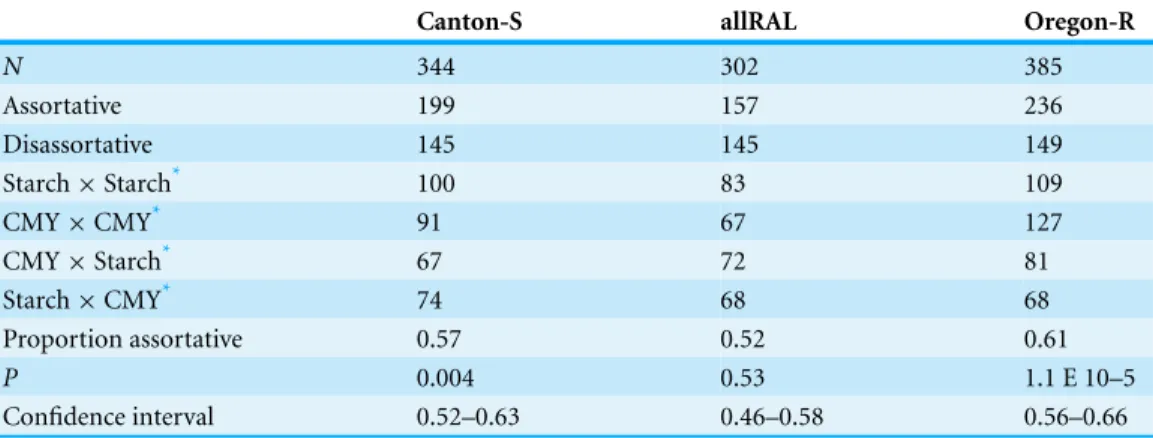
In support of previous findings, we found that the diet of ancestors affected the mate choice of later generations, but only in the inbred Canton-S strain (Fig. 1and Table 1). In the four-fly experiment, 58% of copulations were assortative in Canton-S, where 50% are expected under random mating (binomialp=0.004, 95% confidence
interval=0.52–0.63,N=344). The outbred allRAL strain, in contrast, did not show any
significant deviation from random mating, with 52% of copulations assortative (binomial p=0.53, 95% confidence interval=0.46–0.58,N=302). We used raw data provided by
Sharon et al. (2010)to calculate that the Oregon-R inbred strain mated assortatively 61% of the time (binomial,p=1.08E–5, 95% confidence interval=0.56–0.66,N=385), similar
to our data for Canton-S. When Canton-S mated assortatively, we saw no significant difference in which flies mated first: starch flies were observed to mate first 52% of the time, and CMY flies the other 48% of the time (binomialp=0.56). These data are consistent
with the published data using Oregon-R, where starch flies were the first to mate 46% of the time (binomialp=0.27).
Figure 1 Mate choice behavior among strains.The frequency of assortative mating for each strain tested is shown, with Oregon-R data fromSharon et al. (2010)presented for comparison. Vertical lines are 95% confidence intervals; sample sizes were 302, 344, and 385 for allRAL, Canton-S, and Oregon-R, respectively.
Table 1 Results of four-fly mate choice experiments, wherein a male and female from each treatment are mixed.
Canton-S allRAL Oregon-R
N 344 302 385
Assortative 199 157 236
Disassortative 145 145 149
Starch×Starch* 100 83 109
CMY×CMY* 91 67 127
CMY×Starch* 67 72 81
Starch×CMY* 74 68 68
Proportion assortative 0.57 0.52 0.61
P 0.004 0.53 1.1 E 10–5
Confidence interval 0.52–0.63 0.46–0.58 0.56–0.66
Notes.
*The treatments of the first pair are listed with female first. These rows denote those cases where one pair of flies clearly
mated first.
due to the need to run these multiple comparisons; to maximize sample size, we only investigated Canton-S because of the positive results of the four-fly design (Table 2).
Table 2 Results of three-fly mate choice experiments, wherein a single fly of one sex (the chooser) is presented a fly of the opposite sex from each treatment.
Choosing fly Assortative Disassortative N Proportion assortative
P Confidence
interval
Starch female 89 107 196 0.454 0.23 0.38–0.53
CMY female 113 88 201 0.562 0.09 0.49–0.63
CMY male 106 79 185 0.572 0.06 0.50–0.65
Starch male 88 78 166 0.530 0.49 0.45–0.61
experiment, in which 58% of copulations were assortative (Table 2). When a female CMY fly was combined with both males, 56% of copulations were assortative, and when a male CMY fly was combined with both females, 57% of copulations were assortative. These results were only marginally significant due to decreased sample sizes (binomial p=0.09,N =201 andp=0.06,N =185, for females and males, respectively). If
we use Fisher’s combined probability test (i.e., Fisher’s method) to consider these data together, copulations are significantly assortative when CMY flies are choosers (p=0.03).
In contrast, the cases where starch flies were the “chooser” were not significant (Table 2).
DISCUSSION
In2010, Gil Sharon and colleagues published a report describing assortative mating based on gut bacteria inDrosophila melanogaster. We found these data surprising and interesting, and have attempted to expand on the understanding of this phenomenon here. In partial replication of this previous result, we found that flies from the Canton-S strain mate assortatively based on the diets of their ancestors. Though we did not explicitly investigate the presence of any particular bacterial species, this is consistent with the pattern observed bySharon et al. (2010)with the Oregon-R strain. In contrast, we saw random mating in flies from our outbred allRAL strain. With only two inbred and one outbred strain tested thus far, it is not possible to determine if this was because the flies were outbred or because of a genotype-by-environment interaction. It is also possible that the initial bacterial community was different in this strain for stochastic reasons, and that this community did not produce the affects seen in the other strains. In any case, when the three different genotypes are considered together, the data are not consistent with random mating (Fisher’s combined probability test,p=4.03E–6).
starch only in order to avoid nearly complete mortality in inbred strains (see methods). In contrast, CMY food is a standardDrosophilarearing media. Though the flies used in our experiments were all reared on CMY media for a single generation, the results ofSharon et al. (2010)suggest that those with starch-reared ancestors have lost most of the diversity in their microbiome; flies could therefore still be stressed after one generation on CMY food. This leads us to hypothesize that the pattern seen here could simply be due to assortative mating between the healthiest males and females. For example, both male and femaleD. melanogasterprefer large mates to small mates (Partridge & Farquhar, 1983;Partridge, Hoffmann & Jones, 1987;Pitnick, 1991;Byrne & Rice, 2006;Long et al., 2009). If flies reared on starch lose important bacterial symbionts, then their descendants might be smaller, less vigorous, or otherwise less desirable. We further speculate that this pattern might not be seen in our outbred allRAL stock due to the increase in vigor in outbred vs. inbred strains. If outbred individuals reared on starch are able to either maintain their bacterial community or deal better with its reduction, then assortative mating might not be seen. In this scenario, we might predict that mating would be significantlydisassortativewhen single starch flies are given an option; mating was only disassortative in the case of starch females, and not significantly so (45% of copulations were assortative, 95% CI [38–53]). Further investigating these hypotheses might be a productive direction for future research.
Our proposed mechanism (assortative mating based on quality or condition) is very straightforward but could play an important role in speciation in nature. If some individuals in a population use a sub-optimal habitat, they might mate assortatively simply due to rejection by other individuals using a more typical habitat. If these individuals mate assortatively by default, rare recessive alleles would be more likely to become homozygous, and alleles at unlinked loci could establish gametic disequilibrium, both of which could promote local adaptation. Of course, once these more-fit genotypes emerged, they would no longer be discriminated against by other individuals on typical habitat, so a genetic assimilation-like mechanism would be required to continue reproductive isolation (Waddington, 1953;Badyaev, 2005). Needless to say, these ideas are speculative and require further investigation via theoretical models and experiments in the field.
general vigor as a possible mechanism. We hope that these results will motivate continued work in this area.
ACKNOWLEDGEMENTS
We would like to thank Leslie Benitez, Melina Allahverdian, and Erika Kim for helping collect data and Alison Pischedda, Michael Shahandeh, Steven Proulx, and William Rice for thoughtful discussion regarding experimental design, analysis, and interpretation. This work would not have been possible without the community supported resources available at the Bloomington Drosophila Stock Center.
ADDITIONAL INFORMATION AND DECLARATIONS
Funding
Funding was provided by the University of California Santa Barbara and the National Institutes of Health (R01 GM098614). The funders had no role in study design, data collection and analysis, decision to publish, or preparation of the manuscript.
Grant Disclosures
The following grant information was disclosed by the authors:
University of California Santa Barbara and the National Institutes of Health: R01 GM098614.
Competing Interests
The authors declare there are no competing interests.
Author Contributions
• Michael A. Najarro conceived and designed the experiments, performed the
experi-ments, analyzed the data, wrote the paper, prepared figures and/or tables, and reviewed drafts of the paper.
• Matt Sumethasorn and Alexandra Lamoureux performed the experiments, and
reviewed drafts of the paper.
• Thomas L. Turner conceived and designed the experiments, analyzed the data, wrote the
paper, prepared figures and/or tables, and reviewed drafts of the paper.
Supplemental Information
Supplemental information for this article can be found online athttp://dx.doi.org/ 10.7717/peerj.1173#supplemental-information.
REFERENCES
Badyaev AV. 2005. Stress-induced variation in evolution: from behavioural plasticity to genetic assimilation.Proceedings of the Royal Society B-Biological Sciences 272:877–886
DOI 10.1098/rspb.2004.3045.
Brucker RM, Bordenstein SR. 2012.Speciation by symbiosis.Trends in Ecology & Evolution 27:443–451DOI 10.1016/j.tree.2012.03.011.
Brucker RM, Bordenstein SR. 2013.The hologenomic basis of speciation: gut bacteria cause hybrid lethality in the genusNasonia.Science341:667–669DOI 10.1126/science.1240659.
Byrne PG, Rice WR. 2006. Evidence for adaptive male mate choice in the fruit fly
Drosophila melanogaster.Proceedings of the Royal Society B-Biological Sciences273:917–922
DOI 10.1098/rspb.2005.3372.
Chandler JA, Turelli M. 2014.Comment on “The hologenomic basis of speciation: gut bacteria cause hybrid lethality in the genusNasonia”.Science345:1011DOI 10.1126/science.1251997.
Clopper CJ, Pearson ES. 1934.The use of confidence or fiducial limits illustrated in the case of the binomial.Biometrika26:404–413DOI 10.1093/biomet/26.4.404.
Coyne JA, Orr HA. 2004.Speciation. Sunderland, Massachusetts: Sinauer Associates, Inc.
Crews D, Gore AC, Hsu TS, Dangleben NL, Spinetta M, Schallert T, Anway MD, Skinner MK. 2007.Transgenerational epigenetic imprints on mate preference.Proceedings of the National Academy of Sciences of the United States of America104:5942–5946
DOI 10.1073/pnas.0610410104.
Dodd DMB. 1989.Reproductive isolation as a consequence of adaptive divergence inDrosophila pseudoobscura.Evolution43:1308–1311DOI 10.2307/2409365.
Ioannidis JPA. 2005.Why most published research findings are false.PLoS Medicine2:e124
DOI 10.1371/journal.pmed.0020124.
Jiang Y, Bolnick DI, Kirkpatrick M. 2013.Assortative mating in animals.The American Naturalist 181:E125–E138DOI 10.1086/670160.
Kondrashov AS, Kondrashov F. 1999.Interactions among quantitative traits in the course of sympatric speciation.Nature400:351–354DOI 10.1038/22514.
Koukou K, Pavlikaki H, Kilias G, Werren JH, Bourtzis K, Alahiotis SN. 2006. Influence of antibiotic treatment andWolbachiacuring on sexual isolation amongDrosophila melanogastercage populations.Evolution60:87–96DOI 10.1111/j.0014-3820.2006.tb01084.x.
Long TAF, Pischedda A, Stewart AD, Rice WR. 2009.A cost of sexual attractiveness to high-fitness females.Plos Biology7:e1000254DOI 10.1371/journal.pbio.1000254.
Mackay TFC, Richards S, Stone EA, Barbadilla A, Ayroles JF, Zhu D, Casillas S, Han Y, Magwire MM, Cridland JM, Richardson MF, Anholt RRH, Barr ´on M, Bess C,
Blankenburg KP, Carbone MA, Castellano D, Chaboub L, Duncan L, Harris Z, Javaid M, Jayaseelan JC, Jhangiani SN, Jordan KW, Lara F, Lawrence F, Lee SL, Librado P, Linheiro RS, Lyman RF, Mackey AJ, Munidasa M, Muzny DM, Nazareth L, Newsham I, Perales L, Pu L-L, Qu C, R`amia M, Reid JG, Rollmann SM, Rozas J, Saada N, Turlapati L, Worley KC, Wu Y-Q, Yamamoto A, Zhu Y, Bergman CM, Thornton KR, Mittelman D. 2012.TheDrosophila melanogastergenetic reference panel.Nature482:173–178DOI 10.1038/nature10811.
Miller WJ, Ehrman L, Schneider D. 2010. Infectious speciation revisited: impact of
symbiont-depletion on female fitness and mating behavior ofDrosophila paulistorum.PLoS Pathogens6:e1001214DOI 10.1371/journal.ppat.1001214.
Partridge L, Farquhar M. 1983. Lifetime mating success of male fruitflies (Drosophila melanogaster) is related to their size.Animal Behaviour31:871–877
DOI 10.1016/S0003-3472(83)80242-5.
Partridge L, Hoffmann A, Jones JS. 1987.Male size and mating success in Drosophila melanogasterandD. pseudoobscuraunder field conditions.Animal Behaviour35:468–476
Pfennig DW, Servedio MR. 2013.The role of transgenerational epigenetic inheritance in diversification and speciation.Non-Genetic Inheritance1:17–26DOI 10.2478/ngi-2013-0002.
Pischedda A, Shahandeh MP, Cochrane WG, Cochrane VA, Turner TL. 2014.Natural variation in the strength and direction of male mating preferences for female pheromones inDrosophila melanogaster.PLoS ONE9:e87509DOI 10.1371/journal.pone.0087509.
Pitnick S. 1991.Male size influences mate fecundity and remating interval inDrosophila melanogaster.Animal Behaviour41:735–745DOI 10.1016/S0003-3472(05)80340-9.
Sharon G, Segal D, Ringo JM, Hefetz A, Zilber-Rosenberg I, Rosenberg E. 2010.Commensal bacteria play a role in mating preference ofDrosophila melanogaster.Proceedings of the National Academy of Sciences of the United States of America107:20051–20056
DOI 10.1073/pnas.1009906107.
Sharon G, Segal D, Ringo JM, Hefetz A, Zilber-Rosenberg I, Rosenberg E. 2013.Correction for Sharon et al, Commensal bacteria play a role in mating preference ofDrosophila melanogaster.
Proceedings of the National Academy of Sciences of the United States of America110:4853–4853.
Turner TL, Miller PM, Cochrane VA. 2013.Combining genome-wide methods to investigate the genetic complexity of courtship song variation inDrosophila melanogaster.Molecular Biology and Evolution30:2113–2120DOI 10.1093/molbev/mst111.
Van den Berg MJ, Thomas G, Hendriks H, Van Delden W. 1984.A reexamination of the negative assortative mating phenomenon and its underlying mechanism inDrosophila melanogaster.
Behavior Genetics14:45–61DOI 10.1007/BF01066068.
Waddington CH. 1953.Genetic assimilation of an acquired character.Evolution7:118–126
DOI 10.2307/2405747.
Wright S. 1921.Systems of Mating. III. Assortative mating based on somative resemblance.