UDC 665: 665.1.09 : 553.61 : 665.334.9 APTEFF, 35, 1-280 (2004) BIBLID: 1450–7188 (2004) 35, 31-36 Original scientific paper
INVESTIGATION OF ACTIVATED Al - PILLARED CLAY EFFICIENCY IN VEGETABLE OIL PURIFICATION
Gizela A. Lomić, Erne E. Kiš, Etelka B. Dimić and Ranko S. Romanić
This paper represents a contribution to the applicability of natural clays and their derivates as adsorbents in the process of purification of vegetable oil. Investigation of textural properties of raw and purified clay samples reveals that during acid activation and Al-pillaring, BET and micropore surface area increases significantly. However, bleaching capacity of clay and its derivates is not determined by using sample surface area, but rather sample total pore volume. Surface area, especially micropore surface area contributes to removal of smaller molecules. This was confirmed by successful elimination of moisture and volatile materials by samples with an appropriate micropore structure. Used samples of clay and its derivates do not significantly influence acid and peroxide values of raw sunflower oil during its treatment.
KEYWORDS: Montmorillonite; activated Al-pillared montmorillonite; texture; sunflower oil; purification; bleaching; adsorption
INTRODUCTION
Natural clays are good adsorbents, but modifications are often necessary to improve their performance in order to obtain highly active and selective materials. Acid activation and pillaring processes are commonly used for improvement of natural clay (filosilicates and especially montmorillonites) adsorption capacity. Today, pillared clays are one of the most widely investigated new microporous materials. Intercalation of metal oxide clusters generates new materials with specific porous structure, different incorporated cations and other active sites, offering thus new possibilities for their applications as adsorbents, cata-lysts or auxiliary materials in a variety of industrial branches (1).
the adsorption capacities of Al-pillared clay samples, montmorillonite type, clays were treated by sulfuric acid, before Al-pillaring. Six different samples were prepared: raw mont-morillonite type clay - RM; acid activated raw clay - ARM, acid activated Al-pillared raw clay - AAlRM; purified montmorillonite type clay - PM; acid activated purified clay - APM; and acid activated Al-pillared purified clay - AAlPM. In this paper the influence of the textural properties of raw, purified, acid activated and Al-pillared samples were investigated in correlation with their bleaching capacities.
EXPERIMENTAL
The investigation was carried out using raw and purified montmorillonite type clay from Šipovo. The raw clay was dried at 105°C, milled and sieved to achieve grain size less than 63 µm. Purified clay with particle size less than 2 µm was prepared by hydro-sedi-mentation technique (JUS U.BI.018,1980). After hydro-separation the clay was dried at 105°C. Both raw and purified clays were acid activated with 16 mass % sulfuric acid at boiling temperature during 6 hours (3), following Al-pillaring as described elsewhere (4).
The textural properties, specific surface area, average pore diameter, pore volume, micropore surface area and micropore volume measurements were performed using method of static low temperature nitrogen adsorption (LTNA) by Micrometrics ASAP 2000. BET adsorption isotherm was applied in data processing.
Darker raw sunflower oil (RSFO) with higher quantity of oxidation products was stirred with 2 wt% clay samples for 20 minutes at ambient temperature and pressure. After filtration the clay adsorbents were separated from oil. The quality of prepared oil samp-les was determined according to JUS ISO standard methods. Measurements were carried out by spectrophotometer Hewlett Packard 8452 following bands at 455 nm, 232 and 270 nm for transparency and absorbance, respectively. Also, peroxide and acid values, moisture and volatile materials content in filtered oil samples were determined, as descri-bed in (5).
RESULTS AND DISCUSSION
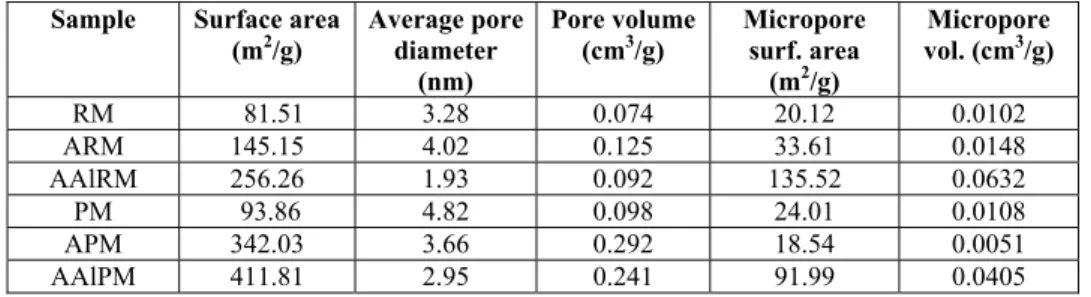
The textural properties of the samples are given in Table 1. Slight hydro-purifica-tion, acid treatment and Al-pillaring strongly enhanced both BET and micropore surface area of the samples. Pillared clay samples have the lowest average pore diameters. The fine pore structure of pillared samples provides well developed BET and micropore surface area.
treatment with acid activated purified clay sample and two times after treatment with acid activated Al-pillared purified clay sample. The obtained results show that BET and mic-ropore surface area are not decisive factors for adsorption capacities of clay and clay de-rivates. Samples with higher pore volumes offer the best adsorption capacities in respect of different pigments in raw sunflower oil. These results suggest that pigments with higher molecules can penetrate only into the pores with higher dimensions, so micropores do not take part in pigment adsorption during bleaching processes of raw sunflower oil.
Table 1. Textural properties of the applied clay samples
Sample Surface area (m2/g)
Average pore diameter
(nm)
Pore volume (cm3/g)
Micropore surf. area
(m2/g)
Micropore vol. (cm3/g)
RM 81.51 3.28 0.074 20.12 0.0102
ARM 145.15 4.02 0.125 33.61 0.0148
AAlRM 256.26 1.93 0.092 135.52 0.0632
PM 93.86 4.82 0.098 24.01 0.0108
APM 342.03 3.66 0.292 18.54 0.0051
AAlPM 411.81 2.95 0.241 91.99 0.0405
Table 2. Transparency (%) of raw and purified oil samples at 455 nm
RSFO 17.5 RM 21.0 ARM 27.5 AAlRM 27.0
PM 16.5 APM 54.5 AA1PM 41.0
Moisture is undesirable in edible oils, since it contributes to increase of oil acid va-lues and losses during oil refining (5). All samples show good adsorption properties in removal of moisture and volatile materials. The best results were obtained by acid activa-ted and subsequently Al-pillared samples (Table 3).
Table 3. Moisture and volatile matter content (%) in raw and purified oil samples
RSFO 0.22 RM 0.12 ARM 0.10 AAlRM 0.08
PM 0.16 APM 0.10 AAlPM 0.09
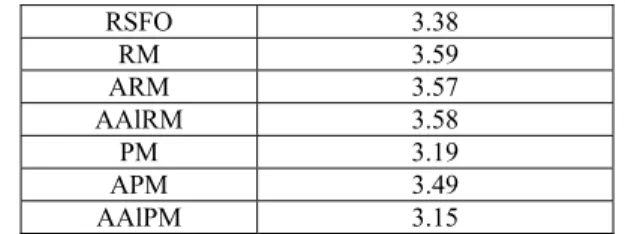
in moisture removal. The dimensions of these molecules are significantly smaller than the dimensions of pigment molecules, therefore they can penetrate into the micropores, i.e. the samples with the most developed surface area have the best adsorption capacities. The applied clay and clay derivates do not influence significantly the amount of free fatty acids (defined by acid values) during the raw sunflower oil treatment (Table 4).
Table 4. Acid values (mg KOH/g) of raw and purified oil samples
RSFO 3.38 RM 3.59 ARM 3.57 AAlRM 3.58
PM 3.19 APM 3.49 AAlPM 3.15
After the treatment, peroxide values show a slight increase (Table 5), although this might be due to direct oxidation with air during mixing of raw sunflower oil with clay samples, rather than a promoted oxidation with the used clay particles. Slight increase of peroxide values in the samples treated by raw clay and its derivates could be explained by promoting effects of different impurities present in natural clay. However, the majo-rity of these impurities were removed during purification of natural clay using hydro-sedimentation technique. In any case, all the obtained peroxide values are below those allowed for edible nonrefined oils (6).
Table 5. Peroxide values (mmol/kg) of raw and purified oil samples
RSFO 1.98 RM 2.10 ARM 3.14 AAlRM 2.86
PM 2.97 APM 2.24 AAlPM 2.47
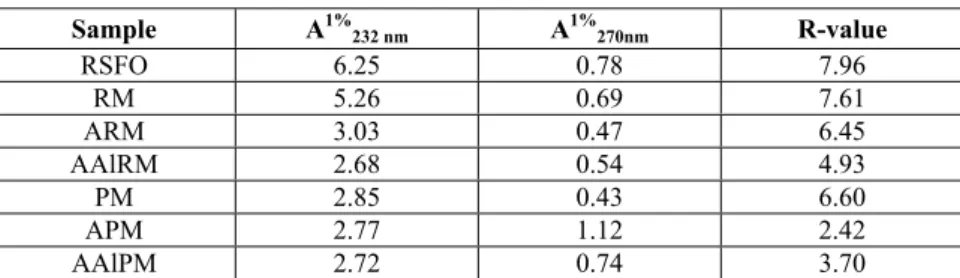
R-values defined as ratio of absorbance at 232 nm and 270 nm, measure the oxidation changes of unsaturated fatty acids during the treatment. At 232 nm, all treated samples show lower absorbencies than raw sunflower oil (Table 6). The absorbences of the samples treated with acid activated and acid activated and subsequently Al-pillared raw clay sam-ples are significantly lower than the absorbance of untreated raw sunflower oil. However, these values are higher than the absorbance values of oil samples obtained after treatment of raw sunflower oil with samples of purified clay and its derivates. Acid treatment and Al-pillaring of purified clay does not significantly influence the absorbance at 232 nm. These values are approximately equal to the value obtained with acid activated Al-pilla-red raw clay sample.
Table 6. Specific absorbance and R-value of raw and purified oil samples
Sample A1%232 nm A1%270nm R-value
RSFO 6.25 0.78 7.96 RM 5.26 0.69 7.61 ARM 3.03 0.47 6.45
AAlRM 2.68 0.54 4.93
PM 2.85 0.43 6.60 APM 2.77 1.12 2.42
AAlPM 2.72 0.74 3.70
CONCLUSION
Acid treatment and especially Al-pillaring causes dramatic increase of both BET and micropore surface area of raw and purified clays. These changes significantly influence the adsorption properties of clay derivates. The best result during treatment of raw sun-flower oil was achieved using acid activated and acid activated and subsequently Al-pil-lared purified clay samples. However, the crucial influence of clay based adsorbents on oil bleaching efficiency is not in correlation with surface area but with total pore volume values. Micropores does not contribute to oil bleaching because the pigment molecules have bigger dimensions and can not penetrate into the micropores. Micropores can adsorb only moisture and molecules of volatile materials. Increase of both BET and micropore surface area improves the efficiency of adsorption of moisture and volatile matter. The decrease of absorbance values at 232 nm and 270 nm reveals that clay and its derivates contribute to the removal of secondary oxidation products. The increase of peroxide values during the clay treatment was insignificant, and the acid values remained the same as before the treat-ment of raw sunflower oil, showing that clay and its derivates did not produce these unde-sirable changes.
ACNOWLEDGEMENT
This work was supported by the Ministry of Science, Technologies and Development of the Republic of Serbia, Project 1368
REFERENCES
1. Kiš E.E., J.G. Ranogajec, R.P. Marinković-Nedučin, T.J. Vulić, A.A. Mesaroš-Bor-belj and D.A. Oprijan: Intercalation of metal oxides into the structure of clay minerals. Acta Periodica Technologica 32 (2001) 71-78.
2. Kiš E.E., J.G. Ranogajec, R.P. Marinković-Nedučin, E.B. Dimić and T.J. Vulić: Soy-bean oil bleaching by Al-pillared montmorillonite. Acta Periodica Technologica 33
(2002) 27-33.
4. Canizares P., J.L Valverde, M.R. Sun Kou and C.B. Molina: Microporous materials
29 (1999) 267-281.
5. Dimić E., J. Turkulov: Kontrola kvaliteta u tehnologiji jestivih ulja, Novi Sad, Uni-verzitet u Novom Sadu, Tehnološki fakultet (2000).
6. Pravilnik o kvalitetu i drugim zahtevima za jestivo biljno ulje i masti, margarin i druge masne namaze, majonez i srodne proizvode, Službeni list SRJ br: 54/1999.
И И И Е Е И И И И И l - И И
И Е И И И
е а . ћ, р е . ш, те а . ћ а . а ћ
. И
l- ЕТ
. М ђ ,
-ђ
-, ,
.
,
.