ISSN 0104-6632 Printed in Brazil
www.abeq.org.br/bjche
Vol. 28, No. 01, pp. 169 - 174, January - March, 2011
Brazilian Journal
of Chemical
Engineering
SUNFLOWER OIL BLEACHING BY ADSORPTION
ONTO ACID-ACTIVATED BENTONITE
E. L. Foletto
1*, G. C. Colazzo
1, C. Volzone
2and L. M. Porto
31
Department of Chemical Engineering, Federal University of Santa Maria (UFSM), 88040-900, Santa Maria - RS, Brazil.
E-mail: [email protected] 2
Center of Technology of Mineral Resources and Ceramic, CETMIC (CIC-CONICET), C.C. 49, (1897) M. B. Gonnet, Prov. Buenos Aires, Argentina.
3
Department of Chemical and Food Engineering, Federal University of Santa Catarina (UFSC), P.O. Box 476, 88040-900, Florianópolis - SC, Brazil.
(Submitted: March 26, 2010 ; Revised: May 4, 2010 ; Accepted: August 31, 2010)
Abstract - Two bentonite clays with different mineralogical compositions from Mendoza, Argentine, were activated with H2SO4 solutions of 4 and 8 N at 90°C for 3.5 hours. This treatment affected clay structural
properties, as was shown by thermogravimetry, infrared spectrometry and chemical analysis. Bleaching efficiency for sunflower oil was strongly dependent on the acid concentration used for clay activation. The samples have bleaching capacity comparable to that observed with a commercial adsorbent standard. The mineralogical composition of natural clays influenced the properties of the activated clays.
Keywords: Acid-treated clays; Bentonite; Oil bleaching; Sunflower oil.
INTRODUCTION
Acid activated bentonites have been used as solid acid catalysts and catalyst supports for a number of organic applications that require an extreme degree of reaction control of considerable industrial interest (Mokaya and Jones, 1995, Breen et al., 1997, Volzone et al., 2001, Foletto et al., 2002, Didi et al., 2009). They have also been used in the foodstuffs industry, for sulphur production, forest and water conservation, in the chemical industry, for environmental protection, and in the paper industry (Clarke, 1985, O’Driscoll, 1988), as well as for bleaching of vegetable oils (Srasra et al., 1989, Christidis et al., 1997, Foletto et al., 2003, Kirali and Laçin, 2006). The bleaching of edible vegetable oils involves the removal of a variety of impurities, which include phosphatides, fatty acids, gums, trace metals, etc., followed by decolorization. The bleaching capacity of bentonites is greatly increased by activation treatment. While some of these clays
170 E. L. Foletto, G. C. Colazzo, C. Volzone and L. M. Porto
were rendered suitable for bleaching of rapeseed oil. It was determined that the optimum bleaching capacity in not associated with maximum surface area and the optimum conditions for activation are obtained by using a variety of combinations of acid strength and residence time. Despite numerous studies, no definite relationship exists between the performance of the acid-activated clay and the composition or properties of the original clay. Hence, each clay has to be specifically activated and tested for its performance (Hymore, 1996). The preparation of acid-activated bentonite must be controlled in order to obtain maximum bleaching capacity (Kirali and Laçin, 2006,Rožićet al., 2010).
The present study deals with the acid activation of Argentine bentonites and testing of their bleaching capacity for sunflower oil, in comparison with the bleaching capacity of a standard commercial bleaching clay.
EXPERIMENTAL
Two natural bentonites (named K and W) from two different deposits of the Mendoza province, Argentine, were used as the starting materials. Tonsil, a commercial acid-activated bentonite extensively used in the vegetable oil industry, was used as reference for the evaluation of the bleaching capacity in the experiments. Alkali-refined sunflower oil was gently donated by Bunge Alimentos S.A (Gaspar-SC, Brazil).
The bentonite sample (40 g) was treated with 400 mL of 4 N or 8 N sulphuric acid (analytical grade) at 90°C for 3.5 h (Foletto et al., 2003) in a stirred glass reaction vessel with reflux. After the acid treatment, the sample was filtered and washed with distilled water until free of SO42-. The samples were dried at 60°Cfor 12 h and ground to pass through a 0.074 mm sieve. Activated samples were designated as K4, K8, W4 and W8, where the numerical value indicates the concentration of acid solution used for the treatment. Bleaching experiments were conducted by a procedure analogous to that of the American oil Chemical Society (AOCS) Official Method Cc 8a-52. The bleaching process was carried
out under a vacuum of 450 mmHg at the constant temperature of 100°Cwith a contact time of 30 min. Stirring and heating were carried out by means of a mechanical stirrer and an electric heating band. The ratio of the mass of clay to the volume of acid solution was 1:10 (w/v). During the bleaching, a stream of N2 was maintained above the oil surface. The hot oil and clay mixture was filtered under vacuum and the color of the bleached oil was measured spectrophotometrically (WFJ525-W UV-visible spectrophotometer). The bleaching capacity percentage of the clays was determined from the equation (Falaras et al., 1999):
( )
(
0)
0BC % =⎡⎣ A −A / A ⎤⎦x100
where “A0” and “A” are the absorbance of neutral oil and bleached oil, respectively, at the maximum absorbance wavelength of the neutral oil (420 nm). The structural changes of the Argentinean acid bentonites were examined by means of thermogravimetric (TGA) and infrared spectrometric (IR) analyses and chemical analysis (XRF). TGA was performed with a Netzsch STA 409 thermal analyzer at a heating rate of 10°C.min-1 under a flow of atmospheric air of 35 mL min-1, in the temperature range 25-1000°C. IR spectra were recorded in the region 4000-350 cm-1 with a Perkin-Elmer 16 PC spectrophotometer, using the KBr pellet technique. Chemical compositions of the samples were determined by X-ray fluorescence with a Philips PW 2400 spectrometer.
RESULTS AND DISCUSSION
The mineralogical compositions of two clay samples were determined by Foletto et al. (2000). Smectite is the main clay mineral in both samples (35 % in K and 47 % in W). The K bentonite contains quartz and feldspar as impurities, whereas W bentonite contains also gypsum and kaolinite. Table 1 shows the chemical analysis of the bentonites after treatment with sulfuric acid. The interlayer cations of the bentonites were removed.
Table 1: Results of XRF analysis, expressed as oxides (%).
Sample SiO2 Al2O3 Fe2O3 MgO CaO Na2O K2O TiO2 MnO * r
K 69.53 15.58 3.49 1.56 0.65 2.70 1.23 0.55 0.09 3.00
K4 77.45 12.55 2.03 1.02 0.35 0.85 1.10 0.55 0.01 4.35
K8 78.51 10.32 1.59 0.85 0.32 0.88 1.04 0.54 0.01 5.37
W 65.18 17.51 4.53 1.18 1.57 2.24 0.86 0.42 0.08 2.56
W4 73.08 14.70 3.43 0.64 0.18 0.57 0.71 0.42 0.01 3.50
W8 75.87 13.06 2.86 0.59 0.18 0.59 0.71 0.42 0.01 4.12
* r: Si4+ / (Al3+
+ Mg2+
+Fe2+/3+
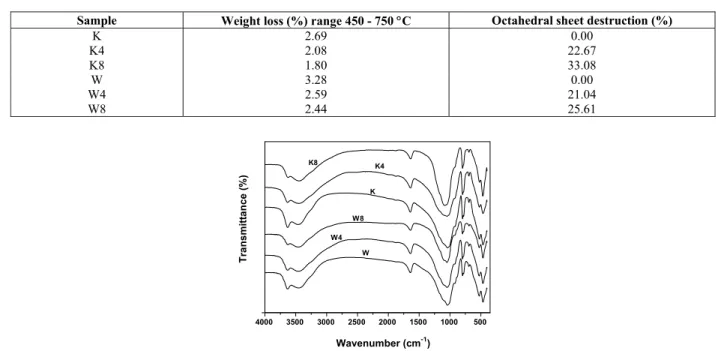
The residual Ca2+, Na+ and K+ are due to the presence of impurities such as micas and feldspars, which are insoluble in acid medium (Barrios et al., 1995). Part of the Mg2+, Fe2+/3+ and Al3+ was removed from the octahedral sheet. Ti4+ cations were insoluble. The increase of Si4+ and the reduction of the octahedral cations, with the increase of the acid concentration resulted in an increase of the Si/(Al+ Mg +Fe) ratio. The loss of weight due to dehydroxylation (%) of the samples, obtained from TGA curves, occurred in the range 450-750°C (Figure 1); the TGA curves were used for the evaluation of the extent of the attack of the acid treatment on the octahedral sheets (Table 2). The octahedral sheet destruction was calculated as a relative percentage reduction of the weight loss, with respect to the original sample (Foletto et al., 2003). The activated K samples showed 14 to 19% destruction of the octahedral sheet, while the activated W samples showed
12 to 15% destruction. These results showed that, even at high acid concentration (i.e., a concentration of 8 N), the structure of smectites was not totally destroyed.
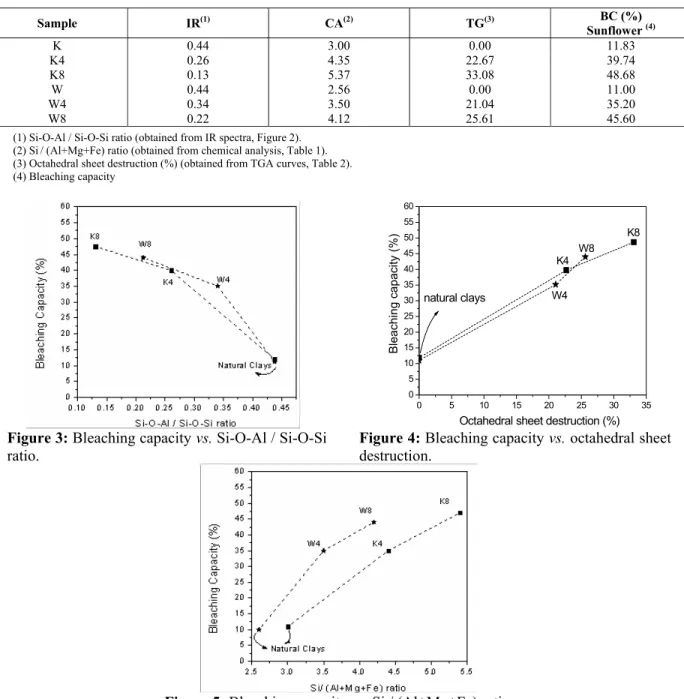
Figure 2 shows the infrared spectra of the original and the acid-treated bentonites. No important changes were observed, although the Si-O-Al (525 cm-1) and Si-O-Si (465cm-1) bands were modified. The intensity ratios of both bands are shown in Table 3. Table 3 presents the results of the characterizations of the natural and activated samples and for bleaching of sunflower oil. Figures 3, 4 and 5 show the relation between the structural changes and bleaching capacity of the bentonites. The results of the analyses indicate that an increase of the acid concentration causes a greater attack on the bentonite structure and, consequently, improves the bleaching capacity. The level of clay attack was higher for the K that the W sample.
0 100 200 300 400 500 600 700 800 900 1000
0 2 4 6 8 10 12 14 16 18 20
K8
K4 K
W8
W4
W
e
ig
h
t
lo
s
s
(
%
)
Temperature (°C)
W
Figure 1: TGA curves of the natural and activated samples.
Table 2: Results obtained from TGA curves.
Sample Weight loss (%) range 450 - 750 °C Octahedral sheet destruction (%)
K 2.69 0.00
K4 2.08 22.67
K8 1.80 33.08
W 3.28 0.00
W4 2.59 21.04
W8 2.44 25.61
4000 3500 3000 2500 2000 1500 1000 500
W W4
W8 K
K4 K8
T
ra
n
s
m
it
ta
n
c
e
(
%
)
Wavenumber (cm-1)
172 E. L. Foletto, G. C. Colazzo, C. Volzone and L. M. Porto
Table 3: Structural changes and oil bleaching capacity of natural and activated samples.
Sample IR(1) CA(2) TG(3) BC (%)
Sunflower (4)
K 0.44 3.00 0.00 11.83
K4 0.26 4.35 22.67 39.74
K8 0.13 5.37 33.08 48.68
W 0.44 2.56 0.00 11.00
W4 0.34 3.50 21.04 35.20
W8 0.22 4.12 25.61 45.60
(1) Si-O-Al / Si-O-Si ratio (obtained from IR spectra, Figure 2). (2) Si/ (Al+Mg+Fe) ratio (obtained from chemical analysis, Table 1). (3) Octahedral sheet destruction (%) (obtained from TGA curves, Table 2). (4) Bleaching capacity
0 5 10 15 20 25 30 35
0 5 10 15 20 25 30 35 40 45 50 55 60
Octahedral sheet destruction (%)
Bl
e
a
ch
in
g
c
a
p
a
c
it
y
(%
)
natural clays
K4
K8
W4 W8
Figure 3: Bleaching capacity vs. Si-O-Al / Si-O-Si ratio.
Figure 4: Bleaching capacity vs. octahedral sheet destruction.
Figure 5: Bleaching capacity vs. Si / (Al+Mg+Fe) ratio.
The acid activated K bentonites showed a slightly superior bleaching capacity than the acid W bentonites and this behavior could be attributed to the greater effect of the acid attack on the K smectite structure when compared to the W smectite. Comparing the mineralogical compositions, the sample K presents a higher MgO content than sample W. It has been observed that smectites with greater MgO contents in their structure are more activated by mineral acids than those smectites with
minor MgO content (Volzone and Ortiga, 2000). An optimization of the experimental conditions of acid treatment of the W bentonite would probably cause a higher attack on its structure and, consequently, would lead to a better adsorptive capacity, because this sample has a higher clay content than K bentonite (Foletto et al., 2000).
Table 4. The retention of colored impurities of sunflower oil by Tonsil (commercial sample) was similar to those of the bentonites treated with 8N sulphuric acid.
Table 4: Bleaching capacities (BC) of Tonsil and the acid-treated bentonites (K8 and W8).
Sample BC (%) Sunflower
Tonsil 48.57 K8 48.68 W8 45.60
CONCLUSION
Attack on the bentonite structure as a result of sulfuric acid treatment is strongly dependent on the acid concentration. The effects of these treatments on clay structural properties were determined by thermogravimetric, infrared spectrometric analysis and chemical analysis. The activated samples were tested in order to verify their bleaching capacity for sunflower oil and were compared to a standard commercial bleaching clay. Bleaching efficiency was strongly dependent on the acid concentration used for clay activation. The treated samples showed a bleaching capacity comparable to the standard. The mineralogical composition of natural clays influenced the properties of the treated clays and these properties increased its bleaching power.
ACKNOWLEDGMENTS
Financial support of CAPES and CNPq, Brazilian governmental agencies for education and research, and PIP02100-CONICET, Argentina are thankfully acknowledged.
REFERENCES
Barrios, M. S., Gonzáles, L. V. F., Rodríguez, M. A. V. and Pozas, J. M. M., Activation of a palygoskite with HCl: development of physico-chemical, textural and surface properties. Applied Clay Science, 10, 247-258 (1995).
Breen, C., Zahoor, F. D., Madejová, J. and Komadel, P., Characterization and catalytic activity of acid-treated, size-fractionated smectites. Journal of Physical Chemistry B, 27, 5324-5331 (1997). Christidis, G. E., Scott, P. W. and Dunham, A. C.,
Acid activation and bleaching capacity of
bentonites from the Islands of Milos and Chios, Aegean, Greece. Applied Clay Science, 12, 329-347 (1997).
Clarke, G. M., Special clays. Industrial Minerals,
216,25-51 (1985).
Didi, M. A., Makhoukhi, B., Azzouz, A. and Villemin, D., Colza oil bleaching through optimized acid activation of bentonite. A comparative study, Applied Clay Science, 42, 336-344 (2009).
Falaras P., Kovais, I., Lezou, F. and Seiragakis, G., Cottonseed oil bleaching by acid-activated montmorillonite. Clay Minerals, 34, 221-232 (1999).
Foletto, E. L., Valentini, A., Probst, L. F. D. and Porto, L. M., Gas-phase β-pinene isomerization over acid-activated bentonite. Latin American Applied Research,32, 141-144 (2002).
Foletto, E. L., Volzone, C., Morgado, A. F. and Porto, L. M., Análise comparativa da ativação ácida de dois materiais argilosos com diferentes composições mineralógicas. In: VI Jornadas Argentinas de Tratamiento de Minerales, Salta (Argentina) 43-48 (2000). (In portuguese).
Foletto, E. L., Volzone, C. and Porto, L. M., Performance of an Argentinian acid-activated bentonite in the bleaching of soybean oil. Brazilian Journal of Chemical Engineering, 20, 139-145 (2003).
Grim, R. E., Applied Clay Mineralogy, McGraw Hill, New York, pp. 442 (1962).
Hymore, F. K., Effects of some additives on the performance of acid-activated clays in the bleaching of palm oil. Applied Clay Science, 10, 379-385 (1996).
Kirali, E. G. and Laçin, O., Statistical modelling of acid activation on cotton oil bleaching by Turkish bentonite, Journal of Food Engineering, 75, 137-141 (2006).
Mokaya, R. and Jones, W., Pillared clays and pillared acid-activated clays: a comparative study of physical, acidic and catalytic properties. Journal of Catalysis, 153, 76-85 (1995).
Mokaya, R., Jones, W., Davies, M. E. and Whittle, M. E., Chlorophyll adsorption by alumina pillared acid-activated clay. Journal of the American Oil Chemists' Society, 70, 241-244 (1993).
Norris, F. A., Extraction of fats and oils. In: Bailey’s Industrial Oil and Fat Products, 2nd ed., New York: Daniel Swern (ed.), John Wiley & Sons, 175-251 (1982).
174 E. L. Foletto, G. C. Colazzo, C. Volzone and L. M. Porto
Patterson, H. B. W., Bleaching and Purifying fats and oils: theory and practice. AOCS Press, Champaign, Ilinois, USA, pp. 242 (1992).
Rossi, M., Gianazza, M., Alamprese, C. and Stanga, F., The role of bleaching clays and synthetic silica in palm oil physical refining, Food Chemistry, 82, 291-296 (2003).
Rožić, L., Novaković, T., and Petrović, S., Applied Clay Science, Modeling and optimization process parameters of acid activation of bentonite by response surface methodology, 48, 154-158 (2010). Srasra, F., Bergaya, H., van Damme, H. and Ariguib,
N. K., Surface properties of an activated bentonite - Decolorisation of rape-seed oils. AppliedClay Science, 4,411-421 (1989).
Volzone, C., Masini O., Comelli, N. A., Grzona, L. M., Ponzi, E. N. and Ponzi M. I., Production of camphene and limonene from pinene over acid di- and trioctahedral smectite clays. Applied Catalysis A: General, 2, 213-218 (2001).