Tetradactyl Footprints of an Unknown Affinity Theropod
Dinosaur from the Upper Jurassic of Morocco
Jaouad Nouri1, Ignacio Dı´az-Martı´nez2,3, Fe´lix Pe´rez-Lorente2,3*
1Faculte´ des Sciences, Universite´ Mohamed V, Rabat, Morocco,2Facultad de Ciencas, Universidad de La Rioja, Logron˜o, La Rioja, Espan˜a,3Fundacio´n Patrimonio Paleontolo´gico de La Rioja, Enciso, La Rioja, Espan˜a
Abstract
Background:New tetradactyl theropod footprints from Upper Jurassic (Oxfordian-Kimmeridgian) have been found in the Iouaride`ne syncline (Morocco). The tracksites are at several layers in the intermediate lacustrine unit of Iouaride`ne Formation. The footprints were named informally in previous works ‘‘Eutynichnium atlasipodus’’. We consider asnomen nudum.
Methodology/Principal Findings:Boutakioutichnium atlasicus ichnogen. et ichnosp. nov. is mainly characterized by the hallux impression. It is long, strong, directed medially or forward, with two digital pads and with the proximal part of the first pad in lateral position. More than 100 footprints in 15 trackways have been studied with these features. The footprints are large, 38–48 cm in length, and 26–31 cm in width.
Conclusions/Significance: Boutakioutichnium mainly differs from other ichnotaxa with hallux impression in lacking metatarsal marks and in not being a very deep footprint. The distinct morphology of the hallux of theBoutakioutichnium trackmaker –i.e. size and hallux position- are unique in the dinosaur autopodial record to date.
Citation:Nouri J, Dı´az-Martı´nez I, Pe´rez-Lorente F (2011) Tetradactyl Footprints of an Unknown Affinity Theropod Dinosaur from the Upper Jurassic of Morocco. PLoS ONE 6(12): e26882. doi:10.1371/journal.pone.0026882
Editor:Carles Lalueza-Fox, Institut de Biologia Evolutiva - Universitat Pompeu Fabra, Spain
ReceivedJuly 12, 2011;AcceptedOctober 5, 2011;PublishedDecember 13, 2011
Copyright:ß2011 Nouri et al. This is an open-access article distributed under the terms of the Creative Commons Attribution License, which permits unrestricted use, distribution, and reproduction in any medium, provided the original author and source are credited.
Funding:This article forms part of the projects: Fomenta 2008/02 and Oficina de Transferencia de Resultados de Investigacio´n (Bureau Transfer Results Investigations) University of La Rioja and EMpresa (enterprise) Foundation Paleontological Heritage of La Rioja 2009. This work was subsidized by the Governement of La Rioja, the Paleontological Heritage of La Rioja Foundation and the University of La Rioja. The funders had no role in study design, data collection and analysis, decision to publish, or preparation of the manuscript.
Competing Interests:The authors have declared that no competing interests exist.
* E-mail: [email protected]
Introduction
More than 1,500 dinosaur footprints in 43 tracksites (Fig. 1) have been mapped in the research of Iouaride`ne syncline [1,2]. According to recent works, the age of the outcrops is Upper Jurassic, Oxfordian-Kimmeridgian [3]. Since the first dinosaur footprints were found in 1937 [1], discoveries and scientific documentation continues.
At the present time, the dating of the 43 cited tracksites [2], new ichnotaxonomic, paleoethologic and paleoecologic contributions is under investigation. The Iouaridene syncline is also noted for its rich ichnodiversity [4–8]. Besides sauropod, thyreophoran, and ornitopod footprints [1], there are several theropod ichnotypes [1,8,9].
‘‘Eutynichnium atlasipodus’’ [6] was defined in the thesis of Jaouad Nouri as a tetradactyl theropod footprint (I, II, III, IV), with a large and independent hallux with two digital pad impresions [6]. The footprints were included in the icnogenusEutynichnium [10] originally defined in the upper Oxfordian of Cabo Mondego area in Portugal [11]. We consider this ichnotaxon as nomen dubium
because is defined based on extramorphological features. ‘‘E. atlasipodus’’ has not been described formally, thus we consider it
nomen nudum. The current findings of more footprints with the same characteristics of ‘‘E. atlasipodus’’, and very different of the ichnogenusEutynichnium, suggest the necessity of a formal diagnosis
for this type of footprints. The feautures of the hallux of this new ichnotaxon allow the discusio´n about the position and the shape of digit I (hallux) in theropod dinosaurs.
Geological setting
The Iouaride´ne syncline is located in the Azilal province (Morocco) at East of the High Central Atlas (Fig. 1) in the M’Goun Geopark. The continental ‘‘red beds’’, are also very common in other basins of the Atlas, in the center of the Iouaride`ne sinclyne [3,12]. The red beds are divided into three formations [3]. The lowest, Guetioua Formation, of Bathonian age is composed of red sandstones and claystones, and basic volcanic rocks. The interme-diate, Iouaride`ne Formation, is composed of red detritical rocks from Bathonian?-Callovian to Barremian age. Finally the upper-most, Jbel Sidal Formation, is formed by alternations of medium to coarse sandstones with red claystones of Barremian age.
The Iouaride`ne Formation is divided into three units [3]. The lower unit is formed maninly by marls and calcretes [12]. The intermediate unit, where the dinosaur footprints have been found, is composed by a superposition of red carbonated shales and red siliceous (silcretes, some with more than 80% SiO2) levels with
environment (carbonate plataform) for these footprints [14]. Recent research indicate a continental origin for all the red beds from the High Atlas [13]. Body fossil remains from the lower and the upper units include vertebrates (principally fishes), charophytes and ostracods. The Iouaride`ne Formation indicates a lacustrine environment [13].
The age of Iouaride`ne syncline red beds has been intertpreted to suggest a wide range of: Upper Lias [15]; Bathonian [16]; Bathonian-Callovian [17]; Lower Cretaceous (Infracenomanian) [18]. Currently, the outcrops with dinosaur footprints (the intermediate unit of the Iouaride`ne Formation) are considered Oxfordian-Kinmeridgian in age, as they lie a few meters below dated Kimmeridgian [3,12].
Ichnodiversity and age of Iouaride`ne syncline footprints Ichnotaxa from the Iouaride`ne Formation include:Megalosaurus
sp. [15], Eubrontes ( =Brontozoum) ichnosp. [19]; Breviparopus taghbaloutensis[20];Carmelopodus ichnosp. [16]; ‘‘Eutynichnium atlas-ipodus’’ [6]; Kayentapus ichnosp. [8,21] y Megalosauripus ichnosp. [8,21]; andDeltapodusichnosp. [22–24], wich occur else where in units that have been assigned various Jurassic and Cretaceous ages. Thus, it appears the assemblages is not easily dated on the basis of tracks identifications.
Theropod footprints are the most abundant in the syncline and both small footprints (14 cm) [6] and the largest theropod footprints in the world (90 cm) [9] have been reported. There are booth digitigrade [1,8,9] and semiplantigrade tracks [2,6,25]. Most of the semiplantigrade footprints (with metatarsal marks) in the Iouaride´ne, have also hallux impression [2,23]. Nevertheless, there are also footprints with an hallux impression without a metatarsal mark. This type of footprints was named ‘‘E. atlasipodus’’ [6] and it is restudied herein.
Sauropod footprints are abundant [5,7,26]. Ornithopod [6,25] and thyreophoran [23,24] footprints have also been reported.
Materials and Methods
The footprints are designated according to previous convention [1,2] as follows: first, the tracksite identification; second, the trackway; and third the footprint. For instance, 7IGR6.1 is the first footprint of tracway number 6 of tracksite 7 from IGR (Iguaridene or Iouaride`ne). To simplify and for consistence, the trackways studied in the Jaouad Nouri thesis with other designations [6], like 1Am8, 8Ta1. etc. have been changed according to previous classification [1,2]. The equivalences are: 1Am1-8IGR1; 1Am2-8IGR2: 1Am3-8IGR3; 1Am4-8IGR4; 1Am8-8IGR5; 1Ta1-11IGR1; 1Ta2-11IGR2; 2Ta2-11IGR4; 2Ta3-11IGR5; 8Ta1-15IGR5.
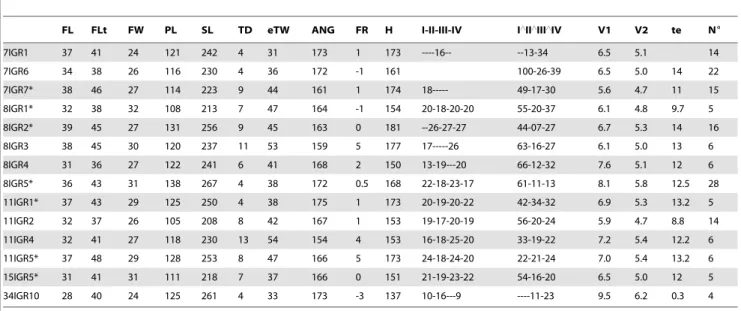
The first place where tetradactyl footprints without a metatarsal impresion were found was tracksite 8IGR from Aı¨t Mimoun (8IGR1 and 8IGR3). In subsequent prospectings they were found at the 7IGR, 8IGR, 11IGR, 15IGR and 34IGR tracksites. Trackways 7IGR7, 8IGR1, 8IGR2, 8IGR5, 11IGR1, 11IGR5 and 15IGR5 reveal tetradactyl footprints throughout (75 footprints in total) (see Appendix S1). In other trackways the hallux impression is recognized only in some footprints (7IGR1, 7IGR6, 8IGR3, 8IGR4, 11IGR2, 11IGR4 and 34IGR10).
The measurements (Table 1, Appendix S2, Appendix S3) and nomenclature used in this study are based on other works [27–30] principally. Measurements taken were: footprint length (FL), footprint total length -including hallux - (FLt), footprint width (FW), pace length (PL), stride length (SL), trackway deviation (TD), outer trackway width (eTW), pace angulation (ANG), footprint rotation (FR), digit length (I-II-III-IV), digit divarication Figure 1. Geologic and geographic location of Iouaride`ne syncline.Batho-Bathonian; Call.-Callovian; Oxf.-Oxfordian; Kimm.-Kimmeridgian; Barre.-Barremian.
(I‘II‘III‘IV) and extension of the digit III beyond a line drawn across the tips digit II and IV, measured down the axis of digit III (te). The hip height (H) was estimated with Thulbon [29] formula, and the speed was calculated using the Alexander [31] formula for V1 and the Demathieu [32] formula for V2.
Thulborn [29]:H~8
:06|FW
0:85
Alexander [31]:V1~2
:81736|SL
1
:67|H{1:17 Demathieu [32]:V2~0
:280263|SL
H0:5
All parameters are given and compared in cm, except ANG, FR and I‘II‘III‘IV in degrees. The parameters have been measured directly in the field or in the laboratory from drawings using AutoCAD software. Subsequently, the measures were observed in the outcrops.
Results
Relationship between sedimentary structures and footprints
In this work the study surface where the footprints were registered was examined carefully [33]. The study surface may or may be not the tracking surface (the surface where the dinosaur stepped) [34]. All the surfaces with true footprints in Iouaride`ne syncline have been found in the hard layers (red siliceous levels) with mud cracks [9]. The undertracks and underprints are in resistant layers with ripples. The number of hard layers varies from the northwest area of the syncline, about 20 layers [22], to the southeast area, where there are places with one hard layer. Currently, in the soft levels (shales) footprints have not been found in the soft levels (shales).
The footprints studied in this work were registered after the formation of mud cracks. The cracks are deformed by the dinosaur feet so that the sides of the tracks were moved upward and outward (Fig. 2). Sometimes they were also bent, but usually the deformation is closer to an elastic than plastic type. Under the foot, the cracks are broken in small fragments. In the Iouaride`ne syncline there are also some theropod footprints crossed by mud cracks produced after the dinosaur steps [1]. In the footprint hole, the small rims and the displacement of the mud cracks are due to the dry layer below (elastic or almost) of the tracking surface, were there was a soft zone (of plastic or fluid) mud.
In general, the footprint depth is less than 5 cm, therefore the feet do not get any deeper into the mud. Only some footprints (7IGR6.6, 8IGR1.24 footprint, for instance) show collapse structures in the proximal part of the digit III (Fig. 3). This occurs because the mud is accumulated in the interdigital area among the digits.
Most of the footprint shafts have been interpreted as direct structures [35]. Therefore the footprints are considered true footprints and although not all are not an accurate representation of the foot, there are also some elite tracks or stamps . he footprint outline is not always easy to see because sometimes the physical features of the mud cracks do not allow the foot to print it well. The footprint outline does not fit exactly with the foot shape because the mud cracks move as coarse fragments and their behavior is not completely plastic. Nonetheless, in some footprints Table 1.Means of the trackways with tetradactyl footprints.
FL FLt FW PL SL TD eTW ANG FR H I-II-III-IV I‘II‘III‘IV V1 V2 te N6
7IGR1 37 41 24 121 242 4 31 173 1 173 ----16-- --13-34 6.5 5.1 14
7IGR6 34 38 26 116 230 4 36 172 -1 161 100-26-39 6.5 5.0 14 22
7IGR7* 38 46 27 114 223 9 44 161 1 174 18--- 49-17-30 5.6 4.7 11 15
8IGR1* 32 38 32 108 213 7 47 164 -1 154 20-18-20-20 55-20-37 6.1 4.8 9.7 5
8IGR2* 39 45 27 131 256 9 45 163 0 181 --26-27-27 44-07-27 6.7 5.3 14 16
8IGR3 38 45 30 120 237 11 53 159 5 177 17---26 63-16-27 6.1 5.0 13 6
8IGR4 31 36 27 122 241 6 41 168 2 150 13-19---20 66-12-32 7.6 5.1 12 6
8IGR5* 36 43 31 138 267 4 38 172 0.5 168 22-18-23-17 61-11-13 8.1 5.8 12.5 28
11IGR1* 37 43 29 125 250 4 38 175 1 173 20-19-20-22 42-34-32 6.9 5.3 13.2 5
11IGR2 32 37 26 105 208 8 42 167 1 153 19-17-20-19 56-20-24 5.9 4.7 8.8 14
11IGR4 32 41 27 118 230 13 54 154 4 153 16-18-25-20 33-19-22 7.2 5.4 12.2 6
11IGR5* 37 48 29 128 253 8 47 166 5 173 24-18-24-20 22-21-24 7.0 5.4 13.2 6
15IGR5* 31 41 31 111 218 7 37 166 0 151 21-19-23-22 54-16-20 6.5 5.0 12 5
34IGR10 28 40 24 125 261 4 33 173 -3 137 10-16---9 ----11-23 9.5 6.2 0.3 4
Abbreviations: see Material and method. doi:10.1371/journal.pone.0026882.t001
Figure 2. Holotype of Boutakioutichnium atlasicus. A) outline. B) photograph.
doi:10.1371/journal.pone.0026882.g002
the diagnostic features as the digits margins, the digital pads and the claws marks are clearly distinghished.
Nomenclatural acts
The electronic version of this document does not represent a published work according to the International Code of Zoological Nomenclature (ICZN), and hence the nomenclatural acts contained in the electronic version are not available under that Code from the electronic edition. Therefore, a separate edition of this document was produced by a method that assures numerous identical and durable copies, and those copies were simultaneously obtainable (from the publication date noted on the first page of this article) for the purpose of providing a public and permanent scientific record, in accordance with Article 8.1 of the Code. The separate print-only edition is available on request from PLoS by sending a request to PLoS ONE, Public Library of Science, 1160 Battery Street, Suite 100, San Francisco, CA 94111, USA along with a check for $10 (to cover printing and postage) payable to ‘‘Public Library of Science’’.
In addition, this published work and the nomenclatural acts it contains have been registered in ZooBank , the proposed online registration system for the ICZN. The ZooBank LSIDs (Life Science Identifiers) can be resolved and the associated information viewed through any standard web browser by appending the LSID to the prefix ‘‘http://zoobank.org/’’. The LSID for this publication is: urn:lsid:zoobank.org:pub: 9383E15A-BC12-404F-B371-32145458FE1B
Systematic paleoichnology
Systematic hierarchy. Dinosauria [36].
Theropoda [37].
Boutakioutichnium ichnogen.nov
ZooBank LSID urn:lsid:zoobank.org:act:3CFC30E8-4E94-4EC8-8448-A9DC9249F3F3.
Etymology. Boutakioutichnium, in honor of Dr. Mohamed Boutakiout, professor at the University of Rabat in recognition of his social scientific work and devoted to the protection of M’Goum natural areas (Azilal Province, Morocco), especially its dinosaur footprints outcrops.
Type ichnospecies.Boutakioutichnium atlasicus.
Boutakioutichnium atlasicus ichnosp.nov.
ZooBank LSID urn:lsid:zoobank.org:act:DA51C3BB-5AA2-4BFB-A5D6-DC15DDA3BA46.
Figure 2, 3. Appendix S1.
Synonymy. 2007Eutynichnium atlasipodus[6] (nomen nudum), p. 113, fig. 115.
2010 ‘‘megalosaurian’’ Morphotype 2D [8], p. 371, fig. 7. Etymology. atlasicus, from Atlas, the name of the mountains where the footprints have been found.
Holotype. Footprint 11IGR1.4 (Fig. 2). It has been deposited a plaster cast in Muse´e de Ge´ologie d’Azilal, MGP, 1, 2011.7.
Horizon and type locality. Red siliceous levels in the Intermediate unit of Iouaride`ne.
Formation in the Iouaride`ne syncline. Upper Jurassic (Oxfor-dian-Kimmeridgian). Tracksite 11IGR [2], Trackway 11IGR1 [38] near Taghbalout, Azilal province, Morocco. Coordinates UTM 29R698501E3512603N.
Diagnosis: Digitigrade, mesaxonic, tetradactyl (I, II, III, IV) and large theropod footprint of a bipedal dinosaur. All the digits have acuminated ends. Digit I (hallux) has two pads. The hallux is directed proximolaterally or almost perpendicularly to the axis of the foot. The first digital pad of digit I has the proximal area at the same level of the lateral end of digit IV. Digit I (hallux) is almost as long as digit II. Digit III is the longest. Digit II is the widest. There are no metatarsal impressions. Footprint rotation is high. The trackway is very narrow. Dimensions of the holotype are: total footprint length 45 cm (whitout hallux 36 cm); width 30 cm; digits I-II-III-IV length 18-22-26-23 cm; interdigital angles I‘II‘III‘IV 44u-25u-29u.
Description: The height for the hind limb calculated according to Thulborn [29] formula ranges between 150 and 180 cm. The total footprint length, hallux included, ranges between 38 to 48 cm (Table 1, Fig. 3). Whitout hallux, it ranges between 31 to 38 cm. The width shows little variability (between 26 and 31 cm). Digit III is the longest (20–25 cm). Digit IV measures 17 to 32 cm. Digit I (16–24 cm) is usually longer than II (18–19 cm). Divarication angle II‘IV is low (33uto 67u), while I‘II is high and variable (33– 100u). I‘III range between 52u and 126u, with lots of data near 80u. Divarication angle II‘III is 10uless than III‘IV. In the good preserved footprints it is possible to distinguish digital pads, even in the digit I (two pads). In other footprints the digital pads are poorly preserved due to the physical characteristics of the mud. All the Figure 3. Footprints ofB. atlasicusfrom other trackways (see Appendix S1).A) 8IGR1.23. B) 8IGR3.2. C) 8IGR3.3.
digits have acuminated end. The pes is relatively narrow according to the (FL-FW)/FW ratio (0.1–0.5). The toe extension (te) of the digit III beyond a line drawn across the tips of digit II and IV is relatively high (12–14 cm).
The trackways are very narrow (TD/WL less than 0.5) with high pace angulation (159–175u) (see Appendix S1). Footprint rotation is low. The relative stride length (Sl/H) indicates that the dinosaur progresses in a walking gait. This data is contrary to the relative high velocity obtained.
The depth has been measured at three points in the good preserved footprints. In the middle of the hallux (0.5–1.8 cm), in the proximal digital pad of digit IV (1.5–2 cm) and in the central pad of digit III (2–3 cm). The distal area of the digits is slightly deeper than the proximal in the footprint soles which not have been eroded. The footprints of the 7IGR tracksite have averages lower than 8IGR tracksite. No criteria have been found to explain the alternation of tetradactyl and tridactyl footprints in some trackways. It is possible that the variation in the depth of the foot sole and the thickness variation of a clay layer are likely causes of this variability.
Digit III proyection (Weems [39] parameter) placed Boutakiou-tichnium close to Atreipus [40] and no showing dispersion data (Appendix S4).
Discussion
Ichnotaxonomic discussion
The hallux trace is considered as a generic ichnotaxobase. Therefore the footprints of Boutakioutichnium are compared with other theropod ichnogenera and ichnospecies with hallux traces described in scientific literature.
Digit I inEutynichniumis slender, associated with the metatarsal impression, and presents two medial digital pads [11,41]. Nevertheless, Boutakioutichnium has a wide digit I, without metatarsal impression and the proximal area of the first pad is lateral.Bueckeburgichnus[42] is also different fromBoutakiouthichnium
because has a narrow digit I, sittuated medially and joined with the metatarsal impression [43].Picuichnus[44] is a very well preserved cast. It has metatarsal impression where there is a narrow digit I perpendicular to digit III. The presence of metatarsus, and the hallux shape and disposition, distinguishes it fromBoutakioutichnium.
Anomoepus isodactylus [45–46] is based on the trackway of a quadruped. The hallux trace is large, with two digital pad impressions directed forwards. It is different fromBoutakioutichnium
because the digit projection is very low, and the first digital pad of digit I is medial to the footprint axis.Tyrannosauripus[47] reveal a long digit I without a metatarsal impression. Nevertheless, the digit is narrow and the proximal area of digit I is medial.Chongqingpus
[48] lacks a metatarsal impression but has residual digit I.
Saurexallopus [49], like Boutakioutichnium, has a digit I with two digital pads [50,51], but also has thinner digits, greater divarication, and the proximal area of digit I is medial with respect to the footprint axis. Neoanomoepus[52] reveal digit I size and digit III projection similar toBoutakioutichnium, although it has metatarsal impressions and the proximal area of digit I is medial. Most of the footprints with hallux are associated with metatarsal impressions [53], tail impressions [54] or they are footprints which penetrate deeply in the mud [55,56]. In other words, they are either footprints of anomalous gait, or the dinosaur stepped in a soft mud. These latter types of footprints shows gravitational collapse structures in the footprint walls or structures that indicate the penetration of the feet in the mud where the hallux impression appears as a narrow lateral line or grove [55,57].
According to this discussion,Boutakioutichniumis the first difined ichnotaxon that has the proximal area of the first digital pad situated laterally close to the digit IV proximal end, the pads of digit I are as wide as other digits, and digit I is similar o longer than digit II.
The hallux in theropod dinosaurs
The hallux consists of three bones in the theropod dinosaurs: one metatarsus and two phalanges [58]. Its size and position (relative elevation and divarication) is variable in Theropoda. The metatarsi and the phalanges are reduced (asociated with the cursorial character of the theropods) roughly half of other digits [59]. In many theropod dinosaurs the metatarsi and the phalanges are very small [58]. Nevertheless the therizinosaurids have a long and robust digit I [60].
The hallux varies its position in both relative elevation and divarication respect to the other metatarsi and phalanges [61]. The elevation depends on the metatarsus I length. It is situated in the middle of digit II in some theropods [59]. The proximal area of metatarsus I is separated from the distal one in some dinosaurs [62]. They do not have fixed articulation point, not even a fixed proximal area or a visible fixed point [58].
The divarication depends on the rotation of the metatarsus I. The hallux position of some theropods does not allow a backward orientation (inversion, retroversion) [59]. In the articulated feet, metatarsus I is parallel to metarasus II [59]. Dinosaurs with not reverse hallux have been cited, such asCoelophysis[63],Velociraptor
[64],Saurornithoides[64] andCompsognathus[65]. Nevertheless, other researchers assert that most of the dinosaurs have the hallux in backward orientation position [29,66]. Based on the study of theropod footprints with hallux, the theropods should have the digit I orientated backward [29,55]. But this assertion is valid only for digitigrade footprints. In semiplantigrade footprints, the metatarsus is flat and digit I should be pointed towards the medial or forward. The divarication angle varies from less than 90u to 180u, in birds to 145u [61]. The retroversion is not only characteristic of birds, but theScleromochlus[67] (Triassic) has the same orientation [68]. Hallux orientation is not necessarily a reliable guide to hallux trace orientation. In fact, studies of footprint formation [55] have shown that a posteriorly oriented hallux may in some cases make an anteriorly oriented hallux trace.
The hallux in Boutakioutichnium
According to the characteristics inferred for Boutakioutichnium
hallux, digit I of the trackmaker should be long (17–24 cm) and strong, similar to the other digits. The width of the hallux pads are incompatible with a residual metatarsus I. It is almost as long as digit II. Metatarsus I is rotated such that its distal end moves away from the digit II and is placed close to distal area of digit IV. To impress the hallux and not impress the metatarsus, the phalanges would have to had been locate relatively low and parallel to the ground.and the halluxwas directed medially or forward.
tridactyls. Also not are drag grooves on the proximal area of the footprint showing variation of foot position in the T phase. To justify retractility the metatarsus should be vertical or inclined forward, and this posture is opposite to the movement of limbs.
Based in the deep data of footprint soles (see above) is possible that the variation in the depth of the foot sole and the thickness variation of a clay layer could explain the alternation of tetradactyl and tridactyl footprints in some trackways.
Trackmaker affinity
The Boutakioutichnium trackmaker must have been a biped dinosaur, with a strong foot and digits with acuminated ends. It was a theropod footprint [69]. The digital divarication, the hallux elevation, the lateral position of the proximal area of the hallux are compatible with a theropod trackmaker. There were neocerato-saurs, spinosauroids, megalosaurids, allosaurids, coelurosaurids and tyrannosauroids in the same age as Boutakioutichnium
(Oxfordian-Kimmeridgian) [58]. Besides, the family Therizino-sauroidea appears in the Lower Jurassic [70].
Undoubtedly there are problems concerning the inferred thickness and length that metatarsus I in the Boutakioutichnium
trackmaker. Almost all the metatarsi I in Theropoda are thin and short [58] and not consistent with strong and long halluxes. Nonetheless, there are long metatarsi I in other theropods [58,59] without thin limbs like therizinosaurids, that range in age from the Lower Jurassic to the Upper Cretaceous [70]. There are also references to other theropods with funtional and well developed digit I both in the Triassic, Tawa [71], and Upper Cretaceous,
Balaur [72]. However, there are no criteria that show that metatarsi I is rotated. In this work it is assumed that both features (size and position) are those of the Boutakioutichnium trackmaker, thus no correlation has been found a between footprints and the autopodial record. It is possible that these footprints are impressed by a theropod whose pes has not been found or by a yet unknown theropod taxon.
Conclusions
A new theropod ichnotaxonBoutakioutichnium atlasicushas been described from the Iouaride`ne syncline (Morocco). It has been found in several layers in the intermediate unit of Iouaride`ne Formation of Upper Jurassic (Oxfordian-Kimmeridgian) age. It is
mainly characterized by the hallux impression that is unique in the paleoichnological record. It is long, strong, laterally or medially directed, with two digital pads, with the proximal area of the first digital pad in lateral position, and does not have metatarsal impression or sinks deep into the mud.
The position and size of the hallux is also unique compared with the osteological pes record of theropods. Metatarsus I is turned in such away from the distal area of metatarsus II and is placed close to the distal area of metatarsus IV.
Supporting Information
Appendix S1 Trackways with all the footprints
tetra-dactyls. (TIF)
Appendix S2 Measurements of the footprints and
trackways.Abbreviations: see Materials and Methods. (TIF)
Appendix S3 Tables with data from all trackways.
Abbreviations: see Materials and Methods. (DOC)
Appendix S4 Weems parameter.Abbreviations: see
Materi-als and Method. (TIF)
Acknowledgments
This paper forms part of the project Fomenta 2008/02. We thank the Association pour la Protection du Patrimoine Ge´ologique du Maroc (APPGM), Fundacio´n Patrimonio Paleontolo´gico de La Rioja, and Ministerio de Asuntos Exteriores (AECID) for their help and support in the field work. We also thank Dr. Jose´ Ignacio Ruiz-Omen˜aca for his discussions about this research, and two anonymous reviewers for helpful critiques of this work.
Author Contributions
Conceived and designed the experiments: JN ID-M FP-L. Performed the experiments: JN ID-M FP-L. Analyzed the data: JN ID-M FP-L. Contributed reagents/materials/analysis tools: JN ID-M FP-L. Wrote the paper: JN ID-M FP-L.
References
1. Boutakiout M, Hadri H, Nouri J, Dı´az-Martı´nez I, Pe´rez-Lorente F (2008) Prospecciones paleoicnolo´gicas en el sinclinal de Iouaride`ne (Alto Atlas, Marruecos). Cuantificacio´n de yacimientos y de icnitas. Geogaceta 45: 51–54. 2. Boutakiout M, Ladel L, Dı´az-Martı´nez I, Pe´rez-Lorente F (2009) Prospecciones
paleoicnolo´gicas en el sinclinal de Iouaride`ne (Alto Atlas, Marruecos).2: Parte oriental. Geogaceta 47: 33–36.
3. Charrie`re A, Haddoumi H, Mojon PO (2005) De´couverte du Jurassique Supe´rieur et d’un niveaux marin du Barre´mien dans les «Couches rouges» continentales du Haut Atlas central marrocain: implications pale´oge´ographiques et structurales. Comptes Rendues palevol 4: 385–394. doi:10.1016/ j.crpv.2005.04.009.
4. Ishigaki S (1988) Les empreintes de dinosaures du Jurassique inferieur du Haut Atlas central marrocain. Notes Service Geologique du Maroc 44: 79–86. 5. Ishigaki S (1989) Footprints of swimming sauropodes from Morocco. In:
Gillette DD, Lockley MG, eds. Dinosaur Tracks and Traces Cambridge University Press. pp 83–86.
6. Nouri J (2007) La palichnologie des empreintes de pas de dinosauriens imprime´es dans les couches du Jurassique du Haut -Atlas Central. PhD Thesis, Universite´ Mohammed V Rabat. 240 p.
7. Ishigaki S, Matsumoto Y (2009) ‘‘Off-tracking’’-like phoenomenon observed in the turning sauropod trackway from the Upper Jurassic of Morocco. Memoir of the Fukui Prefectural Dinosaur Museum 8: 1–10.
8. Belvedere M, Mietto P, Ishigaki S (2010) A Late Jurassic diverse ichnocoenosis from the siliciclastic Iouaride`ne Formation (Central High Atlas, Morocco). Geological Quarterly 54: 367–380.
9. Boutakiout M, Hadri H, Nouri J, Dı´az-Martı´nez I, Pe´rez-Lorente F (2009) Rastrilladas de icnitas tero´podas gigantes del Jura´sico Superior (sinclinal de Iouaride`ne, Marruecos). Revista Espan˜ola de Paleontologı´a 24: 31–46. 10. Nopcsa FB (1923) Die Familien der Reptilien. Forschritte der Geologie und
Pala¨ontologie 2: 1–210.
11. Lockley MG, Meyer CA, Santos VF (1998)Megalosauripusand the problematic concepto of megalosaur footprints. Gaia 15: 313–337.
12. Haddoumi H, Charriere A, Mojon PO (2010) Stratigraphie et se´dimentologie des «Couches rouges» continentales du Jurassique-Cre´tace´ du Haut Atlas central (Maroc): implications pale´oge´ographiques et ge´odynamiques. Geobios 43: 433–451. doi:10.1016/j.geobios.2010.01.001.
13. Mojon PO, Haddoumi H, Charrie`re A (2009) Nouvelles donne´es sur les charophytes et ostracodes du Jurassique Moyen-Supe´rieur- Cre´tace´ Infe´rieur de l’Atlas marrocain. Carnets de Ge´ologie/Notebooks on Geology, Brest 2009/03 (CG2009_M03). Available: http://paleopolis.rediris.es/cg/CG2009_M03/ index.html Accessed 2009 Oct 31.
14. Lockley MG, Rice A (1990) Did ‘‘Brontosaurus’’ ever swim out to sea?: evidence from brontosaur and other dinosaur footprints. Ichnos 1: 81–90. doi:10.1080/ 10420949009386337.
15. Plateau H, Giboulet G, Roch E (1937) Sur la pre´sence d’empreintes de dinosauriens dans la re´gion de Demnat (Maroc). Comptes rendues sommaires Se´ances Socie´te´ Ge´ologique de France. pp 241–242.
17. Jenny J, Jossen JA (1982) De´couverte d’empreintes de pas de Dinosauriens dans le Jurassique inferieur (Pliensbachien) du Haut Atlas central (Maroc). Comptes Rendues he´bdomanaires Se´ances Academie de Sciences 294: 223–226. 18. Choubert G, Faure-Muret A, Leveˆque P (1956) Au sujet des gre`s de Guettioua et
des empreintes de dinosauriens de la re´gion de l’Oued Rhzef (Atlas marocain). Comptes Rendues de l’Academie des Sciences 243: 1639–1642.
19. Lapparent AF (1945) Empreintes de pas de dinosauriens du Maroc expose´s dans la galerie de pale´ontologie. Bulletin du. Museum national d’Histoire naturelle 17: 268–271.
20. Dutuit JM, Ouazzou A (1980) De´couverte d’une piste de dinosaure sauropode sur le site d’empreintes de Demnat (Haut Atlas marocain). Me´moires de la Socie´te´ Ge´ologique de France 139: 95–102.
21. Belvedere M, Mietto P, Mehdi M (2007) Dinosaur tracks from the Upper Jurassic Iouaride`ne Formation. Geoitalia 2007, Rimini (Italy). Abstract book. 306 p.
22. Belvedere M (2008) Ichnological researches on the Upper Jurassic dinosaur tracks in the Iouaride`ne area (Demnat, Central High-Atlas, Morocco). PhD Thesis, Universita` degli Studi di Padova. 121 p.
23. Belvedere M, Mietto P (2008) First complete report of the dinosaur ichnofauna of the Iouaride`ne Formation (Central Hight-Atlas). The Second International Congress on Ichnology - Ichnia 2008. Cracovia (Poland). Abstracts book. 17 p. 24. Belvedere M, Mietto P (2010) First evidence of stegosaurian Deltapodus footprints in North Africa (Iouaride`ne Formation, Upper Jurassic, Morocco). Palaeontology 53: 233–240. doi:10.1111/j.1475-4983.2009.00928.x. 25. Nouri J, Pe´rez-Lorente F, Boutakiout F (2001) Descubrimiento de una pista
semiplantı´grada de dinosaurio en el yacimiento de Tirika (Demnat, Alto Atlas Marroquı´). Geogaceta 29: 83–86.
26. Castanera D, Boutakiout M, Latifa L, Nouri J, Dı´az-Martı´nez I, et al. (2010) Nuevo rastro sauro´podo de la Formacio´n Iouaride`ne (Kimmeridgiense. Jura´sico Superior) en el Alto Atlas, Marruecos. V jornadas internacionales sobre paleontologı´a de dinosaurios y su entorno. Salas de los Infantes (Spain). Abstracts book. pp 47–50.
27. Haubold H (1971) Ichnia amphibiorum et reptiliorum fossilium. In: Kuhn O, ed. Handbuch der Pala¨oherpetologie. Stuttgart: Gustav Fischer Verlag. 124 p. 28. Leonardi G (1987) Glosary and Manual of Tetrapod footprint palaeoichnology. Ministerio das Minas e Energia. Brasilia: Departamento nacional de Producao Mineral. 75 p.
29. Thulborn RA (1990) Dinosaur Tracks. London: Chapman and Hall. 410 p. 30. Pe´rez-Lorente F (2001) Paleoicnologı´a. Los dinosaurios y sus huellas en La
Rioja. Logron˜o: Fundacio´n Patrimonio Paleontolo´gico de la Rioja. 227 p. 31. Alexander RM (1976) Estimates of speed of dinosaures. Nature 261: 129–130.
doi:10.1038/261129a0.
32. Demathieu G (1986) Nouvelles recherches sur la vitesse des verte´bre´s, auteurs de traces fossiles. Geobios 19: 327–333. doi:10.1016/S0016-6995(86)80021-3. 33. Requeta LE, Herna´ndez-Medrano N, Pe´rez-Lorente F (2006–7) La Pellejera:
Descripcio´n y aportaciones. Heterocronı´a y variabilidad de un yacimientos con huellas de dinosaurio de La Rioja (Espan˜a). Zubı´a monogra´fico 18–19: 21–114. 34. Forno´s JJ, Bromley RG, Clemensen LB, Rodrı´guez-Pe´rez A (2002) Tracks and trackways ofMyotragusbalearicus Bate (Artiodactyla, Caprinae) in Pleistocene aeolianites from Mallorca (Balearic Islands, Western Mediterranea). Palaeogeo-graphy, Palaeoclimatology, Palaeoecology 180: 277–313. doi:10.1016/S0031-0182(01)00431-X.
35. Gatesy SM (2003) Direct and indirect tracks features: what sediment did a dinosaur touch? Ichnos 10: 91–98. doi:10.1080/10420940390255484. 36. Owen R (1842) Report on British fossil reptiles. Report of the British Association
for the Advancement of Science 11: 60–204.
37. Marsh O (1881) Classification of the Dinosauria. American Journal of Science 23: 81–86.
38. Nouri J (2009) Inventaire ichnologique des traces de pas de dinosauriens du synclinal d’Iouaride`ne. APPGM. Rabat. 33 p.
39. Weems RE (1992) A re-evaluation of the taxonomy of Newark Supergroup saurischian dinosaur tracks, using extensive statistical data from a recently exposed tracksite near Culpeper, Virginia. Virginia Division of Mineral Resources Publication 119: 113–127.
40. Hitchcock E (1858) Ichnology of New Engalnd. A report on the sandstone of the Connecticut Valley especially its fossil footmarks. Boston: William Whithe. 220 p.
41. Gomes JP (1915–16) Descoberta de rastros de sa´urios gigantescos no Jura´sico de Cabo Mondego. Comunicac¸oes Comision dos Servicios Geolo´gicos de Portugal 9: 132–134.
42. Kuhn O (1958) Die Fa¨hrten der vorzeitlichen Amphibien und Reptilien. Bamberg: Meisenbach. 64 p.
43. Thulborn T (2001) History and nomenclature of the theropod dinosaur tracks Bueckeburgichnus and Megalosauripus. Ichnos 8: 207–222. doi:10.1080/ 10420940109380188.
44. Calvo JO (1991) Huellas de dinosaurios en la Formacio´n Rio Limay (Albiano-Cenomaniano ¿?) Picun Leufu, Provincia de Neuque´n, Repu´blica Argentina (Ornithischia-Saurischia: Sauropoda-Theropoda). Ameghiniana 28: 241–258. 45. Hitchcock CH (1889) Recent progress in ichnology. Proceedings of the Boston
Society of Natural History 24: 117–127.
46. Lull RS (1953) Triassic life in the Connecticut Valey. Bulletin of the State geological and natural history 81: 1–336.
47. Lockley MG, Hunt AP (1994) A track of the giant theropod dinosaur Tyrannosaurus from close to the Cretaceous/Tertiary boundary, northern New Mexico. Ichnos 3: 213–218. doi:10.1080/10420949409386390. 48. Yang XL, Yang DH (1987) Dinosaur footprints from Mesozoic of Sichuan basin.
Chengdu: Sichuan science and technological publication. 30 p.
49. Harris JD (1997) Four toed theropod footprints and a palaeomagnetic age from the Whetstone Falls Member of the Harebell Formation (Upper Cretaceous, Maastrichtian) northwestern Wyoming: a correction. Cretaceous Research 18: 139. doi:10.1006/cres.1996.0053.
50. Harris JD, Johson KR, Hicks J, Tauxe L (1996) Four-toed theropod footprints and a paleomagnetic age from the Whetstone Falls Member of the Harebell Formation (Upper Cretaceous; Maastrichtian), northwestern Wyoming. Creta-ceous Research 17: 381–401. doi:10.1006/cres.1996.0024.
51. Lockley MG, Nadon G, Currie PJ (2003) A diverse dinosaur-bird footprint assemblage from the Lance Formation, Upper Cretaceous, Eastern Wyoming: implications for ichnotaxonomy. Ichnos 11: 229–249. doi:10.1080/ 10420940490428625.
52. Lockley MG, McCrea RT, Matsukawa M (2009) Ichnological evidence for small quadrupedal ornithischians from the basal Cretaceous of SE Asia and North America: implications for a global radiation. Late Palaeozoic and Mesozoic ecosystems in SE Asia. In: Buffetaut E, Cuny E, Le Loeuff J, Suteethorn V, editors. Special Publications of the Geological Society of London 315: 255–269. doi:10.1144/SP315.18.
53. Pe´rez-Lorente F (1993) Dinosaurios plantı´grados en La Rioja. Zubı´a monogra´fico 5: 181–228.
54. Torcida F, Montero D, Huerta P, Izquierdo LA, Pe´rez G, et al. (2003) Rastro ornito´podo de andar cuadru´pedo con marca de cola. Creta´cico inferior (Burgos. Espan˜a). In: Pe´rez-Lorente F, editor. Dinosaurios y otros reptiles mesozoicos de Espan˜a. Ciencias de la Tierra 26: 109–118.
55. Gatesy SM, Middleton KM, Jenkins FAJ, Shubin NH (1999) Three-dimensional preservation of foot movements in Triassic theropod dinosaurs. Nature 399: 141–144. doi:10.1038/20167.
56. Pe´rez-Lorente F (2003) Aportaciones de los yacimientos de La Barguilla, Santisol y Santa Juliana (Hornillos de Cameros, La Rioja. Espan˜a). In: Pe´rez-Lorente F, editor. Dinosaurios y otros reptiles mesozoicos de Espan˜a. Ciencias de la Tierra 26: 161–194.
57. Pe´rez-Lorente F, Herrero-Gasco´n J (2007) El movimiento de un dinosaurio deducido de una rastrillada tero´poda con estructuras de inmersio´n de los pies en el barro y de arrastre de cola (Formacio´n Villar del Arzobispo. Galve, Teruel, Espan˜a). Revista Espan˜ola de Paleontologı´a 22: 157–174.
58. Langer MC (2004) Basal Saurischia. The Dinosauria In: Weishampel DB, Dodson P, Osmo´lska H, eds. University of California Press: Berkeley. pp 25–46. 59. Tarsitano S (1983) Stance and gait in theropod dinosaurs. Acta Paleontologica
Polonica 28: 251–264.
60. Perle A (1982) On a new finding of the hindlimb of Therizinosaurus sp. from the Late Cretaceous of Mongolia [en ruso]. Problems of Mongolian Geology, 5: 94–98.
61. Middleton KM (2001) The morphological basis of hallucal orientation in extant birds. Journal of morphology 250: 51–60. doi:10.1002/jmor.1058.
62. Heilmann G (1926) The origin of birds. London: Appleton. 210 p.
63. Cope ED (1887) The dinosaur genus Coelurus. The American Naturalist 21: 367–369.
64. Osborn HF (1924) Three new Theropoda Protoceratops Zone, central Mongolia. American Museum Novitates 144: 1–12.
65. Wagner, A (1861) Schildkro¨ten un Saurier aus dem lithographischen Schiefer: V. Compsognathus longipes Wagn. Abhandlungen der Mathemat. Physika-lischen Classe der Koeniglich Bayerischen Akademie der Wissenschaften 9: 1–102.
66. Paul GS (1988) Predatory Dinosaurs of the World, a Complete Illustrated Guide. New York: Simon and Schuster. 464 p.
67. Woodward AS (1907) On a new dinosaurian reptile (Scleromochlus taylori gen. Et sp. Nov) from the Trias of Lossiemouth, Elgin. Proceedings of the Geological Society of London 63: 140–144. doi:10.1144/GSL.JGS.1907.063.01-04.12. 68. Bogdanovich AI (2007) Once more abouth origin of birds and fligth: ‘‘cursorial’’
or ‘‘arboreal’’? Vestnik zoologii 41: 283–284.
69. Romero Molina MM, Pe´rez-Lorente F, Rivas Carrera P (2003) Ana´lisis de la parataxonomı´a utilizada con las huellas de dinosaurio. In: Pe´rez-Lorente F, editor. Dinosaurios y otros reptiles mesozoicos de Espan˜a. Ciencias de la Tierra 26: 13–32.
70. Xu X, Zhao X, Clark JM (2002) A new therizinosaur from the Lower Jurassic lower Lufeng Formation of Yunan, China. Journal of Vertebrate Paleontology 21: 477–483. doi:10.1671/0272-4634(2001)021[0477:ANTFTL]2.0.CO;2. 71. Nesbitt SJ, Smith ND, Irmis RB, Turner AH, Downs A, et al. (2009) A complete
skeleton of a Late Triassic saurischian and the early evolution of dinosaurs. Science 326: 1530–1533. doi:10.1126/science.1180350.
72. Csiki Z, Vremir M, Brusatte SL, Norell MA (2010) An aberrant island-dwellikng theropod dinosaur from the Late Cretaceous of Romania. Proceedings of the National Academy of Sciences 107: 15357–15361. doi:10.1073/ pnas.1010366107.