_____________________________
*)
Corresponding author: [email protected]
doi: 10.2298/SOS1503289P
UDK 549.632; 675.92.027
Young’s Modulus Evaluation and Thermal Shock Behavior of a
Porous SiC/cordierite Composite Material
M. Pošarac-Markovi
ć
1, J. Majstorovi
ć
2, A. Devecerski
1,
B. Matovi
ć
1, T.
Volkov -Husovi
ć
2,*)1
University of Belgrade, Vin
č
a Institute of Nuclear Sciences, P.O. Box 522,
11001 Belgrade, Serbia
2
University of Belgrade, Faculty of Mining and Geology, Djusina 4,
11001 Belgrade, Serbia
3
University of Belgrade, Faculty of Technology and Metallurgy, Karnegijeva 4, POB
3503, 11001 Belgrade, Serbia
Abstract:
Porous SiC/Cordierite Composite Material with graphite content (10%) was synthesized. Evaluation of Young modulus of elasticity and thermal shock behavior of these samples was presented. Thermal shock behavior was monitored using water quench test, and non destructive methods such are UPVT and image analysis were also used for accompaniment the level of destruction of the samples during water quench test. Based on the level of destruction graphical modeling of critical number of cycles was given. This approach was implemented on discussion of the influence of the graphite content on thermal stability behavior of the samples.
Key words: Silicon carbide/cordierite, Thermal shock, UPVT, Image analysis, Modeling
1. Introduction
Application of refractory, ceramic and composite materials in industrial applications such are: thermal insulation, chemical, metallurgical and petrochemical industry, includes knowledge of thermal shock behavior of these groups of materials. The thermal shock resistance is measured in terms of the number of cycles that a refractory material can withstand when subjected to rapid temperature changes [1-10].
In operation conditions, when refractory materials are subjected to the rapid temperature changes, crack nucleation and propagation occurs. When cracks are present in the materials, resulting in loss of strength, material degradation is expected. It is well known that the formation of cracks decreases the velocity of ultrasonic pulses traveling in the refractory. As velocity depends on the density and elastic properties of the material, it is expected velocity degradation of material after thermal shock.
ultrasonic velocity technique for simple, sensitive, and reliable non-destructive characterization of thermal shock damage was demonstrated in this work. Thermal shock damage level could be monitored using image analysis, also. Level of destruction of the sample could be related to the number of water quench experiments [14-22].
In this study, evaluation of Young’s modulus and level of degradation of the samples and specifically, characterization of the damage generated was investigated during specific thermal shock cycles.
2. Materials
Group of silicon carbide/cordierite materials was investigated as basis for further investigations in order to obtain porous, but still thermal stable composite materials. For these reasons, materials, with different content and synthesis conditions were investigated, for selection the optimum content of silicon carbide/cordierite material as starting material for porous sample preparation [23-26]. Porosity of the samples was selected by addition of graphite in content of 10%, to the selected SiC/cordierite mixture.
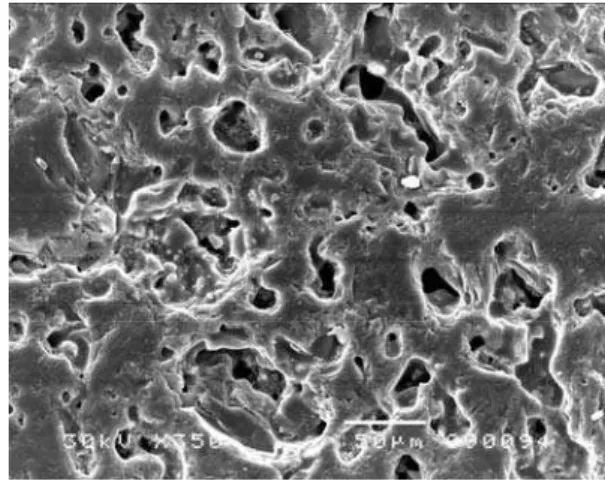
Fig. 1. SEM of S3G1 samples.
Microstructure of SG1 sample is characterized with pores with different shape, dimensions, and distrbution. Heating on the temperature of 600 °C process of elimination the graphite from the bulk of the sample was observed, and pores were replasing the places where graphite was found. One part of the observed pores is formed from graphite particles, and their dimensions are realted to several microns, but pores with grater dimensions were also observed.
3. Experimental
3.1. Water quench test
3.2. Ultra Pulse Velosty Testing (UPVT)
Ultra Pulse Velosty Testing UPVT was first reported on refractory materials in the late 1950’s and it has been subsequently applied frequently to characterize and monitor the properties of industrial refractory materials nondestructively [14-26]. Initial use of sonic velocity was related to specialized applications such as fireclay coke oven shapes, but from the 1980’s it has been applied to bulk refractories as well. Moreover, equations have been proposed to correlate the ultrasonic velocity or Young’s modulus to the strength or porosity of various refractories [14-26]. The UPVT method has been considered in detail in ref. [4-12].
The measurement of ultrasonic velocity was performed by using the equipment OYO model 5210 according to the standard testing procedure (ICS 81.080 SRPS D. B8. 121.). The transducers were rigidly placed on two parallel faces of the cylindrical sample having 1 cm diameter and 1 cm height using Vaseline grease as the coupling medium. The ultrasonic velocity was then calculated from the spacing of the transducers and the waveform time delay on the oscilloscope.
By measuring the bulk density, the Poisson’s ratio and ultrasonic velocity of a refractory material it is possible to calculate the dynamic modulus of elasticity using the equation below [16, 23-28]:
(
)(
)
⎟
⎟
⎠
⎞
⎜
⎜
⎝
⎛
−
−
+
=
dyn dyn dyn dynV
E
μ
μ
μ
ρ
1
2
1
1
2 (1) Where V is the pulse velocity (m/s), ρ is the bulk density (kg/m3) and μdyn the dynamicPoisson ratio, defined as :
(
)
(
2
2
)
1
2
2 2−
−
=
α
α
μ
dyn (2) S L V V =α
(3)3.3. Image analysis
Image analysis is useful tool for macro and micro structural characterization. Based on the structural analysis and by the correlation of these results with mechanical properties, material behavior in different conditions as well as material reliability could be discussed and monitored [14-20, 27]. Image analysis can be applied to define grain characteristics: maximal, minimal, mean; reinforcement: diameter and length of fibers, ratio of different phase, and degradation of the sample caused by different impact. In this paper image analysis will be applied on the samples to determine level of destruction caused by thermal shock testing.
Image Pro Plus presents special program for treatment and analysis of image. Program recognizes and enables work in all known formats of images (TIFF, JPEG, BMP, TGA...). This program automatically performs image analysis. It automatically measures, counts and classifies all obtained data about analyzed objects [13-20,27]. Program communicates directly with Excel program, what enables statistical and graphical treatment of data. In this study image analysis was used for the determination of damage surface level before and during the testing. Samples surfaces were marked by blue color in order to obtain better resolution and difference in damage and undamaged surfaces of the material. Results were given in percent and they were presented as ratio of P (non damaged surface) and P0
4. Results and Discussion
4.1. UPVT
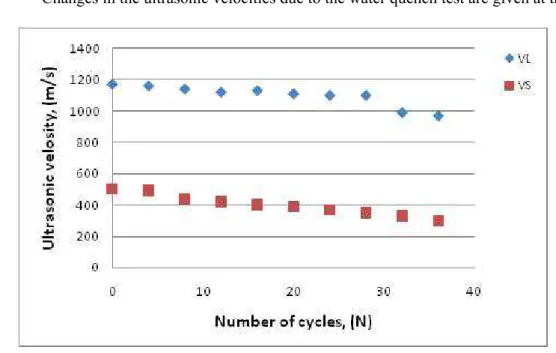
Changes in the ultrasonic velocities due to the water quench test are given at the Fig. 2.
Fig. 2. Changes in the ultrasonic velocities during experiment.
During the water quench test, ultrasonic velocities were decreasing (Fig. 2.), which was expected, as crack nucleation and propagation, as well destruction of the samples during testing was expected.
Fig. 3. Young modulus of elasticity degradation during experiment.
Young modulus of elasticity [5-14, 31].
4.2. Image analysis
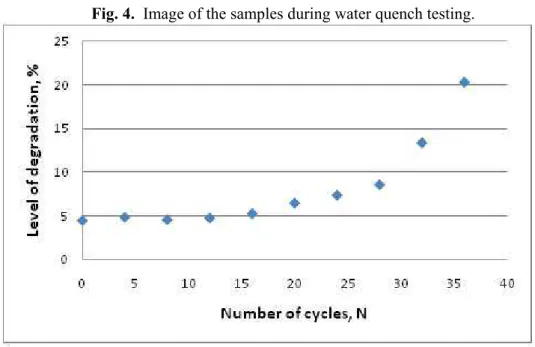
Level of damage during water quench experiment was monitored by image analysis. Image Pro Plus Program was applied for level of destruction determination. Samples were photographed before and during testing, in order to measure level of destruction and photographs are given at the Fig. 4. Results of the image analysis are given in the Fig. 5. as function of number of cycles of water quench test.
Fig. 4. Image of the samples during water quench testing.
These results for original surface before testing have to be taken into account, as they affect behavior of the sample during testing. For the lower values of degradation of the original surface, lower values of degradation at the end of the experiment are expected. Also, considerations related to the crack nucleation and crack propagation due to the thermal shock could be correlated to the influence of the original surface. After 28 cycles, more rapid degradation for SG1 samples was observed. Samples SG1 after 36 cycles showed level of degradation of 20.3 %. Results presented at the Fig. 5. where degradation of the samples during thermal shock was monitored, could be used for prediction of critical number of cycles samples could withstand. According to the standard procedure of water quench test [14-18, 23-27] degradation of the surface of the sample could be tolerated till 50 % of degradation of original surface. Applying this approach if critical level of degradation is 50 % of original surface, than linear interpolation could be used for obtaining the critical number of cycles, Nc, and graphical representation is given at the Fig. 6.
4.3.
Strength degradation modeling
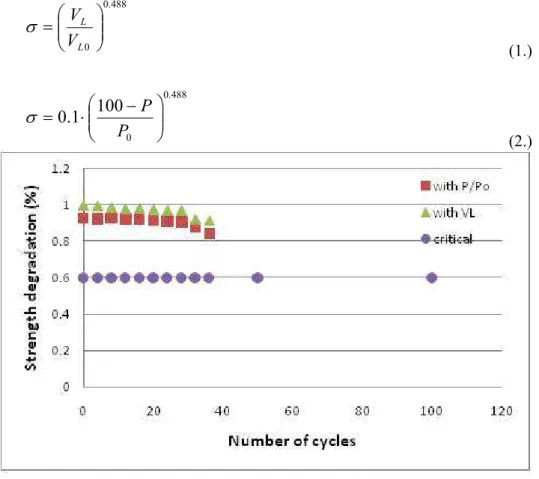
Strength degradation modeling was calculated using equations (1.) and (2.). These equations were similar to those previously used [23-28]
488 . 0
0 ⎟⎟⎠ ⎞ ⎜⎜ ⎝ ⎛ =
L L
V V
σ
(1.)
488 . 0
0
100 1 .
0 ⎟⎟
⎠ ⎞ ⎜⎜
⎝ ⎛ − ⋅
=
P P
σ
(2.)
Fig. 6. Critical number of cycles based on the level of degradation model.
Based on the equations 1 and 2, and using the approximation that critical level for strength degradation could be estimated to 60 % graphical results are given at the Fig.5.
5.
Conclusion
Ceramic composite material based on SiC/cordierite material with graphite content (10%) was synthetized in order to get different porosity of the samples, and investigate these effects on thermal stability behavior.
Thermal stability was monitored by:
1. Standard experimental method (water quench test),
2. UPVT applied for ultrasonic velocity and Young modulus of elasticity monitoring and 3. Image analysis for level of degradation during experiment.
Obtained results showed:
־ UPVT measurements could be correlated to the thermal shock cycles, either with change of ultrasonic velocity or Young modulus of elasticity. Degradation of the ultrasonic velocity could be used for strength modeling (equ 1.)
־ Results for the degradation level measured using image analysis could be correlated with the number of cycles. These results could be used for modeling the strength degradation during testing (equ 2.).
־ Results for modeling strength degradation during testing could be used for graphical presentation for critical number of cycles.
Acknowledgement
This research has been financed by the Ministry of Education, Science and technological development of Serbia as part of project III 45012.
6. Literature
1. G. W. Мееtham & М. H. Van der Voorde, Мaterials for High Temperature Engineering Applications, Springer, 2000
2. M. Bengisu, Engineering Ceramics, Springer, 2001
3. О. P. Gupta, Elements of Fuels, Furnaces and Refractories, Khanna Publishers, 2004.
4. J. D. Gichrist, Fuels, Furnaces and refractories, Pergamon International Laboratory, International Series on Materials Science and Tecnology, Vol 21, Biddlers Ltd, Guilford Surrey, 1997
5. W. D. Kingery, " Factors Affecting Thermal Stress Resistance of Ceramic Materials ", J.Am.Ceram.Soc., Vol 38, No 1, (1955) 3-15
6. D. P. H. Hasselman, "Unified Theory of Thermal Shock Fracture Initation and Crack Propagation in Brittle Ceramics ", J.Am.Ceram.Soc. ,Vol. 52 , No.1, 600 -604 (1969)
7. D. P. H. Hasselman, "Elastic Energy at Fracture and Surface Energy as Design Criteria for Thermal Shock", J. Am.Ceram. Soc. Vol 46, No 11, 535-540 ( 1963) 8. J. Nakayama J.Am.Ceram.Soc., "Direct Measurments of Fracture Energies of Brittle
Heterogenius Materials", J.Am.Ceram.Soc., Vol 48. No 11., 583 - 587 ( 1965) 9. J. Nakayama, M.Ishizuka, "Experimental Evidence for Thermal Shock Damage
Resistance ", Amer.Cer.Soc.Bull., Vol. 45 , No.7 666-669 (1965)
10. C. E. Semler, Nondestructive Ultrasonic Evaluation of Refractories, Interceram, Vol. 5 (1981), 485-488
12. S. K. Nyiogi, A. C. Das, “Prediction of the Thermal Shock Behaviour of Castable Refractories by Sonic Measurments“, Interceram, Vol 43, No 6, (1994), 453-457 13. Robert O. Russell, Gary D. Morrow, Sonic Velocity Quality Control of Steel Plant
Refractories, Am. Ceram. Soc. Bull., 63 (7), (1984) 911-914
14. G. E. Lockyer, E. A. Proudfoot, Nondestructive Determinations of Mechanical Properties of Refractory Materials, Am. Ceram. Soc. Bull, Vol. 46 (5) (1967), 521-526
15.T. D. Volkov Husovic, R. M. Jancic, D Mitrakovic „Image Analyisis Used to Predict Thermal Stability of Refractories“, American Ceramic Society Bulletin, Vol 84, No 10, (2005) October, pp 1-5
16.T. Volkov-Husovic, J. Majstorovic, M. Cvetkovic, Relationship Between Mechanical Characteristics and Thermal Shock Behaviour of Alumina Based Refractories, Interceram, Vol.52 (5) (2003), 296-299
17.T. D. Volkov Husovic, J. Majstorovic, M. Cvetkovic, Thermal Stability of Alumina Based Refractory, American Ceramic Society Bulletin, Vol 85, No 3, (2006) March 18. T.Volkov Husovic, Thermal Stability Testing of Refractory Specimen, Journal of
Testing and Evaluation, (2006) Vol 35, No 1. 1-5
19. J. Dostanić, M. Dimitrijević, R. Jančić Heinemann, T. Volkov Husović, Implementation of Image Analysis for Characterization of Refractories and Ceramic Fibres , 4th Balkan Conference on Metallurgy, Metalurgija/Journal of Metallurgy, Vol.11, No2. 2007,
20. D. N. Boccaccini, M. Romagnoli , E. Kamseu, P. Veronesi, C. Leonelli and G. C. Pellacani, Determination of thermal shock resistance in refractoty materials by ultrasonic pulse velocity measurments, Journal of European Ceramic Society, Volume 27, Issues 2-3, 2007, pp 1859-63
21. D. N. Boccaccini, Elie Kamseu, T. D.Volkov-Husovic, M. Cannio, M. Romagnoli, P. Veronesi, I. Dlouhy, A. R. Boccaccini, C. Leonelli, „Characterization of thermal shock damage in cordierite-mullite refractory material by non-destructive methods“, 4th Balkan Conference on Metallurgy, Zlatibor 2006, Proceedings,503-509
22. D. N. Boccaccini, M. Romagnoli, P. Veronesi, M. Cannio, C. Leonelli, G. Pellecani, T.Volkov Husovic, A. R. Boccaccini, Quality Control and Thermal Shock damage Characterization of High Temperature Ceramics by Ultrasonic Pulse Velocity Testing, International Journal of Applied Ceramic Technology, 4 [3] 260-268 (2007)
23.Posarac Milica B, Dimitrijevic Marija M, Volkov-Husovic Tatjana D , Majstorovic Jelena, Matovic Branko, The ultrasonic and image analysis method for non-destructive quantification of the thermal shock damage in refractory specimens, MATERIALS & DESIGN, (2009), vol. 30 br. 8, str. 3338-3343,
24. M. Dimitrijevic , M. Posarac, T.Volkov -Husovic, A. Devecerski and B. Matovic ,Thermal Shock Damage Characterization of High Temperature Ceramics by Non Destructive Test Methods, Ceramics-Silikaty,ISSN 0862-5468, 32 (2) 2008. pp 115-119,
25. M. Posarac, M. Dimitrijevic, J. Majstorovic, T. Volkov-Husovic, B. Matovic, Nondestructive Testing of thermal Shock Resistance of Cordierite/Silicon Carbide Composite Materials after Cyclic Thermal Shock, Research in Nondestructvive Evaluation, (2010), vol. 21 br. 1, str. 48-59,
26. M. Posarac, M. Dimitrijevic, T.Volkov -Husovic, A. Egelja A. Devecerski and B. Matovic, Thermal Stability of Cordierite/ Silicon Carbide Composites After Cyclic Thermal Shock, Journal of Optoelectronics and Advance Materials, ISSN 1454-4164, vol.10 br.4 (2008) 883-886,
measurements and image analysis application on testing in extreme conditions, Encyclopedia of Composites, 2nd Edition, Editors: Luigi Nicolais, Assunta Borzacchiello, publisher John Wiley &Sons, Hoboken, New Jersey, 2012,ISBN (printed set): 978-0-470-12828-2
28. E. Zadeh Hayati, O. Mohammad Moradi, M. Ghassemi Kakroudi, Investigation the effect of sintering temperature on Young’s modulus evaluation and thermal shock behavior of a cordierite–mullite based composite, Materials and Design, 45 (2013) 571–575
29.I. D. Katsavou, M. K. Krokida, I. C. Ziomas, Determination of mechanical properties and thermal treatment behavior of alumina-based refractories, Ceramics International 38 (2012) 5747–5756
30.A. Benhammou Y.El Hafiane, L. Nibou, A.Yaacoubi, J. Soro, A. Smith, J. P. Bonnet, B. Tanouti, Mechanical behavior and ultrasonic non-destructive characterization of elastic properties of cordierite-based ceramics, Ceramics International 39 (2013) 21–27
31. E. A. Dean, J. A. Lopez, Empirical dependence of elastic moduli on porosity for ceramic materials, Journal of the American Ceramic Society 66 (1983) 366–370.
Са р а: SiC/ ј ј
10 %. Ј
.
ђ ,
UPVT ( ) ј
ђ . Н
, ј ђ ј
, ј .
K учн р чи: ј / ј , , ,