BUILDING A COMPETITIVE BUSINESS INTELLIGENCE
ARCHITECTURE THAT CAN FOSTER PERFORMANCE IN THE
ROMANIAN NATIONAL RAILWAY COMPANY
Dr
ă
gan George Bogdan
Valahia University of Targoviste, RomaniaToday many industry players from banking, financial services, insurance, )T, healthcare, telecommunications and transportation are deploying competitive business intelligence to grow their company s financial results. The use of such advanced business applications is one key enabler to increase their spread which provides them an edge over their competitors. Companies of the future are buiding a new culture developed on fact-based decisions. BusinessWeek Research
Services, These decisions are made through analysis using the business
analytics systems which encourage the anticipation in solving complex business problems in the entire organization. Embracing this approach, these companies focus on their most profitable customers, define the right pricing, a faster product innovation, optimize supply chains and identify the real drivers of financial performance. This research paper will detail the theorethical importance of using competitive business intelligence architectures to gain competitive advantage.
Keywords: Competitive business intelligence, railway, new silk road, market liberalization, )R)S
JEL Code: O , O , O , O , R
1. Timeliness and appropriateness of the proposed theme
„A competitive business "intelligence system" is defined as "the organizational means to systematically collect, analyze, and disseminate information as intelligence to users who can act on it".
(erring, This definition makes a particular reference to those people in an organization who
choose to act taking into account the sifted and noteworthy data that is introduced to them. )t is basic to understand that just assembling information for its own purpose in a professional workplace is of next to no utilization to anybody, unless it aides focus an activity or reaction, if essential.
)ntelligence systems are bolstered commonly by cutting edge data get-together and investigation innovation. Second, these frameworks convey particular sorts of data that are vital deliberately to every organization in its own particular connection, for instance advertising or contender particular data. Third, every one of these frameworks have particular beneficiaries for their items, and not everyone is the beneficiary of the yield from such a framework.
All major companies and even some of the smaller ones have some sort of in-house library service that gathers systematically or on-demand, stores, and presents basic clipping-service type abstracts and reports to whoever wishes them. This is not, however, an organized intelligence system, such companies often have so-called technology assessment functions and even dedicated offices.
The end-product of a competitive business intelligence system is what is known as a competitive intelligence digest, which is a representation of the actionable information tailored to the
requirements and needs of each company. Biotechnology, Oct , The real nature of the
Ultimately, the National Railway Company requires two major types of information: one is science-related and the other is business-related. )t is important to note that in both cases the nature of the information is essentially the same. What is required is knowledge of one's own field, of related fields, and also of the broader contextual parameters that characterize the industry as a whole.
Thusly, a great insight overview would need to convey significant data in every one of the three data zones: in particular, more extensive, and context oriented. )t is additionally imperative to recollect that if significant data is built absolutely in light of data that is assembled from outsider open sources, one runs the danger of conveying noteworthy data that conveys with it the same predispositions as the source, which is an exceptionally critical threat in reality.
The way to great focused insight overviews is that they originate from competitive business intelligence system that start with data that is freely accessible, and utilize this as a premise to get further information specifically from human sources. As it were, the knowledge framework starts by social event open information, and after that this outsider information is coordinated with data acquired straightforwardly from human sources. At long last, organization particular connection is utilized to convey this data in a noteworthy arrangement, specifically one that will empower chiefs to act in an educated way.
2. Implementation of a Competitive Business Intelligence Architecture
A traditional B) architecture has analytical processing first pass through a data warehouse.
Rosebt, )n the new, Competitive Business )ntelligence architecture, data reaches users through
a multiplicity of organization data structures, each tailored to the type of content it contains and the type of user who wants to consume it.
The modern CB) architecture can analyze large volumes and new sources of data and is a significantly better platform for data alignment, consistency and flexible predictive analytics. Thus, the new CB) architecture provides a modern analytical ecosystem featuring both top-down and bottom-up data flows that meet all requirements for reporting and analysis.
Making a uniform perspective of the business from heterogeneous arrangements of information is not simple. )t requires some serious energy, cash, and persistence, frequently more than most departmental heads and business analyst are willing to endure. They regularly relinquish the top-down world for the underworld of spread stores and information shadow frameworks. Utilizing whatever instruments are promptly accessible and inexpensive, these information hungry clients make their own particular perspectives of the business. )n the long run, they invest more energy gathering and incorporating information than dissecting it, undermining their profit and a steady perspective of business data.
The bottom up world is a different process. Modern CB) architecture creates an analytical ecosystem that brings prodigal data users back into the fold. )t allows an organization to perform true ad hoc exploration predictive or exploratory analytics and promotes the rapid development of analytical applications using in-memory departmental tools. )n a bottom-up environment, users can't anticipate the questions they will ask on a daily or weekly basis or the data they'll need to answer those questions. Often, the data they need doesn't yet exist in the data warehouse.
Combining top-down and bottom-up worlds is challenging but doable with determined commitment. CB) professionals need to guard data semantics while opening access to data. Business users need to commit to adhering to data standards. Further, well designed data governance programs are an absolute requirement.
Modern CB) platforms enable organizations to process massive amounts of data in real-time, to search and analyze any type of unstructured or semi-structured data, to perform predictive analytics, and deliver this information to anyone, almost anywhere.
3. Transformation of the 21st century – Intelligent Railway
„The digital railway revolution can increase velocity, reduce congestion and capital expenditure and seamlessly integrate greater capacity for both passengers and freight. We are telling carriers to have higher expectations, because there is no doubt that we will be able to exceed them .
Dorfmeister,
Railways have always been associated with social and economic change. From early wagonways to the steam locomotives that powered the )ndustrial Revolution, rail has had a profound effect on commerce, industry and the movement of people and goods—shrinking distances and opening up exciting new horizons.
After a decline in the twentieth century, partly due to cheaper air travel, rail is undergoing something of a renaissance, with global demand currently outpacing available capacity. Ageing systems and operating models cannot keep up with demand for this inherently efficient, resource and emission-friendly mode of transport. Yet rail can easily be transformed into an agile, efficient and responsive operation using new and existing technologies, integrating real-time information to intelligently address operational, capacity and management issues.
The global rail market is currently estimated at about $ billion with predicted annual
growth of . % to at least. Although Europe has the largest market for railway equipment—
with spending of more than $ billion annually—some Asian countries, especially China, have invested massively in railway networks over the last decade. With an annual spend of more than € billion, Asia is beginning to rival Europe in terms of market size. This trend is forecasted to continue. Supply, demand and simple logistics are driving this growth in many areas. Dorfmeister,
)n what is termed the new silk road , a railway-driven conveyor of computers, TVs, car parts, and steel products moves west across continental Asia and into Europe. Recycled products, auto components, wine, and luxury goods make the journey in the other direction. Advances in manufacturing, commerce and retailing mean that delivery speed is more important than ever. Compared to container shipping, rail makes the journey in half the time and in a fraction of the carbon footprint by air or sea.
The story is the same way everywhere throughout the world. Vitality expenses and environmental change limitations progressively support payload transport by rail over its multi-purpose rivals. Urbanization is driving development sought after for traveler rail in the megalopolises of Europe, Asia and North America, with rapid frameworks moving more travelers from plane to rail, especially in the mid-separation venture division. An arrangement of a few variables is driving interest
for proficient rail transport, with the overall business anticipated to double by .
A significant number of the old, complex )T and control frameworks as of now set up were intended to fill a solitary need and were not constructed to be perfect with different frameworks. A few bearers even have diverse frameworks on distinctive lines. To exploit the new markets in cross‑continental rail, transporters' frameworks and data innovation must have the capacity to "talk"
to one another. Then again, new rail administrators and multimodal contenders have the capacity to receive new, adaptable )T foundations intended to boost the opportunities introduced by developing interest for the proficient development of individuals and products. Most limit issues can actually be overcome with more shrewd interest administration and better composed support of track and rolling stock.
Market liberalization has added further complexity to this picture in recent years. Major reorganizations and restructurings have shed jobs, often losing intellectual property and know-how in the process. The blunt separation of many previously heavily-integrated operations runs the risk of problems in resource allocation, planning management and future strategy.
Using better )T which seamlessly integrates with the existing business will allow operators to make more informed, sustainable responses to demand pressures in the rail sector, rather than simply answering increased demand with increased capacity.
4. The romanian competitive business intelligence architecture for The National Railway Company
The Romanian industry of railways plays a very important part in economy of the European Union because of its geostrategic positioning. Usually such companies are known as the largest employers also taxes payers in the country, consequently their importance is really great. )t is also noticed that the companies, which belong to the sector of railways compete in the market with the companies of other sectors of transport. That is why the matter of planning and implementing of the methods of competitive intelligence has taken on a special topicality as one of the ways to get a competitive advantage in the market. Usually to frame such methods on their own is a very difficult task for business organizations, so they seek assistance from to the companies, which provide them with such service. (owever it is necessary to remark that competitive intelligence is a continuous process with no interruption and only in this circumstance it is possible to expect the positive results. )n our opinion, this process should be started with framing of the methods. Vaidas G, Stasys D,
The competitive business intelligence architecture of the Romanian railway company was not sufficiently developed and strengthened. Existing databases worked freely so that certain capacities, combination, examination, pointers are dealt with exclusively. Computerization control strategies and including cautioning part chain choice data framework means adjusting and executing a satisfactory data framework. (e who has the general goal of improving institutional limit area organization, enhance quality and amount of data needed for choice rolling out and conduct improvement in connection to the foundation's current recipients and inside and outside accomplices. For these reasons it had been implemented a complex and competitive business architecture that meets Romanian National Railway Company and it s called )R)S.
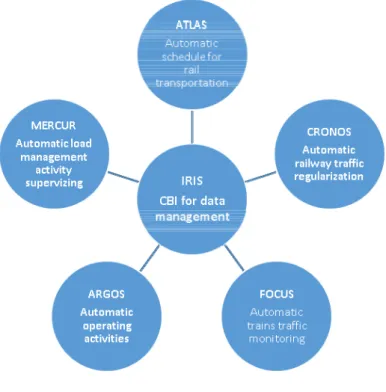
Fig. 1. IRIS framework
From a technical standpoint, in the development of the CB) named )R)S were adopted cutting – edge solutions: client server applications with central database ORACLE – it is a very complex architecture with multiple databases, and whom are using specialized software for transactions management.
)R)S viewed as a CB) architecture, can be presented as an integrated collection of different application, each defined as complex systems. As its main functions, they cover these applications: management of commercial activities for loading and unloading of freight and passengers, contract management and customer management.
)n developing this CB) architecture they were individuals involved as part of the design and implementation team, including specialists in )T, infrastructure, freight and passengers transportation and let s not forget experst in commercial departments. (undreds of prospectives users of this CB) architecture were trained in several centers, thousands of data processing equipment has been bought and installed in many units plus it was set up a complex communications link that will allow fast and secure acces to raw and complex data.
Given the particular pressures faced by railway companies from steakholders, implementing a CB) architecture as )R)S will help improve the quality of rail services.
Work on this CB) architecture began in conditions of rapid developments of data transfer and importance at the international level and therefore could not keep up with this pace of development, because you are forced to put in budget restrictions. Another difficulty has been to create a unique design team. This project is an effort of experts in )T, railway experts from the three railway subsidiaries of the RNRC involved and has enjoyed the technical assistance of a British Consortium. The difficulty in creating a unique design team was manifested particularly in collaboration with British experts, who had not only enlighten them in connection with the technical terms, but also with the practices of the RNRC that are sometimes different from those of the British rail system.
Creating this complex CB) architecture was not very easy, neither because these applications were developed in-house, the whole architecture was conceived by the design team, in the aforementioned team. Then followed the experimentation and implementation of applications, which
represented a great challenge through the installation of over PCs and servers, all interconnected
into a network, and training to thousands of users. Also, in the case of a working system in real time trains never stops , this requires ensuring the functioning of the system and of technical assistance in terms of use of the application continuously.
Therefore, )R)S should be regarded as a condensation of intelligence specialists in )T and in combination with rail experts working side by side, thus being a special effort because it should be noted that for rail professionals involved was a supplementary activity-were occupied by )R)S alongside the other work tasks they had within the railway companies where they were hired.
The )R)S CB) architecture was designed by putting the spotlight mostly on the commercial character of railway activities. The essence of the RNRC and the reform of European Union directives is that you cannot perform activities in a loss, the railway must cover their costs and make a profit. The second feature that gives a distinct personality of this CB) is the integrated approach to activities that are conducted in different companies, but ensuring the privacy of each company. Although it is only in the implementation phase, the )R)S is already known in Europe and beyond. )R)S is made up of multiple applications.
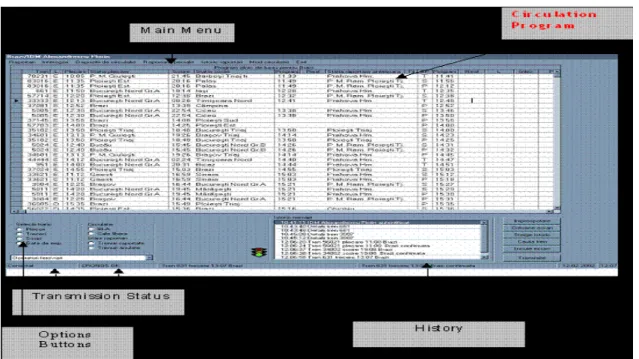
Fig. . Print screen of ATLAS module
The second application of this CB) architecture is called – CRONOS – which reffers to being an automatic railway traffic regularization instrument whos purpose is consisting in deviation and reporting circulation and management of the programme and the provisions regulating the movement of data. The emergence of late trains bear the obligation of provision for regulating shipment movements. They have already preformed in texts and normal system that are much simpler and faster to send; They propagate in a similar e-mail system, of course, protected-mode application that users only can access.
Fig. 3. Print screen of CRONOS module
Fig. 4 Print screen FOCUS module
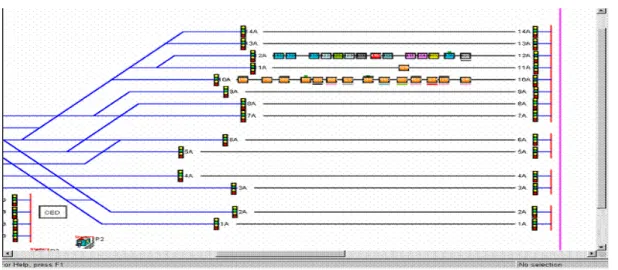
The application number four of this CB) architecture is called – ARGOS – and refers to the automatic monitoring of operational activities in technical stations and marshalling yards and is aimed at Freight and Passenger transportation companies. This application shows the schematic map on the monitor screen of the station as it is represented in the technical plan of station, this being figurative with different types of symbols and locomotives, carriages and trains in the station.
)n a similar vein is the fifth module of the CB) architecture and it is called – MERCURY - which is intended for the management of load-unloading activities with the commercial component. (ere, the user must enter all orders of railcars, which generates in the computer system of electronic waybills, which, as the meeting controls, is filled with real data, and when the wagons are loaded and delivered to the station and customer representative comes to the cashier, pricing and billing can be done automatically. Thus the chances of double records exist of this financial operations are almost zero.
Fig. 5. Print scren for ARGOS and MERCURY modules
Among the main advantages of this CB) architecture we can call:
- )R)S CB) is money well spent, offering real-time information;
- the calculation of transport charges and transferring them correctly and on time;
- control of train movements in order to reduce delays;
- information to customers of real time positioning of their goods;
of trains with the help of this architecture that will lead to the reduction of delays and the precise and quick calculation of revenue obtained through receipt of the RNRC use of the railway infrastructure, customers will be better informed about the status and location of their consignments within and will know in advance the most precise time of the arrival of goods at destination.
5. Conclusions
There is great business value in building a modern CB) architecture to provide an analytics ecosystem where complex and varied data sets can be mined for gold: actionable insights to make better decisions.
Exploring the data involves three key steps:
- )dentifying the data sources that can contribute to an organization's data repository
- Building a strong, scalable data management foundation
- Layering new analytic tools on top of the data to provide new insights.
Transforming the National Railway Company into a data-driven organization - turning information into actionable insights is a part strategy - only one of which is )T - a modern CB) architecture:
- Technology – build a modern B) architecture & analytics ecosystem with the right tools
- Processes – streamline and standardize CB) processes, measurements, and reports wherever
possible
- People – train staff to use CB) tools, become data-driven decision makers to meet the needs of the
organization.
The goal of a modern CB) architecture is to allow the organization to:
- Make confident, data-based decisions based on evidence
- Access timely, relevant information you need, to meet the requirements of all types of users
- Link strategy to execution, leveraging data from all data sources
- Get answers when and where you need them on any device, at any time
- Transform data into actionable insight for everyone
- Uncover new or hidden opportunities to increase competitiveness
- Explore data in an intuitive way, for immediate answers to questions
The full potential of integrating these sensing technologies and intelligently using the vast amounts of data they generate has yet to be realized, but it is without doubt one of the greatest opportunities open to the twenty first century rail carrier.
References
1. Biotechnology, N. (Oct 1, 2000). Competitive business intelligence gathering and analysis. Nature Publishing Group.
2. BusinessWeek Research Services. (2009). Driven by Data: The Importance of Building a Culture of Fact-Based Decision-Making.
3. Dorfmeister, W. (2014). Intelligent Rail - 21st century transformation on track with HP i-Rail. Business White Paper.
4. Herring, J. (1996). Presentation to the Snider Entrepreneurial Center. The Wharton School,The University of Pennsylvania.
5. Rosebt. (2012, 11 7). Retrieved from www.rosebt.com: http://www.rosebt.com/blog/modern-bi-architecture-analytical-ecosystems