J Educ Eval Health Prof 2016; 13: 31 • http://dx.doi.org/10.3352/jeehp.2016.13.31
Research article
Open Access
Hands in medicine: understanding the impact of
competency-based education on the formation of medical students’ identities
in the United States
Catherine Gonsalves
1*, Zareen Zaidi
21University of Florida College of Medicine, Gainesville FL, USA; 2Department of Medicine, University of Florida College of Medicine, Gainesville FL, USA
Abstract
Purpose: There have been critiques that competency training, which deines the roles of a physician by simple, discrete tasks or measurable competencies, can cause students to compartmentalize and focus mainly on being assessed with-out understanding how the interconnected competencies help shape their role as future physicians. Losing the meaning and interaction of competencies can result in a focus on ‘doing the work of a physician’ rather than identity formation and ‘being a physician.’ This study aims to understand how competency-based education impacts the development of a medical student’s identity. Methods: Three ceramic models representing three core competencies ‘medical knowledge,’ ‘patient care,’ and ‘professionalism’ were used as sensitizing objects, while medical students relected on the impact of competency-based education on identity formation. Qualitative analysis was used to identify common themes. Results:
Students across all four years of medical school related to the ‘professionalism’ competency domain (50%). They relected that ‘being an empathetic physician’ was the most important competency. Overall, students agreed that competency-based education played a signiicant role in the formation of their identity. Some students relected on having diiculty in visualizing the interconnectedness between competencies, while others did not. Students reported that the assess-ment structure deemphasized ‘professionalism’ as a competency. Conclusion: Students perceive ‘professionalism’ as a competency that impacts their identity formation in the social role of ‘being a doctor,’ albeit a competency they are less likely to be assessed on. High-stakes exams, including the United States Medical Licensing Exam clinical skills exam, pro-mote this perception.
Keywords: Competency-based education; Perception; Physicians; Medical Students; United States
Introduction
Competency training in the medical ield is based on dein-ing speciic areas in which future doctors need focus and ex-perience. Medical competence has been deined as ‘the habit-ual and judicious use of communication, knowledge, techni-cal skills, clinitechni-cal reasoning, emotions, values, and relection
in daily practice for the beneit of the individuals and commu-nities being served’ [1]. Competency-based education has been defined as: ‘competency-based education (CBE) is an approach to preparing physicians for practice that is funda-mentally oriented to graduate outcome abilities and organized around competencies derived from an analysis of societal and patient needs. It de-emphasizes time-based training and prom-ises greater accountability, lexibility, and learner-centeredness’ [2,3].
The University of Florida College of Medicine (UFCOM) has a competency-based curriculum. At UFCOM, student performance and evaluation is based on six core
competen-*Corresponding email: [email protected]
Received: June 26, 2016; Accepted: August 30, 2016;
Published online: August 31, 2016
his article is available from: http://jeehp.org/
cies: professionalism; patient care; medical knowledge; prac-tice-based learning; interpersonal and communication skills; and systems-based practice. he competencies and how they will be measured are described in each course and clerkship syllabus. Course directors list measurable learning objectives for each competency as part of each course and clerkship. Stu-dents are made aware that they will be evaluated based on how they perform in these areas. his study aims to examine the intersection between CBE and identity formation. Our re-search question is: “How does competency-based education impact the development of a medical student’s identity?”
Methods
Study design
his was a cross-sectional study where the qualitative data was analyzed using a theoretical thematic analysis approach [4].
Creation of ceramic models
he irst author (CG) who just inished her irst-year as a medical student at the UFCOM, Gainesville in 2013 under-took this research project as part of the ‘Medical Student Re-search Program’ (MSRP). During the MSRP, UFCOM medi-cal students are invited to apply for a scholarship that will sup-port them for a 10-week individual research experience dur-ing the break between irst and second year, under the men-torship of a faculty member. CG has multiple years of experi-ence in pottery and set-out to integrate her art skills with her MSRP project. She created three ceramic models collectively called ‘hands in medicine’. he models were used as ‘sensitiz-ing objects’ to help the students relect on the mean‘sensitiz-ing of com-petencies. Reflection requires students to break away from routine actions to pause and make sense of events. Various sensitizing objects or themes have been described in medical education to promote reflection including artwork, poetry and film [5,6]. Here the ceramic models/sensitizing objects were used to promote relective thinking by the medical stu-dents as they described the impact CBE had on the formation of their identity as future physicians. For this study, three of the six UFCOM competencies (medical knowledge, patient care, and professionalism) were picked for the ceramic model development. he authors picked these competencies as the curriculum placed signiicant longitudinal emphasis on these competencies through all four-years. he hands represented the three different training competencies medical students encounter during their training (Fig. 1). he model titled ‘alive by death’ was a partially dissected cadaver hand and was made to represent the ‘medical knowledge’ competency emphasized more in the preclinical years of study. he model named
‘lis-tening touch’ depicted a hand holding a stethoscope and rep-resented the ‘patient care’ competency taught as part of the in-troduction to clinical skills sessions. he third model, called ‘building blocks,’ was a doctor shaking a patient’s hand and was meant to symbolize the ‘professionalism’ competency of building rapport with patients.
Participants and recruitment
Fifty-eight medical students attending the UFCOM were invited to participate in the study. here were 11, 19, 12, and 16 students from medical student (MS)1, MS2, MS3, and MS4 grades each. CG hosted each relection session with all partic-ipants. Each session had a 5-minute introduction that consist-ed of a standardizconsist-ed explanation of what competency each model represented. he competencies were only named and not explained in detail. This left the meaning open to each student’s understanding of their significance based on their personal experience with the curriculum. They were then asked to write their reflections down while answering two questions crafted to help answer the research question: (1) looking at these models, explain why you identify best with a particular competency model (or models) at this stage of your training and (2) looking at these models, how does medical school training in diferent competencies afect the develop-ment of your identity as a future doctor? All data collected was anonymized with only year in medical school recorded as identifying information; denoted MS and year in training. To deine MS year designation: MS1s were beginning their irst year; MS2s had completed their first year and were starting their second year; MS3s were at the beginning of their clerk-ships; and MS4s were in their sub-internship year.
Data analysis
Qualitative data analysis was undertaken using Braun and Clarke framework for thematic analysis [4]. Using her exten-sive experience in qualitative research the second author (ZZ)
guided the process of the thematic analysis. Both researchers independently read through the relective writing texts identi-fying, coding, and reporting themes and sub-themes. They discussed results and agreed on over-arching themes and sub-themes. Inter-rater reliability of identified themes and com-ments assigned to themes were calculated using methods de-scribed by Huberman [7]. Inter-rater reliability was 100% ater discussion among the researchers. he researchers also asked a participant to perform a member check to ensure that the themes captured all-important issues.
Ethical approval
Institutional review board (IRB) approval was sought from the University of Florida IRB oice (Protocol #2014-U-585).
Results
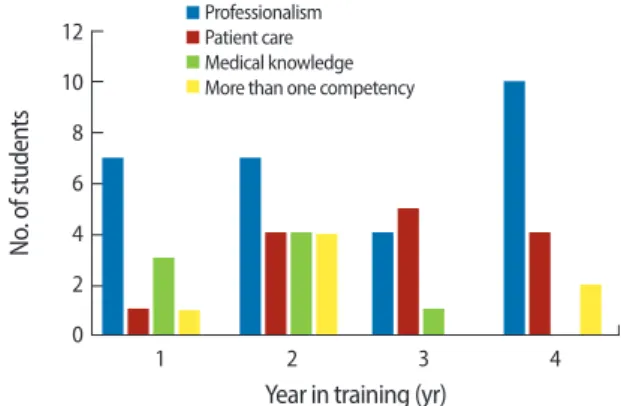
Professionalism depicted in the model of the doctor shak-ing a patient’s hand was the most frequently picked compe-tency by MS1, MS2, and MS4 students as the compecompe-tency that most impacted their identity formation (Fig. 2). MS3s picked ‘patient care’ as the most important competency. hree main themes emerged: impact of curriculum, impact of experience, and perception of the impact of CBE on identity formation. he themes and examples of comments are described below.
Impact of curriculum
This theme refers to the curricular competencies that the students related, based on which ceramic model they chose to relect on. he students identiied professionalism as the com-petency that had the most impact on how they viewed them-selves as future physicians. Students mentioned that they learn-ed about the importance of humanistic skills: “Several patients come with benign pathology and the pill they really need is an open ear, someone they can trust, someone who will listen to
them.” An MS2 commented: “Looking at these models I hope I will remember there is a common thread of the holistic touch of humanism.”
Several students commented that their knowledge within each competency would grow over time, specifically “each competency is crucial to reach [the culmination of quality pa-tient care] and must be continually developed throughout my time as a physician.” Others commented on the structuring of the curriculum: “Medical school training currently emphasiz-es scientiic competency irst in the curriculum, followed by clinical inpatient competencies in third and fourth year. While these three areas act as separate entities during the initial years of training, I feel that they do inluence each other in multiple ways.” Another noted: “During school, [competency stages] are very segmented with only a little interaction between them.” One student also commented on curricular workload: “I’ve found myself putting countless hours into learning facts and processes related to the body and disease.” Some students not-ed that as they progressnot-ed they might develop an ainity for a particular competency based on the specialty they chose to pursue: “[Somewhere] towards the end of our training, we re-alize we have an ainity to one of these competencies over the other.” And “I think as we go along with training we tend to identify with one more than the others and the focus on that competency tends to direct our goals for future profession (i.e., specialty).”
Discussing the impact of contact with patient an MS3 com-mented: “I particularly like how the positioning of [‘listening touch’] invites me to be the patient, as though the sculpture is willing to listen to me … his is how I wish my patients to feel when they visit me. A true physician listens deeply to their pa-tients, both in the exam of their body and in the exploration of the story of their life.”
Impact of experience
Students discussed the role of experience through the years of training in a competency-based curriculum and how work-ing in the hospital helped them co-relate basic science infor-mation with patient care. Other students commented on anxi-ety associated with patient care early in medical school. An MS2 wrote, “I do not yet feel comfortable or as competent … I think this can be attributed to the fact that I spend so little time in the [clinical] settings.” And “At this point, I don’t have the knowledge to identify with the clinical aspects of medi-cine, but I do know about the way doctors should interact with their patients—with care, respect, and kindness.” In con-trast another MS2 commented: “he experiences I have had thus far in medical school have caused an emotional growth as well.”
Fig. 2. Distribution of ‘competency’ model chosen by year of training.
12
10
8
6
4
2
0
No
. of studen
ts
1 2 3 4
Year in training (yr)
Perception of the impact of competency-based education on identity formation
Students commented on how CBE has affected their per-ception about their future roles. Several pointed out that their identity would be impacted positively by exposure to all com-petencies during medical school: “A doctor’s job is not solely to be academic, clinical, or patient-oriented, but a nice mix-ture of all three. My identity as a fumix-ture doctor is driven by the mixture of these three skills taught to me at UFCOM.” An MS2 commented: “he emphasis that the school puts on diferent components of a medical education can definitely influence the emphasis I put on them in my own mind … I would also posit that my training as a doctor afects my identity outside of being a doctor, it permeates through all aspects of my life.”
Several students commented on the negative afect of CBE: “[Each competency is] important but too much focus on one can cause diiculty in your future practice.” An MS4 comment-ed that “[Competency-bascomment-ed training] hurts me. It stresses standardized tests and depersonalizes patients. When residen-cies care most about step 1/step 2 and not your interpersonal skills then that’s the physician population that the system re-wards and cultivates for the future.” One student commented: “Medical school cannot teach us the sculpture of physician holding patient hand. That is something we must all learn from our own hearts—a deep caring for others … ironically, the un-teachable part might just be the most crucial.”
Discussion
he main inding of the study was that students view ‘pro-fessionalism’ as the most important competency that impacts the formation of their identity through medical school. his could stem from the fact that the UFCOM does emphasize this competency throughout its curriculum. he learning ob-jective sections in the UFCOM clerkship syllabi, consistently lists professionalism as the irst competency goal. Profession-alism is also always the irst competency to be evaluated on feedback forms. herefore, in this study CBE helped students focus on speciic graduation competencies, particularly ‘pro-fessionalism,’ which they viewed as the most important com-petency that impacted their future identity of well-trained, competent, and empathetic future physicians. It was interest-ing to note that the MS3s were the only group that picked the ‘patient care’ competency over ‘professionalism.’ As the MS3s were at the beginning of their clerkships, it is possible that transition into the clinical world prompted them to place more emphasis on patient care.
Competency-based education shapes the identities and ex-periences medical students have during their training [1,2]. It has been argued that CBE results in too much focus on
assess-ment and overlooks the importance of stressing the intercon-nectedness of competencies [8]. This is not to suggest that CBE is redundant, but as Jarvis-Selinger et al. [8] point out, there is a need to incorporate frameworks within CBE to re-mind students about their holistic identity as a future care provider. For instance, in order to address ‘professionalism’ as a competency, medical education needs to address the emo-tional realm. As medical students progress, the curriculum should explicitly allow discussions with them about their feel-ings and perceptions about their identities as future physicians in order to counter an oten hidden curriculum that encour-ages students to separate or distance themselves from their emotions [9].
In our study, students presented both a positive and negative viewpoint about the impact of CBE on their view of themselves as future physicians. he negative aspect was described as an alternate curriculum de-emphasizing the importance of the ‘professionalism’ competency, as some students pointed out that residency directors were more concerned about step scores.
Students discussed how they view their medical training as a longitudinal progression through stages of training, most notably preclinical to clinical years. Some saw these stages as distinct entities with little interaction between them, while other students felt that the stages influenced each other in many ways. hese views imply that competency-based educa-tion runs the danger of being too segmented and compart-mentalized. Students relections on their growth, both medi-cally and personally, through their medical training also re-vealed that growth occurred both in and outside the medical setting, which corroborates findings by Jarvis-Selinger et al. [8], who note that medical training does not take place in a vacuum and competency training is not enough. Medical ed-ucators should pay careful attention to professional identity formation by ensuring that curricula provide a continuum of opportunities for formative development focusing on under-standing individual professional identity integrated with other core medical skills rather than a separate entity.
ORCID:
Catherine Gonsalves: http://orcid.org/0000-0003-1957-1543; Zareen Zaidi http://orcid.org/0000-0003-4328-5766Conlict of interest
No potential conlict of interest relevant to this article was reported.
Funding
Col-lege of Medicine scholarship funds dedicated to supporting the Medical Student Research Program and by the Gatorade Trust through funds distributed by the Department of Medi-cine, University of Florida, Gainesville, Florida, USA.
Supplementary materials
Audio recording of the abstract. Raw data of the research.
References
1. Frank JR, Snell LS, Cate OT, Holmboe ES, Carraccio C, Swing SR, Harris P, Glasgow NJ, Campbell C, Dath D, Harden RM, Iobst W, Long DM, Mungroo R, Richardson DL, Sherbino J, Silver I, Taber S, Talbot M, Harris KA. Competency-based medical edu-cation: theory to practice. Med Teach 2010;32:638-645. http:// dx.doi.org/10.3109/0142159X.2010.501190
2. Frank JR, Mungroo R, Ahmad Y, Wang M, De Rossi S, Horsley T. Toward a deinition of competency-based education in medicine: a systematic review of published deinitions. Med Teach 2010; 32:631-637. http://dx.doi.org/10.3109/0142159X.2010.500898
3. ten Cate O, Scheele F. Competency-based postgraduate training: can we bridge the gap between theory and clinical practice? Acad Med 2007;82:542-547. http://dx.doi.org/10.1097/acm.0b013 e31805559c7
4. Braun V, Clarke V. Using thematic analysis in psychology. Qual Res Psychol 2006;3:77-101.
5. Wear D, Zarconi J, Kumagai A, Cole-Kelly K. Slow medical edu-cation. Acad Med 2015;90:289-293. http://dx.doi.org/10.1097/ ACM.0000000000000581
6. Shapiro J, Kasman D, Shafer A. Words and wards: a model of re-lective writing and its uses in medical education. J Med Humanit 2006;27:231-244. http://dx.doi.org/10.1007/s10912-006-9020-y 7. Huberman AM, Miles MB. he qualitative researcher’s
compan-ion. housand Oaks (CA): Sage Publications Inc.; 2002. 424 p. 8. Jarvis-Selinger S, Pratt DD, Regehr G. Competency is not enough:
integrating identity formation into the medical education dis-course. Acad Med 2012;87:1185-1190. http://dx.doi.org/10.1097/ ACM.0b013e3182604968