Phosphate
Eric S. Melby, Douglas J. Soldat*, Phillip Barak
Department of Soil Science, University of Wisconsin-Madison, Madison, Wisconsin, United States of America
Abstract
Phosphorus (P) has only one stable isotope and therefore tracking P dynamics in ecosystems and inferring sources of P loading to water bodies have been difficult. Researchers have recently employed the natural abundance of the ratio of 18O/16O of phosphate to elucidate P dynamics. In addition, phosphate highly enriched in oxygen-18 also has potential to be an effective tool for tracking specific sources of P in the environment, but has so far been used sparingly, possibly due to unavailability of oxygen-18 labeled phosphate (OLP) and uncertainty in synthesis and detection. One objective of this research was to develop a simple procedure to synthesize highly enriched OLP. Synthesized OLP is made up of a collection of species that contain between zero and four oxygen-18 atoms and, as a result, the second objective of this research was to develop a method to detect and quantify each OLP species. OLP was synthesized by reacting either PCl5or POCl3with water enriched with 97 atom % oxygen-18 in ambient atmosphere under a fume hood. Unlike previous reports, we observed no loss of oxygen-18 enrichment during synthesis. Electrospray ionization mass spectrometertry (ESI-MS) was used to detect and quantify each species present in OLP. OLP synthesized from POCl3contained 1.2% P18O16O3, 18.2% P18O216O2, 67.7% P18O
316O, and 12.9% P18O4, and OLP synthesized from PCl5contained 0.7% P16O4, 9.3% P18O316O, and 90.0% P18O4. We found that OLP can be synthesized using a simple procedure in ambient atmosphere without the loss of oxygen-18 enrichment and ESI-MS is an effective tool to detect and quantify OLP that sheds light on the dynamics of synthesis in ways that standard detection methods cannot.
Citation: Melby ES, Soldat DJ, Barak P (2011) Synthesis and Detection of Oxygen-18 Labeled Phosphate. PLoS ONE 6(4): e18420. doi:10.1371/ journal.pone.0018420
Editor:Meni Wanunu, University of Pennsylvania, United States of America
ReceivedNovember 19, 2010;AcceptedMarch 4, 2011;PublishedApril 4, 2011
Copyright:ß2011 Melby et al. This is an open-access article distributed under the terms of the Creative Commons Attribution License, which permits unrestricted use, distribution, and reproduction in any medium, provided the original author and source are credited.
Funding:This research was funded by the University of Wisconsin-Madison Graduate School. The funders had no role in study design, data collection and analysis, decision to publish, or preparation of the manuscript.
Competing Interests:The authors have declared that no competing interests exist.
* E-mail: [email protected]
Introduction
The lack of multiple stable isotopes of P has led researchers to study the ratio of16O and18O in phosphate, the dominant form of P in the natural environment. The naturally occurring ratio of
18
O/16O bonded to phosphorus in phosphate, expressed asd18
Op,
has been used to infer the source of P in water bodies [1–6]. Gruau et al. [7] found substantial variability ofd18
Opwithin P sources
and considerable overlap ofd18Opamong different P sources and
therefore questioned the value of this method as a research tool. Based on the variability and overlap ofd18
Opin natural sources,
some researchers have used a method that enriches phosphate in oxygen-18, making it very distinct from any other P sources. The synthesis of oxygen-18 labeled phosphate (OLP) is generally carried out by hydrolyzing either PCl5 or POCl3 with water
enriched with oxygen-18. This reaction is typically carried out in an atmosphere devoid of moisture to prevent the highly reactive PCl5 or POCl3 from reacting with atmospheric water [8–11].
Middleboe and Saaby Johansen [12] reported that up to one-half of the18O enrichment was sacrificed when POCl
3was hydrolyzed
with H218O in ambient atmosphere.
Analysis of the 18O/16O ratio of OLP has been previously carried out through the use of optical emission spectroscopy [9,13,14], in which the OLP present in solution, plant tissue (after being extracted with 0.5 M HCl), or soil (after being extracted with anion exchange resin) is precipitated as struvite
(MgNH4PO4?6H2O) [9,14]. This precipitate is pyrolyzed to
carbon monoxide, which is analyzed for its 18O/16O ratio by optical emission spectroscopy [14]. Synthesized OLP is made up of a collection of species that contain between zero to four oxygen-18 atoms. Optical emission spectroscopy is only capable of deter-mining an overall18O/16O ratio and is not able to distinguish between the various OLP species. The use of electrospray ionization mass spectrometry (ESI-MS) has also been presented as a viable means to determine the18O/16O ratio of OLP and as a detection tool that can differentiate between OLP species. OLP dissolved in water was analyzed by ESI-MS and the results were compared to those obtained with31P NMR analysis. The authors reported good agreement between the ESI-MS and 31P NMR results [11]. However, ESI-MS is sensitive at mg L21 P levels, which is lower than31P NMR limits of detection.
The first objective of this research was to develop a simpler, efficient technique for the synthesis of OLP. The second objective was to use ESI-MS to quantify the individual OLP species present in synthesized OLP compounds. A final objective included determining the stability of OLP stored in sterile conditions over a period of several months.
Methods
Department (Madison, Wisconsin) as POCl3 and PCl5are both
highly toxic chemicals. A chemical resistant suit, chemical resistant gloves, and a positive pressure, self-contained breathing apparatus (Scott Health and Safety, Monroe, North Carolina) were worn during the handling of these chemicals and during their reaction with water to prevent any contact or inhalation of fumes.
OLP Synthesis from POCl3
The synthesis of OLP from POCl3 was carried out in a
256200 mm glass test tube contained within a 250 mL Erlen-meyer flask filled with 150 mL of water to moderate the temperature. The flask and test tube were placed on a combination stir/hot plate within a fume hood. OLP was synthesized through the following spontaneous and highly exothermic reaction:
POCl3z3H2O?H3PO4z3HCl
2.00 g of water with 97 atom %18O (Sigma-Aldrich, St. Louis, Missouri) were added to the test tube, followed by 4.87 g of POCl3
(Pfaltz and Bauer Inc., Waterbury, Connecticut) added drop wise while stirring with a magnetic stir bar. Labeled water was added in 10% excess to ensure that the POCl3 reacted completely with
water containing 18O. After the vigorous reaction subsided, the test tube was heated for 2 h at 100uC with stirring to remove HCl produced during the reaction. Following heating, the test tube was allowed to cool to room temperature and 5 M KOH was added to raise the pH to 4.7. The KH2PO4 product was diluted with
ultrapure water, and the P concentration of this solution was determined using an IRIS Advantage inductively coupled plasma optical emission spectrometer (ICP-OES) (Thermo Jarrell Ash, Franklin, Massachusetts). The reaction was carried out with pure POCl3, and with POCl3stored for a period of 6 and 17 months
after it was initially opened to determine if there was any effect of long term POCl3storage on the OLP species composition.
OLP Synthesis from PCl5
The synthesis of OLP from PCl5was carried out using the same
procedure as described above, but this time reacting 2.50 g of PCl5
(Sigma-Aldrich, St. Louis, Missouri) with 1.00 g of water containing 97 atom %18O (Sigma-Aldrich, St. Louis, Missouri)
through the following spontaneous and highly exothermic reaction:
PCl5z4H2O?H3PO4z5HCl
The reaction was carried out with freshly opened PCl5, and
PCl5that was stored for a period of 17 months after it was initially
opened.
Quantification of Species Using ESI-MS and Long-Term Stability of OLP in Sterile Water
Electrospray ionization mass spectrometry (ESI-MS) was used to establish a ratio of each of the species present in the synthesized OLP. All samples were analyzed using an Agilent 1100 LC-MSD SL single-quadrupole model 1946D mass spectrometer (Agilent Technologies, Santa Clara, California). Table 1 lists the liquid chromatography (LC) and mass spectrometer (MS) conditions used for this analysis. The samples were diluted to approximately 60 mg L21
P prior to analysis and analyzed in duplicate injections. Oxygen labeled phosphate eluted from the LC beginning at ,4.2 min and ending at 4.5 min after injection. During OLP analysis by ESI-MS, them/zrange monitored was 90–120, as the peaks of interest werem/z 97 (H2P16O42), 99 (H2P16O318O2),
101 (H2P 16
O2 18
O22), 103 (H2P 16
O18O32), and 105 (H2P 18
O42).
All other peaks within this range were negligible (Fig. 1). The area of each spectra for individual phosphate species were compared to the cumulative area of all the phosphate species allowing for the calculation of the relative contribution of each phosphate species shown in Figure 1. This relative information was used with the total P concentration of the sample to calculate the concentration of phosphate species in solution.
To monitor the stability of OLP solutions in a sterile environment, aqueous OLP solutions were diluted with autoclaved ultrapure water, placed in autoclaved polypropylene containers, and stored in darkness at 4uC.
Results
Data from the ESI-MS analysis of OLP synthesized from POCl3
and PCl5are shown in Tables 2 and 3, respectively, along with the
theoretical synthesis values. Theoretical values were calculated
Table 1.Liquid chromatography and mass spectrometry conditions used for electrospray ionization mass spectrometer analysis of oxygen-18 labeled phosphate.
Parameter Condition
Liquid chromatography
Column Waters IC-Pak Anion HR, 4.6675 mm, 6mm particle size (Waters Corp., Milford, Massachusetts)
Mobile phase Isocratic: 25% acetonitrile, 75% 50 mM ammonium bicarbonate (pH 10)
Flow rate 0.5 mL min21
Column temperature 30uC
Mass spectrometry
Injection volume 15mL
Source voltage 2250 V
Drying gas Nitrogen, 350uC, 40 L min21, 40 psi
Ionization Electrospray
MS detection Single ion recording (SIR) mode
assuming completely random arrangement of the oxygen atoms from labeled water and assuming no P-O bonds of POCl3were
broken. We observed almost no loss of oxygen-18 enrichment when synthesizing OLP from pure POCl3 (Table 2). However,
OLP synthesized from POCl3stored six months had an oxygen-18
content of 62.2% and POCl3stored 17 months had an oxygen-18
content of 55.3%. This enrichment loss can probably be attributed
to water vapor entering the POCl3 container either when the
bottle was opened or throughout the storage period. There was no loss of oxygen-18 enrichment when synthesizing OLP from PCl5
that had been stored for 17 months after it was initially opened (Table 3).
Based on the results from the reaction of PCl5with 97 atom % 18
O water carried out in ambient atmosphere (Table 3) in
Figure 1. Electrospray ionization spectra of labeled and unlabeled phosphate species.Relative abundance of (a) unlabeled phosphate (m/z = 97) and (b)18O-labeled phosphate species (m/z= 99, 101, 103, and 105) as determined by ESI-MS.
December 2008, completely labeled P18O4made up 90.0% of the
species present and the overall oxygen-18 content of the OLP was 97.0%.
There was very little deviation between the theoretical values and actual values of the OLP species present in OLP synthesized from PCl5 (Table 3). However, large differences between the
theoretical values and actual values of the amount of each OLP species present in OLP synthesized from POCl3 were observed
(Table 2). One unexpected result of the synthesis of OLP from POCl3was the formation of a significant amount of P18O4(m/z
105), which made up 13.0% of the OLP synthesized from fresh POCl3. This is noteworthy because the POCl3starting material
contains one oxygen atom that was expected to remain bonded to the P atom, preventing the formation of P18O4. The natural
abundance of oxygen-18 at 0.2% does not explain this level of P18O4production. After observing these results, we hypothesized
that the amount of energy released during the reaction between POCl3and water was enough to break the P-O bond in POCl3,
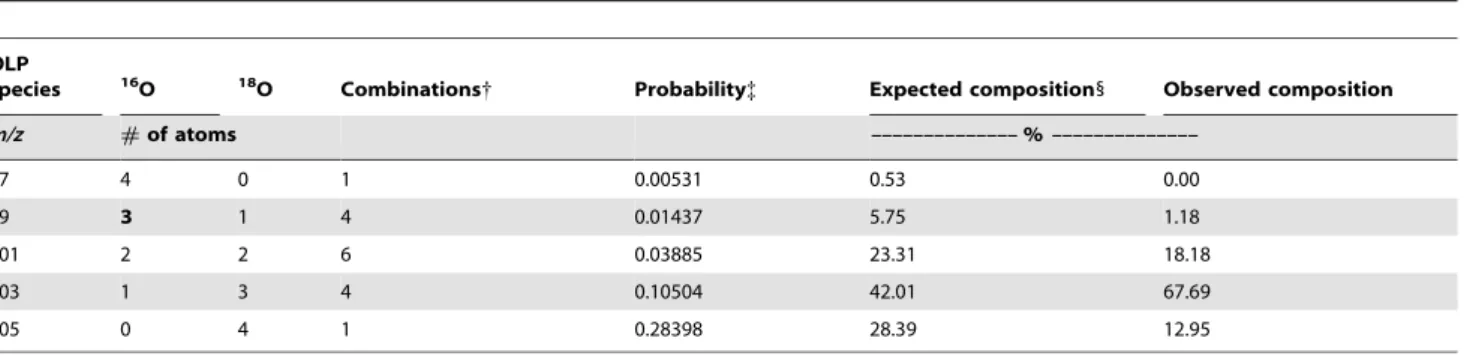
thus resulting in a random assortment of the oxygen-16 and oxygen-18 atoms bonded to the P atoms. We predicted the expected synthesis outcome based on all the P-O bonds in POCl3
breaking and the total amount of 18 (73.0%) and oxygen-16 (27.0%) contained in the synthesized OLP, (Table 4). Based on the differences between the expected and actual results, especially for the OLP species at m/z103 (P18O316O) and 105 (P18O4), it
appears that some of the O atoms present in the POCl3starting
material remained bonded to the P atom during the reaction with water, while the bond between other POCl3O atoms and P was
broken.
The extent of broken P-O bonds in POCl3 during OLP
synthesis was calculated using an implicit equation that reduced the overall 97% oxygen-18 enrichment by an amount equal to the extent of broken bonds supplying additional oxygen-16. This calculation allowed those POCl3 molecules with broken P-O
bonds to react with four O atoms from the O isotope pool and those with no broken P-O bonds to react with three O atoms. Solutions to the equation were iterated comparing the measured isotopic ratios with those predicted until the sum of squares of the
differences was minimized. The results show close agreement between the actual amount of each OLP species synthesized and the predicted values (Table 5). The results of the calculation suggest that 17.9% of the P-O bonds in POCl3were broken during
the December 2008 synthesis, while 38.4% of the bonds were broken during the May 2010 synthesis.
The OLP solutions were synthesized with fresh POCl3and PCl5
in December 2008 and they were analyzed by ESI-MS 16 months later in April 2010. After the 16 month period, the total oxygen-18 content of the OLP solutions synthesized from POCl3and PCl5
were 73.0% and 97.0%, respectively. This indicates that there was no O exchange between phosphate and water, which is in agreement with Blake et al. [15] and McLaughlin and Paytan [16].
Discussion
These synthesis reactions were carried out in ambient air under a fume hood using a fairly simple procedure as compared to previous synthesis attempts. Middleboe and Saaby Johansen [12] reported a loss of about one-half of the expected oxygen-18 enrichment when synthesizing OLP in ambient atmosphere from POCl3, which they suggested should be expected for any OLP
synthesis carried out in ambient atmosphere. Based on the reaction of POCl3 with water that contains 97 atom %
18
O, it would be expected that the maximum amount of oxygen atoms being oxygen-18 would be 72.8% (assuming that 0.2% of the POCl3 oxygen atoms are oxygen-18 based on the natural
abundance of oxygen-18). Additionally, based on the reaction between PCl5and 97 atom %18O water, one would expect the
maximum amount of oxygen-18 atoms to be 97%. Following Middleboe and Saaby Johansen [12], we would have expected only 36.5% of the phosphate oxygen atoms in the OLP synthesized from POCl3 and 48.5% of the phosphate oxygen
atoms in the OLP synthesized from PCl5 would be oxygen-18.
However, our enrichment levels were substantially greater for both POCl3and PCl5(Table 2). In fact, we observed almost no loss of
oxygen-18 enrichment by performing the reactions in ambient air. It is possible that the loss of oxygen-18 enrichment reported by Middleboe and Saaby Johansen [12] when synthesizing OLP in ambient atmosphere was the result of decreased POCl3purity as
the result of reaction with atmospheric water prior to synthesis, as
Table 3. Amount of each oxygen labeled phosphate (OLP) species present in OLP synthesized from PCl5during two separate synthesis events (December 2008 and May 2010) as compared to theoretical values.
OLP species Amount of species present in OLP
Theoretical December 2008 May 2010{
–––– m/z –––– –––––––––––––––––––––––%––––––––––––––––––––––––
97 0.0 0.7 0.0
99 0.0 0.0 0.0
101 0.5 0.0 0.0
103 11.0 9.3 12.2
105 88.5 90.0 87.8
Total18O % 97.0 97.0 97.0
{The May 2010 synthesis event used PCl
5which was opened and stored for 17
months, while the PCl5used in the December 2008 synthesis was opened
immediately prior to synthesis. doi:10.1371/journal.pone.0018420.t003 Table 2.Amount of each oxygen labeled phosphate (OLP)
species present in OLP synthesized with pure POCl3during two separate synthesis events with either fresh POCl3or with POCl3previously opened and stored containers as compared to the theoretical values.
OLP species Amount of species present in OLP
Theoretical{ June 2009 May 2010
Fresh Stored{ Fresh Stored1
–––– m/z –––– ––––––––––––––––––––––––%––––––––––––––––––––––––
97 0.0 0.0 1.0 0.0 21.7
99 0.3 1.2 8.7 3.7 4.0
101 8.5 18.2 36.3 23.6 19.36
103 91.1 67.7 48.5 52.6 51.6
105 0.2 13.0 5.58 20.2 13.4
Total18O % 72.8 73.1 62.2 72.3 55.3
{Calculated assuming no P-O bonds in POCl3were broken during the reaction. {Opened and stored for 6 months.
we noted after running the reactions with POCl3 that had been
opened and stored for several months.
Ray [10] carried out a reaction of water and PCl5in dioxane
and took extreme care to exclude atmospheric water from the reaction; he reported a yield of 8565% P18O4. The results
obtained using the current procedure resulted in a yield of P18O4
that was equal to or greater than that reported using the more difficult procedure of Ray [10] (Table 3). Similarly, Risley and Van Etten [8] also carried out this reaction, this time excluding atmospheric water using drying tubes, and obtained an overall oxygen-18 enrichment of 90%. This enrichment is 9% less than what would be expected from the reaction as 99 atom % 18O water was used. Again, the simpler procedure detailed in this study resulted in an improved oxygen-18 enrichment of 97.0%, which represents no loss of enrichment as 97 atom %18O water was used in this study.
Natural abundance methods rely on ad18Oprange of about 10%
to 25% between different phosphate sources, which represents a narrow range. Additionally, thed18Opranges of many phosphate
sources overlap one another, making it very difficult to infer sources of phosphate. The OLP synthesized from fresh POCl3and PCl5, on
the other hand, had a d18Op value around 1,350,000% and
16,120,000%, respectively. This huge separation from other potential phosphate sources should make it possible to differentiate between OLP and other phosphate sources.
Our use of ESI-MS proved to be an effective means to quantify the products of OLP synthesis. ESI-MS analysis provides information about the individual OLP species composition, which sheds light on reaction dynamics that would not be known by simply analyzing an overall O18/O16 ratio. For example, we determined that although the total 18O composition of our synthesized compounds matched the predicted amount, the18O composition of the individual species differed, indicating that the assumptions of either complete, or no P-O bond-breakage in POCl3 were not met. Bond breakage ranged from 18 to 38%,
possibly due to different reaction temperatures during the very violent and exothermic reaction caused by drop wise additions of labeled water.
There have been several previous reports on the stability or decay of OLP in an aqueous solution. Results have ranged from the exchange of oxygen between water and phosphate reaching equilibrium in 3 h [17] to reports of a much slower half-life period of 100 months [12]. The latter result is in closer agreement with more recent publications that state oxygen exchange between phosphate and water under standard environmental conditions does not occur in the absence of biological mediation [15,16]. Our results support the findings of the later studies.
The results from the reactions carried out in ambient atmospheric conditions between POCl3or PCl5and 97 atom % 18
O water show that over 99% of the OLP molecules contained at
Table 4.Calculation of the expected amount of each oxygen labeled phosphate (OLP) species formed with completely random assortment of the oxygen atoms and comparison to the actual results from OLP synthesized with fresh POCl3in December 2008.
OLP
species 16O 18O Combinations{ Probability{ Expected composition1 Observed composition
m/z #of atoms ––––––––––––––%––––––––––––––
97 4 0 1 0.00531 0.53 0.00
99 3 1 4 0.01437 5.75 1.18
101 2 2 6 0.03885 23.31 18.18
103 1 3 4 0.10504 42.01 67.69
105 0 4 1 0.28398 28.39 12.95
{Number of different ways this combination of oxygen-16 and oxygen-18 atoms can be arranged around the phosphorus atom.
{Probability was calculated by taking the amount of each oxygen atom (62.2 and 37.8% for oxygen-18 and oxygen-16, respectively) to the power of the number of that atom contained in the OLP species (e.g., the probability form/z99 is 0.3783* 0.6221= 0.033594).
1Calculated by multiplying the number of combinations by the probability. doi:10.1371/journal.pone.0018420.t004
Table 5.Comparison between synthesis results and theoretical values of P-O bonds in POCl3broken during the synthesis of oxygen-18 labeled phosphate (OLP) using POCl3.
OLP species December 2008 May 2010
Theoretical{ Actual Theoretical{ Actual
–––– m/z –––– ––––––––––––––––––––––––––––––––––––%––––––––––––––––––––––––––––––––––
97 0.1 0.0 0.2 0.0
99 1.7 1.2 3.5 3.7
101 18.1 18.2 22.4 23.6
103 67.5 67.7 52.8 52.6
105 12.7 13.0 21.1 20.2
{Calculated assuming 17.9% of the POCl3P-O bonds were broken. {Calculated assuming 38.4% of the POCl3P-O bonds were broken.
least one oxygen-18 atom, and would therefore be potentially useful for creating and tracing compounds in the laboratory or possibly the environment. Overall, the results indicate that OLP highly enriched in oxygen-18 can be synthesized under ambient atmosphere using a simple procedure and this product does not lose its label over time in the absence of microbial mediation. ESI-MS can be used to easily and effectively gain information about the individual OLP species composition.
Acknowledgments
The authors thank Cameron Scarlett and the University of Wisconsin-Madison School of Pharmacy Mass Spectrometer Facility for assistance with sample analysis.
Author Contributions
Conceived and designed the experiments: DJS PB. Performed the experiments: ESM DJS PB. Analyzed the data: ES DJS PB. Contributed reagents/materials/analysis tools: DJS PB. Wrote the paper: ES DJS PB.
References
1. Markel D, Kolodny Y, Luz B, Nishri A (1994) Phosphorus cycling and phosphorus sources in Lake Kinneret: Tracing by oxygen isotopes in phosphate. Israel J Earth Sci 43: 165–178.
2. Colman AS, Blake RE, Karl DM, Fogel ML, Turekian KK (2005) Marine phosphate oxygen isotopes and organic matter remineralization in the oceans. Proc Natl Acad Sci USA 102: 13023–13028.
3. McLaughlin K, Cade-Menun BJ, Paytan A (2006a) The oxygen isotopic composition of phosphate in Elkhorn Slough, California: a tracer for phosphate sources. Estuar Coast Shelf S 70: 499–506.
4. McLaughlin K, Kendall C, Silva SR, Young M, Paytan A (2006b) Phosphate oxygen isotope ratios as a tracer for sources and cycling of phosphate in North San Francisco Bay, California. J Geophys Res 111: G03003.
5. Young M, McLaughlin K, Kendall C, Stringfellow W, Rollog M, et al. (2009) Characterizing the oxygen isotopic composition of phosphate sources to aquatic ecosystems. Environ Sci Technol 43: 5190–5196.
6. Elsbury KE, Paytan A, Ostrom NE, Kendall C, Young MB, et al. (2009) Using oxygen isotopes of phosphate to trace phosphorus sources and cycling in Lake Erie. Environ Sci Technol 43: 3108–3114.
7. Gruau G, Legeas M, Riou C, Gallacier E, ois Martineau F, et al. (2005) The oxygen isotope composition of dissolved anthropogenic phosphates: a new tool for eutrophication research? Water Res 39: 232–238.
8. Risley JM, Van Etten RL (1978) A convenient synthesis of crystalline potassium phosphate-18
O4(monobasic) of high isotopic purity. J Labelled Compd 15:
533–538.
9. Larsen S, Middleboe V, Saaby Johansen H (1989) The fate of18
O labelled phosphate in soil/plant systems. Plant Soil 117: 143–145.
10. Ray WJ (1992) A simple procedure for producing oxygen-labelled inorganic phosphate from isotopically labelled water that optimizes yield based on isotope. J Labelled Compd 31: 637–639.
11. Alvarez R, Evans LA, Milham P, Wilson M (2000) Analysis of oxygen-18 in ortho-phosphate by electrospray ionization mass spectrometry. Int J Mass Spectrom 230: 177–186.
12. Middleboe V, Saaby Johansen H (1992) Facile oxygen-18 labelling of phosphate and its delabelling under various conditions. Appl Radiat Isot 43: 1167–1168. 13. Saaby Johansen H (1988) Determination of oxygen-18 abundances by analysis of
the first negative emission spectrum of CO+
. Appl Radiat Isot 39: 1059–1063. 14. Saaby Johansen H, Larsen S, Middleboe V (1989) The stability of oxygen-18
labelled phosphate in aqueous solution. Appl Radiat Isot 40: 641.
15. Blake RE, O’Neil JR, Surkov AV (2005) Biogeochemical cycling of phosphorus: Insights from oxygen isotope effects of photoenzymes. Am J Sci 305: 596–620. 16. McLaughlin K, Paytan A (2007) The oceanic phosphorus cycle. Chem Rev 107:
563–576.