Coordination Devices in the Refurbishment Design
Process: A Partial-Correlation Approach
Azlan Shah Ali 1, Hafez Salleh 2 and Syed Abdul Fattah Al-Zawawi 1 1 Department of Building Surveying, Faculty of Built Environment,
University of Malaya.
2 Department of Quantity Surveying, Faculty of Built Environment, University of Malaya.
Abstract
Building refurbishment is an important sector in the Malaysian construction industry. The increase the number of building renovations, alterations, extensions and extensive repair works contributed to the high demand for refurbishment projects. However, refurbishment projects are more difficult to manage compared to new-built, due to uncertainty factors inherent in the projects. Therefore, this paper identifies factors that contributed to uncertainty and shows how it affects design performance of refurbishment projects. This paper was also extended to the used of coordination devices to improve design performance from the effect of uncertainty in the projects. Partial-correlation technique was used in data analysis to check any significant moderate effects of coordination devices to control the negative effect of uncertainty on design performance of refurbishment projects. Four (4) coordination devices involved in the partial-correlation tests. The results concluded that the use of lateral relations and architect’s characteristics are most likely reducing the uncertainty of client attributes towards design completeness before work started on site.
Key Words:Design Process, Coordination Devices, Partial-Correlation
1.0 INTRODUCTION
Refurbishment is one of the most uncertain among construction projects (Quah, 1988). Majority of refurbishment projects completed with over estimated time and budgeted cost. One of the factors contributed to uncertainty are the design process (Daoud, 1997). The identification of factors that contributes to uncertainty of the design process is paramount because it could affect performance of
refurbishment projects (Rahmat, 1997; Hashim, 2004). By identifying the uncertainty factors, it provided more information regarding the design process of refurbishment projects. This would be able to assist the designers involved to familiarize on the degree of risk and uncertainty that need to be mitigated in the design process of the projects.
projects performance. For instance, Rahmat (1997), Hashim (2004) and Ali (2008) in their studies identified some uncertainty variables in refurbishment projects affects the performance of projects. Rahmat (1997) measured uncertainty in refurbishment planning by identifying thirteen dominant project characteristics. Hashim (2004) and Ali (2008) who also studied in refurbishment projects duplicated the approach used by Rahmat (1997). Eleventh and fifteen situational variables were identified in both studies respectively. From those three studies, ten variables found to be similar as shows in Table 2. Hence, the author considered those similar uncertainty variables as important.
The measurement of performance is important in providing an indicator of the level of success and for improving the quality of work. In measuring project performance, some of the indicators that are normally used are time and cost (Johnson, 1995). However, in measuring design performance of projects, Ali (2008) and Georgy et al. (2005) has introduced the element of design changes, completeness of design timely and the percentage of provisional sum to contract value. These three variables could reflect the quality of design produced for a project.
Differentiation and fragmentation within a project organization demand a high level of coordination (Lawrence & Lorsch, 1967). In managing a project, the best way to achieve coordination in a project organization is by implementing coordination devices (Rahmat, 1997). Therefore, this paper will be extended to the role of coordination devices in
reducing the effects of uncertainty on design performance.
2.0 THE DESIGN PROCESS OF REFURBISHMENT PROJECTS
The design process does not have a standard agreed definition. Building design process defined by Hassan (1996) quoted from Baldwin et al. (1999: p 155) as:
“a process that maps an explicit set of client and end-user requirements to produce based on knowledge and experience, a set of document that describe and justify a project that would satisfy these requirements and other statuary and implicit requirements imposed by the domain or the environment”
More brief description was given by Baldwin at el. (1999: p 33) who described building design process as:
“a multi-disciplinary process, performed in a series of iterative steps to conceive, describe and justify increasingly detailed solutions to meet the needs of the client”
process universally accepted by all the architects. The most commonly used for building design process is from RIBA plan of work (RIBA, 1991). In Malaysia, the architects had to follow PAM the ‘basic service work’ the guideline of design process as mentioned in the ‘Architects Act 1967, Act 117 and Rules’ (2004). Malaysian Architects Act 1967 (2004) described the design process encompass of four main stages that are Schematic Design, Design development, Contract Documentation and Contract Implementation and Management. The stages abstracted from the RIBA plan of work model and been modified in order to suit with local projects environment. Therefore, in the definition, the author included the period for the design process as mentioned by the act as follows:
“a multi-disciplinary process, performed in a series of iterative steps to justify total solutions that is of value to the client starting from schematic design to contract implementation and management phase”
However, the design process is not easy to manage. The design process is made up of a combination of intense technical and social activities (Bucciarelli, 1988). The process involves integration of technical knowledge and greater interaction among the various participants such as clients, designers, users and contractors. Moreover, the design process in a construction environment is extremely dynamic and complex, consisting of multiple interacting feedback processes and non-linear relationships (Ogunlana et al., 1998). The iterative nature in the design
process makes it difficult to coordinate (Stermen, 1992).
This problem is further compounded by the uncertainty that is inherent in refurbishment projects. Egbu (1994) defined refurbishment as a process of improvement, adaptation, upgrading, rehabilitation, restoration, modernization, conversion, retrofit and repair, which are carried out on an existing building for variety of reasons, but excludes emergency maintenance work such as cleaning. Authors such as Egbu (1994), Rahmat (1997), Young et al. (1996) and Hashim (2004) have provided evidence of the complexity and uncertainty of refurbishment projects. The problem mainly derives from the lack of information available to perform a task, especially during the initial stage of the design process.
The existence of complexity and uncertainty in refurbishment design process demand a high level of coordination (Lawrence & Lorsch, 1967). Coordination in the design process is critical in order to prevent any potential problems in the subsequent process and to select better alternatives that could optimize the overall project performance. Hence, it is useful to identify the most effective coordination devices to employ in the design process. This is due to the high cost of including coordination devices in the management of refurbishment projects.
3.0 COORDINATION DEVICES
which are dynamic during the design process. Lack of coordination among building designers is a major problem in the construction industry. This has contributed to the lack of integration of design information, which leads to unnecessary design changes and time variations in the construction projects. Complete and accurate design information is crucial for the architects to produce complete and error free drawings. The problem is often the design information in refurbishment projects is uncertain, scattered and comes from various sources.
To improve the speed and accuracy of design information, more coordination among the team members is needed. Coordination in the design process might be viewed as an activity to handle the uncertainty and to synchronize the flow of design information. Coordinating is also being interpreted as the collection processing, storage and transmission of information is essential for an effective design process (McGeorge, 1998).
To enhance coordination in the design process, appropriate coordination devices in the design process need to be implemented. The use of coordination devices such as lateral relations, architect’s attributes and information technology were important to improve the information processing capacity. In refurbishment projects, the design team’s members are required to have regular communication among each other and to share and exchange related design information, (Tushman and Nadler, 1978). Ali (2008) and Rahmat (1997) identified four appropriate coordination devices that could be used in managing refurbishment projects as listed below.
1. Lateral relations (direct contact and meeting)
2. Information Technology (IT) in the design process
3. Interpersonal relationships with the design team’s members
4. Architects’ attributes
Lateral relations consist of meetings and direct contacts are important coordination devices in highly uncertain environments (Galbraith, 1977). Meeting helps to interface design from one discipline with those of other disciplines so that it would be able to reduce error during the construction stage. Furthermore, meetings could also improve communication flows among the design key participants. On the other hand, direct contact has been identified as the simplest form and one, which involves minimal cost. Two types of direct contacts are used in projects: direct formal contact and direct informal contact. Each method had different approaches in gathering useful information. By using this approach, the participants could bypass the line of authority in a project organization. Lateral relations induce all design problems to be settled among the related key participants locally and remove overloads from the organization’s hierarchy. In addition, greater flexibility could be achieved when lateral relations are used in the design process. The degree of lateral relations used for any projects however, depend on the problems that might arise and the amount of information communicated in an organization.
(1989) and Kartam (1999). IT became an important tool in the design process as an interface tool to improve project coordination. The current development of technologies in IT has the ability to import, process, store and disseminate information within the building industry and could assist the integration of design information within the disciplines (Baldwin, 1999). Coordination through the application of information technology is a method of linking the traditionally discrete phases of design and construction. This could be done through vertical integration by gathering input in later phases of the project to the schematic stage of design. Information such as construction materials and method of statement could be obtained via internet. It could also provided information on construction implication and maintenance guidance for the selected materials. This could help the designers to get more complete information during the initial stage of the design process.
A close relationship is paramount in order to have an efficient working environment among the key design participants. The building design process is a function of the interaction of a number of individuals over a period of time (Wallace, 1987). Therefore, it is important for them to have a good relationship to ensure there are no communication breakdowns. The amount of work involved in design and construction activities are substantial. The design participants need design inputs from each other as a basis for their design solutions. Most of the successful solutions took place in cooperation with colleagues in the projects.
A long term business relationship is one of the non-contractual mechanisms for project coordination (Nam & Tatum, 1992). A good relationship could increase the ability to achieve coordination in projects by sharing and exchange of information available. This is important for fostering an integrated environment in projects. The existing networking between parties enhances the development of greater corporation, trust, flexibility and effectiveness. Therefore, a good relationship among the team members is vital in completing design tasks.
The attributes of the architects in a project could influence the performance of the design process. The World Bank Guideline (1997) for examples pointed out that an individual architect is the person who ultimately determines the quality of performance of a project, not his or her organization. Ali (2008) listed two important attributes of architects in managing refurbishment projects as commitment to the project and coordination skill.
would make an effort to ensure the project would complete within the approved budgeted cost.
The most important role of the design team leaders were the management of the uncertainty of a project (Hill, 1983). Coordination skill was very important in the management of a project, especially during the schematic design stage when creativity of the designers was highly needed. The design team leader is responsible for coordination and overall control of the design works. The weakness of the leader in the project team would cause an uncontrolled situation and the leader’s role could be taken over by other design team personnel. The leader should be able to control the situation. An effective coordinator should be able to get people to commit in their work, ensure the team is working cohesively, provide satisfactory supports and motivation to their team members so that they can perform their work effectively. Hence, the architects as design team leaders are involved in coordination, preparation and control of design to achieve the project objectives.
4.0 RESEARCH METHODOLOGY
A triangulation technique was used in this study, which combined quantitative and qualitative data collection methods. The first stage was a literature review, which was validated in a preliminary questionnaire survey. This was followed by a second stage of data collection involving semi-structured interviews and archive documentations. The purpose of this second stage was mainly to refine the
research problem and the theoretical framework. The third stage was the final questionnaire survey, which was to collect data to form a database for the purpose of statistical analysis.
In order to get high response rate, the final questionnaire survey was design short and simple that did not take long time for the respondents to answer. The respondents for this study consisted of professional architects who are registered with the Board of Architect Malaysia. Architects were selected as the appropriate respondents in this study for the following reasons:
i. The architectural profession contributes the major part of the design work in refurbishment projects compared to other disciplines such as engineers, quantity surveyors, specialists, clients or contractors (Dileo, 1990). ii. Architects play important roles as the
design team’s leader, which controls and monitors all design activities for refurbishment projects.
iii. All the questions asked and information required with regards to this study could be obtained from the architects
value of more than RM 500,000.00. The demographic profile of the respondents is shows in Table1.
Table 1: Demographic profile of respondents
Position Percentage, N=82
Principal 68
Senior Architect 15
Architect 10
Others 7
Table 1 shows almost two-third of the respondents were principal architects. The results indicate that nearly ninety-five percent of them had more that 10 years of experience in construction industries. Therefore, the data obtained are of quality and reliable.
For statistical data analysis, multivariate analysis was used in deriving conclusion of the study. A multivariate analysis is a statistical method that considers more than one variable at the same time (Pallant, 2001). One of the methods is a partial-correlation technique. This method is used to detect any hidden relationship that is normally caused by the intervening variable.
In this paper, the authors intended to measure the correlation between the independent and dependent variables, but at the same time wanted to know the effects of intervening variables that are introduced in the study. A partial-correlation technique can be employed to conclude the relationship between
variable A and C with the presence of B as illustrated in the diagram below.
The true relationship between A and C could be revealed by examining the readings generated by the partial-correlation analysis. The readings would be significantly reduced if there were no genuine relationship between A and C. In the present study, this test was employed to test whether the coordination devices had a moderate effect on controlling the effect of uncertainty on design performance in refurbishment projects.
5.0 DATA ANALYSIS AND DISCUSSION
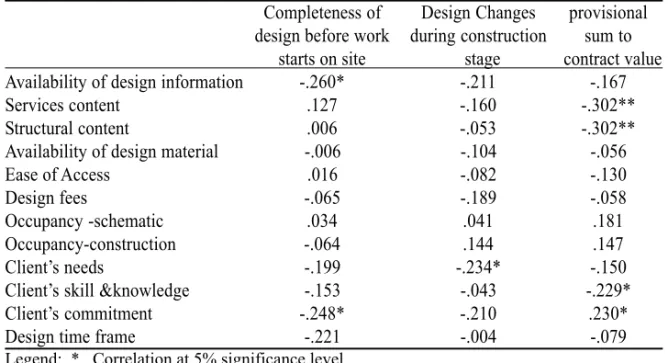
Data obtained from the final questionnaire survey was identified fit for parametric correlation test. Therefore, Pearson’s product moment correlation coefficient was used in the correlation test between uncertainty variables and design performance. The results of the correlation test are shown in Table 2.
In partial-correlation test, three performance variables are involved. They are:
• The degree of completeness of design before work started on site
• The changes of design during the construction stage
• The percentage of provisional sum relative to contract value
A B C
(Uncertainty - (Coordination devices- (Performance
Independent) Intervening) Dependent)
Readings from the Pearson’s product moment (Table 2) were compared with readings of “controlled variable”. Controlled variable refers to the correlation with the effect of the existence of the intervening variable, which in this case the coordination devices. The correlation matrices in Table 3 to 5 show the correlation readings after one of the selected coordination devices has been “controlled” in other words, the effect of the coordination device has been removed. If a significant correlation is remained after a selected coordination device has been controlled, it indicates that the coordination device does not have a moderating effect on the design performance. Four coordination devices involved in the test. They are:
• Lateral relation
• Information Technology
• Architects’ relationship • Architects’ attributes
Table 3 shows results of partial correlations for performance variable “completeness of design before work starts on site”. The results show variable availability of design information was not affected by the use of coordination devices. The Pearson’s product moment reading in Table 2 remained significant after the coordination devices have been control. However, for variable ‘client commitment’, the following coordination devices have moderate effects on the completeness of design before work starts on site. They are:
• Lateral relations • Information Technology • Architects’ relationship
• Architects’ attributes - Coordination skill
Table 2: The Correlation Matrix between the Uncertainty Variables and Design Performance
Completeness of Design Changes provisional design before work during construction sum to
starts on site stage contract value
Availability of design information -.260* -.211 -.167
Services content .127 -.160 -.302**
Structural content .006 -.053 -.302**
Availability of design material -.006 -.104 -.056
Ease of Access .016 -.082 -.130
Design fees -.065 -.189 -.058
Occupancy -schematic .034 .041 .181
Occupancy-construction -.064 .144 .147
Client’s needs -.199 -.234* -.150
Client’s skill &knowledge -.153 -.043 -.229*
Client’s commitment -.248* -.210 .230*
Design time frame -.221 -.004 -.079
Table 3: The Correlation Matrix between Project Variables and Completeness of design before work starts on site
Lateral Information Architects’ Architects’ attributes Relations Technology relationships Coordination commitment
skill
Availability of design information -.318** -.355** -.285* -.313** -.312**
Services content .115 .124 .117 .109 .175
Structural content -.032 -.001 -.003 -.016 .030
Availability of design material .047 .026 .059 .030 .056
Ease of Access -.019 -.050 .021 -.008 .011
Design fees -.059 -.032 .028 .002 -.004
Occupancy -schematic .074 .087 .079 .028 .079
Occupancy-construction .015 .001 .041 -.011 -.031
Client’s needs -.129 -.134 -.104 -.137 -.140
Client’s skill & knowledge -.059 -.130 -.090 -.051 -.117
Client’s commitment -.217 -.221 -.154 -.125 -.245*
Design time frame -.191 -.169 -.198 -.135 -.207
Table 4: Partial Correlation Matrix between Project Variables and Amount of Provisional Sum
Lateral Information Architects’ Architects’ attributes Relations Technology relationships Coordination commitment
skill
Availability of design information -.174 -.151 -.164 -.164 -.155
Services content -.284* -.342** -.311** -.313** -.270*
Structural content -.278* -.308** -.308** -.311** -.300**
Availability of design material -.065 -.124 -.053 -.057 -.013
Ease of Access -.124 -.220 -.127 -.130 -.097
Design fees -.032 -.070 -.053 -.056 -.037
Occupancy -schematic .188 .165 .180 .175 .182
Occupancy-construction .133 .142 .156 .147 .109
Client’s needs -.174 -.132 -.147 -.147 -.117
Client’s skill & knowledge -.279* -.207 -.227 -.224 -.240*
Client’s commitment -.164 -.117 -.133 -.125 -.128
Design time frame -.062 -.076 -.031 -.036 .003
Legend: * Correlation at 5% significance level ** Correlation at 1% significance level
Table 4 shows results of partial correlations for the performance variable “percentage of provisional sum relative to contract value”. The results indicate that the coordination devices do not have moderate effects for variables “services
coordination devices have moderate effect. They are
• Information Technology • Architects’ relationship
• Architects’ attributes - Coordination skill
Table 5 shows results of partial correlations for the performance variable “Design Changes during the Construction Stage”. The results indicate that the certainty of design fees was improved by the presence of the following coordination devices:
• Lateral relations • Architects’ relationship
• Architects’ attributes - Coordination skill
In conclusion, some of the design performance variables appeared to be better with the presence of the coordination devices, which supports the
Table 5: Partial Correlation Matrix between Project Variables and Design Changes Lateral Information Architects’ Architects’ attributes Relations Technology relationships Coordination commitment
skill
Availability of design information -.219 -.210 -.180 -.205 -.200
Services content -.137 -.155 -.198 -.182 -.109
Structural content -.016 -.047 -.077 -.069 -.039
Availability of design material -.115 -.109 -.087 -.107 -.048
Ease of Access -.075 -.079 -.062 -.083 -.035
Design fees -.165 -.185 -.161 -.184 -.170
Occupancy -schematic .047 .040 .039 .021 .038
Occupancy-construction .129 .141 .191 .145 .094
Client’s Needs -.261 -.244* -.196 -.227* -.196
Client’s skill & knowledge -.088 -.041 -.022 -.018 -.051
Client’s commitment -.204 -.223 -.132 -.174 -.209
Design time frame -.031 .006 .022 -.004 .051
Legend: * Correlation at 5% significance level
** Correlation at 1% significance level
hypothesis that the coordination devices have moderate effect to improve design performance from uncertainty of design process.
6.0 CONCLUSION
REFERENCES
Ali, A.S. (2008). Integrative Mechanisms in the Design Process of Refurbishment Projects. Unpublished PhD Thesis, Universiti Teknologi MARA, Shah Alam
Architect Act 1967 (Act 117) & Rules (2004). International Law Book Services Baldwin, A.N., Austin, S.A., Hassan, T.M. &
Thorpe (1999). Modeling information flow during the conceptual and schematic stages of building design, Journal of Construction Management and Economics, Vol.17, 155-167
Bucciarelli, L.L. (1988). An ethnographic perspective an engineering design, Design Studies, Vol. 9. No. 3, 159-168.
CABE, (2003). Creating excellent buildings, A guide for client. London on line books Chiu, M.L. (2002). An organizational view of
design communication in design collaboration, Design Studies, Vol. 23, 187-210.
Daoud (1997). The Architect/Engineer’s role in rehabilitation work, Journal of Construction Engineering and Management Vol. 123, No. 1, 1- 5
Dileo, G. (1990). Altering, extending and converting houses, an owner’s guide to procedure. International Thomson Business Publishing.
Egbu, C.O. (1994). Management education and training for refurbishment work within the construction industry, PhD thesis Department of Civil Engineering, University of Salford, UK.
Galbraith, J.R. (1977). Organization design, Addison-Wesley, Reading M.A.
Georgy, M.E., Chang, L.M. & Zhang, L. (2005). Journal of Construction Engineering and Management Vol. 131, No. 5, 558-568. Hashim, A.E. (2004). Planning and control of
safety in construction refurbishment
projects, PhD Thesis, Universiti Teknologi MARA, Shah Alam
Hollows, J. (1998) IS Project management, Amacom, New York.
Howard, H.C., Levitt, R.E., Paulson, B.C., Pohl, J.G. & Tatum, C.B. (1989). Computer integration: Reducing fragmentation in AEC industry, Journal Computing in Civil Engineering, ASCE Vol. 3, No. 1, 18-32. Kartam, N. A. (1999) Design construction
integration: issue and illustrative prototype, Journal Engineering, Construction and Architectural Management, Vol. 6, No. 3, pp 299-314.
Hill, T. (1983). Production/ Operations Management. Prentice-Hall, New Jersey. Lawrence, P.R. & Lorsch, J.W. (1967).
Organization and environment, Harvard Business School, Boston, MA.
Ling, Y.Y. (2003). A conceptual model for selection of architects by project managers in Singapore. International Journal of Project Management, Vol. 21, 135-144. McGeroge, F., (1988). Design Productivity – A
quality problem, Journal of Management in Engineering, Vol. 10, 350-367.
Nam, C.H. & Tatum, C.B. (1992) Non-contractual methods of integration on construction projects, Journal of Construction Engineering and Management, Vol. 118, No. 2, 479-487. Pallant, J. (2001). SPSS survival manual, Open
University Press, USA.
Ogulana, S., Lim, J. & Saeed, K. (1998). DESMAN: a dynamic model for managing civil engineering projects, computers and structures Vol. 67, No. 5, 401-419. Quah, L.K. (1988). An Evaluation of the risks
in estimating and tendering for refurbishment work., PhD thesis, Herriot Watt University, Edinburgh, UK
RIBA, (1991). Architect’s handbook of practice management, RIBA Publications, London: Royal Institute of British Architects. Stermen, J.D. (1992). Systems dynamics
modelling for project management, working paper, System Dynamic Group, Sloan School of management, Massachusetts Institute of Technology, Cambridge, MA. Tushman, M.L. and Nadler, D.A. (1978).
Information processing as an integrating concept in organizational design, Academy of Management Review, July.
Wallace, W.A. (1987) Capital costs versus cost-in-use: a content analysis of design team
member communication patterns, Journal of Construction Management and Economics, Vol. 5, S73-S92.
World Bank (1997). Guideline: selection and employment of consultants by World bank borrowers. Washington, DC: The International Bank for Reconstruction and Development.