ISSN 1553-345X
© 2005 Science Publications
Corresponding Author: Dr. Mwinyikione Mwinyihija, School of Biological Sciences (Plant and Soil Science), Cruickshank Building, St. Machar Drive, Aberdeen, AB24 3UU, U.K, Tel.: +44 1224 272260, Fax: 44 1224 272703
Assessment of Pulverised Fly Ash (PFA) as an Ameliorant of Lead Contaminated Soils
Edmond Gatima, Mwinyikione Mwinyihija and Ken Killham
School of Biological Sciences, Plant and Soil Science, University of Aberdeen
St. Machar Drive, Cruickshank Building, Aberdeen, AB24 3UU, U.K
Abstract: Fly Ash (FA) is obtained by electrostatic or mechanical precipitation of dust-like particles
from the flue gases of furnace fired with coal or lignite at 1100 to 1400°C. About 95-99% of Fly Ash consists of oxides of Si, Al, Fe and Ca, about 0.5 to 3.5% consists of Na, P, K and S and the remainder is composed of trace elements. PFA has also been used as an adsorbing material when applied in treatment effluents. The use of Fly Ash as a chemical conditioner has previously been investigated with results indicating that Fly Ash does facilitate the filtering process since it decreases both specific resistance and capillary suction time. Therefore, the aim of this paper was to assess the potential of PFA as an ameliorant for soil artificially spiked with various Lead compounds (PbSO4, PbCO3, PbNO3
and PbS). Additions of quicklime and Fly Ash to the contaminated soils effectively reduced heavy metal leachability well below the regulatory limits for hazardous wastes. The results showed the effect of PFA on leaching of lead was significant for all the samples. A high interaction value depicting sampling effect over the use of the PFA as an ameliorant was observed. The order of the difference between samples treated with PFA and without PFA was PbNO3 > PbSO4 > PbCO3 > PbS (17 mg L1)
when compared to that of the control. The results also demonstrated that, effect of filtration and PFA as an ameliorant had a significant effect in reducing toxicity. However, it is important to consider the source of PFA, as certain sources could in essence impart certain toxic elements, defeating the primary purpose of amelioration.
Key words: Pulverised fly ash, toxicity, ameliorant, lead contamination
INTRODUCTION
Coal Combustion Products (CCP) are produced in coal-fired power stations, which burn either hard or brown coal. Due to the mineral component of coal and combustion technique, fly ash (FA), bottom ash (BA), boiler slag (BS) and fluidized bed combustion (FBC) ash as combustion products, as well as the products from dry or wet flue gas desulphurization, especially semi dry absorption (SDA), products and flue gas desulphurization (FGD) gypsum are produced.
The volume of CCP generated worldwide is reported to be on the increase due to the reliance on coal as a major source of energy[1]. For example, approximately 55% of U.S. energy is generated from coal and it is expected that coal will continue to be the leading electrical power source at least until 2010[2]. About 105 million tons of coal combustion products were produced by American power generating utilities in 1997[3]. In China, coal mining waste management is a major problem because of the huge quantities of coal produced for energy production, 75% of which comes from coal[4].
Fly Ash (FA) is obtained by electrostatic or mechanical precipitation of dust-like particles from the flue gases of furnace fired with coal or lignite at 1100
to 1400°C. By mid 1950’s, fly ash from coal combustion became known as Pulverised Fuel Ash (PFA) within the UK. This was to differentiate it from Fly Ashes delivered from other processes, since PFA is delivered from firing boilers with pulverised coal[5]. PFA is still produced in large quantities during the day-to-day operations of coal-fired power plants.
in determining the suitability of some sources for use as a soil amendment[10,12,13].
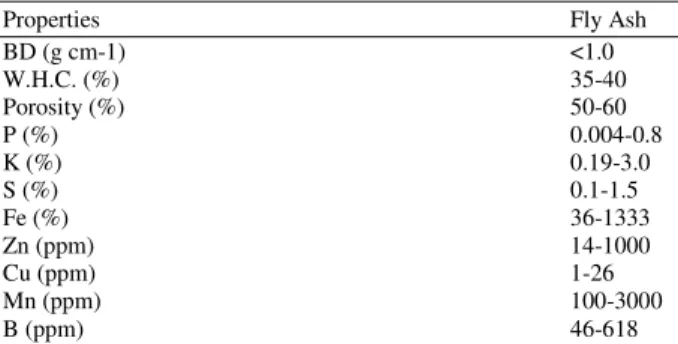
Chemically, the composition of Fly Ash varies depending on the quality of coal used and the operating conditions of the Thermal Power Stations. About 95-99% of Fly Ash consists of oxides of Si, Al, Fe and Ca, about 0.5 to 3.5% consists of Na, P, K and S and the remainder is composed of trace elements[14]. In fact, Fly Ash consists of practically all the elements present in soil except organic carbon and nitrogen (Table 1). Thus, it was found that this material could be used as an additive/amendment material in agriculture applications[14]. The chemistry of PFA reflects the mineral origins of the coals when formed millions of years ago. The combustion process concentrates these minerals. However, most elements are held in the glassy particles that are formed in the furnace[5]. While the trace elements composition may indicate potential for environmental effects, the available leachable elements are minimal. With proper design, unbound PFA can be used as a fill material posing only negligible risk, even to sensitive aquifers[15].
Table 1: Physical and chemical characteristics of Indian fly ash and
soil
Properties Fly Ash
BD (g cm-1) <1.0
W.H.C. (%) 35-40
Porosity (%) 50-60
P (%) 0.004-0.8
K (%) 0.19-3.0
S (%) 0.1-1.5
Fe (%) 36-1333
Zn (ppm) 14-1000
Cu (ppm) 1-26
Mn (ppm) 100-3000
B (ppm) 46-618
Modified from http://www.tifac.org.in/news/flyagr.htm
PFA has also been used as an adsorbing material when applied as an ameliorant in treatment effluents[16]. The idea of using coal fly ash to synthesize artificial zeolite for water treatment is based on the fact that both materials have a similar chemical composition, namely a high content of aluminisilicate glass and high surface areas[17]. Another example for using PFA, is to remove metal ions[18] and phenols from water[19]. In addition PFA has always been used for sludge conditioning for sludge originating from wastewater treatment containing high amounts of water (up to wt. 95%) and that needed to be dewatered in order to reduce its volume and disposal costs[16]. The use of Fly Ash as a chemical conditioner has been investigated[20] with results indicating that Fly Ash does facilitate the filtering process since it decreases both specific resistance and capillary suction time. Fly Ash has been found to have great potential for agriculture. For example, some of the advantages relate to modification of soil texture and bulk density, improvement of water holding capacity of soil, optimisation of soil pH, increase crop yield, as a micronutrient supplement to
soil, creation of conducive conditions for better plant growth and reduction of soil crusting[21]. The addition of appropriate quantities of Fly Ash can alter the soil texture. Fly Ash addition at 70 t ha1 for example, was reported to alter the texture of sandy and clayey soil to loamy[22].
However, despite positive uses of PFA, the rate of its production clearly far outweighs utility as a by product. This is because the remaining PFA material and its disposal practices involve holding ponds, lagoons, landfills and slag heaps, all of which can be regarded as unsightly, environmentally undesirable and/or a non-productive use of land resources, as well as posing an on-going financial burden through their long-term maintenance[23]. Although as mentioned earlier, Fly Ash has immense potential in agriculture, there are some possible concerns, which need to be attended to or kept under control, such as the release of toxic elements into ground water, decreased germination rates of some crops due to high levels of Fly Ash application including uptake of heavy metals toxic elements by the plants[16]. The uptake of heavy metals, toxic elements by plants was demonstrated when Fly Ash was applied to the soil[24]. These elements were found to be absorbed by plants grown on such soils (treated with Fly Ash) and could enter into the food chain[16]. However, the data on trace element uptake and accumulation by plants are limiting. Boron in Fly Ash is reportedly readily available to plants and investigators consider it to be a limiting factor in utilisation of unweathered Fly Ash. Regional Research (RRL), Bhopal conducted a study regarding the uptake of heavy and trace metals from Fly Ash by some vegetable crops and it was observed that the uptake was quite low and remained within the normal range.
Some studies have shown possible negative effects of Fly Ash application[14]. For example, Fly Ashes contain a small amount of trace and heavy metals, which may percolate down the soil profiles and pollute ground water. However related studies have shown that the solubility of these elements is <10%[28]. Moreover Natusch[29] reported that leaching potential between 5 to 30% of toxic elements (especially Cd, Cu and Pb) in Fly Ash was observed in a related laboratory experiment. On the other hand Galloway et al.[30] observed that at least 10% of total Cd would be solubilized in the acidic pH range of 3 to 5. It is unlikely, however that these will have a major effect on the quality of ground water. Furthermore, recent research has shown that the quality of ground water did not change with the application of Fly Ash and that all the parameters including the trace and toxic metal contents were within permissible limits[31].
The concentration of natural Uranium varies from 14 to 100 ppm although in exceptional cases, it could be as high as 1500 ppm, with Thorium less than 10 ppm[34]. Fly Ash, show to contain radioactive contaminants such as 222Ru and 220Ru[35]. Bhaba Atomic Research Centre, Bombay was of the opinion that most of the Indian coals and hence Fly Ash, had very low levels of radioactivity, which were well below hazardous limits[36]. Hence, radioactivity of Fly Ash may well not be a limiting factor for its application in agriculture. Recent research has shown that there is no significant uptake of radioactive elements by plants and that there is negligible cumulative build-up of these contaminants in soil when Fly Ash is applied for agriculture purposes.
Coal power plants are mostly located in urban areas and therefore finding disposal sites for Fly Ash is becoming increasingly difficult[23]. As a consequence, Ciccu[37] carried out an investigation to assess the potential use of Fly Ash from coal-fired power stations for immobilising the heavy metals in soils at a severely contaminated Italian mine site. The results obtained showed that heavy metal content of percolating water could be drastically diminished when the soils were mixed with Fly Ash. Gupta and Imran[38] successfully removed lead and chromium from wastewater using bagasse Fly Ash, a waste by-product of the sugar industry. Chien-Jung Lin et al.[39] looked at the effect of applying Fly Ashes to remove metal ions from wastewater and concluded that the cation exchange capacity and specific surface area of Fly Ashes increased with increasing carbon content and consequently, residual carbon in the Fly Ashes played a much more important role than the mineral content in the removal of metal by the Fly Ashes.
Dermatas and Meng[40] utilised Fly Ash waste material along with quicklime (CaO) to immobilise lead, Cr(III) and Cr(VI) present in artificially contaminated clayey sand soils. The experimental results suggested that the controlling mechanism for both lead and hexavalent chromium immobilisation was through surface adsorption, whereas for trivalent chromium it was the hydroxide precipitation. Additions of quicklime and Fly Ash to the contaminated soils effectively reduced heavy metal leachability well below the regulatory limits for hazardous wastes[40]. The aim of this paper is to investigate the effect of PFA on soils artificially spiked with various Lead compounds (PbSO4, PbCO3, PbNO3 and PbS).
MATERIALS AND METHODS
The topsoil used in these experiments was collected from the top 25 cm of an agricultural field on the Craibstone estate, which is approximately 9 km North West of Aberdeen, at an elevation of 100 m. The pots had a diameter of 150 mm and a surface area of 17,600 mm2. A Whatman 42 filter paper was placed on
the base of each pot to prevent coarse material from passing through. Leaching pots were arranged on a leaching bench with holes wide enough to hold them. Funnels with aligned filter paper (Whatman 42) inside were placed under each pot placed on the leaching bench to collect leachate in a conical flask placed on the bottom of the shelf.
The controls used are soils spiked with lead compounds but not treated with PFA.
Preparation of experimental pots: Thirty pots were
packed with either a mixture of soil, lead compounds and Red earth, or soil with lead compound only.
Control: 3 pots of soil only
3 pots of soil+PFA
Samples: 3 pots of soil+Pb compound
3 pots of soil+Pb compound+PFA
Since 4 Pb compounds were considered (PbS, PbSO4, PbNO3, PbCO3), the total number of samples
were 24. This translates to thirty pots together with 6 pots of control. The mixture of soil, Pb compound and PFA under study was thoroughly shaken together in plastic bags of 1 kg capacity to allow for homogeneity prior to packing the pots. The amount of PFA required per experimental pot was 20 g L1. 42 = 14.08 g of PFA per pot.
The area where the bottles were placed was protected with black, plastic material to minimise the effect of light on leachate chemical properties. All the experimental treatments were carried out in triplicate
Bioassay: Lux-marked bacterial biosensors were used
during the study and the preparation of the biosensor and luminometer measurements were carried out as described. One hundred µL of the resuscitated biosensor suspension was added to the samples at 15 s intervals, accurately timed for measurement in the Bio Orbit 1253 luminometer (Labtech International, Uckfield, U.K). Each sample was exposed to the sensor for exactly the same time. Samples were incubated for 15 min before light output measurements were carried out at 15 s intervals. This ensured the same exposure time to the potentially toxic elements for cells in each of the cuvettes.
Chemical analysis: A1.599 g of lead nitrate, Pb(NO3)2
(analytical grade) was carefully weighed and dissolved in deionized distilled water. When dissolution was complete, it was acidified with 1 ml of 1M HNO3 and
diluted to 1 L with deionized water. Standard Lead Solution was prepared by diluting the stock (lead) solution. Concentration ranges starting from 0.1, 0.5, 100, 200, 400, to a maximum of 800 g L 1) which were used as calibration standards. Standard solutions of lead were prepared fresh for use from a stock solution of lead nitrate (0.1 mol L 1 in HNO3). All standard and
purified water (deionized water) when diluting samples to final volume for quality control purposes.
Deionized water was also used during the final rinsing of all the plastic and glassware. This was after rinsing them first, in solution (with diluted nitric acid) in order to remove any possible traces of lead on them. During the determination of concentration two replicate determinations of absorbance were made for each sample. A blank of deionized water was used to zero the instrument.
A 10 µL sample was injected very carefully with the help of an auto sampler into the cold graphite furnace and by means of an automatic temperature programmer, dried at 120 °C for 35 s and at 140 °C for another 35 s, then heated to 200 °C and allowed to cool for 15 s. These steps were performed, automatically, to remove solvent and any removable volatile matrix. Actual atomization of the sample followed and was performed at 1800 °C, very rapidly, for 5 s. During this time the signal from the chamber (absorbance) was recorded and displayed on the screen as a function of time. Finally the furnace was heated for 5 s at 2600°C. The purpose was to remove any residues and prepare the instrument for next sampling phase. During the atomization step, the absorbance was monitored at 283.3 nm, using a slit width of 0.7 nm, set at "low" level. Purging with argon was interrupted automatically during the absorbance scan. Background correction was provided by means of the deuterium background corrector, which automatically compensated for broadband absorption interferences.
Data analysis: Two-way analyses of
(ANOVA-Analysis of Variance) (except for biosensor experimental data which is One-way ANOVA) were carried out using the statistical package Minitab for windows, release 12.1 (State College, PA, USA). Mean differences were determined using t-test (paired two samples for means) and Pearson Correlations using Excel program (MicrosoftTM Office 2000). Significant differences between treatments were elucidated using least significance difference (LSD) values. Graphs were generated using Sigma Plot for Windows version 9.0 (Jandel Corporation, CA and USA).
RESULTS
Effect of PFA on lead concentration of leachate: The
highest leachate concentration of Pb was observed with PbNO3 (64±2.03 mg L 1) while PbSO4 (29.4±3.0 mg
L1), PbS (28.7±2.973.0 mg L1) and PbCO3
(23.37±3.37 mg L1) showed similar concentrations (Table 1). The lowest leachate Pb concentration was demonstrated with the unspiked samples (control, 4.4±0.4).The results showed that the effect of PFA on leaching of lead was significant for all the samples (Fig. 1). A high interaction value depicting sampling effect (p<0.001) over the use of the PFA as an
ameliorant was observed. The order of the difference between samples treated with PFA and without PFA was PbNO3 (21.7 mg L1), PbSO4 (21.01 mg L1),
PbCO3 (17.4 mg L 1), PbS (17 mg L 1) to that of the
control (3.3 mg L 1) (Table 2). While a significant difference (p<0.05) was observed between all the samples relative to the control there were no differences between PbSO4 and PbS (p=0.45), PbCO3 and PbS
(p=0.19) and PbSO4 and PbCO3 (p=0.25).
Effect of PFA treatment on pH values of leachate
from samples spiked with lead compounds: All Pb
spiked soil samples demonstrated an increase in pH when treated with PFA, highlighting a strong alkaline regulatory role for PFA (Fig. 2). A significant difference (p<0.01) on pH values was observed with all the samples when the treatment effect was measured. The highest pH after treatment with PFA was observed on PbSO4 (8.7±0.05), while the lowest pH value was
for samples not spiked or treated with PFA (7.31±0.13). However, immediately on spiking of the soil samples with lead compounds, the pH increased marginally to over 7.5.
Biosensor based toxicity of the leachate
Effect of filtration of leachate on biosensor response:
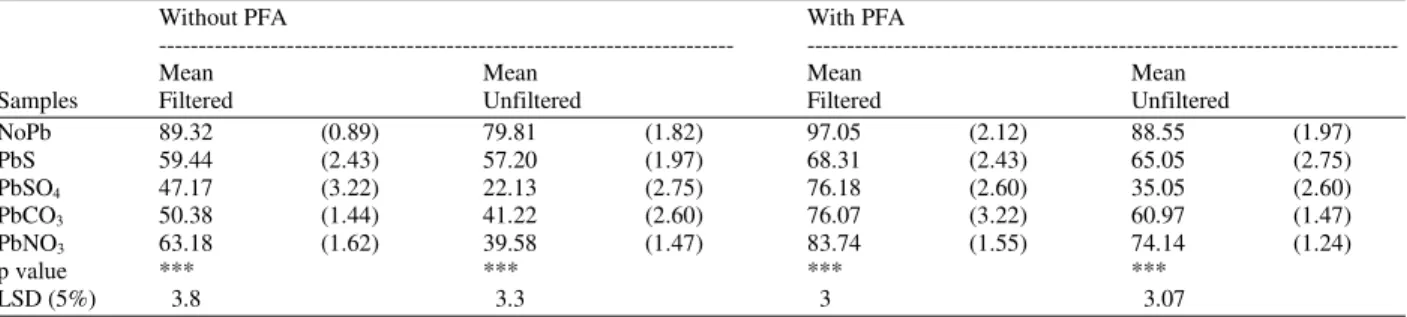
All the samples without PFA, when filtered, showed a marginal increase in percentage bioluminescence with the highest effect amongst the spiked samples observed for Pb NO3 (63.18%±1.62) and the lowest for PbSO4
(47.17%±3.22) (Table 2). All the controls showed higher luminescence in comparison with the spiked samples indicating lower toxicity levels. However, for unfiltered samples (without PFA), the highest luminescence results (apart from the controls) were observed with PbS (57.2%±1.97) and the lowest with PbSO4 (22.13%±2.75).
Immediately after the equilibration period (9 d) (following spiking of the samples and the application of PFA), the samples showed a significant increase (p<0.001) in luminescence in all the treatments. The highest percentage luminescence was observed with PbNO3 (83.74%±1.55) and the lowest with PbS
(68.31%±2.43) when filtered and treated with PFA. However, for unfiltered leachates samples treated with PFA, the highest luminescence result was observed with PbNO3 (74%±1.24), while the lowest was with
PbSO4 (35.05%±2.60).
Further analysis of percentage luminescence data showed that the effects of filtration on samples (not treated with PFA) were higher in comparison to those that were not filtered. The highest difference was observed with PbNO3 (23.60%) and PbSO4 (22.05%),
Table 2: Analysis (ANOVA and LSD) of luminescence-based toxicity data for leachates from samples treated with/without PFA (filtered
/unfiltered)
Without PFA With PFA
--- ---
Mean Mean Mean Mean
Samples Filtered Unfiltered Filtered Unfiltered
NoPb 89.32 (0.89) 79.81 (1.82) 97.05 (2.12) 88.55 (1.97)
PbS 59.44 (2.43) 57.20 (1.97) 68.31 (2.43) 65.05 (2.75)
PbSO4 47.17 (3.22) 22.13 (2.75) 76.18 (2.60) 35.05 (2.60)
PbCO3 50.38 (1.44) 41.22 (2.60) 76.07 (3.22) 60.97 (1.47)
PbNO3 63.18 (1.62) 39.58 (1.47) 83.74 (1.55) 74.14 (1.24)
p value *** *** *** ***
LSD (5%) 3.8 3.3 3 3.07
Figures in parentheses show standard errors of the mean, *** p< 0.001, N = 9
L e a d S o u r c e s
W it h o u t P b P b S P b N O 3 P b S O 4 P b C O 3
P
b
µ
g
L
-1
0 1 0 2 0 3 0 4 0 5 0 6 0 7 0
w i t h p f a W i t h o u t p f a
L S D p < 0 . 0 5
Fig. 1: Effect of PFA on concentration of leachate (mg L-1) Pb from soils amended with different lead sources
S a m p le s
S oil-P b -P FA
S oil-P b +P F
A
S oil+ P bS O
4 -pfa
S oil+ P bN O
3 -pfa
S oil+ P bC O
3 -pfa
S oil+ P bS
-p fa
S oil+ P bS O
4 +p fa
S oil+ P bN O
3 +p fa
S oil+ P bC O
3 +p fa
S oil+ P bS +
p fa
p
H
5 .5 6 .0 6 .5 7 .0 7 .5 8 .0 8 .5 9 .0
L S D p < 0 . 0 5
Fig. 2: Effect of PFA treatment on pH of soil samples spiked with different lead compounds
PbCO3 (25.69%) and PbNO3 (20.56%). The lowest
percentage luminescence was for PbS (8.87%). In comparison, when unfiltered samples were analysed for the effect of PFA (i.e. with/without PFA) the highest difference in mean percentage luminescence was observed with PbNO3 (34.56%) while the lowest yet
again was observed with PbS (8.87%). In contrast, the unfiltered leachate (with PFA), PbSO4 (12.92%)
demonstrated a much lower value in luminescence when compared to earlier results of filtered samples.
To further determine the particulate effect on leachate sample toxicity, analysis of the samples that were not treated initially with PFA and remained unfiltered were compared with those that were filtered and treated with PFA. The results as shown earlier demonstrated that filtration improved bioluminescence. Moreover when considering the effect of both filtration and treatment of the samples with PFA, the results demonstrated that, samples that were unfiltered and not treated with PFA only indicated the highest percentage luminescence with PbS (57.20%±1.97) while the lowest was with PbSO4 (22.13%±1.97). When the same
samples were treated with PFA and filtered,% bioluminescence values increased indicating a reduction to toxicity for PbS (68.31%±2.43) and PbSO4
(76.18%±2.60). However, the highest difference in percentage luminescence between filtered (and treated samples) and unfiltered (and untreated) samples were observed with PbSO4 (54.05%) and PbNO3 (44.16%).
The lowest difference in luminescence was noted with PbS (11.11%)(Table 2).
Effect of PFA on pH (less or above pH 5.0)
adjustment: The effect of PFA on filtered /unfiltered
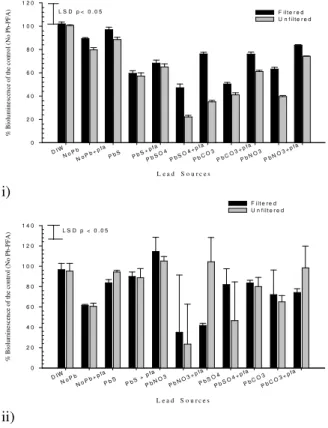
samples was demonstrated when the same samples were further subjected to pH adjustment. They all showed significant (p<0.001) results on adjustment of pH less or above 5.0 (Fig. 3i) and ii)). This observation illustrated that pH management could be used as another potential tool in the intervention of lead contamination.
When the samples were further adjusted at pH > 5.0, higher luminescence was observed for the reference material (double deionised water), No Pb (filtered and Unfiltered) with and without PFA, filtered PbSO4, PbNO3 and PbCO3 with PFA (Fig. 3i). The
lowest percentage luminescence was observed with PbSO4 for both filtered and unfiltered samples.
However, for samples adjusted to pH<5.0, the highest bioluminescence for filtered/unfiltered was observed for PbS treated with PFA (114%) while the lowest luminescence was observed with PbNO3, filtered (35%)
L e a d S o u r c e s
D IW N oP b
N oP b
+ pfa P bS
P bS +
p f a P bS O
4 P bS O
4 +p fa P bC O
3 P bC O
3 +p fa P bN O
3 P bN O
3 +p fa
% B io lu m in e sc en ce o f th e c o n tr o l (N o P b -P F A ) 0 2 0 4 0 6 0 8 0 1 0 0 1 2 0
F i l t e r e d U n f i l t e r e d L S D p < 0 . 0 5
i)
L e a d S o u r c e s
D IW N oP b
N oP b
+ pfa P bS
P bS
+ p fa P bN O
3 P bN O
3 +p fa P bS O
4 P bS O
4 +p f a P bC O
3 P bC O
3 +p f a % B io lu m in e sc en ce o f th e c o n tr o l (N o P b -P F A ) 0 2 0 4 0 6 0 8 0 1 0 0 1 2 0 1 4 0
F i lt e r e d U n f il t e r e d
L S D p < 0 . 0 5
ii)
Fig. 3: i) Effect of Filtration and pH above 5 on the toxicity of leachate from soil amended with various lead compounds and treated with or without PFA. ii) Effect of Filtration and pH below 5 on the toxicity of leachate from soil amended with various lead compounds and treated with or without PFA
Le ad so urces Ref. (
DIW) N oP b
+pfa PbS +
pfa PbNO
3+pfa PbSO
4+pfa P bCO
3+pfa % B io lu m in e s c e n c e o f th e c o n tr o l (U n a d ju s te d , N o P b -P F A ) 0 20 40 60 80 100 120 140 pH <5.0 pH >5.0
Fig. 4: The comparative effect of pH adjustment on the toxicity of leachate from the lead spiked soils treated with PFA
When individual samples treated with PFA were measured, treatment effect on pH adjusted (i.e. pH less than and above 5) lead spiked samples was significant (p<0.05) only with PbS and PbNO3 (Fig. 4) suggesting
most probably that pH did not affect the overall adsorption potential of PFA for the other samples.
DISCUSSION
Many metals are known to be particularly harmful to human health. There is, therefore a pressing need for efficient treatment strategies to reduce the toxicity of metal contaminated soil using cost effective techniques e.g. naturally available ameliorants (e.g. PFA). PFA is known to be alkaline which further aids retention of metals. PFA has almost no biodegradable organic material and produces no gas as a product of such degradation. Chaudhuri et al.[41] studied the mobility and bioavailability of selected heavy metals in coal ash and sewage sludge-amended acid soil and concluded that soil quality was enhanced with the addition of either sludge or ash or their mixtures, with no possible threat to increased bioavailability and mobility of metals. In addition, PFA may be usedas an amendment to improve physical and chemical characteristics of sandy soils. When applied at sufficient rates (e.g. to achieve 10% w/w in surface layers) to sandy soils, Pathan et al.[21] found that Fly Ash altered texture and increased water-holding capacity. However, Fly Ash samples from differentsources (e.g. Australia) showed considerable variation in several properties[21]. Depending on the source used to amend soils, Fly Ash may also provide P and aid nutrient retention by increasingthe P retention index and/or cation exchange capacity. That composition of Fly Ash varies depending on the quality of coal used and the operating condition[10]. For example, PFA from a Thermal Power Station was found to consist of elements essential to plant growth like Ca, Fe, Mg, K but also of other such as B, Se, Mo and metals that can be toxic to the plants[42]. PFA in most of the cases exhibits similar physical and chemical characteristics (Table 1) as demonstrated in samples collected from Indian.
To comprehend in the current study, the ameliorant potential of PFA (in terms of intercepting mobile lead) for soil matrices spiked with various Pb compounds (PbSO4, PbNO3, PbSand PbCO3), data from the leachate
collected after 9 d were compared (i.e. for samples with/without PFA). The order of concentration (mg L1) of Pb (in decreasing order) was; PbNO3>PbSO4>PbS>PbCO3, but, on addition of PFA,
the largest difference in concentration (mg L1) between the control and the treated samples was of the order PbNO3>PbSO4>PbCO3>PbS. The order exhibited the
same pattern except for the PbS and PbCO3 samples.
possibly increase the soil pH[36]. This property of Fly Ash can be exploited to neutralize acidic soils[26,43]. The effect of Fly Ash addition effectively raises the pH and if applied to acidic soil, should reduce the metal solubility and hence availability to plants.
As an ameliorant, PFA’s impact on the bioavailability of various Pb compounds was assessed by the use of a genetically modified biosensor lux -marked E. coli HB101 pUCD607. The choice of the biosensor was appropriate due to its robust, wide pH ranges (3.0–10.00) and sensitivity in measuring the toxicity of the final leachate collected[52]. The results indicated that prior to the application of PFA to the samples leachate; filtration had the highest effect for PbSO4 treated soil with a 113.15% increase in
luminescence (i.e. from 22.13 to 47.17%). However, this result, which suggested the adsorption of PbSO4 on
the particulate matter of the soil matrix, still demonstrated the toxic nature of the leachate from lead spiked soil. When the unfiltered leachate (indicating lowest luminescence values) from PFA amended soils were tested, the highest increase (86.49%) due to PFA was observed with PbNO3 (i.e. luminescence increasing
from 39.58 to 74.14%). This observation suggested that, when PFA was used as an ameliorant for unfiltered Pb spiked samples, all lead compounds (except PbSO4
(35±2.60%)) compounds were rendered less toxic by generating less bioavailable lead in the leachate. However, when the same samples treated with PFA were filtered all the samples increased their luminescence with PbSO4 (which earlier had low
luminescence) showing the highest percentage increase (244.24%).
Bataillard et al.[44] reported that when lead was added as sulphate, between 10 and 20% of lead particles dissolved, regardless of the soil type with lead sulphide progressively oxidising over time. The low dissolution of lead sulphate could explain the immediate effect of filtration by causing increased luminescence, suggesting that most of the metal was held in the colloidal medium. This observation was critical indicating that while the application of PFA, as an ameliorant was effective, filtration as a technique improved the reduction of toxicity even further after the application of PFA but not before. Overall, the application of PFA appeared to reduce metal release from heavily contaminated soils rendering the final leachate less toxic. Shende et al.[45] used alkaline Fly Ash to reduce the metal toxicity of contaminated soil through immobilization of heavy metals. However, these workers found that when the Fly Ash application exceeded 5% on a weight for weight basis in soil, crop growth was significantly reduced. The pot culture studies were carried out with maize (Zea mays) crop grown in acidic sandy loam (pH 4.9) and calcareous silty clay (pH 7.9) soils treated with known concentrations of heavy metals (viz. cadmium, copper,
nickel and zinc). The adsorption properties of PFA are related to PFA’s ability in immobilizing heavy metals and in studies by Wang et al.[46] on characterisation of the metal adsorption capability of class F coal Fly Ash, it was established that the surface physical-chemical characteristics of a class F coal Fly Ash had a quantitative relationship with metal adsorption. During the same study, the adsorption results indicated that metal adsorption was in the linear range of the Langmuir isotherm if the total metal in the system was less than 10% of the total metal binding site. In addition the results showed that, the presence of ionic metal ions does not affect the adsorption of cationic metal ions by the Fly Ash.
Filtration was primarily used to investigate the impact of the particulate matter on bioavailability of the heavy metals and efficacy of PFA as an ameliorant. Thus in other related studies investigating grain size and how the silt size range of Fly Ash affects the bulk density of soil, Chang et al.[47] observed that among five soil types, Reyes silty clay showed an increase in bulk density from 0.89 to 1.01 when the corresponding rates of Fly Ash amendment increased from 0 to 100%. Page et al.[13,48] reported that Fly Ash amendment to a variety of agricultural soils tended to decrease the bulk density. Optimum bulk density in turn improves the soil porosity, the workability of the soil, the root penetration and the moisture retention capacity of the soil. Changes in soil texture could be expected in both agricultural soils as well as strip-mined soils. It was generally observed that both sandy and clayey soils tend to become loamy in texture[49] when PFA is added in the U.S. where the average silt content in Fly Ash is about 63.2%[35], although in India, this content ranges from about 16[50] to 45%[51].
CONCLUSION
The aim of the studywas to investigate the effect of PFA on the leaching of lead from soils amended with various lead compounds (PbS, PbSO4, PbNO3 and
PbCO3). PFA was found to be a useful ameliorant and to
technique managed to remove the colloidal bound toxic particulate matter effectively as indicated with the results shown. However, the most important aspect that needs to be considered is to establish the source of the PFA, as certain sources could possibly impart certain toxic elements, defeating the primary purpose of amelioration.
REFERENCES
1. Brian, R.H., D.B Hayden and M.A Powell, 2003. Evaluation of pulverised fuel ash mixed with organic matter to act as a manufactured growth medium. Intl. AS Utilisation Symp., Centre for Applied Energy Research, Univ. of Kentucky. 2 Rayzman, V.L., 1997. Technology for
chemical-metallurgical coal ash utilization. Energy and Fuels, 11: 761-773.
3 The American Coal Ash Association, Inc. (ACAA), 1998. Coal Combustion Products (CUP) Production and Use–1997 in the USA. Alexandria, VA.
4. Wei, Z., Z. Hu, J. Si and S.S Chen, 2000. The evaluation characteristics of soil elements on reclaimed land filled with fly ash. In Lu Xinshe (Ed.) Mine Land Reclamation and Ecological Restoration for the 21 Century, China Coal Industry Publishing House, pp: 225-230.
5. Sear, L.K.A., A.J. Weatherley and A. Dawson, 2003. Environmental impacts of using fly ash: The UK producers’ perspective. Intl. Ash Utilisation Symp., Centre for Applied Energy Research, Univ. Kentucky.
6. Fisher, G.L., P.D.Y. Chang and M. Brummer, 1976. Fly ash collected from electrostatic precipitators: Microcrystalline structures and the mystery of the spheres. Science (Washington, DC) 129: 553-555.
7. Carlson, C.L. and D.C. Adriano, 1993. Environmental impacts of coal combustion residues. J. Environ. Qual., 22: 227-247.
8. Roberts, F.J., 1966. The effect of sand type and fine particle amendments on the emergence and growth of subterranean clover (Trifolium subterraneum L.) with particular reference to water relations. Aust. J. Agric. Res., 17: 657-672. 9. Summers, R., M. Clarke, T. Pope and T. O’Dea,
1998. Western Australian fly ash on sandy soils for clover production. Commun. Soil Sci. Plant Anal., 29: 2757-2767.
10. Adriano, D.C., A.L. Page, A.A. Elseewi, A.C. Chang and I. Straughan, 1980. Utilisation and disposal of fly ash and other coal residues in terrestrial ecosystems: A review. J. Environ. Qual.,
9: 333-344.
11. El-Mogazi, D., D.J. Lisk and L.H. Weinstein, 1988. A review of physical, chemical and biological properties of fly ash and effects on agricultural ecosystems. Sci. Total Environ., 74:1-37.
12. Bilski, J.J., A.K. Alva and K.S Sajwan, 1995. Fly Ash. In Rechcigl (Ed.) Soil Amendments and Environmental Quality. CRC Press, Boca Raton, FL, pp: 327-363.
13. Page, A.L, A.A Elseewi and I.R. Straugha, 1979. Physical and chemical properties of fly ash from coal-fired plants with reference to environmental impacts. Residue Rev., 7: 83.
14. Kumar, V., G. Goswami and K.A. Zacharia, 1998. Fly ash use in agriculture: Issues and concern. Intl. Conf. Fly Ash Disposal and Utilisation, 20-22nd Jan., New Delhi.
15. Sear, L.K.A., 2001. Fly ash standards, market strategy and UK practice. Intl. Ash Utilisation Symp. Centre for Applied Energy, Univ. Kentucky, pp: 36.
16. Ferreira C., A. Ribeiro and L. Ottosen, 2002. Possible applications for municipal solid waste fly ash. J. Hazard. Mater.,96: 201-216.
17. Querol, X., A. Alastuey, A. Lopezsoler, F. Plana, J.M. Andres, R. Juan, P. Ferrer and C.R. Ruiz, 1997. Environ. Sci. Technol., 31: 2527.
18. Ricou, P., V. Hequet, I. Lecuyer and P. Le Cloirec, 1999. Influence of operation conditions on heavy metal cation removal by fly ash in aqueous solutions. Intl. Ash Utilisation Symp., Centre for Applied Energy Research, Univ. Kentucky, pp: 42. 19. Alemany, L.J., M.A. Jiménez, M.A. Larrubia, F. Delgado and J.M. Blasco, 1996. Removal of phenol from aqueous solution by adsorption on to coal fly ash. Adsorpt. Sci. Technol., 13: 527-536. 20. Hwa, T.J. and S. Jeyaseelan, 1997 Comparison of
lime and alum as oily sludge conditioners. Water Sci. Technol., 36: 117-124.
21. Pathan, S.M., L.A.G. Aylmore and T.D. Colmer, 2003.Properties of several fly ash materials in relation to use as soil amendments. J. Environ. Qual., 32: 687-693.
22. Fail, J.L. and Z.S. Wochok, 1977. Soybean growth on fly ash amended strip mine spoils. Plant Soil, 48: 472-484.
23. Iyer, R.S. and J.A. Scott, 2000. Power station fly ash-a review of value-added utilisation outside of the construction industry. Resource Conserv. Recycl., 31: 217-228.
25. Townsend, W.N. and E.W.F. Gillham, 1975. Pulverised Fuel Ash as a Mdium for Plant Growth. The Ecology and Resource Degradation and Renewal, M.L. Chadwick and G.T. Goodman, Eds., Blackwell Scientific, Oxford, pp: 287. 26. Elseewi, A.A., F.T. Binghman and A.L. Page,
1978. Growth and mineral composition of lettuce and swis chard grow on fly ash amended soils. Environmental Chemistry and Cycling Processes, Conf. 760429, D.C. Adriano and I.L. Brisbin, (Eds.). U.S. Department of Commerce, Springfield, VA, pp: 568.
27. Ciravolo, T.G. and D.C. Adriano, 1979. Utilisation of Coal Ash by Crops under Green House Conditions. Ecology and Coal Resources Development, Wali, M., Ed., Pergamon Press, New York, pp: 958.
28. Rohriman, F.A., 1971. Analysing the effect of fly ash on water pollution. Power, 115: 76.
29. Natusch, D.F.S., 1975. Characteristics of pollutants from coal combustion and conversion process. Toxic Effects on the Aquatic Biota from Coal and Oil Shale Development, Quarterly Progress Rep. Oct.-Dec., Natural Resources Ecology Laboratory, Colorado State University, Fort Collins, pp: 73. 30. Gralloway, J.N., G.E. Likens and E.S. Edgeston,
1976. Acid rain precipitation in the north eastern United States; pH and acidity. Science, 194: 722. 31. Siddiqui, S., A. Ahmad and S. Hayat, 2004. The fly
ash influenced the heavy metal status of the soil and the seeds of sunflower. A case study. J. Environ. Biol., 25: 59-63.
32. Coles, D.G., R.C. Ragain and J.M. Ondov, 1978. Behaviour natural radionuclide in western coal-fired power plant. Environ. Sci. Technol., 12: 442-446.
33. Gowiak, B.J. and J.M. Pacyna, 1980. Radiation dose due to atmospheric releases from coal-fired power stations. Intl. J. Environ. Studies,16: 23. 34. Eisenbud, M. and H.G. Petrow, 1964.
Radioactivity in the atmospheric effluents of power that use fossils fuels. Science, 144: 288-289. 35. Sharma, S., 1989. Fly ash dynamics in soil-water
systems. Crit. Rev. Environ. Control, 19: 251-275. 36. Kumar, V., A.Z. Kiran and G. Goswami, 2000. Fly
ash use in agriculture: A prospective. Proc. 2nd Intl. Conf. Fly Ash Disposal and Utilisation, I: 1-13.
37. Ciccu, R., M. Ghian, R. Peretti, A. Serci and A. Zucca, 2001. Heavy metals immobilisation using fly ash in soils contaminated by mine activity. Intl. Ash Utilisation Symp. Center for Applied Energy Research, Univ. Kentucky, Paper No. 6.
38. Gupta, V.K. and I. Ali, 2003. Removal of lead and chromium from wastewater using bagasse fly ash-a sugar industry waste. J. Colloid. Interf. Sci., 271: 321-328.
39. Chien-Jung, L., C. Juu-En and L. Ming-Chun., 1999. Application of fly ashes in the removal of metal ions from wastewater. Paper Presented at the R’99 Cong. (Recovery, Recycling, Re-Integration), World Cong., Geneva.
40. Dermatas, D. and X. Meng, 2003. Utilisation of fly as for stabilisation/solidification of heavy metal contaminated soils. Eng. Geol., 70:377-394. 41. Chaudhuri, D., S. Tripathy, H. Veeresh, M.A.
Powell and B.R Hart, 2003. Mobility and bioavailability of selected heavy metals in coal ash and sewage sludge-amended acid. Environ. Geol., 44: 419-432.
42. Korcak, R.F., 1995. Utilisation of local combustion by-products in agriculture and horticulture. In: D.L. Karlen, R.J. Wright and W.O Kemp (Eds.) Agriculture Utilisation of Urban and Industrial By-Products. ASA Special Publication No. 58. ASA, CSSA, SSSA. Mad. WI., pp: 107-130.
43. Phung, H.T., I.J. Lund and A.L. Page, 1978. Potential use of fly ash as a liming material in environmental chemistry and cycling processes. Conf. 760429, D.C. Adriano and I.L. Brisbin, Eds. U.S. Department of Energy, pp: 504.
44. Bataillard, P., P. Cambier and C. Picot, 2003. Short transformation of Lead and cadium compound in soil after contamination. Eur. J. Soil Sci., 54: 365-376.
45. Shende, A., A.S. Juwarkar and S.S. Dara, 1994. Use of fly ash in reducing heavy metal toxicity to plants. Resour. Conserv. Recycl., 12: 221-228. 46. Wang, J., X. Teng, H. Wang and H. Ban, 2004.
Characterizing the metal adsorption capacity of a class F coal fly ash. Environ. Sci.Technol., 38: 6710-6715.
47. Chang, A.C., L.J. Lund, A.L. Page and J.E. Warneke, 1977. Physical properties of fly ash amended soils. J. Environ. Qual., 6: 267.
48. Page, A.L., A.A. Elseewi, L.J. Lund, G.R. Bradford, S. Mattigod, A.C Chang and F.T. Bingham, 1980. Consequences of trace element enrichment of soils and vegetation from the combustion of fuels used in power generation. Univ. California, Riverside, pp: 158.
49. Capp, J.P. and C.F. Engle, 1978. Fly ash in agriculture. Bureau ofMines Information Circular. US Department of Interior. Washington, DC 167, 8348: 210-220.
50. Kharagpur, I.I.T., 1999. Draft report of fly ash mission sponsored project. Utilisation of fly ash and organic wastes in restoration of crop land ecosystem. Submitted to Fly Ash Mission.
51. Raichur, C.A.S., 1997. Interim report of fly ash mission sponsored project. Utilization of fly ash in agriculture. Submitted to Fly Ash Mission.