Acta Cirúrgica Brasileira - Vol 21 (5) 2006 - 275
Feasibility analysis of loop colostomy closure in patients under local anesthesia
2 - ORIGINAL ARTICLE
Feasibility analysis of loop colostomy closure in patients under local anesthesia
1Estudo da praticabilidade do fechamento de colostomias em alça em pacientes sob
anestesia local
Rone Antônio Alves de Abreu2, Manlio B. Speranzini3, Luís C. Fernandes4, Delcio Matos5
1. Work performed at General and Digestive System Surgery Unit, Mandaqui Hospital Complex and Surgical Gastroenterology Division, Federal University of São Paulo (UNIFESP), Brazil.
2. Master, Postgraduate Program in Surgical Gastroenterology, UNIFESP, Brazil.
3. Full Professor of Digestive System Surgery, ABC School of Medicine, Santo André – São Paulo, Brazil. 4. PhD, Assistant Professor, Surgical Gastroenterology Division, UNIFESP, São Paulo, Brazil.
5. Associate Professor, Coordinator Postgraduate Program in Surgical Gastroenterology UNIFESP, São Paulo, SP, Brazil.
ABSTRACT
Purpose: To verify prospectively the practicability of performing loop colostomy closure under local anesthesia and sedation. Methods:In this study, 21 patients underwent this operation. Lidocaine 2% and bupivacaine 0.5% were utilized. Pain was evaluated during the operation, on the first postoperative day and at hospital discharge. Intraoperative events, postoperative complications and the acceptability of this procedure were analyzed. Results: The mean duration of the operation was 133 minutes (range: 85 to 290 minutes). The mean postoperative hospitalization was four days (range: one to twelve days). No patients died. Complications occurred in two patients (9.4%): abdominal wall hematoma and operative wound infection. With regard to pain severity, scores of less than or equal to three were indicated in the intraoperative evaluation by 80% of the patients (17/21) and on the first postoperative day by 85% (18/21). At hospital discharge, 95.2% of the patients (20/21) said they were in favor of the local anesthesia technique. Conclusion: Loop colostomy closure under local anesthesia and sedation is feasible, safe and acceptable to patients.
Key words: Colostomy. Anesthesia, Local. Pain, Postoperative. Intraoperative Complications.
RESUMO
Objetivo: Verificar a praticabilidade de se efetuar o fechamento de colostomia em alça sob anestesia local e sedação.
Métodos: Neste estudo 21 doentes foram submetidos a esta intervenção cirúrgica. Utilizou-se Lidocaína a 2% e Bupivacaína a 0,5%. Avaliou-se a dor em três períodos: intra-operatório, 1º pós-operatório e alta hospitalar; analisando-se intercorrências intra-operatórias, complicações pós-operatórias e a aceitabilidade desse procedimento. Resultados: O tempo médio operatório correspondeu a 133 minutos, oscilando entre 85 e 290 minutos. O tempo médio de internação pós-operatória teve média de quatro dias, variando de três a doze dias. Não houve letalidade. Em dois doentes (9,4%) ocorreram complicações: hematoma de parede abdominal e infecção de ferida operatória. Quanto a intensidade de dor, escores iguais ou abaixo de três foram indicados na avaliação intra-operatória por 80% (17/21) dos doentes; no 1º pós-operatório por 85% (18/21). Na alta hospitalar 95,2% (20/21) dos doentes mostraram-se favoráveis à técnica sob anestesia local. Conclusão: Fechamento de colostomia em alça sob anestesia local e sedação é praticável, com segurança e aceitabilidade dos doentes.
Descritores: Colostomia. Anestesia Local. Dor. Dor Pós-Operatória. Complicações Intra-Operatórias.
Introduction
Despite the apparently low risk involved in loop colostomy closure, there are reports of significant morbidity rates: 10-50%1 and 22-30%2; with occasional mortality:
0.5-1%1. Various anesthetic techniques have been utilized for
the closure of loop stomata, among which general anesthesia and locoregional blockade are prominent. The latter is the technique most frequently utilized. A review of the literature demonstrated the existence of only two reports on loop stomata closure using local anesthesia: one for colostomy and the other for ileostomy.3, 4 Both of these
authors reported that local anesthesia has advantages over general anesthesia and locoregional blockade: it involves a
Abreu RAA et al
276 - Acta Cirúrgica Brasileira - Vol 21 (5) 2006 Methods
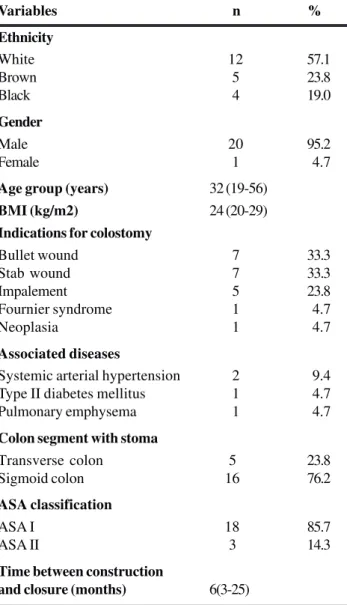
The research ethics committees of the institutions involved approved this experimental study; 21 patients underwent colostomy closure under local anesthesia and sedation at the General and Digestive System Surgery Unit of the Mandaqui Hospital Complex, São Paulo-SP, Brazil. The criteria for patient inclusion and non-inclusion are shown in Chart 1 and the characteristics of the sample are shown in Table 1.
All patients underwent preoperative colon assessment by means of opaque enema. They underwent mechanical intestinal preparation using manitol 10% and glycerinated administered through the efferent opening of the colostomy. Antibiotic prophylaxis using cefoxitin was given intravenously at a dose of 2g one hour before the operation, with maintenance doses of 1g every eight hours for two days thereafter. The patients were monitored by the anesthesiologist and received 2.5 mg of midazolam and 20 mg of meperidine intravenously, ten minutes before the operation. The anesthetics utilized were lidocaine 2%, at a maximum dosage of 7 mg/kg of body weight, and bupivacaine 0.5%, at a maximum dosage of 2.5 mg/kg of body weight. Local infiltration of the anesthetic solution around the colostomy was effected by means of punctures using a needle of dimensions 25 x 7 mm (Figure 1). Supplementary doses of the anesthetic solution were administered into the subcutaneous cellular tissue and aponeurosis whenever necessary (Figure 2).
CHART 1 - Criteria for patient inclusion and non-inclusion in the study
Inclusion
. Both sexes
. Age over 18 years old . Patients with loop colostomy
Non-inclusion
. Allergy to local anesthetics . Cognitive alterations or
psychiatric disturbances . Obesity (BMI > 30 kg/m2) . Patients with paracolostomic
hernia
. Coagulopathy or use of anticoagulants
. Non-acceptance of the method
TABLE 1 - Characteristics of the sample
Variables n %
Ethnicity
White 12 57.1
Brown 5 23.8
Black 4 19.0
Gender
Male 20 95.2
Female 1 4.7
Age group (years) 32 (19-56)
BMI (kg/m2) 24 (20-29)
Indications for colostomy
Bullet wound 7 33.3
Stab wound 7 33.3
Impalement 5 23.8
Fournier syndrome 1 4.7
Neoplasia 1 4.7
Associated diseases
Systemic arterial hypertension 2 9.4 Type II diabetes mellitus 1 4.7
Pulmonary emphysema 1 4.7
Colon segment with stoma
Transverse colon 5 23.8
Sigmoid colon 16 76.2
ASA classification
ASA I 18 85.7
ASA II 3 14.3
Time between construction
and closure (months) 6(3-25)
FIGURE 1 - Local infiltration of the anesthetic solution around the colostomy
FIGURE 2 - Supplementary dose of the anesthetic solution into the aponeurosis.
Acta Cirúrgica Brasileira - Vol 21 (5) 2006 - 277
Feasibility analysis of loop colostomy closure in patients under local anesthesia
All the patients left the surgical center with the advice to start moving around again as soon as they could. They were prescribed ketoprofen 100 mg endovenously every twelve hours and dipyrone 1g, also endovenously, every six hours. The efficacy of the local anesthesia was evaluated at three times: during the operation, on the first postoperative day and at hospital discharge. Pain severity was assessed by obtaining scores on an analog pain scale graduated from zero (complete absence of pain) to ten (the worst pain imaginable). The scale was interpreted thus: scores of 0 and 1, no pain; 2 and 3, minimal pain; 4, 5, 6 and 7, moderate pain; 8, 9 and 10, severe pain. During the operation, to decide whether to continue with the anesthetic method utilized, the following were verified: verbal complaints of pain; need for analgesic supplementation; facies; alterations in arterial pressure, pulse; respiratory pattern; level of oxygen saturation; and agitation.5
Statistical analysis was utilized to evaluate the evolution of the pain over the three observation times, by means of the Friedman test supplemented by the multiple comparisons test, with the limit for statistical significance set at 5%.
Results
There was no need to change the anesthetic method. Three cases presented systemic events during the operation: vomiting, bradycardia and psychomotor agitation (14.2%). There was one case of surgical complication during the operation (4.7%), caused by perforation of the afferent loop of the colostomy. The quantity of lidocaine infiltrated ranged from 300 to 600 mg and the quantity of bupivacaine ranged from 50 to 100 mg. The duration of the operation ranged from 85 to 290 minutes, with an average duration of 133 minutes. The evaluation of the severity of the patients’ pain is shown in Table 2, with significant decrease (P<0.0001).
of the patients were able to get up and move around soon after the surgery: 19 (90.4%) within the first eight hours. Eighteen (85.6%) had resumed dietary intake by the second day. Complications were observed in two patients (9.5%): one with hematoma and the other with infection of the operative wound. There were no deaths among the patients studied. Discharge from the hospital was authorized on average on the fourth day after the operation, with a range from the first to the twelfth day. When questioned, twenty patients (95.2%) said that they were in favor of the procedure, and they stated that they would be prepared to undergo anesthesia utilizing the same technique again if they had to.
Discussion
The sedation administered using midazolam and meperidine was shown to be efficient, and a notable reduction in the patients’ levels of anxiety was observed. Such anxiety is common in surgical procedures3. The dosage
was repeated in the cases of the three patients whose operations extended beyond 180 minutes, without any complication being observed. The anesthetic solution consisted of lidocaine 2% and bupivacaine 0.5% in 40 ml of distilled water, without the need for administering greater doses than what is recommended. There were no complications caused by the anesthesia. Cantele et al.3 in
their series of 14 patients, utilized lidocaine 1% for loop colostomy closure, while Haagmans et al.4 utilized lidocaine
and prilocaine in association with adrenaline for loop ileostomy closure in 15 patients. Neither of these authors found any complications caused by the anesthesia.
One patient in the present study presented nausea and vomiting upon manipulation of the parietal peritoneum. This ceased after administration of metoclopramide and after the more delicate surgical maneuvers had been done. Such manifestations were also reported by Haagmans et al.4 in
four patients, at the moment when the intestine was put back inside the abdominal cavity. Another patient in the present study presented bradycardia, which was reverted using atropine. This may be attributable to the bupivacaine, because of alteration to the entry pattern of the sodium channel6.Psychomotor agitation with involuntary
movements that was observed in a third patient ceased spontaneously after a few minutes, and this may have been a side effect from the midazolam7.Cantele et al.3 did not
mention any intra-operative systemic complications. Enterectomy was performed on two patients, due to granuloma in the stoma and inadvertent lesion of the intestinal loop, which increased the duration of the procedure. The sedation was repeated, without discomfort, and there was no need to change the anesthetic technique. Analog visual scales are the method most recommended for measuring pain in adults. They are simple, fast and objective5.The first pain evaluation was made
inside the surgical center, with the patient alert and able to speak. The scores obtained were low, thus showing the efficacy of the method, since 17 patients (80.9%) indicated scores of less than or equal to three (Table 2). At the second pain evaluation, done on the first postoperative day, 18 (85%) indicated scores at these levels. The patients showed
TABLE 2 - Evaluation of the severity of the patients’ pain
Pain Intra-operative First Hospital postoperative discharge
scale day
n % n % n %
0 0 0 7 33.3 20 95.2
1 7 33.3 9 42.8 1 4.8
2 8 38.1 1 4.8 0 0
3 2 9.5 1 4.8 0 0
4 3 14.3 1 4.8 0 0
5 0 0 1 4.8 0 0
6 1 4.8 1 4.8 0 0
Total 21 100 21 100 21 100
Intra-operative pain > pain on 1st postoperative day > pain at hospital discharge P < 0.0001
Abreu RAA et al
278 - Acta Cirúrgica Brasileira - Vol 21 (5) 2006
themselves to be comfortable in relation to pain control obtained using endovenous ketoprofen and dipyrone, without analgesic supplementation using opioids.
Postoperative hospital complications were observed in two patients (9.4%), with hematoma and infection of the abdominal wall. There was no need for reoperation in either of these cases. There were no cases of deaths in the present study. The low number of complications contrasts with what was observed by Cantele et al.3, who indicated a morbidity
rate of 42.8%, i.e. in six out of the fourteen patients (three cases of dehiscence of the anastomosis; two cases of infection of the abdominal wall; and one case of intestinal obstruction). Haagmans et al.4 found a rate of 20%, i.e. in
three out of the fifteen patients (one case of intestinal subocclusion, one case of dehiscence of the anastomosis; and one case of infection of the operative wound). Even with these rates, these authors stated that local anesthesia was a practicable method for performing loop colostomy closure in their patients.
At the time of discharge from the hospital, 20 out of the 21 patients said that they were in favor of the procedure, thus demonstrating that the anesthetic method utilized has good acceptability.
This method generates less pain and makes it possible for the patient to start moving around again soon after the surgery. It involves a small area of the body; it is simple, efficacious and presents little invasiveness; and it causes few systemic repercussions.
Loop colostomy closure under local anesthesia in association with sedation was shown to be a practicable and safe procedure with good acceptance by the patients. It did not add complications beyond those inherent to the operation itself. It is necessary to proceed further with studies within this field of investigation, by means of
randomized clinical trials to compare loop colostomy closures under local anesthesia and under other anesthetic techniques, thereby improving the treatment for such patients.
Conclusion
Loop colostomy closure under local anesthesia and sedation is feasible, safe and acceptable to patients.
References
1. Dolan PA, Caldewel1 FT, Thompson CH. Problems of colostomy closure. Am J Surg. 1979; 137:188-91. 2. Porkony RM, Heniford T, Allen JW, Tuckson WB,
Galandiuk S. Limited utility of preoperative studies in preparation for colostomy closure. Am Surg. 1999; 4:338-40.
3. Cantele H, Méndez A, Leyba J. Colostomy closure using local anesthesia. Surg Today. 2001; 31:678-80.
4. Haagmans MJ, Brinkert W, Bleichrodt RB, van Goor H, Bremers AJ. Short-term outcome of loop ileostomy closure under local anesthesia: Results of a feasibility study. Dis Colon Rectum. 2004; 47:1930-3.
5. Teixeira MJ, Pimenta CAM. Avaliação do doente com dor. In: Teixeira MJ, Figueiró JAB. Dor: epidemiologia, fisiopatologia, avaliação, síndromes dolorosas e tratamento. São Paulo: Moreira Júnior; 2001. p 58-68. 6. Fernandes de Andrade LO, Craveiro de Melo MC, Santiago
Gómez R. Anestesia para cirurgia ambulatorial. In: Fonseca Pinto F, Rocha Savassi PR. Cirurgia ambulatorial. Rio de Janeiro: Guanabara Koogan; 1999. p 14-49.
7. Thal ER, Yearny EC. Morbidity of colostomy closure following colon trauma. J Trauma. 1980; 20:287-91.
Correspondence:
Rone Antônio Alves de Abreu Rua Voluntários da Pátria, 3880/144A 02402-400 São Paulo – SP Brazil Phone: (55 11)6977-8871
How to cite this article:
Abreu RAA, Speranzini MB, Fernandes LC, Matos D. Feasibility analysis of loop colostomy closure in patients under local anesthesia. Acta Cir Bras. [serial on the Internet] 2006 Sept-Oct;21(5). Available from URL: http://www.scielo.br/acb
*Color figures available from www.scielo.br/acb
Conflict of interest: none Financial source: none