Playing by the rules: co-designing interactive
installations with pupils
Massimo Deriu1, Selene Uras1, Gian Maria Simbula1, Daniele Ardu1, Gavino Paddeu1
1 CRS4, Centro Centro di Ricerca Sviluppo e Studi Superiori in Sardegna, località
Pixinamanna, 09010 Pula, Italy {mderiu, selene, simbula, ardu, gavino}@crs4.it
Abstract. During the last couple of decades our perception of what constitutes a good learning environment has changed. Thanks to the use of technology, education is evolving from a passive model towards a more productive model, where students generate knowledge, teach each other, and collaborate on activities that make learning fun and interesting. In some previous works we have adopted this attitude: creating interactive installations thought for learning in an amusing way. Design-based research has demonstrated its potential as a methodology suitable to both research and design of technology-enhanced learning environments, a further step consists in co-design: students directly involved in designing with researchers. This paper provides some comments on the evaluation of the learning experience using two interactive installations promoting efriendly behaviours, and describe our experience in co-designing with pupils. We also report the ethnographic research performed underlining the weaknesses and the strengths, the difficulties and findings during the whole work.
Keywords: User Experience Design, Interaction Design, Learning, Interactive Installation, co-design.
1 Introduction
The age in which children are exposed to technology has been rapidly increasing. In recent times we have seen the creations of technological materials and devices expressively designed for children [for instance see Oblinger, Sackmann, Haddon, Berchet, Ergocube, Generation5].
Concerning learning and scholar curricula, there are not only computer sciences courses but also new approaches and techniques adopted to stimulate and facilitate learning process among pupils [Uras a, Beetham, Jonassen].
Nevertheless, one of the lackness of this stuff consists in not considering natural or social assimilated gestures. Quite often, children-adapted versions of these tools are
1 Please note that it is assumes that all authors have used the western
only a reproduction in a reduced way of the big ones designed for adults, without considering children’s level of development, abilities and skills. In fact, current pupils’ generation is considered digital native because since their early childhood they learn how to make use of digital devices. But, even now, there are only few examples of technologies developed starting from gestures and activities that children perform in their real life (which mainly consists in playing, alone or with friends).
Then, a good approach consists in developing interactive installations (combining new technologies and learning goals) involving children as co-designers. In that way, gestures required to the users are natural (because they are innate or social assimilated) as their way of interacting, reactions and strategies while using them.
In this paper we describe the ethnographic approach used to develop (on the field and with real final users involved) two different interactive installations thought to allow pupils to learn, in an informal and fun way, concepts and recommended behaviors for being eco-friendly citizens.
2 Technology and learning: an impossible binomial?
Recent studies [ISTAT, BBC, Olafsson] underline that new technologies is the field in which children’s and adolescents’ behaviour has been changing quite rapidly. The daily use of smart technologies becomes a habit between 7-8 year olds with the dramatic rising in using digital games, the internet and mobile phones.
The great majority of them (more than 70%) has her/his own computer and uses mobile phones as multimedia tools (Children’s use of online technologies in Europe). The Internet is mainly used to play games, carry out the homeworks, watch videoclips and instant messaging [Esa]. Less common is posting images and messages, and sharing files and videos [Bauer].
Although, it is well known that electronic games are fun to play and engaging [Wechselberger] that the activity of playing is often connected to the learning process [Wechselberger] that computer games seem to have motivational potential [Prensky] there is not a wide literature concerning the benefits of using highly technological solutions to transmit learning concepts to pupils.
But, after all, “there is much hope and promise that accompanies the use of technologies for teaching and learning in education, but it is challenging to consider what the best possible uses of technology might be in the design of student learning”. [Kirkwood].
3 Interactive installations for pupils: a proper approach
There is a passionate debate about how to investigate children’s and adolescents’ way of interacting with interactive installations.
be able to verbalize their own thoughts concerning abstract concepts or actions [Piaget a, Piaget b].
Moreover, pupils are often perceived as “just short adults” [Berman]: the approach used with adults is adapted without considering pupils’ needs and peculiarities. And it is quite common to find researches involving pupils in which only parents’ and teachers’ viewpoint is asked [Druin b, Druin, c].
The experience has taught that pupils can be involved as users, testers, informants, and partners in designing and evaluating technological devices, tools and installations [Heller] allowing to “understand the impact existing technologies have on child users, so future technologies can be changed or future educational environments enhanced” [Molebash] thanks to feedback given by pupils while answering to specific answers expressly created for them.
Druin [Druin b] has found that while working with children it is necessary to express the concepts in a proper way and adopt different strategies compared to the ones successfully used with adults, as dressing in an informal way, for instance.
The first time we developed an interactive installations for pupils [Uras b] we encountered some difficulties when we moved from our laboratory to the real setting in which pupils are supposed to use Dadodice (DD), although we used a wide variety of Interaction Design techniques. Then, basing on our field experience, we decided to involve pupils not only as users of our two new interactive installations but also as testers and co-designers in an ethnographic approach research.
We give pupils the two interactive installation in a stable version, with a minimal set of functions and, once moved the installations in their final environment, we allowed pupils to freely play with interactive installations, while observing, noticing their difficulties and misunderstanding, asking their impressions, desires, motivations and further explanations when something was obscure.
4 BeGreen and FeelGood
BeGreen (BG) and FeelGood (FG) are two interactive installations expressly created for an amusement park which has also a science communication pole oriented to transmit scientific knowledge to pupils in an amusing way.
For visiting the park, pupils are divided in groups up to 40 people and a science communicator goes always along with them. The role of the science communicator is to go with pupils and teachers while visiting the interactive section of the park, giving them instructions on the path expressly chosen for them, and to facilitate knowledge acquisition and comprehension of scientific phenomenons shown and understandable while playing with interactive installations.
4.1 Xplaces Framework
develop an intelligent environment where technology is at the same time “easy and natural to use” and “non invasive”, for this scope we have developed is a set of library and software that help programmers to create an interactive environment: Xplaces Framework [Paddeu et al.]. Technically it is a message oriented middleware written in ANSI C++ based on linux distribution. As a communication layer and framework for heterogeneous devices, Xplaces allows to easily implement a device cloud where any kind of sensor is able to notify events in a network and generate a triggered reaction on other devices, named “actuators”, or processes, named “applications”. Both installation BeGreen and FeelGood have been developed using Xplaces.
Fig. 1. BeGreen
4.2 BeGreen
This installation is composed by a round plexiglas table with two webcams inside, a PC, a TV screen, and two sets of plastic pawns differentiated by color, (blue and yellow in order to distinguish the competitors). Each set is composed by 20 different pawns that symbolize both positive and negative concepts for the environment. The plane of the table is opaque in order to hide the webcams from the sight of the players. A visual tag is printed at the base of each pawn, shown in Fig.1, so that they are recognised by cameras, and elaborated by the software that updates the scores of the two teams. The points are given according to the meaning (positive or negative) of the pawns. Two sketches (one for team) of the earth planet are displayed in the TV screen. During the game, they change the appearance (step by step from polluted and heavy damaged environment to earthly paradise and viceversa) depending on the choices of the players.
4.3 FeelGood
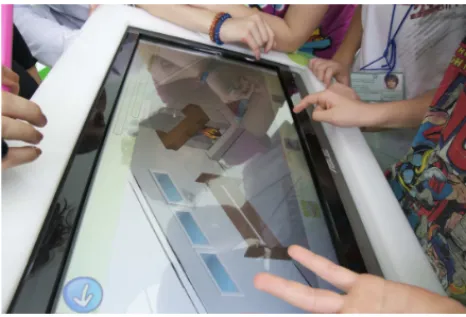
order to be easily touched by the players, as shown in Fig.2. They show a picture of five different home scenarios/rooms. There are three errors, (wrong routines that causes damages to the environment), for each scenario. One after the other the players should individuate and correct the error, dragging a troubleshooter’s icon on it. A countdown represented by the charge of a battery, starts at the beginning of the game, so that they play against the other team and the time too. Each team could slow down the countdown, recharging the battery with the energy generated by cycling. The software elaborates the sensors reading and update the score of the teams. As for the previews installation, two sketches (one for team) of the earth planet are displayed in the TV screen and they change their appearance during the game.
Fig. 2. FeelGood
5 The ethnographic research
The ethnographic research was performed on the field, in the amusement park while pupils were visiting the exhibition concerning renewable energies.
The science communicator (who are two: A. and V.) introduces the two interactive installations underlining that pupils were the first people to play with them and giving some basic rules of the game (see. par. Rules of the game).
The user experience designer introduces herself underlining that she was there to follow pupils while playing with the interactive installations and that was curious to collect their opinions, feedback and suggestion to improve the playing experience.
5.1 The sample
The pupils visited the amusement park during a school trip reserved in advance. It is interesting to underline that the amusement park is located in a big island with a population of 1.500.000 inhabitants, divided in about 300 small-medium municipalities and less than 10 big municipalities.
Participants to the ethnographic research came all from small-medium municipalities.
5.2 The scientific communicators
The two scientific communicators were involved in the whole development phase as co-designers. The minimal set of functions of the two interactive installations are inserted in close collaboration with the scientific communicators. In fact, they offer us their know how, their skills and knowledge developed in more than 8 years of experience.
5.3 Rules of the games
Before starting the research we discussed with amusement park staff in order to propose in the best way interactive installations to pupils and allow them to play. Then, we decide to establish some simple and basic rules:
1. split the group in two teams composed by the same number of pupils; 2. giving general instructions concerning the aim of the game;
a. for FG it was explained that pupils need to make the right eco-friendly choices in order to make the Earth happy;
b. the science communicator introduced BG asserting that someone entered in the house to play a joke on us: pupils need to find all the fonts of energy dispersion in order to transform the grey planet in a lush grassland;
3. the science communicator underlined also that there was a predefined time to play.
The rules of the games were expressly simple in order to allow pupils to autonomously establish their ones basing on the needs emerging on the field.
5.4 Methodology
The user experience designer participates at the visits with pupils, she introduces herself declaring that was there to collect pupils’ feedback and opinions concerning BG and FG.
She stressed the importance of feeling free to express everything.
5.5 Observation and field notes
The user experience designer observed pupils’ while using FG and BG. She was looking for every kind of behavior and communication emerging by the field. She takes field notes of what she is looking at.
5.5.1 FeelGood
Before starting the match, one team divides the pawns in positive and negative and they respect this choice in positioning the pawns on the table. Another team reorganizes pawns’ arrangement and, consequently, their opponents do the same even though it is completely useless for winning the game.
The idea of humanizing the earth creates various behaviors in pupils: • “Earth smiles when we do not contaminate it” (Giulia, 10 years), • “We must make the Earth happy” (Paolo, 10 years)
• “We need only elements that do not pollute: the others are garbage and we do not need them at all” (Lucia, 10 years).
Pupils argue about who is the first to chose the pawn so some specific rules are introduced (see par. Discussion) then each pupil takes one pawn and they lay out themselves in a queue.
• “It is important to check if we are doing well looking at the monitor” , • “We need that someone looks at the monitor in order to discover whether the
scores improves”.
For pupils, no matter the age, it is quite difficult to understand that if a negative pawn is put on the table the score will decrease. During observation only one pupil, after having listened to the enlarged rules of the games (see par. Discussion), asked whether he (Giorgio, 11 years) well understood:
• “this difficult but right way to calculate the score”
We noticed also some coping [Bandura] behaviours: only in one case pupils mirror the pawns chosen (they are the oldest pupils), after having chosen one (right) pawn (considered difficult) pupils turn in our favour in order to have a further confirmation of the right choice. Pupils adopt an attempts and errors approach until one of them starts to explain why he has just chosen one peculiar pawn, after that, before confirming the choice of the pawn, some pupils consult their companions, others prefer to put and take out the pawn (thanks to that a new rule will be introduced, see par. Discussion), in the first seconds of the game pupils look only at their score and the consequences (positive or negative) of their own pawns then they started to look at the same also for the other team, imitating the others when performing better. Sometimes, it happens that an element is considered controversial or that someone does not understand the meaning of a pawn (Roberto, 8 years “Why bottles are considered good?”). So the companions stop playing to explain the value of the pawn. In these cases it is interesting to underline that there is a wide variety of explanations (correct and wrong).
It seems that manipulating the pawns before starting the game make feel pupils more confident: most of them, in fact, reorganize, pawns’ initial dispositions. If a team does it for first, the other immediately performs the same (imitative) behavior.
The great majority of pupils (more than 80%) has some difficulties in understanding the value of two pawns, this creates great discussions within the team.
In six different teams the leadership has emerged on the field: one pupils (male) give the word to companions about how to behave (the pawns to chose, the order of pupils putting the pawns on the table …).
After having won the game, the successful pupils are proud to stay in the winner team.
There is a sort of gap between choices and knowledge, in fact, during the feedback phase (see par. Discussion) pupils demonstrate to know the value of the positive energies not chosen (they offer different examples of energies’ efficacy) but, nevertheless, during the game pupils were not able to chose them.
Some pupils try to put fingers and hands on the table to understand if also those parts of their bodies could be read as it happens with the pawns.
Before leaving, a great number of pupils produce various exclamations asserting how enjoyable was playing the game.
Only one team (aged 11) while playing the game interact directly with the science facilitator: they are curious to know which is the highest score.
5.5.2 BeGreen
Every single pupil wants to touch the screen to choose the right solution to solve the problem, so it was decided to have a special player, a person dedicated to this task. He/she was chosen in the team by the teacher (following teacher’s own criteria) or by the science facilitator (who chose the pupil closer to the monitor).
In that way, in all the games, there is a group of pupils (up to 15) suggesting to the team leader the solutions while the remaining pupils incite the biker (who was chosen by the teacher because of his/her vigour or by the science facilitator basing on proximity). Apart from two teams, all the others have various bikers interchanging for the task. Three teams decide to adopt short periods of time (from 50 to 90 seconds) for every biker. In one case only, the biker is left alone while riding and after few seconds he stops, so companions decide to incite and support him. In some cases, companions inciting the riding decide to compare his/her results with the ones of the biker in the other team: in that way this becomes a challenge between the two of them.
The great majority of pupils, no matter the age, has serious difficulties in understanding how to get in a room/scenario. This needs further explanations given by science facilitators.
Four groups of different ages have serious difficulties in using and interacting with touchscreens.
It is quite common that they have serious difficulties in understanding how to combine problems and solutions so science communicators (only once the teacher did that) often stop the game and give them the needed explanations. While playing, smallest pupils seem to forget the aim of the game: they explore the environment to see which elements are there and give off topic comments (e.g. Paola, 8 years “At home we have a similar sofa but in red”).
Youngest pupils when are not able to find the right solutions, seem to forget the aim of the game and try to combine problems and solutions which in the real world are coherent (the cat and the carpet, radiator and solar panel) but not compliant with game rules.
In the four teams composed by the older players, pupils evaluate if they have performed the right choice looking at the state of the planet displayed in the monitor. In three cases the special person decides not to pay attention on teams’ suggestions and the team does not complain about that but, simply, stay in silence.
Once finished the game, all the pupils want to play another time. Someone for having more pleasure, someone because feels to have not directly played the game (when asked pupils assert that they want to touch the screen and choose the solutions with their hands). It is quite common, in fact, that pupils vividly discuss among themselves about who of them might stay in front of the touchscreen.
Finishing with the same score is considered unseemly by both teams.
5.6 Interviews
The interviews with pupils are administered as soon as they finished to play. We ask them what they think about each interactive installation, if they have fun playing with them, if the installations are intuitive to play, if the pictures (in the pawns for FG, indicating the solutions for BG) are clear and if they discover something new about renewable energies.
They were enthusiastic to be involved also in this phase but their judgements were extremely assertive and positive also when they really encountered one problem while playing (e.g. the incomprehensible element on one pawn).
In different moments we interview also the two science facilitators. Both of them were proactive in giving suggestions for improving the interaction with installations and their work at the park.
In fact, they science communicators prosecute in co-developing with us, adding some insights and improvements coming from on the field experience. Facilitators find interesting the necessity to give some rules for whom has to touch the screen, organizing queues to put the pawns on the table, creating rules and turns for bikers. They find fundamental the feedback phase (see par. Discussion) to verify and build up pupils’ knowledge concerning renewable energies.
6 Discussion
The testing phase was relevant to underline elements to be improved, modified, added and deleted in order to enhance interaction and learning while developing interactive installations.
Whoever is the font, pupils accept the rules without discussing: pupils are accustomed to have rules in their daily life because there is always an adult ready to explain them what and how to do, so they passively accept adult’s suggestions. In this research pupils are able to create their own rules only in case of a natural leadership emerging from the field. It interesting to underline that, in this case, the leader could be a sort of dictator imposing methods, rules and often deciding without consulting the others, who do not complain about that but accept leader’s impositions. This implies that if researchers are interested in pupils self-elaborating their own rules they need to take into account this relevant aspect.
If a characteristic of the game is humanized, pupils have the tendency to take care of it as if it was a person: in some groups the humanized earth has the consequence of arousing empathy among pupils: they are interested in improving earth’s wellness otherwise it was in danger.
If pupils manipulate things on a horizontal surface and, simultaneously, need to check their results on a vertical surface, while designing the installation
researchers need to link the surfaces in a strong way: for the great majority of pupils it is not easy to understand the direct connection between their choices and the consequently results displayed on the monitor. But teams doing that are able to quickly understand some aspects found difficult by other groups (i.e. the decrease of the score when they put a wrong pawn on the table) and to organize game
development within the group.
Reporting an uncommon behavior to a well-known behavioral pattern is the solution to explain and transmit unexploredconcepts: when the game requires behaviors not daily adopted pupils are in great difficulty. For instance, the fact that adding a pawn with a negative value means decreasing the score is difficult to be understood. It requires more explanations about this abstract concept. After making a few attempts the right key is found. It was used a metaphor: when pupils buy
something they have a certain amount of money (the score before putting the pawn on the table), after having paid, their amount of money decreases (the score) but they have a new object (the chosen pawn).
Pupils often try to mirror one another: if pupils divided in team use two sets of the same objects they mirror one another. It is possible to take advantage of this aspect to enhance the creation of a collaborative learning.
community. This is useful in context where it is necessary to collect pupils’ different opinions and knowledge.
If there are artifacts to manipulate pupils want to touch them: during the game it was not possible for each pupil to put a pawn on the table. So, during the feedback phase (see above in this paragraph), it was decided that pupils who do not touch a pawn during the game were appointed to put it away. Then, it is important to allow to all participants to directly manipulate artifacts because, in that way, they feel the amount of their contribution.
When working with highly technological objects it would be recommended to explain the used technology: because pupils try to extend the working way of the device also to objects not included in the game. For instance, pupils pretended that the table is able to read their fingerprints as it does with the code below the pawns. After the explanation they tried to cover a part of the code to better understand how the mechanism works.
When there is the necessity to have a science facilitator (or a similar role) it becomes relevant to minimize her/his participation: pupils are so involved and immerse into that the rest of the world does not exist so the presence of an external person could be perceived as intrusive and interfering to the scheduled and desired activities.
When there are both right and wrong answers it is important to provide feedbacks: the feedback phase allows the science facilitator to officially stop the game, to collect pupils’ opinions, to explain difficult matters, to quickly evaluate if pupils understand what explained in the game and, if not, promote a discussion involving pupils, teachers and science facilitator to deepen important concepts. It is necessary to consider the preliminary knowledge and relationship between participants and the used technology: some problems are due to the unfamiliarity of the pupils with touchscreens and smart technologies. It causes a waste of time and a decrease of the level of enjoyment and independence while playing the game. If the interaction consists in exploring a virtual environment composed of various scenarios/rooms, it is fundamental to suggest a path to be followed: pupils during BG rooms’ exploration sometimes miss the scope of the game. In fact, or they try to combine problems with objects which are not the right solutions or lost themselves analyzing rooms’ details. But if you suggest a path to follow, in our case the science facilitator does it by word of mouth, pupils remember the aim of the game and (re)start to play.
7 Limitations
The research described here follows the ethnographic approach so it is relevant to underline that these results are obtained working with pupils coming from similar contexts, as well represented by their knowledge of touch and smart technologies. For instance, pupils living in smallest places are less surronded by smart and interactive techologies, influencing consequently their way of interacting with these peculiar artifacts.
Co-designing with pupils is not a trivial task because it is necessary to create and develop a common language made of words, gestures and shared meanings. But it requires a great amount of time and a proper non intrusive approach, always remembering that pupils are not in miniature adults.
Collective interviews generate enthusiasm and there everything seems sparkling and gorgeous, even if behaviors performed while playing suggest the opposite.
Last but not least, the first preliminary versions of the two interactive installations were developed in our Lab, without pupils around, but only with silent researchers so some kind of feedbacks during the game or some suppositions completely failed when pupils were engaged in interaction.
8 Conclusions and future developments
Developing interactive installations thought for learning purpose is a quite difficult task, moreover, in case of co-designing with pupils being able to deal with complexity beyond a certain point seems impossible. We have tried to reach this goal adopting and adapting various methods, keeping in mind the final aim to create interactive installations thought and designed for and with their final (small) users.
After the co-design phase the installations were improved thanks to the results of the ethnographic research, some modifications were introduced and, at the moment, pupils are still playing with BG and FG, trying to improve their environmental friendly behaviors.
This work contributes to the state of the art giving some suggestions and key factors to take into account while designing interactive installations for pupils. The novelty of this approch consists in using a quite raw version of an interactive installation, only with a minimal set of funcionalities, in order to be able to co-(re)design the installation thanks to final users’ (pupils in our case) feedback, needs and way of interacting. In that way, are emerged from the field some sort of guidelines useful to develop interactive installations with proper and extremely specific functionalities, i.e., adding controversial elements when the researchers or the commitment are interested in collecting users’ different opinions and implicitly opening a debate among them.
It is important to underline that in this research we work with pupils but the results suggest that it could be interesting adopting the same approach also while
References
1. Oblinger, D., Oblinger J.L., and Lippincott J.K.. Educating the net generation. Boulder, Colo.: EDUCAUSE, (2005)
2. Sackmann, R., and Winkler O.. "Technology generations revisited: The internet generation." Gerontechnology 11.4, pp 493--503 (2013)
3. Haddon, L.. "Mobile media and children." Mobile Media & Communication1.1, pp 89--95 2013
4. Berchet (2013) http://www.berchet.com/index.php (retrieved on July 22 2013) 5. Ergocube (2013) http://www.store.ergocube.com/ (retrieved on July 22 2013) 6. Génération 5 (2013) http://www.generation5.fr/ (retrieved on July 22 2013)
7. Uras, S., Ardu, D., Paddeu, G., & Deriu, M. (2012, December). Do not judge an interactive book by its cover: a field research. In Proceedings of the 10th International Conference on Advances in Mobile Computing & Multimedia (pp. 17-20). ACM
8. Beetham, H., and Sharpe R., eds. Rethinking Pedagogy for a Digital Age: Designing for 21st Century Learning. Routledge (2013)
9. Jonassen, D., and Driscoll M., eds. Handbook of research for educational communications and technology (2013)
10. ISTAT (2013) http://www.istat.it/it/archivio/45646 (retrieved on July 22 2013)
11. BBC (2013) http://www.bbc.co.uk/news/education-12334962 (retrieved on July 22 2013) 12. Ólafsson, K., Livingstone, S. and Haddon, L. Children’s use of online technologies in Europe : a review of the European evidence base. EU Kids Online, EU Kids Online Network, London, UK (2013)
13. Esa, S. and Kotilainen S.. TOWARDS ACTIVE CITIZENSHIP ON THE NET Possibilities of citizen oriented communication: case studies from Finland. Tampereen yliopisto, (2004) 14. Bauer, T. A., Maireder, A., & Nagel, M. (2009). Internet in der Schule - Schule im internet. http://www.bmukk.gv.at/medienpool/18687/internetschule_forschungsber.pdf (Retrieved on July 22 2013)
15. Wechselberger, U. "Teaching me softly: experiences and reflections on informal educational game design." Transactions on Edutainment II. Springer Berlin Heidelberg, pp 90--104 (2009)
16. Prensky, M. "Digital game-based learning." Computers in Entertainment (CIE) 1.1 pp 21--29 (2003)
17. Kirkwood, A. and Price L. "The influence upon design of differing conceptions of teaching and learning with technology." Informed design of educational technologies in higher education: enhanced learning and teaching, pp1--20 (2012)
18. Druin, A. "The role of children in the design of new technology." Behaviour and information technology 21.1, pp 1--25 (2002)
19. Piaget, J. "Biology and knowledge: An essay on the relations between organic regulations and cognitive processes." (1971)
20. Piaget, J. The child and reality: Problems of genetic psychology.(Trans. Arnold Rosin). Grossman, 1973
21. Berman, P. "Federal Programs Supporting Educational Change, Vol. VII: Factors Affecting Implementation and Continuation." (1977)
22. Druin, A. "Cooperative inquiry: developing new technologies for children with
23. Druin, A. and Solomon C. Designing Multimedia Environments for Children: Computers, Creativity, and Kids. Wiley Computer Publishing, John Wiley and Sons, Inc., One Wiley Drive, Somerset, NJ 08875 (1996)
24. Heller, K. A. "Individual (Learning and Motivational) Needs versus Instructional Conditions of Gifted Education [1]." High Ability Studies 10.1 pp 9--21 (1999)
25. Molebash, P. (1999). Technology and education: current and future trends, Information Technology Journal, 8, December 2000.
26. Paddeu, G., Deriu, M., Soro, A., Ardu, D., Kalb, S., Simbula, G. M., & Uras, S. (2006). XPlaces: an Open Framework for Shared Activity Spaces. Computing, 5, 25.
27. Uras, Selene, et al. "DADODICE: An interactive installation to support learning." PsychNology Journal 9.3 (2011): 269-284