ISSN 1557-4989
© 2012 Science Publications
Corresponding Author: Yoon-Doo Kim, Department of Agricultural Economics, Konkuk University, 322 Danwol-Dong, Chungju-Si, Chungcheonbuk-Do, 380-701, Korea
A Note on the Analysis of Time Cost by Difference of
Transaction System in the Agricultural Wholesale Market of Korea
1
Yoon-Doo Kim and
2Seok Yoon
1
Department of Food and Resource Economics, Konkuk University,
322 Danwol-Dong, Chungju-Si, Chungcheonbuk-Do, 380-701, Korea
2
Korea National Assembly, 1 Yoido Dong, Youngdeungpo-Ku, Seoul, 150-703, Korea
Abstract:Problem statement: The purpose of this study is to prove objectively that the market-wholesaler system, introduced to agricultural wholesale market in Korea for the first time, has better operational efficiency than the existing auction system. From an analytical viewpoint, we estimated the time value of two transaction systems at the agricultural wholesale market using the calculation methods of the congestion cost and the accumulation cost, and estimated the operational efficiencies divided by product family and item. Approach: We used data from the Statistical Resource of Agricultural and Marine Wholesale Market by Year for the research conducted in this study.
Results: As a result, we were able to analyze and conclude that the market-wholesaler system had a relatively lower time cost than the auction system by utilizing the time required from the agricultural carrying-in to the preparation for sale by the transaction system at the agricultural wholesale market and calculating the total time cost for 16 main items into the amounts. These results prove that the market wholesaler system has a better efficiency than the auction system. Conclusion: Therefore, if the market-wholesaler system can be enlarged and introduced into Korea’s 32 agricultural wholesale markets as the policy implicates by the study results, we can conclude that the transaction efficiency within the agricultural wholesale market will be better and it will contribute to enhancing the efficiency of the whole agricultural and fishery distribution industry.
Key words: Agricultural wholesale market, time cost, auction system, transaction system
INTRODUCTION
After the urgent change of the agricultural and fishery distribution environment and the opening of the distribution market, the public wholesale market that plays a central role for the agricultural and fishery distribution could not respond to the change of the distribution condition actively due to the inflexibility of operations, the possible need to minimize functions, and because the priority of the wholesale market was gradually on the rise. Therefore, as to whether we can acquire the competitiveness in the agricultural distribution fields or not by enhancing the efficiency of the agricultural wholesale market is on the rise as the main subjects, many discussions have been conducted for the transaction system within the wholesale market.
As a result, a new distribution subject, called the market wholesaler was introduced into the public wholesale market due to the revision of Year 2000 Act on Distribution and Price Stabilization of Agricultural and Fishery Products (Kim and Kwon et al., 2005).
Market wholesaler is the corporation appointed from the establisher of the agricultural and fishery
wholesale market and purchasing, selling to be entrusted, or mediating the agricultural and fishery and it means system like the wholesaler of the agricultural wholesale market in America.
accumulation cost, and estimated the amount of the occurred operation efficiency, comparing it with the existing auction method, calculating the congestion cost and the accumulation cost divided by the product family and the item. Also, we attempted to convert the cost estimates into the amount and find the economic needs. The purpose of this study is to suggest the necessary political implications with the results of these estimates.
MATERIALS AND METHODS
Precedent studies and analysis methods: In the case of Korea’s agricultural wholesale market, it is common knowledge that the road transportation for the agriculture is widely used. When we use it as the premise, as the congestion accumulation cost are occurred due to the inefficiency of the system operation, we can calculate the cost by dividing into the time cost for the product and the vehicle operation cost for the truck occurred as the queuing cost.
Precedent studies: For the estimates of the time cost, there were many studies related to ships and the traffic congestion for the ground transportation such as roads and ships. For the estimates of the economic value for the demurrage and accumulation time based on this study, the studies of Goss and Mann (1977) were representative. It was estimated from the Long-Run Opportunity Cost (LROC) formula that the ship and freighters have round the world-bank after that time. The methodology of Goss and Mann (1977) estimated the cost based on the demurrage and accumulation at the British Ports in 1970, using the same LROC formula stated above. Furthermore, Jansson and Shneerson (1982) considered the increase of the freight treatment cost and the ship service time, caused by the saturation point of the facilities as the congestion cost without the distinction of demurrage and accumulation.
In Korea, the studies of Chang, Young-Tae and Sung-Gui (1993) estimated the reduction effects of the ship queuing cost and general port cost according to development of that harbor as the demurrage and accumulation cost as a part of the economic analysis when we perform the harbor investment business. Also, KMI (2002) estimated the economic cost according to demurrage and accumulation using the compiled resources from eight domestic harbors (Pusan, Incheon, Kwangyang, Ulsan, Donghae, Gunsan, Mokpo, and Phohang) with the serious ships condition based on Goss and Mann (1977) study methods in the Study on the Economic Effects of Port Industries.
However, the precedent study estimating the economic cost directly according to the difference of transaction system for the agricultural and fishery wholesale market was not performed. Therefore, this study analyzed the time cost according to the difference of the transaction system at the agricultural and fishery wholesale market based on the precedent study of the port.
Estimation of congestion cost: We estimated the congestion cost using the theory and the methodology of Goss and Mann (1977); Chang, Young-Tae and Sung-Gui (2002) and Goss (1974). The daily Long-Run Opportunity Cost (LROC) for the truck can be calculated by the formula shown below Eq. 1:
CC OC
LROC (1 2)
365 +
= = + (1)
Capital Charge Eq. 2:
n Co 1 (1 ) CC
− − + γ =
γ
Co = initial capital cost n = durable years of the truck r = social discount rate
Operating Cost = W+FC+I+MC+T+GC … (2)
W = Wage FC = Fuel cost I = Insurance MC = Maintenance cost T = Tax
GC = General cost
As the LROC can be calculated with the sum of the Capital Charge (CC) and the Operating Cost (OC), the yearly capital charge will drive the shadow price as the level making the profits discounted at the level of the given production amount to coincide with the discounted cash operating cost and the capital cost correctly. Meanwhile, the yearly operating cost consists of the fuel cost, insurance, maintenance cost, tax, and general cost as well as the wage needed for the operation of the truck. In conclusion,
n
1 Co.
LROC [( ) W FC I MC T GC]
365 1 (1 )− γ
= + + + + + + − + γ
take back the investment cost of the truck, if expenses of the equal cost are converted into the current values, it will be the same as the initial capital cost.
Estimation method of accumulation cost: The congestion cost includes the resident cost with the condition that the truck did not load the goods; however, when the truck queues with the loaded goods, the social chance cost called the accumulation cost is occurred along with the congestion cost. It commonly reflects social discount rate. The daily resident time cost (Accumulation cost) of the product can be calculated by the economic value of that year’s freight × social discount rate ÷ 365 days.
Furthermore, the accumulation cost per time of the product can be calculated by economic value of that year’s product × Social discount rate ÷ (365 days÷24 h). Drawing data from the internal resources of the Seoul Agricultural and Marine Products (public) Corporation and the official statistical resources of The Ministry for Food, Agriculture, Forestry and Fisheries, the economic value of the product can be calculated with the quantity of transactions and the amount of the vegetables and fruits mainly treated by the market wholesaler at Gangseo agricultural wholesale market.
Accumulation cos t per day
Com mod ities value social discount rate 365
Accumulation cos t per time
com mod ites value social discount rate 365 24
× =
× =
×
RESULTS
Estimates of congestion cost: The congestion cost can be calculated by adding the annual capital charge to the annual operating cost. To calculate the annual capital charge, it is desirable to invest and apply the durable years of the truck and the initial capital cost, but we used the depreciation expenses of 1,595,608 KRW for the most adjacent truck due to the restriction for various conditions. It applied the depreciation expenses of the ground transportation (person) used in year 2007. Also, when we use this method, there is the inconvenience of having to calculate the depreciation expenses and the interest costs separately, but it can be more realistic applying methods with the given condition (Table 1-5). Meanwhile, when we calculate using the depreciation expenses, the annual congestion cost (Long-Run Opportunity Cost) of the truck was estimated at a total of 39,080,000 KRW by adding the
annual capital cost 1,595,608 KRW to the annual operational cost of 37,484,043 KRW.
As the transaction quantities of year 2007 for the Gangseo agricultural wholesale market totaled 499,059 tons and the transaction records for the market-wholesaler totaled 251,234 tons. It represented about 50.3% of the total transaction quantities. The number of vehicle related to the market wholesaler of total parked vehicles at Gangseo agricultural wholesale market based on data from 2007, can be calculated by the following formula and it was calculated as approximately 532 vehicles.
Number of vehicle related to the market wholesaler (2007) = Transaction quantities of market wholesaler ÷ Transaction quantities of Gangseo agricultural wholesale market × 1 day parking vehicle × Number of annual transaction per day ÷ 365 days.
Finally, the daily congestion cost of the truck was estimated to be as about 56,960,000 KRW when we divide (39,080,000 KRW×532 vehicles) by 365 days with the following formula 3. Eq. 3:
Daily congestion cost of truck
= (LROC of truck × Number of trucks) / 365 days (3)
Estimates of accumulation cost:
Calculation of value for carrying-in product: When we see the transaction results of the market wholesaler (Gangseo agricultural wholesale market) in 2007, the total transaction quantity was 251,234 tons, the transaction cost was 349,402,000,000 KRW, and the unit cost was calculated as average of 1,390,743 KRW per 1 ton, as stated below in Table 4.
Table 1: Calculation of annual operation cost of the truck (60312) (Data based on year 2007)
Division Annual Cost (KRW) Remark
Wage (W) 23,064,000 Except the bonus
Fuel Cost (FC) 9,758,560 Light oil, LPG, volatile oil
Insurance (I) 1,005,375
Maintenance Cost (MC) 659,057
Tax (T) 229,240
General Cost (GC) 2,767,811 Apply the miscellaneous expenses
Total 37,484,043
Notes: (1) For the labor cost, we apply the monthly payment cost (flat-rate payment + Overtime payment) for the transportation business. (2) For
the fuel cost, Insurance, maintenance cost, tax and general cost, we apply the business cost (transportation cost) for the ground transportation (personal). (3) From here, the separate truck means the industry activities transferring the freight using the small truck (1ton or less) and medium truck (excess of 1 ton and less than 5 ton). Sources: (1)KSIS (2008). Transportation General. (2) ML(2008-2007). A study on the analysis of actual conditions on 2006 wage structure
Table 2: Gangseo agricultural wholesale market 1 day (24 hours) freight (fruits) parking vehicle condition (Year 2006)
Total 1.5 ton and less 2.5 ton and less 4.5 ton and less Excess of 4.5 ton
1,257 924 172 100 61
Note: Date of survey is based on one day, 24 hours from 07:00∼to the next day 07:00 (year 2006). Source: SeoulAgricultural & Marine
Products Corp., 2009. Annual reports for the agricultural and fishery transaction (Unit: Ton, 1,000,000 KRW)
Table 3: Transaction records by corporation at Gangseo agricultural wholesale market (Year 2007), (Unit: Ton, 1,000,000 KRW) Daily average
Records of transaction --- --- Number of annual Transaction Transaction
Corporation name Quantity Amount transaction day quantity amount
Total 499,059 595,678 307 1,626 1940
Seobu fruit and vegetable 84,419 82,075 307 275 267
corporation
Gangseo national agricultural 91,290 99,452 307 297 324
cooperative federation
Gangseo fruit and vegetable 72,126 64,749 307 235 211
corporation
market-wholesaler 251,234 349,402 307 818 1138
Source: MFAFF(2008- 2007) Statistical Yearbook of Agricultural & Marine Wholesale Market
Table 4: Transaction results of the market wholesaler at Gangseo agricultural wholesale market (Year 2007) (Unit: Ton, 1,000,000 KRW)
Division Transaction quantity Transaction amount Unit amount (KRW/Ton)
Vegetables 143,531 176,981 1,233,051
Fruit 107,702 172,421 1,600,908
Total 251,234 349,402 1,390,743
Source: SeoulAgricultural and Marine Products Corp, 2008. Annual reports for the agricultural and fishery transaction
Table 5: Calculation of accumulation cost for market wholesaler
Accumulation cost (1,200 KRW)
Transaction amount ---
Division (1,000,000 KRW) Social discount rate Per 1 day Per time
Vegetables 176,981 5.5% 26,668 1,111
Fruit 172,421 5.5% 25,981 1,083
Total 349,402 5.5% 52,650 2,194
Table 6: Calculation of congestion accumulation cost of market wholesaler (based on the quantities of 2007) (Currency Unit: 1,200 KRW per $1)
Daily cost Cost per time
--- ---
Division Congestion Accumulation Total Congestion Accumulation Total
Vegetables 32,556 26,668 59,224 1,357 1,111 2,468
Fruit 24,429 25,981 50,411 1,018 1,083 2,100
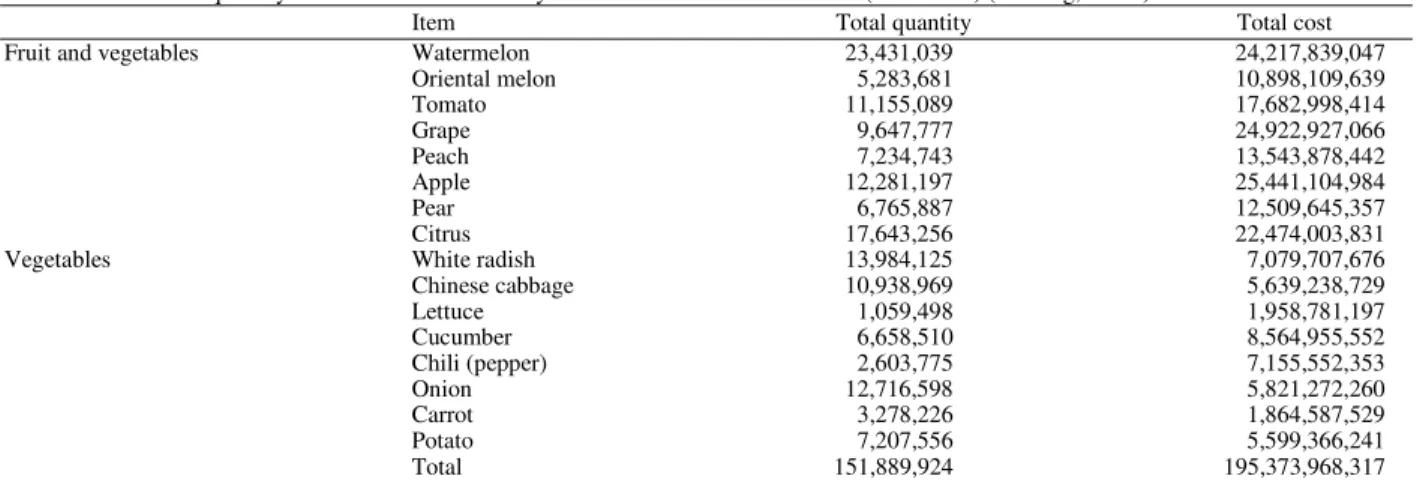
Table 7: Transaction quantity and transaction amount by main item of market wholesaler (Year 2007) (Unit: kg, KRW)
Item Total quantity Total cost
Fruit and vegetables Watermelon 23,431,039 24,217,839,047
Oriental melon 5,283,681 10,898,109,639
Tomato 11,155,089 17,682,998,414
Grape 9,647,777 24,922,927,066
Peach 7,234,743 13,543,878,442
Apple 12,281,197 25,441,104,984
Pear 6,765,887 12,509,645,357
Citrus 17,643,256 22,474,003,831
Vegetables White radish 13,984,125 7,079,707,676
Chinese cabbage 10,938,969 5,639,238,729
Lettuce 1,059,498 1,958,781,197
Cucumber 6,658,510 8,564,955,552
Chili (pepper) 2,603,775 7,155,552,353
Onion 12,716,598 5,821,272,260
Carrot 3,278,226 1,864,587,529
Potato 7,207,556 5,599,366,241
Total 151,889,924 195,373,968,317
Source: SeoulAgricultural and Marine Products Corp 2008. Annual reports for the agricultural and fishery transaction
Table 8: Calculation of congestion accumulation cost by main item (based on the quantities of year 2007) (Currency Unit: 1,200 KRW)
Daily cost Cost per time
--- --- Division Congestion Accumulation Total Congestion Accumulation Total
Fruit and vegetables Watermelon 5,315 4,313 9,627 221 180 401
Oriental melon 1,198 1,941 3,139 50 81 131
Tomato 2,530 3,149 5,679 105 131 237
Grape 2,188 4,438 6,627 91 185 276
Peach 1,641 2,412 4,053 68 100 169
Apple 2,786 4,531 7,316 116 189 305
Pear 1,535 2,228 3,762 64 93 157
Citrus 4,002 4,002 8,004 167 167 334
Vegetables White radish 3,172 1,261 4,433 132 53 185
Chinese cabbage 2,481 1,004 3,485 103 42 145
Lettuce 240 349 589 10 15 25
Cucumber 1,510 1,525 3,036 63 64 126
Chili (pepper) 591 1,274 1,865 25 53 78
Onion 2,884 1,037 3,921 120 43 163
Carrot 744 332 1,076 31 14 45
Potato 1,635 997 2,632 68 42 110
Total 34,452 34,793 69,245 1,436 1,450 2,885
Calculation of congestion accumulation cost by product family: The congestion accumulation cost by product family for Gangseo agricultural wholesale market in 2007 was calculated as the sum of the accumulation cost by item based on the yearly carrying-in quantities and the congestion cost of the truck related to the market wholesaler as per Table 6. The congestion accumulation cost for the vegetables and fruit per day of the market wholesaler is 59,224,000 KRW, and 50,411,000 KRW respectively. The total cost was calculated as 109,635,000 KRW per day. On the other hand, the cost per time was calculated at 2,468,000 KRW, 2,100,000 KRW, and 4,568,000 KRW respectively.
Calculation of congestion/accumulation cost by main item:
Condition for the total of dealing by main item of market wholesaler at Gangseo agricultural wholesale market: Based on data from 2007, Table 7
below shows the market wholesaler’s total transaction quantity and transaction amount, by main item at Gangseo agricultural wholesale market. In looking at the total transaction quantities of fruit and vegetables, watermelon and radish tops the charts at 23,431 tons and 13,984 ton respectively.
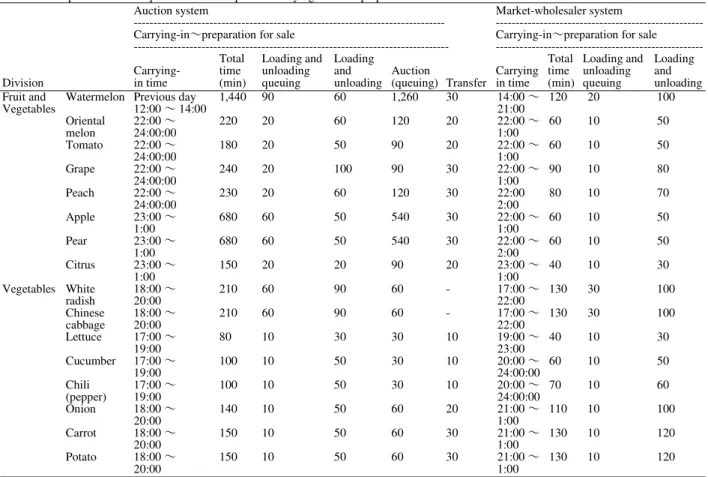
Table 9: Comparison of the required time of the product carrying-in to the preparation time for sale time
Auction system Market-wholesaler system
--- --- Carrying-in~preparation for sale Carrying-in~preparation for sale --- ---
Total Loading and Loading Total Loading and Loading
Carrying- time unloading and Auction Carrying time unloading and Division in time (min) queuing unloading (queuing) Transfer in time (min) queuing unloading
Fruit and Watermelon Previous day 1,440 90 60 1,260 30 14:00 ~ 120 20 100
Vegetables 12:00 ~ 14:00 21:00
Oriental 22:00 ~ 220 20 60 120 20 22:00 ~ 60 10 50
melon 24:00:00 1:00
Tomato 22:00 ~ 180 20 50 90 20 22:00 ~ 60 10 50
24:00:00 1:00
Grape 22:00 ~ 240 20 100 90 30 22:00 ~ 90 10 80
24:00:00 1:00
Peach 22:00 ~ 230 20 60 120 30 22:00 80 10 70
24:00:00 2:00
Apple 23:00 ~ 680 60 50 540 30 22:00 ~ 60 10 50
1:00 1:00
Pear 23:00 ~ 680 60 50 540 30 22:00 ~ 60 10 50
1:00 2:00
Citrus 23:00 ~ 150 20 20 90 20 23:00 ~ 40 10 30
1:00 1:00
Vegetables White 18:00 ~ 210 60 90 60 - 17:00 ~ 130 30 100
radish 20:00 22:00
Chinese 18:00 ~ 210 60 90 60 - 17:00 ~ 130 30 100
cabbage 20:00 22:00
Lettuce 17:00 ~ 80 10 30 30 10 19:00 ~ 40 10 30
19:00 23:00
Cucumber 17:00 ~ 100 10 50 30 10 20:00 ~ 60 10 50
19:00 24:00:00
Chili 17:00 ~ 100 10 50 30 10 20:00 ~ 70 10 60
(pepper) 19:00 24:00:00
Onion 18:00 ~ 140 10 50 60 20 21:00 ~ 110 10 100
20:00 1:00
Carrot 18:00 ~ 150 10 50 60 30 21:00 ~ 130 10 120
20:00 1:00
Potato 18:00 ~ 150 10 50 60 30 21:00 ~ 130 10 120
20:00 1:00
Source: SAMPC(2007). Annual reports for the agricultural and fishery transaction
Comparison of operational time by system: As shown in Table 9, when comparing the required time by operating systems, the carrying-in time for the auction system is an hour faster than the market wholesaler system and the width of the carrying-in time in the market wholesaler system is 1~2 times faster than that in the auction system. In comparing the required time of the quantity carrying-in to the preparation for sale time, we can conclude that the auction system requires 4 times that of the market wholesaler system for the fruits and vegetables, and for the vegetables, the auction system requires 1.4 times that of the market wholesaler system. In comparing the results of the vegetables versus the fruits and vegetables, the reason that it takes a less required time by transaction system relatively is that the fruits and vegetables start the auction late as it has the storage issue.
Moreover, the difference of the time between the auction system and the market wholesaler system occurs from auction (queuing) and transfer time mainly. The auction system and the market wholesaler system show similar times for the loading and unloading time and the loading and unloading queuing time, with the exception of water melon, apple, and pear.
DISCUSSION
Comparison of the efficiency by system through the calculation of cost: Table 10 shows the results by calculating the required cost according to the congestion accumulation using the required time from the product carrying-in by system to the preparation time for sale. When examining the time cost of the system operation by main item, watermelon has a time cost of the market wholesaler system of 8,825,000 KRW less than that of the auction system. Therefore, we can see that watermelon is the item with the biggest difference in time cost. Then, analysis shows the following difference of time costs: apple at 3,150,000 KRW and pear at 1,620,000 KRW.
Table 10: Comparison of congestion accumulation time per hour in the calculation of cost (Year 2007), (Unit: 1,200 KRW) Required time (hour) Required cost
--- --- Market wholesaler Auction Market wholesaler
Division Auction system system system (C) system (D) Difference (C-D)
Fruit & Vegetables Watermelon 24.00 2.00 9,627 802 8,825
Oriental melon 3.67 1.00 480 131 349
Tomato 3.00 1.00 710 237 473
Grape 4.00 1.50 1,104 414 690
Peach 3.83 1.33 647 225 422
Apple 11.33 1.00 3,455 305 3,150
Pear 11.33 1.00 1,777 157 1,620
Citrus 2.50 0.67 834 222 611
Vegetables White radish 3.50 2.17 646 400 246
Chinese cabbage 3.50 2.17 508 315 194
Lettuce 1.33 0.67 33 16 16
Cucumber 1.67 1.00 211 126 84
Chili (pepper) 1.67 1.17 130 91 39
Onion 2.33 1.83 381 300 82
Carrot 2.50 2.17 112 97 15
Potato 2.50 2.17 274 238 37
Total - - 20,929 4,076 16,854
Namely, in the analysis results, we can see that the market-wholesaler system has a higher efficiency rate than the auction system in the time saved and the required cost. If we concretely mention the results analyzed in this study, when we calculate total time cost of 16 main items into the amount utilizing the required time from the agricultural carrying-in to the preparation for sales by the transaction system at the agricultural wholesaler market, as the required time of the market-wholesaler system is less than that of the auction system, the market-wholesaler system demonstrates better transaction efficiency.
CONCLUSION
Established in 2004, Gangseo agricultural wholesale market operates the first market-wholesaler system in Korea. It was introduced to provide a way to counter any glitches in the market that may lead to a drop of product value for agriculture products, where freshness is life, and enhance the effectiveness.
The question has been raised over how much the introduction of the market-wholesaler system contributes to raising the efficiency of agricultural distribution through the rapid movement of logistics and the minimization of the distribution step within the wholesale market currently.
Therefore, in this study, we converted the time reduction of the operation, according to the difference of the transaction method during the introduction of the market-wholesaler system into the amount, through the estimates of congestion and accumulation cost and examined its economic feasibility.
Particularly, in the analysis by item results, watermelon had the greatest difference of time cost. The results studied in this study suggest that we must
explore the conversion to a more low-cost high efficiency structure by improving the problem of the low-efficiency structure and accepting the auction system for the past twenty years as the main transaction method of the agricultural wholesale market in Korea.
Therefore, if the market wholesaler system is expanded and introduced into the 32 agricultural wholesale market system of Korea, we can expect that the transaction efficiency within the agricultural wholesale market will be enhanced and the efficiency of the whole agricultural distribution system will see the much needed improvements. However, the push for a change of the transaction system within the agricultural wholesale market in Korea is meeting with the great opposition and resistance by the group with the vested right, which get the gain easily under the existing auction system. As we expect such resistance will become stronger in the future, the change of the wholesale market transaction system must be supported and driven by the government’s strong political movement to meet with the establishment purpose of the agricultural wholesale market, in order to guarantee the protection of the interests of the producer and the customer.
AKNOWLEDGEMENT
This study was supported by Konkuk university research fund.
REFERENCES
Jansson, J.O. and D. Shneerson, 1982. Port economics. 1st Ed., MIT Press, Cambridge, ISBN: 0262100258 9780262100250
Kim, Y.D. and S.G. Kwon, 2005. Review of the first year of market-wholesaler system and future challenges. Korean J. Agriculture Management Policy, 32: 823-848.
KMI, 2002. A study on the economic effects of port-logistic industry. Korea Maritime Institute
KSIS, 2008. Summary of transportation. Korean Statistical Information System.
MFAFF, 2008-2007. Statistical yearbook of agricultural and marine wholesale market. Ministry for Food, Agriculture, Forestry and Fisheries.
ML, 2008-2007. A study on the analysis of actual conditions on wage structure. Ministry of Labor SAMPC, 2007. Annual reports for the agricultural and
fishery transaction. Seoul Agricultural and Marine Products Corporation.
Young-Tae, C. and K. Sung-Gui, 1993. Study on the estimate of the cost of ship's time in port. J. Korean Maritime, 16: 229-259.