DOI 10.1140/epjc/s10052-014-2847-x Regular Article - Experimental Physics
Study of the production of charged pions, kaons, and protons
in pPb collisions at
√
s
N N
=
5.02 TeV
The CMS Collaboration⋆
CERN, Geneva, Switzerland
Received: 12 July 2013 / Accepted: 4 April 2014 / Published online: 3 June 2014
© CERN for the benefit of the CMS collaboration 2014. This article is published with open access at Springerlink.com
Abstract Spectra of identified charged hadrons are mea-sured in pPb collisions with the CMS detector at the LHC at √s
N N =5.02 TeV. Charged pions, kaons, and protons in the
transverse-momentum rangepT≈0.1–1.7 GeV/cand
labo-ratory rapidity|y| < 1 are identified via their energy loss
in the silicon tracker. The averagepTincreases with particle
mass and the charged multiplicity of the event. The increase
of the average pT with charged multiplicity is greater for
heavier hadrons. Comparisons to Monte Carlo event
gener-ators reveal thatEpos Lhc, which incorporates additional
hydrodynamic evolution of the created system, is able to
reproduce most of the data features, unlikeHijingandAmpt.
The pT spectra and integrated yields are also compared to
those measured in pp and PbPb collisions at various ener-gies. The average transverse momentum and particle ratio measurements indicate that particle production at LHC ener-gies is strongly correlated with event particle multiplicity.
1 Introduction
The study of hadron production has a long history in high-energy particle and nuclear physics, as well as in cosmic-ray physics. The absolute yields and the transverse momentum (pT) spectra of identified hadrons in high-energy hadron– hadron collisions are among the most basic physical observ-ables. They can be used to test the predictions for non-perturbative quantum chromodynamics (QCD) processes like hadronization and soft-parton interactions, and the valid-ity of their implementation in Monte Carlo (MC) event gen-erators. Spectra of identified particles in proton–nucleus col-lisions also constitute an important reference for studies of high-energy heavy-ion collisions, where final-state effects are known to modify the spectral shape and yields of
differ-ent hadron species [1–7].
The present analysis focuses on the measurement of thepT
spectra of charged hadrons, identified mostly via their energy
⋆e-mail: [email protected]
deposits in silicon detectors, in pPb collisions at√sN N =
5.02 TeV. The analysis procedures are similar to those pre-viously used in the measurement of pion, kaon, and proton production in pp collisions at several center-of-mass energies
[8]. Results onπ, K, and p production in pPb collisions have
been also reported by the ALICE Collaboration [9].
A detailed description of the CMS (Compact Muon
Solenoid) detector can be found in Ref. [10]. The CMS
experiment uses a right-handed coordinate system, with the
origin at the nominal interaction point (IP) and the z axis
along the counterclockwise-beam direction. The
pseudo-rapidity η and rapidity y of a particle (in the laboratory
frame) with energy E, momentump, and momentum along
the z axis pz are defined as η = −ln[tan(θ/2)], where
θ is the polar angle with respect to the z axis and y =
1
2ln[(E +pz)/(E−pz)], respectively. The central feature
of the CMS apparatus is a superconducting solenoid of 6 m internal diameter. Within the 3.8 T field volume are the silicon pixel and strip tracker, the crystal electromagnetic calorime-ter, and the brass/scintillator hadron calorimeter. The tracker measures charged particles within the pseudorapidity range
|η|<2.4. It has 1440 silicon pixel and 15 148 silicon strip
detector modules, ordered in 13 tracking layers in theyregion
studied here. In addition to the barrel and endcap detectors, CMS has extensive forward calorimetry. Steel/quartz-fiber
forward calorimeters (HF) cover 3 <|η| <5. Beam
Pick-up Timing for the eXperiments (BPTX) devices were used to trigger the detector readout. They are located around the beam pipe at a distance of 175 m from the IP on either side, and are designed to provide precise information on the Large Hadron Collider (LHC) bunch structure and timing of the incoming beams.
The reconstruction of charged particles in CMS is bounded
by the acceptance of the tracker (|η| < 2.4) and by the
decreasing tracking efficiency at low momentum (greater
than about 60 % forp>0.05, 0.10, 0.20, and 0.40 GeV/cfor
e,π, K, and p, respectively). Particle identification
capabili-ties using specific ionization are restricted top<0.15 GeV/c
for kaons, and p < 1.70 GeV/c for protons. Pions are identified up to a higher momentum than kaons because
of their high relative abundance. In view of the (y,pT)
regions where pions, kaons, and protons can all be identified
(p = pTcoshy), the band−1 < y <1 (in the laboratory
frame) was chosen for this measurement, since it is a good
compromise between thepTrange and ycoverage.
In this paper, comparisons are made to predictions from
three MC event generators. The Hijing[11] event
gener-ator is based on a two-component model for hadron pro-duction in high-energy nucleon and nuclear collisions. Hard parton scatterings are assumed to be described by perturba-tive QCD and soft interactions are approximated by string excitations with an effective cross section. In version 2.1
[12], in addition to modification of initial parton
distribu-tions, multiple scatterings inside a nucleus lead to transverse momentum broadening of both initial and final-state partons.
This is responsible for the enhancement of intermediate-pT
(2–6 GeV/c) hadron spectra in proton–nucleus collisions,
with respect to the properly scaled spectra of proton–proton
collisions (Cronin effect). TheAmpt[13] event generator is
a multi-phase transport model. It starts from the same initial
conditions asHijing, contains a partonic transport phase, the
description of the bulk hadronization, and finally a hadronic rescattering phase. These processes lead to hydrodynamic-like effects in simulated nucleus–nucleus collisions, but not necessarily in proton–nucleus collisions. The latest available
version (1.26/2.26) is used. TheEpos [14] event
genera-tor uses a quantum mechanical multiple scattering approach based on partons and strings, where cross sections and parti-cle production are calculated consistently, taking into account energy conservation in both cases. Nuclear effects related to transverse momentum broadening, parton saturation, and screening have been introduced. The model can be used both for extensive air shower simulations and accelerator
physics.Epos Lhc[15] is an improvement of version 1.99
(v3400) and contains a three-dimensional viscous event-by-event hydrodynamic treatment. This is a major difference
with respect to theHijing and Ampt models for proton–
nucleus collisions.
2 Data analysis
The data were taken in September 2012 during a 4-h-long pPb run with very low probability of multiple interactions (0.15 % “pileup”). A total of 2.0 million collisions were collected, corresponding to an integrated luminosity of approximately
1µb−1. The dominant uncertainty for the reported
measure-ments is systematic in nature. The beam energies were 4 TeV for protons and 1.58 TeV per nucleon for lead nuclei,
result-ing in a center-of-mass energy per nucleon pair of√sN N =
5.02 TeV. Due to the asymmetric beam energies the
nucleon-nucleon center-of-mass in the pPb collisions was not at rest with respect to the laboratory frame but was moving with a
velocityβ = −0.434 or rapidity−0.465. Since the
higher-energy proton beam traveled in the clockwise direction, i.e. at
θ=π, the rapidity of a particle emitted atycmin the
nucleon-nucleon center-of-mass frame is detected in the laboratory
frame with a shift, y−ycm = −0.465, i.e. a particle with
y = 0 moves with rapidity 0.465 in the Pb-beam direction
in the center-of-mass system. The particle yields reported in
this paper have been measured for laboratory rapidity|y|<1
to match the experimentally accessible region.
The event selection consisted of the following require-ments:
– at the trigger level, the coincidence of signals from both BPTX devices, indicating the presence of both proton and lead bunches crossing the interaction point; in addition, at
least one track withpT>0.4 GeV/cin the pixel tracker;
– offline, the presence of at least one tower with energy above 3 GeV in each of the HF calorimeters; at least one reconstructed interaction vertex; beam-halo and beam-induced background events, which usually
pro-duce an anomalously large number of pixel hits [16], are
suppressed.
The efficiencies for event selection, tracking, and vertex-ing were evaluated usvertex-ing simulated event samples produced
with the Hijing2.1 MC event generator, where the CMS
detector response simulation was based on Geant4 [17].
Simulated events were reconstructed in the same way as col-lision data events. The final results were corrected to a par-ticle level selection applied to the direct MC output, which is very similar to the data selection described above: at least
one particle (proper lifetimeτ >10−18s) withE >3 GeV
in the range−5 < η < −3 and at least one in the range
3 < η < 5; this selection is referred to in the following as
the “double-sided” (DS) selection. These requirements are expected to suppress single-diffractive collisions in both the data and MC samples. From the MC event generators stud-ied in this paper, the DS selection efficiency for inelastic, hadronic collisions is found to be 94–97 %.
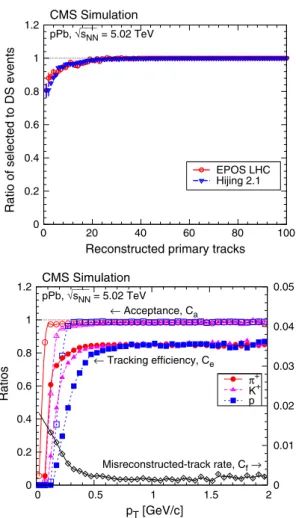
The simulated ratio of the data selection efficiency to the DS selection efficiency is shown as a function of the
recon-structed track multiplicity in the top panel of Fig. 1. The
ratio is used to correct the measured events. The results are also corrected for the fraction of DS events without a recon-structed track. This fraction, as given by the simulation, is about 0.1 %.
The extrapolation of particle spectra into the unmeasured
(y,pT)regions is model dependent, particularly at lowpT. A
high-precision measurement therefore requires reliable track
reconstruction down to the lowest possible pT. The present
0 0.2 0.4 0.6 0.8 1 1.2
0 20 40 60 80 100
Ratio of selected to DS events
Reconstructed primary tracks
EPOS LHC Hijing 2.1 pPb,⎯⎯⎯√sNN = 5.02 TeV
CMS Simulation
0 0.2 0.4 0.6 0.8 1 1.2
0 0.5 1 1.5 2 0
0.01 0.02 0.03 0.04 0.05
Ratios
pT [GeV/c]
← Acceptance, Ca
← Tracking efficiency, Ce
Misreconstructed-track rate, Cf→ π+
K+ p pPb, ⎯⎯⎯√sNN = 5.02 TeV
CMS Simulation
Fig. 1 Topthe ratio of selected events to double-sided (DS) events (ratio of the corresponding efficiencies in the inelastic sample), accord-ing toEpos LhcandHijingMC simulations, as a function of the
reconstructed primary charged-particle multiplicity.Bottomacceptance, tracking efficiency (leftscale), and misreconstructed-track rate (right
scale) in the range|η|<2.4 as a function ofpTfor positively charged
pions, kaons, and protons
tracking algorithms [18], used in previous studies [8,16,19],
to provide high reconstruction efficiency and low background rate. The charged-pion mass was assumed when fitting par-ticle momenta.
The acceptance of the tracker (Ca) is defined as the
frac-tion of primary charged particles leaving at least two hits in
the pixel detector. It is flat in the region−2 < η < 2 and
pT > 0.4 GeV/c, and its value is 96–98 % (Fig.1, bottom
panel). The loss of acceptance atpT<0.4 GeV/cis caused by
energy loss and multiple scattering of particles, both depend-ing on the particle mass. Likewise, the reconstruction
effi-ciency (Ce) is about 75–85 %, degrading at low pT, also
in a mass-dependent way. The misreconstructed-track rate
(Cf) is very small, reaching 1 % only for pT <0.2 GeV/c.
The probability of reconstructing multiple tracks (Cm) from
a single true track is about 0.1 %, mostly due to particles spiralling in the strong magnetic field of the CMS solenoid.
The efficiencies and background rates do not depend on the
charged-multiplicity of the event. They largely factorize inη
andpT, but for the final corrections an(η,pT)matrix is used. The region where pPb collisions occur (beam spot) is mea-sured by reconstructing vertices from many events. Since the
bunches are very narrow in the transverse direction, thex y
location of the interaction vertices is well constrained;
con-versely, theirzcoordinates are spread over a relatively long
distance and must be determined on an event-by-event basis. The vertex position is determined using reconstructed tracks
which have pT >0.1 GeV/cand originate from the vicinity
of the beam spot, i.e. their transverse impact parametersdT
satisfy the condition dT < 3σT. Here σT is the quadratic
sum of the uncertainty in the value ofdTand the
root-mean-square of the beam spot distribution in the transverse plane.
The agglomerative vertex-reconstruction algorithm [20] was
used, with thezcoordinates (and their uncertainties) of the
tracks at the point of closest approach to the beam axis as input. For single-vertex events, there is no minimum require-ment on the number of tracks associated with the vertex, even one-track vertices are allowed. Only tracks associated with a primary vertex are used in the analysis. If multiple vertices are present, the tracks from the highest multiplicity vertex are used. The resultant bias is negligible since the pileup rate is extremely small.
The vertex reconstruction resolution in thezdirection is
a strong function of the number of reconstructed tracks and
it is always smaller than 0.1 cm. The distribution of the z
coordinates of the reconstructed primary vertices is Gaus-sian, with a standard deviation of 7.1 cm. The simulated data
were reweighted so as to have the same vertexzcoordinate
distribution as the data.
The hadron spectra were corrected for particles of
non-primary origin (τ >10−12s). The main sources of secondary
particles are weakly decaying particles, mostly K0S, / , and
+/−. While the correction (Cs) is around 1 % for pions, it
rises up to 15 % for protons withpT≈0.2 GeV/c. As none of
the mentioned weakly decaying particles decay into kaons, the correction for kaons is small. Based on studies comparing
reconstructed K0S, , and spectra and predictions from the
Hijingevent generator, the corrections are reweighted by a
pT-dependent factor.
For p < 0.15 GeV/c, electrons can be clearly identified.
The overall e±contamination of the hadron yields is below
0.2 %. Although muons cannot be separated from pions, their fraction is very small, below 0.05 %. Since both contamina-tions are negligible, no correccontamina-tions are applied for them.
3 Estimation of energy loss rate and yield extraction
In this paper an analytical parametrization [21] has been
the silicon detectors. The method provides the probability
densityP(|ε,l)of energy deposit, if the most probable
energy loss rateεat a reference path-lengthl0 = 450µm
and the path-lengthl are known. It was used in
conjunc-tion with a maximum likelihood method, for the estimate of ε.
For pixel clusters, the energy deposits were calculated as the sum of individual pixel deposits. In the case of strips, the energy deposits were corrected for capacitive coupling and cross-talk between neighboring strips. The readout threshold, the coupling parameter, and the standard deviation of the Gaussian noise for strips were determined from data, using tracks with close-to-normal incidence.
For an accurate determination ofε, the response of all
readout chips was calibrated with multiplicative gain cor-rection factors. The measured energy deposit spectra were compared to the energy loss parametrization and hit-level corrections (affine transformation of energy deposits using scale factors and shifts) were introduced. The corrections were applied to individual hits during the determination of
the lnεfit templates (described below).
The best value ofε for each track was calculated with
the corrected energy deposits by minimizing the joint energy deposit negative log-likelihood of all hits on the trajectory
(indexi),χ2 = −2
ilnP(i|ε,li). Hits with
incompati-ble energy deposits (contributing more than 12 to the jointχ2)
were excluded. At most one hit was removed; this affected about 1.5 % of the tracks.
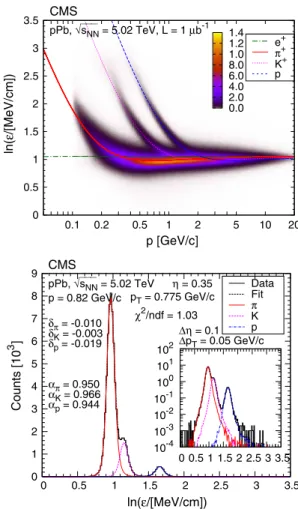
Distributions of lnεas a function of total momentum p
for positive particles are plotted in the top panel of Fig.2
and compared to the predictions of the energy loss method
[21] for electrons, pions, kaons, and protons. The remaining
deviations were taken into account by means of track-level corrections mentioned above (affine transformation of
tem-plates using scale factors and shifts, lnε→αlnε+δ).
Low-momentum particles can be identified unambigu-ously and can therefore be counted. Conversely, at high
momentum, the lnε bands overlap (above about 0.5 GeV/c
for pions and kaons and 1.2 GeV/cfor protons); the particle
yields therefore need to be determined by means of a series of
template fits in lnε, in bins ofηandpT(Fig.2, bottom panel).
Finally, fit templates, giving the expected lnεdistributions
for all particle species (electrons, pions, kaons, and protons), were built from tracks. All kinematical parameters and hit-related observables were kept, but the energy deposits were regenerated by sampling from the analytical parametrization. For a less biased determination of track-level residual correc-tions, enhanced samples of each particle type were employed. These were used for setting starting values of the fits. For electrons and positrons, photon conversions in the beam-pipe and innermost first pixel layer were used. For high-purity
π and enhanced p samples, weakly decaying hadrons were
selected (KS0, / ). The relations and constraints described
e+
π+
K+ p
0.1 0.2 0.5 1 2 5 10 20
p [GeV/c] 0 0.5 1 1.5 2 2.5 3 3.5 ln( ε /[MeV/cm]) 0.0 2.0 4.0 6.0 8.0 1.0 1.2 1.4 pPb,⎯⎯⎯√sNN = 5.02 TeV, L = 1 μb-1
CMS 0 1 2 3 4 5 6 7 8 9
0 0.5 1 1.5 2 2.5 3 3.5
Counts [10
3 ]
ln(ε/[MeV/cm])
p = 0.82 GeV/c
Δη = 0.1
ΔpT = 0.05 GeV/c
δπ = -0.010
δK = -0.003
δp = -0.019
απ = 0.950
αK = 0.966
αp = 0.944
η = 0.35 pT = 0.775 GeV/c
χ2
/ndf = 1.03
pPb, ⎯⎯⎯√sNN = 5.02 TeV Data Fit π K p CMS 10-4 10-3 10-2 10-1 100 101 102
0 0.5 1 1.5 2 2.5 3 3.5
Fig. 2 Topdistribution of lnεas a function of total momentump, for positively charged particles (εis the most probable energy loss rate at a reference path lengthl0=450µm). Thezscale is shown in arbitrary units and is linear. The curves show the expected lnεfor electrons, pions, kaons, and protons (Eq. (30.11) in Ref. [22]).Bottomexample lnεdistribution atη=0.35 andpT=0.775 GeV/c, with bin widths
η=0.1 andpT=0.05 GeV/c. Scale factors (α) and shifts (δ) are
indicated (see text). Theinsetshows the distribution with logarithmic vertical scale
in Ref. [8] were also exploited, this way better constraining
the parameters of the fits: fitting the lnεdistributions in
num-ber of hits (nhits) and track-fitχ2/ndf slices simultaneously;
fixing the distributionnhitsof particle species, relative to each
other; using the expected continuity for refinement of
track-level residual corrections, in neighboring(η,pT)bins; using
the expected convergence for track-level residual
correc-tions, as the lnεvalues of two particle species approach each
other.
The results of the (iterative) lnε fits are the yields for
each particle species and charge in bins of(η,pT)or(y,pT),
both inclusive and divided into classes of reconstructed pri-mary charged-track multiplicity. In the end, the histogram
fitχ2/ndf values were usually close to unity. Although pion
their sum was measured. This information is an important
constraint when fitting the pTspectra.
The statistical uncertainties for the extracted yields are given by the fits. The observed local variations of
parame-ters in the(η,pT)plane for track-level corrections cannot
be attributed to statistical fluctuations and indicate that the average systematic uncertainties in the scale factors and shifts
are about 10−2and 2×10⁻³, respectively. These scale
fac-tors and shifts agree with those seen in the high-purity sam-ples to well within a factor of two. The systematic uncer-tainties in the yields in each bin were obtained by refit-ting the histograms with the parameters changed by these amounts.
4 Corrections and systematic uncertainties
The measured yields in each(η,pT)bin,Nmeasured, were
first corrected for the misreconstructed-track rate (Cf) and
the fraction of secondary particles (Cs):
N′=Nmeasured·(1−Cf)·(1−Cs). (1)
The distributions were then unfolded to take into account
the finiteηandpTresolutions. Theηdistribution of the tracks
is almost flat and theηresolution is very good. Conversely,
thepTdistribution is steep in the low-momentum region and
separate corrections in eachηbin were necessary. An
unfold-ing procedure with linear regularization [23] was used, based
on response matrices obtained from MC samples for each particle species.
The corrected yields were obtained by applying
correc-tions for acceptance (Ca), efficiency (Ce), and multiple track
reconstruction rate (Cm):
1 Nev
d2N
dηdpT corrected=
1 Ca·Ce·(1+Cm)
N′
NevηpT
, (2)
whereNevis the corrected number of DS events (Fig.1). Bins
with acceptance smaller than 50 %, efficiency smaller than 50 %, multiple-track rate greater than 10 %, or containing less than 80 tracks were not used.
Finally, the differential yields d2N/dηdpT were
trans-formed to invariant yields d2N/dydpTby multiplying with
the Jacobian E/pand the(η,pT)bins were mapped into a
(y,pT)grid. As expected, there is a small (5–10 %)y
depen-dence in the narrow region considered (|y|<1), depending
on event multiplicity. The yields as a function of pT were
obtained by averaging over rapidity.
The systematic uncertainties are very similar to those in
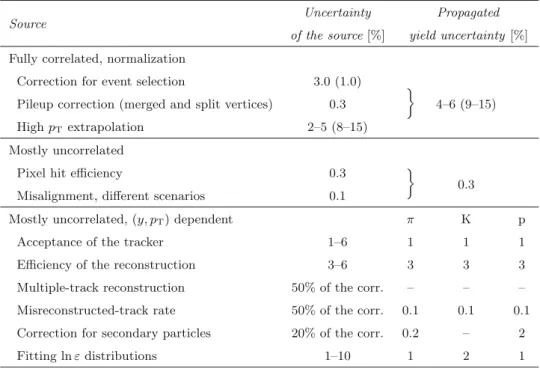
Ref. [8] and are summarized in Table1. The uncertainties
of the corrections related to the event selection and pileup are fully or mostly correlated and were treated as normal-ization uncertainties: 3.0 % uncertainty on the yields and
Table 1 Summary of the systematic uncertainties affecting thepTspectra. Values in parentheses indicate uncertainties in thepTmeasurement.
The systematic uncertainty related to the lowpTextrapolation is small compared to the contributions from other sources and therefore not included
in the combined systematic uncertainty of the measurement. Representative, particle-specific uncertainties (π, K, p) are given forpT=0.6 GeV/c
0 2 4 6 8 10 12 14 16
0 0.5 1 1.5 2
1/N
ev
d
2 N / dy dp
T
[(GeV/c)
-1 ]
pT [GeV/c]
π+
K+ x10 p x25
π+
+K+ pPb,⎯⎯⎯√sNN = 5.02 TeV, L = 1 μb-1
CMS 0 2 4 6 8 10 12 14 16
0 0.5 1 1.5 2
1/N
ev
d
2 N / dy dp
T
[(GeV/c)
-1 ]
pT [GeV/c]
π−
K− x10 − p x25
π−+K− pPb,⎯⎯⎯√sNN = 5.02 TeV, L = 1 μb-1
CMS
Fig. 3 Transverse momentum distributions of identified charged hadrons (pions, kaons, protons, sum of pions and kaons) in the range |y|<1, for positively (top) and negatively (bottom) charged particles. Kaon and proton distributions are scaled as shown in the legends. Fits to Eqs. (3) and (5) are superimposed.Error barsindicate the uncorre-lated statistical uncertainties, whileboxesshow the uncorrelated sys-tematic uncertainties. The fully correlated normalization uncertainty (not shown) is 3.0 %.Dotted linesillustrate the effect of varying the 1/nvalue of the Tsallis–Pareto function by±0.1 above the highest measuredpTpoint
1.0 % on the averagepT. In order to study the influence of
the high pT extrapolation on dN/dy and pT, the 1/n
parameter of the fitted Tsallis–Pareto function (Sect.5) was
varied. While keeping the function in the measured range,
1/nwas increased and decreased by±0.1 above the highest
pTmeasured point, ensuring that the two function pieces are
continuous both in value and derivative. The choice of the
magnitude for the variation was motivated by the fitted 1/n
values and their distance from a Boltzmann distribution. (The
resulting functions are plotted in Fig.3as dotted lines.) The
highpTextrapolation introduces sizeable systematic
uncer-tainties, 4–6 % fordN/dy, and 9–15 % forpTin case of
the DS selection.
The tracker acceptance and the track reconstruction effi-ciency generally have small uncertainties (1 and 3 %,
respec-tively), but change rapidly at very low pT (bottom panel of
Fig.1), leading to a 6 % uncertainty on the yields in that
range. For the multiple-track and misreconstructed-track rate corrections, the uncertainty is assumed to be 50 % of the cor-rection, while for the case of the correction for secondary particles it was estimated to be 20 %. These mostly uncorre-lated uncertainties are due to the imperfect modeling of the detector: regions with mismodeled efficiency in the tracker, alignment uncertainties, and channel-by-channel varying hit efficiency. These circumstances can change frequently in momentum space, so can be treated as uncorrelated.
The systematic uncertainties originating from the
unfold-ing procedure were studied. Since the pT response
matri-ces are close to diagonal, the unfolding of pT distributions
did not introduce substantial systematics. At the same time the inherited uncertainties were properly propagated. The
introduced correlations between neighboring pT bins were
neglected, hence statistical uncertainties were regarded as uncorrelated while systematic uncertainties were expected
to be locally correlated in pT. The systematic uncertainty of
the fitted yields is in the range 1–10 % depending mostly on total momentum.
5 Results
In previously published measurements of unidentified and
identified particle spectra [16,24], the following form of the
Tsallis–Pareto-type distribution [25,26] was fitted to the data:
d2N
dydpT =
dN
dy ·C·pT
1+mT−m
nT
−n
, (3)
where
C = (n−1)(n−2)
nT[nT +(n−2)m] (4)
and mT =
m2+p2
T (factors of c are omitted from the
preceding formulae). The free parameters are the integrated
yield dN/dy, the exponentn, and parameterT. The above
formula is useful for extrapolating the spectra to zeropTand
very highpTand for extractingpTand dN/dy. Its validity
for different multiplicity bins was cross-checked by fitting
MC spectra in the pT ranges where there are data points,
and verifying that the fitted values ofpTand dN/dywere
consistent with the generated values. Nevertheless, for a more
robust estimation of both quantities (pTanddN/dy), the
range and the fitted functions only for the extrapolation in the unmeasured regions. According to some models of particle
production based on non-extensive thermodynamics [26], the
parameterT is connected with the average particle energy,
whilen characterizes the “non-extensivity” of the process,
i.e. the departure of the spectra from a Boltzmann distribution
(n= ∞).
As discussed earlier, pions and kaons cannot be unam-biguously distinguished at higher momenta. Because of this, the pion-only, the kaon-only, and the joint pion and kaon
d2N/dydpT distributions were fitted for|y| <1 and p <
1.20 GeV/c,|y| < 1 and p <1.05 GeV/c, and|η| <1 and
1.05 < p < 1.7 GeV/c, respectively. Since the ratio p/E
for the pions (which are more abundant than kaons) at these
momenta can be approximated bypT/mTatη≈0, Eq. (3)
becomes:
d2N
dηdpT ≈
dN
dy ·C·
pT2 mT
1+mT−m
nT
−n
. (5)
The approximate fractions of particles outside the
mea-sured pT range depend on track multiplicity; they are
15–30 % for pions, 40–50 % for kaons, and 20–35 % for
protons. The average transverse momentum pT and its
uncertainty were obtained using data points in the measured
range complemented by numerical integration of Eq. (3) with
the fitted parameters in the unmeasured regions, under the assumption that the particle yield distributions follow the
Tsallis–Pareto function in the low-pTand high-pTregions.
The results discussed in the following are for laboratory
rapidity|y|<1. In all cases, error bars indicate the
lated statistical uncertainties, while boxes show the uncorre-lated systematic uncertainties. The fully correuncorre-lated
normal-ization uncertainty is not shown. For thepTspectra, the
aver-age transverse momentum, and the ratio of particle yields,
the data are compared toAmpt1.26/2.26 [13],Epos Lhc
[14,15], andHijing2.1 [11] MC event generators.
Numeri-cal results corresponding to the plotted spectra, fit results, as well as their statistical and systematic uncertainties are given
in Ref. [27].
10-1 100 101
0 0.5 1 1.5 2
1/N
ev
d
2 N / dy dp
T
[(GeV/c)
-1 ]
pT [GeV/c] pPb,⎯⎯⎯√sNN = 5.02 TeV, L = 1 μb-1
CMS
π+
K+ p
AMPT EPOS LHC Hijing 2.1
10-1 100 101
0 0.5 1 1.5 2
1/N
ev
d
2 N / dy dp
T
[(GeV/c)
-1 ]
pT [GeV/c]
pPb,⎯⎯⎯√sNN = 5.02 TeV, L = 1 μb-1
CMS
π−
K− − p
AMPT EPOS LHC Hijing 2.1
Fig. 4 Transverse momentum distributions of identified charged hadrons (pions, kaons, protons) in the range|y|<1, for positively (top) and negatively (bottom) charged particles. Measured values (same as in Fig.3) are plotted together with predictions fromAmpt,Epos Lhc,
andHijing.Error barsindicate the uncorrelated statistical uncertain-ties, whileboxesshow the uncorrelated systematic uncertainties. The fully correlated normalization uncertainty (not shown) is 3.0 %
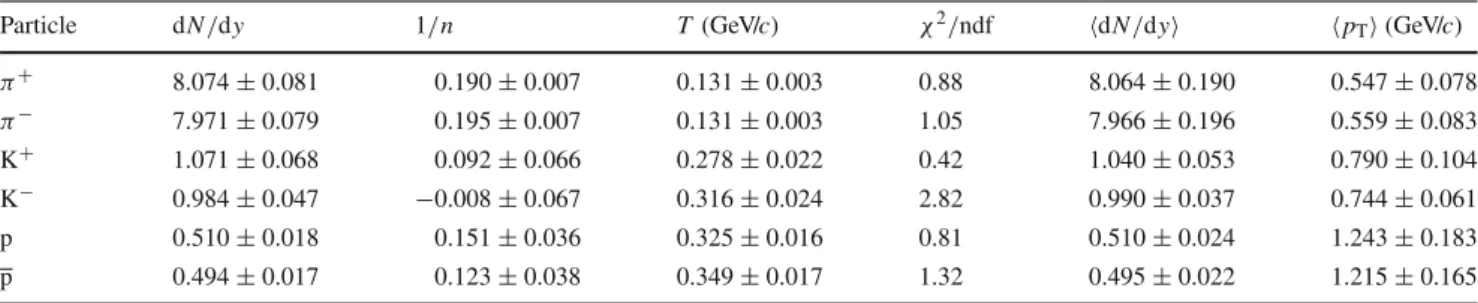
Table 2 Fit results (dN/dy, 1/n, andT) and goodness-of-fit values for the DS selection shown together with calculated averages (dN/dy,pT) for charged pions, kaons, and protons. The systematic uncertainty related to the lowpTextrapolation is small compared to the contributions from
other sources and therefore not included in the combined systematic uncertainty of the measurement. Combined uncertainties are given
Particle dN/dy 1/n T(GeV/c) χ2/ndf dN/dy p
T(GeV/c)
π+ 8.074±0.081 0.190±0.007 0.131±0.003 0.88 8.064±0.190 0.547±0.078
π− 7.971±0.079 0.195±0.007 0.131±0.003 1.05 7.966±0.196 0.559±0.083
K+ 1.071±0.068 0.092±0.066 0.278±0.022 0.42 1.040±0.053 0.790±0.104
K− 0.984±0.047 −0.008±0.067 0.316±0.024 2.82 0.990±0.037 0.744±0.061
p 0.510±0.018 0.151±0.036 0.325±0.016 0.81 0.510±0.024 1.243±0.183
0 0.05 0.1 0.15 0.2 0.25 0.3 0.35
0 0.5 1 1.5 2
Yield ratios
pT [GeV/c] pPb,⎯⎯⎯√sNN = 5.02 TeV, L = 1 μb-1
CMS
(K++K−)/(π+
+π−) (p+−p)/(π+
+π−) AMPT EPOS LHC Hijing 2.1 0.6 0.8 1 1.2 1.4
0 0.5 1 1.5 2
Yield ratios
pT [GeV/c]
π−/π+
K−/K+ − p/p pPb,⎯⎯⎯√sNN = 5.02 TeV, L = 1 μb-1
CMS
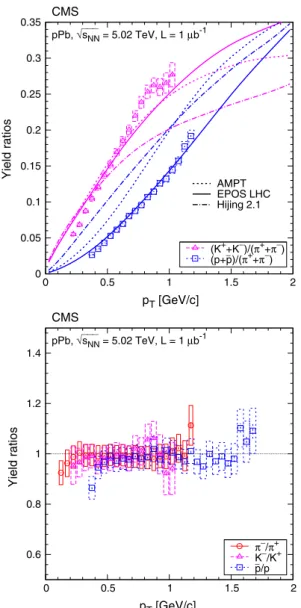
Fig. 5 Ratios of particle yields as a function of transverse momentum. K/πand p/πvalues are shown in thetoppanel, and opposite-charge ratios are plotted in thebottompanel.Error barsindicate the uncorre-lated statistical uncertainties, whileboxesshow the uncorrelated sys-tematic uncertainties. In thetoppanel,curvesindicate predictions from
Ampt,Epos Lhc, andHijing
5.1 Inclusive measurements
The transverse momentum distributions of positively and negatively charged hadrons (pions, kaons, protons) are shown
in Fig.3, along with the results of the fits to the Tsallis–
Pareto parametrization (Eqs. (3) and (5)). The fits are of good
quality withχ2/ndf values in the range 0.4–2.8 (Table2).
Figure4presents the data compared to theAmpt,Epos Lhc,
andHijingpredictions.Epos Lhcgives a good description,
while other generators predict steeper pTdistributions than
found in data.
Ratios of particle yields as a function of the transverse
momentum are plotted in Fig.5. While the K/π ratios are Ta
32 58 84 58 84 109 135 160 185 210 = 235 〉
〈Ntracks〉
0 0.5 1 1.5 2 2.5 3 3.5 4 4.5
0 0.5 1 1.5 2
dN/dp
T
[normalized to fit integral]
pT [GeV/c]
π±
8 pPb,⎯⎯⎯√sNN = 5.02 TeV, L = 1 μb
-1 CMS 32 58 84 109 135 160 185 210 = 235 0 0.5 1 1.5 2 2.5 3 3.5
0 0.5 1 1.5 2
dN/dp
T
[normalized to fit integral]
pT [GeV/c]
K±
8 pPb,⎯⎯⎯√sNN = 5.02 TeV, L = 1 μb
-1 CMS
32
〈Ntracks
0 0.5 1 1.5 2 2.5 3 3.5
0 0.5 1 1.5 2
dN/dp
T
[normalized to fit integral]
pT [GeV/c]
p,−p
8 pPb,⎯⎯⎯√sNN = 5.02 TeV, L = 1 μb
-1 CMS 109 135 160 185 210
〈Ntracks〉 = 235
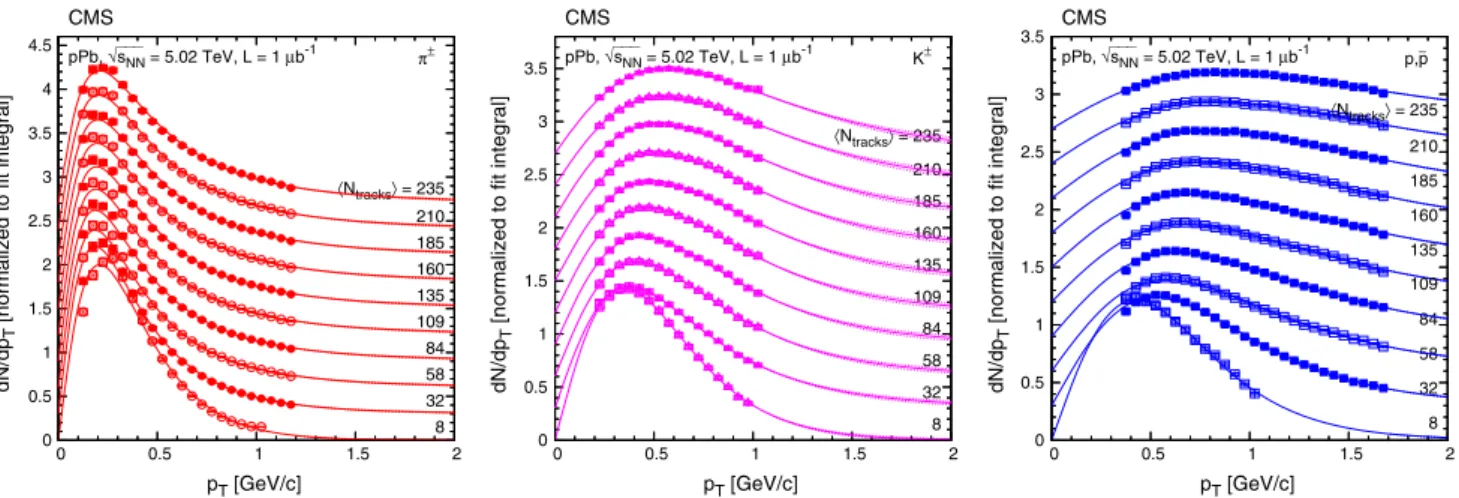
Fig. 6 Transverse momentum distributions of charged pions, kaons, and protons, normalized such that the fit integral is unity, in every second multiplicity class (Ntracksvalues are indicated) in the range|y|<1,
fitted with the Tsallis–Pareto parametrization (solid lines). For better visibility, the result for any givenNtracksbin is shifted by 0.3 units
with respect to the adjacent bins.Error barsindicate the uncorrelated statistical uncertainties, whileboxesshow the uncorrelated systematic uncertainties.Dotted linesillustrate the effect of varying the 1/nvalue of the Tsallis–Pareto function by±0.1 above the highest measuredpT
point
well described by theAmptsimulation, onlyEpos Lhcis
able to predict both K/π and p/π ratios. The ratios of the
yields for oppositely charged particles are close to one, as expected for LHC energies at midrapidity.
5.2 Multiplicity dependent measurements
A study of the dependence on track multiplicity is motivated partly by the intriguing hadron correlations measured in pp
and pPb collisions at high track multiplicities [28–31],
sug-gesting possible collective effects in “central” pp and pPb collisions at the LHC. At the same time, it was seen that in
pp collisions the characteristics of particle production (pT,
ratios) at LHC energies are strongly correlated with event par-ticle multiplicity rather than with the center-of-mass energy
of the collision [8]. The strong dependence on multiplicity (or
centrality) was also seen in dAu collisions at RHIC [6,7]. In
addition, the multiplicity dependence of particle yield ratios is sensitive to various final-state effects (hadronization, color reconnection, collective flow) implemented in MC models
used in collider and cosmic-ray physics [32].
The event multiplicityNrecis obtained from the number
of reconstructed tracks with |η| < 2.4, where the tracks
are reconstructed using the same algorithm as for the
identi-fied charged hadrons [18]. (The multiplicity variableNtrkoffline,
used in Ref. [29], is obtained from a different track
recon-struction configuration and a value ofNtrkoffline =110
corre-sponds roughly toNrec =170.) The event multiplicity was
divided into 19 classes, defined in Table3. To facilitate
com-parisons with models, the corresponding corrected charged
particle multiplicity in the same acceptance of |η| < 2.4
(Ntracks) is also determined. For each multiplicity class, the
correction fromNrectoNtracksuses the efficiency estimated
with theHijingsimulation in(η,pT)bins. The corrected data
are then integrated over pT, down to zero yield at pT = 0
(with a linear extrapolation belowpT=0.1 GeV/c). Finally,
the integrals for each eta slice are summed. The average
cor-rected charged-particle multiplicityNtracks, and also its
val-ues with the conditionpT>0.4 GeV/c, are shown in Table3
for each event multiplicity class. The value ofNtracksis used
to identify the multiplicity class in Figs.6,7,8,9, and10.
Transverse-momentum distributions of identified charged hadrons, normalized such that the fit integral is unity, in
selected multiplicity classes for|y|<1 are shown in Fig.6
for pions, kaons, and protons. The distributions of negatively and positively charged particles have been summed. The dis-tributions are fitted with the Tsallis–Pareto parametrization
withχ2/ndf values in the range 0.8–4.0 for pions, 0.1–1.1
for kaons, and 0.1–0.7 for protons. For kaons and protons,
the parameterT increases with multiplicity, while for pions
T slightly increases and the exponent n slightly decreases
with multiplicity (not shown).
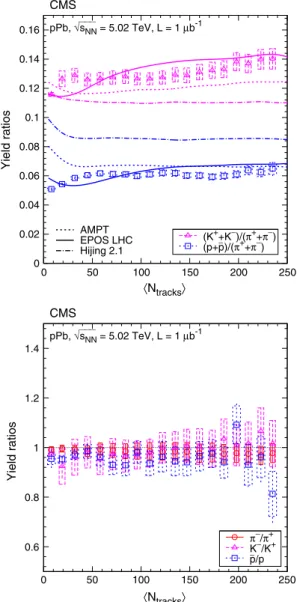
The ratios of particle yields are displayed as a function
of track multiplicity in Fig.7. The K/π and p/π ratios are
flat, or slightly rising, as a function ofNtracks. While none
of the models is able to precisely reproduce the track multi-plicity dependence, the best and worst matches to the overall
scale are given byEpos LhcandHijing, respectively. The
ratios of yields of oppositely charged particles are
indepen-dent ofNtracksas shown in the bottom panel of Fig.7. The
average transverse momentumpTis shown as a function
of multiplicity in Fig.8. As expected from the discrepancies
between theory and data shown in Fig.4,Epos Lhcagain
gives a reasonable description, while the other event gener-ators presented here underpredict the measured values. For
0 0.02 0.04 0.06 0.08 0.1 0.12 0.14 0.16
0 50 100 150 200 250
Yield ratios
〈Ntracks〉
pPb,⎯⎯⎯√sNN = 5.02 TeV, L = 1 μb-1
CMS
(K++K−)/(π+
+π−) (p+−p)/(π++π−) AMPT
EPOS LHC Hijing 2.1
0.6 0.8 1 1.2 1.4
0 50 100 150 200 250
Yield ratios
〈Ntracks〉
π−/π+
K−/K+ − p/p pPb,⎯⎯⎯√sNN = 5.02 TeV, L = 1 μb-1
CMS
Fig. 7 Ratios of particle yields in the range|y|<1 as a function of the corrected track multiplicity for|η|<2.4. K/πand p/πvalues are shown in thetoppanel, and opposite-charge ratios are plotted in the bot-tompanel.Error barsindicate the uncorrelated combined uncertainties, whileboxesshow the uncorrelated systematic uncertainties. In thetop
panel, curves indicate predictions fromAmpt,Epos Lhc, andHijing
tions match the pion data well; the kaon and proton values
are much higher than inAmptorHijing.
5.3 Comparisons to pp and PbPb data
The comparison with pp data taken at various center-of-mass
energies (0.9, 2.76, and 7 TeV) [8] is shown in Fig.9, where
the dependence ofpTand the particle yield ratios (K/π
and p/π) on the track multiplicity is shown. The plots also display the ranges of these values measured by ALICE in
PbPb collisions at√sN N =2.76 TeV for centralities from
peripheral (80–90 % of the inelastic cross-section) to
cen-tral (0–5 %) [33]. These ALICE PbPb data cover a much
0.2 0.4 0.6 0.8 1 1.2 1.4 1.6
0 50 100 150 200 250
〈
pT
〉
[GeV/c]
〈Ntracks〉 pPb,⎯⎯⎯√sNN = 5.02 TeV, L = 1 μb-1
CMS
π±
K± p,−p AMPT
EPOS LHC Hijing 2.1
Fig. 8 Average transverse momentum of identified charged hadrons (pions, kaons, protons) in the range|y|<1, as a function of the cor-rected track multiplicity for|η|<2.4, computed assuming a Tsallis– Pareto distribution in the unmeasured range.Error barsindicate the uncorrelated combined uncertainties, while boxes show the uncorre-lated systematic uncertainties. The fully correuncorre-lated normalization uncer-tainty (not shown) is 1.0 %.Curvesindicate predictions fromAmpt, Epos Lhc, andHijing
wider range of Ntracks than is shown in the plot. Although
PbPb data are not available at√sN N = 5.02 TeV for
com-parison, the evolution of event characteristics from RHIC
(√sN N =0.2 TeV, [3,4,6]) to LHC energies [33] suggests
that yield ratios should remain similar, whilepTvalues will
increase by about 5 % when going from√sN N =2.76 TeV
to 5.02 TeV.
For low track multiplicity (Ntracks 40), pPb collisions
behave very similarly to pp collisions, while at higher
multi-plicities (Ntracks50) thepTis lower for pPb than in pp.
The first observation can be explained since low-multiplicity events are peripheral pPb collisions in which only a few proton–nucleon collisions are present. Events with more par-ticles are indicative of collisions in which the projectile pro-ton strikes the thick disk of the lead nucleus. Interestingly,
the pPb curves (Fig.9, top panel) can be reasonably
approx-imated by taking the pp values and multiplying theirNtracks
coordinate by a factor of 1.8, for all particle types. In other
words, a pPb collision with a given Ntracks is similar to a
pp collision with 0.55×Ntracks for produced charged
par-ticles in the|η| < 2.4 range. Both the highest-multiplicity
pp and pPb interactions yield higherpTthan seen in
cen-tral PbPb collisions. While in the PbPb case even the most
central collisions possibly contain a mix of soft (lower-pT)
and hard (higher-pT) nucleon-nucleon interactions, for pp
0.2 0.4 0.6 0.8 1 1.2 1.4 1.6
0 50 100 150 200 250
〈
pT
〉
[GeV/c]
〈Ntracks〉 pp pPb pp pPb pp pPb π± K± p,−p
CMS ALICE PbPb ALICE PbPb ALICE PbPb 0 0.02 0.04 0.06 0.08 0.1 0.12 0.14 0.16
0 50 100 150 200 250
Yield ratios
〈Ntracks〉 pp
pPb
pp
pPb
(K++K−)/(π++π−) (p+−p)/(π+
+π−)
CMS
ALICE PbPb
ALICE PbPb
Fig. 9 Average transverse momentum of identified charged hadrons (pions, kaons, protons;toppanel) and ratios of particle yields (bottom
panel) in the range|y|<1 as a function of the corrected track multi-plicity for|η|<2.4, for pp collisions (open symbols) at several energies [8], and for pPb collisions (filled symbols) at√sN N=5.02 TeV. Both pTand yield ratios were computed assuming a Tsallis–Pareto
distri-bution in the unmeasured range.Error barsindicate the uncorrelated combined uncertainties, whileboxesshow the uncorrelated systematic uncertainties. ForpTthe fully correlated normalization uncertainty
(not shown) is 1.0 %. In both plots, lines are drawn to guide the eye (gray solidpp 0.9 TeV,gray dotted pp 2.76 TeV,black dash-dotted
pp 7 TeV,colored solidpPb 5.02 TeV). The ranges ofpT, K/πand
p/πvalues measured by ALICE in various centrality PbPb collisions (see text) at√sN N = 2.76 TeV [33] are indicated withhorizontal
bands
The transverse momentum spectra could also be
success-fully fitted (χ2/ndf in the range 0.7–1.8) with a functional
form proportional to pTexp(−mT/T′), whereT′ is called
the inverse slope parameter, motivated by the success of Boltzmann-type distributions in nucleus–nucleus collisions
[34]. In the case of pions, the fitted range was restricted to
0.1 0.2 0.3 0.4 0.5 0.6 0.7
0 0.2 0.4 0.6 0.8 1 1.2
T
′
[GeV/c]
m [GeV/c2]
8 32 58 84 109 135 160 185 210 235 pPb, ⎯⎯⎯√sNN = 5.02 TeV, L = 1 μb-1
CMS 0.1 0.2 0.3 0.4 0.5 0.6 0.7
0 0.2 0.4 0.6 0.8 1 1.2
T
′
[GeV/c]
m [GeV/c2] 〈Ntracks〉 = 8
AMPT EPOS LHC Hijing 2.1 pPb, ⎯⎯⎯√sNN = 5.02 TeV
CMS
〈Ntracks〉 = 235 AMPT EPOS LHC Hijing 2.1
Fig. 10 Inverse slope parametersT′from fits of pion, kaon, and proton spectra (both charges) with a form proportional topTexp(−mT/T′).
Results for a selection of multiplicity classes, with differentNtracksas
indicated, are plotted for pPb data (top) and for MC event generators
Ampt,Epos Lhc, andHijing(bottom). Thecurvesare drawn to guide the eye
mT >0.4 GeV/cin order to exclude the region where
reso-nance decays would significantly contribute to the measured spectra. The inverse slope parameter as a function of hadron
mass is shown in Fig.10, for a selection of event classes, both
for pPb data and for MC event generators (Ampt,Epos Lhc,
andHijing). While the data display a linear dependence on mass with a slope that increases with particle multiplicity, the models predict a flat or slowly rising behavior versus mass and only limited changes with track multiplicity. This is to
be compared with pp results [8], where both data and several
tunes of thepythia6 [35] andpythia8 event generators
show features very similar to those in pPb data. A similar
pp DS
π±
K± p,−p
pp DS
π±
K± p,−p 0.1
1 10
0.5 1 2 5 10
〈
dN/dy
〉
⎯⎯⎯ √sNN [TeV] pPb DS
π±
K± p,−p CMS
0.2 0.4 0.6 0.8 1 1.2 1.4
0.5 1 2 5 10
〈
pT
〉
[GeV/c]
⎯⎯⎯ √sNN [TeV] pPb DS
π±
K± p,−p CMS
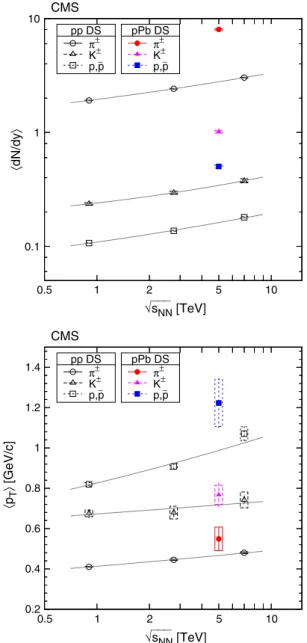
Fig. 11 Average rapidity densitiesdN/dy(top) and average trans-verse momentapT(bottom) as a function of center-of-mass energy
for pp [8] and pPb collisions, for charge-averaged pions, kaons, and protons.Error barsindicate the uncorrelated combined uncertainties, whileboxesshow the uncorrelated systematic uncertainties. Thecurves
show parabolic (fordN/dy) or linear (forpT) interpolation on a
log-log scale. The pp and pPb data are for laboratory rapidity|y|<1, which is the same as the center-of-mass rapidity only for the pp data
which is attributed to the effect of radial flow velocity boost
[1].
Average rapidity densities dN/dy and average
trans-verse momentapT of charge-averaged pions, kaons, and
protons as a function of center-of-mass energy are shown in
Fig.11for pp and pPb collisions, both corrected to the DS
selection. To allow comparison at the pPb energy, a parabolic
(linear) interpolation of the pp collision values at√s=0.9,
2.76, and 7 TeV is shown for dN/dy (pT). The rapidity
densities are generally about three times greater than in pp interactions at the same energy, while the average trans-verse momentum increases by about 20, 10, and 30 % for pions, kaons, and protons, respectively. The factor of three difference in the yields for pPb as compared to pp can be compared with the estimated number of projectile collisions
Ncoll/2=3.5±0.3 or with the number of nucleons
partici-pating in the collisionNpart/2=4.0±0.3, based on the ratio
of preliminary pPb and pp cross-section measurements, that have proven to be good scaling variables in proton–nucleus
collisions at lower energies [36].
6 Conclusions
Measurements of identified charged hadron spectra produced
in pPb collisions at√sN N =5.02 TeV have been presented,
normalized to events with simultaneous hadronic activity at
pseudorapidities−5 < η < −3 and 3 < η < 5. Charged
pions, kaons, and protons were identified from the energy deposited in the silicon tracker and other track information. In the present analysis, the yield and spectra of identified
hadrons for laboratory rapidity|y|<1 have been studied
as a function of the event charged particle multiplicity in the
range|η|<2.4. ThepTspectra are well described by fits with
the Tsallis–Pareto parametrization. The ratios of the yields of oppositely charged particles are close to one, as expected
at mid-rapidity for collisions of this energy. The average pT
is found to increase with particle mass and the event multi-plicity. These results are valid under the assumption that the particle yield distributions follow the Tsallis–Pareto function
in the unmeasuredpTregions.
The results can be used to further constrain models of hadron production and contribute to the understanding of basic non-perturbative dynamics in hadron collisions. The Epos Lhcevent generator reproduces several features of the
measured distributions, a significant improvement from the previous version, attributed to a new viscous hydrodynamic treatment of the produced particles. Other studied generators (Ampt,Hijing) predict steeper pT distributions and much
smallerpTthan found in data, as well as substantial
devi-ations in the p/π ratios.
Combined with similar results from pp collisions, the track multiplicity dependence of the average transverse momen-tum and particle ratios indicate that particle production at LHC energies is strongly correlated with event particle mul-tiplicity in both pp and pPb interactions. For low track multi-plicity, pPb collisions appear similar to pp collisions. At high
multiplicities, the averagepTof particles from pPb collisions
with a charged particle multiplicity of Ntracks(in|η|<2.4)
is similar to that for pp collisions with 0.55×Ntracks. Both
the highest-multiplicity pp and pPb interactions yield higher
Acknowledgments We congratulate our colleagues in the CERN accelerator departments for the excellent performance of the LHC and thank the technical and administrative staffs at CERN and at other CMS institutes for their contributions to the success of the CMS effort. In addi-tion, we gratefully acknowledge the computing centres and personnel of the Worldwide LHC Computing Grid for delivering so effectively the computing infrastructure essential to our analyses. Finally, we acknowl-edge the enduring support for the construction and operation of the LHC and the CMS detector provided by the following funding agencies: the Austrian Federal Ministry of Science and Research and the Aus-trian Science Fund; the Belgian Fonds de la Recherche Scientifique, and Fonds voor Wetenschappelijk Onderzoek; the Brazilian Funding Agencies (CNPq, CAPES, FAPERJ, and FAPESP); the Bulgarian Min-istry of Education, Youth and Science; CERN; the Chinese Academy of Sciences, Ministry of Science and Technology, and National Natural Science Foundation of China; the Colombian Funding Agency (COL-CIENCIAS); the Croatian Ministry of Science, Education and Sport; the Research Promotion Foundation, Cyprus; the Ministry of Education and Research, Recurrent financing contract SF0690030s09 and Euro-pean Regional Development Fund, Estonia; the Academy of Finland, Finnish Ministry of Education and Culture, and Helsinki Institute of Physics; the Institut National de Physique Nucléaire et de Physique des Particules/CNRS, and Commissariat à l’Énergie Atomique et aux Éner-gies Alternatives/CEA, France; the Bundesministerium für Bildung und Forschung, Deutsche Forschungsgemeinschaft, and Helmholtz-Gemeinschaft Deutscher Forschungszentren, Germany; the General Secretariat for Research and Technology, Greece; the National Scientific Research Foundation, and National Office for Research and Technol-ogy, Hungary; the Department of Atomic Energy and the Department of Science and Technology, India; the Institute for Studies in Theoret-ical Physics and Mathematics, Iran; the Science Foundation, Ireland; the Istituto Nazionale di Fisica Nucleare, Italy; the Korean Ministry of Education, Science and Technology and the World Class Univer-sity program of NRF, Republic of Korea; the Lithuanian Academy of Sciences; the Mexican Funding Agencies (CINVESTAV, CONACYT, SEP, and UASLP-FAI); the Ministry of Science and Innovation, New Zealand; the Pakistan Atomic Energy Commission; the Ministry of Sci-ence and Higher Education and the National SciSci-ence Centre, Poland; the Fundaç ao para a Ciência e a Tecnologia, Portugal; JINR (Arme-nia, Belarus, Georgia, Ukraine, Uzbekistan); the Ministry of Education and Science of the Russian Federation, the Federal Agency of Atomic Energy of the Russian Federation, Russian Academy of Sciences, and the Russian Foundation for Basic Research; the Ministry of Science and Technological Development of Serbia; the Secretaría de Estado de Investigación, Desarrollo e Innovación and Programa Consolider-Ingenio 2010, Spain; the Swiss Funding Agencies (ETH Board, ETH Zurich, PSI, SNF, UniZH, Canton Zurich, and SER); the National Sci-ence Council, Taipei; the Thailand Center of ExcellSci-ence in Physics, the Institute for the Promotion of Teaching Science and Technology of Thai-land and the National Science and Technology Development Agency of Thailand; the Scientific and Technical Research Council of Turkey, and Turkish Atomic Energy Authority; the Science and Technology Facil-ities Council, UK; the US Department of Energy, and the US National Science Foundation. Individuals have received support from the Marie-Curie programme and the European Research Council and EPLANET (European Union); the Leventis Foundation; the A. P. Sloan Founda-tion; the Alexander von Humboldt FoundaFounda-tion; the Belgian Federal Science Policy Office; the Fonds pour la Formation à la Recherche dans l’Industrie et dans l’Agriculture (FRIA-Belgium); the Agentschap voor Innovatie door Wetenschap en Technologie (IWT-Belgium); the Ministry of Education, Youth and Sports (MEYS) of Czech Republic; the Council of Science and Industrial Research, India; the Compagnia di San Paolo (Torino); the HOMING PLUS programme of Foundation for Polish Science, cofinanced by EU, Regional Development Fund; and the Thalis and Aristeia programmes cofinanced by EU-ESF and the Greek NSRF.
Open Access This article is distributed under the terms of the Creative Commons Attribution License which permits any use, distribution, and reproduction in any medium, provided the original author(s) and the source are credited.
Funded by SCOAP3/ License Version CC BY 4.0.
References
1. E. Schnedermann, J. Sollfrank, U.W. Heinz, Thermal phe-nomenology of hadrons from 200 A GeV S+S collisions. Phys. Rev. C 48, 2462 (1993). doi:10.1103/PhysRevC.48.2462.
arXiv:nucl-th/9307020
2. P. Huovinen, P.V. Ruuskanen, Hydrodynamic models for heavy ion collisions. Annu. Rev. Nucl. Part. Sci.56, 163 (2006). doi:10.1146/ annurev.nucl.54.070103.181236.arXiv:nucl-th/0605008
3. PHENIX Collaboration, Identified charged particle spectra and yields in Au+Au collisions at √sN N = 200 GeV. Phys. Rev. C 69, 034909 (2004). doi:10.1103/PhysRevC.69.034909.
arXiv:nucl-ex/0307022
4. BRAHMS Collaboration, Centrality dependent particle produc-tion at y = 0 and y ∼ 1 in Au+Au collisions at√sN N =200 GeV. Phys. Rev. C72, 014908 (2005). doi:10.1103/PhysRevC.72. 014908.arXiv:nucl-ex/0503010
5. PHOBOS Collaboration, Identified hadron transverse momen-tum spectra in Au+Au collisions at√sN N =62.4 GeV. Phys. Rev. C 75, 024910 (2007). doi:10.1103/PhysRevC.75.024910.
arXiv:nucl-ex/0610001
6. S.T.A.R. Collaboration, Systematic measurements of identified particle spectra in pp,d+Au and Au+Au collisions at the star detector. Phys. Rev. C79, 034909 (2009). doi:10.1103/PhysRevC. 79.034909.arXiv:0808.2041
7. PHENIX Collaboration, Spectra and ratios of identified particles in Au+Au andd+Au collisions at√sN N = 200 GeV. Phys. Rev. C. (2013).arXiv:1304.3410
8. C.M.S. Collaboration, Study of the inclusive production of charged pions, kaons, and protons in pp collisions at √s =0.9, 2.76, and 7 tev. Eur. Phys. J. C 72, 2164 (2012). doi:10.1140/epjc/ s10052-012-2164-1.arXiv:1207.4724
9. ALICE Collaboration, Multiplicity dependence of pion, kaon, pro-ton and lambda production in p-Pb collisions at√sN N =5.02 TeV. Phys. Lett. B (2013). doi:10.1016/j.physletb.2013.11.020.
arXiv:1307.6796
10. C.M.S. Collaboration, The cms experiment at the cern lhc. JINST
3, S08004 (2008). doi:10.1088/1748-0221/3/08/S08004
11. W.-T. Deng, X.-N. Wang, R. Xu, Hadron production in p+p, p+Pb, and Pb+Pb collisions with the hijing 2.0 model at energies available at the cern large hadron collider. Phys. Rev. C83, 014915 (2011). doi:10.1103/PhysRevC.83.014915.arXiv:1008.1841
12. R. Xu, W.-T. Deng, X.-N. Wang, Nuclear modification of high-pT
hadron spectra in p+A collisions at LHC. Phys. Rev. C86, 051901 (2012). doi:10.1103/PhysRevC.86.051901.arXiv:1204.1998
13. Z.W. Lin, Current status and further improvements of a multi-phase transport (ampt) model. Indian J. Phys.85, 837 (2011). doi:10. 1007/s12648-011-0086-7
14. K. Werner, F.-M. Liu, T. Pierog, Parton ladder splitting and the rapidity dependence of transverse momentum spectra in deuteron-gold collisions at rhic. Phys. Rev. C74, 044902 (2006). doi:10. 1103/PhysRevC.74.044902.arXiv:hep-ph/0506232
15. T. Pierog et al., EPOS LHC: test of collective hadronization with LHC data (2013).arXiv:1306.0121
16. CMS Collaboration, Transverse momentum and pseudorapidity distributions of charged hadrons in pp collisions at√s= 0.9 and 2.36 TeV. JHEP02, 041 (2010). doi:10.1007/JHEP02(2010)041,
17. S. Agostinelli et al., Geant4—a simulation toolkit. Nucl. Instrum. Methods A506, 250 (2003). doi:10.1016/S0168-9002(03)01368-8
18. F. Siklér, Low pT hadronic physics with CMS. Int. J. Mod. Phys. E 16, 1819 (2007). doi:10.1142/S0218301307007052.
arXiv:physics/0702193
19. C.M.S. Collaboration, Transverse-momentum and pseudorapidity distributions of charged hadrons in pp collisions at√s =7 tev. Phys. Rev. Lett.105, 022002 (2010). doi:10.1103/PhysRevLett. 105.022002.arXiv:1005.3299
20. F. Siklér, Study of clustering methods to improve primary vertex finding for collider detectors. Nucl. Instrum. Methods A621, 526 (2010). doi:10.1016/j.nima.2010.04.058.arXiv:0911.2767
21. F. Siklér, A parametrisation of the energy loss distributions of charged particles and its applications for silicon detectors. Nucl. Instrum. Methods A691, 16 (2012). doi:10.1016/j.nima.2012.06. 064.arXiv:1111.3213
22. Particle Data Group, J. Beringer et al., Review of particle physics.Phys. Rev. D86, 010001 (2012). doi:10.1103/PhysRevD. 86.010001
23. W.H. Press, B.P. Flannery, S.A. Teukolsky, W.T. Vetterling, Numer-ical Recipes: The Art of Scientific Computing, 3rd edn. (Cambridge University Press, Cambridge, 2007)
24. CMS Collaboration, Strange particle production in pp collisions at √s = 0.9 and 7 TeV. JHEP 05, 064 (2011). doi:10.1007/ JHEP05(2011)064.arXiv:1102.4282
25. C. Tsallis, Possible generalization of Boltzmann–Gibbs statistics. J. Stat. Phys.52, 479 (1988). doi:10.1007/BF01016429
26. T.S. Biró, G. Purcsel, K. Ürmössy, Non-extensive approach to quark matter. Eur. Phys. J. A40, 325 (2009). doi:10.1140/epja/ i2009-10806-6.arXiv:0812.2104
27. https://twiki.cern.ch/twiki/bin/view/CMSPublic/ PhysicsResultsHIN12016#Data(2014)
28. C.M.S. Collaboration, Observation of long-range near-side angu-lar correlations in proton–proton collisions at the LHC. JHEP09, 091 (2010). doi:10.1007/JHEP09(2010)091.arXiv:1009.4122
29. C.M.S. Collaboration, Observation of long-range near-side angular correlations in proton-lead collisions at the LHC. Phys. Lett. B718, 795 (2013). doi:10.1016/j.physletb.2012.11.025.arXiv:1210.5482
30. ALICE Collaboration, Long-range angular correlations on the near and away side in p-Pb collisions at √sN N = 5.02 TeV. Phys. Lett. B719, 29 (2013). doi:10.1016/j.physletb.2013.01.012.
arXiv:1212.2001
31. ATLAS Collaboration, Observation of associated near-side and away-side long-range correlations in√sN N=5.02 TeV proton-lead collisions with the ATLAS detector. Phys. Rev. Lett.110, 182302 (2013). doi:10.1103/PhysRevLett.110.182302.arXiv:1212.5198
32. D. d’Enterria et al., Constraints from the first LHC data on hadronic event generators for ultra-high energy cosmic-ray physics. Astropart. Phys.35, 98 (2011). doi:10.1016/j.astropartphys.2011. 05.002.arXiv:1101.5596
33. ALICE Collaboration, Centrality dependence ofπ, K, p production in Pb-Pb collisions at√sN N= 2.76 TeV. Phys. Rev. C88, 044910 (2013). doi:10.1103/PhysRevC.88.044910.arXiv:1303.0737
34. P. Braun-Munzinger, D. Magestro, K. Redlich, J. Stachel, Hadron production in Au–Au collisions at rhic. Phys. Lett. B 518, 41 (2001). doi:10.1016/S0370-2693(01)01069-3.
arXiv:hep-ph/0105229
35. T. Sjöstrand, S. Mrenna, P. Z. Skands, PYTHIA 6.4 physics and manual. JHEP05, 026 (2006). doi:10.1088/1126-6708/2006/05/ 026.arXiv:hep-ph/0603175
36. J.E. Elias et al., Experimental study of multiparticle production in hadron-nucleus interactions at high energy. Phys. Rev. D22, 13 (1980). doi:10.1103/PhysRevD.22.13
The CMS Collaboration
Yerevan Physics Institute, Yerevan, Armenia
S. Chatrchyan, V. Khachatryan, A. M. Sirunyan, A. Tumasyan
Institut für Hochenergiephysik der OeAW, Wien, Austria
W. Adam, T. Bergauer, M. Dragicevic, J. Erö, C. Fabjan1, M. Friedl, R. Frühwirth1, V. M. Ghete, N. Hörmann, J. Hrubec,
M. Jeitler1, W. Kiesenhofer, V. Knünz, M. Krammer1, I. Krätschmer, D. Liko, I. Mikulec, D. Rabady2, B. Rahbaran,
C. Rohringer, H. Rohringer, R. Schöfbeck, J. Strauss, A. Taurok, W. Treberer-Treberspurg, W. Waltenberger,
C.-E. Wulz1
National Centre for Particle and High Energy Physics, Minsk, Belarus V. Mossolov, N. Shumeiko, J. Suarez Gonzalez
Universiteit Antwerpen, Antwerpen, Belgium
S. Alderweireldt, M. Bansal, S. Bansal, T. Cornelis, E. A. De Wolf, X. Janssen, A. Knutsson, S. Luyckx, L. Mucibello, S. Ochesanu, B. Roland, R. Rougny, Z. Staykova, H. Van Haevermaet, P. Van Mechelen, N. Van Remortel,
A. Van Spilbeeck
Vrije Universiteit Brussel, Brussel, Belgium
Université Libre de Bruxelles, Bruxelles, Belgium
C. Caillol, B. Clerbaux, G. De Lentdecker, L. Favart, A. P. R. Gay, T. Hreus, A. Léonard, P. E. Marage, A. Mohammadi, L. Perniè, T. Reis, T. Seva, L. Thomas, C. Vander Velde, P. Vanlaer, J. Wang
Ghent University, Ghent, Belgium
V. Adler, K. Beernaert, L. Benucci, A. Cimmino, S. Costantini, S. Dildick, G. Garcia, B. Klein, J. Lellouch, A. Marinov, J. Mccartin, A. A. Ocampo Rios, D. Ryckbosch, M. Sigamani, N. Strobbe, F. Thyssen, M. Tytgat, S. Walsh, E. Yazgan, N. Zaganidis
Université Catholique de Louvain, Louvain-la-Neuve, Belgium
S. Basegmez, C. Beluffi3, G. Bruno, R. Castello, A. Caudron, L. Ceard, C. Delaere, T. du Pree, D. Favart, L. Forthomme,
A. Giammanco4, J. Hollar, P. Jez, V. Lemaitre, J. Liao, O. Militaru, C. Nuttens, D. Pagano, A. Pin, K. Piotrzkowski,
A. Popov5, M. Selvaggi, J. M. Vizan Garcia
Université de Mons, Mons, Belgium
N. Beliy, T. Caebergs, E. Daubie, G. H. Hammad
Centro Brasileiro de Pesquisas Fisicas, Rio de Janeiro, Brazil
G. A. Alves, M. Correa Martins Junior, T. Martins, M. E. Pol, M. H. G. Souza
Universidade do Estado do Rio de Janeiro, Rio de Janeiro, Brazil
W. L. Aldá Júnior, W. Carvalho, J. Chinellato6, A. Custódio, E. M. Da Costa, D. De Jesus Damiao, C. De Oliveira Martins,
S. Fonseca De Souza, H. Malbouisson, M. Malek, D. Matos Figueiredo, L. Mundim, H. Nogima, W. L. Prado Da Silva,
A. Santoro, A. Sznajder, E. J. Tonelli Manganote6, A. Vilela Pereira
Universidade Estadual Paulista, São Paulo, Brazil
F. A. Dias7, T. R. Fernandez Perez Tomei, C. Lagana, S. F. Novaes, Sandra S. Padula
Universidade Federal do ABC, São Paulo, Brazil C. A. Bernardes, E. M. Gregores, P. G. Mercadante
Institute for Nuclear Research and Nuclear Energy, Sofia, Bulgaria
V. Genchev2, P. Iaydjiev2, S. Piperov, M. Rodozov, G. Sultanov, M. Vutova
University of Sofia, Sofia, Bulgaria
A. Dimitrov, R. Hadjiiska, V. Kozhuharov, L. Litov, B. Pavlov, P. Petkov
Institute of High Energy Physics, Beijing, China
J. G. Bian, G. M. Chen, H. S. Chen, C. H. Jiang, D. Liang, S. Liang, X. Meng, J. Tao, J. Wang, X. Wang, Z. Wang, H. Xiao, M. Xu
State Key Laboratory of Nuclear Physics and Technology,Peking University, Beijing, China
C. Asawatangtrakuldee, Y. Ban, Y. Guo, W. Li, S. Liu, Y. Mao, S. J. Qian, H. Teng, D. Wang, L. Zhang, W. Zou
Universidad de Los Andes, Bogota, Colombia
C. Avila, C. A. Carrillo Montoya, L. F. Chaparro Sierra, J. P. Gomez, B. Gomez Moreno, J. C. Sanabria
Technical University of Split, Split, Croatia
N. Godinovic, D. Lelas, R. Plestina8, D. Polic, I. Puljak
University of Split, Split, Croatia Z. Antunovic, M. Kovac
Institute Rudjer Boskovics, Zagreb, Croatia
V. Brigljevic, S. Duric, K. Kadija, J. Luetic, D. Mekterovic, S. Morovic, L. Tikvica
University of Cyprus, Nicosia, Cyprus
A. Attikis, G. Mavromanolakis, J. Mousa, C. Nicolaou, F. Ptochos, P. A. Razis