24 (2014), Number 3, 359-370 DOI: 10.2298/YJOR140401033C
DECISION MAKING WITH CONSONANT BELIEF
FUNCTIONS: DISCREPANCY RESULTING WITH THE
PROBABILITY TRANSFORMATION METHOD USED
Esma Nur CINICIOGLU
School of Business, Istanbul University, Istanbul, TURKEY [email protected]
Received: April 2014 / Accepted: October 2014
Abstract: Dempster−Shafer belief function theory can address a wider class of uncertainty than the standard probability theory does, and this fact appeals the researchers in operations research society for potential application areas. However, the lack of a decision theory of belief functions gives rise to the need to use the probability transformation methods for decision making. For representation of statistical evidence, the class of consonant belief functions is used which is not closed under Dempster’s rule of combination but is closed under Walley’s rule of combination. In this research, it is shown that the outcomes obtained using both Dempster’s and Walley’s rules do result in different probability distributions when pignistic transformation is used. However, when plausibility transformation is used, they do result in the same probability distribution. This result shows that the choice of the combination rule and probability transformation method may have a significant effect on decision making since it may change the choice of the decision alternative selected. This result is illustrated via an example of missile type identification.
Keywords: Belief functions, Consonant belief functions, Plausibility transformation, Pignistic transformation.
MSC: 68T37.
1. INTRODUCTION
belief functions establish a major appeal to operation researchers for potential application areas wherein uncertainty is involved. Belief functions has been used in a wide range of applications such as target identification (Delmotte and Smets 2004), data fusion (Appriou 1997), auditing (Srivastava et al. 2011), and data mining (Wickramaratna et al. 2009).
Belief functions theory originates to the early works of Dempster (1967 & 1968) on upper and lower limits of probability. This work was developed by Shafer (1976) and thus, belief functions are also named as Dempster-Shafer theory of belief functions, or theory of evidence.
For combination of independent belief functions, Dempster’s rule of combination is the classical one, and the most widely used rule in Dempster-Shafer (D-S) theory. However, the rule has been criticized on various matters. One of the criticisms made at DS combination rule is the fact that consonant belief functions are not closed under Dempster’s rule of combination. As a remedy to this problem, Walley (1987) proposed an alternative rule for combination of belief function representations of statistical evidence. Consonant belief functions are closed under Walley’s rule of combination; however, the drawback of Walley’s rule is that it is only defined for partially consonant belief functions. A detailed review and comparison of these two combination rules is done by Cinicioglu and Shenoy (2006). In their work they also showed that when plausibility transformation is applied to outcomes obtained by Dempster’s and Walley’s combination rule, they do result in the same probability distribution function. The fact that there is no decision theory of belief functions gives rise to the need to transform belief functions into probability distributions. Consequently, according to the result obtained by Cinicioglu and Shenoy (2006), a decision made with the expected utility theory would be indifferent of the combination rule (Dempster or Walley’s rule) used. On the other hand, though plausibility transformation is one of the available methods of probability transformation, it is not the only one. In this research, both pignistic and the plausibility transformation are used to transform the outcomes of both of the combination rules into a probability distribution. It is shown that when pignistic transformation is used on the outcomes obtained from both of the combination rules, the result is different probability distributions. So, the choice of the combination rule, and the resulting discrepancy, depending on the transformation method used, may have significant effect on decisions.
2. EVIDENCE THEORY
2.1. Belief Functions
Belief functions theory is also called the theory of evidence since it deals with weights of evidence and with numerical degrees of support based on evidence (Shafer 1976). The main advantage of belief functions lies in their ability to represent ignorance and ambiguity. As shown by Ellsberg’s paradox (1961), the probability theory is unable to distinguish between a situation of complete ignorance and a situation where we have complete knowledge (Srivastava, 1997). Dempster-Shafer theory allows the description of partial or complete ignorance, since the belief not accorded to a proposition does not have to be accorded to the negation of that proposition (Cattaneo, 2011).
There are several equivalent ways of representing a belief function, namely basic probability assignment, belief function, plausibility function, and a commonality function.
Consider a set of mutually exclusive and exhaustive propositions,
Θ = {θ1, θ2, …, θK}, referred to as frame of discernment. A proposition θi states the lowest level of discernible information. Any proposition that is not singleton, e.g. {θ1, θ2}, is referred to as a composite.
A basic probability assignment (bpa) m for Θ is a function m: 2Θ→ [0, 1] such that
m(∅) =0 and Σ{m(A) | A ⊆Θ}=1 (1) m(A) is a measure of the belief that is committed exactly to A. If m(A) > 0, then A is called a focal element of m. Note that if is the complement of A, then m(A) + m( ) ≤ 1. Basic probability assignment differ from a probability function in that they can assign a measure of belief to a subset of the state space without assigning any belief to its elements. If all the focal elements are singletons, a belief function is reduced to a Bayesian probability function (Shafer 1976). Consequently, belief function calculus is a generalization of probability calculus, and any Bayesian model of uncertainty is also a belief function model (Shafer and Srivastava 1990)
There are three important functions in DS theory, belief functions, plausibility functions, and commonality functions. They can all be defined in terms of the basic probability assignments.
A belief function Bel corresponding to a bpam is a function
Bel: 2Θ→ [0, 1] such that Bel(A) = Σ{m(B) | B⊆A} for all A⊆Θ (2) Bel(A) can be interpreted as the probability of obtaining a set observation that implies the occurrence of A.
A plausibility function Pl corresponding to a bpam is a function
Pl: 2Θ→ [0, 1] such that Pl(A) = Σ{m(B) | B∩A≠∅} for all A ⊆Θ (3) Pl(A) can be interpreted as the probability of obtaining a set observation that is consistent with some element of A.
A commonality function Q corresponding to bpam is a function
Q: 2Θ→ [0, 1] such that Q(A) = Σ{m(B) | B⊇A} for all A⊆Θ (4) Q(A) can be interpreted as the probability of obtaining a set observation that is
1 ) ( ) 1
(− 1 =
∑
≠∅ +
A Q A
A
(5)
Notice that for singleton subsets {θ}, the definitions of plausibility and commonality functions coincide, i.e., Q({θ}) = Pl({θ}) for all θ∈Θ.
A famous example named “Betty’s testimony”, given by Shafer & Srivastava (1990), demonstrates the fact that belief functions base the beliefs on the evidence. Suppose that I have a friend called Betty, and according to my subjective probability, Betty is reliable 90% of time, and she is unreliable 10% of time.
Accordingly, P(Betty = reliable) = 0.9, P(Betty = unreliable) = 0.1. Betty tells me a tree limb fell on my car. Betty's statement must be true if she is reliable, but it is not necessarily false if she is unreliable. So, representing this situation under a belief function framework, the following results are obtained:
Bel(limb fell) = 0.9 Bel(no limb fell) = 0
It does not mean that I am sure that no limb fell on my car, as a zero probability would. This zero value only means that Betty's testimony gives me no reason to believe that no limb fell on my car.
In the following section, consonant belief functions are introduced, and the use of consonant belief functions for representation of statistical evidence is demonstrated.
2.2. Consonant Belief Functions
A belief function is said to be consonant if its focal elements are nested, meaning that each is contained in the following one (Shafer, 1976). The nested structure of consonant belief functions restricts the number of focal elements the belief function may have. In a belief function which is not consonant, depending on the number of elements n, the belief function may have up to 2n – 1 focal elements. This property of consonant belief functions makes it preferable for representation of statistical evidence (Shafer 1976). However, when Dempster’s rule is applied for combination of consonant belief functions, then the resulting belief function is not consonant any more. For that reason, an alternative rule was proposed by Walley (1987) for combination of partially consonant belief functions.
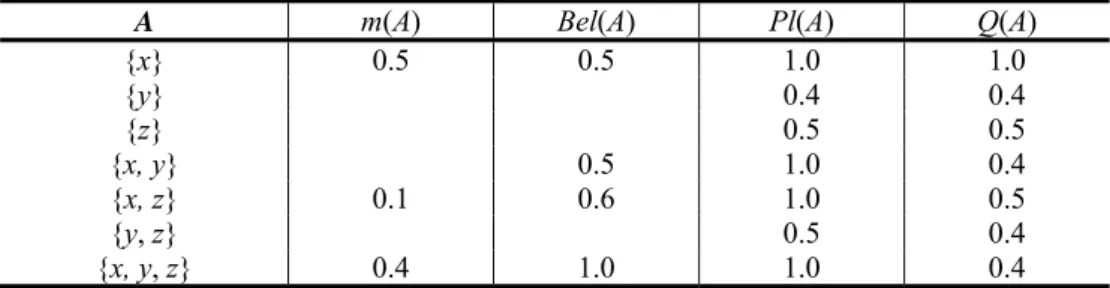
An example of a consonant bpa m with the frame of discernment {x, y, z}, and the focal elements {x}, {x, z} and {x, y, z} is as follows: m({x}) = 0.5, {x, z} = 0.1 and {x, y, z} = 0.4. The corresponding belief, plausibility, and commonality functions are given in Table 1.
Table 1:Different representations of a consonant belief function
A m(A) Bel(A) Pl(A) Q(A)
{x} 0.5 0.5 1.0 1.0
{y} 0.4 0.4
{z} 0.5 0.5
{x, y} 0.5 1.0 0.4
{x, z} 0.1 0.6 1.0 0.5
{y, z} 0.5 0.4
A type of consonant belief functions is partially consonant belief functions, where the state space is partitioned and with focal elements nested within each element of partition, (Walley, 1987). Partially consonant belief functions are the only class of DS belief functions that are consistent with the likelihood principle of statistics. A decision theory for partially consonant belief functions is proposed by Giang and Shenoy (2011).
An example for representation of statistical evidence that use consonant belief functions is provided below as “Missile Fall Down”.
Example: Missile Fall Down
Suppose that an attack has been placed, and three foe missiles are thrown to the country of Neverland. The missile defense system of Neverland is able to shut down two of the three missiles. Neverland Security Defense Deputy has the information that all three foe missiles are of the same type, either type X309, type Y118, or type Z127. However, they do not know which type these three foe missiles do belong. These three types use different technologies and hence have different likelihoods for being shut down by the missile defense system of Neverland. Let MT denote the missile type and let the state space of MT be denoted by ΩMT = {X309, Y118, Z127}. Let F denote the result of Neverland Missile Defense Systems’ response, f indicate the foe missile fell down, nf indicate it did not fell down (it was missed by the missile defense system of Neverland)
ΩF = {f, nf}. The probabilistic likelihoods for each type of foe missile for being shut down by Neverland forces are as follows:
P(f| X309) = 7/10 P(nf| X309) = 3/10 P(f| Y118) = 5/10 P(nf| Y118) = 5/10 P(f| Z127) = 3/10 P(nf| Z127) = 7/10
In this example, for representation of evidences observed (either the missile fall down or did not), a consonant belief function framework seems reasonable, since the number of parameters needed for a consonant belief function representation is the same as the number of likelihoods available, three. A belief function which is not consonant would require 23−1 parameters instead. Additionally, notice that the likelihood of X309 is greater than the likelihood of Y118 (for the fall down), and the likelihood of Y118 is greater than the likelihood of Z127. Following this intuition, an evidence x should lend the plausibility to a singleton {θ} Θ in strict proportion to the chance that qθ assigns x,
i.e., that x should determine a plausibility function Plx obeying
Plf({X309}) = (10/7)(7/10) =1 Plnf({X309}) = (10/7)(3/10) =3/7 Plf({Y118}) = (10/7)(5/10) = 5/7 Plnf({Y118}) = (10/7)(5/10) =5/7 Plf({Z127}) = (10/7)(3/10) =3/7 Plnf({Z127}) = (10/7)(7/10)=1
The corresponding bpa of these consonant belief functions can be found as follows:
mf({X309}) = 1 − 5/7 = 2/7 mnf({Z127}) = 1 − 5/7 = 2/7 mf({X309, Y118}) = 5/7 − 3/7 = 2/7 mnf({Z127, Y118}) = 5/7 − 3/7 = 2/7 mf({X309, Y118, Z127}) = 3/7 mnf({Z127, Y118, X309}) = 3/7
The next section describes Dempster’s and Walley’s combination rules.
2.3. Combination Rules
2.3.1 Dempster’s Rule of Combination
The classical combination rule for combining independent belief functions is called Dempster’s rule. Let m1⊕m2 denote the joint bpa resulting from the combination of
two independent bpa’sm1 and m2, where ⊕ represents the operator of combination, then
( ∑ | , Θ, for all A⊆Θ, A ≠ ∅(7) where K is a normalization constant given by ∑ |
for K> 0
If K = 0, this means the two bpa’s are totally conflicting and cannot be combined. Dempster’s rule in terms of bpa’s consists of assigning the product of the masses to the intersection of the focal elements followed by normalization. Zadeh (1986) claimed that this normalization involves counter-intuitive behaviours (Lefevre et al. 2002). Many alternative combination rules have been proposed in order to solve the problem of conflict management (Yager 1987, Dubois and Prade 1998, Smets 1990, Murphy 2000). Another point where Dempster’s rule of combination is criticized is that the class of partially consonant belief functions is not closed under Dempster’s rule of combination. For that reason, Walley (1987) proposed an alternative rule, defined for partially consonant belief functions (this rule is introduced in the next section).
Dempster’s rule of combination may also be expressed by commonality functions. Let Q1, Q2, and Q1⊕Q2 denote commonality functions corresponding to m1,
m2, and m1⊕m2, respectively. Then,
(Q1⊕Q2)(A)=K-1Q1(A)Q2(A) for all non-empty A⊆Θ, (8)
where K is given as follows: K =∑ 1 | |
Dempster’s rule in terms of commonality functions is essentially pointwise multiplication of the commonality functions followed by normalization.
2.3.2 Walley’s Rule of Combination
Walley’s combination rule for partially consonant commonality functions Q1
(Q1 Q2)(A) = 0 if Q1(A)Q2(A) = 0
(Q1 Q2)(A) = K-1min{Q1({θ})Q2({θ}) | θ∈A} otherwise (9)
for all non-empty sets A, where K > 0 is uniquely determined by (5) so that Q1 Q2 is a
commonality function. Q1 Q2 is well defined provided Q1({θ})Q2({θ}) > 0 for some
θ Θ.
The class of partially consonant commonality functions are closed under . However, Walley’s combination rule cannot be used to combine arbitrary commonality functions, since if combined under this rule, they may not be commonality function.
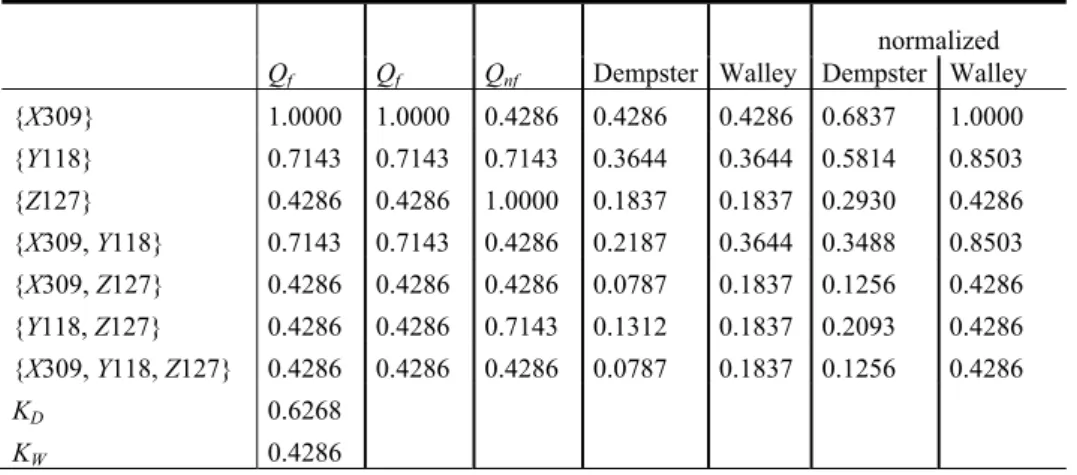
In Table 2 the combination of observations f, f, nf represented by commonality functions Qf Qf Qnf using both Dempster and Walley’s rule of combination is illustrated.
Notice that for the case of singletons, the two rules do agree before normalization since both are pointwise multiplication of commonality functions. The next section describes the probability transformation methods, pignistic and plausibility transformation.
Table 2: Missile Fall Down Example continued: Combination of observations f, f, nf using both Dempster and Walley’s rule of combination
Qf Qf Qnf Dempster Walley
normalized Dempster Walley
{X309} 1.0000 1.0000 0.4286 0.4286 0.4286 0.6837 1.0000 {Y118} 0.7143 0.7143 0.7143 0.3644 0.3644 0.5814 0.8503 {Z127} 0.4286 0.4286 1.0000 0.1837 0.1837 0.2930 0.4286 {X309, Y118} 0.7143 0.7143 0.4286 0.2187 0.3644 0.3488 0.8503 {X309, Z127} 0.4286 0.4286 0.4286 0.0787 0.1837 0.1256 0.4286 {Y118, Z127} 0.4286 0.4286 0.7143 0.1312 0.1837 0.2093 0.4286 {X309, Y118, Z127} 0.4286 0.4286 0.4286 0.0787 0.1837 0.1256 0.4286
KD 0.6268
KW 0.4286
3. DISCREPANCY OF PROBABILITY DISTRIBUTIONS
3.1. Probability Transformation Methods
As there is no decision theory of belief functions, the researchers are forced to use probability transformation methods. In sections 3.1.1 and 3.1.2, two famous probability transformation methods, pignistic and plausibility transformation are introduced. In section 3.1.3, using both of the probability transformation methods introduced, the combination results of the Missile Fall Down example are transformed into probability distributions.
3.1.1 Pignistic Transformation
singletons involved in that element split by the cardinality of the proposition when working with normalized basic probability assignments (Han et al. 2010).
Suppose that Θ = {θ1, θ2, ..., θ3} is the frame of discernment. The pignistic
probability transformation for the singletons is illustrated as follows (Smets and Kennes 1994):
∑ , | | (10)
where 2Θ is the power set of frame of discernment.
3.1.2 Plausibility Transformation
Cobb and Shenoy (2006) argue that the pignistic transformation method produces results that appear to be inconsistent with Dempster’s rule of combination. Claiming this, they proposed the plausibility transformation which is defined as follows:
Suppose m is a subset for s. Let Plm denote the plausibility function for s corresponding to bpam. Let Pl_Pm denote the probability function that is obtained from m using the plausibility transformation method. Let Pl_Pmdenote the probability function that is obtained from m using the plausibility transformation method. Pl_Pm is defined as follows:
Pl_Pm(x) = K−1Plm({x} for all x Ω ,
whereK = ∑ | Ω is a normalization constant (11)
3.2. Discrepancy Resulting from the Transformation Method Used
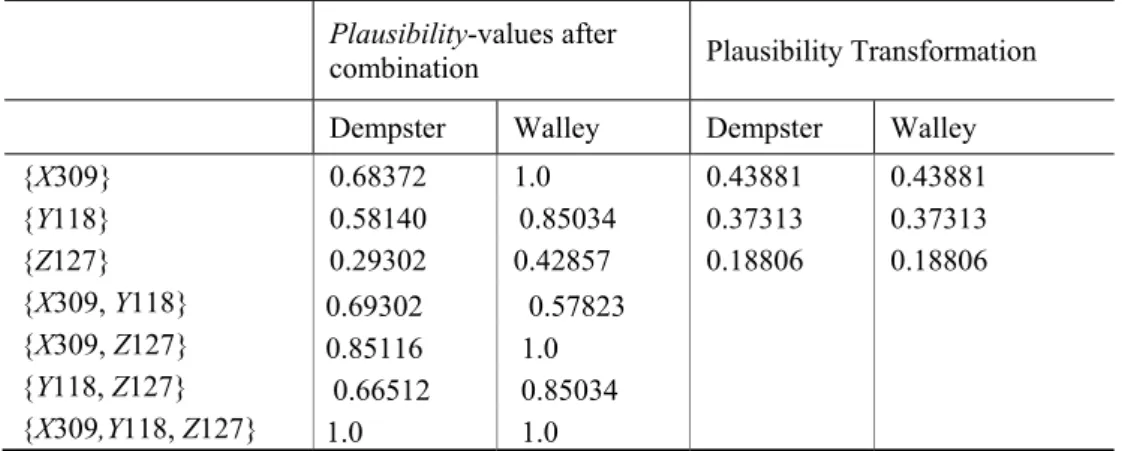
In the preceding sections, going back to the Example Missile Fall Down, we used two combination rules, Dempster’s and Walley’s rule, for combining the observations represented under a consonant belief function framework to identify the type of the missile thrown at the country of Neverland. When the results of these two combination rules are compared, identical results before normalization are obtained, so both rules are the same for the case of singletons, as illustrated in Table 2. Investigating the m-values after combination given in Table 4, it can be seen that the resulting belief function by Walley’s rule of combination is consonant after combination. Looking to the results obtained by Dempster’s rule of combination, it is clear that the class of consonant belief functions is not closed under Dempster’s rule of combination.
Table 3:Transformation of results using plausibility transformation
Plausibility-values after
combination Plausibility Transformation
Dempster Walley Dempster Walley
{X309} 0.68372 1.0 0.43881 0.43881 {Y118} 0.58140 0.85034 0.37313 0.37313 {Z127} 0.29302 0.42857 0.18806 0.18806 {X309, Y118} 0.69302 0.57823
{X309, Z127} 0.85116 1.0 {Y118, Z127} 0.66512 0.85034 {X309,Y118, Z127} 1.0 1.0
Table 4:Transformation of results using pignistic transformation
m-values after combination Pignistic transformation Dempster's rule Walley's rule Dempster Walley
{X309} 0.33488 0.14966 0.48837 0.50340
{Y118} 0.14884 0 0.34419 0.35374
{Z127} 0.08372 0 0.16744 0.14286
{X309, Y118} 0.22326 0.42177 {X309, Z127} 0 0
{Y118, Z127} 0.08372 0 {X309,Y118, Z127} 0.12558 0.42857
Table 5: Expected utilities obtained with three probability distributions
Probabilities Expected Utilities
Dempster,
Walley Dempster Walley
Dempster,
Walley Dempster Walley Missile
type
Utilities $ (in thousand)
Plausibility Pignistic Pignistic Plausibility Pignistic Pignistic X309 1000 0.4388 0.4884 0.5034 438.8060 503.4014 488.3721 Y118 1500 0.3731 0.3442 0.3537 559.7015 530.6122 516.2791 Z127 3500 0.1881 0.1674 0.1429 658.2090 500.0000 586.0465
4. CONCLUSIONS
Dempster−Shafer belief function theory can address a wider class of uncertainty than the standard probability theory, and this fact appeals the researchers in operations research society for potential application areas. However, the lack of a decision theory of belief functions gives rise to the need to use the probability transformation methods for decision making.
In this work first an example of statistical evidence is represented using the consonant belief function framework. Then, the observations are combined using the classical Dempster's rule of combination and the newly proposed Walley's rule of combination for consonant belief functions. The combination results demonstrate that the class of consonant belief functions is closed under Walley's rule of combination, which is not the case for Dempster's rule. For decision making purposes, both of the combination results are transformed into probability distributions using the pignistic, and the plausibility transformation methods. In this work, it is shown that although the two combination rules do result in the same probability distribution function when plausibility transformation is used, they end up with different probability distributions when pignistic transformation is applied. Consequently, it is demonstrated that the choice of the combination rule and/or the probability transformation method may have a significant effect on decision making, on the choice of the decision alternative.
ACKNOWLEDGEMENT
This work was partly supported by Istanbul University Scientific Research Fund project number 15284 and 27540.
REFERENCES
[1] Appriou, A., “Multisensor Data Fusion in Situation Assessment Processes”, Qualitative and Quantitative Practical Reasoning, Gabbay D. M. , Kruse R., Nonnengart A., Ohlbach H. J. eds., Springer, Berlin, 1997, 1-15.
[2] Cattaneo, M. EGV., “Belief functions combination without the assumption of independence of the information sources”, International Journal of Approximate Reasoning, 52 (3) (2011) 299-315.
[3] Cinicioglu, E.N., & Shenoy, P.P., "On Walley's combination rule for statistical evidence," Eleventh international conference on information processing and management of uncertainty in knowledge-based systems (IPMU-06) Les Cordeliers, Paris, France, 2006, 386−394.
[4] Cobb, B. R., & Shenoy, P.P. "On the plausibility transformation method for translating belief function models to probability models", International Journal of Approximate Reasoning, 41(3) (2006), 314-330.
[5] Delmotte, F., & Smets, Ph., “Target Identification based on the Transferable Belief Model Interpretation of Dempster-Shafer Model”, IEEE Transactions on Systems, Man and Cybernetics A, 34(4) (2004) 457–471.
[6] Dempster, A.P., “Upper and lower probabilities induced by a multivalued mapping”, Annals of Mathematical Statistics, 38 (1967) 325−339.
[7] Dempster, A.P., “Upper and lower probabilities generated by a random closed interval”, Annals of Mathematical Statistics, 39 (3) (1968) 957−966.
[8] Dubois, D. & Prade, H., “Representation and combination of uncertainty with belief functions and possibility measures”, Computational Intelligence 4 (1998) 244–264.
[9] Ellsberg, D., “Risk, Ambiguity, and the Savage Axioms”, Quarterly Journal of Economics, 75 (1961) 643-669.
[10] Giang, P. H., & Shenoy, P.P.. "A decision theory for partially consonant belief functions." International Journal of Approximate Reasoning, 52 (3) (2011) 375-394.
[11] Han, D., Dezert, J., Han, C., & Yang, Y. “Is entropy enough to evaluate the probability transformation approach of belief function?”, Information fusion (FUSION), 2010 13th Conference on IEEE, (2010).
[12] Lefevre, E., Colot, O., & Vannoorenberghe, P., “Belief function combination and conflict management”, Information fusion, 3 (2) (2002) 149-162.
[13] Murphy, C.K., “Combining belief functions when evidence conflicts”, Decision Support Systems, 29 (2000) 1–9.
[14] Shafer, G. “A Mathematical Theory of Evidence. Princeton University Press, Princeton, N.J., (1976).
[15] Shafer, G. “Belief functions and parametric models”, Journal of the Royal Statistical Society, Series B 44, 3 (1982) 322-352.
[16] Shafer, G., & Srivastava, R., “The Bayesian and belief-function formalisms: A general perspective for auditing”, Auditing: A Journal of practice and Theory, 9 (1990) 110-48.
[17] Smets, P., “The combination of evidence in the transferable belief model”, IEEE Transactions on Pattern Analysis and Machine Intelligence, 12 (5) (1990) 447–458.
[18] Smets, P., & Kennes, R., “The transferable belief model”, Artificial intelligence, 66.2 (1994) 191-234.
[20] Srivastava, R.P., Rao, S.S., Mock, T.J., Planning Assurance Services for Sustainability Reporting, 2011.
[21] Walley, P., “Belief Function Representations of Statistical Evidence”, The Annals of Statistics, 15 (4) (1987) 1439-1465.
[22] Wickramaratna, K., Kubat, M., Premaratne, K., “Predicting Missing Items in Shopping Carts”, IEEE Trans. on Know. and Data Eng. 21 (7) 2009.
[23] Yager, R.R.,“On the Dempster–Shafer framework and new combination rules”, Information Sciences, 41 (1987) 93–138.