Nanomed. J., 3(1):49-56, Winter 2016
Effects of combination of magnesium and zinc oxide nanoparticles and
heat on
Escherichia coli
and
Staphylococcus aureus
bacteria in milk
1M. Kimiaee Sadr;2, 3*M. Mirhosseini;4Gh. Rahimi
1Department of Biology, Ashkezar Branch, Islamic Azad University, Ashkezar, Yazd, Iran.
2 Department of Biology, Payame Noor University, Iran
3 Department of Biotechnology, Nano Structured Coatings Institute, Payame Noor University, Yazd, Iran
4Young Researchers and Elite Club, Marvdasht Branch, Islamic Azad University, Marvdasht, Iran
AB STRACT
Objective: The objective of this study was to investigate the antibacterial activities of combination of MgO and ZnO nanoparticles in the presence of heat against Escherichia coli and Staphylococcus aureus.
Materials and Methods: Bacteria were grown on either agar or broth media followed by the addition of ZnO and MgO nanoparticles. Then the combined effect of ZnO and MgO nanoparticles was investigated. Furthermore, the media containing nanoparticles were treated with mild heat and their synergistic antibacterial activity was investigated against E. coli and S. aureus in milk.
Results:The data showed that the nanoparticles used in this study had no effect on the bacteria in the agar medium. However, the results showed that ZnO and MgO nanoparticles resulted in a significant decrease in the number ofE. coli (P<0.000) andS. aureus (Pd”0.05) in the broth medium. The combination of nanoparticles and mild heat exhibited a significant decrease in the number ofE. coli andS. aureus indicating the synergistic effects of nanoparticles and heat. Conclusion: Using a combination of mild heat, ZnO and MgO nanoparticles,E. coliandS. aureus can be controlled successfullyin the milk. Mild heating plus ZnO and MgO nanoparticles has a synergistic effect which would reduce the need for high temperature and also the concentrations of ZnO and MgO nanoparticles required for pathogen control in minimally processed milk during maintaining.
Keywords:Escherichia coli, Magnesium oxide, Nanoparticles, Staphylococcus aureus, Zinc oxide
Nanomed. J., 3(1): 49-56, Winter 2016 DOI: 10.7508/nmj.2016.01.006
*Corresponding Author Email:[email protected].
Tel: (+98)35-35216135
Note. This manuscript was submitted on July 19, 2015; approved on September 25, 2015
Received; 19 July 2015 Accepted; 25 September 2015
INTRODUCTION
One of the significant problems nowadays is the increase of the prevalence of antibiotic resistance in various human and animal pathogens. In human and animal populations, antibiotics are used to treat and prevent infectious diseases. The main factor for the increase of the resistance of pathogenic bacteria is overuse of antibiotics and this has led to the emergence and spread of resistant pathogens and resistant genes in them [1].
Staphylococcus aurous and Escherichia coli are important pathogens in nosocomial infections. These
bacteria have been found on all surfaces of the hospital [2].
S. aureusis one of the most common and important pathogens in hospital infections that can cause infection anywhere in the body due to several enzymes, including coagulase, hyaluronidase, nuclease, lipase, leukocidin and hemolysin.
This bacterium also causes infections in the hospital and is the second cause of hospital infections after
Pseudomonas aeruginosa and it has the ability to create serious infections such as septicemia, endocarditis and osteomyelitis in patients admitted to the hospital. It is also mentioned as the most common cause of mortality in hemodialysis patients [3-4].
gastroenteritis, neonatal meningitis and intra-abdominal infections [5].
Antibiotic resistance is one of the problems for eliminating these bacteria. Access to materials with powerful antibacterial, antiviral and antifungal properties can be useful for disinfection and infection control in many cases. Due to the increasing spread of infectious diseases and food poisoning caused by different bacteria, includingE. coli andS. aureus, as well as the resistance of microorganisms to different common antibiotics, researchers are considering the use of new antimicrobial agents against the bacteria. Researchers around the world are trying to find new pharmaceutical composition for ideal treatment of infections. Biological and physicochemical properties of inorganic nanomaterials have attracted the attention of many researchers.
Historically nanomaterials have been discussed on two categories which are metallic and nonmetallic nanoparticles [6].
Nanomaterials whose base is formed of metal ions have extensive cytotoxic activity against bacteria, fungi and viruses [7]. Sometimes, to increase the inhibition effects, combination of nanoparticles can be used.
The combined use of these materials can be considered as a good solution that, in addition to increasing antimicrobial properties, can overcome the limitations of each individual case the nanoparticles. The combination of nanoparticles with each other and the their use against microorganisms has led to the development of different research areas.
One of the advantages of using a combination of nanoparticles is the extent of their performance, the use of lower concentrations of nanoparticles in combined state compared to single-nanoparticle state, reduced toxicity, prevention of emergence of resistance to each of the nanoparticles [8-3].
One of the nanoparticles, Zinc oxide (ZnO) is used on an industrial scale in many countries [9-10]. Nanoparticles of Magnesium oxide (MgO) is used in industry and medicine.
Studies show that magnesium oxide nanoparticles, alone or in a combination with other antibacterial groups, act as a potential effective antimicrobial factor to enhance food safety [11].
The objective of this study was to investigate the antibacterial activities of combination of MgO and ZnO
nanoparticles and its synergistic effect in combination with heat against foodborne pathogens including E. coli andS. aureus.
MATERIALS AND METHODS Materials
Standard strains ofS. aureus (PTCC: 1431) andE. coli (PTCC: 1394) used in this research was purchased in the form of lyophilized microorganisms from The Iranian Center for Collection of Industrial Microorganism. These strains of bacteria were cultured in tryptic soy agar medium (Merck, Germany) and were stored at 0-2 ° C for use in the subsequent steps. ZnO nanoparticles used in this study were purchased from TECONAN Company and had the purity of 99.98 percent. MgO nanoparticles with the purity of 99.98 percent were purchased from US Nano Company. Transmission electron microscope (TEM), visible-ultraviolet spectrometer and X-ray diffraction were used to evaluate and verify the chemical and physical properties and morphology of the nanoparticles purchased.
Preparation of MgO and ZnO nanoparticles mixture Nanoparticles mixture was prepared using deionized water. In order to achieve a concentration of ZnO and MgO nanoparticles that is the effective against both bacteria, the effect of nanoparticles in the agar media was explored in two stages.
In the first stage, concentrations of 0.25, 0.50, and 0.75 mg/ml and combined nanoparticles concentrations of 0.50(ZnO) + 0.50(MgO), 0.25(ZnO) + 0.75(MgO), 0.25(MgO) + 0.75
(ZnO) mg/ml were used.
In the second stage, with increasing the concentration, the effect of the nanoparticles with concentrations of 0.50, 1, 1.5 mg/ml and combined concentrations of 1(ZnO) + 1(MgO), 0.50(ZnO) + 1.50(MgO), 0.50(MgO) + 1.5(ZnO) mg/ml against the bacteria were measured [12].
Evaluation the effect of combined nanoparticles against E. coli and S. aureus in agar media.
Nanomed. J., 3(1):49-56, Winter 2016
Using sterile forceps, disks were placed on plates containing 107 cfu/ml of each of bacterium. Then,20 μ l
of different concentrations of nanoparticles of ZnO and MgOwere placed on plates.
Then the plates were incubated at 37 °C for 24 h and after that time, inhibition zone was measured using a caliper. Inhibition zone around the disk shows the antibacterial activity of nanoparticles.
The control group at this stage was consisted of raw disk and disks contained distilled water and tetracycline antibiotic discs [13].
Evaluation of the effect of combined nanoparticles in liquid medium
The tryptic soy broth (TSB) containing concentrations of 0.5, 1, 1.5 mg/ml and combined concentrations of 1(ZnO) +1(MgO), 0.5(ZnO) +1.5(MgO), 0.5(MgO) +1.5(ZnO) mg/ml of nanoparticles were prepared. Samples were then inoculated with the 107 cfu/ml suspension of
S. aureus (PTCC: 1431) andE. coli (PTCC: 1394). The samples were stored at room temperature on the shaker at around 100 rpm and examined every 2 h for 24 h. Manitol salt agar (MSA, Merck, Darmstadt, Germany) was used for the isolation and enumeration of S. aureus.
Eosin methylene blue (EMB, Merck, and Darmstadt, Germany) agar was employed for the isolation and identification ofE. coli [9].
Combined effect of mild heat, MgO and ZnO nanoparticles in milk
Culture conditions
Each strain was cultured in a tryptic soy broth (TSB; Merck, Germany) at 37 °C for 24 h, harvested by centrifugation at 4000 g for 20 min at 4 °C and washed three times with buffered peptone water. The final pellet was resuspended in buffered peptone water, corresponding to approximately 107-108 cfu/ml and
mixed cocktails were prepared by blending the equal volumes of each test strain.
Sample treatment
The milk samples containing 0.5(ZnO), 1.5(MgO), 1.5(MgO) + o.5 (ZnO) mg/ml nanoparticles were prepared. Samples were then inoculated with the prepared mixed culture cocktails (106-107 cfu/ml of each strain). Heat treatments
were performed at 25 °C, 50°C and 60°C in a water bath, with the temperature monitored by inserting a thermometer into a bottle of milk. During the heat
treatment, the sample bottles were vigorously agitated to facilitate uniform distribution of the inoculums. Once the temperature of the sample reached the target treatment temperature of 50 and 60 °C the glass bottles were removed and immediately cooled in crushed ice. The samples were stored at room temperature and examined after 3, 8, 24 and 48 h, respectively, to allow for the recovery and then enumeration of injured cells [13]. Bacterial enumeration Aliquots (1ml) of the treated milk samples were dispersed in 9 ml of 0.2% (w/ v) sterile peptone water and then serially diluted (10-1
-10-5) in 0.1% sterile peptone water. Manitol salt agar
(MSA, Merck, Darmstadt, Germany) was used for the isolation and enumeration ofS. aureus.
Eosin methylene blue (EMB, Merck, and Darmstadt, Germany) agar was employed for the isolation and identification ofE. coli. Microscopic examination of the isolates was performed by staining smears according to the Gram method. Identification and characterization of bacterial isolates up to the species level were implemented using various biochemical and sugar fermentation tests [9-14].
Statistical analysis
Antimicrobial experiments were conducted in triplicate. Data points were expressed as the mean ± standard deviation. Data were analyzed using analysis
of variance from SPSS version 16 software. Duncan’s
multiple range tests were used to determine the significant difference of mean values. Unless stated otherwise, significance was expressed at 5% level.
RESULTS AND DISCUSSION
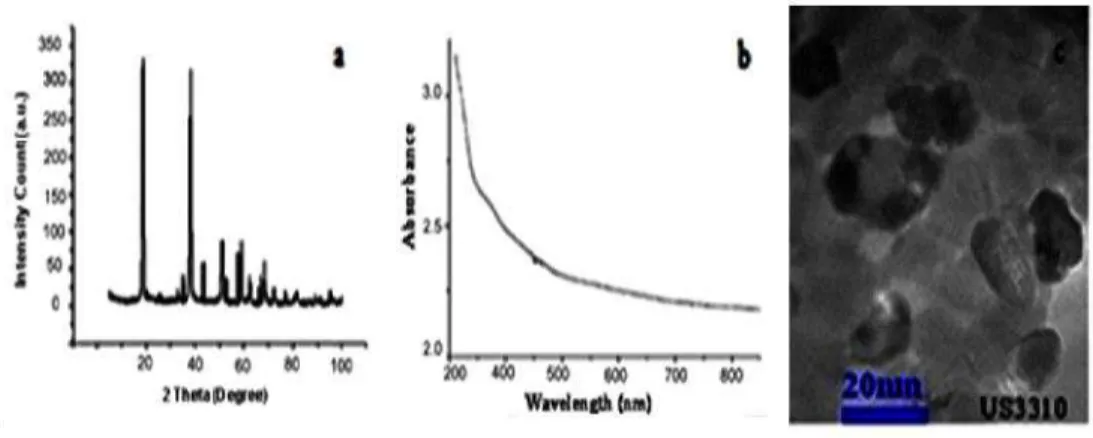
Physiochemical properties of MgO nanoparticles Fig 1 shows physicochemical properties of MgO nanoparticles. Fig 1(a) shows X-ray diffraction pattern for magnesium oxide nanoparticles. As shown in Fig 1,
diffraction peaks at 2θ values have been absorbed. A sharp increase in the peak of XRD shows that particles have a crystalline nature. Fig 1(b) shows the characteristics of the ultraviolet visible spectrum of MgO nanoparticles. As can be seen in the Fig, absorption peak in the 200-700 nm area proves the existence of magnesium oxide nanoparticles. Fig 1(c) shows Transmission Electron Microscopy (TEM) image of the MgO nanoparticles.
Physiochemical properties of ZnO nanoparticles Fig 2 shows physiochemical properties of zinc oxide nanoparticles. Fig 2(a) shows X-ray diffraction pattern of ZnO nanoparticles. Fig 2(b) shows the characteristics of the ultraviolet visible spectrum of ZnO nanoparticles. As can be seen in Fig 1, absorption peak in the 200-800 nm area proves the existence of ZnO nanoparticles. The peak lack of sharpness indicates the production of nanoparticles in different sizes and verifies the results of the ultraviolet visible spectrum and electron microscopy data. Fig 2(c) shows TEM image of the ZnO nanoparticles. According to the results of the TEM studies, the diameter of the ZnO nanoparticles is in the range of 20-25 nm.
Fig. 1. The physicochemical properties of MgO nanoparticles. 1(a), X-ray diffraction pattern. 1(b) the visible spectrum - ultraviolet. 1(c) TEM image
Fig. 2. The physicochemical properties of ZnO anoparticles. 1(a), X-ray diffraction pattern, 1(b) the ultraviolet visible spectrum, 1(c) TEM image
Antimicrobial assays
Nanomed. J., 3(1):49-56, Winter 2016
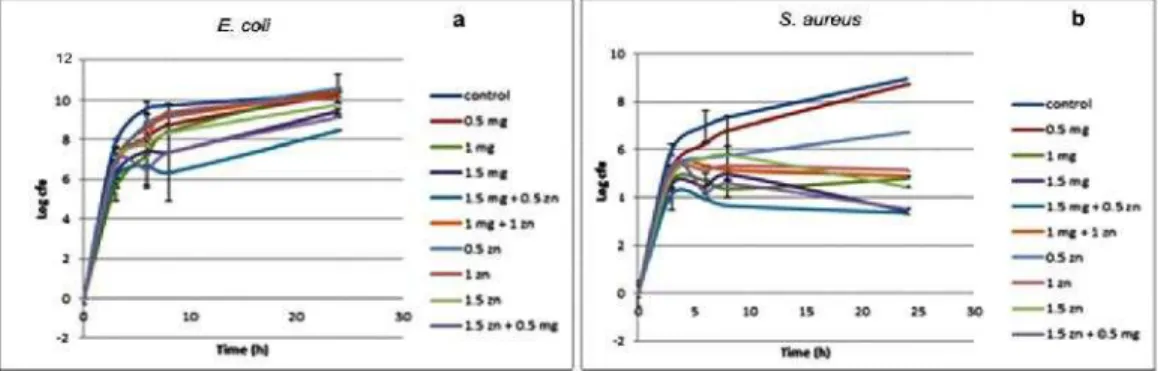
Treatment of the bacteria with concentrations of 0.5(ZnO), 1(ZnO),1.5(ZnO) ,0.5(MgO) , 1(MgO) , 1.5(MgO) , 1(ZnO) + 1(MgO), 0.5(ZnO) + 1.5(MgO) , 0.5(MgO) + 1.5(ZnO) mg/ml resulted in significant reduction of the growth of bacteria compared to the control group. Among the 9 evaluated concentrations, the concentration of 0.5(ZnO) + 1.5(MgO) mg/ml shows the highest level of impact againstE.coli. Also, 0.5 concentration of ZnO had the lowest level of impact onE. coli. The results showed that the reduction in the number of bacteria cells compared with the control group is significant p<0/000. These results showed that combination of MgO and ZnO nanoparticles had a significant effect onS. aureus in a way that these nanoparticles showed a significant
decrease compared to the control group (p value d”
0.05). The results show that among the studied concentration, the concentration of 0.5(ZnO) + 1.5(MgO) mg/ml resulted in a significant decrease in the number of bacterial cells compared to the control group. The data also showed that S. aureus was more sensitive thanE. coli to the nanoparticles in liquid medium. Also the results showed that the MgO nanoparticles have stronger effect onE. coli andS. aureus compared to ZnO nanoparticles in TSB medium. The results showed that the antibacterial activity of nanoparticles depends on the amount consumed. Therefore, concentrations o) 1.5(MgO) +o.5 (ZnO) mg/ml was used for studying the antibacterial effect of nanoparticles in milk.
The use of the combination of MgO and ZnO nanoparticles and mild hea
Three concentrations of MgO, ZnO nanoparticles including 0.5(ZnO), 1.5(MgO), 1.5(MgO) + o.5 (ZnO) and heat were used as antibacterial treatments in milk. Fig 4 shows the effect of the combination of MgO and ZnO nanoparticles againstE. coli in milk for 48 h at ambient temperature, 50 °C and 60 °C. The results showed a reduction in bacterial counts in the milk in the presence of nanoparticles, compared to the control group. The results indicated that among the concentrations studied, the concentration of 0.5(ZnO) + 1.5(MgO) mg/ml resulted in the highest reduction in the number of cells. In fact, after inoculation with bacterial suspension of 7log cfu/ml, at 48 h, control group showed increase to 10log cfu/ml. However, the treatment group with the concentration of 0.5(ZnO) + 1.5(MgO) mg/ml the number of cells were reduced to 6log cfu/ml in ambient temperature and to 4log cfu/ml and 3log cfu/mL at temperatures of 50 °C and 60 °C respectively, compared to the control group. The results show that the nanoparticles used in this study have a stronger activity on S. aureus than
E. coli. Our data indicate a decrease in the number ofS. aureus cells (p value<0.000) in the presence of the nanoparticles. Among the concentrations, the highest level of effect belonged to the concentration of 0.5(ZnO) + 1.5(MgO) mg/ml (Fig 5). The results showed that the
intracellular contents of E. coli and S. aureus at high temperatures resulted in cell death [18]. Data showed that compared to E. coli, S. aureus is more sensitive to both nanoparticles. Differences in the sensitivity of the bacteria studied in this experiment can be attributed to the physiology of the bacteria. The Gram-negative bacteria have one outer wall more than Gram-positive bacteria [22, 24].For increasing the inhibitory effect of antimicrobial compounds such as nanoparticles, in some cases, the combined use of these materials can be considered as a good solution in a way that in addition to increasing antimicrobial effect, can overcome the limitations of each individual nanoparticles [3]. The combination of two or more nanoparticles to determine the antagonistic or synergistic behavior has been the subject of many studies. For example, in one study, Reddy et al. used a combination of ZnO nanoparticles and other metal oxide nanoparticles against pathogenic bacteria [23]. Ren et al used a combination of ZnO nanoparticles
with other metal oxides against strains of methicillin resistantS. aureus (MRSA) and some Gram negative bacteria pathogens. They also revealed that the combination of these nanoparticles results in synergism effect. Although the exact mechanism of nanomaterials on microorganisms has not been established, several studies suggest that nanomaterials release ions that react with thiol group (- SH) in protein on the surface of the bacterial cells and thus reduce adhesion and biofilm formation [25]. Metal ion homeostasis is very important for living bacteria. These metal ions have a role in the regulation of metabolic functions such as coenzyme, the co-factors, catalysts and DNA-binding proteins. However, increase in metal ions can be considered as toxic [26]. In addition, the production of hydrogen peroxide ions in the presence of zinc oxide nanoparticles can also be considered as the key mechanism against pathogens[16].
Fig. 3. The effect of the combination of MgO and ZnO nanoparticles onE. coliandS. aureusin liquid medium, 3(a)E. coli, 3(b) S. aureus
Nanomed. J., 3(1):49-56, Winter 2016
CONCLUSION
The results showed that the combination of ZnO and MgO nanoparticles has a favorable effect against
S. aureus andE.coli in liquid media and milk and it has a synergistic behavior. A pharmaceutical composition with a new formulation with magnesium oxide and zinc oxide nanoparticles can function effectively to treat infections in the future. Also creating a new compound containing these nanoparticles can have a protective role in food safety. This is the first report describing the antibacterial activity of the combination of ZnO and MgO nanoparticles in milk and it showed the aforementioned combination to be a potential for use as an antibacterial agent in the food systems.
ACKNOWLEDGEMENTS
The authors gratefully acknowledge the generous cooperation of the Nano Structured Coatings Institute, Yazd Payame Noor University, Yazd, Iran.
REFERENCES
[1] van den Bogaard AE, Stobberingh EE. Epidemiology of resistance to antibiotics. Links between animals and humans. Int J Antimicrob Agents. 2000; 14: 327-335. [2] Aslan K, Gryczynski I, Malicka J, Matveeva E, Lakowicz
JR, Geddes CD. Metal-enhanced fluorescence: an emerging tool in biotechnology. Curr Opin Biotech. 2005; 16: 55-62.
[3] Kluytmans J, van Belkum A, Verbrugh H. Nasal carriage of
Staphylococcus aureus: epidemiology, underlying
mechanisms, and associated risks. Clin Microbiol Rev. 1997; 10: 505-520.
[4] Nester EW, Roberts CE, Pearsall NN, Andreson DG, Nester NT. Microbiology: a Human Perspective. WCM McGraw-HILL, Boston, Massachusetts. 2001.
[5] Hoseinzadeh E. Evaluation of antimicrobial properties of Copper Oxide Nanoparticle, Zinc Oxide nanoparticle and their combine against bacterial nosocomial infections agents. [Thesis] Hamedan .Iran: Hamedan University of Medical Sciences and Health Services. 2011.
[6] Sun Y, Mayers B, Herricks T, Xia Y. Polyol synthesis of uniform silver nanowires: a plausible growth mechanism and the supporting evidence. Nano letters. 2003; 3: 955-960.
[7] Jones GL, Muller CT, O’Reilly M, Stickler DJ. Effect of triclosan on the development of bacterial biofilms by urinary tract pathogens on urinary catheters. J Antimicrob Chemoth. 2006; 57: 266-272.
[8] Te Dorsthorst D, Verweij P, Meis J, Punt N, Mouton J. Comparison of fractional inhibitory concentration index with response surface modeling for characterization of in vitro interaction of antifungals against itraconazole-susceptible and resistant Aspergillus fumigatus isolates. Antimicrob Agents Ch. 2002; 46: 702-70.
[9] Handy RD, von der Kammer F, Lead JR, Hassellov M, Owen R, Crane M. The ecotoxicology and chemistry of manufactured nanoparticles. Ecotoxicology. 2008; 17: 287-314.
[10] Ostrowski AD, Martin T, Conti J, Hurt I, Harthorn BH (2009). Nanotoxicology: characterizing the scientific literature, 2000-2007. J Nanopart Res 11: 251-257. [11] Shi LE, Xing L, Hou B, Ge H, Guo X, Tang Z. Inorganic
nano mental oxides used as anti-microorganism agents for pathogen control. Current Research, Technology and Fig. 5. The effect of the combination of MgO and ZnO nanoparticles and mild heat againstS.areusin milk. a
Education Topics in Applied Microbiology and Microbial Biotechnology. 2007; 361-368.
[12] Barzegari Firouzabadi F, Noori M, Edalatpanah Y, Mirhosseini M. ZnO nanoparticle suspensions containing citric acid as antimicrobial to control Listeria monocytogenes,Escherichia coli,Staphylococcus aureus
andBacillus cereus in mango juice. Food Control. 2014; 42: 310-314.
[13] Mirhosseini M, Arjmand V. Reducing pathogens by using zinc oxide nanoparticles and acetic acid in sheep meat. J Food Protect. 2014; 77: 1599-1604.
[14] Roselli M, Finamore A, Garaguso I, Britti MS (2003). Zinc oxide protects cultured enterocytes from the damage induced byEscherichi coli. J Nutr 133: 4077–4082. [15] Okouchi S, Murata R, Sugita H, Moriyoshi Y, Maeda N.
Calorimetric evaluation of the antimicrobial activities of calcined dolomite. J Antibact Antifungal Agents. 1995; 26: 109–114.
[16] Sawai J, Kojima H, Igarashi H, Hashimoto A, Shoji S, Shimizu M. Bactericidal action of calcium oxide powder. T MRS JAP. 1999; 24: 667–670.
[17] Mirhosseini M, Firouzabadi FB. Antibacterial activity of zinc oxide nanoparticle suspensions on food borne pathogens. Int J Dairy Technol. 2013; 66: 291-295. [18] Liu Y, He L, Mustapha A, Li H. Antibacterial activities
of zinc oxide nanoparticles against Escherichia coli
O157:H7. J Appl Microbiol. 2009; 107: 1193-1201. [19] Zohdy MH, Abdel Kareem H, El-Naggar AM, Hassan MS.
Microbial detection, surface morphology, and thermal stability of cotton and cotton/polyester fabrics treated with antimicrobial formulations by a radiation method. J Appl Polym Sci. 2003; 89: 2604–2610.
[20] Jin T, Sun D, Su JY, Zhang H. Antimicrobial efficacy of Zinc Oxide quantum dots againstListeria monocytogenes,
Salmonella enteritidis andE. coli O157:H7. J Food Sci. 2009; 74: 46–52.
[21] Aronsson K, Rinner U. Inûuence of pH, water activity and temperature on the inactivation of Escherichia coli
and Saccharomyces cerevisiae by pulsed electric ûelds. Innovative Food Sci Emerging Technol. 2001; 2: 105-112.
[22] Ameer Azam B, Arham S, Ahmed M, Oves MS, Adnan M. Size- dependent antimicrobial properties of CuO nanoparticles against Gram-positive and Gram-negative bacterial strains. Int J Nanomedicine. 2012; 7: 3527-3535.
[23] Reddy KM, Feris K, Bell J, Wingett DG, Hanley C, Punnoose A. Selective toxicity of zinc oxide nanoparticles to prokaryotic and eukaryotic systems. Appl Phys Lett. 2007; 90: 2139021-2139023.
[24] Ren G, Hu D, Cheng EW, Vargas-Reus MA, Reip P, Allaker RP. Characterisation of copper oxide nanoparticles for antimicrobial applications. Int J Antimicrob Ag. 2009; 33: 587-590.
[25] Feng QL, Wu J, Chen GQ, Cui FZ, Kim TN, Kim JO. A mechanistic study of the antibacterial effect of silver ions on Escherichia coli and Staphylococcus aureus. J Biomed Mater Res. 2000; 52: 662-668.
[26] Jones N, Ray B, Ranjit KT, Manna AC. Antibacterial activity of ZnO nanoparticle suspensions on a broad spectrum of microorganisms. FEMS Microbiol Lett. 2008; 279: 71-76.
How to cite this article:
Kimiaee Sadr M, Mirhosseini M, Rahimi GH. Effects of combination of magnesium and zinc oxide nanoparticles and heat on Escherichia coli and Staphylococcus aureus bacteria in milk. Nanomed. J., 2016; 3(1): 49-56.
DOI:10.7508/nmj.2016.01.006