Palavras chave: Propriedades retardantes de fogo Nanocompósitos Óxido de zinco nano Compósitos de polímero-madeira Histórico: Recebido 12/08/2016
Aceito 16/11/2016 Keywords: Fire retarding properties Nanocomposite Nano-zinc oxide Wood polymer composites
1 Gorgan University of Agricultural Sciences & Natural Reasources - Gorgan, Iran 2 Shahid Rajaee Teacher Training University - Tehran, Iran
3 Shahid Beheshti University - Mazandaran, Iran +Correspondência:
DOI: 10.1590/01047760201622042213
Siroos Habibzade1, Hamid R. Taghiyari2+, Asghar Omidvar1, Hamid R. Roudi3
EFFECTS OF IMPREGNATION WITH STYRENE AND NANO-ZINC OXIDE ON FIRE-RETARDING, PHYSICAL, AND MECHANICAL PROPERTIES OF POPLAR WOOD
ABSTRACT: Nanoparticles have been vastly applied in wood polymer composites (WPCs) in the recent years to improve some of the drawbacks of solid wood species. In the present study, the effects of ZnO nanoparticles on fire retarding, physical, and mechanical properties of polymerized poplar wood were investigated. Poplar specimens were impregnated with styrene monomer, containing four different contents of nano-zinc oxide (ZnO) (0, 0.5, 1 and 1.5%, based on the dry weight of monomer). Results of the scanning electron microscopy (SEM) showed homogeneous dispersion of ZnO nanoparticles in the WPC matrix. Nano-zinc oxide improved physical properties such as dimensional stability and water absorption. Moreover, mechanical properties increased in comparison to the control specimens. The impregnation process also significantly improved some of the fire-retarding properties, including the ignition time; however, the flammability nature of styrene aggravated some others, such as carbonized area. It was concluded that, although most of the properties were improved, the final application of WPC should be taken in to consideration before making decision on whether or not to impregnate populus wood with styrene.
EFEITOS DA IMPREGNAÇÃO COM ÓXIDO DE ESTIRENO E NANO-ZINCO SOBRE PROPRIEDADES RETARDADORAS DE FOGO, FÍSICAS E MECÂNICAS DA MADEIRA DE POPULUS
PHYSICAL, AND MECHANICAL PROPERTIES OF POPLAR WOOD
INTRODUCTION
With the development of human society, tree plantations and the consumption of wood are rapidly increasing year by year; moreover, a multi-purpose attitude towards plantation of trees is growing worldwide (AMUSANT et al. 2015). However, wood and wood composites are susceptible to some organisms such as fungi and termites, as well as to fire (HILL, 2008; OZDEMIR & TUTUS, 2013&2016). These vulnerabilities limit the applications of wood and wood composites. Researchers have therefore worked on engineered wood to improve the drawbacks, using new production techniques and modern materials at micro or nano scales (ANDRADE et al. 2016; BAL 2016; WANG et al. 2016). Nano materials have been the subject of intense scientific and technological activities due to their interesting size dependent physicochemical and bio and green properties and consequently have exciting application potential (LI 2012; GHARIEB et al. 2016). The first practical application of nanotechnology in wood science and technology was the use of metal nanoparticles with high thermal conductivity (SABER et al., 2013) that increased the rate of heat transfer in solid wood (TAGHIYARI, 2012&2014), increased resistance to decay (HABIBZADE et al., 2014; FARAHANI and BANIKARIM, 2013), and decreased the hot press time in particleboard manufacture. There was an improvement in physical and mechanical properties and fungal and fire retardancy by infusing wood with some mineral nanomaterials (KARIMI et al., 2013; TAGHIYARI et al., 2013; RANGAVAR et al., 2016).
Nano-ZnO, as one of the multifunctional inorganic nanoparticles, has achieved and increasing attention in recent years due to its many significant physical and chemical properties, such as chemical stability, high light transmittance, effective antibacterial properties, and intensive ultraviolet and infrared adsorption (TURTON et al., 2004; HAMMINGA et al., 2004; WU et al., 2002; WU and XIE, 2004; KITANO and SHIOJIRI, 1997; KAMAT et al., 2002). Moreover, the advance of nano-ZnO particles could improve the mechanical and optical properties of the polymer matrix (RASHMI et al., 2012).
There are studies reporting the use of nano-zinc oxide to improve physical and mechanical properties (RASHMI et al., 2012), to act as a fire retardant (RASHMI et al., 2013), and also as a wood preservative (HABIBZADE et al., 2014, FARAHANI & BANIKARIM, 2013).
It should be added that the ZnO nanoparticles, like other nanoparticles, possess a high surface energy, which may result in the agglomeration of particles when ZnO nanoparticles are dispersed in an organic solvent
and matrices. Therefore, it is necessary to prepare ZnO/ polymer nanocomposites to prevent the formation of agglomerated nanoparticles. Surface modification is a common strategy to prevent the agglomeration of nanoparticles in polymers. On the other hand, grafting polymers on the surface of the nanoparticles effectively improves their dispersibility in the polymer matrix, resulting in enhanced properties of the composites. The surface modification of ZnO nanoparticles is achieved by grafting with silane coupling agent or with some polymers (SHU-RUI et al., 2008; TANG et al., 2006).
Poplar wood (Populus deltoids), a fast growing species with low-quality, is not useful for constructional purposes due to its poor dimensional stability, vulnerability to wood-deteriorating fungi, and low mechanical properties. The present study focused on the preparation of wood polymer nanocomposite by impregnating poplar specimens with styrene monomer, vinyl trichlorosilane (VTCS) and modified ZnO nanoparticles. The aim of the study was to find the effects of nano-ZnO on fire retarding, physical and mechanical properties of wood.
EXPERIMENTAL
Materials
Poplar wood (Populous deltoids L.) was collected from the Gorgan province, located in the Northern part of Iran. The chemicals for the production of WPCs were styrene (St) and glycidyl methacrylate (GMA), purchased from Merck & Co., Inc. (Germany). ZnO nanopowder (<50 nm, 90 m2.g-1) was purchased from Nano Pars Lima Co. (Tehran, Iran). Tetrahydrofuran (THF, anhydrous) and vinyl trichloro silane (VTCS) were purchased from Sigma-Aldrich chemical company (Darmstadt, Germany). All other chemicals and solvents used in this study were of analytical grade.
Sample preparation
Wood samples used for testing were prepared from clear and defect-free poplar wood, cut into blocks for different experiments. The dimensions of blocks were 2×2×2 cm2 for dimensional stability test (ASTM D4442), 1×1×10 cm2 (radial × tangential × longitudinal) for flexural strength (ASTM D790), 10×0.5×2 cm2 for tensile strength (ASTM D638), and 2×2×6 cm2 for compression strength (ISO 3787). Seven replicate specimens were prepared for each treatment.
Surface modification of nano-zinc oxide
was carried out as follows: firstly, a 1.0 g portion of ZnO nanoparticle, 1.0 mL of VTCS, and 40 mL of toluene were added into a three-necked round-bottom flask (250 mL) and refluxed at 80°C for 6 h under mechanical stirring. Then, the precipitate was centrifuged and extracted with ethanol for 12 h to remove the residual silane. At the last stage, the precipitate was dried in vacuum for 48 h, and the double bonds were introduced onto the surface of the ZnO nanoparticle (Hong et al., 2009).
Preparation of St/ZnO nanocomposite
Glycidyl methacrylate (GMA) was mixed with styrene (St), as a cross-linker. Then, the different amounts of modified ZnO nanoparticles (0/5, 1 and 1/5 wt% of St) were dispersed in St monomer in the presence of minimum amount of solvent (THF) and the dispersion was treated by ultrasonic instrument for 30 min at room temperature.
Impregnation and polymerization procedure All the samples were oven dried at 100°C to constant weight before treatment and weights were measured. The samples were then impregnated by St monomer and ZnO nanoparticles for half an hour, using Bethel method. Once impregnated, the samples were kept in a chamber at room temperature for 30 min so that the excess chemicals would be drawn out of the samples. Each sample was then wrapped in aluminum foil to be cured in an oven for 24 h at 90°C. The cured samples were then soxhlet extracted using chloroform to remove homopolymers, if any, formed during polymerization. Finally the samples were dried and weights were measured.
MEASUREMENTS
Weight percent gain
The weight percent gain (WPG) after polymer loading was calculated according to Equation 1, where W1 (g.cm-3) is oven-dry weight of wood blocks before polymer treatment, and W2 (g.cm-3) is oven-dry weight of block after polymer treatment.
Water uptake test
Both control and impregnated wood samples were immersed in distilled water at 20°C and weight was taken after different time intervals. It is expressed as, where Wt is the weight after immersion in distilled water for specific time period (0-160 hours) and Wd is the weight of the oven-dry sample.
( ) ( ) 1
2 1 1
WPG % = W -W ×(W´100)- [1]
Volume increase (%) after impregnation
Percentage of volume increase after curing of wood samples was calculated using Equation 2, where V0 is the oven-dry volume of the control wood and Vt is the oven-dry volume of the impregnated wood.
( ) 1
t 0 0
Volume increase % =(V – V)×(V ´100)- [2]
( ) 1
t d d
Water uptake % =(W – W )×(W ´100)- [3]
Mechanical properties
A Universal Instron testing machine with a load capacity of 2000 kgf was used to carry out the mechanical tests. Samples were stored at 20 ± 1°C and relative humidity of 65 ± 5% inside a climatic chamber for two weeks before the tests.
Fire-retardant testing apparatus
PHYSICAL, AND MECHANICAL PROPERTIES OF POPLAR WOOD
Once the fl ame was extinguished and the specimen was no longer burning, the length and width of burning were measured. The weight was also measured just before, as well as 2 h after the test, to measure the weight loss. The whole structure of the apparatus was placed in a three-wall-compartment in order to protect the burning fl ame from wind and air movements.
Statistical analysis
SPSS (16) was used for statistical analysis and signifi cance was determined at 1 and 5% level of confi dence using analysis of variance (ANOVA). Treatments were then classifi ed as per Duncan’s multiple range test.
Weight percent gain (WPG %)
The values of WPG for both raw wood and WPCs for samples test were measured (Table 1).
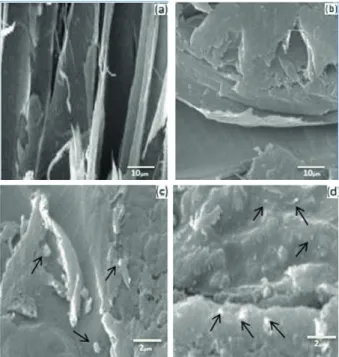
specimens (Figure 2b-d). The empty cell wall and pits were clearly observed in the control wood (Figure 2a). In the impregnated specimens (Figure 2b), the empty spaces and part of the cell cavities were fi lled with St-polymer. The impregnated nanoparticles as white spots were uniformly scattered in the composite (Figure 2c-d). No agglomeration of nanoparticles was observed.
TABLE 1 Average weight gain of speciment after polymerization for fi re-retarding, physical, and mechanical properties.
Sample particulars Weight gain
(%)
Volume increase (%) Impregnated with ST/THF/BP/GMA/ZnO
100/20/2/1/0 50(± 5.6)* 3.28(±3.8)
100/20/2/1/0.5 50(± 4.1) 3.64(±0.9)
100/20/2/1/1 50(± 6.8) 3.17(±2.6)
100/20/2/1/1.5 50(± 2) 3.84(±2.8)
* Numbers in the parenthesis are the standard division.
RESULTS AND DISCUSSION
Analysis of the scanning electronic microscope
SEM results
Figure 2 shows the SEM micrographs of the control (Figure 2a) and impregnated poplar wood FIGURE 1 Schematic picture of the slide fi re testing
apparatus (SFTA) (invented by the second author under Iranian Patent No. 67232; approved by Iranian Research Organization for Science and Technology under license No. 3407 issued to H.R. Taghiyari) (TAGHIYARI, 2012).
FIGURE 2 SEM images of wood (a) control and impregnated with (b) St, (c) St/ZnO (0.5%), and (d) St/ZnO (1.5%.).
Water uptake
Dimensional stability test
The results of volumetric swelling in water for control and impregnated wood samples at room temperature for different time periods are shown in Figure 4. The reduction in volumetric swelling with increasing nano-zinc oxide suggested that higher concentrations of ZnO provided substantial water resistance (SOLTANI et al., 2013). The improvement in dimensional stability samples containing ZnO can be attributed to the void being occupied by ZnO nanoparticles (RASHMI et al., 2012).
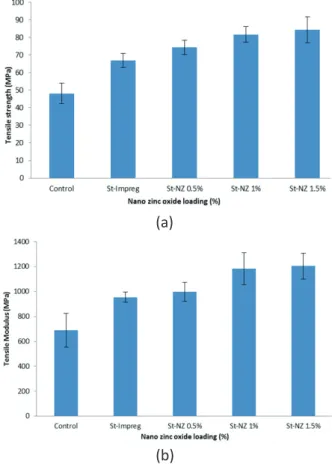
nanocomposite. The maximum improvement in tensile strength (26%) and modulus (26.1%) was achieved when 1.5 wt% of ZnO was added into the styrene matrix. The increased tensile strength up to 1.5 wt% ZnO may be attributed to the higher extent of interaction of ZnO with wood and styrene through its surface hydroxyl and vinyl groups of polymer chains (RASHMI et al. 2012, 2013; GUO et al. 2006, 2008). Nevertheless, with further increase in nano-zinc oxide loading from 1 to 1.5 wt%, a low increase in the tensile strength and tensile modulus was observed. This indicated the nano-zinc oxide was distributed more uniformly through the polymer matrix at its lower concentrations (1wt%); this uniform distribution, in turn, improved a better surface contact between nano-zinc oxide and polymer matrix. However, it should be noticed that more concentrations of ZnO (1.5wt%) caused decreased tensile properties of nanocomposite. FIGURE 3 Effect of nano-ZnO content on water absorption (%)
in the control, impregnated with styrene (St-Impreg), impregnated with styrene containing 0.5% (St-NZ 0.5%), 1% (St-NZ 1%), and 1.5% nano-ZnO (St-NZ 1.5%) poplar specimens.
FIGURE 4 Effect of nano-ZnO content on dimensional stability (%) of the control (W), impregnated with St (WPCN 0), poplar impregnated with styrene containing 0.5% nano-ZnO (WPCN 0/5), ST/ 1% nano-ZnO (WPCN1), ST/1.5% nano-ZnO (WPCN 1/5).
Mechanical properties
Tensile strength and modulus
Figure s 5 (a) and (b) illustrate the tensile strength and modulus of WPCs made with different nano-zinc oxide contents. It can be seen that with the increase in the nano-zinc oxide loading from 0 to 1.5 wt%, there was improvement in the tensile strength and modulus of
FIGURE 5 Effects of nano-ZnO content on: a) tensile strength; b) tensile modulus
(a)
(b)
Flexural strength and modulus
PHYSICAL, AND MECHANICAL PROPERTIES OF POPLAR WOOD
wt% of ZnO was added in the styrene matrix. This was attributed to the increasing positive interaction between wood, styrene and nano-zinc oxide. In addition, this interaction might have stiffened the composite due to reduction in mobility of the intercalated polymer chains, resulting in the enhancement of the compression strength.
Fire retarding properties
Ignition Time
ZnO-containing WPCs demonstrated an improvement in the ignition time (Figure 8). The highest and lowest fl ammability times were observed in specimens containing 1.5% nano-zinc oxide (20 s) and the control ones (15.4 s), respectively.
(a)
(b)
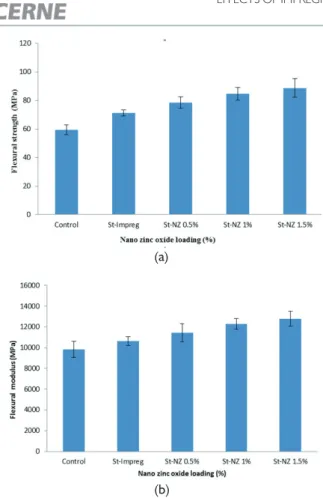
FIGURE 6 Effects of nano-ZnO content on: a) fl exural strength; b)fl exural modulus
attributed to the increasing positive interaction between wood, styrene and ZnO (RASHMI et al., 2012), as well as good interfacial adhesion between the nano particles and the polymer chain.
Compression strength
A noticeable increase in compression strength was observed in the WPCs with nano-zinc oxide content (Figure 7). The highest strength was obtained in samples containing the highest ZnO content. The maximum improvement in compression strength (47.1%) was achieved when 1.5
FIGURE 7 Effects of nano-ZnO content on compression strength
FIGURE 8 Effect of nano-zinc oxide content on ignition time.
FIGURE 9 Effect of nano-znO content on glowing time. Carbonized area
Nano-zinc oxide impregnation in all three concentrations resulted in a signifi cant increase in the carbonized area (Figure 10). However, different
Glowing time
concentration levels showed no signifi cant difference in the carbonized area.
The increase in the ignition time was attributed to the heat-transferring property of metal nanoparticles (WANG et al., 2010; LI, 2012; TAGHIYARI, 2012 & 2014). In fact, the heat was more quickly transferred from the spot nearest to the burning fl ame of the Bunsen-type burner, preventing the accumulation of heat to initiate the ignition on the spot (TAGHIYARI, 2012). However, the fl ammability nature of styrene caused signifi cant easier burning effect on the surrounding area of the spot, resulting in a signifi cant increase in the carbonized area (Figure 10).
Cluster analysis based on all physical, mechanical, and fi re-retarding properties showed clear remote clustering of the control specimens (Figure 11 A). The other four treatments containing styrene and zinc oxide were clustered rather based on their nano-zinc oxide content; that is, those treatments having no or little NZ (0 or 0.5%) were clustered similarly, and those with higher NZ content (1 and 1.5%) were closely clustered together. This indicated the signifi cant effects of both impregnation with styrene and NZ content on the overall properties of WPC.
However, cluster analysis based only on physical properties showed that although the control specimens were clustered signifi cantly different, the other four treatments were similarly clustered, showing no signifi cant difference between them (Figure 11B). This demonstrated that impregnation with styrene had very signifi cant effect on physical properties but ZnO content had no signifi cant effect on water uptake and dimensional stability. Cluster analysis based only on mechanical properties demonstrated that the control specimens were clustered differently from the other four treatments (Figure 11C); however, the control was more closely clustered to the treatments with no or lower ZnO contents (St and St-NZ0.5% treatments). This indicated that both St and ZnO nanoparticles had signifi cant effect on mechanical properties. Cluster analysis based only on
the fi re properties showed that the control specimens were clustered signifi cantly different (Figure 11D). This showed that the fl ammability effect of styrene on ignition time and carbonized area (Figure s 8 and 10) resulted in the fi nal clear different clustering of St-impregnated specimens. However, the cluster analysis also showed that those specimens impregnated with only styrene (with ZnO content of zero) showed a difference, although not very signifi cant, with those St-impregnated specimens with ZnO content (Figure 11D). This indicated that ZnO nanoparticles could prevent some of the negative effects on fi re properties caused by the fl ammability of styrene. FIGURE 10 Effect of nano-zinc oxide content on carbonized area.
It was therefore concluded that impregnation with styrene and ZnO depends entirely on the fi nal application of the impregnated poplar wood; if the physical properties are of preliminary importance, St-impregnation can be recommended. If the mechanical properties are to be signifi cantly improved, then both impregnation with St and NZ would be a better option. As to the fi re properties, ignition time can be improved by impregnation with ZnO+ST; however, careful attention should be made because other fi re properties could be aggravated.
CONCLUSIONS
Following conclusions were made based on the results of the present research project:
FIGURE 11 Cluster analysis of the fi ve treatments based on all physical, mechanical, and fi re-retarding properties (A); based only on physical properties (B); based on mechanical properties (C); and based only on fi re-retarding properties (D) (St=styrene; NZ=nanozinc-oxide content).
A
B
C
PHYSICAL, AND MECHANICAL PROPERTIES OF POPLAR WOOD
1- Presence of zinc oxide nanoparticles significantly improves the physical and mechanical properties in poplar wood impregnated with styrene.
2- Nano-zinc oxide effectively improves some fire-retarding properties in the modified poplar wood. However, it should be noticed that the flammability nature of styrene does not allow all fire-retarding properties to be improved. The final application of WPC should therefore be carefully supervised.
REFERENCES
AMUSANT, N.; DIGEON, A.; DESCROIX, L.; BRUNEAU, O.; BEZARD, V.; BEAUCHENE, J. () Planting rosewood for sustainable essential oil production: Influence of surrounding forest and seed provenance on tree growth and essential oil yields. Bois et Forest Des Tropiques, v. 326, n. 4, p. 57 – 65, 2015.
ANDRADE, A. C. D. A.; SILVA, J. R. M.; BRAGA JUNIOR, R. A.; MOULIN J. C. Distinction of mechanically processed wood surfaces with similar qualities using sunset laser technique. CERNE, v. 22, n. 2, p.159 – 162, 2016.
BAL, B. C. Some technological properties of laminated veneer lumber produced with fast-growing Poplar and Eucalyptus. Maderas Ciencia y tecnologia v.18, n. 3, p. 413-424, 2016. CLAUSEN, C. A.; GREEN, F.; AND KARTAL, S. N. Weatherability and Leach Resistance of Wood Impregnated with Nano-Zinc Oxide. Nanoscale Research Letters, v. 5, p.1464–1467, 2010.
FARAHANI, M.R.M. AND BANIKARIM, F. Effect of nano zinc oxide on decay resistance of wood plastic composites. BioResources, v. 8, n. 4, p. 5715-5720, 2013.
GHARIEB, M.M.; MAGDY, Z. M.; EL SHOBAKY, A.; TAUFIK, W. HAFFEZ, E. E. The Green Synthesized Nanosilver and Their Effects on the Multidrug Resistant Bacteria Ribosomal DNA. Journal of Nanomaterials & Molecular Nanotechnology, v. 5, n.4, 2016
GUO, Z.; LEI, K., LI, Y., NG, H. W.; PRIKHODKO, S.; AND HAHN, H. T. Fabrication and characterization of iron oxide nanoparticles reinforced vinyl-ester resin nanocomposite. Composite Science and Technology, v. 68, 1513-1520, 2008.
GUO, Z.; PEREIRA, T.; CHOI, O.; WANG, Y.; AND HAHN, H. T. Surface functionalized alumina nanoparticle filled polymeric nanocomposites with enhanced mechanical properties.Journal of Materials Chemistry, v. 16, 2800-2808, 2006.
HABIBZADE, S., OMIDVAR, A., FARAHANI, M. R. M., AND MASHKOUR, M. Effect of Nano-ZnO on Decay Resistance and Artificial Weathering of Wood Polymer Composite. Journal of Nanomaterials and Molecular Nanotechnology, v. 3, n. 3, p. 2, 2014.
HAMMINGA, G. M.; MUL, G.; AND MOULIJN, J. A. Real-time in situ ATR-FTIR analysis of the liquid phase hydrogenation ofcbutyrolactone over Cu–ZnO catalysts: a mechanistic study by varying lactone ring size. Chemical Engineering Science, v. 59, n. (22-23), 5479–5485, 2004.
HILL, C.A.S. The reduction in the fiber saturation point of wood due to chemical modification using anhydride reagents: A reappraisal. Holzforschung, v. 62, n.4, p. 423-428, 2008. HONG, R. Y.; LI, J. H.; CHEN, L. L.; LIU, D. Q.; LI, H. Z.;
ZHENG, Y.; AND DING, J. Synthesis, surface modification and photocatalytic property of ZnO nanoparticles. Powder Technology, v. 189, n. 3, p. 426-432, 2009.
KAMAT, P. V.; HUEHN, R.; AND NICOLAESCU, R. A. Sense and Shoot approach for photocatalytic degradation of organic contaminants in water. The Journal of Physical Chemistry, v. 106, n. 4, 788–94, 2002.
KARIMI, A.; TAGHIYARI, H. R.; FATTAHI, A.; KARIMI, S.; EBRAHIMI, G. H.; AND TARMIAN, A. Effects of wollastonite nanofibers on biological durability of poplar wood (Populus nigra) against Trametes versicolor. BioResources, v. 8, n.3, 4134–4141, 2013.
KHANJANZADEH, H.; TABARSA, T.; SHAKERI, A.; AND OMIDVAR, A. Effect of organoclay platelets on the mechanical properties of wood plastic composite formulated with virgin and recycled polypropylene. Wood Material Science and Technology, v. 6, n.4, 207-212, 2011.
KITANO, M.; AND SHIOJIRI, M. Benard convection ZnO/resin lacquer coating – a new approach to electrostatic dissipative coating. Powder Technology, v. 93, n.3, 267–73, 1997. LI, D. Nanostructuring materials towards conventionally
unachievable combination of desired properties. Journal of Nanomaterials and Molecular Nanotechnology, v. 1, n.1, p. 1-2, 2012
OZDEMIR, F.; AND TUTUS, A. The effects of some fire retardants on physical and mechanical properties of HDF panels covered with resin-impregnated paper. Lignocellulose, v. 2, n. 2, 329-337, 2013.
OZDEMIR, F.; AND TUTUS, A. Effects of coating with calcite together with various fire retardants on the fire propertie of particleboard. BioResources, v.11, n. 3, p. 6407-6415, 2016. RANGAVAR, H.; TAGHIYARI, H. R.; OROMIEHIE, A.; GHOLIPOUR, T.; SAFARPOUR, A. Effects of nanoclay on physical and mechanical properties of wood-plastic composites. Wood Material Science & Engineering,
p.1-9, 2016.
RASHMI, R.; DEVI, K.; AND TARUN, K. Effect of nanofillers on flame retardancy, chemical resistance, antibacterial properties and biodegradation of wood/styrene acrylonitrile co-polymer composites. Wood Science & Technology, v. 47, 1135-1152, 2013.
SABER, R.; SHAKOORI, Z.; SARKAR, S.; TAVOOSIDANA, GH.; KHARRAZI, S. H.; AND GILL, P. Spectroscopic and microscopic analyses of rod-shaped gold nanoparticles interacting with single-stranded DNA oligonucleotides. IET Nanobiotechnology, v. 7,p. 42–49, 2013
SALARI, A.; TABARSA, T.; KHAZAEIAN, A.; AND SARAEIAN, A. Effect of nanoclay on some applied properties of oriented strand board (OSB) made from underutilized low quality paulownia (paulownia fortunei) wood. Journal of Wood Science, v. 58, n. 6, p. 513-524, 2012.
SCHMIDT, O. Indoor wood-decay basidiomycetes: damage, causal fungi, physiology, identification and characterization, prevention and control. Mycological Progress, v. 6, n. 4, p. 261-279, 2007.
SHU-RUI, M.A.; YI, S.; XIN, F.; JUN, Y.; AND BO, L. Graft modification of ZnO nanoparticles with silane coupling agent KH570 in mixed solvent. Journal of Shanghai Jiatong University (Engl. Ed.), v.12, n. 3, 278-282, 2008. SOLTANI, M.; NAJAFI, A.; YOUSEFIAN, S.; NAJI, H.R.; AND
SUHAIMI, B. E. Water repellent effect and dimension stability of beech wood impregnated with Nano-Zinc Oxide. BioResources, v. 8, n. 4, 6280-6287, 2013. TAGHIYARI, H. R. Fire-Retarding Properties of Nano-Silver in
Solid Woods. Springer: Wood Science & Technology, v. 46, n. 5, p. 939 – 952, 2012.
TAGHIYARI, H. R. Nanotechnology in Wood and Wood-Composite Materials. Journal of Nanomaterials and Molecular Nanotechnology, v.3, n.1, 2014.
TAGHIYARI, H. R.; RANGAVAR, H.; AND NOURI, P. Fire-retarding properties of nanowollastonite in MDF. European Journal of Wood and Wood Products, v. 71, n. 5, p. 573-581, 2013.
TANG, E.; CHANG, G.; AND MA, X. Preparation of nano ZnO/ PMMA composite particles via grafting of the copolymer onto the surface of zinc oxide nanoparticles. Powder Technology, v.161, p. 209-214, 2006.
TURTON, R., BERRY, D.A., GARDNER, TH., AND MILTZ, A. Evaluation of zinc oxide sorbents in a pilot-scale transport reactor: sulfidation kinetics and reactor modeling. Industrial Engineering and Engineering Chemical Research, v.43, n. 5, 1235–1243, 2004.
WANG, Z.; YONGLAI, L.; LIU, J.; DANG, Z.; AND ZHANG, L. Preparation of Nano-Zinc Oxide/EPDM composites with both good thermal conductivity and mechanical properties. Journal of Applied Polymer Science, v. 119, n. 2, p. 1144-1155, 2010.
WANG, Z.; YANG, X.; SUN, B.; CHAI. Y.; LIU, J.; CAO, J. Effect of vacuum heat treatment on the chemical composition of larch wood. BioResources, v.11, n. 3, p. 5743-5750, 2016. WHITE, R.H.; AND DIETENBERGER, M. A. Wood Handbook, Chapter 17: Fire Safety; Forest Products Laboratory, Gen. Tech. Rep. FPL - GTR - 113, Madison, WI: U.S. Department of Agriculture, Forest Service, And Forest Products Laboratory, 1999.
WU, J.; XIE, C. S.; BAI, Z.K.; ZHU, B. L.; HUANG K.J.;AND WU, R. Preparation of ZnO-glass varistor from tetrapod ZnO nanopowders. Materials Science and Engineering, v. 95, n. 2, 157–61, 2002.