'-.~FGV
EBAPE FUNDAÇÃO GETULIO VARGAS
ESCOLA BRASILEIRA DE ADMINISTRAÇÃO PÚBLICA E DE EMPRESAS MESTRADO EXECUTIVO EM GESTÃO EMPRESARIAL
RELATIONSHIP OF COCA-COLA BRAZIL AND THE COMMUNITIES PARTICIPANT
OF THE SOCIAL PROJECTS: (IM) POSSIBILITIES
DISSERTAÇÃO APRESENTADA À ESCOLA BRASILEIRA DE ADMINISTRAÇÃO PÚBLICA E DE EMPRESAS PARA OBTENÇÃO DO GRAU DE MESTRE
V ANESSA SOBREIRA CASALI LIMA
CORPORATE INTERNATIONAL MASTERS
DISSERTATION
VANESSA SOBREIRA CASALI LIMA
“RELATIONSHIP OF COCA-COLA BRAZIL AND THE COMMUNITIES PARTICIPANT OF THE SOCIAL PROJECTS: (IM) POSSIBILITIES.”
CORPORATE INTERNATIONAL MASTERS
DISSERTATION
“RELATIONSHIP OF COCA-COLA BRAZIL WITH THE COMMUNITIES PARTICIPANTS OF THE SOCIAL PROJECTS: (IM) POSSIBILITIES.”
Dissertation presented by the Fundação Getúlio Vargas – Escola Brasileira de Administração Pública e de Empresas (EBAPE) as a requirement to obtain the “Master in Corporate
International Masters”
Under the guidance of Professor Helio Arthur IRIGARAY
Source of Knowledge: CSR (Corporate Social Responsibility)
VANESSA CASALI
Ficha catalográfica elaborada pela Biblioteca Mario Henrique Simonsen/FGV
Lima, Vanessa Sobreira Casali
Relationship of Coca-Cola Brazil and the communities participant of the social projects: (im) possibilities / Vanessa Sobreira Casali Lima. – 2014.
61 f.
Dissertação (mestrado) - Escola Brasileira de Administração Pública e de Empresas, Centro de Formação Acadêmica e Pesquisa.
Orientador: Hélio Arthur Irigaray Inclui bibliografia.
1. Responsabilidade social da empresa – Estudo de casos. 2. Indústria – Aspectos sociais. I. Irigaray, Hélio Arthur. II. Escola Brasileira de Administração Pública e de Empresas. Centro de Formação Acadêmica e Pesquisa. III. Título.
AKNOWLEDGMENTS
I would like to express my special appreciation and thanks to my advisor Helio Arthur Reis Irigaray to recommend this wonderful field of study, related to social projects, which is something totally different from my finance background and that provided me a new world
and area of knowledge.
A special thanks to my husband, Alvaro Andres Ibarra Lagos, which encouraged me to perform this Masters and supported my whole family, taking care of our two daughters during
my absence because of the international presence modules.
A deeply thanks to my daughters, Carolina and Marina, with 12 and 6 years old, respectively, that understood that I needed to provide less attention to them during some hard periods of studying, travelling and working.
My gratitude to the company that I work for, Coca-Cola Brazil and Latin America Group, represented by its great and inspiring leaders. All senior leadership team, my direct leader and the group of Brazilian Coca-Cola Institute and Social Business areas are fantastic! Thank you for your patience and support on my dissertation.
I could not forget to mention on the CIM – Corporate International Masters cohort, administrative staff and professors. They were all-great and provided me unforgettable experiences and knowledge during the journey of this master.
ABSTRACT
Five years ago, Coca-Cola Brasil launched a program named “Coletivo Project”, with the purpose to enjoy an opportunity of increase on the potential consumption power of the
low-income pyramid population that lived on the “favelas”. At the same time, it had the objective to offer to them a social and financial impact, which is a trust on the future, the first job for the young adults’ participant of this program and an increase on their family source of revenues, through salaries.
This was possible because through Coletivo Project, Coca-Cola identified the assets they have through its value chain, focusing on its competencies, such as retail, merchandising and logistics to apply them on courses to teach the young people of the communities and, as a result, form them to be able to find their new jobs.
Internal indicators followed in a monthly basis by Coca-Cola demonstrated that the communities that had the presence of Coletivos, in comparison to those without Coletivos, had social and financial impacts. The social was the fact that the young formed started to have more confidence on their future and felt with a higher self-stem to apply for and obtain their first job. On the financial aspect, they were benefit through the increasing of their revenues and also their families and Coca-Cola had an increase on sales, when compared to a community without a Coletivo Project installed.
This dissertation seeks to identify the current relationship between Coca-Cola and the communities, through the Coletivo Project classes performed on the NGOs located at this places, in order to identify opportunities for improvement the benefits and the impacts (financial and social) on the NGOs, communities and all stakeholders of this project.
This dissertation examines this relationship, through presence interviews performed on four NGOs selected, and located on four of the twenty communities, that are participants of the
Coletivo Project on Rio de Janeiro city. These interviews performed with the students, representatives and educators of these NGOs. The covered period of the interviews ranges from April 2014 to August 2014. This dissertation draws on first-hand qualitative empirical evidence gathered through extensive fieldwork.
The main findings among possibilities for improvement by Coca-Cola are:
Increase the content of the employment module of Coletivo classes, focusing on
improving educational, cultural, economic, political, social and professional life. Increase the scale, through the quantity of positions on the Retail Coletivo classes. Develop cultural and sports events with the communities.
Support the points of sales, participant of the practical classes of the Coletivo Retail,
with refrigerators and furniture with the Coca-Cola logo.
Provide coffee breaks and meals during the Coletivo classes, using Coca-Cola beverages and partners for food items, developing the nutrition platform of the company and filling a need of the students.
Perform a research with all stakeholders related to this Project, including those
students and mothers that are not participant of the Coletivo, in order to listen to them, understand their needs, and offer solutions to fulfill these gaps. and on the side of the Perform partnerships with educational institutions to make viable other type of
courses, more technical, but that have a relation with the core business of Coca-Cola Brasil, such as marketing.
Implement the Coca-Cola University, already existed at the Company. Create courses or activities focused on the children.
Regarding the impossibilities, the findings are:
Improve the basic sanitation of the communities. Improve the safety on the communities.
Provide a home to those do not have.
Implement courses that have no relationship with Coca-Cola business and expertise,
such as gastronomy. However, Coca-Cola can influence stakeholders on that.
The results suggest to executives of Coca-Cola that a deep and a qualitative research on the communities of Brazil, in order to listen young people, educators, mothers, partners that offer jobs, from Coletivo and out of the project, is mandatory, to understand their needs, dreams, complains and offer valuable solutions to all.
Key words: Corporate Social Responsibility, Social Business, Shared Value, Reciprocal
TABLE OF CONTENTS
ABSTRACT………..6
ABBREVIATIONS...7
QUESTIONS TO BE RESPONDED……….…...8
1. THE PROBLEM………..11
1.1 Introduction………...11
1.2 Objectives of the dissertation...22
1.3 Relevance of the study...23
1.4 Limitations of the dissertation……….…..25
2. FRAME OF REFERENCE………...26
2.1 Corporate Social Responsibility………...26
2.2 Constructing Reciprocal Value………..31
2.3 The context of the NGOs in Brazil………...32
2.4 The Methodology of Coletivo………...33
3. RESEARCH METHODOLOGY………...37 4. FIELD REVELATIONS (RESEARCH RESULTS)…...38
5. ANALYSIS AND DISCUSSIONS...54
6. CONCLUSION………...60
ABREVIATIONS
NGO
–
Non-Governmental Organizations
FSG
–
Foundation Strategy Group
UPP – Pacific Police Unit
ICCB
–
Coca-Cola Brazil Institute
CSR
–
Corporate Social Responsibility
CSV
–
Creating Shared Value
CRV
–
Constructing Reciprocal Value
FAETEC
–
Foundation to Support Technical School
SENAI –
National Industry Service
QUESTIONS TO BE RESPONDED
1) In regards to the quality of life of the resident of the community, what is good and what is bad and why is that?
2) What have changed on the communities on the last years? Is it better or worse? Is the government present?
3) Moreover, the companies? Do they have supported the communities; they have come to the communities? In which way? What have been good? What they could improve?
4) Do you remember the names of the companies that are present on the communities? Was there anyone that came and went out?
5) Moreover, Coca-Cola? What is your opinion of Coletivo?
6) What do you think that would be possible to do, in order to improve the reality of the community? How Coca-Cola could collaborate?
7) What Coca-Cola could do differently to improve the life on the community?
1.
THE PROBLEM
1.1 Introduction
The Coca-Cola Brazil created in 1999 the Coca-Cola Brazil Institute (ICCB), with the purpose of incentive projects of recycling, reduction of the schools evasion, among others. They were social projects exclusively related to corporate social responsibility, in order to perform charitable donations to help the cooperatives and communities, named
“favelas”.
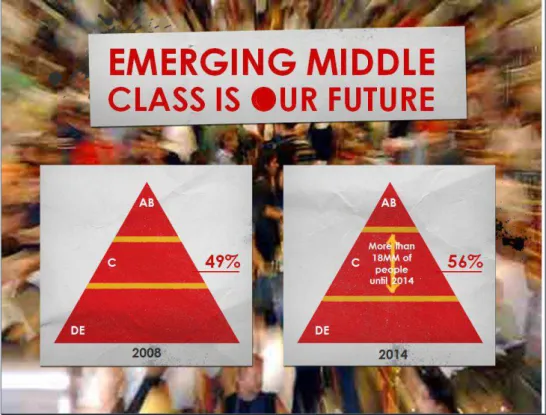
In 2008, on the strategic planning process of the Coca-Cola Brasil, the macro economic scenarios indicated the increase of the purchase power of the consumers of the emerging social classes (classes C and D), with a projection of 56 million of Brazilians on the C class in 2014. Based on this context, the Coca-Cola Brazil glimpsed that on a perspective of a Company it was feasible, and had a sense of logic, to analyze the opportunities of business arisen from this new economic scenario. The Company used to have a relationship with these consumers, through one million of points of sales, spread
Figure 1: Emerging middle class in 2008 and 2014.
Source: Internal data collected at Coca-Cola Brazil
Figure 2: Middle class growth
Thus, they created a multifunctional group, with the participation of several areas of Coca-Cola Brazil, such as Research and Development, Marketing, Shopper Marketing, Innovation, Finance, and others, including two bottling companies of the Coca-Cola Brazilian System (one located on the Northeast Region and the other one situated on the Southeast Region). The purpose of this group was to join different perspectives and ideas, in order to construct a unique vision and at the same time a collective one.
This group worked together for a period of six months in 2008 in conjunction with anthropologists, NGO´s leaders, researches, among other external specialists, and performed a work of immersion on the communities, so that they could capture and live the reality of these people and their environment of living. Based on this experience, they were capturing ideas and building focus groups with the participation of all teams mentioned previously and with the local livers of the communities.
They interviewed several young people livers of the communities, with an age between 15 and 18 years, including their respective mothers. In general, they emphasized that would like to have a better future, have their finance independence and the opportunity to help their family by providing financial resources. The first job was a synonym of this dream. To the mothers it was also relevant.
Figure 3: Research to identify relevance of Coca-Cola and social needs
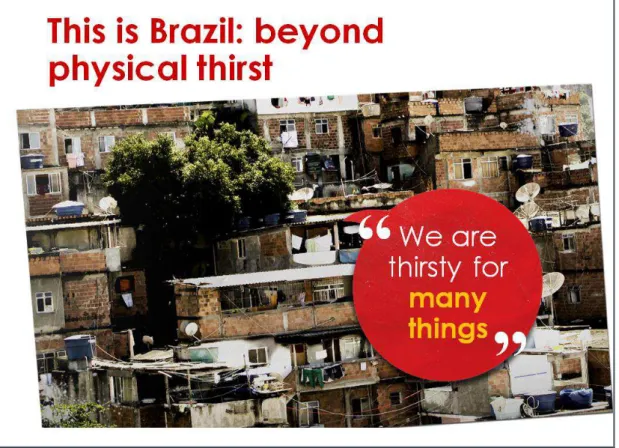
One phrase detected on the immersions that happened on the communities was the following: “we love Coca-Cola, but with are thirsty for many things”. So, to finish and
“kill” the thirst the focus group thought on a solution of how make Coca-Cola a relevant brand and company and transform the lives of the communities.
Figure 4: Thirsty for many things
Source: Internal data collected at Coca-Cola Brazil
Thus, the focus group had a look inside the Company with the aim of analyzing
what internal “assets” on the value chain they could offer to the communities.
It´s important to emphasize that, at that period, Coca-Cola Brazil did not presented unsatisfactory financial and economic results. It was the opposite situation. The Company has generated profit since its conception, being in Brazil for more than 70 years.
conscience from her and from the Company side that they were creating a shared value and more than that, a new concept designed on this study named “construction of reciprocal value”.
What happened to the creation of the “Coletivo Project” was to challenge the
successful worldwide position of a consolidated brand with more than 120 years of existence (nowadays Coca-Cola has 128 years), of a global and international Company, through which there was the challenge to take risk on a territory that had never been explored before.
There was a transformation of an idea on reality, with a strong initiative and positioning of the Coca-Cola Brazil Leadership, providing the time and autonomy for this project, to allow the execution of it, in a planned and structured way.
With the purpose of focusing on this new business area, in order to enhance the relationship with the consumers of C and D and explore in a better way the power of the Operations and Social activities with the communities impacted, a new area was created on Cola Brazil, named Social Business Area. It´s important to mention, that Coca-Cola Brazil is the only business unit in the world of Coca-Coca-Cola that has the area of Social Business.
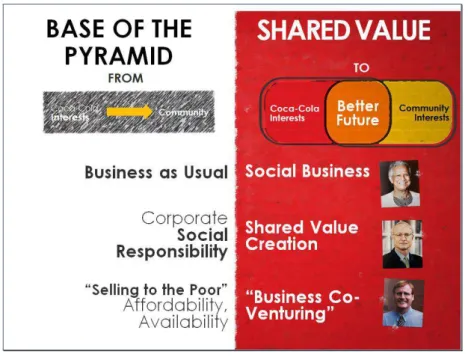
Figure 5: Creating Shared Value
In addition, in order to analyze the social aspects of the communities and enhance the relationship between Cola and the communities, the Company used the Coca-Cola Brazil Institute, already existent since 1999.
In order to successfully deploy a social and operational project, using the appropriate approach to link Coca-Cola and the communities, this group analyzed the skills and capabilities of Coca-Cola to be applied in communities. The question was: what strengths did Coca-Cola has that could cover the need and the “thirsty” of many things from the communities?
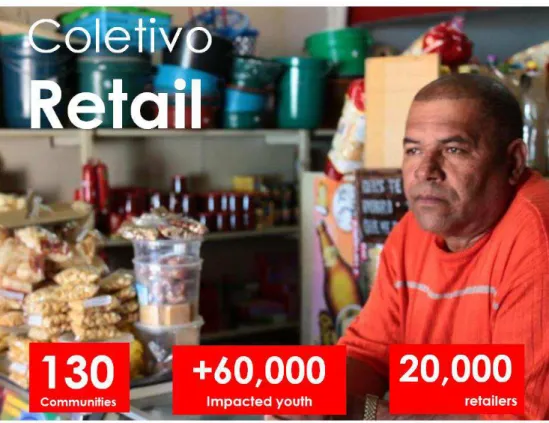
The first strength identified on Coca-Cola was the knowledge of the retail market. And in June 2009, it was launched the “Coletivo Project”, that had as a the first platform
the “Retail Coletivo” (Coletivo Varejo), through which the Company could teach the young people with low income to forward them to their first job on a company of the Coca-Cola Brasil System or on the partners of Company, such as key accounts, or even on another type of entity.
Figure 6: Coletivo Retail
The first “Coletivos” were installed on five NGOs pilots, which were located on communities of Brazil, where there were two in Recife – Pernambuco and three in São Paulo. Subsequently the “Coletivos” started to be created on other big cities of Brazil, such as Rio de Janeiro, Belo Horizonte, Fortaleza, Curitiba, etc.
The challenge of this project consists on how to make this model scalable and with a high impact on Brazil, in order to guarantee a sustainable expansion.
With the “Coletivo Project”, Coca-Cola constructed a new business model. Initially, the social operation was outsourced and counted with the support and partnership
with the NGOs that were leaders on the social area in Brazil, such as “Visão Mundial” and “Comunidade e Democracia na Visão Tecnológica” (CDI), seeking to facilitate the interactions between Coca-Cola and the communities and to help on the identification of the local NGOs that could support the increase of the project throughout Brazil.
Thereafter, Coca-Cola understood that it was important to construct this social expertise internally and decided that the partner would be the Coca-Cola Brazil Institute, within the Company. As a result of that Coca-Cola Brazil Institute moves from only two employees (in 2009) to around 47 employees (2014) that work for the Coca-Cola Brazil Institute, at many areas, such as Human Resources, Legal, Administrative and Finance, Social Operations and Social Programs. In addition, there were 50 indirect resources, outsourced, with a focus on Social Technology.
And the Coca-Cola Brazil Institute begins to perform partnerships with Roberto Marinho Foundation, beyond other partnerships, to construct a social expertise and form Social Technology knowledge, grounded on four pillars:
Expertise on community and environment.
Educational methodology.
Social operation.
Partnerships.
The basic assumptions of “Coletivo Project” are the following:
Be collaborative: Be constructed together with the communities and the
NGOs (co-creation concept);
Be present: Have classrooms, through the “Coletivo” rooms installed on the NGOs, located at the communities. The program only works properly with the active participation of the community. To that purpose and to be relevant, the project focus on the needs of the younger generations, that is
to be financially independent. In accordance with internal studies and researches performed by the Coca-Cola in Brazil, 61% of the low income young people believe they should be financially independent, starting
between 15 and 18 years
Be legitimate and have impact: Coca-Cola Brazil closely monitors the
Coletivo Project through many indicators and tracking, with the purpose of identify the confidence of the young people on their future, on how the Coca-Cola brand is perceived on the community and mainly to measure the sales and distribution of Coca-Cola Brazil beverages on the focus regions.
Have scale: Data obtained internally from Coca-Cola Brazil, in July 2014,
Figure 7: The Concept of Coletivo
Source: Internal data collected at Coca-Cola Brazil
The Coletivo Coca-cola acts on communities of low income, through the creation of mutual value between the interests of the brand and the community. Everything aligned with the core business of the company (Retail, Entrepreneurship, Logistics and Recycling).
This study will focus on the Coletivo Retail (Coletivo Varejo), however there are other platforms of Coletivo, that were created during the last 5 years, such as:
Coletivo Retail (Varejo): 125
Coletivo Arts (Artes): 25
Coletivo Recycling (Reciclagem): 450
Figure 8: The presence concept of Coletivo on the communities
Source: Internal data collected at Coca-Cola Brazil
The perspectives of Coletivo have always two sides: the social and the business one. The social side is represented by the relationship between the Company and the community, providing to the young people more confidence on the future and increasing the self-steam of the young people and being represented by the connection of the community with the Coca-Cola brand and its relevance to the consumer.
Figure 9: Coca-Cola Brazil value chain and social benefits.
Source: Internal data collected at Coca-Cola Brazil
Currently, Coletivo Project is under a moment of revaluation with the young people impacted, educators, communities, NGOs and all stakeholders, on what have been positive, what have been negative, the aspirations of the young people and what could be improved. Based on this context, this case study has the objective to help the Company to
identify what is possible and what is impossible to be performed by Coca-Cola Brazil to the communities, participant of the Coletivo Project in order to improve this relationship.
The young people have change during the last 5 years, period of the Project since
the creation of Coletivo Retail. There was a change on their behavior and currently there are more job offers than young people willing to work.
In order to make it happen, four key enablers should be considered, as demonstrated on the figure 8.
Figure 10: Coca-Cola Brazil pillars of Coletivo
Source: Internal data collected at Coca-Cola Brazil
1.2 Objectives of the dissertation
what is impossible, that is not worthy, or it´s beyond the competency and expertise of the company, that requires initiatives from the government, as an example.
Specific Objectives
1. Understand how the residents of the communities that are participant of the Coletivo Project perceive the quality of their life, what is good and bad and the reason for both answers.
2. Understand what have changed on the last years on the communities, if it have become better or worse to live there, as well as if the government has been more present.
3. Understand how they see the companies in general, if they have contributed to the communities and which companies have made something positive and left legacy. 4. Verify their opinion on the Retail Coletivo Project.
5. Verify with them what would be possible to perform, in order to improve the community´s reality and how Coca-Cola could collaborate.
6. If they had the choice to change the Retail Coletivo Project, what they would do, if they would apply the money invested on the same project, or something different.
1.3 Relevance of the study
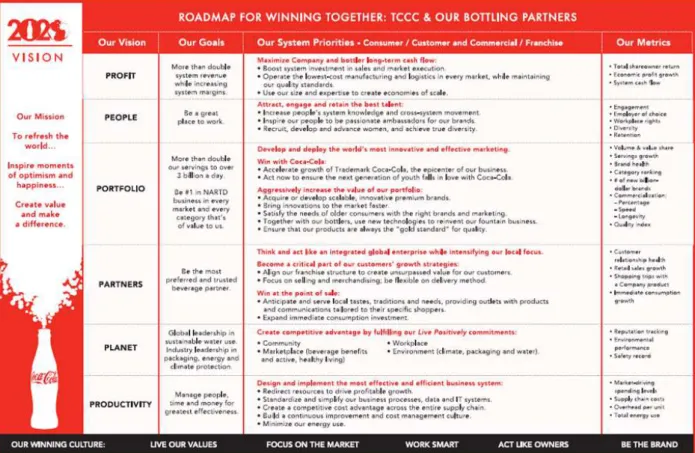
The Coletivo Project is part of one of the pillars of the 2020 Vision of the Coca-Cola Company, detailed on the Planet segment, with a priority on the community, among other goals. Coca-Cola wants to be the “most preferred and trusted beverage partner of the
communities, on the construction of a better future.”
Figure 11: The Coca-Cola Company 2020 Vision
Source: Internal data collected at Coca-Cola Brazil
Since 2008, the Company has invested on the Coletivo Project, but in order to continuously improve it, renovate and be relevant to the young people, educators and NGOs located at the communities, it´s important to investigate on the perception they have on it.
If this relationship is not continuously evaluated and analyzed, the presence of Coca-Cola on the communities may be ineffective, without generating value in terms of social impacts to the communities and positive business impacts to the Company.
The objective of this dissertation is to present an analysis of the critical success factors of the Coletivo Project and the relationship between the communities that are participant of them and the Coca-Cola Brazil, in terms of the Retail Coletivo Project platform.
The questions that are going to drive this case study have been prepared together with Coca-Cola Brazil executives, which work for Coca-Cola Institute
communities, participant of the social projects (Coletivo Project), we understand that is necessary to delimitate a city and a quantity of communities to be researched. This will provide more quality and focus on the interviews and respective results, that could be easily adapted to other communities from Brazil, participant of the Coletivo Project.
1.4 Limitation of the dissertation
It´s known that each region and community of Brazil has a different reality, and also the NGOs located at them. The region differs in terms of economy, healthy support, security, education and cultures, for example, however, the basic problems and dreams of the young people are unique by individuals and not by region or community. At the end, among many differences there are similarities, like enjoying football, music, etc.
As a consequence, we have delimitated the city of Rio de Janeiro as object of this case study and research, which has 20 communities participant of the Coletivo Project, as well as we have visited 20% of this universe, comprising four communities visited and Coletivos /NGOs educators, students and responsible interviewed.
As such, the NGOs visited were selected with the support of the executives of Coca-Cola Brazilian Institute, based on their relevance in terms of existence and maturity on the Coletivo Project, such as:
Morro dos Macacos – ONG Centro Comunitário Lídia dos Santos (CEACA) Cidade de Deus – ONG Igreja Metodista
Realengo – ONG Centro Social e Cultural Tatiane Lima
2. FRAME OF REFERENCE
2.1 CORPORATE SOCIAL RESPONSIBILITY
What does it mean corporate social responsibility? On a first glance, it means companies, which have a responsibility with the social aspects with the communities, where they have presence, to which they sell and serve. It used to have an understanding of something restricted to the government, but not to the private society. It´s also seem as an obligation of the companies, without necessarily generate financial results to them and to the entities that
receive the “donations”.
However, there is a mix and misunderstanding between topics related to Philanthropy, Corporate Social Responsibility and Shared Value.
Business can engage with society in those three ways. Past efforts have emphasized the collision between business and society instead of synergy. (KRAMER, 2014).
Figure 12: Three different concepts of social impacts
Philanthropy represents pure donations to cover community’s needs. Corporate Responsibility relates to the responsibility and obligation of the companies to reduce the damage to the society.
Figure 13: The matrix of social and business impact
Source: FSG (Social Impact Consultants)
CSR is related to the fact that the powerful multinational companies, such as Coca-Cola, Unilever, Nestle, generate profit and therefore they are responsible for solving a social problem of the environment they impact, they exist. Thus, they are designated to solve a social problem at scale and have a social impact, not necessarily generating a business impact.
As a field of study in management, CSR probably emerged in the 1950s in the United States. Business practices in the 1900s that could be termed socially responsible took different forms: philanthropic donations to charity, service to the community, enhancing employee welfare and promoting religious conduct. (BANERJEE, 2007)
On the other hand, shared value represents the virtuous cycle, that generates social and business impact at the same time for the company that donates and invest and the entity that receives the cash and investments. (PORTER, 2011)
Figure 14: The change on perspective to adopt share value
Source: FSG (Social Impact Consultants)
Even more, many entities are creating shared value, through the development of strategies of profit business that deliver social and tangible benefits. This way of thinking, which requires a lot of innovation on the business models of the companies, have created new opportunities of increasing profits for both sides.
That means that in order to achieve a social responsibility and also create value, companies should go beyond an ethical and social obligation.
They should look inside at their competencies, which are connected with their value chain and core business and innovate on a new strategy to connect social and financial needs of the customers with profit increase of the company.
However, unlike conventional approaches to sustainability and CSR, creating shared value is not just about examining the long list of different social and environmental consequences in the value chain and trying to minimize each of them. It is also about discovering the opportunities for new business development by finding the social issues at the root of the core business strategy. You would think it would be easy, but companies are so used to working with social blinders on that it turns out to be quite difficult. These issues are not different just by industry, but for each company within an industry. As we work with companies, it is one of the most challenging parts – but it can be found at the overlap between social needs, business opportunities and the core expertise of the business. (FSG, 2014)
Figure 15: The potential scale of shared value
Figure 16: The opportunity on shared value
Source: FSG Consulting to Coca-Cola (internal data)
Figure 17: Measurement and connection between business and social value
2.2 CONSTRUCTING RECIPROCAL VALUE
Many authors have created some acronyms and special words through the literature, with the purpose to address the social aspects of the business transactions related to donations, such as philanthropy, social business, corporate social responsibility and creation of shared value (PORTER, 2011).
The Coletivo Project that Coca-Cola Brazil has performed during the last five years with the communities has led me to introduce a new acronym and name: CRV –
Constructing Reciprocal Value.
The idea to create this new name is the fact that the Coletivo Project drives not only value and knowledge implemented by the company into the communities, but also the reverse situation, where Coca-Cola has received orientations and insights on the social needs from the communities, with the help and support of the NGOs.
Therefore, this relationship is something about “tell me what I can do for you, to make your life better, to make you feel a better person and important to me as a company and to your community as a member of this entire society.
A clear example of that is the real fact that some former students of the Coletivo Project have been hired to work for Coca-Cola Brazil, connecting their social needs with what Coca-Cola Brazil can offer, that is part of its value chain. Consequently, there is a true reciprocal value under constant construction.
2.3 THE CONTEXT OF THE NGOs IN BRAZIL
Brasil has 557.246 Non-Governmental Entities, where Rio de Janeiro state counts with 58.206 and at the city there are 31.771 NGOs. (www.ibge.gov.br)
The NGOs are entities of the Third Sector and seek to act in the name of social, environmental and sometimes political of the places where they are located.
They have become each time an important stakeholder to the companies (DAHAN ET AL., 2010; HANSEN & SPITZECK, 2010; SPITZECK, 2009; SPITZECK AND HANSEN, 2010).
Companies often engage in partnerships with NGOs, because they represent important source of knowledge that help the entities to address social and environmental community needs(ÄHLSTRÖM AND SJÖSTRÖM, 2005; HANSEN ET AL., 2010).
Private companies and nonprofit organizations work together to achieve positive relationships, of a win-win result, in which both sides learn from each other (BRUGMANN AND PRAHALAD, 2007).
In fact, this has been the best way for the companies to penetrate on communities, understand their needs and try to find strengths they have to cover these needs. This is because companies like Coca-Cola do not have this expertise; it´s not part of their core business. And what many companies have performed is to construct partnerships with the NGOs, so that they can intermediate the relationship between communities and the companies, on the indemnification of the existent gaps on the low income society, in order to
cover these differences with share value offers, in accordance with the “knowledge assets”
and expertize of the companies.
And this practice cannot be different with the Coletivo Project, where on the beginning of it, five years ago, Coca-Cola Brazil performed partnerships with consolidated and robust NGOs, such as ONG Doe Seu Lixo, CDA, among others.
The challenge of the NGOs resides on their organization as an entity, on the sense of
development, etc. The NGOs still need to ride on a long journey to develop them and become auto sustainable, without depending on the companies to receive charitable donations. On the other hand, the companies need to develop an internal knowledge and expertise on the social aspects and for that, maybe they need to contract and hire employees specialized on this area, and to develop internal areas with this focus, like Coca-Cola Brasil did with the creation of Social Business Area and the focus on Coca-Cola Brazil Institute.
Coca-Cola Brazil has hired professional from educational area, research on social business, a partnership with Fundação Roberto Marinho and recently a Consulting from Michael Porter, through FSG.org (Social Impact Consultants).
2.4 THE METHODOLOGY OF COLETIVO
The purpose of this section is to demonstrate in a detailed manner the stages of the implementation of a Coletivo on a community. Coca-Cola has determined 17 steps to implement Coletivo in a community (Figure 18).
Figure 18: Steps to implement Coletivo in a community.
After following those steps, the Company performs a partnership with local government, with a shared value and a co-creation model with the communities. The concept of Coletivo is to be fixed at the community, with a place dedicated to that, flexible and free. Also they construct horizontal relations with the NGOs leaders. The classes comprises theoretical and practical teaching on a two month period, with maximum of 20 students per class.
Figure 19: How Coletivo operates?
Figure 20: Focus on the 1st job of young people
Source: Internal data collected at Coca-Cola Brazil
The focus of the course named Retail Coletivo (Coletivo Varejo) is to explain concepts related to retail and merchandising, important aspects connected to the first job placement, such as how to prepare a curriculum, how to dress, how to talk on an interview, etc. At the end of the training, the students have a practical class that is to improve a local retail point of sale, in terms of activation of the Coca-Cola beverages, so that they can sell more products and earn more money. Finally, by the end of the course they have some indications of companies, partners of Coca-Cola, to apply for
Figure 21: The Business Model
Source: Internal data collected at Coca-Cola Brazil
Results tracked by Coca-Cola Brazil demonstrate that part of the young that pass through the Coletivo classes gain at the end of them self-confidence and a new job (Figures 22 and 23).
Figure 22: Social Impact – self confidence
Figure 23: Social and Financial Impact – more employments
Source: Internal data collected at Coca-Cola Brazil
3. RESEARCH METHODOLOGY
As for the purpose, the research was interventionist, given that the ultimate goal was "interfering in fact studied to modify it." (VERGARA, 2009).
As for the means of research, case study and fieldwork was adopted.
Case Study: this project represented a study about four communities that have NGOs with partnership with Coca-Cola Brasil, through the conception of Coletivo Project, that are located on Rio de Janeiro city.
The data that was collected occurred through individual interviews, with a focus on qualitative research, performed with three persons on each NGO, such as: the responsible for the NGO, the educator of Coletivo Retail classes and a former student.
Morro dos Macacos – ONG Centro Comunitário Lídia dos Santos (CEACA) Cidade de Deus – ONG Igreja Metodista
Realengo – ONG Centro Social e Cultural Tatiane Lima
Cantagalo-Pavão-Pavãozinho – ONG Viva Rio Espaço Criança Esperança
The purpose was to have a clear and deep understanding of the perception that the NGOs responsible, educators and former students have on the following pillars:
The life on the community.
The role of public and private sector communities.
The relationship between Coca-Cola and the communities. The Coletivo Project.
Field Research: The field research was performed on three stages, as demonstrated on the following:
On the first stage, we interviewed the main executive of Social Business of
Coca-Cola Brazil, with the purpose to diagnostic the main problems that they see in regards to the Coletivo Project, the NGOs and the communities.
We developed a questionnaire with them, as mentioned previously, to be used on
the interviews with the four NGOs selected on four different communities.
On the second stage, we applied the questionnaire indicated on the section
“Questions to be responded”, separately, to three people on each NGO ate each
community, which were directly involved with the Coletivo Project.
On the third stage, we debated the results with the Coca-Cola executives of Social Business Area and Coca-Cola Brazilian Institute, what reinforced the necessity to create a new Coletivo concept, named Coletivo 2.0.
4. FIELD REVELATIONS (RESEARCH RESULTS)
people were comprised by (a) the educator of the Coletivo Project, (b) a former student of it and (c) the responsible for the NGO, in order to capture different perspectives and point of views.
In order to make results analysis more clear and concise, we presented the results categorized by questions performed sand segregated by NGO, what allows comparing the information and the vision of each organization with respect to their respective communities, of Coletivo Project and the improvements necessary for both.
(4.1) With respect to the quality of life of the residents of the community –
what is good and what is bad:
Morro dos Macacos – ONG Centro Comunitário Lídia dos Santos (CEACA): In regards to the quality of life of the community residents, the common
answer for the NGO representative, educator and student was the fact that the good side resides on the friendship relation they construct on the community, the union and solidarity. It was also commented the fact of living with liberty, out of prison of those that live in buildings.
In fact, they have more freedom, because they implement their own laws, different
from the rules of the formal livings, neighborhoods out of the slams.
The bad side commented as the lack of basic sanity, with problems such as lack of light, gas and water on some moments. It was commented the fact that the communities
are not well seen by the majority of the population that live on urban residences, having too much bias with them.
Another comment was the lack of extra-curriculum activities outside the school, such as sports, recreation, except for the existence of the Olympic Vila, that really brought some opportunities of leisure to the community, but the mothers depend on someone to take their children there after school, when they are working.
It was also related the violence, drugs traffic and the thieves as being the bad side of the communities, although they have reduced with the implementation of the UPP by the governments.
It was mentioned that UPP has a good and a bad aspect. The good one is that the violence on the communities after the installment of the UPPs has been reduced. On the other hand, the bad aspect is that some policemen that are part of the UPPs are very young and have not received an appropriate training to deal with community people, without bias of those who are black, for example.
Finally, the interviewed said they live at the communities due to lack of a better place to live and because the community is closed to everything they need (market, schools, entertainment, etc.).
That is one of the problems on the last decades that have generated an increase on
the communities, “favelas” of Rio de Janeiro. Much of the people that live there could live on a better place, with appropriate infrastructure in terms of house constructions. However, these places are very far from the main centers of the city and they prefer to live on bad life quality conditions, without basic sanity and some violence, instead of living far.
Cidade de Deus – ONG Igreja Metodista: The persons interviewed
mentioned that there are not so many things good on the community. Only the FAETEC,
with many courses offered and some social projects, such as Coletivo Retail, Arts and Dance, etc., which are very good. Friends are also part of the good side of the communities and the local has a lot of movement and has good schools.
The bad side is on the mentality of the population of the community, which is used to see everything under the short term optic, without planning, with the objective to accept only the opportunities that bring financial benefits, such as “Bolsa Familia”, courses that pay salary, etc.
There are some students that leave Coletivo, because they migrate to other courses, like those offered by SESI, because of the salary paid to them. They do not have a long term view, to understand that the knowledge represents an intangible asset that can value much more in the future than the low salary paid for other types of courses.
not pay have punishment and are obliged to comply with their obligations. This would generate a fair regulation of this situation.
Community Realengo Batan - ONG Centro Social e Cultural Tatiane Lima: The quality of life is good in virtue of union and friendship among residents of the
community. There is also the realization of many projects with opportunities for youth and adults, such as FAETEC courses and the Coca-Cola Coletivo Project. The presence of good schools, lacking only fun for young children on weekends was also informed. According to the educator security has improved after the UPP settled in the community. There was also new kindergartens and health centers, but lack more schools for high school.
In the vision of the founder of the NGO, Luciano, quality of life is good, more safely and is one of the quietest places in the West Zone. Friendship is also something very strong among all. The bad part is the lack of interest of young people to study, take courses, empower.
Communities Cantagalo, Pavão e Pavãozinho – ONG Viva Rio-Criança
Esperança: In view of the NGO responsible for, the quality of life is good, one of the best
among other communities in Rio de Janeiro, with plenty of free entertainment as the Cantagalo, Pavão and Pavãozinho communities are near the beach of Ipanema and Copacabana, closed to Lagoa Rodrigo de Freitas and to the trade in the South Zone of Rio de Janeiro, one of the most prized locations in the city. The UPP also greatly improved the level of security. The bad part is the lack of sanitation, the condition of the dwellings, which are falling short, and trafficking that despite having reduced have sprayed in communities.
In the student's opinion, with the UPP was the coming of many businesses to the community, such as lottery shops, commercial banks, besides several social projects by private and public companies as well. The bad part is that there is still a lot of prejudice from people of asphalt with the community and they hardly visit the community, due to the fear of lack of security, despite having improved greatly.
(4.2) About the change on the community life on the last years:
Morro dos Macacos – ONG Centro Comunitário Lídia dos Santos
(CEACA): In general, they have identified an improvement in recent years, with several
positive changes in the community, but with some caveats negatives. See the main positive and negative points below:
a) The opening of an Olympic Village, created by the Government of the State of Rio de Janeiro, with the growing number of projects for the communities.
b) Improvement of the infrastructure of the schools with the most toys, school supplies and uniforms provided by the government, in addition to greater comfort with air conditioning, for example. However, despite a better structure of schools the quality of education remains poor, with a lack of incentives for teachers.
c) The community kinder gardens increased.
d) Increased participation of society in relation to the affairs of the community was also reported another improvement, with an interest in discovering the problems of communities and disseminate improved. One example cited was this interview; the first time a student comes to interview people in the community to conduct a research.
e) The arrival of the UPP, which brought an improvement in the safety of communities by reducing the shootings, clashes between traffickers and police and dances "funks". However, this process caused the bandits to rob communities pass on city streets. This is due to the fact that they have lost some of its "source of income" with drug trafficking and there are few police on the streets to defend the population.
g) The increase in the number of community residents, who brought several problems of the past, among them the lack of water, light, sanitation, clogging of ditches and services that were not enough to meet all the population living in the community.
h) The residents who had more access to work changed their lives for the better.
i) The government has improved, is more present with the social programs of the "Bolsa Familia", “Minha Casa, Minha Vida” ("My Home, My Life"), etc.
Cidade de Deus – ONG Igreja Metodista: Improvements were observed in
the community in recent years, but in some parallel themes remain bad. Consider these points in more detail below:
a) The quality of life was something highlighted as having improved in the community, much due to the coming of the UPP, which brought security to the residents. Consequently, many shops were open and trade improved. However, it was commented that the UPPs there are good and bad cops, the latter being ill prepared to perform the function of the form proper.
b) The courses that have been made available to community have improved the
minds of the young, but there is still a lot of discrimination with people who are from the community.
c) The government is more present, with works of paving of streets, sidewalks, buildings daycare. However this occurs intensely whenever there upcoming elections. Often the government installs improvements, but destroys the population, by not having to keep education. A work of education and culture to guide the residents of the community in preserving its environment is required.
d) The arrival of UPA (Emergency Unit) was also an improvement in health, but has been perceived a shortage of doctors and attendants in recent months.
Community Realengo Batan - ONG Centro Social e Cultural Tatiane Lima: Security has improved and drug trafficking reduced because of the UPP. But
In view of the educator also improved after the UPP, making the community safer and making companies pass to come to the site, such as Light, Cedae, Clinical Family and the Coca-Cola itself. In the vision of the founder, the community has improved 80% compared to what it was before also due to the UPP, because many things have been made easier. Currently companies can join the community to provide resources, such as cable television, water, light, etc.
Communities Cantagalo, Pavão e Pavãozinho – ONG Viva Rio-Criança Esperança: According to the vision of the NGO responsible, the security greatly
improved, allowing, for example, that "Criança Esperança" Project of the Globo Television Network could establish itself in the community with several projects for 11 years. The public power and safety are more present.
And in view of the student, it has improved, because the community is no longer under the control of criminal gangs. There is still uncertainty, but less than in the past, before the UPP. The Government could be more present, because only appears in the elections.
From the perspective of an educator, community life has improved because the children began to be created in an environment more safely with fewer guns, less violence, fewer shootings and fewer people doing drugs.
(4.3) If companies have helped communities out, what has been good and
what could be improved:
Morro dos Macacos – ONG Centro Comunitário Lídia dos Santos
(CEACA): Companies have been more to the communities to hire people who live in it
In fact, figures are important to be measured and some company´s indicators, such as brand love increase, generation of jobs to the students, but the quality of how everything is being delivered must be periodically visited to detect improvements or not.
Cidade de Deus – ONG Igreja Metodista: It was commented that companies
have not been very present, except Coca-Cola, with the Collective and Project Light, which has placed clocks to control electrical energy measurement.
Community Realengo Batan - ONG Centro Social e Cultural Tatiane Lima: Under the vision of the student, business has not been much, except Coca-Cola,
through the Collective project. On the perspective of an educator, companies have helped the community to make it more formal and legalized, for example, the Light, Cedae and Itinerant Justice. Light donated a refrigerator to each resident who adhered to regularize the bill. However, Cedae did nothing to encourage settlement. Coca-Cola has helped a lot with classes Retail Design Collective and the students began to improve local trade giving guidance to merchants, retail tips. Finally, under the perception of the founder of the NGO, companies have also collaborated. Highlighted the Light, Cedae, with a few caveats to this lack of a water meter and use of estimated values and Coca-Cola.
It is important to mention that this ONG was subject to a famous program of TV Globo
named “Home Sweet Home” (Lar Doce Lar) from a presenter named Luciano Huck, with
the sponsorship of Coca-Cola and other companies. This is a great example of the power of influence that a company like Coca-Cola has to improve the quality of life of the communities.
Communities Cantagalo, Pavão e Pavãozinho – ONG Viva Rio-Criança Esperança: From the perspective of the educator companies have helped communities,
such as the Gas Natural Fenosa, with a project to train professionals in the area of construction, specializing in gas, but also in other segments, with a course that provides allowance of up to $ 250.00 per course of a month and a half the participants, and on-site dining and passages. Also Petrobras, FAETEC with several courses and Coca-Cola with the Collective project. And TV Globo with the immense project "Criança Esperança”
In view of student, companies have collaborated, creating an economic and financial growth in the community, because there is more trade and greater employment generation and income. There are also more choices of stores, allowing consumers greater power to choose where to buy at lower prices and higher quality.
(4.4) Regarding the names of the companies that are present at the
communities and the legacy left by them:
Morro dos Macacos – ONG Centro Comunitário Lídia dos Santos (CEACA): Natura did the “Projeto Limpar” (“Clear Project”), to help cleaning and
working with the environment. Unilever has supported a research project on hygiene and raffled filters offered soaps and other toiletries for the whole community.
The Coca-Cola came with different modalities of projects, such as recycling and the integration into the labor market with the Collective. Petrobras came with the workshop of knowledge, with educational support for better performance in schools and readings. Nike, with a wonderful project called "Winners", which sought to develop professional skills in community residents. The result was that people who participated in this project continue working, changed their outlook on life, your perspective on life, etc. The Senac (National Commercial Training Service) and SENAI (National Industrial Apprenticeship
Service) also offer courses in baking, icing assist, care for special children, the elderly, "pizzaiolos", cooks, etc.
Finally, it was reported the constant need for companies to support communities in
self-sustaining projects, like having a house party, for example.
Cidade de Deus – ONG Igreja Metodista: Petrobras held a course in cultural
producer, aiming to teach people in the community to organize events with classes about politics, journalism and social services. Light left the legacy of organization measurement of electricity and hence the possibility of community residents, that have adopted the program, to have proof of residence. Coca-Cola has taught young people to think differently, to have more confidence in yourself and in a better future, with the Collective project.
founder mentioned the Light, Comlurb and Coca-Cola. Light left the great legacy of fair formalization of accounts and records. Comlurb also implemented an excellent program for garbage collection.
Communities Cantagalo, Pavão e Pavãozinho – ONG Viva Rio-Criança
Esperança: In view of the NGO responsible, for the legacies have been left employability
and vocational training. In the company Gas Natural Fenosa project participants built a toilet on site Project "Criança Esperança” (“Hope Child") in Cantagalo. According to the student, the space of the Child Project Hope is very good, with places for courses, sports projects (swimming, futsal, volleyball, judo and other martial arts, etc.), with the social projects such as FAETEC, the Child Project hope, Coletivo, etc.
(4.5) As an opinion of the Coletivo Coca-Cola:
Morro dos Macacos – ONG Centro Comunitário Lídia dos Santos
(CEACA): In the opinion of the student, the Collective project teaches very well to the
young community, with shared knowledge among students and educators ideas, the exchange of knowledge, opinions and a guidance on the first job. There is a learning
notion of retail product marketing and events. She reported that students come too shy for the course and then become extroverts.
In fact, the model facilitates an interaction studies and the fact that the trainer / educator and being young resident of the community, usually former students and compulsorily attending a university, makes the proximity of the student in relation to, most genuine, most much larger educator true. And the student indicated the emotional way that the course represents a "springboard" for life, pair the first work in which a person studies, the mind opens, finds himself able and welcomed. There is a junction of care and attention to education.
The Collective helps the community, not only because it improves the structure of the NGO in terms of presentation and construction, but it attracts young people to learn about the project. Found that transmits wellness and pleasure for those who are on site, as there are rooms in comfort and organization.
improved in the Collective is the printed material, rather than just dialogue. Indeed visual communication helps a lot on memorization and retention of content transmitted.
Another noteworthy point is that the teacher recommends changing the language of training, the way it deals with students for mobilization, etc. She pointed out that enrich content and offer more vacancies at the end to work at Coca-Cola.
The problem is that to work at Coca-Cola Brazil, as in other large companies, you must have an educational background in parallel, eg, a university education, knowledge of other languages such as English and Spanish and basic posture that some community members have and are well articulated in their communication, but the vast majority do not, for lack of references in the house, in your own family.
In the employability module educator recommended to add existing truths about prejudice against those who live in the community, racism, the place where you live, social prejudice, geographic, etc.
Also offer more practical lessons should be included, with booths representing each type of market (bars, supermarkets, etc.), make visits to the Andean market with supervisors, invite speakers who work in their own Coca-Cola to give testimonies, teaching, especially those who came from low, from poor backgrounds, who represent well the diversity (black, for example) so that young people could see that it is possible to get there. The Coca-Cola could open more doors for graduates’ students with job offers Collective Institute in Coca-Cola Brazil, Coca-Cola or the manufacturer of beverage Refreshments Rio de Janeiro (Andean Group).
The Collective is very good for these young people 15-23 years, but there has to be a parallel work of education increased, along with the Collective.
Cidade de Deus – ONG Igreja Metodista: The Collective was highlighted as
being a great opportunity to enter the labor market. The instructor was also recognized by the student, because of his behavioral skills and assertive communication with the youth project. The workload should be increased, to create the opportunity to be more represented and the course content was considered adequate.
emphasized that the Collective broke the paradigm that working in a big company is something impossible for young people, showing both these companies as to the students that it is possible to hire youth community program.
The responsible for the Methodist Church, Sandra Lima, indicated that the Collective is very good, because students who participate in the Collective and form begin to dream of a better future. The educator transmits positives to students about his own effort, the will to win and get there. There is a rescue of the young self-esteem and the ability to dream and achieve.
Community Realengo Batan - ONG Centro Social e Cultural Tatiane Lima: According to the student, the Collective is a very good project that was formed
and created with the goal of helping communities and young people to think and grow in life, taking the young street. Has helped in the growth of the community in the development of the young man who happened to have a different look, with a life goal with this project.
From the perspective of an educator is very important to help young people in search of their first job, which in fact has been obtained for them project, according to her, and have learned how to make a resume too. It has also helped the trade to be better organized about selling beverages effectively. This project helps the family, trade and the
young. Coca-Cola is no longer just a beverage company and now started to help improve the lives of all with this social action.
Finally, the vision of the founder is that the design is excellent, because it came to
give opportunity to young people who want to change their lives. The presence of Coca-Cola in the community appreciated the NGO, the community has improved, the profile of young people. Also has all the closest community of this great company, formerly a far cry for them and the Collective made to approach? For him Coca-Cola is a "godmother" of the NGO, making very healthy and strong relationship.
Communities Cantagalo, Pavão e Pavãozinho – ONG Viva Rio-Criança Esperança: The responsible of the NGO believes that the Collective is another initiative
the Collective Retail fashion. To improve the Collective should have a daily supply during the course and a scholarship, as well as in the design of the company Fenosa Gas. In view of the student, the Collective helped a lot to understand what the job market, how it works, to be uninhibited and communicate more and better. She said the course opens a way for the young in the labor market. The educator also agrees on this point. Young people leave more confident after the course. Could be just a snack during class and helps transport. The strongest point of the course content is the part that teaches about employability.
(4.6) Regarding the possibilities of improvement of the reality of the communities
and how Coca-Cola could collaborate:
Morro dos Macacos – ONG Centro Comunitário Lídia dos Santos (CEACA): It was commented that Coca-Cola could invest more in recycling projects,
fair employment, offering positions in enterprises, citizenship courses, computer, Portuguese, how to make a good resume. The lack of a reference, a guide, guidance, vocational tests, etc., also makes many young people opt for unconventional approaches, such as drug trafficking, for example. Could take courses in gastronomy and the Olympic Village could be exploited by Coca-Cola, with sports competitions, such as swimming, ballet, football, judo, capoeira, etc.
The Collective is considered a good design, which helps a lot to young people, but to improve the mobilization to attract new young people to the project could be more active, with billboards. Coca-Cola has invested in expensive past an advertising agency to teach
educators in mobilizing, but representatives of this agency lacked adequate knowledge about the youth of the community and did not use an assertive communication to lure them unknowingly approach them effectively.
Could have projects for women, who are mothers, housewives, which are very important in the communities they serve as an example for the children.
Cidade de Deus – ONG Igreja Metodista: According to the vision of the
mentioned the need to open more vacancies in the Collective programs and increase the workload.
Community Realengo Batan - ONG Centro Social e Cultural Tatiane Lima: According to the student, Coca-Cola could bring more projects for the
community, for the Olympic Village, for example, as sports competitions, concerts, more recreational areas, cultural venues, etc. Also bring computer courses, arts. Think of other ways to attract more young people to the Coletivo. In view of the educator, it could have other projects, other courses such as recycling, entrepreneurship, logistics, etc. As for the founder of the NGO, Coletivo has a small amount of classes for young people between 15 and 17 years, it gives preference to those over 18 years. However, demand from younger is too big. This way, they could have more places for them as there are many young people between 15 and 18 years wanting to work.
Communities Cantagalo, Pavão e Pavãozinho – ONG Viva Rio-Criança
Esperança: The responsible for the NGO would suggest initiatives with distinct designs
to be used in the training of young people, with something more technical, within the limits of educational background of each. Coca-Cola University could be created in partnership with educational institutions with training in various areas such as Marketing, for example.
The student interviewed mentioned that the project could offer more jobs; more refer young people to the labor market. Also it should offer other courses, like hospitality, for example, because of the surrounding community which is in the South Zone of Rio de Janeiro and has many hotels.
(4.7) On what Coca-Cola could do differently to improve the life on the
community:
Morro dos Macacos – ONG Centro Comunitário Lídia dos Santos (CEACA): the student informed that Coca-Cola could provide shelter for people who
sleep on the street and give more fun for the community, in addition to offering more courses was one of the responses of a student.
create more fun, such as theater, cinema, etc. It could improve education in the community as well.
The leader of the NGO said that Coca-Cola could create soccer tournaments, swimming, dancing, which demanded that only children and young people up to date with the schooling with good grades and attendance in schools could participate and compete. Thus, there would be an incentive for young people and children to attend classes, schools. It would be a Project Education.
Cidade de Deus – ONG Igreja Metodista: The Coca-Cola could offer spaces
for sports, promote more cultural and sporting events. The Collective is already good at preparing young people for the labor market. Could there be organizing contests and street cleaning. Finally, it was reported that Coca-Cola could influence other companies to take the same initiative.
Community Realengo Batan - ONG Centro Social e Cultural Tatiane
Lima: Responded on item 4.6.
Communities Cantagalo, Pavão e Pavãozinho – ONG Viva Rio-Criança
Esperança: According to the NGO responsible for, in addition to the comments made in
answer to question six, he understands that because the Coca-Cola represent greatness in size and as a reference in the world of business, should have a project with greater impact, with more graduates, with greater activation of the outlets that participate in practical activities. The owners of the outlets have commented that they should make more accessories activation for their local sales of Coca-Cola, such as tables and chairs, refrigerators, tents, etc. The community would be better served with better-enabled trade in Coca-Cola.
The teacher would also make a larger work activation at point of sale, as exchange process in field work that is part of the course, where students visit the points of sale, exchange ideas and give suggestions, but in exchange offer tables, chairs , tents and refrigerators merchants participating in the project. This will further improve the image of Coca-Cola and benefit local businesses.
(4.8) If there was the option to change the Collective, what could be done