A perceived gap between invasive species research and stakeholder priorities 67
A perceived gap between invasive species research
and stakeholder priorities
Helen R. Bayliss1,2, Gavin B. Stewart3, Andrew Wilcox1, Nicola P. Randall1
1 Crop and Environment Sciences Department, Harper Adams University, Newport, Shropshire, TF10 8NB, UK 2 Current address: Centre for Environmental Policy, Imperial College London, South Kensington Campus, London, SW7 2AZ, UK 3 Centre for Reviews and Dissemination, University of York, York, YO10 5DD, UK
Corresponding author:Helen R. Bayliss ([email protected])
Academic editor:Ingolf Kühn | Received 21 February 2013 | Accepted 24 August 2013 | Published 11 October 2013
Citation: Bayliss HR, Stewart GB, Wilcox A, Randall NP (2013) A perceived gap between invasive species research and stakeholder priorities. NeoBiota 19: 67–82. doi: 10.3897/neobiota.19.4897
Abstract
Information from research has an important role to play in shaping policy and management responses to biological invasions but concern has been raised that research focuses more on furthering knowledge than on delivering practical solutions. We collated 449 priority areas for science and management from 160 stakeholders including practitioners, researchers and policy makers or advisors working with invasive species, and then compared them to the topics of 789 papers published in eight journals over the same time period (2009–2010). Whilst research papers addressed most of the priority areas identiied by stake-holders, there was a diference in geographic and biological scales between the two, with individual studies addressing multiple priority areas but focusing on speciic species and locations. We hypothesise that this diference in focal scales, combined with a lack of literature relating directly to management, contributes to the perception that invasive species research is not suiciently geared towards delivering practical solu-tions. By emphasising the practical applications of applied research, and ensuring that pure research is translated or synthesised so that the implications are better understood, both the management of invasive species and the theoretical science of invasion biology can be enhanced.
Keywords
Alien species, biological invasions, knowledge transfer, research evaluation, science policy
Copyright Helen R. Bayliss et al. This is an open access article distributed under the terms of the Creative Commons Attribution License 3.0 (CC-BY), which permits unrestricted use, distribution, and reproduction in any medium, provided the original author and source are credited. NeoBiota 19: 67–82 (2013)
doi: 10.3897/neobiota.19.4897 www.pensoft.net/journals/neobiota
RESEARCH ARTICLE
Advancing research on alien species and biological invasions
A peer-reviewed open-access journal
Helen R. Bayliss et al. / NeoBiota 19: 67–82 (2013) 68
Introduction
Access to scientiic information is important in ensuring an efective response to bio-logical invasions (Browne et al. 2009, Simpson et al. 2009). his scientiic information needs to be used judiciously alongside legislative and socio-economic information and local knowledge to inform decision-making (Segan et al. 2011). he scientiic infor-mation generated through research activities can be broadly described as relating to the processes, impacts or management of invasive species (Kuefer and Hirsch-Hadom 2008). his information is continuously being published in both books and journals (Simberlof 2004, Richardson and Pyšek 2008), with the number of journal articles relating to biological invasions rising exponentially (Kühn et al. 2011). Whilst many journals in the ields of ecology and conservation biology publish papers on invasive species, the recent growth in the number of journals focusing speciically on biological invasions relects the increasing demand in this area (e.g. Aquatic Invasions, Biological Invasions, Management of Biological Invasions, NeoBiota). Yet, despite the accumula-tion of a massive body of literature, there are still gaps in our fundamental knowledge about many invasive species (McGeoch et al. 2010). here is a need for much basic data on invasive species drawn from empirical research, which could be used to underpin theoretic ecological approaches, for example risk assessment (Andersen et al. 2004). Topics still to be explored fully relate to the underlying mechanisms, consequences, assessment, management, ecology and economics of biological invasions (Kühn et al. 2011, Williamson et al. 2011).
he IUCN Red List database implicates invasive species in the extinction of more than half of the 170 species for which data are available (Blackburn et al. 2010). To halt or reduce future global biodiversity loss, increased investment in the management of in-vasive species will be required (McGeoch et al. 2010). However, criticism has been made that much of the scientiic literature on invasive species focuses on furthering knowledge and quantifying impacts rather than on delivering practical solutions (Hulme 2006, Esler et al. 2010). To explore this, we collated key priorities for invasive species science and management from stakeholders working with invasive species and then compared them to the topics of articles published over the same period in eight journals to deter-mine whether the topics identiied as important by stakeholders were being addressed by research, and to identify any areas that may require a greater focus in the future.
Methods
A perceived gap between invasive species research and stakeholder priorities 69
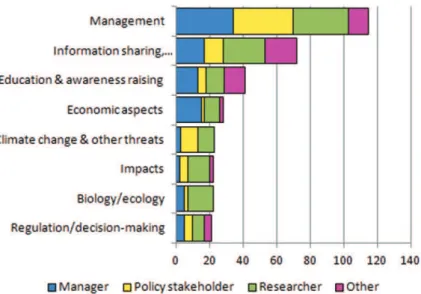
were asked to identify their main area of responsibility (i.e. research, policy, practice, others). he questionnaires inished with a question asking respondents to identify their three top priorities for invasive species science and management. he same ques-tion was distributed to delegates attending a dedicated workshop held at the Euro-pean Congress of Conservation Biology in Prague, 2009. In 2010, the question was included in an anonymous electronic questionnaire exploring information selection and sharing that was distributed to the international invasive species community using the Aliens-L email list of the Invasive Species Specialist Group of the IUCN Species Survival Commission and subsequently reposted onto other web pages and email lists by recipients. Responses from the questionnaires and the workshop were entered into a spread sheet for thematic analysis, whereby related priorities were grouped using an iterative process (see online Appendix I: Stakeholder priorities for the data used in the analyses). Priorities were also analysed by comparing responses between stakeholder groups, with the eight most frequently identiied priorities (those identiied a total of twenty or more times) charted to allow comparison by stakeholder group.
We then undertook a search of eight journals likely to publish research of broad relevance to invasion biology. Four journals were ‘traditional’ ecological journals; Biological Invasions; Diversity and Distributions; the Journal of Applied Ecology; and Trends in Ecology and Evolution. he other four were subsequently selected to broaden the scope of the study, and included Ecological Economics, Journal of Envi-ronmental Management, Weed Research and Conservation Evidence. Other relevant journals which did not cover the time period of 2009–2010 (such as Management of Biological Invasions or NeoBiota, which produced their irst issues in 2010 and 2011 respectively) or those which were speciic to a particular group or biome (such as Aquatic Invasions) were not included. We collected all articles relating to biological invasions that were published in the eight journals during 2009 and 2010 (the same period as the priorities were gathered) except letters to the editors, obituaries, book reviews and errata, which were not included in the assessment. Papers were classiied using the main theme described in the title, or using the abstract when this was not clear. We attempted to classify all of the articles against the same thematic groups that had been identiied from the priorities, but as many papers related to more than one priority area or covered diferent topics, the thematic groups were revised using an iterative process to better relect the nature of the articles collected. Each paper was classiied against only one main topic area (see onlineAppendix II: Journal article clas-siications for the data used in these analyses).
Helen R. Bayliss et al. / NeoBiota 19: 67–82 (2013) 70
Results
Stakeholder priorities
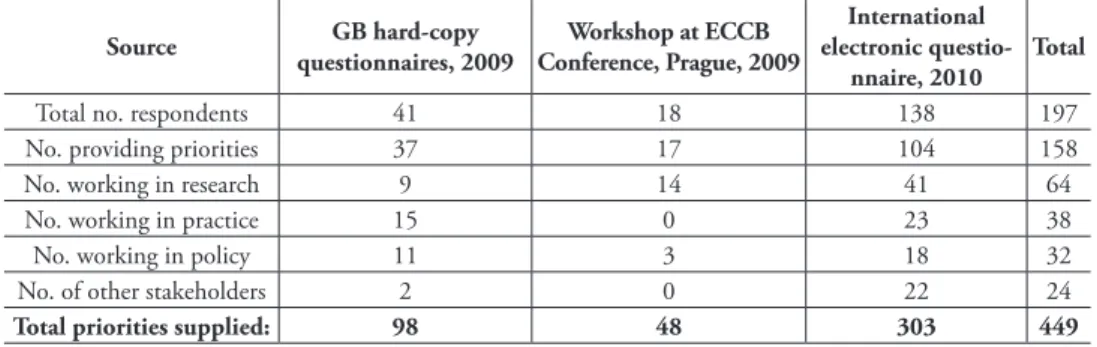
197 individuals responded to the diferent questionnaires (Table 1). Of these, 159 respondents provided a total of 449 individual priorities. Respondents represented a range of stakeholder groups; the main being researchers (40.5% of respondents pro-viding priorities), practitioners (24.0%), and policy makers and advisors (20.3%). Re-spondents from other stakeholder groups such as volunteers or knowledge brokers accounted for 15.2% of respondents.
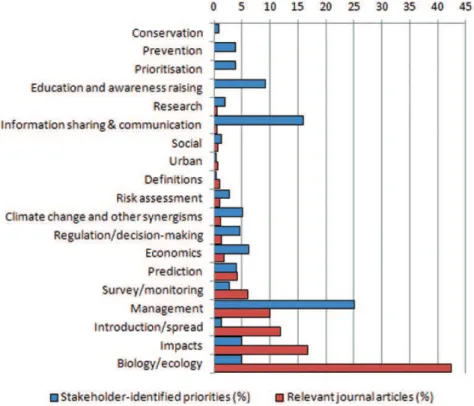
Nineteen broad priority categories or topics were identiied (Figure 1). A quarter of all of the priorities identiied by stakeholders (25.2%) related to the management of biological invasions. A further 16% related to information sharing, communication and collaboration, 9.1% related to education and awareness raising, 6.2% to econom-ics, 5.1% to climate change and 4.9% each to impacts of invasive species and to syner-gies with climate change and other threat drivers.
When compared across stakeholder groups, the two most frequently identiied priorities were the same for stakeholders working in management, policy and research; these were the management of invasive species, followed by information sharing, com-munication and collaboration (Figure 2). Despite being the most frequently identiied, these topics represented varying proportions of the overall priorities within diferent stakeholder categories, representing 31.2% and 15.9% of manager priorities, 38.3% and 11.7% of policy stakeholder priorities and only 18.6% and 14.1% of researcher priorities respectively (Table 2). he order and relative proportions of subsequent pri-orities varied between stakeholder groups. Researchers identiied pripri-orities within each of the 19 topic areas, managers within 16, policy stakeholders within 15, whilst the ‘other stakeholders’ category only identiied priorities within 13 of the topic areas. he ‘other stakeholders’ group most frequently identiied information sharing, communi-cation and collaboration as a key priority (27.5%), followed by educommuni-cation and aware-ness raising and the management of invasive species (17.4% each).
Table 1. he number and type of respondents each providing up to three priorities for invasive species sci-ence and management through questionnaires deployed at two events in 2009 and electronically in 2010.
Source GB hard-copy
questionnaires, 2009
Workshop at ECCB Conference, Prague, 2009
International electronic
questio-nnaire, 2010
Total
Total no. respondents 41 18 138 197
No. providing priorities 37 17 104 158
No. working in research 9 14 41 64
No. working in practice 15 0 23 38
No. working in policy 11 3 18 32
No. of other stakeholders 2 0 22 24
A perceived gap between invasive species research and stakeholder priorities 71
Journal articles
789 articles of broad relevance to invasive species were identiied from the eight jour-nals during the two year period. Biological Invasions unsurprisingly published the highest number of articles deemed relevant to invasion biology as the only specialist journal included in the sample (545 articles). Diversity and Distributions published the second highest number (82), followed by Weed Research (75) and he Journal of Applied Ecology (48). Ecological Economics contained 12 articles, Journal of Envi-ronmental Management contained 11, Trends in Ecology and Evolution contained nine, and Conservation Evidence contained seven relevant articles. he majority of articles retrieved were original research articles.
Most journal articles related to the ecology or biology of invasive species (42.5%), the impacts of biological invasions (16.7%), or modes of introduction and spread (11.9%). he 79 management articles identiied represented 10% of the sample. Approximately 6% of papers related to surveying or monitoring and 4.2% to prediction for invasive species. All other topics were the focus of less than 2% of articles in the sample.
Helen R. Bayliss et al. / NeoBiota 19: 67–82 (2013) 72
Comparison of topics
he greatest proportion of research papers related broadly to the biology and ecology of invasive species, whereas the greatest proportion of stakeholder priorities related to management (Figure 2). he odds ratio tests indicated that the proportion of top-ics identiied as priorities by stakeholders were statistically diferent from the toptop-ics covered by journal articles for 14 out of 19 topics (p ≤ 0.05; Table 3), indicating a mismatch. Education and awareness raising, prevention, prioritisation, information sharing and communication and conservation had the largest efect sizes, suggesting that they were under-represented in the literature when compared to the stakeholder priorities. Conservation, deinitions, predictions, social issues and urban invasives were not signiicantly diferent with the 95% conidence interval crossing 1, suggesting that coverage of these topics by journals is roughly proportional to their identiication as priorities; however, these topics represented only small values in both categories and so the odds ratios were likely to be closer to one.
Discussion
A per
ceiv
ed gap betw
een inv
asiv
e species r
esear
ch and stakeholder priorities
73
Table 2. Relative proportions (% to 1dp) of journal articles and stakeholder priorities (total and by individual stakeholder groups) addressing each of the 19 topics in invasive species science and management and collated during 2009–2010.
Topic Relevant journal
articles (%)
Total % of
stakeholder-identiied priorities Manager %
Policy
stakeholder % Researcher % Other %
Biology/ecology 42.5 4.9 4.6 2.1 8.5 0
Climate change and other synergisms 1.1 5.1 2.8 10.6 5.6 0
Conservation 0 0.9 0 0 2.3 0
Deinitions 1.0 0.4 0 0 1.1 0
Economics 1.8 6.2 13.8 2.1 5.1 2.9
Education and awareness raising 0 9.1 11.9 5.3 6.2 17.4
Impacts 16.7 4.9 1.8 5.3 7.3 2.9
Information sharing, communication and collaboration 0.5 16.0 15.6 11.7 14.1 27.5
Introduction/spread 11.9 1.3 0 3.2 1.7 0
Management 10.0 25.2 31.2 38.3 18.6 17.4
Prediction 4.2 4.0 0.9 2.1 7.9 1.4
Prevention 0 3.8 1.8 3.2 2.8 10.1
Prioritisation 0 3.8 3.7 3.2 3.4 5.8
Regulation/decision-making 1.3 4.7 4.6 5.3 4.0 5.8
Research 0.5 2.0 1.8 1.1 2.8 1.4
Risk assessment 1.0 2.7 1.8 4.3 2.8 1.4
Social 0.6 1.3 0.9 2.1 1.1 1.4
Survey/monitoring 6.1 2.7 1.8 0 4.0 4.3
H
elen R. B
ayliss et al. / N
eoB
iota 19: 67–82 (2013)
74
Table 3. Odds ratios with calculated 95% conidence intervals, z statistics and p values comparing the diferences between the relative frequencies of stakeholder-identiied priorities for invasive species science and management and the topics of journal articles published during the same period (2009–2010).
Topic
a) Number of times priority identiied by
stakeholders
b) Total number of other priorities
c) Number of relevant journal
articles
d) Total number of other journal
articles
Odds Ratio (a/b) / (c/d)
to 2 dp
95% CI z statistic P
Climate change and other
synergistic threats 23 426 9 780 4.68 2.15 to 10.20 3.88 P = 0.0001 Conservation 4 445 0 789 15.95 0.86 to 296.94 1.86 P = 0.0634 Deinitions 2 447 8 781 0.44 0.09 to 2.06 1.05 P = 0.2961 Biology/ecology 22 427 335 454 0.07 0.05 to 0.11 11.56 P <0.0001 Economics 28 421 14 775 3.68 1.92 to 7.07 3.92 P = 0.0001 Education and awareness
raising 41 408 0 789 160.41 9.84 to 2614.46 3.57 P = 0.0004 Impacts 22 427 132 657 0.26 0.16 to 0.41 5.71 P < 0.0001 Information sharing,
communication and collaboration
72 377 4 785 37.48 13.59 to 103.35 7.00 P < 0.0001
A perceived gap between invasive species research and stakeholder priorities 75
identiied by stakeholders. his disparity, and in particular the lack of focus on man-agement in the scientiic literature, may be creating the perception that there is a gap between invasive species research and practice, supporting criticisms that research is not geared towards delivering practical solutions (e.g. Hulme 2006, Esler et al.2010). However, there are several factors likely to inluence this perceived mismatch.
Firstly, individual journal articles appeared to address multiple priority areas but were focused on speciic species, sites or geographic regions, such as the introduc-tion, spread and impacts of an individual species, whereas the priority areas identiied by stakeholders in our sample were focused on deined topics such as ‘management techniques’ or ‘surveying and monitoring’. his diference is likely to be due, at least in part, to the practicalities of undertaking ield or laboratory research, necessitating greater focus and control. Baskerville (1997) identiies that scientists do not work or publish on the scale that ecological managers work in due to the focus on precision, and that the small temporal and spatial scales traditionally presented in the scientiic literature have no context in management problems at the scales at which a manager must face. However, the increasing number of macro-ecological studies on invasive species may help to address this. Also, the stakeholders in our sample were not given a speciic focus to consider when developing their priorities; the responses may have been more speciic if we had asked for example about the priorities for their job, re-gion or species of concern. Still, the information in journal articles may need to be unpacked and reassembled to better inform or address speciic priorities.
Helen R. Bayliss et al. / NeoBiota 19: 67–82 (2013) 76
to invasive species management submitted by practitioner-led groups that may not be typically published in most scientiic journals, although the number of papers relating to invasive species published during the study time period was low.
Finally, there may be a potential lag time between the identiication of a priority and the reporting of research outcomes due to the time taken to mobilise funding and undertake the research. A comparison of stakeholder priorities collated several years prior to research outputs may provide a better relection of the responsive nature of research.
Information for invasive species management
Biological invasions are by their nature multidisciplinary, and a wide range of subjects need to contribute to their successful management (Kühn et al.2011, Williamson et al. 2011). For example, it may be important to understand human behaviours and motiva-tions when trying to prevent releases of potentially invasive species by the public as part of a wider management programme. hese forms of socially-derived data can be explic-itly integrated into decision tools to guide invasive species management (Maguire 2004), although this approach has yet to be widely implemented. he need for research into biological invasions that crosses disciplinary boundaries has been identiied elsewhere (e.g. Matzek et al. 2013). However, ecological journals cannot be expected to cover all of these topics as they have a clear purpose and audience, highlighting the crucial role for invasion-speciic journals in helping to bring this information together. Whilst these topics may currently receive coverage in other discipline-speciic journals that provide a more appropriate it in terms of their scope, the journals may not be easily accessible to environmental workers with limited access to published research. here may also be lower awareness of papers published in other disciplines meaning that they are not iden-tiied or used by those that would beneit from the information they contain. Informa-tion sharing via colleague recommendaInforma-tion and sign-posting of relevant materials, as occurs through the IUCN SSC Invasive Species Specialist Group email list for example, may help to ensure that those working in the ield become aware of other relevant mate-rials (Bayliss et al. 2012). Information sharing was frequently identiied as important by stakeholders, but this may have been inluenced by the mechanisms used to capture to capture the data, as many of the responses came from an information sharing question-naire, potentially introducing bias in the responses, and should be taken into account when interpreting the results. However, the information sharing category also included collaboration and cooperative working, which may also help to explain why it was so prominent as it may have included more than one priority from each individual.
prioritisa-A perceived gap between invasive species research and stakeholder priorities 77
tion do not appear to be receiving suicient coverage. Whilst these may not be the predominant tasks for scientists, an increasing focus on interdisciplinary projects like the Working for Water programme in South Africa may help to address the lack of coverage these topics currently receive. Although the largest proportion of respondents were researchers, their priorities still did not match the topics covered by journal arti-cles, although they appear least diferent. However, they were the only stakeholders to identify as priorities some of the topics that were not signiicantly diferent from the topics of journal articles (i.e. conservation and deinitions).
Although the management of invasive species was a key priority identiied by stakeholders, we identiied a lack of papers in the literature focused on the manage-ment of biological invasions, with most of those identiied studying the impacts of invasive species control or eradication rather than its efectiveness. Other papers ad-dressed management indirectly, for example by discussing the potential implications of a species’ ecology on the efectiveness of management. he strong focus towards biology and ecology identiied within the journal articles is likely to relect the interests of the journals covered by this exercise; it is worth noting that the ecological journals contributed almost 87% of the total studies included in the analysis, and so despite eforts to include data from other journals to reduce the bias towards ecological stud-ies, the greater volume of papers produced in these journals may also help to explain the focus towards ecological studies in the results. It may be interesting to repeat this exercise once more of the journals focused speciically on the ield of biological inva-sions have had time to establish and mature.
Next steps
Kühn et al. (2011) identify seven broad areas in which our understanding relating to the management of invasive species could be improved. hese include: social and po-litical aspects of invasions; vector management for prevention; ballast water manage-ment; restoration; prevention tools e.g. risk analysis; legal measures; and rapid practical implementation of advances for prevention, eradication and control. We add that the sharing of experience of invasive species management, whether efective or otherwise, is important in providing an evidence base to evaluate and to inform practice. A greater focus on making management data available is required to provide the evidence need-ed to inform efective prevention and control. Any management data collectneed-ed neneed-eds to be of a suicient quality to allow robust analysis (Blossey 1999). In addition, we need to develop methods to analyse available management options. For example, an approach for analysing the costs and beneits of phytosanitary measures for use against quarantine pests (Kehlenbeck et al. 2012) could potentially be developed to analyse invasive species management actions more broadly.
Helen R. Bayliss et al. / NeoBiota 19: 67–82 (2013) 78
Evidence database and practitioner journal (www.conservationevidence.com), which includes case studies of invasive species management projects. Hofman et al. (2011) used the Aliens newsletter of the IUCN Invasive Species Specialist Group to detail all of the unpublished ant eradications they are aware of and include them in a synthe-sis of eradication attempts. However, scientists are also increasingly developing novel ways of disseminating their research indings to stakeholders. For example, attempts are being made to develop an early warning system for invasive species similar to those used in the European Union for animal health and food safety.
Of course, it is important to note that scientiic information derived from research forms only one component of environmental management decisions. Previous research suggests that scientists are not keen to make decisive statements, preferring instead to ar-ticulate uncertainty and recommend other sources of information, whilst managers often have to make rapid decisions before all scientiic information has been evaluated (Lach et al. 2003). Yet much of the information embedded in ecologically-focused research publications may be what is needed to inform policy and management but is incompre-hensible in its current form, and may need collating and interpreting. he perceived gap between invasion biology research and practice may be best addressed through collabora-tive working and the translation of research indings into information accessible to end users. Scientists have a duty, particularly when their work is publically funded, to ensure that the scientiic information they produce is not just published in journal articles but is explained to help resolve important policy questions (Lackey 2007). It may be that this is not a role for the scientists themselves, rather for specially trained knowledge facilitators (e.g. after Francis and Goodman 2010). Funders also have an important role in ensuring that applied research really is applied. Efective engagement is necessary to ensure that research is contextualised (Esler et al. 2010), whilst synthesis methods such as meta-anal-ysis may help to address the diference in focal scales by combining data from multiple studies to inform decision making (Stewart 2010). Recent initiatives to collate primary research data to inform environmental management more broadly have advocated the use of synthesis methods such as systematic reviews or maps or synopses of conservation evidence (e.g. Pullin et al. 2009; Sutherland et al. 2013), and these may prove useful tools for invasive species management information.
A perceived gap between invasive species research and stakeholder priorities 79
Conclusions
Similarities in the priorities most frequently identiied by diferent stakeholder groups sug-gest that there are broad topics that urgently need addressing, particularly in relation to the lack of research directly relevant to management or to sociological aspects of invasion biol-ogy such as education and awareness-raising. hese may need to be addressed through re-search or through the evaluation and sharing of current experience to inform future practice. Whilst there are many topics still to be explored fully in invasion biology (e.g. Kühn et al. 2011, Williamson et al. 2011) that would beneit from new research, we consider that better use of existing information, much of which is not currently optimised to address pressing issues, would provide a sound basis for future research and management to build on.
As a community, we need to ensure that any research with practical applications to invasive species management addresses the needs of the stakeholders that ultimately stand to beneit from our science, either directly by undertaking targeted research with practical applications, or by ensuring that ‘pure’ biological and ecological research is translated or synthesised, either by researchers or by people trained for this purpose, so that the implications are better understood. By ensuring that the potential application of research is clearly expressed, and by inding ways to bridge the diference between research papers and stakeholder needs, eforts to control invasive species and the theo-retical science of invasion biology will both be strengthened.
Acknowledgements
We particularly thank all of the individuals that provided us with their priorities for science and management. We also thank the British Ecological Society Invasive Species Group, the GB Non Native Species Secretariat, the Society for Conservation Biology European Section and the other individuals and organisations that kindly supported our workshops and questionnaires. We also thank Peter Mills and Jane Hill for feed-back, and Ingolf Kühn and two anonymous referees whose comments helped greatly improve an earlier version of this manuscript.
References
Andersen MC, Adams H, Hope B, Powell M (2004) Risk analysis for invasive species: gen-eral framework and research needs. Risk Analysis 24: 893–900. doi: 10.1111/j.0272-4332.2004.00487.x
Baskerville GL (1997) Advocacy, science, policy and life in the real world. Conservation Ecology 1: 9. http://www.consecol.org/vol1/iss1/art9/
Helen R. Bayliss et al. / NeoBiota 19: 67–82 (2013) 80
Blackburn TM, Pettorelli N, Katzner T, Gompper ME, Mock K, Garner TWJ, Altwegg R, Redpath S, Gordon IJ (2010) Dying for conservation: eradicating invasive alien spe-cies in the face of opposition. Animal Conservation 13: 227–228. doi: 10.1111/j.1469-1795.2010.00372.x
Bland JM, Altman DG (2000) he odds ratio. BMJ 320: 1. doi: 10.1136/bmj.320.7247.1468 Blossey B (1999) Before, during and after: the need for long-term monitoring in invasive plant
species management. Biological Invasions 1: 301–311. doi: 10.1023/A:1010084724526 Browne M, Pagad S, De Poorter M (2009) he crucial role of information exchange and
research for efective responses to biological invasions. Weed Research 49: 6–18. doi: 10.1111/j.1365-3180.2008.00676.x
Esler KJ, Prozesky H, Sharma GP, McGeoch M (2010) How wide is the “knowing-doing” gap in invasion biology? Biological Invasions 12: 4065–4075. doi: 10.1007/s10530-010-9812-x Francis RA, Goodman MK (2010) Post normal science and the art of nature conservation.
Journal for Nature Conservation 18: 89–105. doi: 10.1016/j.jnc.2009.04.002
Hofman B, Davis P, Gott K, Jennings C, Joe S, Krushelnycky P, Miller R, Webb G, Widmer M (2011) Improving ant eradications: details of more successes, a global synthesis and recommendations. Aliens 31: 16–23.
Hulme PE (2006) Beyond control: wider implications for the management of biological inva-sions. Journal of Applied Ecology 43: 835–847. doi: 10.1111/j.1365-2664.2006.01227.x Kehlenbeck H, Cannon R, Breukers A, Battisti A, Leach A, Mumford J, MacLeod A (2012)
A protocol for analysing the costs and beneits of phytosanitary measures. EPPO Bulletin 42(1): 81–88. doi: 10.1111/j.1365-2338.2011.02524.x
Koricheva J (2003) Non-signiicant results in ecology: a burden or a blessing in disguise? Oikos 102: 397–401. doi: 10.1034/j.1600-0579.2003.12353.x
Kuefer C, Hirsch Hadorn G (2008) How to achieve efectiveness in problem-oriented land-scape research: the example of research on biotic invasions. Living Reviews in Landland-scape Research 2. www.livingreviews.org/lrlr-2008-2
Kühn I, Kowarik I, Kollmann J, Staringer U, Bacher S, Blackburn T, Bustamante R, Celesti-Grapow L, Chytrý M, Colautti R, Essl F, Foxcroft L, Gollasch S, García-Berthou E, Hier-ro J, Hufbauer R, Hulme P, JaHier-rošik V, Jeschke J, Karrer G, Mack R, Molofsky J, Murray B, Nentwig W, Osborne B, Pyšek P, Rabitsch W, Rejmanek M, Roques A, Shaw R, Sol D, van Kleunen M, Vilà M, von der Lippe M, Wolfe L, Penev L (2011) Open minded and open access: introducing NeoBiota, a new peer-reviewed journal of biological invasions. NeoBiota 9: 1–11. doi: 10.3897/neobiota.9.1835
Lach D, List P, Steel B, Shindler B (2003) Advocacy and Credibility of Ecological Scien-tists in Resource Decision-Making: A Regional Study. Bioscience 53: 171–179. doi: 10.1641/0006-3568(2003)053[0170:AACOES]2.0.CO;2
Lackey RT (2007) Science, scientists and policy advocacy. Conservation Biology 21: 12–17. doi: 10.1111/j.1523-1739.2006.00639.x
A perceived gap between invasive species research and stakeholder priorities 81
Matzek V, Covino J, Funk JL, Saunders M (2013) Closing the knowing-doing gap in invasive plant management: accessibility and interdisciplinarity of scientiic research. Conservation Letters. Early View Article. doi: 10.1111/conl.12042
McGeoch MA, Butchart SHM, Spear D, Marais E, Kleynhans EJ, Symes A, Chanson J, Hof-man M (2010) Global indicators of biological invasion: species numbers, biodiversity im-pact and policy responses. Diversity & Distributions 16: 95–108. doi: 10.1111/j.1472-4642.2009.00633.x
Pullin AS, Knight TM, Watkinson AR (2009) Linking reductionist science and holistic policy using systematic reviews: unpacking environmental policy questions to construct an evi-dence-based framework. Journal of Applied Ecology 46: 970–975. doi: 10.1111/j.1365-2664.2009.01704.x
Pyšek P, Richardson DM, Pergl J, Jarošík V, Sixtová Z, Weber E (2008) Geographic and taxonomic biases in invasion ecology. Trends in Ecology & Evolution 23: 237–244. doi: 10.1016/j.tree.2008.02.002
Richardson DM, Pyšek P (2008) Fifty years of invasion ecology-the legacy of Charles Elton. Diversity & Distributions 14: 161–168. doi: 10.1111/j.1472-4642.2007.00464.x
Segan DB, Bottrill MC, Baxter PWJ, Possingham HP (2011) Using conservation evidence to guide management. Conservation Biology 25: 200–202. doi: 10.1111/j.1523-1739.2010.01582.x
Simberlof D (2003) How much information on population biology is needed to manage intro-duced species? Conservation Biology 17: 83–92. doi: 10.1046/j.1523-1739.2003.02028.x Simberlof D (2004) A rising tide of species and literature: a review of some recent books on bi-ological invasions. BioScience 54: 247–254. doi: 10.1641/0006-3568(2004)054[0247:AR-TOSA]2.0.CO;2
Simberlof D, Parker IM, Windle PN (2005) Introduced species policy, management, and future research needs. Frontiers in Ecology and the Environment 3: 12–20. doi: 10.1890/1540-9295(2005)003[0012:ISPMAF]2.0.CO;2
Simpson A, Jarnevich C, Madsen J, Westbrooks R, Fournier C, Mehrhof L, Browne M, Gra-ham J, Sellers E (2009) Invasive species information networks: collaboration at multiple scales for prevention, early detection, and rapid response to invasive alien species. Biodi-versity 10: 5–13. doi: 10.1080/14888386.2009.9712839
Stewart GB (2010) Meta-analysis in applied ecology. Biology Letters 6: 78–81. doi: 10.1098/ rsbl.2009.0546
Sutherland WJ, Mitchell R, Walsh J, Amano T, Ausden M, Beebee TJC, Bullock D, Daniels M, Deutsch J, Griiths RA, Prior SV, Whitten T, Dicks LV (2013) Conservation practice could beneit from routine testing and publication of management outcomes. Conservation Evi-dence 10: 1–3. http://www.conservationeviEvi-dence.com/individual-study/4019#internal-article Van Acker R (2009) Weed biology serves practical weed management. Weed Research 49: 1–5.
doi: 10.1111/j.1365-3180.2008.00656.x
Helen R. Bayliss et al. / NeoBiota 19: 67–82 (2013) 82
Appendix 1
Stakeholder priorities. (doi: 10.3897/neobiota.19.4897.app1) File format: Micrisoft Comma Separated Value File (csv).
Explanation note: File containing stakeholder-identiied priorities for invasive species science and management along with source from which they were obtained, stakeholder category (policy maker, practitioner, researcher or other) and the classiication of the priority used for analysis.
Copyright notice: his dataset is made available under the Open Database License (http://opendatacommons.org/licenses/odbl/1.0/). he Open Database License (ODbL) is a license agreement intended to allow users to freely share, modify, and use this Dataset while maintaining this same freedom for others, provided that the original source and author(s) are credited.
Citation: Bayliss HR, Stewart GB, Wilcox A, Randall NP (2013) A perceived gap between invasive species research and stakeholder priorities. NeoBiota 19: 67–82. doi: 10.3897/neobiota.19.4897 Stakeholder priorities. NeoBiota 19: 67–82.
doi: 10.3897/neobiota.19.4897.app1
Appendix 2
Journal article classiications (doi: 10.3897/neobiota.19.4897.app2) File format: Comma Separated Value File (csv).
Explanation note: File containing details of journal articles relevant to biological inva-sions included in the analysis, source journals and the main area of classiication used for analysis.
Copyright notice: his dataset is made available under the Open Database License (http://opendatacommons.org/licenses/odbl/1.0/). he Open Database License (ODbL) is a license agreement intended to allow users to freely share, modify, and use this Dataset while maintaining this same freedom for others, provided that the original source and author(s) are credited.