ACPD
12, 11351–11389, 2012H2SO4 and organics
contribution to particle formation
and growth
F. Riccobono et al.
Title Page
Abstract Introduction
Conclusions References
Tables Figures
◭ ◮
◭ ◮
Back Close
Full Screen / Esc
Printer-friendly Version
Interactive Discussion
Discussion
P
a
per
|
Dis
cussion
P
a
per
|
Discussion
P
a
per
|
Discussio
n
P
a
per
|
Atmos. Chem. Phys. Discuss., 12, 11351–11389, 2012 www.atmos-chem-phys-discuss.net/12/11351/2012/ doi:10.5194/acpd-12-11351-2012
© Author(s) 2012. CC Attribution 3.0 License.
Atmospheric Chemistry and Physics Discussions
This discussion paper is/has been under review for the journal Atmospheric Chemistry and Physics (ACP). Please refer to the corresponding final paper in ACP if available.
Contribution of sulfuric acid and oxidized
organic compounds to particle formation
and growth
F. Riccobono1, L. Rondo2, M. Sipil ¨a3, P. Barmet1, J. Curtius2, J. Dommen1, M. Ehn3, S. Ehrhart2, M. Kulmala3, A. K ¨urten2, J. Mikkil ¨a3, T. Pet ¨aj ¨a3, E. Weingartner1, and U. Baltensperger1
1
Laboratory of Atmospheric Chemistry, Paul Scherrer Institute, Switzerland
2
Institute for Atmospheric and Environmental Sciences, Goethe-University Frankfurt am Main, Germany
3
Department of Physics, University of Helsinki, Finland
Received: 6 April 2012 – Accepted: 11 April 2012 – Published: 3 May 2012 Correspondence to: U. Baltensperger ([email protected])
ACPD
12, 11351–11389, 2012H2SO4 and organics
contribution to particle formation
and growth
F. Riccobono et al.
Title Page
Abstract Introduction
Conclusions References
Tables Figures
◭ ◮
◭ ◮
Back Close
Full Screen / Esc
Printer-friendly Version
Interactive Discussion
Discussion
P
a
per
|
Dis
cussion
P
a
per
|
Discussion
P
a
per
|
Discussio
n
P
a
per
|
Abstract
Lack of knowledge about the mechanisms underlying new particle formation and their subsequent growth is one of the main causes for the large uncertainty in estimating the radiative forcing of atmospheric aerosols in global models. We performed chamber experiments designed to study the contributions of sulfuric acid and organic vapors
5
to formation and to the early growth of nucleated particles, respectively. Distinct
ex-periments in the presence of two different organic precursors (1,3,5-trimethylbenzene
andα-pinene) showed the ability of these compounds to reproduce the formation rates observed in the low troposphere. These results were obtained measuring the sulfuric acid concentrations with two Chemical Ionization Mass Spectrometers confirming the
10
results of a previous study which modeled the sulfuric acid concentrations in presence of 1,3,5-trimethylbenzene.
New analysis methods were applied to the data collected with a Condensation Par-ticle Counter battery and a Scanning Mobility ParPar-ticle Sizer, allowing the assessment
of the size resolved growth rates of freshly nucleated particles. The effect of organic
15
vapors on particle growth was investigated by means of the growth rate enhancement
factor (Γ), defined as the ratio between the measured growth rate in the presence of
α-pinene and the kinetically limited growth rate of the sulfuric acid and water system.
The observed Γ values indicate that the growth is dominated by organic compounds
already at particle diameters of 2 nm. Both the absolute growth rates andΓshowed a
20
strong dependence on particle size supporting the nano-K ¨ohler theory. Moreover, the separation of the contributions from sulfuric acid and organic compounds to particles growth reveals that the organic contribution seems to be enhanced by the sulfuric acid concentration. The size resolved growth analysis finally indicates that both condensa-tion of oxidized organic compounds and reactive uptake contribute to particle growth.
ACPD
12, 11351–11389, 2012H2SO4 and organics
contribution to particle formation
and growth
F. Riccobono et al.
Title Page
Abstract Introduction
Conclusions References
Tables Figures
◭ ◮
◭ ◮
Back Close
Full Screen / Esc
Printer-friendly Version
Interactive Discussion
Discussion
P
a
per
|
Dis
cussion
P
a
per
|
Discussion
P
a
per
|
Discussio
n
P
a
per
|
1 Introduction
Aerosols affect the climate by directly absorbing or scattering the solar radiation.
Parti-cles with diameters larger than∼50–100 nm (the exact diameter depends on water
su-persaturation and particle chemical composition) can act as cloud condensation nuclei (CCN) (K ¨ohler, 1936; McFiggans et al., 2006) and influence cloud lifetime and optical
5
properties (Twomey, 1977; Albrecht, 1989; Seinfeld and Pandis, 2006). Aerosol parti-cles can either be directly emitted (primary emission) or be formed in the atmosphere by nucleation of gaseous precursors (secondary formation). Global models suggest that up to 45 % of global low-level cloud CCN may originate from secondary forma-tion (Merikanto et al., 2009). However, the lack of knowledge about the mechanism
10
underlying the aerosol nucleation is one of the causes for the large uncertainty when estimating the radiative forcing of atmospheric aerosols to predict the climate (IPCC, 2007).
At a given nucleation rate (i.e. number of particles created per unit of volume and time) the number of particles that can grow to CCN sizes depends on the competition
15
between the growth rate and the coagulation onto large pre-existing particles
(Kermi-nen and Kulmala, 2002). The efficiency of coagulation scavenging by large particles is
maximum when the nucleated particles are small (diameter Dp<10 nm) due to their
large diffusion coefficient. Therefore, initial growth rates are a key issue in
determin-ing which fraction of freshly nucleated particles becomes large enough to act as CCN
20
(Kerminen et al., 2001).
Hydrated sulfuric acid is considered to be the main responsible vapor for nucle-ation under atmospheric conditions (Kulmala et al., 2004a; Curtius, 2006; Kulmala and Kerminen, 2008; Sipil ¨a et al., 2010). Besides sulfuric acid, other compounds such as ammonia and organics are thought to participate in atmospheric nucleation. Recently
25
ACPD
12, 11351–11389, 2012H2SO4 and organics
contribution to particle formation
and growth
F. Riccobono et al.
Title Page
Abstract Introduction
Conclusions References
Tables Figures
◭ ◮
◭ ◮
Back Close
Full Screen / Esc
Printer-friendly Version
Interactive Discussion
Discussion
P
a
per
|
Dis
cussion
P
a
per
|
Discussion
P
a
per
|
Discussio
n
P
a
per
|
field measurements (Smith et al., 2010). A number of laboratory and field studies re-port direct and/or indirect observations indicating that organic compounds are domi-nant contributors to the chemical composition of freshly nucleated particles (O’Dowd et al., 2002; Wehner et al., 2005; Smith et al., 2008; Zhang et al., 2009; Metzger et al., 2010; Paasonen et al., 2009, 2010; Riipinen et al., 2011). Current global models include
5
both, sulfuric acid and oxidation products of organic vapors (i.e. monoterpenes), in the aerosol growth process (Spracklen et al., 2008; Pierce et al., 2011). However, con-straining the model’s uncertainties requires a better understanding of the roles these vapors play in the nucleation and growth mechanisms (Riipinen et al., 2011).
In this work we present the results from a set of chamber experiments designed to
10
study the contribution of sulfuric acid and organic vapors to the formation and to the early growth of nucleated particles, respectively. First we performed three nucleation experiments in the presence of 1,3,5-trimethylbenzene (TMB), an anthropogenic or-ganic aerosol precursor. The aim of the TMB experiments was the confirmation of the results of our previous work (Metzger et al., 2010). These showed that nucleation
ex-15
periments performed under the presence of sulfuric acid and TMB in the Paul Scherrer Institute (PSI) environmental chamber were able to reproduce the particle formation rates observed in the atmosphere at similar sulfuric acid concentrations. In the work of Metzger et al. (2010), a large uncertainty originated from using a model for
deter-mining the sulfuric acid concentrations. The H2SO4concentration was calculated with
20
a simple kinetic model which used the TMB lifetime to retrieve the available OH
radi-cals needed to oxidize the SO2 molecules. Wall losses and condensation on aerosol
particles were taken into account as well. With the present study we reduced this uncer-tainty by measuring the sulfuric acid concentration with two independently calibrated chemical ionization mass spectrometers (Eisele and Tanner, 1993; Pet ¨aj ¨a et al., 2009;
25
K ¨urten et al., 2012).
Furthermore we performed a second set of experiments usingα-pinene, a common
biogenic organic precursor. We completed eight photooxidation experiments in order
ACPD
12, 11351–11389, 2012H2SO4 and organics
contribution to particle formation
and growth
F. Riccobono et al.
Title Page
Abstract Introduction
Conclusions References
Tables Figures
◭ ◮
◭ ◮
Back Close
Full Screen / Esc
Printer-friendly Version
Interactive Discussion
Discussion
P
a
per
|
Dis
cussion
P
a
per
|
Discussion
P
a
per
|
Discussio
n
P
a
per
|
nanoparticles. We measured the size dependent growth rates under various vapor con-centrations using four Condensation Particle Counters (CPC battery) and a Scanning
Mobility Particle Sizer (SMPS). We will discuss different growth rate analysis methods
and their limitations. Finally, the observed size dependent growth rates will be com-pared with the modeled growth rates expected by the measured sulfuric acid
concen-5
tration, obtaining the size dependent organic contribution to particle growth.
2 Methods
We investigated the particle formation rates and the subsequent growth rates (GR)
during 11 photooxidation experiments in the 27-m3 PSI environmental chamber in the
presence of NOxand SO2at various mixing ratios and two different organic precursors:
10
1,3,5-trimethylbenzene (TMB) andα-pinene. As light source four 4 kW xenon arc lamps
were used, which closely simulate the sun light spectrum (Paulsen et al., 2005). In the beginning of an experiment the chamber was filled with purified and filtered air
in the dark (i.e. lights off). After the addition of the various trace gases H2O, SO2, NOx,
the organic precursor was injected through a vaporizer. When the concentrations of the
15
gases were stable the experiment was started by turning on the lights and monitoring the gas and the aerosol phase evolution. The equipment of the PSI environmental chamber includes the following instrumentation: humidity sensor (Rotronic Hygro Clip
SC05), SO2 monitor (Enhanced Trace Level SO2 Analyzer, Model 43i-TLE, Thermo
Scientific, USA), trace level NOx analyzer (Thermo Environmental Instruments 42C),
20
O3monitor (Monitor Labs Inc. Model 8810), proton transfer reaction mass spectrometer
(PTR-MS, Ionicon) to measure the organic vapors and a scanning mobility particle sizer (SMPS, particle diameter size range 14–800 nm) (Paulsen et al., 2005). In addition to
these instruments, we employed a second SMPS with a differential mobility analyzer
(DMA) designed to have a higher size resolution and transmission for particle diameters
25
between 5 and 60 nm. A CPC battery, composed of three TSI CPCs, a model TSI 3776
ACPD
12, 11351–11389, 2012H2SO4 and organics
contribution to particle formation
and growth
F. Riccobono et al.
Title Page
Abstract Introduction
Conclusions References
Tables Figures
◭ ◮
◭ ◮
Back Close
Full Screen / Esc
Printer-friendly Version
Interactive Discussion
Discussion
P
a
per
|
Dis
cussion
P
a
per
|
Discussion
P
a
per
|
Discussio
n
P
a
per
|
and a TSI 3010 with D50=10.5 nm and, a Particle Size Magnifier (PSM, Airmodus
A09 prototype) with D50=1.5 nm (Vanhanen et al., 2011), served to determine the
initial particle growth rates. Finally two chemical ionization mass spectrometers (CIMS) measured the sulfuric acid concentration. The two CIMS were constructed following the previous work of Eisele and Tanner (Eisele and Tanner, 1993; Berresheim et al., 2000;
5
Mauldin et al., 2001; Pet ¨aj ¨a et al., 2009). All the experiments were performed at 50 %
RH (±5 %) and 20◦C (±2◦C). Typical initial concentrations of gases varied between 4
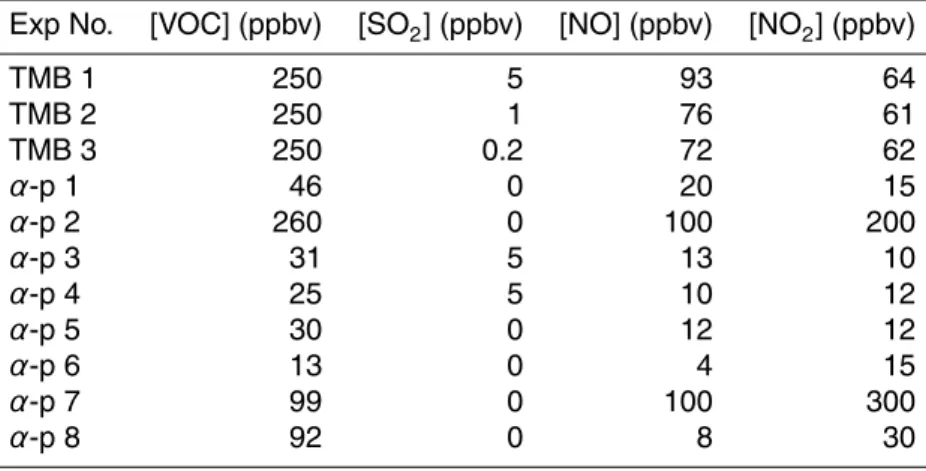
and 200 ppbv for NOx, 0 and 5 ppbv of SO2, and 13 and 260 ppbv of VOC (Table 1).
2.1 Determination of particle formation rates and growth rates
2.1.1 Particle formation rates
10
Particle formation rates atDp=1.5 nm were retrieved from the formation rate (dN/dt)
measured by the PSM and by the TSI 3776 CPC. In the first step the measured
par-ticle concentrations were corrected for diffusion losses occurring in the sampling line
assuming laminar flow diffusion losses (equation 8.56 in Baron and Willeke, 2001). The
apparent measured formation rates dN/dtwere then corrected for coagulation and wall
15
losses following the same procedure as described by Metzger et al. (2010).
2.1.2 Growth rates from the CPC battery measurements
Particle growth rates were determined from the CPC battery and the SMPS measure-ments, respectively. The CPC battery allowed determining the initial growth rates for particle diameters between 1.5 and 6 nm. Before the start of a nucleation experiment,
20
when the lights are still off, the particle concentration in the environmental chamber is
close to zero (the background concentration is in the order of 10 cm−3). When the lights
are turned on, the oxidation of SO2as well as of organic precursors generates
nucleat-ing and condensnucleat-ing vapors (e.g. sulfuric acid and oxidized organic molecules) and thus produces stable clusters which then grow into detectable size ranges by coagulation
ACPD
12, 11351–11389, 2012H2SO4 and organics
contribution to particle formation
and growth
F. Riccobono et al.
Title Page
Abstract Introduction
Conclusions References
Tables Figures
◭ ◮
◭ ◮
Back Close
Full Screen / Esc
Printer-friendly Version
Interactive Discussion
Discussion
P
a
per
|
Dis
cussion
P
a
per
|
Discussion
P
a
per
|
Discussio
n
P
a
per
|
and condensation. The corresponding condensational growth rate depends on the availability of condensing vapors.
Growing particles appear in a CPC as soon as they exceed the minimum detection size of that specific CPC. The analysis of the time delay between the CPC signals, together with the accurate determination of the detection thresholds of the CPCs
al-5
lowed us to retrieve the growth rates of the particles withDp<6 nm using the following
equation:
GRi j=D
j
threshold−D i threshold
∆ti j (1)
where Dithreshold and Dthresholdj are the detection thresholds of two CPCs (CPCi and
CPCj), withDthresholdj > Dithreshold, and∆ti j being the time delay between the rise of the
10
two CPCs (Sihto et al., 2006; Riipinen et al., 2007). Figure 1 shows the time series of
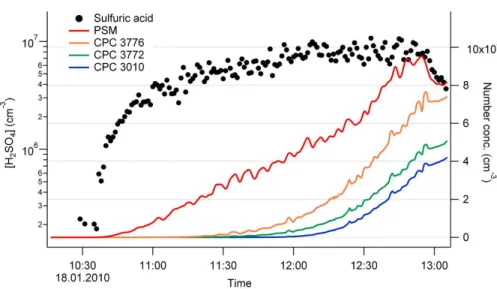
the CPC battery and CIMS data during a typicalα-pinene experiment.
The accuracy of the growth rate calculated with Eq. (1) strongly depends on the choice of the detection thresholds and on the point of measurement of the time delay.
The detection threshold of a CPC is generally defined as theD50 of the cutoffcurve,
15
corresponding to the particle diameter for which the CPC has a counting efficiency of
50 %. However, one has to keep in mind that the number of particles measured by one CPC is given by the convolution of the particle size distribution and the actual CPC
cutoffcurve which does not follow an ideal step function.
Ifti andtj are the times at which the same concentration of particles (within 1 cm−3)
20
is measured by CPCi and CPCj, we can define∆ti j=tj−ti. As we will discuss below,
if the cutoffcurves of the CPCi and CPCj do not have the same shape in their
detec-tion efficiencies, the time delay ∆ti j varies over time as the particle diameters grow,
resulting in a variation in time for the calculated GR from Eq. (1).
Here we propose a new method that is based on a conscientious choice of the
25
ACPD
12, 11351–11389, 2012H2SO4 and organics
contribution to particle formation
and growth
F. Riccobono et al.
Title Page
Abstract Introduction
Conclusions References
Tables Figures
◭ ◮
◭ ◮
Back Close
Full Screen / Esc
Printer-friendly Version
Interactive Discussion
Discussion
P
a
per
|
Dis
cussion
P
a
per
|
Discussion
P
a
per
|
Discussio
n
P
a
per
|
detection threshold D1 (diameter at which the CPC has a counting efficiency of 1 %)
and we calculate the onset time delay∆ti j at the initial rise of the CPCs signals (see
below for a detailed discussion).
In the following discussion we will demonstrate how the choices of D1 and of the
onset time delay ∆ti j are preferable to the choice of D50 and of any other point of 5
measurement of the time delay. In addition, becauseD1is smaller thanD50, this method
will also allow us to extend the growth rate calculation to a smaller range of particle
diameters without the necessity for changing the CPC cutoffsizes.
To better understand how the choice of the detection threshold and of the time at
which we measure the ∆ti j influences the growth rate calculation we simulated the
10
growth rate measurement performed by three pairs of CPCs with different relations
between their efficiency curves (see Fig. A1). For the sake of simplicity we simulated
a chamber experiment at a constant formation rateJconst=10 cm−
3
s−1 and constant
growth rate GRconst=10 nm h−1; although it is not crucial for the aim of the simulation,
these are typical numbers measured during our experiments. Coagulation and wall
15
losses were neglected in the simulation. This produces a uniform size distribution that drops to zero at a certain particle diameter which increases in time at a rate given by GRconst. The use of a non-constant formation rate and a size dependent growth rate
(or the inclusion of coagulation and wall losses) would add complexity to the system complicating the results of the simulation which, once more, only aims to demonstrate
20
that the result of the growth rate calculation strongly depends on the choices for the
detection threshold and∆ti j.
The results reported in Fig. 2 show that, if the CPC efficiency curves have different
slopes, the calculated growth rate (GRcalc) changes both over time (vertical panel c)
and as the number concentration increases (vertical panel d). Nevertheless, the D1
25
method, correctly calculates the growth rate at the beginning of the experiment (i.e. GRcalc/GRconst=1, Fig. 2). Thus, the beginning of the experiment is the point in time
when we should measure the onset time delay ∆ti j between the CPCs to correctly
ACPD
12, 11351–11389, 2012H2SO4 and organics
contribution to particle formation
and growth
F. Riccobono et al.
Title Page
Abstract Introduction
Conclusions References
Tables Figures
◭ ◮
◭ ◮
Back Close
Full Screen / Esc
Printer-friendly Version
Interactive Discussion
Discussion
P
a
per
|
Dis
cussion
P
a
per
|
Discussion
P
a
per
|
Discussio
n
P
a
per
|
using different working fluids revealing the effective growth rate of nanoparticles with
respect to water and butanol (Kulmala et al., 2007; Riipinen et al., 2009).
The simulation also reveals that in the realistic case of two CPCs that have an offset
between the two efficiency curves at large particle diameters (possibly due to different
internal losses or errors in the aerosol flow reading/setting) the growth rate
calcula-5
tion using theD50 is only accurate in a single point in time which is a priori unknown
(horizontal panel 3).
Based on these results we decided to calculate the growth rates from the CPC
bat-tery by applying the D1 method to the CPC battery data, obtaining size dependent
growth rates in three size ranges (1.5–2 nm; 2–3 nm; 3–6 nm). For each experiment we
10
estimated theonset∆ti j at particle concentrationN=0. This is determined measuring
the∆ti j between the CPCs at each integer particle concentration between Nmin and
Nmax and applying a quadratic polynomial fitting to obtain the value of ∆ti j at N=0
(corresponding to the intercept with the y axis of the red curve of panel d3 in Fig. 2).
The value ofNmin is set equal to 10 cm−
3
to avoid low signal to noise ratios; Nmax is
15
determined for each individual experiment and is calculated as 10 times the standard deviation of the PSM base line over a period of 5 min before the lights went on; the
choice ofNmaxdoes not strongly affect the value of onset∆t
i j
.
The error in the growth rate calculation derives from the uncertainties in both
mea-surements of D1 and ∆t
i j
. The uncertainty in D1 of the two CPCs is mainly due to
20
calibration uncertainties, such as diffusion loss corrections, flow rate measurements
and transfer function of the differential mobility analyzer used for the calibration, which
have an overall uncertainty assumed to be smaller than 20 %. We assume that a
sen-sitivity of the efficiency curves to particle composition and charge would affect the two
CPCs in a similar manner, resulting in a comparable shift in the diameter range for both
25
CPCs, preserving the∆D1within 20 %. The maximum relative error in∆ti j is assumed
ACPD
12, 11351–11389, 2012H2SO4 and organics
contribution to particle formation
and growth
F. Riccobono et al.
Title Page
Abstract Introduction
Conclusions References
Tables Figures
◭ ◮
◭ ◮
Back Close
Full Screen / Esc
Printer-friendly Version
Interactive Discussion
Discussion
P
a
per
|
Dis
cussion
P
a
per
|
Discussion
P
a
per
|
Discussio
n
P
a
per
|
2.1.3 Growth rates from the SMPS measurements
For particles withDp>6 nm, the growth rates were retrieved from the SMPS
measure-ments. The SMPS concentrations were firstly corrected for diffusion losses in the
sam-pling line and in the DMA column and for the CPC counting efficiency. Subsequently
the mode diameter was determined by fitting a Gaussian distribution to the dN/dlogDp
5
data. Rather than determining the growth rates using the time evolution of the mode diameter we calculated the particle growth rates following an approach similar to the one used to obtain the growth rates from the CPC battery, i.e. looking at the time delay of the onset of particles in the largest size bins of the SMPS. Here the SMPS leading edge diameter is defined as the diameter corresponding to the size bin at which the
fit-10
ted Gaussian size distribution reaches 1 % of the concentration measured in the mode diameter bin. The growth rates are then retrieved from the time evolution of the leading edge diameter.
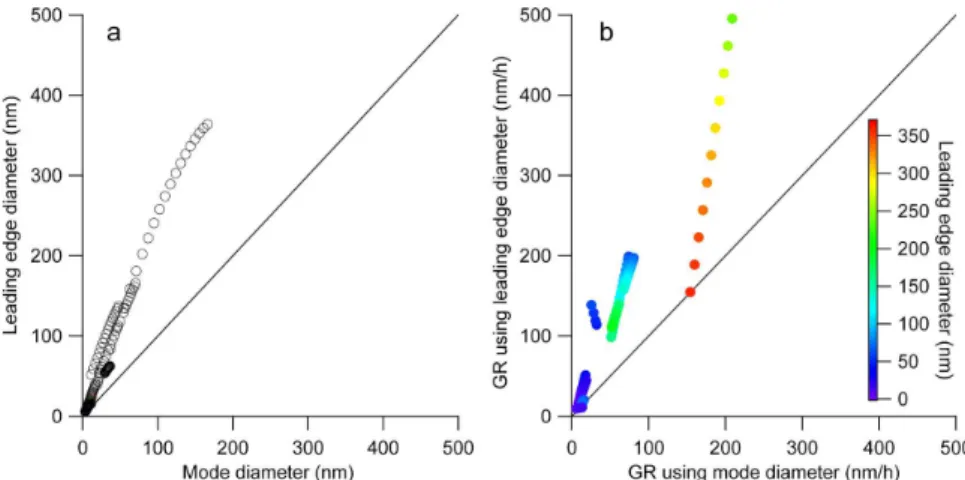
In Fig. 3a, we show a comparison between the leading edge diameters and the mode
diameters for all theα-pinene experiments. Figure 3b depicts the comparison between
15
the growth rates calculated from the leading edge diameters and from the mode diam-eters. The choice of the leading edge diameter is superior to the mean diameter for the growth rate analysis of nucleation chamber experiments because of the following
two effects. Firstly, once lights are turned on in the chamber, the concentrations of
sul-furic acid and oxidized organic compounds build up and the formation rate increases
20
with time until the losses of cluster precursors equals their production rate. This effect
shifts the mode of the size distribution to a lower diameter than it would be the case
for condensational growth without continuous nucleation. The second effect is the
dy-namic change of the shape of the size distribution with growth. The size distribution
broadens due to the Kelvin effect and the presence of many organic compounds with
25
different saturation vapor pressures, allowing larger particles to grow at a higher rate
than smaller particles. In other words the condensational driving force for a specific
ACPD
12, 11351–11389, 2012H2SO4 and organics
contribution to particle formation
and growth
F. Riccobono et al.
Title Page
Abstract Introduction
Conclusions References
Tables Figures
◭ ◮
◭ ◮
Back Close
Full Screen / Esc
Printer-friendly Version
Interactive Discussion
Discussion
P
a
per
|
Dis
cussion
P
a
per
|
Discussion
P
a
per
|
Discussio
n
P
a
per
|
pressure of compoundi is larger than the equilibrium vapor pressure over the curved
particle surface; increasingDp increases the number of volatile compounds that can
condense on particles of diameterDp, speeding up the growth of particles with larger
diameters (see results section for a more detailed discussion).
The leading edge method was introduced by Kulmala et al. (1998) for ambient
5
new particle formation studies. However, it has its limitations when applied to ambient aerosols. While chamber experiments always start at a number concentration close to zero, the nucleation occurring in the ambient atmosphere happens in the presence of a
pre-existing population of particles (withDp>10 nm) which creates a high background
over which the nucleating mode grows without a distinct leading edge. In this study
10
the background particles do not hinder the use of the leading edge method; hence, the data presented in the following discussion are obtained applying the leading edge method.
2.1.4 Growth rate enhancement factorΓ
In order to quantify the relative contributions to the particle growth by sulfuric acid
15
and by organic compounds we compared the observed growth rates, obtained from the CPC battery and from the SMPS, with the modeled growth rates expected from the measured sulfuric acid gas phase concentration when assuming that the aerosol
growth is driven only by condensation of H2SO4and H2O.
The collision rate K used in the H2SO4 growth model is shown in Equation 2. In
20
addition to classical condensation kinetic theory (Seinfeld and Pandis, 2006) it also
contains the diameter of the condensing moleculeDv and the diffusion coefficient of
the growing particle, which are both relevant when the particle size is comparable to that of the condensing molecule (Nieminen et al., 2010).
K=π
3Knβd(Kn,α) Dp+Dv
2
c2p+c 2 v
1/2
Cv (2)
ACPD
12, 11351–11389, 2012H2SO4 and organics
contribution to particle formation
and growth
F. Riccobono et al.
Title Page
Abstract Introduction
Conclusions References
Tables Figures
◭ ◮
◭ ◮
Back Close
Full Screen / Esc
Printer-friendly Version
Interactive Discussion
Discussion
P
a
per
|
Dis
cussion
P
a
per
|
Discussion
P
a
per
|
Discussio
n
P
a
per
|
Subscripts “p” and “v” refer to particle and vapor properties, respectively, Kn is the
Knudsen number,βd is the Fuchs-Sutugin correction factor, α is the accommodation
coefficient,cis the thermal speed andCvis the concentration of vapor molecules per
unit volume. In case of sulfuric acid we made the assumption ofα=1, which implies
that the maximum condensation rate at a given partial pressure is limited by the kinetic
5
collision rate of sulfuric acid molecules with the growing particles. Under the experi-mental relative humidity of 50 % the sulfuric acid is thought to be mainly dihydrated
(Kurt ´en et al., 2007), the density is assumed to be 1490 kg m−3(H2SO4+2 H2O) and
the diffusion coefficient is taken equal to 0.08 cm2s−1 (Hanson and Eisele, 2000).
As-suming that each collision increases the particle volume by∆Vp=Vv=mv/ρv, we can
10
write
dVp
dt =K Vv (3)
and finally calculate the diameter growth rate (GR) as
GR=dDp
dt =
dVp
dt
dVp
dDp
= K Vπ v
2D 2 p
. (4)
For all the measured growth rates from the CPC battery and SMPS (GRmeas), we
calcu-15
lated the corresponding expected growth rate by sulfuric acid (GRmod) through Eqs. (2)
and (4). To compare correctly GRmeaswith GRmod we used the average particle
diam-eter and the average sulfuric acid concentration in Eq. (2) calculated over the same time window used for deriving the growth rate with the SMPS. For the comparison
with the observed growth rates from the CPC battery we used the average of theD1
20
ACPD
12, 11351–11389, 2012H2SO4 and organics
contribution to particle formation
and growth
F. Riccobono et al.
Title Page
Abstract Introduction
Conclusions References
Tables Figures
◭ ◮
◭ ◮
Back Close
Full Screen / Esc
Printer-friendly Version
Interactive Discussion
Discussion
P
a
per
|
Dis
cussion
P
a
per
|
Discussion
P
a
per
|
Discussio
n
P
a
per
|
If we assume that the measured growth rate is only due to sulfuric acid and organic vapors, we can define and calculate the growth rate enhancement factor due to organic compounds as
Γ =GRmeas
GRmod
. (5)
The particle growth rate in the kinetic and transition regime due to an organic
com-5
pound i is also described by Eq. (4), where the collision rate K is replaced by the
collision rate for the specific compoundKi:
Ki = π
3RTKn,iβd,i Kn,iα
Dp+Dv,i 2
c2p+c 2 v,i
1/2
pi−pi,eq
(6)
wherepi is the partial pressure,pi,eqis the equilibrium vapor pressure over the particle
surface,R is the gas constant andT is the temperature.pi,eqis linked to the saturation
10
vapor pressure over a flat surfacepi,satvia the Raoult (Rai) and the Kelvin (Kei) terms:
pi,eq=pi,sat·Rai·Kei (7)
with
Rai =γixi (8)
15
Kei =exp 4σiMi
RT ρiDp
(9)
whereγ is the activity coefficient, x is the mole fraction, σ is the surface tension, M
is the molecular mass andρ is the density of the organic compound i. In Eq. (6) the
condensational driving force for the compoundi ultimately depends on the difference
20
between the partial pressurepi and the equilibrium vapor pressure pi,eq, which is a
ACPD
12, 11351–11389, 2012H2SO4 and organics
contribution to particle formation
and growth
F. Riccobono et al.
Title Page
Abstract Introduction
Conclusions References
Tables Figures
◭ ◮
◭ ◮
Back Close
Full Screen / Esc
Printer-friendly Version
Interactive Discussion
Discussion
P
a
per
|
Dis
cussion
P
a
per
|
Discussion
P
a
per
|
Discussio
n
P
a
per
|
3 Results and discussion
3.1 Particle formation rates vs. sulfuric acid concentration
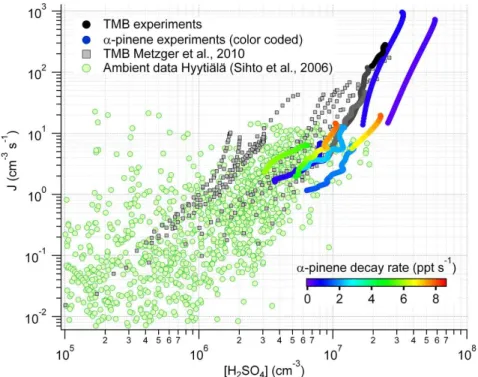
Figure 4 reports the formation rates as a function of the sulfuric acid concentrations measured in this work, and compares them with the laboratory study of Metzger et al. (2010) and ambient measurements in Hyyti ¨al ¨a, Finland (Sihto et al., 2006). The
5
comparison of theα-pinene experiments with the ambient data indicates thatα-pinene
is capable of reproducing the formation rates observed in the boreal forest for similar concentrations of sulfuric acid.
Indeed, our observations do not rule out the possibility that other compounds partici-pate in the particle formation mechanism. The total concentration of organic precursors
10
concentration in a boreal forest is comparable to theα-pinene concentration used in
these experiments, but other compounds may have been present as contaminants. A recent study (Kirkby et al., 2011) performed in an ultraclean organics free environmen-tal chamber showed that binary sulfuric acid and water nucleation is not capable of re-producing ambient nucleation rates, and the presence of ammonia increased the pure
15
binary nucleation but saturated at three orders of magnitude lower nucleation rates than the ambient values. For the conditions in our chamber the organic compounds are the most likely candidates to enhance the formation rates to ambient values, but we cannot elucidate at which stage the organics enter the process of particle formation. The real nucleation mechanism which occurs at molecular level cannot be investigated
20
with the instrumentation available during this work; for this reason we always refer to formation rates rather than to nucleation rates.
The formation rates for the α-pinene experiments of Fig. 4 are color coded with
the decay rate of α-pinene which is a proxy for the NucOrg concentration (using the
same notation as used by Metzger et al. (2010), NucOrg are the organic molecules that
25
participate in the particle formation process). The correlation of theα-pinene decay rate
with the formation rate vs. sulfuric acid concentration of Fig. 4 is hindered by at least
ACPD
12, 11351–11389, 2012H2SO4 and organics
contribution to particle formation
and growth
F. Riccobono et al.
Title Page
Abstract Introduction
Conclusions References
Tables Figures
◭ ◮
◭ ◮
Back Close
Full Screen / Esc
Printer-friendly Version
Interactive Discussion
Discussion
P
a
per
|
Dis
cussion
P
a
per
|
Discussion
P
a
per
|
Discussio
n
P
a
per
|
generate different families of oxidation products that may participate differently in the
particle formation process; (b) additional unmonitored compounds may contribute to
the particle formation together with sulfuric acid and oxidation products ofα-pinene.
Also TMB reveals to be capable of reproducing the formation rates observed in the atmosphere in the same range of sulfuric acid concentrations. The data collected in this
5
work agree well with the experiments performed by Metzger et al. (2010) although they all lie on the higher end of the sulfuric acid concentration range modeled by Metzger
et al. (2010) (∼107cm−3). Here we point out once more that we measured the sulfuric
acid concentration with two Chemical Ionization Mass Spectrometers instead of mod-eling the sulfuric acid concentration as done in Metzger et al. (2010). The comparison
10
between the two CIMS instruments is discussed in Appendix A.
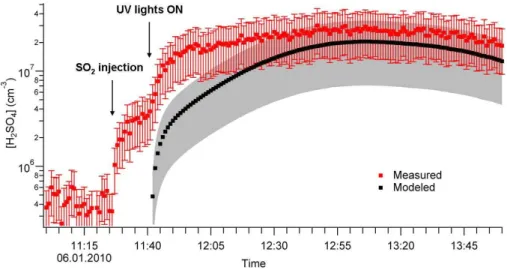
Figure 5 shows the comparison of the time series of the measured and modeled sul-furic acid concentration. Note that the measured peak concentration is well estimated by the model (within the model and measurement uncertainties), but the time series comparison also shows that the model underestimates the sulfuric acid concentration
15
at the beginning of the experiment. One of the reasons responsible for this behavior is that the model did not include any sulfuric acid background concentration, but as depicted in Fig. 5, the sulfuric acid concentration measured by the CIMS rises at the
moment of SO2 injection before the UV lights are switched on. This dark production
of H2SO4 was observed throughout the whole measurement campaign. It may be
at-20
tributed either to heterogeneous reactions on the Teflon walls of the chamber or in case
of the α-pinene experiments to the OH formation during the ozonolysis of α-pinene,
however, further experiments are needed to discriminate between these processes. As
a result of this dark production, the background H2SO4 concentration varied between
2×105cm−3and 3×106cm−3depending on the SO2initial concentration. Another
rea-25
ACPD
12, 11351–11389, 2012H2SO4 and organics
contribution to particle formation
and growth
F. Riccobono et al.
Title Page
Abstract Introduction
Conclusions References
Tables Figures
◭ ◮
◭ ◮
Back Close
Full Screen / Esc
Printer-friendly Version
Interactive Discussion
Discussion
P
a
per
|
Dis
cussion
P
a
per
|
Discussion
P
a
per
|
Discussio
n
P
a
per
|
In conclusion, the observed background concentration of sulfuric acid (which is a
function of the initial SO2 concentration) indicates that the modeled sulfuric acid
con-centration of Metzger et al. (2010) might have been underestimated by a few times
105cm−3 for the experiments with low SO2 and up to a maximum of 10
7
cm−3 for the
experiments in the presence of high SO2. However, this relative shift towards higher
5
sulfuric acid concentrations does not change the main results presented in the previ-ous work, which suggested that the role of NucOrg is crucial for the overall process of particle formation.
3.2 Role of sulfuric acid and organic vapors for size dependent growth rates
Figure 6 depicts the growth rate enhancement factor as a function of the diameter
de-10
termined from the CPC battery and SMPS during theα-pinene experiments.Γvalues
are found between∼1 and 2000, indicating that, after the reaction of a few ppbv of
α-pinene, the growth due to organic compounds is dominating nearly through the whole particle size distribution. The results show that even at particle diameters below 2 nm a large fraction (up to more than 90 %) of the observed growth is attributable to organic
15
vapors, similar to the findings of other recent publications (Sihto et al., 2006; Yli-Juuti et al., 2011; Kuang et al., 2011).
The general trend of Fig. 6 shows that as the diameter of the particles increases,
the organic contribution to the growth (Γ) increases as well, indicating that the organic
condensational driving force (p−peq) increases while the particles grow (Eq. 6). The
20
increase of the condensational force is achievable either by increasing the partial
pres-surep or decreasing the equilibrium vapor pressurepeq due to the growth of the
par-ticle size (Kelvin term) or the change in parpar-ticle chemistry (Roult’s law). Usually both
pandpeqare unknown resulting in a large number of combinations that would explain
the observed growth. The attempt of disentangling the effects ofp andpeq on particle
25
growth is further hindered by the broad family of condensable organic compounds that
ACPD
12, 11351–11389, 2012H2SO4 and organics
contribution to particle formation
and growth
F. Riccobono et al.
Title Page
Abstract Introduction
Conclusions References
Tables Figures
◭ ◮
◭ ◮
Back Close
Full Screen / Esc
Printer-friendly Version
Interactive Discussion
Discussion
P
a
per
|
Dis
cussion
P
a
per
|
Discussion
P
a
per
|
Discussio
n
P
a
per
|
grow to larger diameters both the chemical composition and the concentration of the condensable organic compounds change.
A qualitative distinction between the temporal effect and the other effects is revealed
in Fig. 3. It contains the direct evidence of the role played by the particle size and com-position in lowering the equilibrium vapor pressure when the particles grow. Figure 3b
5
shows that the growth rate of the leading edge (big particles) is larger than the growth rate of the mode diameter (smaller particles) at a given point in time, i.e. for particles
exposed to the same distribution of vapors. The difference between the two growth
rates becomes smaller as the particles grow (color code in Fig. 3) since the relative
differences of both Kelvin effect and particle composition become smaller for larger
10
particles.
The difference between the measured GR and the model GR due to sulfuric acid
(GRmeas−GRmod, see Sect. 2.1.4) is equal to the growth rate attributable to
conden-sation of organic compounds. Plotting growth rates due to organic compounds as a function of sulfuric acid concentration for particles smaller than 6 nm allows observing
15
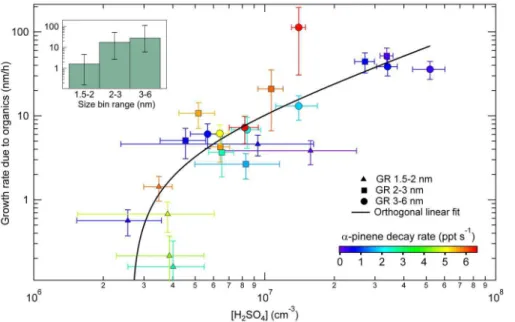
the contribution of organic compounds to the early stage particle growth from another perspective. Figure 7 shows the growth rates due to organic compounds retrieved from the CPC battery as a function of sulfuric acid in three separate size bins (1.5–2 nm,
2–3 nm and 3–6 nm), color coded with the decay rate ofα-pinene. The error bars
cor-respond to the standard deviation of the sulfuric acid concentration (x-axis) and to the
20
estimated error of the GR (y-axis, see Sect. 2.1).
The first and most important feature of Fig. 7 is that, in this size range (1.5–6 nm), the sulfuric acid concentration seems to enhance the growth rate by organic compounds. Within a single size bin the growth rate due to organics is higher when the sulfuric acid
concentration is higher, independently of theα-pinene decay rate (color code in Fig. 7).
25
Although the mechanism related to this observation remains to be elucidated we can make some considerations looking at Figs. 6 and 7. When sulfuric acid condenses onto growing particles, it lowers the organic activity (decreasing the organic molar fraction)
ACPD
12, 11351–11389, 2012H2SO4 and organics
contribution to particle formation
and growth
F. Riccobono et al.
Title Page
Abstract Introduction
Conclusions References
Tables Figures
◭ ◮
◭ ◮
Back Close
Full Screen / Esc
Printer-friendly Version
Interactive Discussion
Discussion
P
a
per
|
Dis
cussion
P
a
per
|
Discussion
P
a
per
|
Discussio
n
P
a
per
|
pressure of the condensing organics. At high sulfuric acid concentration the addition of sulfuric acid molecules to the growing particle is accelerated, this might speed up the process of lowering the equilibrium vapor pressure and consequently speed up the condensation of organics. Theoretical calculations show that gas-phase oxidation can produce organic compounds with low enough saturation vapor pressures which are
5
able to condense onto particles with diameter of a few nanometers (Donahue et al., 2011; Pierce et al., 2011).
On the other hand looking at Fig. 6 we know that the growing particles are mainly
composed of organics;Γ∼10 for 2–6 nm particles means that only∼10 % of the GR is
due to sulfuric acid. Hence, sulfuric acid produces minor changes of the particle size
10
and organic activities, resulting in small changes in the Kelvin and Raoult terms. This opens the door to other possible mechanisms which may contribute to particle growth, such as reactive uptake, which has already been observed to contribute to the growth of organic aerosol (e.g. Smith et al., 2010; Wang et al., 2010). Sulfuric acid condensation may enhance the uptake of organic molecules via increasing the solution acidity (Gao
15
et al., 2004) and/or increasing its ionic strength (Kroll et al., 2005).
The fact that reactive uptake might be an important process for growth of nanopar-ticles is supported by another observation: the weak correlation between the growth
rates due to organics and the decay rate ofα-pinene (color code in Fig. 7) suggests a
decoupling of the growth mechanism from pure gas-phase oxidation processes.
Anal-20
ogously, a weak correlation is also found between Γ and the decay rate of α-pinene
for the CPC battery data (Fig. 6). The correlation betweenΓ and the decay rate of
α-pinene becomes more evident at particle sizes larger than 6 nm (SMPS data in Fig. 6),
where the Kelvin effect becomes smaller and a larger mass of the absorbing particle
decreases the activity of organic compounds; at the same time, higher partial pressures
25
of organic compounds, with low saturation vapor pressure, build up and accumulate,
increasing the driving forcep−peq (Eq. 6).
For small particles (Dp<6 nm) the α-pinene decay rate seems to correlate with
ACPD
12, 11351–11389, 2012H2SO4 and organics
contribution to particle formation
and growth
F. Riccobono et al.
Title Page
Abstract Introduction
Conclusions References
Tables Figures
◭ ◮
◭ ◮
Back Close
Full Screen / Esc
Printer-friendly Version
Interactive Discussion
Discussion
P
a
per
|
Dis
cussion
P
a
per
|
Discussion
P
a
per
|
Discussio
n
P
a
per
|
associated with a large uncertainty on the GR. This outlier is a growth rate
measure-ment performed during experimeasure-mentα-p 8, conducted at high initialα-pinene
concentra-tions, which followed a high NOx experiment (α-p 7). The latter might have produced
high HONO concentrations which together with other unmonitored contaminant
com-pounds left over from the previous experiment might have resulted in strongα-pinene
5
decay and thus enhanced the growth rate.
The second important feature of Fig. 7 is that the absolute growth rates increase with particle size (inset of Fig. 7). This observation would fit with the nano-K ¨ohler the-ory, which, assuming multi-component organic condensation, predicts an increasing GR with particle size (Kulmala et al., 2004b). Reactive uptake might also fit with this
10
observation: these reactions would allow the first organic molecules to bind with the sulfuric acid molecules overcoming the initial barrier for condensation and increasing the particle diameter to sizes where further condensation of organic compounds is permitted.
The large uncertainties reported in Figs. 6 and 7, together with the lack of knowledge
15
about saturation vapor pressures and the unknown partial pressures of the species during the experiment, do not allow us to definitively conclude if organic compounds are the only substances responsible for the observed growth rate enhancement factors
Γ. Kirkby et al. (2011) recently showed that trace amounts such as ammonia or amines
may have a strong influence on the particle formation process; ammonia or aminium
20
salts (Smith et al., 2010; Wang et al., 2010) might indeed be involved in the initial growth as well, contributing to the observed variability in the growth rate enhancement factors.
4 Summary and conclusions
We measured the particle formation rates and growth rates of particles under
atmo-25
ACPD
12, 11351–11389, 2012H2SO4 and organics
contribution to particle formation
and growth
F. Riccobono et al.
Title Page
Abstract Introduction
Conclusions References
Tables Figures
◭ ◮
◭ ◮
Back Close
Full Screen / Esc
Printer-friendly Version
Interactive Discussion
Discussion
P
a
per
|
Dis
cussion
P
a
per
|
Discussion
P
a
per
|
Discussio
n
P
a
per
|
measured in the atmosphere at the corresponding sulfuric acid concentrations. These results are in agreement with the observations of our previous work (Metzger et al., 2010), where no CIMS was available and the sulfuric acid concentrations were based on a kinetic model.
We developed a new method for the analysis of size resolved growth rate
mea-5
surements using a CPC battery, and we optimized the SMPS growth rates analysis for chamber nucleation experiments showing the comparison with the traditional ap-proaches.
The size resolved growth rate analysis allowed us to study the contribution of sulfu-ric acid and organic compounds to aerosol growth. The measured growth rates were
10
compared with the kinetically limited growth rates by sulfuric acid. This comparison
demonstrated that in the presence of sulfuric acid and α-pinene the growth due to
organic compounds is dominating nearly through the whole particle size distribution. The observation that the organic contribution to growth increases as the diameter of the particles increases supports the multiple activation mechanism predicted by the
15
nano-K ¨ohler theory.
We also observed that, once isolated, the contribution of organic compounds to growth seems to be enhanced by the sulfuric acid concentration. The mechanism re-sponsible for this observation remains to be elucidated through further chamber experi-ments. If confirmed, its inclusion in global models might change the present estimations
20
of the anthropogenic contribution to the formation of secondary aerosol.
The considerations made about the latter effect and the weak correlation of the initial
growth rates with the decay rate of α-pinene suggest that other mechanisms, diff
er-ent from pure gas-phase chemistry, may participate in the initial steps of growth (i.e. reactive uptake).
25
ACPD
12, 11351–11389, 2012H2SO4 and organics
contribution to particle formation
and growth
F. Riccobono et al.
Title Page
Abstract Introduction
Conclusions References
Tables Figures
◭ ◮
◭ ◮
Back Close
Full Screen / Esc
Printer-friendly Version
Interactive Discussion
Discussion
P
a
per
|
Dis
cussion
P
a
per
|
Discussion
P
a
per
|
Discussio
n
P
a
per
|
measurements together with advanced growth rates analysis tools are needed to pro-vide better size resolved growth rate measurements in order to further constrain uncer-tainties in global aerosol, chemistry and climate models.
Appendix A
CPC calibration and sulfuric acid measurement
5
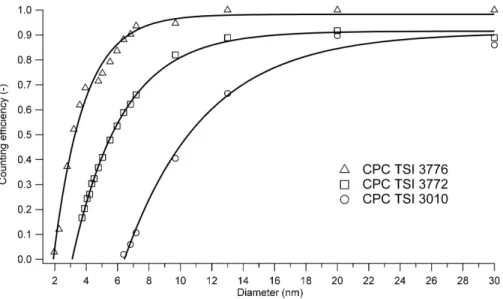
The growth rate measurements of particles smaller than 6 nm were obtained with the CPC battery. This method requires accurate calibration of the CPCs in the laboratory.
We used a high resolution Herrmann DMA (Herrmann et al., 2000) to classify WOx
particles smaller than 4 nm. A short column DMA (TSI-type, effective length 11 cm)
was used to classify particles larger than 4 nm. The measured counting efficiencies
10
(Fig. A1) of the three TSI CPCs are fitted with the following three-parameter equation that is based on the fit equation proposed by Stolzenburg and McMurry (1991)
η=a−exp b−Dp
c
, Dp> D0
η=0, Dp< D0 (A1)
15
withD0=b−cln(a).
Table A1 contains the fitting parameters and the corresponding D0 and D1 for the
three TSI CPCs. For the PSM we assumed a nominalD1=1.5 nm assuming that this
is the critical cluster size at which particles appear (Vuollekoski et al., 2010; Vanhanen et al., 2011).
20
For simplicity, we always refer to nominal values ofD1: 2, 3 and 6 nm for the CPCs
used in the CPC battery but the actual growth rate calculation is performed with theD1
values reported in Table A1.
The two CIMS instruments employed in our study were independently calibrated. The concentrations measured by the two instruments correlate with a slope of 2.08
av-25
ACPD
12, 11351–11389, 2012H2SO4 and organics
contribution to particle formation
and growth
F. Riccobono et al.
Title Page
Abstract Introduction
Conclusions References
Tables Figures
◭ ◮
◭ ◮
Back Close
Full Screen / Esc
Printer-friendly Version
Interactive Discussion
Discussion
P
a
per
|
Dis
cussion
P
a
per
|
Discussion
P
a
per
|
Discussio
n
P
a
per
|
was determined as the arithmetic mean of the concentrations measured by the two CIMS instruments. The reason for the average deviation by a factor of 2.08 between the two measurements is currently not resolved. Both instruments were operated with identical inlets and similar sample flow rates. Further comparisons and
inter-calibrations are necessary to resolve the differences. The CIMS H2SO4 instruments
5
have reported a factor of two total uncertainty (Frankfurt-CIMS, Kirkby et al., 2011)
and±35 % (Helsinki-CIMS, Pet ¨aj ¨a et al., 2009), therefore the measurements do agree
within these uncertainties.
The CIMS from University of Helsinki was calibrated by measurement of OH gener-ated from photolysis of a known amount of water vapor. More information is presented
10
in Mauldin et al. (2001) and Pet ¨aj ¨a et al. (2009). The CIMS from University of Frankfurt
was calibrated by an external set-up which provided a known concentration of H2SO4.
The H2SO4 was produced by illuminating a mixture of SO2, H2O, O2 and N2 with UV
light (see K ¨urten et al. (2012) for details).
Acknowledgements. This work was supported by the EC Seventh Framework Programmes
15
under grant agreement nos 215072 (Marie Curie Initial Training Network, “CLOUD-ITN”) and 228335 (EUROCHAMP), as well as the Swiss National Science Foundation (project no. 206621 125025 and 206620 130527), the German Federal Ministry of Education and Re-search (project no. 01LK0902A), the ERC-Advanced Grant “ATMNUCLE” no. 227463, and the Academy of Finland Center of Excellence program (project no. 1118615 and 139656).
20
References
Albrecht, B. A.: Aerosols, cloud microphysics, and fractional cloudiness, Science, 245, 1227– 1230, 1989.
Baron, P. A. and Willeke, K.: Aerosol measurement. Principles, Techniques and Applications, second ed. Wiley Interscience, New York, 2001.
25
ACPD
12, 11351–11389, 2012H2SO4 and organics
contribution to particle formation
and growth
F. Riccobono et al.
Title Page
Abstract Introduction
Conclusions References
Tables Figures
◭ ◮
◭ ◮
Back Close
Full Screen / Esc
Printer-friendly Version
Interactive Discussion
Discussion
P
a
per
|
Dis
cussion
P
a
per
|
Discussion
P
a
per
|
Discussio
n
P
a
per
|
vapour, NH3and the amine tert-butylamine on the overall process, Atmos. Chem. Phys., 10, 7101–7116, doi:10.5194/acp-10-7101-2010, 2010.
Berresheim, H., Elste, T., Plass-D ¨ulmer, C., Eisele, F. L., and Tanner D. J.: Chemical ionization mass spectrometer for longterm measurements of atmospheric OH and H2SO4, Int. J. Mass. Spec., 202, 91–109, 2000.
5
Curtius, J.: Nucleation of atmospheric aerosol particles, C. R. Phys., 7, 1027–1045, 2006. Donahue, N. M., Trump, E. R., Pierce, J. R., and Riipinen, I.: Theoretical constraints on pure
vapor-pressure driven condensation of organics to ultrafine particles, Geophys. Res. Lett., 38, L16801, doi:10.1029/2011GL048115, 2011.
Eisele, F. L. and Tanner, D. J.: Measurement of the gas phase concentration of H2SO4 and
10
methane sulfonic acid and estimates of H2SO4 production and loss in the atmosphere, J. Geophys. Res., 98, 9001, doi:10.1029/93JD00031, 1993.
Gao, S., Nga, L. N., Keywood, M., Varutbangkul, V., Bahreini, R., Nenes, A., He, J., Yoo, K. Y., Beauchamp, J. L., Hodyss, R. P., Flagan, R. C., and Seinfeld, J. H.: Particle phase acidity and oligomer formation in secondary organic aerosol, Environ. Sci. Technol., 38, 6582–6589,
15
2004.
Hanson, D. R. and Eisele, F. L.: Diffusion of H2SO4in humidified nitrogen: Hydrated H2SO4, J. Phys. Chem. A, 104, 1715–1719, 2000.
Herrmann, W., Eichler, T., Bernardo, N., and Fernandez de la Mora, J.: Turbulent transition arises at Re 35000 in a short Vienna-type DMA with a large laminarizing inlet, Abstract to
20
the annual conference of the AAAR, St. Louis, MO, 6–10 October, 2000.
IPCC, Climate Change 2007: the Physical Science Basis. Contribution of Working Group I to the Fourth Assessment Report of the Intergovernmental Panel on Climate Change, Cambridge Univ. Press, 2007.
Kerminen, V.-M., Pirjola, L., and Kulmala, M.: How significantly does coagulation scavenging
25
limit atmospheric particle production, J. Geophys. Res., 106, 24119–24125, 2001.
Kerminen, V.-M. and Kulmala, M.: Analytical formulae connecting the “real” and the “apparent” nucleation rate and the nuclei number concentration for atmospheric nucleation events, J. Aerosol Sci., 33, 609–622, 2002.
Kirkby, J., Curtius, J., Almeida, J., Dunne, E., Duplissy, J., Ehrhart, S., Franchin, A., Gagne,
30
ACPD
12, 11351–11389, 2012H2SO4 and organics
contribution to particle formation
and growth
F. Riccobono et al.
Title Page
Abstract Introduction
Conclusions References
Tables Figures
◭ ◮
◭ ◮
Back Close
Full Screen / Esc
Printer-friendly Version
Interactive Discussion
Discussion
P
a
per
|
Dis
cussion
P
a
per
|
Discussion
P
a
per
|
Discussio
n
P
a
per
|
W., Junninen, H., Kreissl, F., Kvashin, A., Laaksonen, A., Lehtipalo, K., Lima, J., Lovejoy, E. R., Makhmutov, V., Mathot, S., Mikkila, J., Minginette, P., Mogo, S., Nieminen, T., Onnela, A., Pereira, P., Pet ¨aj ¨a, T., Schnitzhofer, R., Seinfeld, J. H., Sipila, M., Stozhkov, Y., Stratmann, F., Tome, A., Vanhanen, J., Viisanen, Y., Vrtala, A., Wagner, P. E., Walther, H., Weingartner, E., Wex, H., Winkler, P. M., Carslaw, K. S., Worsnop, D. R., Baltensperger, U., and Kulmala, M.:
5
Role of sulphuric acid, ammonia and galactic cosmic rays in atmospheric aerosol nucleation, Nature, 476, 429–433, 2011.
K ¨ohler, H.: The nucleus in and the growth of hygroscopic droplets, T. Faraday Soc., 43, 1152– 1161, 1936.
Kroll, J. H., Ng, N. L., Murphy, S. M., Varutbangkul, V., Flagan, R. C., and Seinfeld, J. H.:
Cham-10
ber Studies of Secondary Organic Aerosol Growth by Reactive Uptake of Simple Carbonyl Compounds, J. Geophys. Res. Atmos., 110, D23207, doi:10.1029/2005JD006004, 2005. Kuang, C., Chen, M., Zhao, J., Smith, J., McMurry, P. H., and Wang, J.: First size-dependent
growth rate measurements of 1 to 5 nm freshly formed atmospheric nuclei, Atmos. Chem. Phys. Discuss., 11, 25427–25471, doi:10.5194/acpd-11-25427-2011, 2011.
15
Kulmala, M., Toivonen, A., M ¨akel ¨a, J. M., and Laaksonen, A.: Analysis of the growth of nucle-ation mode particles observed in Boreal forest, Tellus B, 50, 449–462, 1998.
Kulmala, M., Vehkam ¨aki, H., Pet ¨aj ¨a, T., Dal Maso, M., Lauri, A., Kerminen, V.-M., Birmili, W., and McMurry, P. H.: Formation and growth of ultrafine atmospheric particles: A review of observations, J. Aerosol Sci., 35, 143–176, 2004a.
20
Kulmala, M., Kerminen, V.-M., Anttila, T., Laaksonen, A., and O’Dowd, C. D.: Organic aerosol formation via sulphate cluster activation, J. Geophys. Res., 109, D04205, doi:10.1029/2003JD003961, 2004b.
Kulmala, M., Mordas, G., Pet ¨aj ¨a, T., Gr ¨onholm, T., Aalto, P P., Vehkam ¨aki, H., Hienola, A. I., Herrmann, E., Sipil ¨a, M., Riipinen, I., Manninen, H., H ¨ameri, K., Stratmann, F., Bilde, M.,
25
Winkler, P. M., Birmili, W., and Wagner, P. E.: The Condensation Particle Counter Battery (CPCB): A new tool to investigate the activation properties of nanoparticles, J. Aerosol Sci., 38, 289–304, 2007.
Kulmala, M. and Kerminen, V.-M.: On the formation and growth of atmospheric nanoparticles, Atmos. Res., 90, 132–150, 2008.
30
ACPD
12, 11351–11389, 2012H2SO4 and organics
contribution to particle formation
and growth
F. Riccobono et al.
Title Page
Abstract Introduction
Conclusions References
Tables Figures
◭ ◮
◭ ◮
Back Close
Full Screen / Esc
Printer-friendly Version
Interactive Discussion
Discussion
P
a
per
|
Dis
cussion
P
a
per
|
Discussion
P
a
per
|
Discussio
n
P
a
per
|
K ¨urten, A., Rondo, L., Ehrhart, S., and Curtius, J.: Calibration of a Chemical Ionization Mass Spectrometer for the Measurement of Gaseous Sulfuric Acid, J. Phys. Chem. A, doi:10.1021/jp212123n, 2012.
Mauldin III, R. L., Eisele, F. L., Tanner, D. J., Koschiuch, E., Shetter, R., Lefer, B., Hall, S. R., Nowak, J. B., Buhr, M., Chen, G., Wang, P., and Davis, D.: Measurements of OH, H2SO4,
5
and MSA at the South Pole during ISCAT, Geophys. Res. Lett., 28, 3629–3632, 2001. McFiggans, G., Artaxo, P., Baltensperger, U., Coe, H., Facchini, M. C., Feingold, G., Fuzzi, S.,
Gysel, M., Laaksonen, A., Lohmann, U., Mentel, T. F., Murphy, D. M., O’Dowd, C. D., Snider, J. R., and Weingartner, E.: The effect of physical and chemical aerosol properties on warm cloud droplet activation, Atmos. Chem. Phys., 6, 2593–2649, doi:10.5194/acp-6-2593-2006,
10
2006.
Merikanto, J., Spracklen, D. V., Mann, G. W., Pickering, S. J., and Carslaw, K. S.: Impact of nucleation on global CCN, Atmos. Chem. Phys., 9, 8601–8616, doi:10.5194/acp-9-8601-2009, 2009.
Metzger, A., Verheggen, B., Dommen, J., Duplissy, J., Prevot, A. S. H., Weingartner, E.,
Riip-15
inen, I., Kulmala, M., Spracklen, D. V., Carslaw, K. S., and Baltensperger, U.: Evidence for the role of organics in aerosol particle formation under atmospheric conditions, P. Natl Acad. Sci., 107, 6646–6651, 2010.
Nieminen, T., Lehtinen, K. E. J., and Kulmala, M.: Sub-10 nm particle growth by vapor conden-sation – effects of vapor molecule size and particle thermal speed, Atmos. Chem. Phys., 10,
20
9773–9779, doi:10.5194/acp-10-9773-2010, 2010.
O’Dowd, C. D., Aalto, P., Hameri, K., Kulmala, M., and Hoffmann, T.: Aerosol formation-Atmospheric particles from organic vapours, Nature, 416, 497–498, 2002.
Paasonen, P., Sihto, S.-L., Nieminen, T., Vuollekoski, H., Riipinen, I., Plass-D ¨ulmer, C., Berresheim, H., Birmili, W., and Kulmala, M.: Connection between new particle formation
25
and sulphuric acid at Hohenpeissenberg (Germany) including the influence of organic com-pounds, Boreal Env. Res., 14, 616–629, 2009.
Paasonen, P., Nieminen, T., Asmi, E., Manninen, H. E., Pet ¨aj ¨a, T., Plass-D ¨ulmer, C., Flentje, H., Birmili, W., Wiedensohler, A., H ˜orrak, U., Metzger, A., Hamed, A., Laaksonen, A., Facchini, M. C., Kerminen, V.-M., and Kulmala, M.: On the roles of sulphuric acid and low-volatility
30